

The DOI matches its Crossref record; 42 of the 42 references it cites were found in a registry or an index; none of the 21 sources its claims cite is checked for support yet.
Optical Realization of Relativistic Non-Hermitian Quantum Mechanics
Open accessAbstract
Light propagation in distributed-feedback optical structures with gain or loss regions is shown to provide an accessible laboratory tool to visualize in optics the spectral properties of the one-dimensional Dirac equation with non-Hermitian interactions. Spectral singularities and PT symmetry breaking of the Dirac Hamiltonian are shown to correspond to simple observable physical quantities and are related to well-known physical phenomena such as resonance narrowing and laser oscillation.
Overview
AI snapshot
Written from the paper’s full text.
TL;DR
Light propagation in distributed-feedback optical structures with gain/loss regions is proposed as a classical optical simulator of the one-dimensional non-Hermitian Dirac equation. Spectral singularities and PT symmetry breaking of the Dirac Hamiltonian are mapped to observable DFB phenomena such as resonance narrowing and laser oscillation.
Key findings
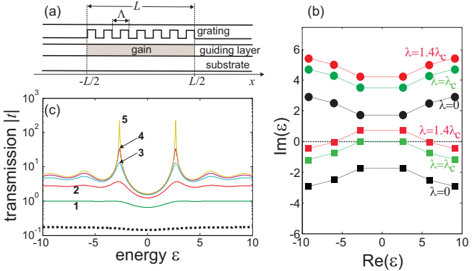
- For a PT-non-invariant uniform-gain DFB structure, the critical normalized gain is λ_c L ≈ 1.755 for m₀L = 1; at λ_c two resonances cross the real energy axis and become spectral singularities, and above λ_c bound states emerge and the spectrum ceases to be real-valued.
- For the same structure with uniform loss, at λ_c two antiresonances cross the real axis; the spectral transmission does not diverge, and the bound states have Im(E) < 0, so perturbations are damped rather than amplified.
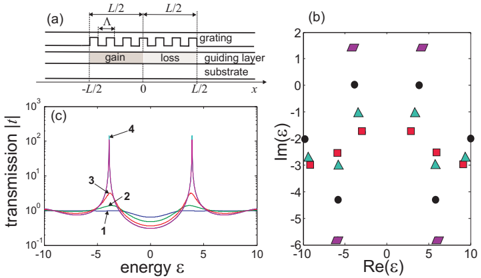
- For a PT-invariant DFB structure with symmetric gain and loss regions, PT symmetry breaking occurs at λ_c ≈ 4.46/L for m₀L = 1, with two pairs of complex-conjugate eigenvalues appearing from resonances and antiresonances crossing the real axis.
- The paper reports that spectral singularities and PT symmetry breaking of the Dirac Hamiltonian correspond to measurable DFB quantities, including resonance narrowing and the onset of lasing.
Methods
- Theoretical mapping of the 1D Dirac equation with real mass m(x) and complex vector potential V(x) to coupled-mode equations for counterpropagating optical envelopes in a DFB grating.
- Scattering theory and transfer-matrix analysis: the transfer matrix M(E), Green function/resolvent, and zeros of M₁₁ and M₂₂ are used to classify continuous spectrum, point spectrum, resonances, and spectral singularities.
- Two examples are analyzed numerically for m₀L = 1: a uniform index grating with homogeneous gain (PT-non-invariant) and a uniform grating with symmetric homogeneous gain/loss regions (PT-invariant).
Limitations
- The paper states no limitations.
- Evident from the text: this is a theoretical proposal for a classical optical simulator, not an experimental realization; no fabricated device or measured data are reported.
- Evident from the text: the analysis is restricted to the 1D Dirac equation and two specific DFB configurations with uniform grating and piecewise-constant gain/loss, with numerical examples given for m₀L = 1.
Model-written summary. Check it against the paper before relying on it.
Integrity signals
Registry
Cites
Statistics
Figures
Verification
Claims the paper makes
13 No basis given · 8 Sources not found · 6 Own interpretation · 4 Not checked yet · 4 Own result · 1 No full text of the sources
The paper states this without a source or data behind it here, so there is nothing to check it against. The quote shows it is in the paper.
In the paper
“Let us consider now the same DFB structure of Fig.1(a) but with γ ( x ) = λ , corresponding to a uniform grating with a homogeneous lossy region. The transfer matrix of the structure is given again by Eq.(7), but with σ = -E -iλ .”
plaindirect- Asserted: passes — The authors put it forward as true.
- Checkable: passes — It can be checked against evidence.
- Load-bearing: passes — The paper’s conclusions depend on it.
- Based: passes — The paper gives a reason why it holds.
- The authors state this as an assumption: Both m(x) and V(x) have limited support, i.e. m = V = 0 for |x| > L/2.
None of the sources cited for this claim have been checked yet.
In the paper
“Note that the imaginary parts of the eigenvalues E for λ > λ c are precisely the growth rates of the two detuned unstable modes at the onset of lasing found in the theory of DFB lasers with a uniform grating [18, 19].”
What the sources say
- Not matchedcites [18] H. Kogelnik and C.V. Shank, J. Appl. Phys. 43 , 2327 (1972).
Couldn’t be matched to a paper in Crossref, so it can’t be checked.
- Not checked — no full text of the sourcecites [19] J. Carroll, J. Whiteaway, and D. Plumb, Distributed feedback semiconductor lasers (The Institution of Electrical Engineers, London, 1998). source
plaincorrelational- Asserted: passes — The authors put it forward as true.
- Checkable: passes — It can be checked against evidence.
- Load-bearing: unclear — It is unclear whether the paper’s conclusions depend on it.
- Based: passes — The paper gives a reason why it holds.
- The authors state this as an assumption: Both m(x) and V(x) have limited support, i.e. m = V = 0 for |x| > L/2.
- Not matched
The paper states this without a source or data behind it here, so there is nothing to check it against. The quote shows it is in the paper.
In the paper
“the envelopes ψ 1 and ψ 2 satisfy Eq.(1) with a real mass m and a complex-valued vector potential V defined by”
plaincorrelational- Asserted: passes — The authors put it forward as true.
- Checkable: passes — It can be checked against evidence.
- Load-bearing: passes — The paper’s conclusions depend on it.
- Based: passes — The paper gives a reason why it holds.
The paper states this without a source or data behind it here, so there is nothing to check it against. The quote shows it is in the paper.
In the paper
“However, for a PT -non-invariant Hamiltonian, a spectral singularity could arise from the vanishing of M 11 but not of M 22 , i.e. it might not correspond to a divergence of the spectral transmission or reflection coefficients.”
hedgedconditional- Asserted: passes — The authors put it forward as true.
- Checkable: passes — It can be checked against evidence.
- Load-bearing: passes — The paper’s conclusions depend on it.
- Based: passes — The paper gives a reason why it holds.
- The authors state this as an assumption: Both m(x) and V(x) have limited support, i.e. m = V = 0 for |x| > L/2.
The paper states this without a source or data behind it here, so there is nothing to check it against. The quote shows it is in the paper.
In the paper
“The transfer matrix of the structure can be calculated as M = M 2 M 1 , where M 1 and M 2 are the transfer matrices of the uniform gain and lossy sections [see Eq.(7)].”
plaindirect- Asserted: passes — The authors put it forward as true.
- Checkable: passes — It can be checked against evidence.
- Load-bearing: passes — The paper’s conclusions depend on it.
- Based: passes — The paper gives a reason why it holds.
- The authors state this as an assumption: Both m(x) and V(x) have limited support, i.e. m = V = 0 for |x| > L/2.
A conclusion the paper draws from its own results — it cites no other source for it, so there is none to check. The quote shows it is in the paper.
In the paper
“This work suggests that well-known phenomena occurring in DFB structures, like spectral narrowing of resonances and self-oscillation, are the measurable quantities associated to the onset of spectral singularities and PT symmetry breaking of Dirac Hamiltonians with certain complex couplings.”
hedgedcorrelational- Asserted: passes — The authors put it forward as true.
- Checkable: passes — It can be checked against evidence.
- Load-bearing: passes — The paper’s conclusions depend on it.
- Based: passes — The paper gives a reason why it holds.
In the paper
“As a first example, let us consider a PT -non-invariant potential corresponding to θ ( x ) = 0 and m ( x ) = m 0 , γ ( x ) = -λ in the interval | x | < L/ 2 [Fig.1(a)], where λ is the dimensionless gain coefficient. This case corresponds to the simplest version of a DFB laser with a uniform index grating and a uniform gain region [19].”
What the sources say
- Not checked — no full text of the sourcecites [19] J. Carroll, J. Whiteaway, and D. Plumb, Distributed feedback semiconductor lasers (The Institution of Electrical Engineers, London, 1998). source
plaincorrelational- Asserted: passes — The authors put it forward as true.
- Checkable: passes — It can be checked against evidence.
- Load-bearing: passes — The paper’s conclusions depend on it.
- Based: passes — The paper gives a reason why it holds.
- The authors state this as an assumption: Both m(x) and V(x) have limited support, i.e. m = V = 0 for |x| > L/2.
None of the sources cited for this claim could be matched to a paper in Crossref, so there is nothing to check it against.
In the paper
“The main motivation in the study of such quantum-optical analogs is that concepts like exceptional points, spectral singularities and PT symmetry breaking become measurable quantities in an optical experiment [8, 9].”
What the sources say
- Not matchedcites [8]
Couldn’t be matched to a paper in Crossref, so it can’t be checked.
- Not matchedcites [9]
Couldn’t be matched to a paper in Crossref, so it can’t be checked.
plaindirect- Asserted: passes — The authors put it forward as true.
- Checkable: passes — It can be checked against evidence.
- Load-bearing: passes — The paper’s conclusions depend on it.
- Based: passes — The paper gives a reason why it holds.
- Not matched
In the paper
“An optical realization of the Dirac equation (1) is provided by propagation of light waves in an effective one-dimensional DFB structure [18].”
What the sources say
- Not matchedcites [18] H. Kogelnik and C.V. Shank, J. Appl. Phys. 43 , 2327 (1972).
Couldn’t be matched to a paper in Crossref, so it can’t be checked.
plaindirect- Asserted: passes — The authors put it forward as true.
- Checkable: passes — It can be checked against evidence.
- Load-bearing: passes — The paper’s conclusions depend on it.
- Based: passes — The paper gives a reason why it holds.
- Not matched
None of the sources cited for this claim have been checked yet.
In the paper
“Light propagation in distributed feedback optical structures with gain/loss regions is shown to provide an accessible laboratory tool to visualize in optics the spectral properties of the one-dimensional Dirac equation with non-Hermitian interactions.”
- Also stated in: § Optical realization of relativistic non-Hermitian quantum mechanics · p. 1 · plain
“Here it is shown that light propagation in distributed-feedback (DFB) optical structures with gain and/or loss regions, which is at the heart of such important devices as DFB semiconductor lasers [18, 19], can provide a fertile ground to test the spectral properties of non-Hermitian Dirac Hamiltonians.”
What the sources say
- Not matchedcites [18] H. Kogelnik and C.V. Shank, J. Appl. Phys. 43 , 2327 (1972).
Couldn’t be matched to a paper in Crossref, so it can’t be checked.
- Not checked — no full text of the sourcecites [19] J. Carroll, J. Whiteaway, and D. Plumb, Distributed feedback semiconductor lasers (The Institution of Electrical Engineers, London, 1998). source
plaindirect- Asserted: passes — The authors put it forward as true.
- Checkable: passes — It can be checked against evidence.
- Load-bearing: passes — The paper’s conclusions depend on it.
- Based: passes — The paper gives a reason why it holds.
- Also stated in: § Optical realization of relativistic non-Hermitian quantum mechanics · p. 1 · plain
- It may state two separate claims as one. 16
- Probably not a substantial claim. 4
The paper states this without a source or data behind it here, so there is nothing to check it against. The quote shows it is in the paper.
In the paper
“At λ > λ c the resonances cross the real energy axis and bound states with Im( E ) > 0 emerge; correspondingly, the spectrum of H ceases to be real-valued.”
plaindirect- Asserted: passes — The authors put it forward as true.
- Checkable: passes — It can be checked against evidence.
- Load-bearing: passes — The paper’s conclusions depend on it.
- Based: passes — The paper gives a reason why it holds.
It may state two separate claims as one.
- The authors state this as an assumption: Both m(x) and V(x) have limited support, i.e. m = V = 0 for |x| > L/2.
The paper states this without a source or data behind it here, so there is nothing to check it against. The quote shows it is in the paper.
In the paper
“As λ is increased, the spectrum remains real-valued, the resonances (antiresonances) rigidly shift parallel to the imaginary axis, until at a critical value λ = λ c two resonances cross the real energy axis, i.e. they become two spectral singularities [Fig.1(b)].”
plaindirect- Asserted: passes — The authors put it forward as true.
- Checkable: passes — It can be checked against evidence.
- Load-bearing: passes — The paper’s conclusions depend on it.
- Based: passes — The paper gives a reason why it holds.
It may state two separate claims as one.
- The authors state this as an assumption: Both m(x) and V(x) have limited support, i.e. m = V = 0 for |x| > L/2.
A result the paper reports from its own data — it cites no other source for it, so there is none to check. The quote shows it is in the paper.
In the paper
“In the Hermitian limit λ = 0, the spectrum of H is purely continuous, and a number of resonances (i.e. zeros of M 22 in the Im( E ) < 0 half plane) as well as of anti-resonances (i.e. zeros of M 11 in the Im( E ) > 0 half plane) do exist [Fig.1(b)].”
plain- Asserted: passes — The authors put it forward as true.
- Checkable: passes — It can be checked against evidence.
- Load-bearing: passes — The paper’s conclusions depend on it.
- Based: passes — The paper gives a reason why it holds.
It may state two separate claims as one.
- The authors state this as an assumption: Both m(x) and V(x) have limited support, i.e. m = V = 0 for |x| > L/2.
The paper states this without a source or data behind it here, so there is nothing to check it against. The quote shows it is in the paper.
In the paper
“In this case, as the loss coefficient λ is increased from zero, the spectrum remains real-valued shifting parallel to the imaginary axis. At the critical value λ = λ c , two antiresonances (rather than resonances) now cross the real energy axis, i.e. they become two spectral singularities.”
plaindirect- Asserted: passes — The authors put it forward as true.
- Checkable: passes — It can be checked against evidence.
- Load-bearing: passes — The paper’s conclusions depend on it.
- Based: passes — The paper gives a reason why it holds.
It may state two separate claims as one.
- The authors state this as an assumption: Both m(x) and V(x) have limited support, i.e. m = V = 0 for |x| > L/2.
The paper states this without a source or data behind it here, so there is nothing to check it against. The quote shows it is in the paper.
In the paper
“(ii) Point spectrum . The zeros of M 22 ( E ) on the Im( E ) > 0 half plane, together with the zeros of M 11 ( E ) on the Im( E ) < 0 half plane, define the point spectrum of H ; at such energies, the function φ (2) E ( x ) [for Im( E ) > 0] and φ (1) E ( x ) [for Im( E ) < 0] are bound states of H .”
plaincorrelational- Asserted: passes — The authors put it forward as true.
- Checkable: passes — It can be checked against evidence.
- Load-bearing: passes — The paper’s conclusions depend on it.
- Based: passes — The paper gives a reason why it holds.
It may state two separate claims as one.
- The authors state this as an assumption: Both m(x) and V(x) have limited support, i.e. m = V = 0 for |x| > L/2.
The paper states this without a source or data behind it here, so there is nothing to check it against. The quote shows it is in the paper.
In the paper
“Note that, owing to the PT -invariance of H , M 11 ( E ) = M ∗ 22 ( E ∗ ), and thus the zeros of M 11 (not shown in the figure) are simply the complex conjugates of those of M 22 .”
plaindirect- Asserted: passes — The authors put it forward as true.
- Checkable: passes — It can be checked against evidence.
- Load-bearing: unclear — It is unclear whether the paper’s conclusions depend on it.
- Based: passes — The paper gives a reason why it holds.
It may state two separate claims as one.
- The authors state this as an assumption: Both m(x) and V(x) have limited support, i.e. m = V = 0 for |x| > L/2.
The paper states this without a source or data behind it here, so there is nothing to check it against. The quote shows it is in the paper.
In the paper
“Such a transition, from λ < λ c to λ > λ c , is accompanied by a narrowing of the resonance widths in the transmission spectrum as λ → λ -c [see Fig.1(c)] and to the threshold for self-oscillation at λ = λ c .”
plaindirect- Asserted: passes — The authors put it forward as true.
- Checkable: passes — It can be checked against evidence.
- Load-bearing: passes — The paper’s conclusions depend on it.
- Based: passes — The paper gives a reason why it holds.
It may state two separate claims as one.
- The authors state this as an assumption: Both m(x) and V(x) have limited support, i.e. m = V = 0 for |x| > L/2.
A result the paper reports from its own data — it cites no other source for it, so there is none to check. The quote shows it is in the paper.
In the paper
“Figure 2(b) shows the loci of zeros of M 22 in the complex energy plane for increasing values of λL and for m 0 L = 1.”
plaincorrelational- Asserted: passes — The authors put it forward as true.
- Checkable: passes — It can be checked against evidence.
- Load-bearing: fails — The paper’s conclusions may not depend on it.
- Based: passes — The paper gives a reason why it holds.
Probably not a substantial claim. The paper’s conclusions may not depend on it.
- The authors state this as an assumption: Both m(x) and V(x) have limited support, i.e. m = V = 0 for |x| > L/2.
In the paper
“Note that, for a PT -invariant Hamiltonian, M 11 ( E ) = M ∗ 22 ( E ∗ ) and hence at a spectral singularity both M 11 and M 22 vanish, the resolvent is unbounded for E = E 0 ± i 0 + , and the transmission and reflection spectral coefficients diverge according to Eq.(4) [22].”
What the sources say
- Not matchedcites [22] Unitarity of the scattering matrix, implying | t | 2 + | r ( l,r ) | 2 = 1 and thus bounded values of transmission and reflection coefficients, is satisfied for Hermitian Hamiltonians, however in non-Hermitian systems unitarity may be broken [see, for instance: F. Cannata, J.-P. Dedonder, and A. Ventura, Ann. Phys. 322 , 397 (2007)].
Couldn’t be matched to a paper in Crossref, so it can’t be checked.
plaindirect- Asserted: passes — The authors put it forward as true.
- Checkable: passes — It can be checked against evidence.
- Load-bearing: passes — The paper’s conclusions depend on it.
- Based: passes — The paper gives a reason why it holds.
It may state two separate claims as one.
- The authors state this as an assumption: Both m(x) and V(x) have limited support, i.e. m = V = 0 for |x| > L/2.
- Not matched
A result the paper reports from its own data — it cites no other source for it, so there is none to check. The quote shows it is in the paper.
In the paper
“The critical value λ c can be expressed in the form λ c = f ( m 0 L ) /L , where the function f ( m 0 L ) can be calculated numerically. For instance, for the case of Fig.1 ( m 0 L = 1) one has λ c L ≃ 1 . 755.”
plaincorrelationalSingle case- Asserted: passes — The authors put it forward as true.
- Checkable: passes — It can be checked against evidence.
- Load-bearing: passes — The paper’s conclusions depend on it.
- Based: passes — The paper gives a reason why it holds.
It may state two separate claims as one.
- The authors state this as an assumption: Both m(x) and V(x) have limited support, i.e. m = V = 0 for |x| > L/2.
The paper states this without a source or data behind it here, so there is nothing to check it against. The quote shows it is in the paper.
In the paper
“(iii) Resonances . The zeros of M 22 ( E ) [ M 11 ( E )] on the Im( E ) < 0 [Im( E ) > 0] half plane, i.e. the poles of the analytic continuation of G + [ G -] on the Im( E ) < 0 [Im( E ) > 0] half plane, correspond to the resonances [antiresonances] of the scattering problem.”
plaincorrelational- Asserted: passes — The authors put it forward as true.
- Checkable: passes — It can be checked against evidence.
- Load-bearing: passes — The paper’s conclusions depend on it.
- Based: passes — The paper gives a reason why it holds.
It may state two separate claims as one.
- The authors state this as an assumption: Both m(x) and V(x) have limited support, i.e. m = V = 0 for |x| > L/2.
The paper states this without a source or data behind it here, so there is nothing to check it against. The quote shows it is in the paper.
In the paper
“(i) Continuous spectrum . The continuous spectrum of H is the entire real energy axis ( -∞ < E < ∞ ), where G ( E ) has a branch cut.”
plaincorrelational- Asserted: passes — The authors put it forward as true.
- Checkable: passes — It can be checked against evidence.
- Load-bearing: passes — The paper’s conclusions depend on it.
- Based: passes — The paper gives a reason why it holds.
It may state two separate claims as one.
- The authors state this as an assumption: Both m(x) and V(x) have limited support, i.e. m = V = 0 for |x| > L/2.
A result the paper reports from its own data — it cites no other source for it, so there is none to check. The quote shows it is in the paper.
In the paper
“As the point of PT symmetry breaking is approached, narrowing of the transmission resonances is observed [see Fig.2(c)], and the onset of lasing at λ = λ + c corresponds to the breaking of the PT symmetry.”
plaindirect- Asserted: passes — The authors put it forward as true.
- Checkable: passes — It can be checked against evidence.
- Load-bearing: passes — The paper’s conclusions depend on it.
- Based: passes — The paper gives a reason why it holds.
It may state two separate claims as one.
- The authors state this as an assumption: Both m(x) and V(x) have limited support, i.e. m = V = 0 for |x| > L/2.
In the paper
“If every eigenfunction of a PT -invariant Hamiltonian is also an eigenfunction of the PT operator, the PT symmetry of H is said to be unbroken and its spectrum is real-valued [4].”
What the sources say
- Not matchedcites [4]
Couldn’t be matched to a paper in Crossref, so it can’t be checked.
plaindirect- Asserted: passes — The authors put it forward as true.
- Checkable: passes — It can be checked against evidence.
- Load-bearing: passes — The paper’s conclusions depend on it.
- Based: passes — The paper gives a reason why it holds.
Probably not a substantial claim. It may state two separate claims as one.
- Not matched
None of the sources cited for this claim could be matched to a paper in Crossref, so there is nothing to check it against.
In the paper
“Let us consider the Dirac equation in one spatial dimension for a two-component spinor wave function ψ ( x, t ) = ( ψ 1 , ψ 2 ) T with time-independent vector ( V ) and scalar ( S ) couplings, which in natural units ( ℏ = c = 1) reads [11, 12]”
What the sources say
- Not matchedcites [11]
Couldn’t be matched to a paper in Crossref, so it can’t be checked.
- Not matchedcites [12]
Couldn’t be matched to a paper in Crossref, so it can’t be checked.
plain- Asserted: passes — The authors put it forward as true.
- Checkable: passes — It can be checked against evidence.
- Load-bearing: passes — The paper’s conclusions depend on it.
- Based: passes — The paper gives a reason why it holds.
Probably not a substantial claim.
- Not matched
In the paper
“Similarities between light propagation in DFB structures and relativistic wave equations were noticed in early studies on gap solitons in connection with the massive Thirring model of field theory [20], however these previous studies did not consider non-Hermitian interactions.”
What the sources say
- Not checked yetcites [20] A.B. Aceves and S. Wabnitz, Phys. Lett. A 141 , 37 (1989); D.N. Christodoulides and R.I. Joseph, Phys. Rev. Lett. 62 , 1746 (1989).
plaincorrelational- Asserted: passes — The authors put it forward as true.
- Checkable: passes — It can be checked against evidence.
- Load-bearing: unclear — It is unclear whether the paper’s conclusions depend on it.
- Based: passes — The paper gives a reason why it holds.
It may state two separate claims as one.
A conclusion the paper draws from its own results — it cites no other source for it, so there is none to check. The quote shows it is in the paper.
In the paper
“Spectral singularities and PT symmetry breaking of the Dirac Hamiltonian are shown to correspond to simple observable physical quantities and related to well-known physical phenomena like resonance narrowing and laser oscillation.”
- Also stated in: § Optical realization of relativistic non-Hermitian quantum mechanics · p. 4 · hedged
“This work suggests that well-known phenomena occurring in DFB structures, like spectral narrowing of resonances and self-oscillation, are the measurable quantities associated to the onset of spectral singularities and PT symmetry breaking of Dirac Hamiltonians with certain complex couplings.”
plaincorrelational- Asserted: passes — The authors put it forward as true.
- Checkable: passes — It can be checked against evidence.
- Load-bearing: passes — The paper’s conclusions depend on it.
- Based: passes — The paper gives a reason why it holds.
It may state two separate claims as one.
- Also stated in: § Optical realization of relativistic non-Hermitian quantum mechanics · p. 4 · hedged
None of the sources cited for this claim have been checked yet.
In the paper
“Recently, optical structures in media with a complex refractive index have been proposed to test and visualize non-Hermitian features rooted in the non-relativistic Schr¨ odinger equation with a complex potential [8, 9, 14, 15].”
What the sources say
- Not matchedcites [8]
Couldn’t be matched to a paper in Crossref, so it can’t be checked.
- Not matchedcites [9]
Couldn’t be matched to a paper in Crossref, so it can’t be checked.
- Not matchedcites [14] A. Ruschhaupt, F. Delgado, and J. G. Muga, J. Phys. A 38 , L171 (2005).
Couldn’t be matched to a paper in Crossref, so it can’t be checked.
- Not checked yetcites [15] R. El-Ganainy, K. G. Makris, D. N. Christodoulides, and Z. H. Musslimani, Opt. Lett. 32 , 2632 (2007); K.G. Makris, R. El-Ganainy, D.N. Christodoulides, and Z.H. Musslimani, Phys. Rev. Lett. 100 , 103904 (2008); S. Longhi, Phys. Rev. Lett. 103 , 123601 (2009).
plaincorrelational- Asserted: passes — The authors put it forward as true.
- Checkable: passes — It can be checked against evidence.
- Load-bearing: fails — The paper’s conclusions may not depend on it.
- Based: passes — The paper gives a reason why it holds.
Probably not a substantial claim. The paper’s conclusions may not depend on it.
- Not matched
The paper states this without a source or data behind it here, so there is nothing to check it against. The quote shows it is in the paper.
In the paper
“If either V or m assume complex values, the Dirac Hamiltonian H is non-Hermitian and its spectrum is, in general, complexvalued.”
plaindirect- Asserted: passes — The authors put it forward as true.
- Checkable: passes — It can be checked against evidence.
- Load-bearing: passes — The paper’s conclusions depend on it.
- Based: passes — The paper gives a reason why it holds.
It may state two separate claims as one.
The authors state this as an assumption.
Both m(x) and V(x) have limited support, i.e. m = V = 0 for |x| > L/2.
“In the following, we will assume that both m ( x ) and V ( x ) have a limited support, i.e. m = V = 0 for | x | > L/ 2.”
Citations
Cites
(1998) · doi:10.1103/physrevlett.80.5243 · Cited by 6,280
Observation of parity–time symmetry in optics
Rüter, C. E., Makris, K. G., El‐Ganainy, R., Christodoulides, D. N., Segev, M., & Kip, D. (2010) · Nature Physics · doi:10.1038/nphys1515 · Cited by 3,564
Making sense of non-Hermitian Hamiltonians
Bender, C. M. (2007) · Reports on Progress in Physics · doi:10.1088/0034-4885/70/6/r03 · Cited by 2,984
Observation of P T -Symmetry Breaking in Complex Optical Potentials
Guo, A., Salamo, G. J., Duchesne, D., Morandotti, R., Volatier, M., Aimez, V., Siviloglou, G. A., & Christodoulides, D. N. (2009) · Physical Review Letters · doi:10.1103/physrevlett.103.093902 · Cited by 2,723
Coupled-Wave Theory of Distributed Feedback Lasers
Kogelnik, H., & Shank, C. V. (1972) · Journal of Applied Physics · doi:10.1063/1.1661499 · Cited by 2,176
Beam Dynamics in P T Symmetric Optical Lattices
Makris, K. G., El‐Ganainy, R., Christodoulides, D. N., & Musslimani, Z. H. (2008) · Physical Review Letters · doi:10.1103/physrevlett.100.103904 · Cited by 2,046
Naĭmark, M. A. (1967) · Frederick Ungar eBooks · Cited by 1,807
Complex Extension of Quantum Mechanics
Bender, C. M., Brody, D. C., & Jones, H. F. (2002) · Physical Review Letters · doi:10.1103/physrevlett.89.270401 · Cited by 1,803
Making Sense of Non-Hermitian Hamiltonians
Bender, C. M. (2007) · CERN Document Server (European Organization for Nuclear Research) · Cited by 1,546
Naimark, M. (1967) · doi:10.1017/cbo9780511627040.005 · Cited by 1,434
Cited by
Sorted by citations
Items 201–225 of 225
Ferreira, C. J. S., Valverde, C., & Baseia, B. (2019) · Brazilian Journal of Physics · doi:10.1007/s13538-019-00646-9
SIMMETRIA PARITÀ-TEMPO IN OTTICA: VERSO UNA NUOVA INGEGNERIA DELLA LUCE
Longhi, S. (2020) · Istituto Lombardo - Accademia di Scienze e Lettere - Rendiconti di Scienze · doi:10.4081/scie.2016.549
Self-citationExcess noise: why exceptional points do not increase sensor precisionPreprint
Smith, D. D., & Chang, H. (2020) · arXiv (Cornell University)
$N$-channel comb filtering and lasing in $\mathcal{PT}$-symmetric superstructuresPreprint
Raja, S. V., Govindarajan, A., Mahalingam, A., et al. (2020) · arXiv (Cornell University) · doi:10.48550/arxiv.2012.11934
“In this paper, we consider a SFBG with gain and loss under the expectation that the concept of reversal of direction of incidence [44, 49, 50] can possibly overcome the problem of reduction in reflectivity with an increase in the number of channels in contrast to the conventional SFBGs.”
ResultPT and Anti-PT Symmetry Arising in Time Dependent Weak Value MeasurementsPreprint
Parks, A., Gray, J. E., & Josemans, G. K. (2021) · arXiv (Cornell University) · doi:10.48550/arxiv.2111.10035
Mu, W.-L., Fan, D.-Z., Zhang, L.-L., Li, X., Cui, W., & Gong, W. (2022) · The European Physical Journal Plus · doi:10.1140/epjp/s13360-022-02370-x
Harmonic Oscillators and Two-by‑two Matrices in Symmetry Problems in Physics
Kim, Y. (2017) · MDPI eBooks · doi:10.3390/books978-3-03842-501-4
Higher-order Topological Phase in a Simple Two-dimensional Dielectric Photonic CrystalsPreprint
Yu, G., Xiaomeng, Y., Shen, Y., et al. (2022) · Research Square · doi:10.21203/rs.3.rs-1188271/v1
Improving parameter estimation precision by parity-time symmetric operation
Chen, F., He, Z., & Wang, Q. (2022) · Laser Physics · doi:10.1088/1555-6611/ac7ec5
Yu, G., Zhang, X., Chen, X., Wang, H., & Yu, S. (2023) · Journal of Optics · doi:10.1007/s12596-023-01246-2
Butterfly-Shaped and Dromion-Like Waves in GRIN Waveguide
Raju, T. S. (2024) · SpringerBriefs in applied sciences and technology · doi:10.1007/978-981-97-0441-5_3
Symmetry Equivalents of the Weak Value Measurement Pointer Hamiltonian
Parks, A. (2024) · Proceedings of the West Virginia Academy of Science · doi:10.55632/pwvas.v96i2.1100
Effect of parity-time symmetric operation on quantum dense coding in non-Markovian environments
Li, W., & Leng, Y. (2025) · Laser Physics · doi:10.1088/1555-6611/adcaa5
Non-hermitian bilayer graphene with non-decaying states: Fractional dimension of electron-hole pairs
Flores, J. C., Palma-Chilla, L., & Lazzús, J. A. (2025) · Physica B Condensed Matter · doi:10.1016/j.physb.2025.417719
Symmetry-guided scattering engineering in modular gain–loss photonic crystals
Chen, X. Y., & Zhang, X. Z. (2025) · Optics Express · doi:10.1364/oe.580633
Longxiayu, 胡. H., & Junlong, 寇. K. (2025) · ACTA PHOTONICA SINICA · doi:10.3788/gzxb20255410.1026001
Topological defect state coalescence in non-Hermitian chains
Rafi‐Ul‐Islam, S. M., Siu, Z. B., Razo, M. S. H., et al. (2026) · Physical review. B./Physical review. B · doi:10.1103/bz7d-q2rz
Thermal Bhabha scattering under the influence of non-hermiticity effects
Cabral, D. S., Santos, A. F., & Bufalo, R. (2026) · Journal of subatomic particles and cosmology. · doi:10.1016/j.jspc.2026.100324
Mohamed, A.-B. A., Jaradat, E. K., Alotaibi, A. M., & Khedr, A. N. (2026) · International Journal of Theoretical Physics · doi:10.1007/s10773-026-06264-x
Chen, F., & Leng, Y. (2026) · Laser Physics · doi:10.1088/1555-6611/ae6302
Smoking gun signatures of quasilocal probability in black hole ringdowns
Trivedi, O., Gurrola, A., & Scherrer, R. J. (2026) · Physics of the Dark Universe · doi:10.1016/j.dark.2026.102359
“The spectral structure is correspondingly generalized, requiring a biorthogonal basis which preserves consistency even for complex eigenvalues [10–14].”
Non-Hermitian quantum mechanics with applications to gravity
Trivedi, O., Gurrola, A., & Scherrer, R. J. (2026) · Physical review. D/Physical review. D. · doi:10.1103/d4cg-jh47 · Cited by 3
“Consequently, non-Hermitian models are now studied both as effective theories of open-system dynamics and, in some proposals, as generalized frameworks with modified inner products and biorthogonal constructions that restore probabilistic consistency in a broader sense [10–14].”
Metadata
- Authors
- Longhi, S.
- Affiliations
- Politecnico di Milano (IT)
- Corresponding author
- Longhi, Stefano
- ORCID
- Longhi, Stefano
- Venue
- Physical Review Letters
- Publisher
- American Physical Society (APS)
- Published
- 2010-06-30
- Volume
- 105
- Issue
- 1
- Pages
- 013903-013903
- ISSN
- 0031-9007 (ISSN-L)
- 1079-7114
- OpenAlex
- W1974418311
- Cited by
- 225
- References
- 41
- Citations by year
- 2026: 8 · 2025: 13 · 2024: 10 · 2023: 9 · 2022: 17 · 2021: 17 · 2020: 18 · 2019: 10 · 2018: 6 · 2017: 10 · 2016: 20 · 2015: 15 · 2014: 18 · 2013: 13 · 2012: 20
- FWCI
- 9.28
- Type
- journal article
- Language
- en
- Open access
- green
- arxiv.org
- Locations
- Physical Review Letters (publishedVersion)
- PubMed (publishedVersion)
- arXiv (Cornell University) (submittedVersion)
- Virtual Community of Pathological Anatomy (University of Castilla La Mancha) (submittedVersion)
- arXiv (Cornell University)
- Topics
- Physical Sciences › Physics and Astronomy › Atomic and Molecular Physics, and Optics › Quantum Mechanics and Non-Hermitian Physics
- Physical Sciences › Mathematics › Mathematical Physics › Spectral Theory in Mathematical Physics
- Physical Sciences › Physics and Astronomy › Atomic and Molecular Physics, and Optics › Quantum Mechanics and Applications
- Keywords
- non-Hermitian quantum mechanics, Dirac equation, PT symmetry breaking, spectral singularities, optical gain and loss, laser oscillation
About these checks
Registry, retraction, Cites and statistics results are computed, not judged, with one exception: a printed reference that no index lists is read once by a model before it counts as a citation error. Claims are extracted by a model and kept only when their quote appears verbatim in the text; each cited source is then checked, with a model’s help, for whether it says what the claim relies on. Those verdicts can be wrong — read the claim’s quote and the cited source before relying on one.
A language model drew the claims from the paper on 2026-10-23, under version 3 of the claim definition (model deepseek-v4.1-flash, prompt extract-v3).
A second model labelled each claim on 2026-10-23 (model jev-1.13-20260917, definition revision gold-guideline-v0.2).
Statistics and arithmetic are recomputed, not judged.
Confidence bands are shown only for fields calibrated on our annotated test set. None is calibrated yet, so no band is shown.
What counts as a claim ›How we measure confidence ›How we check this ›
Are you an author, or do you see a problem with this page? Request a review
