

The α–β phase transition in volcanic cristobalite
Open accessThe DOI matches its Crossref record; 68 of the 70 references it cites were found in a registry or an index.
Abstract
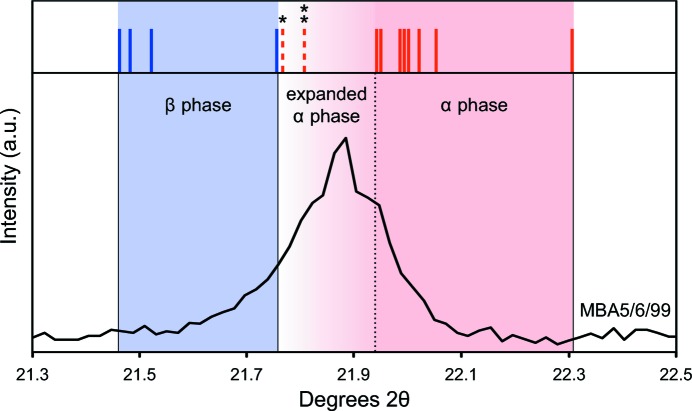
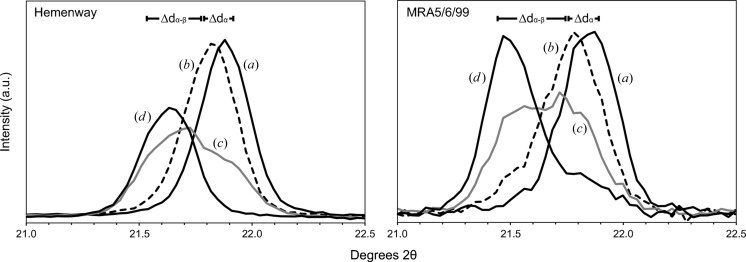
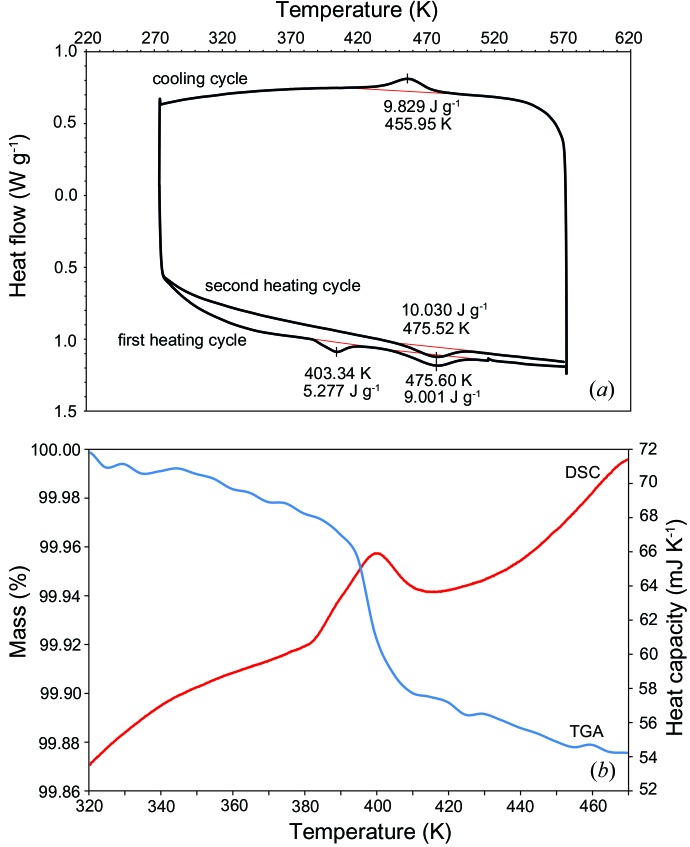
Cristobalite is a common mineral in volcanic ash produced from dome-forming eruptions. Assessment of the respiratory hazard posed by volcanic ash requires understanding the nature of the cristobalite it contains. Volcanic cristobalite contains coupled substitutions of Al3+ and Na+ for Si4+; similar co-substitutions in synthetic cristobalite are known to modify the crystal structure, affecting the stability of the α and β forms and the observed transition between them. Here, for the first time, the dynamics and energy changes associated with the α–β phase transition in volcanic cristobalite are investigated using X-ray powder diffraction with simultaneous in situ heating and differential scanning calorimetry. At ambient temperature, volcanic cristobalite exists in the α form and has a larger cell volume than synthetic α-cristobalite; as a result, its diffraction pattern sits between ICDD α- and β-cristobalite library patterns, which could cause ambiguity in phase identification. On heating from ambient temperature, volcanic cristobalite exhibits a lower degree of thermal expansion than synthetic cristobalite, and it also has a lower α–β transition temperature (∼473 K) compared with synthetic cristobalite (upwards of 543 K); these observations are discussed in relation to the presence of Al3+ and Na+ defects. The transition shows a stable and reproducible hysteresis loop with α and β phases coexisting through the transition, suggesting that discrete crystals in the sample have different transition temperatures.
Overview
The claims and statistics of this paper haven’t been checked yet.
Free: it reads the open-access text and checks the first 5 claims that cite a source we can check. Create a free account to check every claim.
Integrity signals
Registry
Cites
Statistics
Figures
Verification
Claims the paper makes
The claims and statistics of this paper haven’t been checked yet.
Free: it reads the open-access text and checks the first 5 claims that cite a source we can check. Create a free account to check every claim.
Claims other papers make about this one
Each is checked against this paper’s own text: does it say what the citing paper says it does?
In the citing paper
“indeed, structural and chemical defects of volcanic cristobalite (which contains up to 3 wt.% aluminum) together with its presence in a heterogeneous dust have all been previously implicated in its reduced potency (8, 14, 15).”
From Volcanic Ash Activates the NLRP3 Inflammasome in Murine and Human Macrophages (2018) · cites this paper as [14]
In the citing paper
“Therefore, intrinsic modifications may act to suppress volcanic cristobalite reactivity beyond the aforementioned diminished surface area-dose, as previously postulated (8, 14).”
From Volcanic Ash Activates the NLRP3 Inflammasome in Murine and Human Macrophages (2018) · cites this paper as [14]
Self-check
Percentages, sums and reported differences re-computed from the paper’s own numbers.
The self-check needs the paper’s full text.
Citations
Cites
The nanosilica hazard: another variable entity
Napierska, D., Thomassen, L. C., Lison, D., Martens, J. A., & Hoet, P. H. (2010) · Particle and Fibre Toxicology · doi:10.1186/1743-8977-7-39 · Cited by 806 · cited 1×
“As such, its pathogenic potential has been deemed a ‘variable entity’, whereby chemical and structural variability can modulate its toxicity (Donaldson & Borm, 1998; Napierska et al., 2010).”
BackgroundThe respiratory health hazards of volcanic ash: a review for volcanic risk mitigation
Horwell, C. J., & Baxter, P. J. (2006) · Bulletin of Volcanology · doi:10.1007/s00445-006-0052-y · Cited by 587 · cited 1×
“On collapse, the cristobalite-bearing lava fragments to produce cristobalite-rich ash, prompting concern for exposed populations (Horwell & Baxter, 2006).”
BackgroundSelf-citationAscent-driven crystallisation of dacite magmas at Mount St Helens, 1980–1986
Blundy, J., & Cashman, K. (2001) · Contributions to Mineralogy and Petrology · doi:10.1007/s004100000219 · Cited by 506 · cited 2×
“…has also been observed in dome rock from Soufrière Hills (Horwell et al., 2013; Plail et al., 2014), Merapi (Damby et al., 2013), Mount St Helens (Blundy & Cashman, 2001; Pallister et al., 2008) and Santiaguito (Damby, 2012; Scott et al., 2012), and sectioned ash from Sakurajima (Hillman et…”
BackgroundMURPHY, M. D., SPARKS, R. S. J., BARCLAY, J., CARROLL, M. R., & BREWER, T. S. (2000) · Journal of Petrology · doi:10.1093/petrology/41.1.21 · Cited by 472 · cited 1×
“The volcanic dome environment is typically below 1073 K (Barclay et al., 1998; Murphy et al., 2000), which is more than 300 K cooler than the minimum crystallization temperatures used to synthesize cristobalite; for example, a minimum temperature of 1373 K was used in experiments by Alcalá et al.…”
MethodRichet, P., Bottinga, Y., Denielou, L., Petitet, J. P., & Tequi, C. (1982) · Geochimica et Cosmochimica Acta · doi:10.1016/0016-7037(82)90383-0 · Cited by 397 · cited 1×
“…necessarily imply an increase in cristobalite abundance or inherent structural order, but instead is likely to result from the irreversible nature of the transition hysteresis for cristobalite, where cycling through the – transition is accompanied by an increase in entropy (Richet et al., 1982).”
BackgroundSilica, Some Silicates, Coal Dust and Para-Aramid Fibrils.
(1997) · PubMed Central · Cited by 385
Raju, B., & Rom, W. N. (1998) · Cancer Causes & Control · doi:10.1023/a:1011242002145 · Cited by 330
Sosman, R. B. (1965) · Rutgers University Press eBooks · Cited by 323
Spontaneous strain as a determinant of thermodynamic properties for phase transitions in minerals
Carpenter, M. A., Salje, E. K. H., & Graeme-Barber, A. (1998) · European Journal of Mineralogy · doi:10.1127/ejm/10/4/0621 · Cited by 317 · cited 1×
“The to transition is accompanied by a 5% reduction in volume, which causes the crystals to crack on cooling (Carpenter et al., 1998); the resulting ‘fish-scale’ texture is indicative of cristobalite that has undergone the displacive transition.”
BackgroundSelf-citationA volcano rekindled: The renewed eruption of Mount St. Helens, 2004-2006
Sherrod, D. R., Scott, W. E., & Stauffer, P. H. (2008) · Professional Paper · doi:10.3133/pp1750 · Cited by 295
Research works printed but not linked: 5
- Damby, D. E. (2012). Durham University e-thesis 1–258, Durham, UK.
- Frondel, C. (1962). The System of Mineralogy: Silica Minerals, 7th ed. New York: Wiley.
- Smallwood, G., Thomas, P. S. & Ray, A. S. (2008). J. Thermal Anal. Calorim. 92, 91–95.
- Thompson, A. B. & Wennemer, M. (1979). Am. Mineral. 64, 1018–1026.
- Wahl, F. M., Grim, R. E. & Graf, R. B. (1961). Am. Mineral. 46, 1064–1076.
Cited by
Kiani, D., Sourav, S., Baltrusaitis, J., & Wachs, I. E. (2019) · ACS Catalysis · doi:10.1021/acscatal.9b01585 · Cited by 213
Volcanic air pollution and human health: recent advances and future directions
Stewart, C., Damby, D. E., Horwell, C. J., Elias, T., Ilyinskaya, E., Tomašek, I., Longo, B. M., Schmidt, A., Carlsen, H. K., Mason, E., et al. (2021) · Bulletin of Volcanology · doi:10.1007/s00445-021-01513-9 · Cited by 155
Self-citationMolecular dynamics simulations of liquid silica crystallization
Niu, H., Piaggi, P. M., Invernizzi, M., & Parrinello, M. (2018) · Proceedings of the National Academy of Sciences · doi:10.1073/pnas.1803919115 · Cited by 135
“15 Å, in agreement with experimental results (15).”
ResultEvidence for the development of permeability anisotropy in lava domes and volcanic conduits
Farquharson, J. I., Heap, M. J., Lavallée, Y., Varley, N. R., & Baud, P. (2016) · Journal of Volcanology and Geothermal Research · doi:10.1016/j.jvolgeores.2016.05.007 · Cited by 104
Alteration‐Induced Volcano Instability at La Soufrière de Guadeloupe (Eastern Caribbean)
Heap, M. J., Baumann, T. S., Rosas‐Carbajal, M., Komorowski, J., Gilg, H. A., Villeneuve, M. C., Moretti, R., Baud, P., Carbillet, L., Harnett, C. E., et al. (2021) · Journal of Geophysical Research Solid Earth · doi:10.1029/2021jb022514 · Cited by 97
“temperature for the transition from - to -cristobalite (Damby et al., 2014).”
Background
Metadata
- Authors
- Damby, D. E., Llewellin, E. W., Horwell, C. J., Williamson, B. J., Najorka, J., Cressey, G., & Carpenter, M.
- Affiliations
- Durham University (GB)
- University of Exeter (GB)
- Natural History Museum (GB)
- University of Cambridge (GB)
- Corresponding author
- Horwell, Claire J.
- ORCID
- Venue
- Journal of Applied Crystallography
- Published
- 2014-06-14
- Volume
- 47
- Issue
- 4
- Pages
- 1205-1215
- ISSN
- 0021-8898 (ISSN-L)
- 1600-5767
- PMC
- PMC4119948
- OpenAlex
- W2138076841
- Cited by
- 113
- References
- 70
- Citations by year
- 2026: 13 · 2025: 13 · 2024: 17 · 2023: 10 · 2022: 15 · 2021: 12 · 2020: 6 · 2019: 6 · 2018: 6 · 2017: 7 · 2016: 2 · 2015: 5 · 2014: 1
- FWCI
- 2.27
- Type
- journal article
- Language
- en
- Open access
- hybrid
- doi.org
- Licence
- cc-by
- creativecommons.org/licenses/by/2.0/uk/legalcode (vor)
- creativecommons.org/licenses/by/2.0/uk/legalcode (tdm)
- Locations
- Journal of Applied Crystallography (publishedVersion, cc-by)
- PubMed Central (publishedVersion, cc-by)
- PubMed (publishedVersion)
- Durham Research Online (Durham University) (acceptedVersion, other-oa)
- Department of Earth Sciences EPrints Repository (acceptedVersion)
- Durham Research Online (Durham University) (submittedVersion, cc-by)
- Figshare (submittedVersion)
- Open Research Exeter (University of Exeter) (submittedVersion, cc-by)
- Funders
- Natural Environment Research Council (NE/C518081/1, NE/C518081/2)
- Topics
- Physical Sciences › Materials Science › Materials Chemistry › X-ray Diffraction in Crystallography
- Physical Sciences › Materials Science › Materials Chemistry › Solid-state spectroscopy and crystallography
- Physical Sciences › Earth and Planetary Sciences › Geophysics › High-pressure geophysics and materials
- Keywords
- cristobalite, alpha-beta phase transition, volcanic ash, volcanic glass, thermal expansion, transition temperature, hysteresis, cell volume, respiratory hazards
About these checks
Registry, retraction, Cites and statistics results are computed, not judged, with one exception: a printed reference that no index lists is read once by a model before it counts as a citation error. Claims are extracted by a model and kept only when their quote appears verbatim in the text; each cited source is then checked, with a model’s help, for whether it says what the claim relies on. Those verdicts can be wrong — read the claim’s quote and the cited source before relying on one.
Statistics and arithmetic are recomputed, not judged.
Confidence bands are shown only for fields calibrated on our annotated test set. None is calibrated yet, so no band is shown.
What counts as a claim ›How we measure confidence ›How we check this ›
Are you an author, or do you see a problem with this page? Request a review
How to cite
Cite CoChat for the checks on this page, and the paper for its own findings.
- This page
- CoChat. (2026). Citation check: The α–β phase transition in volcanic cristobalite. https://app.cochat.ai/papers/10.1107/s160057671401070x
- The paper
- Damby, D. E., Llewellin, E. W., Horwell, C. J., Williamson, B. J., Najorka, J., Cressey, G., & Carpenter, M. (2014). The α–β phase transition in volcanic cristobalite. Journal of Applied Crystallography. https://doi.org/10.1107/s160057671401070x
Data sources
Bibliographic data: Semantic Scholar, OpenAlex, Crossref.
Contains information from the Semantic Scholar Academic Graph Datasets, made available under the ODC Attribution License (ODC-BY 1.0).
Semantic Scholar’s data is described in: Kinney, R., et al. (2023). The Semantic Scholar Open Data Platform. arXiv:2301.10140.
