

The DOI matches its Crossref record; 1 of the 1 references it cites were found in a registry or an index.
Transforming scholarship in the archives through handwritten text recognition: Transkribus as a case study
Abstract
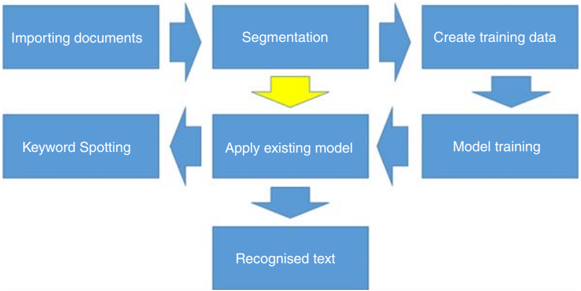
Purpose: An overview of the current use of handwritten text recognition (HTR) on archival manuscript material, as provided by the EU H2020 funded Transkribus platform. It explains HTR, demonstrates Transkribus , gives examples of use cases, highlights the affect HTR may have on scholarship, and evidences this turning point of the advanced use of digitised heritage content. The paper aims to discuss these issues. Design/methodology/approach: This paper adopts a case study approach, using the development and delivery of the one openly available HTR platform for manuscript material. Findings: Transkribus has demonstrated that HTR is now a useable technology that can be employed in conjunction with mass digitisation to generate accurate transcripts of archival material. Use cases are demonstrated, and a cooperative model is suggested as a way to ensure sustainability and scaling of the platform. However, funding and resourcing issues are identified. Research limitations/implications: The paper presents results from projects: further user studies could be undertaken involving interviews, surveys, etc. Practical implications: Only HTR provided via Transkribus is covered: however, this is the only publicly available platform for HTR on individual collections of historical documents at time of writing and it represents the current state-of-the-art in this field. Social implications: The increased access to information contained within historical texts has the potential to be transformational for both institutions and individuals. Originality/value: This is the first published overview of how HTR is used by a wide archival studies community, reporting and showcasing current application of handwriting technology in the cultural heritage sector.
Overview
The claims and statistics of this paper haven’t been checked yet.
Run the check — free, no account needed. It reads the open-access text and checks the sources it cites.
Integrity signals
Registry
Cites
Statistics
Figures

Verification
Claims the paper makes
The claims and statistics of this paper haven’t been checked yet.
Run the check — free, no account needed. It reads the open-access text and checks the sources it cites.
Claims other papers make about this one
Each is checked against this paper’s own text: does it say what the citing paper says it does?
In the citing paper
“However, the Bentham dataset was used in the pre-training of existing Transkribus PyLaia models, consequently, it can be supposed that even supermodels could have been trained using this data (Muehlberger et al., 2019, p. 959).”
From Benchmarking large language models for handwritten text recognition (2025) · cites this paper as Muehlberger et al., 2019, p. 959
Self-check
Percentages, sums and reported differences re-computed from the paper’s own numbers.
The self-check needs the paper’s full text.
Citations
Cites
Samek, W., Wiegand, T., & Müller, K.-R. (2017) · arXiv · doi:10.48550/arxiv.1708.08296 · Cited by 1,080
Research works printed but not linked: 41
- Alvermann, D. and Blüggel, B. (2017), “Transkribus at Greifswald. Idea, practice, results, perspective”, paper presented at Transkribus User Conference 2017, 2–3 November, Technical University of Vienna, Vienna, available at: https://read.transkribus.eu/wp-content/uploads/2017/07/Alvermann_Bluegel_Greifswald.pdf (accessed 13 December 2018).
- 2008, Hidden Markov model-based ensemble methods for offline handwritten text line recognition, Pattern Recognition, 41, 3452, 10.1016/j.patcog.2008.04.003 · DOI
- Boenig, M. and Würzner, K.-M. (2017), “Compilation of a large ground-truth data set using transkribus”, paper presented at Transkribus User Conference 2017, 2–3 November, Technical University of Vienna, Vienna, available at: https://read.transkribus.eu/wp-content/uploads/2017/07/Boenig_Wuerzner_Groundtruth-1.pdf (accessed 13 December 2018).
- 2016, Digitization of heritage collections as indicator of innovation, Economics of Innovation and New Technology, 26, 227
- Carbonell, J.G., Michalski, R.S. and Mitchell, T.M. (2013), “An overview of machine learning”, in Michalski, R.S., Carbonell, J.G. and Mitchell, T.M. (Eds), Machine Learning: An Artificial Intelligence Approach, Springer-Verlag, Berlin and Heidelberg, pp. 3-23.
- Causer, T. and Terras, M. (2014), “‘Many hands make light work. Many hands together make merry work’: transcribe Bentham and Crowdsourcing manuscript collections”, in Ridge, M. (Ed.), Crowdsourcing Our Cultural Heritage, Ashgate, Farnham, pp. 57-88.
- Cornell, D. (2017), “Georgian papers programme”, paper presented at Transkribus User Conference 2017, 2–3 November, Technical University of Vienna, Vienna, available at: https://read.transkribus.eu/wp-content/uploads/2017/07/Cornell_Georgian_Papers.pdf (accessed 13 December 2018).
- 2001, Artificial neural networks: opening the black box, Cancer, 91, 1615
- Dellinger, M. (2018), “The READ-COOP: working together for the future of digital cultural heritage”, paper presented at Transkribus User Conference 2018, 8–9 November, Technical University of Vienna, Vienna, available at: https://read.transkribus.eu/wp-content/uploads/2018/11/DELLINGER-SCE.pdf (accessed 13 December 2018).
- Dillen, W. (2017), “Transkribus in practice”, paper presented at Transkribus User Conference 2017, 2–3 November, Technical University of Vienna, Vienna, available at: https://read.transkribus.eu/wp-content/uploads/2017/07/Dillen_Beckett_edition.pdf (accessed 13 December 2018).
- 1997, Automatic bankcheck processing: a new engineered system, International Journal of Pattern Recognition and Artificial Intelligence, 11, 467, 10.1142/S0218001497000214 · DOI
- Dimond, T.L. (1957), “Devices for reading handwritten characters”, papers and discussions presented at the December 9–13, Eastern Joint Computer Conference: Computers with Deadlines to Meet, ACM, Washington, DC, pp. 232-37.
- Edwards, J.A. (2007), “Easily adaptable handwriting recognition in historical manuscripts”, PhD Dissertation, University of California, Berkeley, CA, available at: www2.eecs.berkeley.edu/Pubs/TechRpts/2007/EECS-2007-76.pdf (accessed 13 December 2018).
- 2016, Chapter 12 evaluating digital remediations of women’s manuscripts, Digital Studies/Le champ numérique, 6
- Firmani, D., Maiorino, M., Merialdo, P. and Nieddu, E. (2018), “Towards knowledge discovery from the Vatican secret archives. In Codice ratio – episode 1: machine transcription of the manuscripts”, available at: https://arxiv.org/abs/1803.03200 (accessed 13 December 2018). · DOI
- Gázquez, R.V. (2017), “La edición del teatro de Lope”, paper presented at Transkribus User Conference 2017, 2–3 November, Technical University of Vienna, Vienna, available at: https://read.transkribus.eu/wp-content/uploads/2017/07/Valdes_PROLOPE.pdf (accessed 13 December 2018).
- 2017, A survey of document image word spotting techniques, Pattern Recognition, 68, 310, 10.1016/j.patcog.2017.02.023 · DOI
- 1990, Character recognition – a review, Pattern Recognition, 23, 671, 10.1016/0031-3203(90)90091-X · DOI
- 2015, Geoparsing, GIS and textual analysis: current developments in spatial humanities research, International Journal of Humanities and Arts Computing, 9, 1, 10.3366/ijhac.2015.0135 · DOI
- Hafemann, L.G., Sabourin, R. and Oliveira, L.S. (2015), “Offline handwritten signature verification – literature review”, available at: https://arxiv.org/abs/1507.07909 (accessed 13 December 2018). · arXiv
- Jerkov, A. and Sofronijevic, A. (2017), “University of Belgrade library, Transkribus user experience”, paper presented at Transkribus User Conference 2017, 2–3 November, Technical University of Vienna, Vienna, available at: https://read.transkribus.eu/wp-content/uploads/2017/07/Jerkov_Uni_Belgrade_library.pdf (accessed 13 December 2018).
- Kampkaspar, D. (2017), “Digital edition of the ‘Wienerisches Diarium’”, paper presented at Transkribus User Conference, 2–3 November, Technical University of Vienna, Vienna, available at: https://read.transkribus.eu/wp-content/uploads/2017/07/Kampkaspar_Wienerisches_Diarium.pdf (accessed 13 December 2018).
- 2015, Loose, falling characters and sentences: the persistence of the OCR problem in digital repository e-books, Libraries and the Academy, 15, 59, 10.1353/pla.2015.0005 · DOI
- Leifert, G., Strauß, T., Grüning, T. and Labahn, R. (2016), “CITlab ARGUS for historical handwritten documents”, available at: http://arxiv.org/abs/1605.08412 (accessed 13 December 2018). · arXiv
- Lemke, K. and Onasch, P. (2017), “‘I do not find hot punch as nice as writing letters.’ Transcribing Ernst Barlach’s letters (1870–1938) with Transkribus”, paper presented at Transkribus User Conference, 2–3 November, Technical University of Vienna, Vienna, available at: https://read.transkribus.eu/wp-content/uploads/2017/07/Onasch_Lemke_Barlach.pdf (accessed 13 December 2018).
- 2015, Semantic technologies for historical research: a survey, Semantic Web, 6, 539
- 2018, Gender and handedness prediction from offline handwriting using convolutional neural networks, Complexity, 2018
- 2016, Scientific archives in the age of digitization, Isis, 107, 77, 10.1086/686075 · DOI
- 2017, Querying out-of-vocabulary words in lexicon-based keyword spotting, Neural Computing and Applications, 28, 2373, 10.1007/s00521-016-2197-8 · DOI
- 1982, The History of OCR (Optical Character Recognition)
- 2017, OCR of historical printings with an application to building diachronic corpora: a case study using the RIDGES herbal corpus, Digital Humanities Quarterly, 11
- 2006, Image to Interpretation: An Intelligent System to Aid Historians in the Reading of the Vindolanda Texts
- Terras, M. (2010), “The rise of digitisation: an overview”, in Rukowski, R. (Ed.), Digitisation Perspectives, Sense Publishers, pp. 3-20.
- Thöle, K. (2017), “Transcribing a highly abbreviated incunable (and some more manuscript sources)”, paper presented at Transkribus User Conference, 2–3 November, Technical University of Vienna, Vienna, available at: https://read.transkribus.eu/wp-content/uploads/2017/07/Thoele_Incunable.pdf (accessed 13 December 2018).
- 2017, Word graphs size impact on the performance of handwriting document applications, Neural Computing and Applications, 28, 2477, 10.1007/s00521-016-2336-2 · DOI
- 2009, Where are the search engines for handwritten documents?, Interdisciplinary Science Reviews, 34, 224
- Vetter, A. (2017), “The Austrian Bible translator – the word of God in German. Annotated critical hybrid edition”, paper presented at Transkribus User Conference, 2–3 November, Technical University of Vienna, Vienna, available at: https://read.transkribus.eu/wp-content/uploads/2017/07/Vetter_Austrian_Bible.pdf (accessed 13 December 2018).
- Weber, A., Ameryan, M., Wolstencroft, K., Stork, L., Heerlien, M. and Schomaker, L. (2018), “Towards a digital infrastructure for illustrated handwritten archives”, in Ioannides, M. (Ed.), Digital Cultural Heritage, Springer International, pp. 155-166. · DOI
- 2016, Practical Corpus Linguistics: An Introduction to Corpus-Based Language Analysis
- 2017, Unsupervised word spotting in historical handwritten document images using document-oriented local features, IEEE Transactions on Image Processing, 26, 4032, 10.1109/TIP.2017.2700721 · DOI
- Mühlberger, G. (2015), “Die automatisierte Volltexterkennung historischer Handschriften als gemeinsame Aufgabe von Archiven, Geistes- und Computerwissenschaftlern. Das Modell einer zentralen Transkriptionsplattform als virtuelle Forschungsumgebung”, in Becker, I.C. and Oertel, S. (Eds), Digitalisierung im Archiv. Neue Wege der Bereitstellung des Archivguts. Beiträge des 18. Archivwissenschaftlichen Kolloquiums am 26. und 27. November 2013, Archivschule Marburg, Marburg, pp. 87-116.
Cited by
Archives and AI: An Overview of Current Debates and Future Perspectives
Colavizza, G., Blanke, T., Jeurgens, C., & Noordegraaf, J. (2022) · Journal on Computing and Cultural Heritage · doi:10.1145/3479010 · Cited by 162
Benchmarking large language models for handwritten text recognition
Crosilla, G., Klic, L., & Colavizza, G. (2025) · Journal of Documentation · doi:10.1108/jd-03-2025-0082 · Cited by 34
Arias Hernández, R., & Rockembach, M. (2025) · AI & SOCIETY · doi:10.1007/s00146-025-02194-0 · Cited by 22
Metadata
- Authors
- Muehlberger, G., Seaward, L., Terras, M., Ares Oliveira, S., Bosch, V., Bryan, M., Colutto, S., Déjean, H., Diem, M., Fiel, S., Gatos, B., Greinoecker, A., Grüning, T., Hackl, G., Haukkovaara, V., Heyer, G., Hirvonen, L., Hodel, T., Jokinen, M., Kahle, P., Kallio, M., Kaplan, F., Kleber, F., Labahn, R., Lang, E. M., Laube, S., Leifert, G., Louloudis, G., McNicholl, R., Meunier, J.-L., Michael, J., Mühlbauer, E., Philipp, N., Pratikakis, I., Puigcerver Pérez, J., Putz, H., Retsinas, G., Romero, V., Sablatnig, R., Sánchez, J. A., Schofield, P., Sfikas, G., Sieber, C., Stamatopoulos, N., Strauß, T., Terbul, T., Toselli, A. H., Ulreich, B., Villegas, M., Vidal, E., Walcher, J., Weidemann, M., Wurster, H., & Zagoris, K.
- Venue
- Journal of Documentation
- Publisher
- Emerald
- Published
- 2019-09-09
- Volume
- 75
- Issue
- 5
- Pages
- 954-976
- ISSN
- 0022-0418
- Cited by
- 108
- References
- 1
- Language
- en
About these checks
Registry, retraction, Cites and statistics results are computed, not judged, with one exception: a printed reference that no index lists is read once by a model before it counts as a citation error. Claims are extracted by a model and kept only when their quote appears verbatim in the text; each cited source is then checked, with a model’s help, for whether it says what the claim relies on. Those verdicts can be wrong — read the claim’s quote and the cited source before relying on one.
Statistics and arithmetic are recomputed, not judged.
Confidence bands are shown only for fields calibrated on our annotated test set. None is calibrated yet, so no band is shown.
What counts as a claim ›How we measure confidence ›How we check this ›
Are you an author, or do you see a problem with this page? Request a review
Data sources
Bibliographic data: Semantic Scholar, OpenAlex, Crossref.
Contains information from the Semantic Scholar Academic Graph Datasets, made available under the ODC Attribution License (ODC-BY 1.0).
Semantic Scholar’s data is described in: Kinney, R., et al. (2023). The Semantic Scholar Open Data Platform. arXiv:2301.10140.
