

Providing End-to-End Security Using Quantum Walks in IoT Networks
Open accessThe DOI matches its Crossref record; 50 of the 50 references it cites were found in a registry or an index.
Abstract
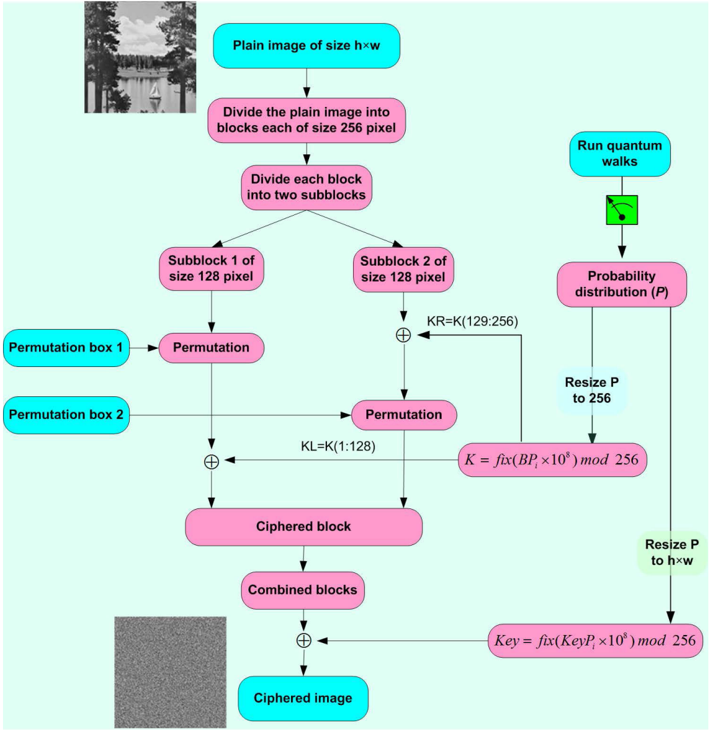
Internet of Things acts an essential role in our everyday lives and it definitely has the potential to grow on the importance and revolutionize our future. However, the present communication technologies have several security related issues which is required to provide secure end to end connectivity among services. Moreover, due to recent, rapid growth of quantum technologies, most common security mechanisms considered secure today may be soon imperilled. Thus, the modern security mechanisms during their construction also require the power of quantum technologies to resist various potential attacks from quantum computers. Because of its characteristics, quantum walks (QW) is considered as a universal quantum computation paradigm that can be accepted as an excellent key generator. In this regard, in this paper a new lightweight image encryption scheme based on QW for secure data transfer in the internet of things platforms and wireless networking with edge computing is proposed. The introduced approach utilises the power of nonlinear dynamic behaviour of QW to construct permutation boxes and generates pseudo-random numbers for encrypting the plain image after dividing it into blocks. The results of the conducted simulation and numerical analyses confirm that the presented encryption algorithm is effective. The encrypted images have randomness properties, no useful data about the ciphered image can be obtained via analysing the correlation of adjacent pixels. Moreover, the entropy value is close to 8, the number of the pixel change rate is greater than 99.61%, and there is high sensitivity of the key parameters with large key space to resist various attacks.
Overview
The claims and statistics of this paper haven’t been checked yet.
Free: it reads the open-access text and checks the first 5 claims that cite a source we can check. Create a free account to check every claim.
Integrity signals
Registry
Cites
Statistics
Figures


Verification
Claims the paper makes
The claims and statistics of this paper haven’t been checked yet.
Free: it reads the open-access text and checks the first 5 claims that cite a source we can check. Create a free account to check every claim.
Self-check
Percentages, sums and reported differences re-computed from the paper’s own numbers.
The self-check needs the paper’s full text.
Citations
Cites
The Internet of Things: A survey
Atzori, L., Iera, A., & Morabito, G. (2010) · Computer Networks · doi:10.1016/j.comnet.2010.05.010 · Cited by 15,613
Internet of Things (IoT): A vision, architectural elements, and future directions
Gubbi, J., Buyya, R., Marusic, S., & Palaniswami, M. (2013) · Future Generation Computer Systems · doi:10.1016/j.future.2013.01.010 · Cited by 12,293 · cited 1×
“INTRODUCTION The Internet of Things (IoT) has heightened an integral part of the future of communication systems [1], [2].”
BackgroundInternet of Things for Smart Cities
Zanella, A., Bui, N., Castellani, A., Vangelista, L., & Zorzi, M. (2014) · IEEE Internet of Things Journal · doi:10.1109/jiot.2014.2306328 · Cited by 6,292 · cited 1×
“In smart cities, IoT can include important data to control and monitor installations as well as private information of inhabitants of the city [43], [47].”
BackgroundQuantum information and computation
Bennett, C. H., & DiVincenzo, D. P. (2000) · Nature · doi:10.1038/35005001 · Cited by 3,263 · cited 1×
“Quantum computers have shown promise for operations unrivalled by the best-known digital resources due to quantum phenomena like quantum superposition and quantum entanglement [25], [26].”
BackgroundThe Internet of Things for Health Care: A Comprehensive Survey
Riazul Islam, S. M., Kwak, D., Humaun Kabir, M., Hossain, M., & Kwak, K.-S. (2015) · IEEE Access · doi:10.1109/access.2015.2437951 · Cited by 3,095 · cited 1×
“For example, the confidential health records of patients, geotagging people’s location using wearable devices [45], [46] need to be safely guarded against the everincreasing sophistication of criminals.”
BackgroundA Survey on Security and Privacy Issues in Internet-of-Things
Yang, Y., Wu, L., Yin, G., Li, L., & Zhao, H. (2017) · IEEE Internet of Things Journal · doi:10.1109/jiot.2017.2694844 · Cited by 1,278
Universal Computation by Quantum Walk
Childs, A. M. (2009) · Physical Review Letters · doi:10.1103/physrevlett.102.180501 · Cited by 1,002
Quantum walks: a comprehensive review
Venegas-Andraca, S. E. (2012) · Quantum Information Processing · doi:10.1007/s11128-012-0432-5 · Cited by 934 · cited 2×
“Quantum walks (QW) is considered as a universal quantum computational model [28]–[30], that can be accepted as a good key generator because of its inherent nonlinear chaotic dynamical behaviour [31]–[40].”
BackgroundSelf-citationUrban planning and building smart cities based on the Internet of Things using Big Data analytics
Rathore, M. M., Ahmad, A., Paul, A., & Rho, S. (2016) · Computer Networks · doi:10.1016/j.comnet.2015.12.023 · Cited by 932 · cited 1×
“In smart cities, IoT can include important data to control and monitor installations as well as private information of inhabitants of the city [43], [47].”
BackgroundSecurity in the Internet of Things: A Review
Suo, H., Wan, J., Zou, C., & Liu, J. (2012) · 2012 International Conference on Computer Science and Electronics Engineering · doi:10.1109/iccsee.2012.373 · Cited by 777 · cited 1×
“Securing such sensitive information from malicious attacks becomes currently the most pressing aspect of IoT [48].”
Background
Cited by
Abbas, A., Alroobaea, R., Krichen, M., Rubaiee, S., Vimal, S., & Almansour, F. M. (2024) · Personal and Ubiquitous Computing · doi:10.1007/s00779-021-01583-8 · Cited by 168
“The response time is the same as that of cloud servers and patient servers, greatly decreasing storage space [36 – 39] .”
Elgendy, I. A., Zhang, W.-Z., He, H., Gupta, B. B., & Abd El-Latif, A. A. (2021) · Wireless Networks · doi:10.1007/s11276-021-02554-w · Cited by 169
Self-citationSambas, A., Vaidyanathan, S., Tlelo-Cuautle, E., Abd-El-Atty, B., El-Latif, A. A. A., Guillen-Fernandez, O., Sukono, Hidayat, Y., & Gundara, G. (2020) · IEEE Access · doi:10.1109/access.2020.3011724 · Cited by 166
“Data protection play an important role in our daily lives in which data encryption mechanisms are commonly used [42].”
BackgroundSelf-citationA New Chaotic Map With Dynamic Analysis and Encryption Application in Internet of Health Things
Tsafack, N., Sankar, S., Abd-El-Atty, B., Kengne, J., Jithin, K. C., Belazi, A., Mehmood, I., Bashir, A. K., Song, O.-Y., & El‐Latif, A. A. A. (2020) · IEEE Access · doi:10.1109/access.2020.3010794 · Cited by 156
Self-citationLeveraging blockchain for ensuring trust in IoT: A survey
Kumar, R., & Sharma, R. (2021) · Journal of King Saud University - Computer and Information Sciences · doi:10.1016/j.jksuci.2021.09.004 · Cited by 157
Metadata
- Authors
- El-Latif, A. A. A., Abd-El-Atty, B., Venegas-Andraca, S. E., Elwahsh, H., Piran, M. J., Bashir, A. K., Song, O.-Y., & Mazurczyk, W.
- Affiliations
- Menoufia University (EG)
- Tecnológico de Monterrey (MX)
- Kafrelsheikh University (EG)
- Sejong University (KR)
- Manchester Metropolitan University (GB)
- Warsaw University of Technology (PL)
- ORCID
- Venue
- IEEE Access
- Published
- 2020
- Volume
- 8
- Pages
- 92687-92696
- ISSN
- 2169-3536 (ISSN-L)
- OpenAlex
- W3023713876
- Cited by
- 89
- References
- 50
- Citations by year
- 2026: 3 · 2025: 9 · 2024: 10 · 2023: 10 · 2022: 24 · 2021: 26 · 2020: 7
- FWCI
- 6.51
- Type
- journal article
- Language
- en
- Open access
- gold
- doi.org
- Locations
- IEEE Access (publishedVersion, cc-by)
- e-space (Manchester Metropolitan University) (acceptedVersion, cc-by)
- DOAJ (DOAJ: Directory of Open Access Journals) (submittedVersion, cc-by-sa)
- Figshare (submittedVersion, cc-by)
- Greater South Information System
- Funders
- Iran Telecommunication Research Center
- Menofia University
- Ministry of Science and ICT, South Korea (IITP-2020-2016-0-00312)
- Narodowe Centrum Badań i Rozwoju (/2018)
- Institute for Information and Communications Technology Promotion (IITP-2020-2016-0-00312)
- Topics
- Physical Sciences › Computer Science › Computer Vision and Pattern Recognition › Chaos-based Image/Signal Encryption
- Physical Sciences › Physics and Astronomy › Atomic and Molecular Physics, and Optics › Quantum Information and Cryptography
- Physical Sciences › Computer Science › Artificial Intelligence › Cryptographic Implementations and Security
- Keywords
- quantum walks, image encryption, Internet of Things security, lightweight encryption, pseudorandom number generation, quantum key generation, end-to-end security, edge computing, wireless networks, quantum attacks
About these checks
Registry, retraction, Cites and statistics results are computed, not judged, with one exception: a printed reference that no index lists is read once by a model before it counts as a citation error. Claims are extracted by a model and kept only when their quote appears verbatim in the text; each cited source is then checked, with a model’s help, for whether it says what the claim relies on. Those verdicts can be wrong — read the claim’s quote and the cited source before relying on one.
Statistics and arithmetic are recomputed, not judged.
Confidence bands are shown only for fields calibrated on our annotated test set. None is calibrated yet, so no band is shown.
What counts as a claim ›How we measure confidence ›How we check this ›
Are you an author, or do you see a problem with this page? Request a review
How to cite
Cite CoChat for the checks on this page, and the paper for its own findings.
- This page
- CoChat. (2026). Citation check: Providing End-to-End Security Using Quantum Walks in IoT Networks. https://app.cochat.ai/papers/10.1109/access.2020.2992820
- The paper
- El-Latif, A. A. A., Abd-El-Atty, B., Venegas-Andraca, S. E., Elwahsh, H., Piran, M. J., Bashir, A. K., Song, O.-Y., & Mazurczyk, W. (2020). Providing End-to-End Security Using Quantum Walks in IoT Networks. IEEE Access. https://doi.org/10.1109/access.2020.2992820
Data sources
Bibliographic data: Semantic Scholar, OpenAlex, Crossref.
Contains information from the Semantic Scholar Academic Graph Datasets, made available under the ODC Attribution License (ODC-BY 1.0).
Semantic Scholar’s data is described in: Kinney, R., et al. (2023). The Semantic Scholar Open Data Platform. arXiv:2301.10140.
