

The DOI matches its Crossref record; 31 of the 31 references it cites were found in a registry or an index.
Parameter Optimization of Support Vector Regression Using Henry Gas Solubility Optimization Algorithm
Open accessAbstract
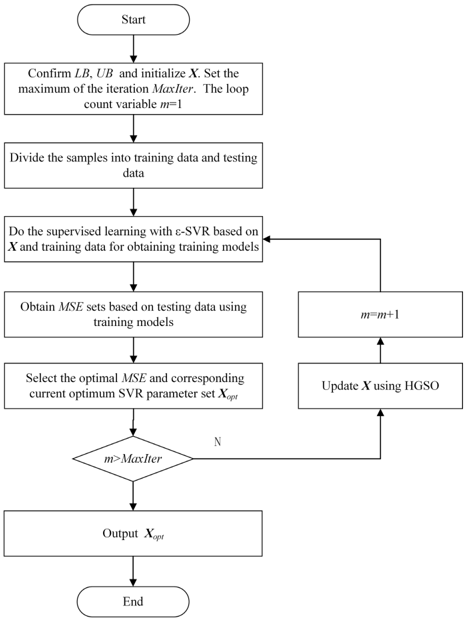
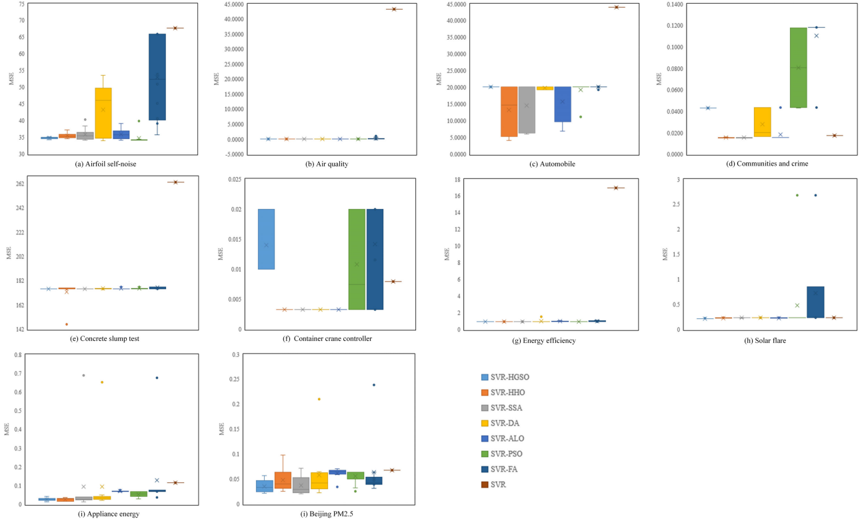
Support vector regression (SVR) is one of the most powerful and widely used machine learning algorithms regarding prediction. The kernel type, penalty factor and other parameters influence the efficiency and performance of SVR deeply. The optimization of these parameters is held a hot issue. In this work, we propose a SVR based prediction approach using henry gas solubility optimization algorithm (HGSO), which is a recent meta-heuristic algorithm inspired by Henry's law. First, SVR parameters are randomly generated in some certain ranges to form parameter population. Second, the prediction accuracies (PAs) are obtained using the population and SVR. Thirdly, the population and optimal SVR parameters are updated via PAs and HGSO. We repeat the second and third steps until the cut-off conditions are met. Ten low- and high-dimensional benchmark data sets are utilized to assess the prediction accuracy, convergence performance and computational complexity of the presented approach and other well-known algorithms. The experimental results reveal that our approach has the optimum comprehensive performance.
Overview
The claims and statistics of this paper haven’t been checked yet.
Free: it reads the open-access text and checks the first 5 claims that cite a source we can check. Create a free account to check every claim.
Integrity signals
Registry
Cites
Statistics
Figures


Verification
Claims the paper makes
The claims and statistics of this paper haven’t been checked yet.
Free: it reads the open-access text and checks the first 5 claims that cite a source we can check. Create a free account to check every claim.
Claims other papers make about this one
Each is checked against this paper’s own text: does it say what the citing paper says it does?
The check wasn’t confident either way, so it gives no verdict — never disputed.
In the citing paper
“The test functions are widely used to assess the performance of state-of-the-art algorithms [28].”
From Support vector regression-based operational effectiveness evaluation approach to reconnaissance satellite system (2023) · cites this paper as [28]
Experimental — accuracy not yet measured
Self-check
Percentages, sums and reported differences re-computed from the paper’s own numbers.
The self-check needs the paper’s full text.
Citations
Cites
LIBSVM: A library for support vector machines
Chang, C.-C., & Lin, C.-J. (2011) · ACM Transactions on Intelligent Systems and Technology · doi:10.1145/1961189.1961199 · Cited by 40,918 · cited 3×
“We can easily achieve MSE since (cid:15) -SVR of LIBSVM itself has the MSE output [2].”
BackgroundMethodInfluentialUCI Machine Learning Repository
Asuncion, A. (2007) · Medical Entomology and Zoology · Cited by 25,410
No free lunch theorems for optimization
Wolpert, D. H., & Macready, W. G. (1997) · IEEE Transactions on Evolutionary Computation · doi:10.1109/4235.585893 · Cited by 14,237 · cited 1×
“The no free lunch theorem in optimization [28] proves that there is and will never be an algorithm to resolve all optimization problems.”
BackgroundGSA: A Gravitational Search Algorithm
Rashedi, E., Nezamabadi-pour, H., & Saryazdi, S. (2009) · Information Sciences · doi:10.1016/j.ins.2009.03.004 · Cited by 7,358 · cited 1×
“Compared with PSO, gravitational search algorithm (GSA) [29], cuckoo search algorithm (CS) [30], GWO, WOA, EHO and SA, it obtained competitive and superior results [17].”
ResultHarris hawks optimization: Algorithm and applications
Heidari, A. A., Mirjalili, S., Faris, H., Aljarah, I., Mafarja, M., & Chen, H. (2019) · Future Generation Computer Systems · doi:10.1016/j.future.2019.02.028 · Cited by 6,324 · cited 1×
“Simultane-ously, the SVR, SVR-FA, SVR-PSO, SVR-ALO, SVR-DA, SVR-SSA and SVR-HHO (harris hawks optimization [19]) algorithms are compared with our approach.”
MethodAn overview of statistical learning theory
Vapnik, V. N. (1999) · IEEE Transactions on Neural Networks · doi:10.1109/72.788640 · Cited by 6,266 · cited 2×
“The (cid:15) -SVR prediction approach is a type of SVR that was developed by Vapnik [1].”
MethodCuckoo search algorithm: a metaheuristic approach to solve structural optimization problems
Gandomi, A. H., Yang, X.-S., & Alavi, A. H. (2013) · Engineering with Computers · doi:10.1007/s00366-011-0241-y · Cited by 2,257
Henry gas solubility optimization: A novel physics-based algorithm
Hashim, F. A., Houssein, E. H., Mabrouk, M. S., Al-Atabany, W., & Mirjalili, S. (2019) · Future Generation Computer Systems · doi:10.1016/j.future.2019.07.015 · Cited by 1,061 · cited 1×
“Compared with PSO, gravitational search algorithm (GSA) [29], cuckoo search algorithm (CS) [30], GWO, WOA, EHO and SA, it obtained competitive and superior results [17].”
ResultBearing Health Monitoring Based on Hilbert–Huang Transform, Support Vector Machine, and Regression
Soualhi, A., Medjaher, K., & Zerhouni, N. (2015) · IEEE Transactions on Instrumentation and Measurement · doi:10.1109/tim.2014.2330494 · Cited by 665 · cited 1×
“It has been applied in many fields such as stock market price forecasting [4], bearing health monitoring [5], electric load forecasting [6], river stage prediction [7], prediction of global solar radiation [8], predictive model of surface The associate editor coordinating the review of this…”
BackgroundSupport vector regression with chaos-based firefly algorithm for stock market price forecasting
Kazem, A., Sharifi, E., Hussain, F. K., Saberi, M., & Hussain, O. K. (2013) · Applied Soft Computing · doi:10.1016/j.asoc.2012.09.024 · Cited by 466 · cited 3×
“The algorithms applied to SVR include GA [15], [22], FA [4], gray wolf optimization (GWO) [23], PSO [10], ALO [11], DA [12], SSA [13], whale”
BackgroundMethod
Cited by
Opposition based Henry gas solubility optimization as a novel algorithm for PID control of DC motor
Ekinci, S., Hekimoğlu, B., & İzci, D. (2020) · Engineering Science and Technology an International Journal · doi:10.1016/j.jestch.2020.08.011 · Cited by 107
Oh, H. J., Lee, B., Ma, H. H., Jang, D., & Park, S. (2023) · Public Relations Review · doi:10.1016/j.pubrev.2023.102398 · Cited by 82
A new algorithm for support vector regression with automatic selection of hyperparameters
Wang, Y., Wu, J., Hu, Z., & McLachlan, G. J. (2022) · Pattern Recognition · doi:10.1016/j.patcog.2022.108989 · Cited by 68
Mishra, R. K., Choudhary, A., Mohanty, A., & Fatima, S. (2022) · Proceedings of the Institution of Mechanical Engineers Part C Journal of Mechanical Engineering Science · doi:10.1177/09544062221101737 · Cited by 54
Hoang, N., Huynh, T., Tran, X.-L., & Tran, V.-D. (2022) · Advances in Civil Engineering · doi:10.1155/2022/9193511 · Cited by 48
“Recently, various novel algorithms have been successfully utilized including artificial bee colony [66], differential flower pollination [67], Henry Gas Solubility Optimization [68], Harris hawks optimization [69], symbiotic organisms search [70], monarch butterfly optimization [71], and social spider optimization [72…”
Method
Metadata
- Authors
- Cao, W., Liu, X., & Ni, J.
- Affiliations
- Hohai University (CN)
- Venue
- IEEE Access
- Published
- 2020
- Volume
- 8
- Pages
- 88633-88642
- ISSN
- 2169-3536 (ISSN-L)
- OpenAlex
- W3022789660
- Semantic Scholar
- 15e00411673abe3924a0fb528c9398fe030fb48a
- Cited by
- 49
- References
- 31
- Citations by year
- 2026: 5 · 2025: 7 · 2024: 3 · 2023: 11 · 2022: 14 · 2021: 7 · 2020: 2
- FWCI
- 3.34
- Type
- journal article
- Language
- en
- Open access
- gold
- doi.org
- Locations
- IEEE Access (publishedVersion, cc-by)
- DOAJ (DOAJ: Directory of Open Access Journals) (submittedVersion, cc-by-sa)
- Funders
- Changzhou Science and Technology Bureau (CJ20190045)
- Fundamental Research Funds for the Central Universities (2019B01214)
- National Natural Science Foundation of China (61873086)
- Topics
- Physical Sciences › Computer Science › Artificial Intelligence › Metaheuristic Optimization Algorithms Research
- Physical Sciences › Computer Science › Artificial Intelligence › Machine Learning and ELM
- Physical Sciences › Computer Science › Artificial Intelligence › Machine Learning and Data Classification
- Keywords
- support vector regression, parameter optimization, metaheuristic optimization, kernel selection, penalty factor, prediction accuracy, benchmark dataset
About these checks
Registry, retraction, Cites and statistics results are computed, not judged, with one exception: a printed reference that no index lists is read once by a model before it counts as a citation error. Claims are extracted by a model and kept only when their quote appears verbatim in the text; each cited source is then checked, with a model’s help, for whether it says what the claim relies on. Those verdicts can be wrong — read the claim’s quote and the cited source before relying on one.
Statistics and arithmetic are recomputed, not judged.
Confidence bands are shown only for fields calibrated on our annotated test set. None is calibrated yet, so no band is shown.
What counts as a claim ›How we measure confidence ›How we check this ›
Are you an author, or do you see a problem with this page? Request a review
How to cite
Cite CoChat for the checks on this page, and the paper for its own findings.
- This page
- CoChat. (2026). Citation check: Parameter Optimization of Support Vector Regression Using Henry Gas Solubility Optimization Algorithm. https://app.cochat.ai/papers/10.1109/access.2020.2993267
- The paper
- Cao, W., Liu, X., & Ni, J. (2020). Parameter Optimization of Support Vector Regression Using Henry Gas Solubility Optimization Algorithm. IEEE Access. https://doi.org/10.1109/access.2020.2993267
Data sources
Bibliographic data: Semantic Scholar, OpenAlex, Crossref.
Contains information from the Semantic Scholar Academic Graph Datasets, made available under the ODC Attribution License (ODC-BY 1.0).
Semantic Scholar’s data is described in: Kinney, R., et al. (2023). The Semantic Scholar Open Data Platform. arXiv:2301.10140.
