

One-Class Classifier Based Fault Detection in Distribution Systems With Varying Penetration Levels of Distributed Energy Resources
Open accessThe DOI matches its Crossref record; 39 of the 40 references it cites were found in a registry or an index.
Abstract
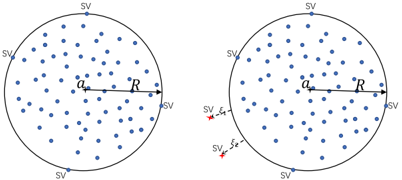
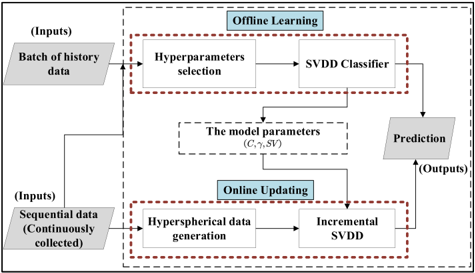
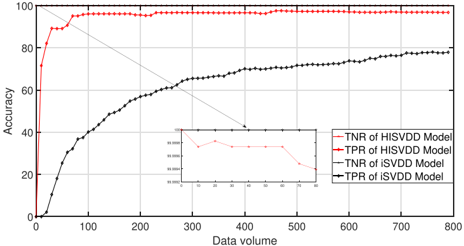
The integration of Distributed Energy Resources (DERs) into distribution systems greatly increases the system complexity and introduces two-way power flow. Conventional protection schemes are based upon local measurements and simple linear system models, and are thus not capable of handling the new complexity and power flow patterns in systems with high DER penetration. In this paper, we propose a data-driven protection framework to address the challenges introduced by DERs. Firstly, considering the limited available data under fault conditions, we adopt the Support Vector Data Description (SVDD) method, a commonly used one-class classifier, for distribution system fault detection, which only requires the normal data for its training process. Secondly, incremental learning is incorporated into the proposed SVDD-based protection framework to accommodate variations of the integration level of DERs in distribution systems over time. In particular, the artificial uniform-hyperspherical data generation model is incorporated into the incremental SVDD to boost the training speed. Finally, we validate the proposed method under the IEEE 123-node test feeder. Simulation results demonstrate that our proposed SVDD-based fault detection framework significantly improves the robustness and resilience against DERs in comparison with conventional protection systems. Meanwhile, the proposed online updating model outperforms the existing incremental SVDD models in terms of successful training speed.
Overview
The claims and statistics of this paper haven’t been checked yet.
Free: it reads the open-access text and checks the first 5 claims that cite a source we can check. Create a free account to check every claim.
Integrity signals
Registry
Cites
Statistics
Figures






Verification
Claims the paper makes
The claims and statistics of this paper haven’t been checked yet.
Free: it reads the open-access text and checks the first 5 claims that cite a source we can check. Create a free account to check every claim.
Self-check
Percentages, sums and reported differences re-computed from the paper’s own numbers.
The self-check needs the paper’s full text.
Citations
Cites
LIBSVM: A library for support vector machines
Chang, C.-C., & Lin, C.-J. (2011) · ACM Transactions on Intelligent Systems and Technology · doi:10.1145/1961189.1961199 · Cited by 40,918
Internet of Things in industries: A survey
Xu, L. D., He, W., & Li, S. (2014) · IEEE Transactions on Industrial Informatics · doi:10.1109/tii.2014.2300753 · Cited by 5,172
A Practical Guide to Support Vector Classication
Hsu, C., Chang, C.-C., & Lin, C. (2008) · Cited by 5,083
Support Vector Data Description
Tax, D. M. J., & Duin, R. P. W. (2004) · Machine Learning · doi:10.1023/b:mach.0000008084.60811.49 · Cited by 3,512
Radial distribution test feeders
Kersting, W. H. (1991) · IEEE Transactions on Power Systems · doi:10.1109/59.119237 · Cited by 1,888
Data-based techniques focused on modern industry: An overview
Yin, S., Li, X., Gao, H., & Kaynak, O. (2015) · IEEE Transactions on Industrial Electronics · doi:10.1109/tie.2014.2308133 · Cited by 1,025
One-class classification: taxonomy of study and review of techniques
Khan, S. S., & Madden, M. G. (2014) · The Knowledge Engineering Review · doi:10.1017/s026988891300043x · Cited by 600
Online wind turbine fault detection through automated SCADA data analysis
Zaher, A., McArthur, S. D. J., Infield, D. G., & Patel, Y. (2009) · Wind Energy · doi:10.1002/we.319 · Cited by 464
Smart operations of smart grids integrated with distributed generation: A review
Kakran, S., & Chanana, S. (2018) · Renewable and Sustainable Energy Reviews · doi:10.1016/j.rser.2017.07.045 · Cited by 427
GridLAB-D: An open-source power systems modeling and simulation environment
Chassin, D. P., Schneider, K., & Gerkensmeyer, C. (2008) · 2008 IEEE/PES Transmission and Distribution Conference and Exposition · doi:10.1109/tdc.2008.4517260 · Cited by 420
Cited by
Vaish, R., Dwivedi, U. D., Tewari, S., & Tripathi, S. M. (2021) · Engineering Applications of Artificial Intelligence · doi:10.1016/j.engappai.2021.104504 · Cited by 198
Fault diagnosis and self-healing for smart manufacturing: a review
Aldrini, J., Chihi, I., & Sidhom, L. (2023) · Journal of Intelligent Manufacturing · doi:10.1007/s10845-023-02165-6 · Cited by 162
Xu, X., Huang, X., Bian, H., Wu, J., Chen, L., & Cong, F. (2023) · Energy and AI · doi:10.1016/j.egyai.2023.100318 · Cited by 93
A comprehensive review of AI-driven approaches for smart grid stability and reliability
Ahmadi, M., Aly, H. H., & Gu, J. J. (2025) · Renewable and Sustainable Energy Reviews · doi:10.1016/j.rser.2025.116424 · Cited by 86
Flynn, C., Pengwah, A. B., Razzaghi, R., & Andrew, L. L. H. (2023) · IEEE Transactions on Smart Grid · doi:10.1109/tsg.2023.3239650 · Cited by 71
Oelhaf, J., Kordowich, G., Pashaei, M., Bergler, C., Maier, A., Jaeger, J., & Bayer, S. (2025) · International Journal of Electrical Power & Energy Systems · doi:10.1016/j.ijepes.2025.111257 · Cited by 60
A Novel GaN-Based Solid-State Circuit Breaker With Voltage Overshoot Suppression
Ruiz, G. E. M., Paternina, M. R. A., Zamora‐Mendez, A., Rosas‐Caro, J. C., & Bolivar-Ortiz, G. (2021) · IEEE Transactions on Industrial Electronics · doi:10.1109/tie.2021.3116557 · Cited by 46
Distribution Grid Fault Classification and Localization using Convolutional Neural Networks
Zhou, M. L., Kazemi, N., & Musílek, P. (2024) · Smart Grids and Sustainable Energy · doi:10.1007/s40866-024-00205-5 · Cited by 28
Butt, A. S., Huda, N. U., & Amin, A. A. (2022) · Measurement and Control · doi:10.1177/00202940221122185 · Cited by 26
Fault Detection and Fault Diagnosis in Power System Using AI: A Review
Nasim, S. F., Aziz, S., Qaiser, A., Kulsoom, U., & Ahmed, S. (2024) · Sir Syed University Research Journal of Engineering & Technology · doi:10.33317/ssurj.598 · Cited by 17
Detection and Location of Fault in Microgrid using Discrete Wavelet Transform based Technique
Banerjee, S., Bhowmik, P. S., & Bohre, A. K. (2022) · IEEE International Conference on Condition Assessment Techniques in Electrical Systems (CATCON) · doi:10.1109/catcon56237.2022.10077697 · Cited by 15
Vaish, R., & Dwivedi, U. D. (2024) · IEEE Access · doi:10.1109/access.2024.3425057 · Cited by 15
Vaish, R., Chikondra, B., & Dwivedi, U. D. (2024) · International Telecommunications Energy Conference (INTELEC) · doi:10.1109/intelec60315.2024.10679013 · Cited by 11
Research on online anomaly detection methods for bearing degradation
Jin, S., Xu, H., Lu, Z., Yan, A., Zhao, Y., & He, H. (2024) · Measurement Science and Technology · doi:10.1088/1361-6501/ad4621 · Cited by 10
Ali, S., Waleed, M., & Lee, D. (2026) · Applied Sciences · doi:10.3390/app16136311 · Cited by 9
Differential Negative Sequence Power Angle-Based Protection of Microgrid Feeders
Ansari, S., & Gupta, O. H. (2021) · Electric Power Components and Systems · doi:10.1080/15325008.2022.2131015 · Cited by 5
Chothani, N., Desai, I., Chan, C. K., Singh, S., Varshney, D., & Naik, N. (2026) · Applications in Engineering Science · doi:10.1016/j.apples.2026.100300 · Cited by 4
Yang, J., & Isa, N. A. M. (2025) · Journal of Asian Scientific Research · doi:10.55493/5003.v15i3.5556 · Cited by 2
Fault diagnosis in incremental learning: an overview of technologies and industrial practices
Zhang, C., Li, C., & Guo, Z. (2026) · Computing · doi:10.1007/s00607-026-01725-x · Cited by 1
Active Distribution Network Fault Identification Based on Deep Learning of Fused Entropy FeaturesPreprint
Ren, X., Xu, L., Hou, M., Liang, R., Jiang, H., Gao, H., Zhang, X., Su, L., & Zhang, P. (2024) · SSRN Electronic Journal · doi:10.2139/ssrn.4800869
Outlier Detection via SVDD with Mixed Kernel in Distributed Sensors
Xu, N., Chen, F., & Li, Y. (2024) · Global Reliability and Prognostics and Health Management Conference (PHM) · doi:10.1109/phm-beijing63284.2024.10874509
Gupta, O. H., Ansari, S., & Mahato, T. N. (2026) · Istanbul University - Journal of Electrical & Electronics Engineering · doi:10.5152/electrica.2026.25197
Signal Construction-Based Ultra-Fast Protection Scheme for DC Feeder of an AC/DC Microgrid
Kant, K., Ansari, S., Gupta, O. H., Murari, K., & Kamalasadan, S. (2025) · IEEE International Conference on Power Electronics, Smart Grid, and Renewable Energy (PESGRE) · doi:10.1109/pesgre65581.2025.11521207
Desai, I., & Chothani, N. (2026) · International Conference on Electrical and Electronics for Sustainable Innovations (ICEESI) · doi:10.1109/iceesi68020.2026.11583159
Fault Detection Methods in a Power Distribution System with DER: A Review
Lempe, L., & Saha, A. K. (2026) · Energies · doi:10.3390/en19225440
Metadata
- Authors
- Lin, Z., Duan, D., Yang, Q., Hong, X., Cheng, X., Yang, L., & Cui, S.
- Affiliations
- Xiamen University (CN)
- University of Wyoming (US)
- Peking University (CN)
- Shenzhen Research Institute of Big Data (CN)
- Venue
- IEEE Access
- Published
- 2020
- Volume
- 8
- Pages
- 130023-130035
- ISSN
- 2169-3536 (ISSN-L)
- OpenAlex
- W3042779897
- Cited by
- 21
- References
- 40
- Citations by year
- 2026: 3 · 2025: 3 · 2024: 7 · 2023: 3 · 2022: 2 · 2021: 3
- FWCI
- 0.99
- Type
- journal article
- Language
- en
- Open access
- gold
- doi.org
- Licence
- Locations
- IEEE Access (publishedVersion, cc-by)
- Rare & Special e-Zone (The Hong Kong University of Science and Technology) (submittedVersion)
- DOAJ (DOAJ: Directory of Open Access Journals) (submittedVersion, cc-by-sa)
- Funders
- Key-Area Research and Development Program of Guangdong Province Project (2018B030338001)
- Natural Science Foundation of China (NSFC-61629101)
- Shenzhen Fundamental Research Fund (JCYJ20170411102217994)
- National Science Foundation (DMS-1923142)
- Open Research Fund from Shenzhen Research Institute of Big Data (2019ORF01006)
- National Basic Research Program of China (2018YFB1800800)
- Guangdong Zhujiang Project (2017ZT07X152)
- Topics
- Physical Sciences › Engineering › Control and Systems Engineering › Power Systems Fault Detection
- Physical Sciences › Engineering › Electrical and Electronic Engineering › Power System Optimization and Stability
- Physical Sciences › Engineering › Electrical and Electronic Engineering › Electrical Fault Detection and Protection
- Keywords
- distributed energy resources, one-class classification, support vector data description, incremental learning, bidirectional power flow, online model updating, IEEE 123-node test feeder
About these checks
Registry, retraction, Cites and statistics results are computed, not judged, with one exception: a printed reference that no index lists is read once by a model before it counts as a citation error. Claims are extracted by a model and kept only when their quote appears verbatim in the text; each cited source is then checked, with a model’s help, for whether it says what the claim relies on. Those verdicts can be wrong — read the claim’s quote and the cited source before relying on one.
Statistics and arithmetic are recomputed, not judged.
Confidence bands are shown only for fields calibrated on our annotated test set. None is calibrated yet, so no band is shown.
What counts as a claim ›How we measure confidence ›How we check this ›
Are you an author, or do you see a problem with this page? Request a review
Data sources
Bibliographic data: Semantic Scholar, OpenAlex, Crossref.
Contains information from the Semantic Scholar Academic Graph Datasets, made available under the ODC Attribution License (ODC-BY 1.0).
Semantic Scholar’s data is described in: Kinney, R., et al. (2023). The Semantic Scholar Open Data Platform. arXiv:2301.10140.
