

The DOI matches its Crossref record; 1 of the 1 references it cites were found in a registry or an index.
Comprehensive Survey of Radio Resource Allocation Schemes for 5G V2X Communications
Open accessAbstract
In recent years, intelligent transportation systems, which provide safety and autonomous services on the road using the Internet and cellular technologies, have become increasingly important. Vehicles are equipped with sensors that can transmit data to other vehicles or infrastructure according to different types of services. In order to ensure robust connectivity for safety services, the transmission among vehicles requires low latency, high reliability, and high packet delivery ratio. With the increased number of vehicles, more frequency resources are needed to establish fast and reliable services. In the area of high vehicle density, the demand of frequency resources is increasing to establish stable connectivity in a short time. However, the amount of frequency resources is limited; the resource allocation scheme (RAS) should effectively assign a resource block to each user to ensure the quality of service. In this paper, we present a comprehensive survey of RASs for the 5G-based vehicular networks known as 5G V2X. We also discuss the challenges and opportunities for resource allocation in modern vehicular networks and present numerous promising future research directions.
Overview
The claims and statistics of this paper haven’t been checked yet.
Run the check — free, no account needed. It reads the open-access text and checks the sources it cites.
Integrity signals
Registry
Cites
Statistics
Figures


Verification
Claims the paper makes
The claims and statistics of this paper haven’t been checked yet.
Run the check — free, no account needed. It reads the open-access text and checks the sources it cites.
Claims other papers make about this one
Each is checked against this paper’s own text: does it say what the citing paper says it does?
In the citing paper
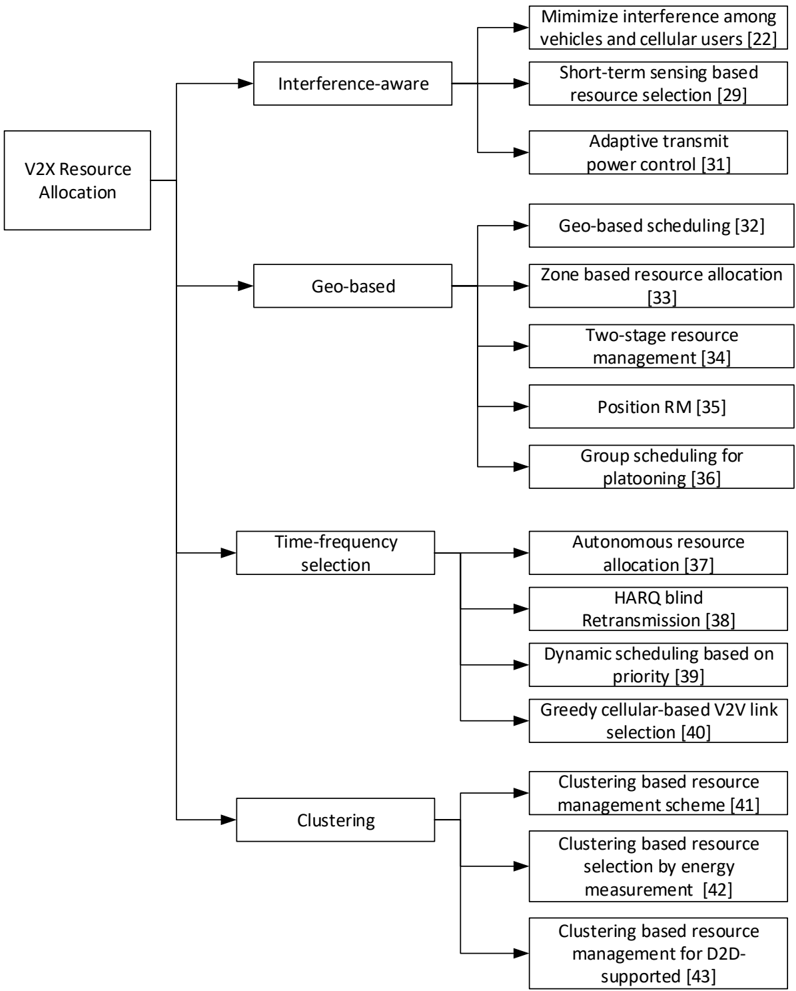
“Zone-based resource allocation [116], [9], [115] is an innovative scheme tailored for 6G V2X sidelink communication.It leverages the geographical information of the vehicles to divide the vehicular network into zones and efficiently allocate resources to users within each zone based on traffic demand and channel conditions.”
From Towards 6G V2X Sidelink: Survey of Resource Allocation—Mathematical Formulations, Challenges, and Proposed Solutions (2024) · cites this paper as [9]
In the citing paper
“Position-based resource management [117], [9], [118] is a specialized approach designed for 6G V2X sidelink communication, which optimizes resource allocation based on the geographical positions of the vehicles.”
From Towards 6G V2X Sidelink: Survey of Resource Allocation—Mathematical Formulations, Challenges, and Proposed Solutions (2024) · cites this paper as [9]
In the citing paper
“Geo-based scheduling [114], [9], [115] is an emerging resource allocation scheme for 6G V2X sidelink communication.It leverages the vehicles' geographical information to optimize resource allocation, improving communication efficiency and reducing interference.”
From Towards 6G V2X Sidelink: Survey of Resource Allocation—Mathematical Formulations, Challenges, and Proposed Solutions (2024) · cites this paper as [9]
Self-check
Percentages, sums and reported differences re-computed from the paper’s own numbers.
The self-check needs the paper’s full text.
Citations
Cites
Interference Mitigation based on NOMA for Scheduling Algorithm in V2X Environments
Rigane, E. B., Marouane, H., Trabelsi, A., & Zarai, F. (2020) · 2020 International Wireless Communications and Mobile Computing (IWCMC) · doi:10.1109/iwcmc48107.2020.9148397 · Cited by 7
Research works printed but not linked: 42
- 10.1109/IWCMC.2019.8766632 · DOI
- wang, 2020, Effect of retransmissions on the performance of C-V2X communication for 5G, Proc IEEE 92nd Veh Technol Conf (VTC-Fall), 1
- 10.1109/IWCMC48107.2020.9148108 · DOI · Paper page
- 10.1109/TVT.2019.2924698 · DOI · Paper page
- 10.3390/electronics8080846 · DOI
- 2017, Study on Scenarios and Requirements for Next Generation Access Technologies, 41
- 10.1109/ICCWorkshops49005.2020.9145466 · DOI
- 10.1109/5GWF.2019.8911647 · DOI · Paper page
- 10.1007/s11277-017-4935-3 · DOI · Paper page
- 10.1109/VTC2020-Spring48590.2020.9129179 · DOI
- 10.3390/fi11100217 · DOI
- 10.1109/TITS.2018.2865173 · DOI
- 10.3390/s19071603 · DOI
- 10.3390/s19235201 · DOI
- 10.1007/s11276-020-02419-8 · DOI
- 2018, Intelligent Transport Systems (ITS) V2X Applications Part 2 Intersection Collision Risk Warning (ICRW) Application Requirements Specification, 1
- 2020, Service requirements for enhanced V2X scenarios, 19
- vinet, 2011, The 5G evolution: 3GPP release 16-17, J Phys A Math Theor, 44, 1689
- 10.1109/JPROC.2019.2961937 · DOI
- 10.1109/MCOMSTD.001.1900047 · DOI
- 2020, Physical layer procedures for data
- 10.1109/JPROC.2011.2132790 · DOI
- 10.1109/ACCESS.2020.3004779 · DOI
- 10.3390/s19030550 · DOI
- 2020, Overall Description of Radio Access Network (RAN) Aspects for Vehicle-to-Everything (V2X) Based on LTE and NR, 36
- 10.1109/JIOT.2020.2996958 · DOI
- 10.1109/TVT.2016.2591558 · DOI · Paper page
- guerreo-ibanez, 2018, Sensor technologies for intelligent transportation systems, SENSORS, 18, 1
- 2017, Toward Fully Connected Vehicles? Edge Computing White Paper
- 10.1109/TITS.2017.2749459 · DOI
- 10.3390/s20123573 · DOI
- 10.1109/MCOMSTD.2017.1700015 · DOI
- 2020, 5G NR Physical channels and modulation, 1
- 10.1155/2020/2985367 · DOI
- 10.1109/ACCESS.2020.2973706 · DOI · Paper page
- 10.1109/VTCSpring.2019.8746637 · DOI
- 10.1109/VTCFall.2018.8690903 · DOI
- 10.1109/TWC.2015.2509978 · DOI
- 10.1109/ACCESS.2019.2891073 · DOI
- 10.1155/2019/2430656 · DOI
- 10.1109/VTCSpring.2019.8746297 · DOI
- 10.1109/COMST.2021.3057017 · DOI · Paper page
Cited by
Sorted by citations
Annu, & Rajalakshmi, P. (2024) · IEEE Open Journal of Vehicular Technology · doi:10.1109/ojvt.2024.3368240 · Cited by 73
Yang, C., Kwong, C. F., Chieng, D., Kar, P., Yau, K.-L. A., & Chen, Y. (2025) · IEEE Communications Surveys & Tutorials · doi:10.1109/comst.2024.3440033 · Cited by 33
Reuse Distance-Aided Resource Selection Mechanisms for NR-V2X Sidelink Communication
Yin, J., & Hwang, S.-H. (2023) · Sensors · doi:10.3390/s24010253 · Cited by 14
Leveraging 3GPP Features and Optimization Techniques for 5G NR-V2X Resource Allocation: A Survey
Bin Ali Wael, C., Hadj Dogheche, E., Armi, N., Subekti, A., & Dayoub, I. (2025) · IEEE Open Journal of Intelligent Transportation Systems · doi:10.1109/ojits.2025.3584024 · Cited by 10
“• Reference [13] evaluates resource allocation schemes in terms of quality-of-service (QoS) and network scenarios, highlighting their limitations and future research directions.”
5G NR sidelink time domain based resource allocation in C-V2X
Tabassum, M., & Oliveira, A. (2025) · Vehicular Communications · doi:10.1016/j.vehcom.2025.100902 · Cited by 4
Metadata
- Authors
- Thanh Le, T. T., & Moh, S.
- Affiliations
- Chosun University (KR)
- Corresponding author
- Moh, Sangman
- Venue
- IEEE Access
- Published
- 2021
- Volume
- 9
- Pages
- 123117-123133
- ISSN
- 2169-3536 (ISSN-L)
- OpenAlex
- W3198104660
- Cited by
- 61
- References
- 1
- Citations by year
- 2026: 4 · 2025: 13 · 2024: 19 · 2023: 11 · 2022: 12 · 2021: 2
- FWCI
- 3.24
- Type
- journal article
- Language
- en
- Open access
- gold
- doi.org
- Locations
- IEEE Access (publishedVersion, cc-by)
- DOAJ (DOAJ: Directory of Open Access Journals) (submittedVersion, cc-by-sa)
- Funders
- Saigon University, Vietnam (TD2020-49)
- National Research Foundation of Korea (NRF) funded by the Korean Government through the Ministry of Science and ICT (2019R1F1A1060501)
- Topics
- Physical Sciences › Engineering › Electrical and Electronic Engineering › Vehicular Ad Hoc Networks (VANETs)
- Physical Sciences › Engineering › Electrical and Electronic Engineering › Advanced Wireless Network Optimization
- Physical Sciences › Engineering › Control and Systems Engineering › Traffic control and management
- Keywords
- radio resource allocation, 5G-V2X, vehicular networks, intelligent transportation systems, resource block assignment, vehicle-to-vehicle communication, vehicle-to-infrastructure communication, quality of service, low-latency connectivity
About these checks
Registry, retraction, Cites and statistics results are computed, not judged, with one exception: a printed reference that no index lists is read once by a model before it counts as a citation error. Claims are extracted by a model and kept only when their quote appears verbatim in the text; each cited source is then checked, with a model’s help, for whether it says what the claim relies on. Those verdicts can be wrong — read the claim’s quote and the cited source before relying on one.
Statistics and arithmetic are recomputed, not judged.
Confidence bands are shown only for fields calibrated on our annotated test set. None is calibrated yet, so no band is shown.
What counts as a claim ›How we measure confidence ›How we check this ›
Are you an author, or do you see a problem with this page? Request a review
How to cite
Cite CoChat for the checks on this page, and the paper for its own findings.
- This page
- CoChat. (2026). Citation check: Comprehensive Survey of Radio Resource Allocation Schemes for 5G V2X Communications. https://app.cochat.ai/papers/10.1109/access.2021.3109894
- The paper
- Thanh Le, T. T., & Moh, S. (2021). Comprehensive Survey of Radio Resource Allocation Schemes for 5G V2X Communications. IEEE Access. https://doi.org/10.1109/access.2021.3109894
