

The DOI matches its Crossref record; 1 of the 1 references it cites were found in a registry or an index.
Genie: Show Me the Data for Quantization
Open accessAbstract
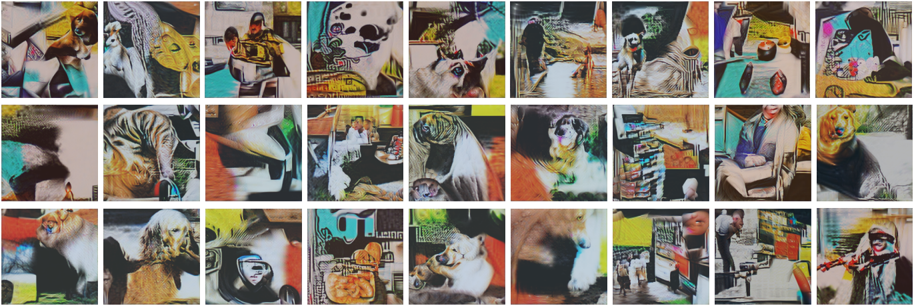
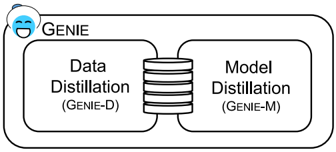
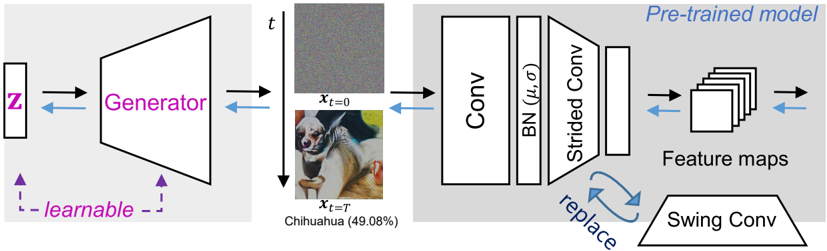
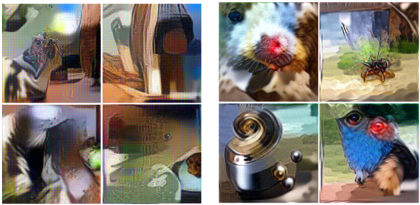
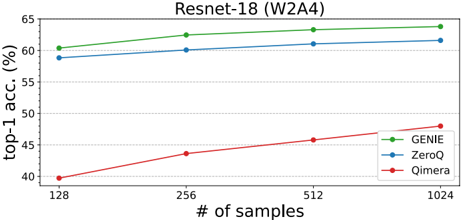
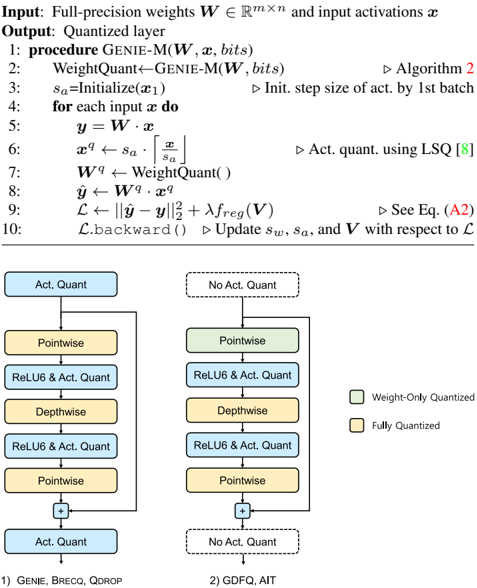
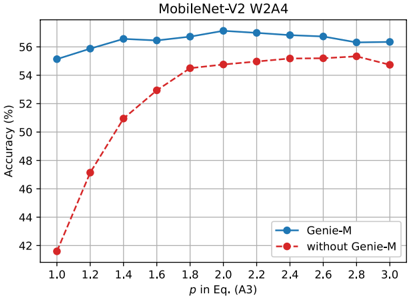
Zero-shot quantization is a promising approach for developing lightweight deep neural networks when data is inaccessible owing to various reasons, including cost and issues related to privacy. By exploiting the learned parameters ($\mu$and$\sigma$) of batch normalization layers in an FP32-pretrained model, zero-shot quantization schemes focus on generating synthetic data. Subsequently, they distill knowledge from the pre-trained model (teacher) to the quantized model (student) such that the quantized model can be optimized with the synthetic dataset. However, thus far, zeroshot quantization has primarily been discussed in the context of quantization-aware training methods, which require task-specific losses and long-term optimization as much as retraining. We thus introduce a post-training quantization scheme for zero-shot quantization that produces high-quality quantized networks within a few hours. Furthermore, we propose a framework called Genie that generates data suited for quantization. With the data synthesized by Genie, we can produce robust quantized models without real datasets, which is comparable to few-shot quantization. We also propose a post-training quantization algorithm to enhance the performance of quantized models. By combining them, we can bridge the gap between zero-shot and few-shot quantization while significantly improving the quantization performance compared to that of existing approaches. In other words, we can obtain a unique state-of-the-art zero-shot quantization approach. The code is available at https://github.com/SamsungLabs/Genie.
Overview
The claims and statistics of this paper haven’t been checked yet.
Run the check — free, no account needed. It reads the open-access text and checks the sources it cites.
Integrity signals
Registry
Cites
Statistics
Figures
Verification
Claims the paper makes
The claims and statistics of this paper haven’t been checked yet.
Run the check — free, no account needed. It reads the open-access text and checks the sources it cites.
Claims other papers make about this one
Each is checked against this paper’s own text: does it say what the citing paper says it does?
In the citing paper
“Notably, both baselines are taskagnostic and therefore lack essential knowledge specific to object detection.”
From Task-Specific Zero-Shot Quantization-Aware Training for Object Detection (2025) · cites this paper as [23]
Self-check
Percentages, sums and reported differences re-computed from the paper’s own numbers.
The self-check needs the paper’s full text.
Citations
Cites
Designing Network Design Spaces
Radosavovic, I., Kosaraju, R. P., Girshick, R., He, K., & Dollar, P. (2020) · 2020 IEEE/CVF Conference on Computer Vision and Pattern Recognition (CVPR) · doi:10.1109/cvpr42600.2020.01044 · Cited by 2,084
Research works printed but not linked: 36
- jeon, 2021, Gradient inversion with generative image prior, Advances in neural information processing systems, 34, 29898
- 10.24963/ijcai.2017/486 · DOI
- hubara, 0, Accurate post training quantization with small calibration sets, Proc of the International Conference on Machine Learning (ICML), 4466
- 10.1007/978-3-030-58610-2_1 · DOI
- kingma, 2013, Auto-encoding variational bayes, ArXiv Preprint
- 10.24963/ijcai.2021/478 · DOI
- jeon, 0, Mr. BiQ: Post-training non-uniform quantization based on minimizing the reconstruction error, Proceedings of the IEEE/CVF Conference on Computer Vision and Pattern Recognition (CVPR), 12329
- zhong, 0, In-traq: Learning synthetic images with intra-class heterogeneity for zero-shot network quantization, Proceedings of the IEEE/CVF Conference on Computer Vision and Pattern Recognition (CVPR), 12339
- wan, 2013, Regularization of neural networks using dropconnect, International Conference on Machine Learning, 1058
- 10.1007/s11263-020-01303-4 · DOI
- andrew, 2017, MobileNets: Efficient convolutional neural networks for mobile vision applications, ArXiv Preprint
- wei, 0, QDrop: Randomly dropping quantization for extremely low-bit post-training quantization, International Conference on Learning Representations (ICLR)
- he, 0, Deep residual learning for image recognition In Proceedings of the IEEE/CVF Conference on Computer Vision and Pattern Recognition (CVPR), 770
- 10.1609/aaai.v36i2.20142 · DOI
- bengio, 2013, Estimating or propagating gradients through stochastic neurons for conditional computation, ArXiv Preprint
- 10.1145/3306346.3323023 · DOI · Paper page
- li, 0, BRECQ: Pushing the limit of post-training quantization by block reconstruction, International Conference on Learning Representations (ICLR)
- 10.1214/aoms/1177729694 · DOI · Paper page
- 10.1109/CVPR46437.2021.00156 · DOI
- 10.1109/ICCV48922.2021.00437 · DOI
- 10.23915/distill.00003 · DOI
- nagel, 0, Overcoming oscillations in quantization-aware training, Proc of the International Conference on Machine Learning (ICML), 16318
- 10.1007/s11263-015-0816-y · DOI · Paper page
- mordvintsev, 2015, Deepdream-a code example for visualizing neural networks, Google research, 2
- 10.1109/ICCV.2019.00141 · DOI · Paper page
- nagel, 0, Up or down? adaptive rounding for post-training quantization, International Conference on Machine Learning (ICML), 7197
- srivastava, 2014, Dropout: a simple way to prevent neural networks from overfitting, The Journal of Machine Learning Research, 15, 1929
- 10.1109/CVPR.2018.00474 · DOI · Paper page
- tan, 0, Mnas-Net: Platform-aware neural architecture search for mobile, Proceedings of the IEEE/CVF Conference on Computer Vision and Pattern Recognition (CVPR), 2820
- steven, 0, Learned step size quantization, International Conference on Learning Representations (ICLR)
- 10.1109/CVPR52688.2022.00813 · DOI
- 10.1109/CVPR42600.2020.00852 · DOI
- 10.1109/CVPR42600.2020.01318 · DOI · Paper page
- bojanowski, 0, Optimizing the latent space of generative networks, Proc of the International Conference on Machine Learning (ICML)
- choi, 2021, Qimera: Data-free quantization with synthetic boundary supporting samples, Advances in Neural IInformation Processing Systems, 34, 14835
- 10.1109/CVPR.2019.00741 · DOI
Cited by
Sorted by citations
Task-Specific Zero-Shot Quantization-Aware Training for Object Detection
Li, C., Chen, X., Wang, J., Zhao, K., & Chen, J. (2025) · 2025 IEEE/CVF International Conference on Computer Vision (ICCV) · doi:10.1109/iccv51701.2025.02123 · Cited by 2
Zero-shot quantization for object detection via scene-aware synthesis and instance-guided alignment
Li, X., Di, X., Liu, M., & Ye, S. (2026) · International Journal of Multimedia Information Retrieval · doi:10.1007/s13735-026-00412-z · Cited by 1
Metadata
- Authors
- Jeon, Y., Lee, C., & Kim, H.-Y.
- Affiliations
- Samsung (South Korea) (KR)
- ORCID
- Kim, Ho-young
- Venue
- 2023 IEEE/CVF Conference on Computer Vision and Pattern Recognition (CVPR)
- Publisher
- IEEE
- Published
- 2023-06
- Pages
- 12064-12073
- ISSN
- 1063-6919 (ISSN-L)
- OpenAlex
- W4386075967
- Cited by
- 18
- References
- 1
- Citations by year
- 2026: 5 · 2025: 8 · 2024: 3 · 2023: 2
- FWCI
- 1.93
- Type
- conference paper
- Language
- en
- Open access
- green
- arxiv.org
- Locations
- IEEE Computer Society Conference on Computer Vision and Pattern Recognition/Proceedings - IEEE Computer Society Conference on Computer Vision and Pattern Recognition/Proceedings (publishedVersion)
- arXiv (Cornell University) (submittedVersion, cc-by-nc-nd)
- arXiv (Cornell University)
- Topics
- Physical Sciences › Computer Science › Computer Vision and Pattern Recognition › Advanced Neural Network Applications
- Physical Sciences › Computer Science › Artificial Intelligence › Domain Adaptation and Few-Shot Learning
- Physical Sciences › Computer Science › Artificial Intelligence › Machine Learning and Data Classification
- Keywords
- post-training quantization, synthetic data generation, batch normalization statistics, knowledge distillation, lightweight neural networks, data privacy
About these checks
Registry, retraction, Cites and statistics results are computed, not judged, with one exception: a printed reference that no index lists is read once by a model before it counts as a citation error. Claims are extracted by a model and kept only when their quote appears verbatim in the text; each cited source is then checked, with a model’s help, for whether it says what the claim relies on. Those verdicts can be wrong — read the claim’s quote and the cited source before relying on one.
Statistics and arithmetic are recomputed, not judged.
Confidence bands are shown only for fields calibrated on our annotated test set. None is calibrated yet, so no band is shown.
What counts as a claim ›How we measure confidence ›How we check this ›
Are you an author, or do you see a problem with this page? Request a review
How to cite
Cite CoChat for the checks on this page, and the paper for its own findings.
- This page
- CoChat. (2026). Citation check: Genie: Show Me the Data for Quantization. https://app.cochat.ai/papers/10.1109/cvpr52729.2023.01161
- The paper
- Jeon, Y., Lee, C., & Kim, H.-Y. (2023). Genie: Show Me the Data for Quantization. 2023 IEEE/CVF Conference on Computer Vision and Pattern Recognition (CVPR). https://doi.org/10.1109/cvpr52729.2023.01161
