

Swin Transformer: Hierarchical Vision Transformer using Shifted Windows
Open accessThe DOI matches its Crossref record; 105 of the 139 references it cites were found in a registry or an index; 36 of the 41 sources its claims cite were checked for support.
Abstract
This paper presents a new vision Transformer, called Swin Transformer, that capably serves as a general-purpose backbone for computer vision. Challenges in adapting Transformer from language to vision arise from differences between the two domains, such as large variations in the scale of visual entities and the high resolution of pixels in images compared to words in text. To address these differences, we propose a hierarchical Transformer whose representation is computed with Shifted windows. The shifted windowing scheme brings greater efficiency by limiting self-attention computation to non-overlapping local windows while also allowing for cross-window connection. This hierarchical architecture has the flexibility to model at various scales and has linear computational complexity with respect to image size. These qualities of Swin Transformer make it compatible with a broad range of vision tasks, including image classification (87.3 top-1 accuracy on ImageNet-1K) and dense prediction tasks such as object detection (58.7 box AP and 51.1 mask AP on COCO test-dev) and semantic segmentation (53.5 mIoU on ADE20K val). Its performance surpasses the previous state-of-the-art by a large margin of +2.7 box AP and +2.6 mask AP on COCO, and +3.2 mIoU on ADE20K, demonstrating the potential of Transformer-based models as vision backbones. The hierarchical design and the shifted window approach also prove beneficial for all-MLP architectures. The code and models are publicly available at https://github.com/microsoft/Swin-Transformer.
Overview
CoChat Summary
TL;DR
Swin Transformer is a hierarchical vision Transformer that computes self-attention within non-overlapping local windows and alternates regular and shifted window partitions to enable cross-window connections with linear complexity to image size. It achieves strong results as a general-purpose vision backbone on ImageNet-1K classification, COCO object detection/instance segmentation, and ADE20K semantic segmentation.
Key findings
- Image classification: Swin-L reaches 87.3 top-1 accuracy on ImageNet-1K with ImageNet-22K pre-training; regular ImageNet-1K training gives Swin-T 81.3, Swin-S 83.0, and Swin-B 83.5 top-1 at 224² input.
- COCO object detection/instance segmentation: Swin-L (HTC++) achieves 58.7 box AP and 51.1 mask AP on COCO test-dev, surpassing previous state-of-the-art by +2.7 box AP and +2.6 mask AP.
- ADE20K semantic segmentation: Swin-L with ImageNet-22K pre-training achieves 53.5 mIoU on the val set, an improvement of +3.2 mIoU over the previous state-of-the-art (SETR).
- Ablation: shifted windows improve Swin-T by +1.1% top-1 on ImageNet-1K, +2.8 box AP/+2.2 mask AP on COCO, and +2.8 mIoU on ADE20K over no shifting; relative position bias also improves results across the three tasks.
Methods
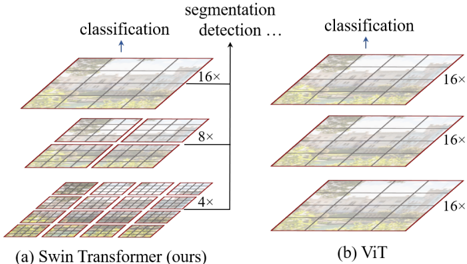
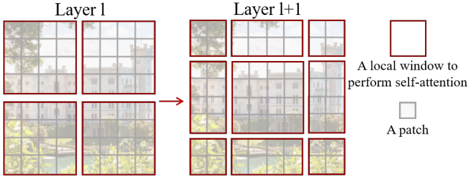
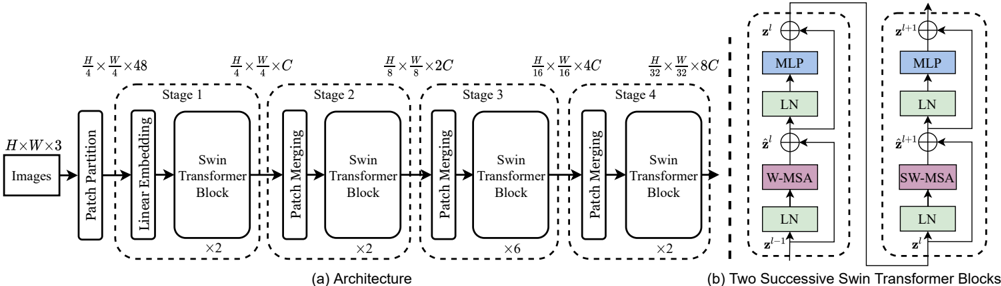
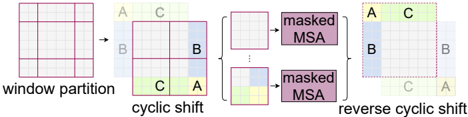
- Architecture: input RGB image split into 4×4 non-overlapping patches, linearly embedded; four stages with patch merging to produce hierarchical feature maps. Swin Transformer blocks replace standard multi-head self-attention with window-based MSA using regular and shifted window partitioning; default window size M=7, query dimension d=32, MLP expansion α=4, and relative position bias.
- Data and tasks: ImageNet-1K classification (1.28M training images, 50K validation images, 1,000 classes), ImageNet-22K pre-training (14.2M images, 22K classes), COCO 2017 detection/instance segmentation (118K train, 5K val, 20K test-dev), and ADE20K semantic segmentation (25K images: 20K train, 2K val, 3K test; 150 categories).
- Analysis: reports top-1 accuracy, COCO box/mask AP, and ADE20K mIoU; compares against ViT/DeiT and ResNe(X)t backbones; ablates shifted windows, position embedding methods, and self-attention computation methods.
Limitations
- The paper states that “a thorough kernel optimization is beyond the scope of this paper” and notes that Swin Transformer is implemented with built-in PyTorch functions that are not all well-optimized, which affects inference-speed comparisons against highly optimized Cudnn-based ResNe(X)t.
- The paper states that SoftMax computation is omitted when determining computational complexity.
- No dedicated limitations section is present; evident from the text, the main design ablations are conducted with Swin-T, and the COCO system-level comparison uses HTC++ with additional components (instaboost, stronger multi-scale training, soft-NMS, ImageNet-22K initialization), so those gains are not solely attributable to the backbone.
Model-written summary. Check it against the paper before relying on it.
Integrity signals
Registry
Cites
Statistics
Figures
Verification
Claims the paper makes
17 Valid · 8 Not valid · 2 Not checked · 63 Own results and interpretations
At least one cited source doesn’t support this claim or points to a different paper, and none confirmed it — see the verdicts below.
In the paper
“The results of ViT on image classification are encouraging, but its architecture is unsuitable for use as a general-purpose backbone network on dense vision tasks or when the input image resolution is high, due to its low-resolution feature maps and the quadratic increase in complexity with image size.”
What the sources say
- Disputedcites [20] [20] Alexey Dosovitskiy, Lucas Beyer, Alexander Kolesnikov, Dirk Weissenborn, Xiaohua Zhai, Thomas Unterthiner, Mostafa Dehghani, Matthias Minderer, Georg Heigold, Sylvain Gelly, Jakob Uszkoreit, and Neil Houlsby. An image is worth 16x16 words: Transformers for image recognition at scale. In International Conference on Learning Representations , 2021. 1, 2, 3, 4, 5, 6, 9 - sourceExperimental — accuracy not yet measured
Split into 2 atoms — 0 confirmed, 1 partially supported, 1 disputed, 0 misattributed, 0 unverifiable. Expand the claim to see per-atom verdicts.
Checked by a reasoning model — may be wrong.
plainstates a cause- Asserted: passes — The authors put it forward as true.
- Checkable: passes — It can be checked against evidence.
- Load-bearing: passes — The paper’s conclusions depend on it.
- Based: passes — The paper gives a reason why it holds.
- Disputed
The sources with a verdict support this claim; the rest weren’t checked yet, have no full text we could read, or their verdicts aren’t rated yet.
In the paper
“Unlike the word tokens that serve as the basic elements of processing in language Transformers, visual elements can vary substantially in scale, a problem that receives attention in tasks such as object detection [42, 53, 54].”
What the sources say
- Supportedcites [42] [42] Tsung-Yi Lin, Piotr Dollar, Ross Girshick, Kaiming He, Bharath Hariharan, and Serge Belongie. Feature pyramid networks for object detection. In The IEEE Conference on Computer Vision and Pattern Recognition (CVPR) , July 2017. 2 - source
The Introduction (p. 1) calls recognizing objects at vastly different scales a fundamental computer-vision challenge and describes feature pyramids as a standard solution for detecting objects across a large range of scales. The comparison with word tokens is framing by the citing authors, not a claim this source is needed to establish. (LLM, conf=0.93)
- Not checked — no full text of the sourcecites [53] [53] Bharat Singh and Larry S Davis. An analysis of scale invariance in object detection snip. In Proceedings of the IEEE conference on computer vision and pattern recognition , pages 3578-3587, 2018. 2 - source
- Supportedcites [54] [54] Bharat Singh, Mahyar Najibi, and Larry S Davis. Sniper: Efficient multi-scale training. In Advances in Neural Information Processing Systems , volume 31. Curran Associates, Inc., 2018. 2 - source
The Introduction (p. 1) describes objects at different scales as a challenge for visual recognition and says object-detection algorithms use multi-scale image pyramids to obtain scale-robust representations. That supports the point for which this object-detection paper is cited; the comparison with word tokens is framing in the citing sentence. (LLM, conf=0.90)
plain- Asserted: passes — The authors put it forward as true.
- Checkable: passes — It can be checked against evidence.
- Load-bearing: passes — The paper’s conclusions depend on it.
- Based: passes — The paper gives a reason why it holds.
- Supported
The cited sources that could be checked couldn’t confirm or dispute this claim.
In the paper
“Its performance surpasses the previous state-of-theart by a large margin of +2.7 box AP and +2.6 mask AP on COCO, and +3.2 mIoU on ADE20K, demonstrating the potential of Transformer-based models as vision backbones.”
- Also stated in: § 1. Introduction · plain
“On ADE20K semantic segmentation, it obtains 53.5 mIoU on the val set, an improvement of +3.2 mIoU over the previous state-of-the-art (SETR [81]).”
What the sources say
- Could not verifycites [81] [81] Sixiao Zheng, Jiachen Lu, Hengshuang Zhao, Xiatian Zhu, Zekun Luo, Yabiao Wang, Yanwei Fu, Jianfeng Feng, Tao Xiang, Philip HS Torr, et al. Rethinking semantic segmentation from a sequence-to-sequence perspective with transformers. arXiv preprint arXiv:2012.15840 , 2020. 2, 3, 7, 8 - sourceExperimental — accuracy not yet measured
Section 4.3 reports that SETR-MLA achieved 50.28% mIoU on ADE20K with multi-scale inference. Searches for Swin Transformer and a +3.2 mIoU improvement found no passage in our copy addressing the attributed claim; the SETR result does not establish or refute Swin Transformer's performance. (LLM, conf=0.76)
boostedstates a cause- Asserted: passes — The authors put it forward as true.
- Checkable: passes — It can be checked against evidence.
- Load-bearing: passes — The paper’s conclusions depend on it.
- Based: passes — The paper gives a reason why it holds.
- Also stated in: § 1. Introduction · plain
Every source the paper cites for this claim was checked and supports it.
In the paper
“Further adding absolute position embedding to the input as in [20] drops performance slightly, thus it is not adopted in our implementation.”
What the sources say
- Supportedcites [20] [20] Alexey Dosovitskiy, Lucas Beyer, Alexander Kolesnikov, Dirk Weissenborn, Xiaohua Zhai, Thomas Unterthiner, Mostafa Dehghani, Matthias Minderer, Georg Heigold, Sylvain Gelly, Jakob Uszkoreit, and Neil Houlsby. An image is worth 16x16 words: Transformers for image recognition at scale. In International Conference on Learning Representations , 2021. 1, 2, 3, 4, 5, 6, 9 - source
The citation’s “as in [20]” identifies the method: Section 3.1 (p. 3) says the paper adds learnable 1D position embeddings to patch embeddings before the encoder. The slight performance drop and decision not to adopt the method describe the citing authors’ implementation, not a result attributed to this source. (LLM, conf=0.88)
plainstates a cause- Asserted: passes — The authors put it forward as true.
- Checkable: passes — It can be checked against evidence.
- Load-bearing: unclear — It is unclear whether the paper’s conclusions depend on it.
- Based: passes — The paper gives a reason why it holds.
- Supported
The cited sources support only part of this claim — read each source’s verdict below.
In the paper
“Compared with the state-of-the-art ConvNets, i.e. RegNet [48] and EfficientNet [58], the Swin Transformer achieves a slightly better speed-accuracy trade-off.”
What the sources say
- Supportedcites [48] [48] Ilija Radosavovic, Raj Prateek Kosaraju, Ross Girshick, Kaiming He, and Piotr Doll´ ar. Designing network design spaces. In Proceedings of the IEEE/CVF Conference on Computer Vision and Pattern Recognition , pages 1042810436, 2020. 6 - source
The citation to this paper is attached to RegNet as an example of a state-of-the-art ConvNet, not to the sentence’s claim about Swin Transformer. Section 5.3 compares RegNet models with EfficientNet as representative of the state of the art. The paper need not evaluate Swin to support this identification citation. (LLM, conf=0.91)
- Could not verifycites [58] [58] Mingxing Tan and Quoc Le. Efficientnet: Rethinking model scaling for convolutional neural networks. In International Conference on Machine Learning , pages 6105-6114. PMLR, 2019. 3, 6 - sourceExperimental — accuracy not yet measured
The cited paper’s experiment setup and ablation study (pp. 8–9) compare deformable ConvNets with other convolutional models. Searches for Swin Transformer, RegNet, EfficientNet, and the claimed speed–accuracy trade-off found no passage addressing that comparison. (LLM, conf=0.78)
plain- Asserted: passes — The authors put it forward as true.
- Checkable: passes — It can be checked against evidence.
- Load-bearing: passes — The paper’s conclusions depend on it.
- Based: passes — The paper gives a reason why it holds.
- Supported
47 more claims · 5 with their cited sources checked
Create a free account to see all 90 claims and to verify the 3 references still open.
- Probably not a substantial claim. 11
- It may state two separate claims as one. 28
Claims other papers make about this one
Each is checked against this paper’s own text: does it say what the citing paper says it does?
The source backs part of the claim, not all of it — or backs it for a different population, condition or comparison.
In the citing paper
“Swin Transformer: Uses shifted window-based selfattention to compute multi-scale spatial features efficiently, improving performance in crowded or cluttered scenes [31].”
From A Comprehensive Survey of Transformer-Based Models for Video Anomaly Detection in Surveillance Systems (2025) · cites this paper as [31]
Experimental — accuracy not yet measuredThe source backs part of the claim, not all of it — or backs it for a different population, condition or comparison.
In the citing paper
“For example, local MSAs (Yang et al., 2019; Liu et al., 2021; Chu et al., 2021), which calculate self-attention only within small windows, achieve better performance than global MSAs not only on small datasets but also on large datasets, e.g., ImageNet-21K.”
From How Do Vision Transformers Work? (2022) · cites this paper as Liu et al., 2021
Experimental — accuracy not yet measuredThe source backs part of the claim, not all of it — or backs it for a different population, condition or comparison.
In the citing paper
“Vision Transformer is known for its inherent tendency to prioritize global features [8], [242]”
From Evolving from Single-modal to Multi-modal Facial Deepfake Detection: Progress and Challenges (2024) · cites this paper as [242]
Experimental — accuracy not yet measuredThe source backs part of the claim, not all of it — or backs it for a different population, condition or comparison.
In the citing paper
“Furthermore, Swin-Transformer [7] saw another significant advancement. This model enhances the ViT framework by integrating a hierarchical structure with shifted windows, a design choice that substantially improves the model's ability to capture local features while still maintaining a global context.”
From Model Quantization and Hardware Acceleration for Vision Transformers: A Comprehensive Survey (2024) · cites this paper as [7]
Experimental — accuracy not yet measuredThe source backs part of the claim, not all of it — or backs it for a different population, condition or comparison.
In the citing paper
“Models such as DINOv2 [7], Vision Transformers (ViT) [8], and Swin Transformers [9] have demonstrated outstanding transfer learning performance across a wide range of domains, often achieving state-of-the-art results with only minimal fine-tuning.”
From Trustworthy Celestial Eye: Calibrated and Robust Planetary Classification via Self-Supervised Vision Transformers (2026) · cites this paper as [9]
Experimental — accuracy not yet measured
19 more claims about this paper
Create a free account to see every claim other papers make about this one.
Self-check
Percentages, sums and reported differences re-computed from the paper’s own numbers.
Each contradiction between two passages listed here was confirmed by an independent check.
Rated minor: it would not touch a result — a value no result rests on, a p-value that stays on the same side of the significance level, or a conflict that is clerical, resolved elsewhere in the paper, or outside its own findings.
In the paper
§ 4.1. Image Classification on ImageNet-1K
“Swin-B (83.3%/84.5%) over DeiT-B (81.8%/83.1%) using 224 2 /384 2 input”
§ 4.1. Image Classification on ImageNet-1K
“| Swin-B | 224 2 | 88M | 15.4G | 278.1 | 83.5 |”
Citations
Cites
Deep Residual Learning for Image Recognition
He, K., Zhang, X., Ren, S., & Sun, J. (2016) · 2016 IEEE Conference on Computer Vision and Pattern Recognition (CVPR) · doi:10.1109/cvpr.2016.90 · Cited by 235,474 · cited 11×
“Our Swin-T architecture brings consistent +3.4∼4.2 box AP gains over ResNet-50, with slightly larger model size, FLOPs and latency.”
BackgroundMethodInfluentialVaswani, A., Shazeer, N., Parmar, N., Uszkoreit, J., Jones, L., Gomez, A. N., Kaiser, L., & Polosukhin, I. (2017) · arXiv · doi:10.48550/arxiv.1706.03762 · Cited by 120,404
Very Deep Convolutional Networks for Large-Scale Image Recognition
Simonyan, K., & Zisserman, A. (2014) · arXiv · doi:10.48550/arxiv.1409.1556 · Cited by 114,148 · cited 3×
“Since then, deeper and more effective con- 2While there are efficient methods to implement a sliding-window based convolution layer on general hardware, thanks to its shared kernel weights across a feature map, it is difficult for a sliding-window based self-attention layer to have efficient memory access in practice.…”
BackgroundImageNet classification with deep convolutional neural networks
Krizhevsky, A., Sutskever, I., & Hinton, G. E. (2017) · Communications of the ACM · doi:10.1145/3065386 · Cited by 112,155 · cited 3×
“Beginning with AlexNet [35] and its revolutionary performance on the ImageNet image classification challenge, CNN architec-”
MethodU-Net: Convolutional Networks for Biomedical Image Segmentation
Ronneberger, O., Fischer, P., & Brox, T. (2015) · Lecture notes in computer science · doi:10.1007/978-3-319-24574-4_28 · Cited by 99,404
Adam: A Method for Stochastic Optimization
Kingma, D. P., & Ba, J. (2014) · arXiv · doi:10.48550/arxiv.1412.6980 · Cited by 98,946 · cited 3×
“We employ an AdamW optimizer for 90 epochs using a cosine learning rate scheduler with a 5-epoch linear warm-up.”
MethodInfluentialExploiting Generative AI to Scale up Intelligent Tutoring Systems
Jakubův, J., Chvalovský, K., Goertzel, Z., Kaliszyk, C., Olšák, M., Piotrowski, B., Schulz, S., Suda, M., & Urban, J. (2023) · DROPS (Schloss Dagstuhl – Leibniz Center for Informatics) · doi:10.4230/lipics.itp.2023.19 · Cited by 76,658
ImageNet: A large-scale hierarchical image database
Deng, J., Dong, W., Socher, R., Li, L.-J., Li, K., & Fei-Fei, L. (2009) · 2009 IEEE Conference on Computer Vision and Pattern Recognition · doi:10.1109/cvpr.2009.5206848 · Cited by 65,333 · cited 15×
“While ViT requires large-scale training datasets (i.e., JFT-300M) to perform well, DeiT [57] introduces several training strategies that allow ViT to also be effective using the smaller ImageNet-1K dataset.”
MethodInfluentialGradient-based learning applied to document recognition
Lecun, Y., Bottou, L., Bengio, Y., & Haffner, P. (1998) · Proceedings of the IEEE · doi:10.1109/5.726791 · Cited by 58,805 · cited 1×
“While the CNN has existed for several decades [36], it was not until the introduction of AlexNet [35] that the CNN took off and became mainstream.”
MethodDensely Connected Convolutional Networks
Huang, G., Liu, Z., Van Der Maaten, L., & Weinberger, K. Q. (2017) · 2017 IEEE Conference on Computer Vision and Pattern Recognition (CVPR) · doi:10.1109/cvpr.2017.243 · Cited by 48,566 · cited 3×
“Since then, deeper and more effective con- 2While there are efficient methods to implement a sliding-window based convolution layer on general hardware, thanks to its shared kernel weights across a feature map, it is difficult for a sliding-window based self-attention layer to have efficient memory access in practice.…”
BackgroundSelf-citation
Research works printed but not linked: 2
- [50] Prajit Ramachandran, Niki Parmar, Ashish Vaswani, Irwan Bello, Anselm Levskaya, and Jon Shlens. Stand-alone selfattention in vision models. In Advances in Neural Information Processing Systems , volume 32. Curran Associates, Inc., 2019. 2, 3 -
- [51] Olaf Ronneberger, Philipp Fischer, and Thomas Brox. Unet: Convolutional networks for biomedical image segmentation. In International Conference on Medical image computing and computer-assisted intervention , pages 234-241. Springer, 2015. 2 -
Cited by
Items 11,801–11,900 of 33,022
Lightweight Monocular Depth Estimation via Token-Sharing Transformer
Lee, D.-J., Lee, J. Y., Shon, H., Yi, E., Park, Y.-H., Cho, S.-S., & Kim, J. (2023) · Proceedings - IEEE International Conference on Robotics and Automation/Proceedings · doi:10.1109/icra48891.2023.10160566 · Cited by 11
Underwater Object Detection Based on Improved Transformer and Attentional Supervised Fusion
Li, Z., Li, C., Guan, T., & Shang, S. (2023) · Information Technology And Control · doi:10.5755/j01.itc.52.2.33214 · Cited by 7
Car Price Quotes Driven by Data-Comprehensive Predictions Grounded in Deep Learning Techniques
Dutulescu, A., Cǎtrunǎ, A., Ruşeţi, Ş., Iorga, D., Ghita, V., Neagu, L.-M., & Dascălu, M. (2023) · Electronics · doi:10.3390/electronics12143083 · Cited by 20
Transformer Based Models for Unsupervised Anomaly Segmentation in Brain MR Images
Ghorbel, A., Aldahdooh, A., Albarqouni, S., & Hamidouche, W. (2023) · Lecture notes in computer science · doi:10.1007/978-3-031-33842-7_3 · Cited by 20
Improved breast ultrasound tumor classification using dual-input CNN with GAP-guided attention loss
Zou, X., Zhai, J., Qian, S., Li, A., Tian, F., Cao, X., & Wang, R. (2023) · Mathematical Biosciences & Engineering · doi:10.3934/mbe.2023682 · Cited by 7
A brief study of generative adversarial networks and their applications in image synthesis
Sharma, H., & Das, S. (2023) · Multimedia Tools and Applications · doi:10.1007/s11042-023-16175-2 · Cited by 9
Huang, H., Liu, Y., Xiong, Q., Xing, Y., & Du, H. (2023) · Biomedical Signal Processing and Control · doi:10.1016/j.bspc.2023.105267 · Cited by 7
MERLIN-Seg: Self-supervised despeckling for label-efficient semantic segmentation
Dalsasso, E., Rambour, C., Trouvé, N., & Thome, N. (2024) · Computer Vision and Image Understanding · doi:10.1016/j.cviu.2024.103940 · Cited by 9
Xue, F., Zhou, M., Zhang, C., Shao, Y., Wei, Y., & Wang, M. (2023) · The Visual Computer · doi:10.1007/s00371-023-03017-3 · Cited by 7
Self-citationZhu, Y., Chen, L.-H., Xiong, D., Chen, S., Du, F., Hao, J., He, R., & Sun, Z. (2023) · ACM SIGKDD Conference on Knowledge Discovery and Data Mining (KDD) · doi:10.1145/3580305.3599786 · Cited by 8
Lagunas, M., Impata, B., Martinez, V., Fernandez, V., Georgakis, C., Braun, S., & Bertrand, F. (2023) · LatinX in AI at Computer Vision and Pattern Recognition Conference (LXAI) · doi:10.52591/lxai202306183 · Cited by 14
RaMLP: Vision MLP via Region-aware Mixing
Lai, S., Du, X., Guo, J., & Zhang, K. (2023) · International Joint Conference on Artificial Intelligence · doi:10.24963/ijcai.2023/111 · Cited by 8
AdaMTL: Adaptive Input-dependent Inference for Efficient Multi-Task Learning
Neseem, M., Agiza, A., & Reda, S. (2023) · IEEE/CVF Conference on Computer Vision and Pattern Recognition Workshops (CVPRW) · doi:10.1109/cvprw59228.2023.00501 · Cited by 17
Pareto-aware Neural Architecture Generation for Diverse Computational Budgets
Guo, Y. F., Chen, Y., Zheng, Y., Chen, Q., Zhao, P., Huang, J., Chen, J., & Tan, M. (2023) · IEEE/CVF Conference on Computer Vision and Pattern Recognition Workshops (CVPRW) · doi:10.1109/cvprw59228.2023.00219 · Cited by 9
D3Former: Debiased Dual Distilled Transformer for Incremental Learning
Mohamed, A., Grandhe, R., Joseph, K. J., Khan, S. H., & Khan, F. S. (2023) · IEEE/CVF Conference on Computer Vision and Pattern Recognition Workshops (CVPRW) · doi:10.1109/cvprw59228.2023.00240 · Cited by 19
Zou, L., Cai, Z., Qiu, Y., Gui, L., Mao, L., & Yang, X. (2023) · Physics in Medicine and Biology · doi:10.1088/1361-6560/acf110 · Cited by 10
On Content-Aware Post-Processing: Adapting Statistically Learned Models to Dynamic Content
Zhang, Y., Ding, G., Ding, D., Ma, Z., & Li, Z. (2023) · ACM Transactions on Multimedia Computing Communications and Applications · doi:10.1145/3612925 · Cited by 8
Context-Aware Chart Element Detection
Yan, P., Ahmed, S., & Doermann, D. (2023) · Lecture notes in computer science · doi:10.1007/978-3-031-41676-7_13 · Cited by 20
Shi, G., Mei, Y., Wang, X., & Yang, Q. (2023) · IEEE Access · doi:10.1109/access.2023.3307642 · Cited by 7
Masking Strategies for Background Bias Removal in Computer Vision Models
Aniraj, A., Dantas, C. F., Ienco, D., & Marcos, D. (2023) · IEEE International Conference on Computer Vision Workshops · doi:10.1109/iccvw60793.2023.00474 · Cited by 19
Learning to refine object boundaries
Deng, R., Chen, Z., Chen, H., & Hu, J. (2023) · Neurocomputing · doi:10.1016/j.neucom.2023.126742 · Cited by 9
Enhanced Masked Image Modeling for Analysis of Dental Panoramic Radiographs
Almalki, A., & Latecki, L. J. (2023) · IEEE International Symposium on Biomedical Imaging (ISBI) · doi:10.1109/isbi53787.2023.10230656 · Cited by 7
Ship Detection with Optical Image Based on CA-YOLO v3 Network
Li, D., Zhang, Z., Fang, Z., & Cao, F. (2023) · International Conference on Frontiers of Electronics, Information and Computation Technologies · doi:10.1109/icfeict59519.2023.00103 · Cited by 9
Self-citationAttention Mechanism Used in Monocular Depth Estimation: An Overview
Li, Y., Wei, X., & Fan, H. (2023) · Applied Sciences · doi:10.3390/app13179940 · Cited by 7
Partial channel pooling attention beats convolutional attention
Zhang, J., & Slamu, W. (2023) · Expert Systems with Applications · doi:10.1016/j.eswa.2023.121436 · Cited by 11
3M3D: Multi-View, Multi-Path, Multi-Representation for 3D Object Detection
Park, J., Singh, A., & Bankiti, V. (2023) · Proceedings - International Conference on Image Processing · doi:10.1109/icip49359.2023.10222769 · Cited by 10
AICT: An Adaptive Image Compression Transformer
Ghorbel, A., Hamidouche, W., & Morin, L. (2023) · Proceedings - International Conference on Image Processing · doi:10.1109/icip49359.2023.10222799 · Cited by 10
Exploring Effective Knowledge Distillation for Tiny Object Detection
Liu, H., Liu, Q., Liu, Y. M., Liang, Y., & Zhao, G. (2023) · Proceedings - International Conference on Image Processing · doi:10.1109/icip49359.2023.10222589 · Cited by 7
A Multi-Modal Transformer Approach for Football Event Classification
Zhang, Y., Li, B., Fang, H., & Meng, Q. (2023) · Proceedings - International Conference on Image Processing · doi:10.1109/icip49359.2023.10223172 · Cited by 6
Co-Salient Object Detection with Semantic-Level Consensus Extraction and Dispersion
Xu, P., & Mu, Y. (2023) · ACM International Conference on Multimedia (ACM MM) · doi:10.1145/3581783.3612133 · Cited by 14
Image Quality Assessment of Diabetic Retinopathy Based on ADD-Net
Zhang, P., Hu, T., Han, X., Liu, X., Ni, J., Shen, J., & Liu, Q. (2023) · IEEE Access · doi:10.1109/access.2023.3318876 · Cited by 8
Three-Dimensional Multifaceted Attention Encoder–Decoder Networks for Pulmonary Nodule Detection
Cao, K., Tao, H., & Wang, Z. (2023) · Applied Sciences · doi:10.3390/app131910822 · Cited by 7
A Review of Attention Mechanisms in Computer Vision
Qi, X., & Zhi, M. (2023) · International Conference on Image, Vision and Computing (ICIVC) · doi:10.1109/icivc58118.2023.10270435 · Cited by 9
Praschl, C., Zopf, L. M., Kiemeyer, E., Langthallner, I., Ritzberger, D., Slowak, A., Weigl, M., Blüml, V., Nešić, N., Stojmenović, M., et al. (2023) · PLoS ONE · doi:10.1371/journal.pone.0291946 · Cited by 7
TCM-Net: Mixed Global–Local Learning for Salient Object Detection in Optical Remote Sensing Images
He, J., Zhao, L., Hu, W., Zhang, G., Wu, J., & Li, X. (2023) · Remote Sensing · doi:10.3390/rs15204977 · Cited by 7
Underwater Acoustic Signal Classification using Hierarchical Audio Transformer with Noisy Input
Vo, Q. T., & Han, D. K. (2023) · Machine learning for signal processing ... · doi:10.1109/mlsp55844.2023.10285893 · Cited by 10
Xiang, M., Dai, Y., Zhang, F., Shi, J., Tian, X., & Zhang, Z. (2023) · International Journal of Computer Vision · doi:10.1007/s11263-023-01915-6 · Cited by 7
Self-citationFusing bi-directional global–local features for single image super-resolution
Hwang, K., Yoon, G.-J., Yoon, G., et al. (2023) · Engineering Applications of Artificial Intelligence · doi:10.1016/j.engappai.2023.107336 · Cited by 7
Sharma, R., Mahanti, G. K., & Panda, G. (2023) · International Conference on I-SMAC (IoT in Social, Mobile, Analytics and Cloud) (I-SMAC) · doi:10.1109/i-smac58438.2023.10290455 · Cited by 7
Moiré Backdoor Attack (MBA): A Novel Trigger for Pedestrian Detectors in the Physical World
Wei, H., Yu, H., Zhang, K., Wang, Z., Zhu, J., & Wang, Z. (2023) · ACM International Conference on Multimedia (ACM MM) · doi:10.1145/3581783.3611910 · Cited by 16
A Person Re-Identification Method Based on Multi-Branch Feature Fusion
Wang, X., Hu, X., Liu, P., & Tang, R. (2023) · Applied Sciences · doi:10.3390/app132111707 · Cited by 7
Neural-Based Compression Scheme for Solar Image Data
Zafari, A., Khoshkhahtinat, A., Grajeda, J. A., Mehta, P. M., Nasrabadi, N. M., Boucheron, L. E., Thompson, B. J., Kirk, M. S., & da Silva, D. E. (2023) · IEEE Transactions on Aerospace and Electronic Systems · doi:10.1109/taes.2023.3332056 · Cited by 9
Jia, Z. Y., Yang, Q., Li, Y., Wang, S., Xu, P., & Liu, Z. (2023) · Sensors · doi:10.3390/s23229125 · Cited by 10
Self-citationHybrid CNN and Transformer Network for Semantic Segmentation of UAV Remote Sensing Images
Zhou, X., Zhou, L., Gong, S., Zhang, H., Zhong, S., Yu, X., & Huang, Y. (2023) · IEEE Journal on Miniaturization for Air and Space Systems · doi:10.1109/jmass.2023.3332948 · Cited by 8
Human Fall Detection Based on Re-Parameterization and Feature Enhancement
Shen, G., Zhao, B., Chen, X., Liu, L., Wei, Y., & Yin, T. (2023) · IEEE Access · doi:10.1109/access.2023.3335833 · Cited by 7
Self-citationHD‐Net: A hybrid dynamic spatio‐temporal network for traffic flow prediction
Liu, L., Wang, F., Liu, H., Zhu, S., & Wang, Y. (2023) · IET Intelligent Transport Systems · doi:10.1049/itr2.12462 · Cited by 8
CloudformerV3: Multi-Scale Adapter and Multi-Level Large Window Attention for Cloud Detection
Zhang, Z., Tan, S., & Zhou, Y. (2023) · Applied Sciences · doi:10.3390/app132312857 · Cited by 8
Self-citationSelf-Prompting Perceptual Edge Learning for Dense Prediction
Chen, H., Dong, Y., Lu, Z., Yu, Y., & Han, J. (2023) · IEEE Transactions on Circuits and Systems for Video Technology · doi:10.1109/tcsvt.2023.3340740 · Cited by 11
Yang, J. S., Mendili, L. E., Khayer, Y., McArdle, S., & Beni, L. H. (2023) · The international archives of the photogrammetry, remote sensing and spatial information sciences/International archives of the photogrammetry, remote sensing and spatial information sciences · doi:10.5194/isprs-archives-xlviii-1-w2-2023-203-2023 · Cited by 14
LEF: Late-to-Early Temporal Fusion for LiDAR 3D Object Detection
He, T., Sun, P., Leng, Z., Liu, C., Anguelov, D., & Tan, M. (2023) · IEEE/RSJ International Conference on Intelligent Robots and Systems (IROS) · doi:10.1109/iros55552.2023.10341958 · Cited by 12
Chen, H., Han, Y., Li, Y., Xu, P., Li, K., & Yin, J. (2023) · Lecture notes in computer science · doi:10.1007/978-981-99-8558-6_39 · Cited by 8
CheXNet: Combing Transformer and CNN for Thorax Disease Diagnosis from Chest X-ray Images
Wu, X., Feng, Y., Xu, H. L., Lin, Z., Li, S., Qiu, S., Liu, Q., & Ma, Y. (2023) · Lecture notes in computer science · doi:10.1007/978-981-99-8558-6_7 · Cited by 10
Contextual Dependency Vision Transformer for spectrogram-based multivariate time series analysis
Yao, J., Han, L., Yang, K., Guo, G., Liu, N., Huang, X., Zheng, Z., Zhang, D., & Han, J. (2023) · Neurocomputing · doi:10.1016/j.neucom.2023.127215 · Cited by 8
Efficient cross-information fusion decoder for semantic segmentation
Zhang, S., Ren, G., Zeng, X., Zhang, L., Du, K., Liu, G., & Lin, H. (2024) · Computer Vision and Image Understanding · doi:10.1016/j.cviu.2023.103918 · Cited by 10
FULLER: Unified Multi-modality Multi-task 3D Perception via Multi-level Gradient Calibration
Huang, Z., Lin, S., Liu, G., Luo, M., Ye, C., Xu, H., Chang, X., & Liang, X. (2023) · IEEE/CVF International Conference on Computer Vision (ICCV) · doi:10.1109/iccv51070.2023.00324 · Cited by 23
Self-citationSingle Image Deblurring with Row-dependent Blur Magnitude
Ji, X., Wang, Z., Satoh, S., & Zheng, Y. (2023) · IEEE/CVF International Conference on Computer Vision (ICCV) · doi:10.1109/iccv51070.2023.01127 · Cited by 14
Learning Long-range Information with Dual-Scale Transformers for Indoor Scene Completion
Wang, Z., Luo, F., Long, X., Zhang, W., & Xiao, C. (2023) · IEEE/CVF International Conference on Computer Vision (ICCV) · doi:10.1109/iccv51070.2023.01702 · Cited by 7
Unsupervised Prompt Tuning for Text-Driven Object Detection
He, W., Chen, W., Chen, B., Yang, S., Xie, D., Lin, L., Qi, D., & Zhuang, Y. (2023) · IEEE/CVF International Conference on Computer Vision (ICCV) · doi:10.1109/iccv51070.2023.00250 · Cited by 9
Borrowing Knowledge From Pre-trained Language Model: A New Data-efficient Visual Learning Paradigm
Ma, W., Li, S., Zhang, J., Liu, C. H., Kang, J., Wang, Y., & Huang, G. M. (2023) · IEEE/CVF International Conference on Computer Vision (ICCV) · doi:10.1109/iccv51070.2023.01722 · Cited by 14
Anchor-Intermediate Detector: Decoupling and Coupling Bounding Boxes for Accurate Object Detection
Lv, Y., Li, M., He, Y., He, Z., Li, S., & Yang, A. (2023) · IEEE/CVF International Conference on Computer Vision (ICCV) · doi:10.1109/iccv51070.2023.00577 · Cited by 13
Stain Normalization and Augmentation in Frequency Space for Histology Analysis
Li, Y., Zhou, H., Liu, N., & Shen, Y. (2023) · IEEE International Conference on Bioinformatics and Biomedicine (BIBM) · doi:10.1109/bibm58861.2023.10385658 · Cited by 9
Yao, X., Chen, H., Li, Y., Sun, J., & Wei, J. (2024) · Multimedia Systems · doi:10.1007/s00530-023-01242-3 · Cited by 8
Iterative Temporal-spatial Transformer-based Cardiac T1 Mapping MRI Reconstruction
Lyu, J., Wang, G., & Hossain, M. S. (2024) · ACM Transactions on Multimedia Computing Communications and Applications · doi:10.1145/3643640 · Cited by 9
Montalbo, F. J. P., Hernandez, L. R. T., Palad, L. P., Castillo, R. C., Alon, A. S., & Ocampo, A. L. P. D. (2023) · International Conference on Biomedical Imaging, Signal Processing (ICBSP) · doi:10.1145/3634875.3634878 · Cited by 9
PCCFormer: Parallel coupled convolutional transformer for image super-resolution
Hou, B., & Li, G. (2024) · The Visual Computer · doi:10.1007/s00371-023-03257-3 · Cited by 8
Two Steps Forward and One Behind: Rethinking Time Series Forecasting with Deep Learning
Ughi, R., Lomurno, E., & Matteucci, M. (2024) · Lecture notes in computer science · doi:10.1007/978-3-031-53969-5_34 · Cited by 11
Dong, G., Li, W., Dong, Z., Wang, C., Qian, S., Zhang, T., Ma, X., Zou, L., Lin, K., & Liu, Z. (2024) · Applied Sciences · doi:10.3390/app14041657 · Cited by 10
Self-citationTong, N., Gou, S., Yang, Y., Liu, B., Bai, Y., Liu, J., & Ding, T. (2024) · IEEE Journal of Biomedical and Health Informatics · doi:10.1109/jbhi.2024.3366780 · Cited by 8
YOLOv7-Swin: Urban road trash detection based on improved YOLOv7
Li, H., He, T., Wang, S., et al. (2023) · doi:10.1109/eiect60552.2023.10442812 · Cited by 7
A Trimodal Dataset: RGB, Thermal, and Depth for Human Segmentation and Temporal Action Detection
Stippel, C., Heitzinger, T., & Kampel, M. (2024) · Lecture notes in computer science · doi:10.1007/978-3-031-54605-1_2 · Cited by 12
Semenov, A., Rysz, M., & Demeyer, G. (2024) · IEEE Transactions on Geoscience and Remote Sensing · doi:10.1109/tgrs.2024.3376691 · Cited by 8
LGDNet: local feature coupling global representations network for pulmonary nodules detection
Chi, J., Jin, Z., Wang, S., Yu, X., & Wu, C. (2024) · Medical & Biological Engineering & Computing · doi:10.1007/s11517-024-03043-w · Cited by 7
Li, W., Zhang, J., Xia, H., et al. (2024) · IEEE Journal of Selected Topics in Applied Earth Observations and Remote Sensing · doi:10.1109/jstars.2024.3375321 · Cited by 7
Multi-Context Dual Hyper-Prior Neural Image Compression
Khoshkhahtinat, A., Zafari, A., Mehta, P. M., Akyash, M., Kashiani, H., & Nasrabadi, N. M. (2023) · International Conference on Machine Learning and Applications · doi:10.1109/icmla58977.2023.00091 · Cited by 13
SeTformer Is What You Need for Vision and Language
Shamsolmoali, P., Zareapoor, M., Granger, É., & Felsberg, M. (2024) · Proceedings of the AAAI Conference on Artificial Intelligence · doi:10.1609/aaai.v38i5.28272 · Cited by 14
An Embedding-Unleashing Video Polyp Segmentation Framework via Region Linking and Scale Alignment
Fang, Z., Guo, X., Lin, J., Wu, H., & Qin, J. (2024) · Proceedings of the AAAI Conference on Artificial Intelligence · doi:10.1609/aaai.v38i2.27942 · Cited by 10
DeVOS: Flow-Guided Deformable Transformer for Video Object Segmentation
Fedynyak, V., Romanus, Y., Hlovatskyi, B., Sydor, B., Dobosevych, O., Babin, I., & Riazantsev, R. (2024) · IEEE Winter Conference on Applications of Computer Vision · doi:10.1109/wacv57701.2024.00031 · Cited by 12
Two-Level Feature Fusion Network for Remote Sensing Image Change Detection
Feng, M., Zhang, R., Wang, H., Liu, Y., & Yang, G. (2024) · IEEE Journal of Selected Topics in Applied Earth Observations and Remote Sensing · doi:10.1109/jstars.2024.3387093 · Cited by 9
Dynamic Gaussian Splatting from Markerless Motion Capture Reconstruct Infants Movements
Cotton, R. J., & Peyton, C. (2024) · IEEE/CVF Winter Conference on Applications of Computer Vision Workshops (WACVW) · doi:10.1109/wacvw60836.2024.00014 · Cited by 10
Spectral Superresolution Using Transformer with Convolutional Spectral Self-Attention
Liao, X., He, L., Mao, J., & Xu, M. (2024) · Remote Sensing · doi:10.3390/rs16101688 · Cited by 7
Building Extraction from Satellite Images Using Mask R-CNN and Swin Transformer
Gibril, M. B. A., Al-Ruzouq, R. I., Bolcek, J., et al. (2024) · International Conference Radioelektronika · doi:10.1109/radioelektronika61599.2024.10524085 · Cited by 7
A deep learning-based algorithm for intelligent prediction of adverse geologic bodies in tunnels
Mei, H., Wang, Q., Lei, Y., & Zeng, Q. (2024) · Measurement Science and Technology · doi:10.1088/1361-6501/ad4c8a · Cited by 7
Deep Learning for Medical Image Super-Resolution: A Review
Wei, Y.-J., Xiao, H., Shi, X., et al. (2023) · Asian Conference on Artificial Intelligence Technology (ACAIT) · doi:10.1109/acait60137.2023.10528477 · Cited by 7
Self-citationBridging Global Context Interactions for High-Fidelity Pluralistic Image Completion
Zheng, C., Song, G., Cham, T., Cai, J., Luo, L., & Phung, D. (2024) · IEEE Transactions on Pattern Analysis and Machine Intelligence · doi:10.1109/tpami.2024.3403695 · Cited by 11
Medical image super-resolution via transformer-based hierarchical encoder–decoder network
Sun, J., Zeng, X., Lei, X., Gao, M., Li, Q., Zhang, H., & Ba, F. (2024) · Network Modeling Analysis in Health Informatics and Bioinformatics · doi:10.1007/s13721-024-00469-y · Cited by 8
TouchUp-G: Improving Feature Representation through Graph-Centric Finetuning
Zhu, J., Song, X., Ioannidis, V. N., Koutra, D., & Faloutsos, C. (2024) · International ACM SIGIR Conference on Research and Development in Information Retrieval (SIGIR) · doi:10.1145/3626772.3657978 · Cited by 22
Li, B., Wang, J., Wang, B., Shao, Z., Li, W., Huang, J., & Li, P. (2024) · Computers in Biology and Medicine · doi:10.1016/j.compbiomed.2024.108939 · Cited by 7
BroadBEV: Collaborative LiDAR-camera Fusion for Broad-sighted Bird’s Eye View Map Construction
Kim, M., Kim, G., Jin, K. H., & Choi, S. (2024) · Proceedings - IEEE International Conference on Robotics and Automation/Proceedings · doi:10.1109/icra57147.2024.10610946 · Cited by 12
Can Textual Semantics Mitigate Sounding Object Segmentation Preference?
Wang, Y., Sun, P., Li, Y., Zhang, H., & Hu, D. (2024) · Lecture notes in computer science · doi:10.1007/978-3-031-72904-1_20 · Cited by 25
DuMLP-Pin: A Dual-MLP-Dot-Product Permutation-Invariant Network for Set Feature Extraction
Fei, J., Zhu, Z., Liu, W., Deng, Z., Li, M., Deng, H., & Zhang, S. (2022) · Proceedings of the AAAI Conference on Artificial Intelligence · doi:10.1609/aaai.v36i1.19939 · Cited by 10
A Novel-based Swin Transfer Based Diagnosis of COVID-19 Patients
Almalki, Y. E., Zaffar, M., Irfan, M., Abbas, M. A., Khalid, M., Quraishi, K. S., Ali, T. M., Alshehri, F., Alduraibi, S. K., Asiri, A. A. M., et al. (2022) · Intelligent Automation & Soft Computing · doi:10.32604/iasc.2023.025580 · Cited by 8
Cai, Y., Fan, L., & Zhang, C. (2022) · Remote Sensing · doi:10.3390/rs14112673 · Cited by 10
Revisiting Dropout Regularization for Cross-Modality Person Re-Identification
Rachmadi, R. F., Nugroho, S. M. S., & Purnama, I. K. E. (2022) · IEEE Access · doi:10.1109/access.2022.3208562 · Cited by 11
A Robust Ensemble Model For Parasitic Egg Detection And Classification
Wang, Y., He, Z., Huang, S., & Du, H. (2022) · Proceedings - International Conference on Image Processing · doi:10.1109/icip46576.2022.9897192 · Cited by 13
Exploring attention on faces: similarities between humans and Transformers
Cadoni, M. I., Nixon, S., Lagorio, A., & Fadda, M. (2022) · IEEE International Conference on Advanced Video and Signal Based Surveillance (AVSS) · doi:10.1109/avss56176.2022.9959705 · Cited by 7
Zhang, Y., Zhao, H., Ma, G., Xie, D., Geng, S., Lu, H., Tian, W., & Sian, K. T. C. L. K. (2023) · ISPRS International Journal of Geo-Information · doi:10.3390/ijgi12050206 · Cited by 7
Image deraining based on dual-channel component decomposition
Lin, X., Xu, D., Tan, P., Ma, L., & Wang, Z. (2023) · Computers & Graphics · doi:10.1016/j.cag.2023.08.010 · Cited by 6
Stable, Fast and Accurate: Kernelized Attention with Relative Positional Encoding
Luo, S., Li, S., Cai, T., He, D., Peng, D., Zheng, S., Ke, G., Wang, L., & Liu, T. (2021) · neural information processing systems · doi:10.48550/arxiv.2106.12566 · Cited by 57
Styleformer: Transformer based Generative Adversarial Networks with Style VectorPreprint
Park, J., & Kim, Y.-G. (2021) · arXiv (Cornell University) · doi:10.48550/arxiv.2106.07023 · Cited by 7
Probing Inter-modality: Visual Parsing with Self-Attention for Vision-Language Pre-training
Xue, H., Huang, Y., Liu, B., Peng, H., Fu, J., Li, H., & Luo, J. (2021) · neural information processing systems · doi:10.48550/arxiv.2106.13488 · Cited by 89
Metadata
- Authors
- Liu, Z., Lin, Y., Cao, Y., Hu, H., Wei, Y., Zhang, Z., Lin, S., & Guo, B.
- Affiliations
- University of Science and Technology of China (CN)
- Microsoft Research Asia (China) (CN)
- Venue
- 2021 IEEE/CVF International Conference on Computer Vision (ICCV)
- Publisher
- IEEE
- Published
- 2021-10
- Pages
- 9992-10002
- OpenAlex
- W3138516171
- Cited by
- 35,534
- References
- 139
- Citations by year
- 2026: 6175 · 2025: 10280 · 2024: 9238 · 2023: 6683 · 2022: 2761 · 2021: 389
- FWCI
- 1556.28
- Type
- conference paper
- Language
- en
- Open access
- green
- arxiv.org
- Locations
- IEEE/CVF International Conference on Computer Vision (ICCV) (publishedVersion)
- arXiv (Cornell University) (submittedVersion, cc-by)
- arXiv (Cornell University) (cc-by)
- Topics
- Physical Sciences › Computer Science › Computer Vision and Pattern Recognition › Advanced Neural Network Applications
- Physical Sciences › Computer Science › Artificial Intelligence › Domain Adaptation and Few-Shot Learning
- Physical Sciences › Computer Science › Computer Vision and Pattern Recognition › Visual Attention and Saliency Detection
- Keywords
- Swin Transformer, vision transformer, hierarchical vision transformer, self-attention, linear computational complexity, image classification, object detection, semantic segmentation, dense prediction
About these checks
Registry, retraction, Cites and statistics results are computed, not judged, with one exception: a printed reference that no index lists is read once by a model before it counts as a citation error. Claims are extracted by a model and kept only when their quote appears verbatim in the text; each cited source is then checked, with a model’s help, for whether it says what the claim relies on. Those verdicts can be wrong — read the claim’s quote and the cited source before relying on one.
The claim verdicts this report counts are experimental: their accuracy is not yet measured.
A language model drew the claims from the paper on 2026-09-28, under version 3 of the claim definition (prompt extract-v3).
A second model labelled each claim on 2026-09-28 (model jev-1.13-20260917, definition revision gold-guideline-v0.2).
Cited sources are checked with a language model’s help (gpt-6-sol).
Statistics and arithmetic are recomputed, not judged.
Confidence bands are shown only for fields calibrated on our annotated test set. None is calibrated yet, so no band is shown.
What counts as a claim ›How we measure confidence ›How we check this ›
Are you an author, or do you see a problem with this page? Request a review
Data sources
Bibliographic data: Semantic Scholar, OpenAlex, Crossref.
Contains information from the Semantic Scholar Academic Graph Datasets, made available under the ODC Attribution License (ODC-BY 1.0).
Semantic Scholar’s data is described in: Kinney, R., et al. (2023). The Semantic Scholar Open Data Platform. arXiv:2301.10140.
