

Swin Transformer: Hierarchical Vision Transformer using Shifted Windows
Open accessThe DOI matches its Crossref record; 105 of the 139 references it cites were found in a registry or an index; 36 of the 41 sources its claims cite were checked for support.
Abstract
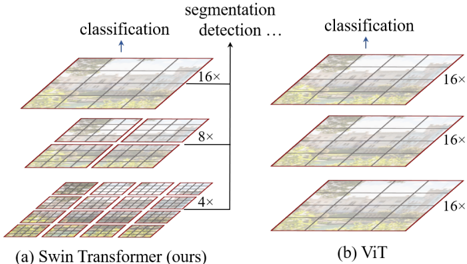
This paper presents a new vision Transformer, called Swin Transformer, that capably serves as a general-purpose backbone for computer vision. Challenges in adapting Transformer from language to vision arise from differences between the two domains, such as large variations in the scale of visual entities and the high resolution of pixels in images compared to words in text. To address these differences, we propose a hierarchical Transformer whose representation is computed with Shifted windows. The shifted windowing scheme brings greater efficiency by limiting self-attention computation to non-overlapping local windows while also allowing for cross-window connection. This hierarchical architecture has the flexibility to model at various scales and has linear computational complexity with respect to image size. These qualities of Swin Transformer make it compatible with a broad range of vision tasks, including image classification (87.3 top-1 accuracy on ImageNet-1K) and dense prediction tasks such as object detection (58.7 box AP and 51.1 mask AP on COCO test-dev) and semantic segmentation (53.5 mIoU on ADE20K val). Its performance surpasses the previous state-of-the-art by a large margin of +2.7 box AP and +2.6 mask AP on COCO, and +3.2 mIoU on ADE20K, demonstrating the potential of Transformer-based models as vision backbones. The hierarchical design and the shifted window approach also prove beneficial for all-MLP architectures. The code and models are publicly available at https://github.com/microsoft/Swin-Transformer.
Overview
CoChat Summary
TL;DR
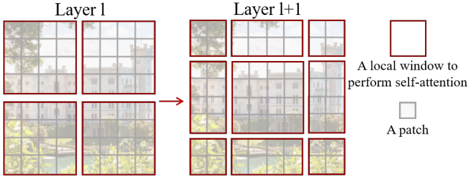
Swin Transformer is a hierarchical vision Transformer that computes self-attention within non-overlapping local windows and alternates regular and shifted window partitions to enable cross-window connections with linear complexity to image size. It achieves strong results as a general-purpose vision backbone on ImageNet-1K classification, COCO object detection/instance segmentation, and ADE20K semantic segmentation.
Key findings
- Image classification: Swin-L reaches 87.3 top-1 accuracy on ImageNet-1K with ImageNet-22K pre-training; regular ImageNet-1K training gives Swin-T 81.3, Swin-S 83.0, and Swin-B 83.5 top-1 at 224² input.
- COCO object detection/instance segmentation: Swin-L (HTC++) achieves 58.7 box AP and 51.1 mask AP on COCO test-dev, surpassing previous state-of-the-art by +2.7 box AP and +2.6 mask AP.
- ADE20K semantic segmentation: Swin-L with ImageNet-22K pre-training achieves 53.5 mIoU on the val set, an improvement of +3.2 mIoU over the previous state-of-the-art (SETR).
- Ablation: shifted windows improve Swin-T by +1.1% top-1 on ImageNet-1K, +2.8 box AP/+2.2 mask AP on COCO, and +2.8 mIoU on ADE20K over no shifting; relative position bias also improves results across the three tasks.
Methods
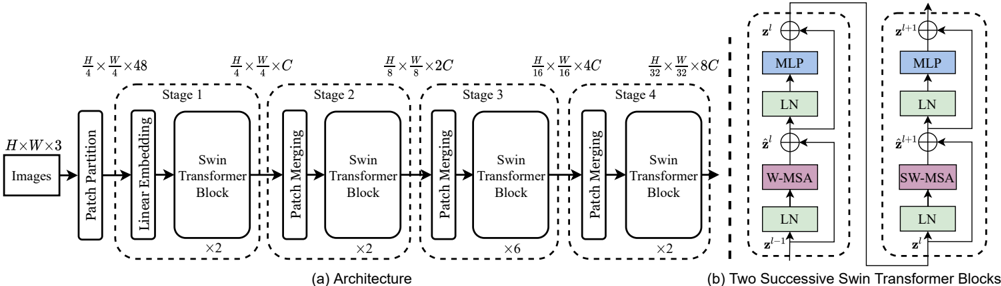
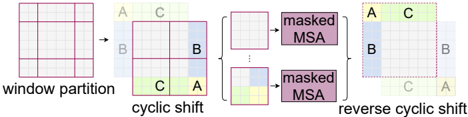
- Architecture: input RGB image split into 4×4 non-overlapping patches, linearly embedded; four stages with patch merging to produce hierarchical feature maps. Swin Transformer blocks replace standard multi-head self-attention with window-based MSA using regular and shifted window partitioning; default window size M=7, query dimension d=32, MLP expansion α=4, and relative position bias.
- Data and tasks: ImageNet-1K classification (1.28M training images, 50K validation images, 1,000 classes), ImageNet-22K pre-training (14.2M images, 22K classes), COCO 2017 detection/instance segmentation (118K train, 5K val, 20K test-dev), and ADE20K semantic segmentation (25K images: 20K train, 2K val, 3K test; 150 categories).
- Analysis: reports top-1 accuracy, COCO box/mask AP, and ADE20K mIoU; compares against ViT/DeiT and ResNe(X)t backbones; ablates shifted windows, position embedding methods, and self-attention computation methods.
Limitations
- The paper states that “a thorough kernel optimization is beyond the scope of this paper” and notes that Swin Transformer is implemented with built-in PyTorch functions that are not all well-optimized, which affects inference-speed comparisons against highly optimized Cudnn-based ResNe(X)t.
- The paper states that SoftMax computation is omitted when determining computational complexity.
- No dedicated limitations section is present; evident from the text, the main design ablations are conducted with Swin-T, and the COCO system-level comparison uses HTC++ with additional components (instaboost, stronger multi-scale training, soft-NMS, ImageNet-22K initialization), so those gains are not solely attributable to the backbone.
Model-written summary. Check it against the paper before relying on it.
Integrity signals
Registry
Cites
Statistics
Figures
Verification
Claims the paper makes
17 Valid · 8 Not valid · 2 Not checked · 63 Own results and interpretations
At least one cited source doesn’t support this claim or points to a different paper, and none confirmed it — see the verdicts below.
In the paper
“The results of ViT on image classification are encouraging, but its architecture is unsuitable for use as a general-purpose backbone network on dense vision tasks or when the input image resolution is high, due to its low-resolution feature maps and the quadratic increase in complexity with image size.”
What the sources say
- Disputedcites [20] [20] Alexey Dosovitskiy, Lucas Beyer, Alexander Kolesnikov, Dirk Weissenborn, Xiaohua Zhai, Thomas Unterthiner, Mostafa Dehghani, Matthias Minderer, Georg Heigold, Sylvain Gelly, Jakob Uszkoreit, and Neil Houlsby. An image is worth 16x16 words: Transformers for image recognition at scale. In International Conference on Learning Representations , 2021. 1, 2, 3, 4, 5, 6, 9 - sourceExperimental — accuracy not yet measured
Split into 2 atoms — 0 confirmed, 1 partially supported, 1 disputed, 0 misattributed, 0 unverifiable. Expand the claim to see per-atom verdicts.
Checked by a reasoning model — may be wrong.
plainstates a cause- Asserted: passes — The authors put it forward as true.
- Checkable: passes — It can be checked against evidence.
- Load-bearing: passes — The paper’s conclusions depend on it.
- Based: passes — The paper gives a reason why it holds.
- Disputed
The sources with a verdict support this claim; the rest weren’t checked yet, have no full text we could read, or their verdicts aren’t rated yet.
In the paper
“Unlike the word tokens that serve as the basic elements of processing in language Transformers, visual elements can vary substantially in scale, a problem that receives attention in tasks such as object detection [42, 53, 54].”
What the sources say
- Supportedcites [42] [42] Tsung-Yi Lin, Piotr Dollar, Ross Girshick, Kaiming He, Bharath Hariharan, and Serge Belongie. Feature pyramid networks for object detection. In The IEEE Conference on Computer Vision and Pattern Recognition (CVPR) , July 2017. 2 - source
The Introduction (p. 1) calls recognizing objects at vastly different scales a fundamental computer-vision challenge and describes feature pyramids as a standard solution for detecting objects across a large range of scales. The comparison with word tokens is framing by the citing authors, not a claim this source is needed to establish. (LLM, conf=0.93)
- Not checked — no full text of the sourcecites [53] [53] Bharat Singh and Larry S Davis. An analysis of scale invariance in object detection snip. In Proceedings of the IEEE conference on computer vision and pattern recognition , pages 3578-3587, 2018. 2 - source
- Supportedcites [54] [54] Bharat Singh, Mahyar Najibi, and Larry S Davis. Sniper: Efficient multi-scale training. In Advances in Neural Information Processing Systems , volume 31. Curran Associates, Inc., 2018. 2 - source
The Introduction (p. 1) describes objects at different scales as a challenge for visual recognition and says object-detection algorithms use multi-scale image pyramids to obtain scale-robust representations. That supports the point for which this object-detection paper is cited; the comparison with word tokens is framing in the citing sentence. (LLM, conf=0.90)
plain- Asserted: passes — The authors put it forward as true.
- Checkable: passes — It can be checked against evidence.
- Load-bearing: passes — The paper’s conclusions depend on it.
- Based: passes — The paper gives a reason why it holds.
- Supported
The cited sources that could be checked couldn’t confirm or dispute this claim.
In the paper
“Its performance surpasses the previous state-of-theart by a large margin of +2.7 box AP and +2.6 mask AP on COCO, and +3.2 mIoU on ADE20K, demonstrating the potential of Transformer-based models as vision backbones.”
- Also stated in: § 1. Introduction · plain
“On ADE20K semantic segmentation, it obtains 53.5 mIoU on the val set, an improvement of +3.2 mIoU over the previous state-of-the-art (SETR [81]).”
What the sources say
- Could not verifycites [81] [81] Sixiao Zheng, Jiachen Lu, Hengshuang Zhao, Xiatian Zhu, Zekun Luo, Yabiao Wang, Yanwei Fu, Jianfeng Feng, Tao Xiang, Philip HS Torr, et al. Rethinking semantic segmentation from a sequence-to-sequence perspective with transformers. arXiv preprint arXiv:2012.15840 , 2020. 2, 3, 7, 8 - sourceExperimental — accuracy not yet measured
Section 4.3 reports that SETR-MLA achieved 50.28% mIoU on ADE20K with multi-scale inference. Searches for Swin Transformer and a +3.2 mIoU improvement found no passage in our copy addressing the attributed claim; the SETR result does not establish or refute Swin Transformer's performance. (LLM, conf=0.76)
boostedstates a cause- Asserted: passes — The authors put it forward as true.
- Checkable: passes — It can be checked against evidence.
- Load-bearing: passes — The paper’s conclusions depend on it.
- Based: passes — The paper gives a reason why it holds.
- Also stated in: § 1. Introduction · plain
Every source the paper cites for this claim was checked and supports it.
In the paper
“Further adding absolute position embedding to the input as in [20] drops performance slightly, thus it is not adopted in our implementation.”
What the sources say
- Supportedcites [20] [20] Alexey Dosovitskiy, Lucas Beyer, Alexander Kolesnikov, Dirk Weissenborn, Xiaohua Zhai, Thomas Unterthiner, Mostafa Dehghani, Matthias Minderer, Georg Heigold, Sylvain Gelly, Jakob Uszkoreit, and Neil Houlsby. An image is worth 16x16 words: Transformers for image recognition at scale. In International Conference on Learning Representations , 2021. 1, 2, 3, 4, 5, 6, 9 - source
The citation’s “as in [20]” identifies the method: Section 3.1 (p. 3) says the paper adds learnable 1D position embeddings to patch embeddings before the encoder. The slight performance drop and decision not to adopt the method describe the citing authors’ implementation, not a result attributed to this source. (LLM, conf=0.88)
plainstates a cause- Asserted: passes — The authors put it forward as true.
- Checkable: passes — It can be checked against evidence.
- Load-bearing: unclear — It is unclear whether the paper’s conclusions depend on it.
- Based: passes — The paper gives a reason why it holds.
- Supported
The cited sources support only part of this claim — read each source’s verdict below.
In the paper
“Compared with the state-of-the-art ConvNets, i.e. RegNet [48] and EfficientNet [58], the Swin Transformer achieves a slightly better speed-accuracy trade-off.”
What the sources say
- Supportedcites [48] [48] Ilija Radosavovic, Raj Prateek Kosaraju, Ross Girshick, Kaiming He, and Piotr Doll´ ar. Designing network design spaces. In Proceedings of the IEEE/CVF Conference on Computer Vision and Pattern Recognition , pages 1042810436, 2020. 6 - source
The citation to this paper is attached to RegNet as an example of a state-of-the-art ConvNet, not to the sentence’s claim about Swin Transformer. Section 5.3 compares RegNet models with EfficientNet as representative of the state of the art. The paper need not evaluate Swin to support this identification citation. (LLM, conf=0.91)
- Could not verifycites [58] [58] Mingxing Tan and Quoc Le. Efficientnet: Rethinking model scaling for convolutional neural networks. In International Conference on Machine Learning , pages 6105-6114. PMLR, 2019. 3, 6 - sourceExperimental — accuracy not yet measured
The cited paper’s experiment setup and ablation study (pp. 8–9) compare deformable ConvNets with other convolutional models. Searches for Swin Transformer, RegNet, EfficientNet, and the claimed speed–accuracy trade-off found no passage addressing that comparison. (LLM, conf=0.78)
plain- Asserted: passes — The authors put it forward as true.
- Checkable: passes — It can be checked against evidence.
- Load-bearing: passes — The paper’s conclusions depend on it.
- Based: passes — The paper gives a reason why it holds.
- Supported
47 more claims · 5 with their cited sources checked
Create a free account to see all 90 claims and to verify the 3 references still open.
- Probably not a substantial claim. 11
- It may state two separate claims as one. 28
Claims other papers make about this one
Each is checked against this paper’s own text: does it say what the citing paper says it does?
The source backs part of the claim, not all of it — or backs it for a different population, condition or comparison.
In the citing paper
“Swin Transformer: Uses shifted window-based selfattention to compute multi-scale spatial features efficiently, improving performance in crowded or cluttered scenes [31].”
From A Comprehensive Survey of Transformer-Based Models for Video Anomaly Detection in Surveillance Systems (2025) · cites this paper as [31]
Experimental — accuracy not yet measuredThe source backs part of the claim, not all of it — or backs it for a different population, condition or comparison.
In the citing paper
“For example, local MSAs (Yang et al., 2019; Liu et al., 2021; Chu et al., 2021), which calculate self-attention only within small windows, achieve better performance than global MSAs not only on small datasets but also on large datasets, e.g., ImageNet-21K.”
From How Do Vision Transformers Work? (2022) · cites this paper as Liu et al., 2021
Experimental — accuracy not yet measuredThe source backs part of the claim, not all of it — or backs it for a different population, condition or comparison.
In the citing paper
“Vision Transformer is known for its inherent tendency to prioritize global features [8], [242]”
From Evolving from Single-modal to Multi-modal Facial Deepfake Detection: Progress and Challenges (2024) · cites this paper as [242]
Experimental — accuracy not yet measuredThe source backs part of the claim, not all of it — or backs it for a different population, condition or comparison.
In the citing paper
“Furthermore, Swin-Transformer [7] saw another significant advancement. This model enhances the ViT framework by integrating a hierarchical structure with shifted windows, a design choice that substantially improves the model's ability to capture local features while still maintaining a global context.”
From Model Quantization and Hardware Acceleration for Vision Transformers: A Comprehensive Survey (2024) · cites this paper as [7]
Experimental — accuracy not yet measuredThe source backs part of the claim, not all of it — or backs it for a different population, condition or comparison.
In the citing paper
“Models such as DINOv2 [7], Vision Transformers (ViT) [8], and Swin Transformers [9] have demonstrated outstanding transfer learning performance across a wide range of domains, often achieving state-of-the-art results with only minimal fine-tuning.”
From Trustworthy Celestial Eye: Calibrated and Robust Planetary Classification via Self-Supervised Vision Transformers (2026) · cites this paper as [9]
Experimental — accuracy not yet measured
19 more claims about this paper
Create a free account to see every claim other papers make about this one.
Self-check
Percentages, sums and reported differences re-computed from the paper’s own numbers.
Each contradiction between two passages listed here was confirmed by an independent check.
Rated minor: it would not touch a result — a value no result rests on, a p-value that stays on the same side of the significance level, or a conflict that is clerical, resolved elsewhere in the paper, or outside its own findings.
In the paper
§ 4.1. Image Classification on ImageNet-1K
“Swin-B (83.3%/84.5%) over DeiT-B (81.8%/83.1%) using 224 2 /384 2 input”
§ 4.1. Image Classification on ImageNet-1K
“| Swin-B | 224 2 | 88M | 15.4G | 278.1 | 83.5 |”
Citations
Cites
Deep Residual Learning for Image Recognition
He, K., Zhang, X., Ren, S., & Sun, J. (2016) · 2016 IEEE Conference on Computer Vision and Pattern Recognition (CVPR) · doi:10.1109/cvpr.2016.90 · Cited by 235,474 · cited 11×
“Our Swin-T architecture brings consistent +3.4∼4.2 box AP gains over ResNet-50, with slightly larger model size, FLOPs and latency.”
BackgroundMethodInfluentialVaswani, A., Shazeer, N., Parmar, N., Uszkoreit, J., Jones, L., Gomez, A. N., Kaiser, L., & Polosukhin, I. (2017) · arXiv · doi:10.48550/arxiv.1706.03762 · Cited by 120,404
Very Deep Convolutional Networks for Large-Scale Image Recognition
Simonyan, K., & Zisserman, A. (2014) · arXiv · doi:10.48550/arxiv.1409.1556 · Cited by 114,148 · cited 3×
“Since then, deeper and more effective con- 2While there are efficient methods to implement a sliding-window based convolution layer on general hardware, thanks to its shared kernel weights across a feature map, it is difficult for a sliding-window based self-attention layer to have efficient memory access in practice.…”
BackgroundImageNet classification with deep convolutional neural networks
Krizhevsky, A., Sutskever, I., & Hinton, G. E. (2017) · Communications of the ACM · doi:10.1145/3065386 · Cited by 112,155 · cited 3×
“Beginning with AlexNet [35] and its revolutionary performance on the ImageNet image classification challenge, CNN architec-”
MethodU-Net: Convolutional Networks for Biomedical Image Segmentation
Ronneberger, O., Fischer, P., & Brox, T. (2015) · Lecture notes in computer science · doi:10.1007/978-3-319-24574-4_28 · Cited by 99,404
Adam: A Method for Stochastic Optimization
Kingma, D. P., & Ba, J. (2014) · arXiv · doi:10.48550/arxiv.1412.6980 · Cited by 98,946 · cited 3×
“We employ an AdamW optimizer for 90 epochs using a cosine learning rate scheduler with a 5-epoch linear warm-up.”
MethodInfluentialExploiting Generative AI to Scale up Intelligent Tutoring Systems
Jakubův, J., Chvalovský, K., Goertzel, Z., Kaliszyk, C., Olšák, M., Piotrowski, B., Schulz, S., Suda, M., & Urban, J. (2023) · DROPS (Schloss Dagstuhl – Leibniz Center for Informatics) · doi:10.4230/lipics.itp.2023.19 · Cited by 76,658
ImageNet: A large-scale hierarchical image database
Deng, J., Dong, W., Socher, R., Li, L.-J., Li, K., & Fei-Fei, L. (2009) · 2009 IEEE Conference on Computer Vision and Pattern Recognition · doi:10.1109/cvpr.2009.5206848 · Cited by 65,333 · cited 15×
“While ViT requires large-scale training datasets (i.e., JFT-300M) to perform well, DeiT [57] introduces several training strategies that allow ViT to also be effective using the smaller ImageNet-1K dataset.”
MethodInfluentialGradient-based learning applied to document recognition
Lecun, Y., Bottou, L., Bengio, Y., & Haffner, P. (1998) · Proceedings of the IEEE · doi:10.1109/5.726791 · Cited by 58,805 · cited 1×
“While the CNN has existed for several decades [36], it was not until the introduction of AlexNet [35] that the CNN took off and became mainstream.”
MethodDensely Connected Convolutional Networks
Huang, G., Liu, Z., Van Der Maaten, L., & Weinberger, K. Q. (2017) · 2017 IEEE Conference on Computer Vision and Pattern Recognition (CVPR) · doi:10.1109/cvpr.2017.243 · Cited by 48,566 · cited 3×
“Since then, deeper and more effective con- 2While there are efficient methods to implement a sliding-window based convolution layer on general hardware, thanks to its shared kernel weights across a feature map, it is difficult for a sliding-window based self-attention layer to have efficient memory access in practice.…”
BackgroundSelf-citation
Research works printed but not linked: 2
- [50] Prajit Ramachandran, Niki Parmar, Ashish Vaswani, Irwan Bello, Anselm Levskaya, and Jon Shlens. Stand-alone selfattention in vision models. In Advances in Neural Information Processing Systems , volume 32. Curran Associates, Inc., 2019. 2, 3 -
- [51] Olaf Ronneberger, Philipp Fischer, and Thomas Brox. Unet: Convolutional networks for biomedical image segmentation. In International Conference on Medical image computing and computer-assisted intervention , pages 234-241. Springer, 2015. 2 -
Cited by
Items 1,401–1,500 of 33,022
Excavating RoI Attention for Underwater Object Detection
Liang, X., & Song, P. (2022) · Proceedings - International Conference on Image Processing · doi:10.1109/icip46576.2022.9897515 · Cited by 104
Yang, Z., Zhou, D., Yang, Y., Zhang, J., & Chen, Z. (2022) · IEEE Geoscience and Remote Sensing Letters · doi:10.1109/lgrs.2022.3171973 · Cited by 98
Üzen, H., Türkoğlu, M., Yanikoglu, B. A., & Hanbay, D. (2022) · Expert Systems with Applications · doi:10.1016/j.eswa.2022.118269 · Cited by 80
Single Stage Virtual Try-On Via Deformable Attention Flows
Bai, S., Zhou, H., Li, Z., Zhou, C. S., & Yang, H. (2022) · Lecture notes in computer science · doi:10.1007/978-3-031-19784-0_24 · Cited by 134
PPT: Token-Pruned Pose Transformer for Monocular and Multi-view Human Pose Estimation
Ma, H., Wang, Z., Chen, Y., Kong, D., Chen, L., Liu, X., Yan, X., Tang, H., & Xie, X. S. (2022) · Lecture notes in computer science · doi:10.1007/978-3-031-20065-6_25 · Cited by 111
Cui, L., Jing, X., Wang, Y., Huan, Y., Xu, Y., & Zhang, Q. (2022) · IEEE Journal of Selected Topics in Applied Earth Observations and Remote Sensing · doi:10.1109/jstars.2022.3225150 · Cited by 84
Combining convolutional and vision transformer structures for sheep face recognition
Li, X., Xiang, Y., & Li, S. (2023) · Computers and Electronics in Agriculture · doi:10.1016/j.compag.2023.107651 · Cited by 92
From Patch to Pixel: A Transformer-Based Hierarchical Framework for Compressive Image Sensing
Gan, H., Shen, M., Hua, Y., Ma, C., & Zhang, T. (2023) · IEEE Transactions on Computational Imaging · doi:10.1109/tci.2023.3244396 · Cited by 93
TransCFD: A transformer-based decoder for flow field prediction
Jiang, J., Li, G., Jiang, Y., Zhang, L., & Deng, X. (2023) · Engineering Applications of Artificial Intelligence · doi:10.1016/j.engappai.2023.106340 · Cited by 97
Multi-Task Learning With Multi-Query Transformer for Dense Prediction
Xu, Y., Li, X., Yuan, H., Yang, Y., & Zhang, L. (2023) · IEEE Transactions on Circuits and Systems for Video Technology · doi:10.1109/tcsvt.2023.3292995 · Cited by 116
X-Pruner: eXplainable Pruning for Vision Transformers
Lu, Y., & Xiang, W. (2023) · IEEE Computer Society Conference on Computer Vision and Pattern Recognition/Proceedings - IEEE Computer Society Conference on Computer Vision and Pattern Recognition/Proceedings · doi:10.1109/cvpr52729.2023.02333 · Cited by 155
Improving Graph Representation for Point Cloud Segmentation via Attentive Filtering
Zhang, N., Pan, Z., Li, T. H., Gao, W., & Li, G. (2023) · IEEE Computer Society Conference on Computer Vision and Pattern Recognition/Proceedings - IEEE Computer Society Conference on Computer Vision and Pattern Recognition/Proceedings · doi:10.1109/cvpr52729.2023.00126 · Cited by 95
Vision Transformer With Quadrangle Attention
Zhang, Q., Zhang, J., Xu, Y., & Tao, D. (2024) · IEEE Transactions on Pattern Analysis and Machine Intelligence · doi:10.1109/tpami.2023.3347693 · Cited by 149
An Adaptive Model Ensemble Adversarial Attack for Boosting Adversarial Transferability
Chen, B., Yin, J.-L., Chen, S., Chen, B., & Liu, X. (2023) · IEEE/CVF International Conference on Computer Vision (ICCV) · doi:10.1109/iccv51070.2023.00414 · Cited by 151
Pan, J. H., Bai, Y., Shu, Q., Zhang, Z., Hu, J., & Wang, M. (2024) · IEEE Transactions on Geoscience and Remote Sensing · doi:10.1109/tgrs.2024.3374421 · Cited by 109
Self-citationA Small-Object Detection Model Based on Improved YOLOv8s for UAV Image Scenarios
Ni, J., Zhu, S., Tang, G., Ke, C., & Wang, T. (2024) · Remote Sensing · doi:10.3390/rs16132465 · Cited by 98
Advances in the Neural Network Quantization: A Comprehensive Review
Lu, W., Ma, Z., Yang, C., & Yao, Q. (2024) · Applied Sciences · doi:10.3390/app14177445 · Cited by 145
OrientedFormer: An End-to-End Transformer-Based Oriented Object Detector in Remote Sensing Images
Zhao, J., Ding, Z., Zhou, Y. Z., Zhu, H., Du, W.-L., Yao, R., & Saddik, A. E. (2024) · IEEE Transactions on Geoscience and Remote Sensing · doi:10.1109/tgrs.2024.3456240 · Cited by 133
A novel hybrid ConvNeXt-based approach for enhanced skin lesion classification
Aruk, İ., Paçal, İ., & Toprak, A. N. (2025) · Expert Systems with Applications · doi:10.1016/j.eswa.2025.127721 · Cited by 99
A Practical Contrastive Learning Framework for Single-Image Super-Resolution
Wu, G., Jiang, J., & Liu, X. (2023) · IEEE Transactions on Neural Networks and Learning Systems · doi:10.1109/tnnls.2023.3290038 · Cited by 104
Explainable multimodal trajectory prediction using attention models
Zhang, K., & Li, L. (2022) · Transportation Research Part C Emerging Technologies · doi:10.1016/j.trc.2022.103829 · Cited by 84
MSG-Transformer: Exchanging Local Spatial Information by Manipulating Messenger Tokens
Fang, J., Xie, L., Wang, X., Zhang, X., Liu, W., & Tian, Q. C. (2022) · IEEE Computer Society Conference on Computer Vision and Pattern Recognition/Proceedings - IEEE Computer Society Conference on Computer Vision and Pattern Recognition/Proceedings · doi:10.1109/cvpr52688.2022.01175 · Cited by 114
CTMFNet: CNN and Transformer Multiscale Fusion Network of Remote Sensing Urban Scene Imagery
Song, P., Li, J., An, Z., Fan, H., & Fan, L. (2022) · IEEE Transactions on Geoscience and Remote Sensing · doi:10.1109/tgrs.2022.3232143 · Cited by 110
Joint Hand Motion and Interaction Hotspots Prediction from Egocentric Videos
Liu, S., Tripathi, S., Majumdar, S., & Wang, X. (2022) · IEEE Computer Society Conference on Computer Vision and Pattern Recognition/Proceedings - IEEE Computer Society Conference on Computer Vision and Pattern Recognition/Proceedings · doi:10.1109/cvpr52688.2022.00328 · Cited by 158
Lin, X., Yu, L., Cheng, K.-T. T., & Yan, Z. (2023) · IEEE Transactions on Medical Imaging · doi:10.1109/tmi.2023.3247814 · Cited by 89
Fully Transformer Network for Change Detection of Remote Sensing Images
Yan, T., Wan, Z., & Zhang, P. (2023) · Lecture notes in computer science · doi:10.1007/978-3-031-26284-5_5 · Cited by 100
Cui, F., & Jiang, J. (2023) · International Journal of Applied Earth Observation and Geoinformation · doi:10.1016/j.jag.2023.103294 · Cited by 115
Transformer-Based Multi-Scale Feature Integration Network for Video Saliency Prediction
Zhou, X., Wu, S., Shi, R., Zheng, B., Wang, S., Yin, H., Zhang, J., & Yan, C. C. (2023) · IEEE Transactions on Circuits and Systems for Video Technology · doi:10.1109/tcsvt.2023.3278410 · Cited by 100
Joint Token Pruning and Squeezing Towards More Aggressive Compression of Vision Transformers
Wei, S., Ye, T., Zhang, S., Tang, Y., & Liang, J. (2023) · IEEE Computer Society Conference on Computer Vision and Pattern Recognition/Proceedings - IEEE Computer Society Conference on Computer Vision and Pattern Recognition/Proceedings · doi:10.1109/cvpr52729.2023.00208 · Cited by 162
OmniMAE: Single Model Masked Pretraining on Images and Videos
Girdhar, R., El-Nouby, A., Singh, M., Alwala, K. V., Joulin, A., & Misra, I. (2023) · IEEE Computer Society Conference on Computer Vision and Pattern Recognition/Proceedings - IEEE Computer Society Conference on Computer Vision and Pattern Recognition/Proceedings · doi:10.1109/cvpr52729.2023.01003 · Cited by 161
High-resolution single-photon imaging with physics-informed deep learning
Bian, L., Song, H., Peng, L., Chang, X., Yang, X., Horstmeyer, R. W., Ye, L., Zhu, C., Qin, T., Zheng, D., et al. (2023) · Nature Communications · doi:10.1038/s41467-023-41597-9 · Cited by 100
ViTMatte: Boosting image matting with pre-trained plain vision transformers
Yao, J., Wang, X., Yang, S., & Wang, B. (2023) · Information Fusion · doi:10.1016/j.inffus.2023.102091 · Cited by 142
Lin, F., Crawford, S., Guillot, K., Zhang, Y., Chen, Y., Yuan, X., Chen, L., Williams, S., Minvielle, R., Xiao, X., et al. (2023) · IEEE/CVF International Conference on Computer Vision (ICCV) · doi:10.1109/iccv51070.2023.00531 · Cited by 126
Mohammed, F. A., Tune, K. K., Assefa, B. G., Jett, M., & Muhie, S. Y. (2024) · Machine Learning and Knowledge Extraction · doi:10.3390/make6010033 · Cited by 111
On Transforming Reinforcement Learning With Transformers: The Development Trajectory
Hu, S., Shen, L., Zhang, Y., Chen, Y., & Tao, D. (2024) · IEEE Transactions on Pattern Analysis and Machine Intelligence · doi:10.1109/tpami.2024.3408271 · Cited by 137
Nazir, A., Hussain, A. B., Singh, M., & Assad, A. (2024) · Multimedia Tools and Applications · doi:10.1007/s11042-024-19694-8 · Cited by 113
MAE-YOLOv8-based small object detection of green crisp plum in real complex orchard environments
Liu, Q., Lv, J., & Zhang, C. (2024) · Computers and Electronics in Agriculture · doi:10.1016/j.compag.2024.109458 · Cited by 94
Segment Anything Model for Road Network Graph Extraction
Hetang, C., Xue, H., Le, C. X., Yue, T., Wang, W., & He, Y. (2024) · IEEE/CVF Conference on Computer Vision and Pattern Recognition Workshops (CVPRW) · doi:10.1109/cvprw63382.2024.00262 · Cited by 141
Zhu, X., Zhu, J., Li, H., Wu, X., Li, H., Wang, X., & Dai, J. (2022) · IEEE Computer Society Conference on Computer Vision and Pattern Recognition/Proceedings - IEEE Computer Society Conference on Computer Vision and Pattern Recognition/Proceedings · doi:10.1109/cvpr52688.2022.01630 · Cited by 164
Diffusion Model with Detail Complement for Super-Resolution of Remote Sensing
Liu, J., Yuan, Z., Pan, Z., Fu, Y., Liu, L., & Lu, B. (2022) · Remote Sensing · doi:10.3390/rs14194834 · Cited by 93
Real-Time Online Video Detection with Temporal Smoothing Transformers
Zhao, Y., & Krähenbühl, P. (2022) · Lecture notes in computer science · doi:10.1007/978-3-031-19830-4_28 · Cited by 137
Point-to-Box Network for Accurate Object Detection via Single Point Supervision
Chen, P., Yu, X., Han, X., Hassan, N., Wang, K., Li, J., Zhao, J., Shi, H., Han, Z., & Ye, Q. (2022) · Lecture notes in computer science · doi:10.1007/978-3-031-20077-9_4 · Cited by 98
R-YOLO: A Robust Object Detector in Adverse Weather
Wang, L., Qin, H., Zhou, X., Lu, X. B., & Zhang, F. (2022) · IEEE Transactions on Instrumentation and Measurement · doi:10.1109/tim.2022.3229717 · Cited by 107
Hydra Attention: Efficient Attention with Many Heads
Bolya, D., Fu, C.-Y., Dai, X., Zhang, P., & Hoffman, J. (2023) · Lecture notes in computer science · doi:10.1007/978-3-031-25082-8_3 · Cited by 144
Multi-modal Fake News Detection on Social Media via Multi-grained Information Fusion
Zhou, Y., Yang, Y., Ying, Q., Qian, Z., & Zhang, X. (2023) · International Conference on Multimedia Retrieval · doi:10.1145/3591106.3592271 · Cited by 117
YOLO-DCTI: Small Object Detection in Remote Sensing Base on Contextual Transformer Enhancement
Min, L., Fan, Z., Lv, Q., Reda, M., Shen, L., & Wang, B. (2023) · Remote Sensing · doi:10.3390/rs15163970 · Cited by 90
Talwar, V., Singh, P., Mukhia, N., Shetty, A., Birur, P. N., Desai, K. M., Sunkavalli, C., Varma, K. S., Sethuraman, R., Jawahar, C. V., et al. (2023) · Cancers · doi:10.3390/cancers15164120 · Cited by 85
MixMAE: Mixed and Masked Autoencoder for Efficient Pretraining of Hierarchical Vision Transformers
Liu, J., Huang, X., Zheng, J., Liu, Y., & Li, H. (2023) · IEEE Computer Society Conference on Computer Vision and Pattern Recognition/Proceedings - IEEE Computer Society Conference on Computer Vision and Pattern Recognition/Proceedings · doi:10.1109/cvpr52729.2023.00605 · Cited by 175
Radars for Autonomous Driving: A Review of Deep Learning Methods and Challenges
Srivastav, A., & Mandal, S. (2023) · IEEE Access · doi:10.1109/access.2023.3312382 · Cited by 121
X2-VLM: All-in-One Pre-Trained Model for Vision-Language Tasks
Zeng, Y., Zhang, X., Li, H., Wang, J., Zhang, J., & Zhou, W. (2023) · IEEE Transactions on Pattern Analysis and Machine Intelligence · doi:10.1109/tpami.2023.3339661 · Cited by 168
Multiple-environment Self-adaptive Network for aerial-view geo-localization
Wang, T., Zheng, Z., Sun, Y., Yan, C. C., Yang, Y., & Chua, T. (2024) · Pattern Recognition · doi:10.1016/j.patcog.2024.110363 · Cited by 130
Zhao, T., Wang, Y., Li, Z., Gao, Y., Chen, C., Feng, H., & Zhao, Z. (2024) · Remote Sensing · doi:10.3390/rs16071145 · Cited by 99
DiffusionEdge: Diffusion Probabilistic Model for Crisp Edge Detection
Ye, Y., Xu, K., Huang, Y., Yi, R., & Cai, Z. (2024) · Proceedings of the AAAI Conference on Artificial Intelligence · doi:10.1609/aaai.v38i7.28490 · Cited by 148
Low-Rank Transformer for High-Resolution Hyperspectral Computational Imaging
Liu, Y., Dian, R., & Li, S. (2024) · International Journal of Computer Vision · doi:10.1007/s11263-024-02203-7 · Cited by 100
TextFusion: Unveiling the power of textual semantics for controllable image fusion
Cheng, C., Xu, T., Wu, X., Li, H., Li, X., Tang, Z., & Kittler, J. (2024) · Information Fusion · doi:10.1016/j.inffus.2024.102790 · Cited by 106
ESOD: Efficient Small Object Detection on High-Resolution Images
Liu, K., Fu, Z., Jin, S., Chen, Z., Zhou, F., Jiang, R., Chen, Y., & Ye, J. (2024) · IEEE Transactions on Image Processing · doi:10.1109/tip.2024.3501853 · Cited by 139
Benchmarking Detection Transfer Learning with Vision TransformersPreprint
Li, Y., Xie, S., Chen, X., Dollár, P., He, K., & Girshick, R. (2021) · arXiv (Cornell University) · doi:10.48550/arxiv.2111.11429 · Cited by 255
Stand-Alone Inter-Frame Attention in Video Models
Long, F., Qiu, Z., Pan, Y., Yao, T., Luo, J., & Mei, T. (2022) · IEEE Computer Society Conference on Computer Vision and Pattern Recognition/Proceedings - IEEE Computer Society Conference on Computer Vision and Pattern Recognition/Proceedings · doi:10.1109/cvpr52688.2022.00319 · Cited by 86
Zorn, M., Ionescu, C., Klohs, D., Zähl, K., Kisseler, N., Daldrup, A., Hams, S., Zheng, Y., Offermanns, C., Flamme, S., et al. (2022) · Recycling · doi:10.3390/recycling7040048 · Cited by 83
Object Detection in Medical Images Based on Hierarchical Transformer and Mask Mechanism
Shou, Y., Meng, T., Ai, W., Xie, C., Liu, H., & Wang, Y. (2022) · Computational Intelligence and Neuroscience · doi:10.1155/2022/5863782 · Cited by 111
EEG temporal–spatial transformer for person identification
Du, Y., Xu, Y., Wang, X., Liu, L., & Ma, P. (2022) · Scientific Reports · doi:10.1038/s41598-022-18502-3 · Cited by 98
Spatial-Temporal Transformer for Video Snapshot Compressive Imaging
Wang, L., Cao, M., Zhong, Y., & Yuan, X. (2022) · IEEE Transactions on Pattern Analysis and Machine Intelligence · doi:10.1109/tpami.2022.3225382 · Cited by 116
Multi-modal policy fusion for end-to-end autonomous driving
Huang, Z., Sun, S., Zhao, J., & Mao, L. (2023) · Information Fusion · doi:10.1016/j.inffus.2023.101834 · Cited by 90
HIPA: Hierarchical Patch Transformer for Single Image Super Resolution
Cai, Q., Qian, Y., Li, J., Lyu, J., Yang, Y., Wu, F., & Zhang, D. D. (2023) · IEEE Transactions on Image Processing · doi:10.1109/tip.2023.3279977 · Cited by 85
HCformer: Hybrid CNN-Transformer for LDCT Image Denoising
Yuan, J., Zhou, F., Guo, Z., Li, X., & Yu, H. (2023) · Journal of Imaging Informatics in Medicine · doi:10.1007/s10278-023-00842-9 · Cited by 93
ADAPT: Action-aware Driving Caption Transformer
Jin, B., Liu, X., Zheng, Y., Li, P., Zhao, H., Zhang, T., Zheng, Y., Zhou, G., & Liu, J. (2023) · 2023 IEEE International Conference on Robotics and Automation (ICRA) · doi:10.1109/icra48891.2023.10160326 · Cited by 75
Bridging the Domain Gap for Multi-Agent Perception
Xu, R., Li, J., Dong, X., Yu, H., & Ma, J. (2023) · Proceedings - IEEE International Conference on Robotics and Automation/Proceedings · doi:10.1109/icra48891.2023.10160871 · Cited by 123
Hard Patches Mining for Masked Image Modeling
Wang, H., Song, K., Fan, J., Wang, Y., Xie, J., & Zhang, Z. (2023) · IEEE Computer Society Conference on Computer Vision and Pattern Recognition/Proceedings - IEEE Computer Society Conference on Computer Vision and Pattern Recognition/Proceedings · doi:10.1109/cvpr52729.2023.01000 · Cited by 129
Self-citationA Simple Baseline for Video Restoration with Grouped Spatial-Temporal Shift
Li, D., Shi, X., Zhang, Y., Cheung, K. C., See, S. C. W., Wang, X., Qin, H., & Li, H. (2023) · IEEE Computer Society Conference on Computer Vision and Pattern Recognition/Proceedings - IEEE Computer Society Conference on Computer Vision and Pattern Recognition/Proceedings · doi:10.1109/cvpr52729.2023.00947 · Cited by 153
Cascaded Local Implicit Transformer for Arbitrary-Scale Super-Resolution
Chen, H., Xu, Y.-S., Hong, M.-F., Tsai, Y., Kuo, H.-K., & Lee, C. (2023) · IEEE Computer Society Conference on Computer Vision and Pattern Recognition/Proceedings - IEEE Computer Society Conference on Computer Vision and Pattern Recognition/Proceedings · doi:10.1109/cvpr52729.2023.01751 · Cited by 126
GD-MAE: Generative Decoder for MAE Pre-Training on LiDAR Point Clouds
Yang, H., He, T., Liu, J., Chen, H., Wu, B., Lin, B., He, X., & Ouyang, W. (2023) · IEEE Computer Society Conference on Computer Vision and Pattern Recognition/Proceedings - IEEE Computer Society Conference on Computer Vision and Pattern Recognition/Proceedings · doi:10.1109/cvpr52729.2023.00907 · Cited by 136
Fast Hyperspectral Image Classification Combining Transformers and SimAM-Based CNNs
Liang, L., Zhang, Y., Zhang, S., Li, J., Plaza, A., & Kang, X. (2023) · IEEE Transactions on Geoscience and Remote Sensing · doi:10.1109/tgrs.2023.3309245 · Cited by 98
Point-aware Interaction and CNN-induced Refinement Network for RGB-D Salient Object Detection
Cong, R., Liu, H., Zhang, C., Zhang, W., Zheng, F., Song, R., & Kwong, S. (2023) · ACM International Conference on Multimedia (ACM MM) · doi:10.1145/3581783.3611982 · Cited by 116
Improved Ship Detection with YOLOv8 Enhanced with MobileViT and GSConv
Zhao, X., & Song, Y. (2023) · Electronics · doi:10.3390/electronics12224666 · Cited by 81
SeMask: Semantically Masked Transformers for Semantic Segmentation
Jain, J., Singh, A. T., Orlov, N., Huang, Z., Li, J., Walton, S., & Shi, H. (2023) · IEEE International Conference on Computer Vision Workshops · doi:10.1109/iccvw60793.2023.00083 · Cited by 168
Direct training high-performance deep spiking neural networks: a review of theories and methods
Zhou, C., Zhang, H., Yu, L., Ye, Y., Zhou, Z., Huang, L., Ma, Z., Fan, X., Zhou, H., & Tian, Y. (2024) · Frontiers in Neuroscience · doi:10.3389/fnins.2024.1383844 · Cited by 123
Dong, X., Shi, P., Liang, T., & Yang, A. (2024) · Transportation Research Record Journal of the Transportation Research Board · doi:10.1177/03611981241258753 · Cited by 80
Enhancing pine wilt disease detection with synthetic data and external attention-based transformers
Amin, S. U., Jung, Y.-H., Fayaz, M., et al. (2025) · Engineering Applications of Artificial Intelligence · doi:10.1016/j.engappai.2025.111655 · Cited by 73
Chen, H., Song, J. H., Dietrich, O., Broni-Bediako, C., Xuan, W., Wang, J., Shao, X., Wei, Y., Xia, J., Lan, C., et al. (2025) · Earth system science data · doi:10.5194/essd-17-6217-2025 · Cited by 152
Self-citationZheng, H., Wang, G., & Li, X. (2022) · Journal of Food Measurement & Characterization · doi:10.1007/s11694-022-01396-0 · Cited by 79
Tian, Y., Wang, J., Wang, Y., Zhao, C., Yao, F., & Wang, X. (2022) · IEEE Transactions on Intelligent Vehicles · doi:10.1109/tiv.2022.3197815 · Cited by 85
LESSFormer: Local-Enhanced Spectral-Spatial Transformer for Hyperspectral Image Classification
Zou, J., He, W. P., & Zhang, H. (2022) · IEEE Transactions on Geoscience and Remote Sensing · doi:10.1109/tgrs.2022.3196771 · Cited by 79
ZeroWaste Dataset: Towards Deformable Object Segmentation in Cluttered Scenes
Bashkirova, D., Abdelfattah, M. S., Zhu, Z., Akl, J., Alladkani, F., Hu, P., Ablavsky, V., Çallı, B., Bargal, S. A., & Saenko, K. (2022) · IEEE Computer Society Conference on Computer Vision and Pattern Recognition/Proceedings - IEEE Computer Society Conference on Computer Vision and Pattern Recognition/Proceedings · doi:10.1109/cvpr52688.2022.02047 · Cited by 142
DearKD: Data-Efficient Early Knowledge Distillation for Vision Transformers
Chen, X., Cao, Q., Zhong, Y., Zhang, J., Gao, S., & Tao, D. (2022) · IEEE Computer Society Conference on Computer Vision and Pattern Recognition/Proceedings - IEEE Computer Society Conference on Computer Vision and Pattern Recognition/Proceedings · doi:10.1109/cvpr52688.2022.01174 · Cited by 149
ParC-Net: Position Aware Circular Convolution with Merits from ConvNets and Transformer
Zhang, H., Hu, W., & Wang, X. (2022) · Lecture notes in computer science · doi:10.1007/978-3-031-19809-0_35 · Cited by 113
MuIT: An End-to-End Multitask Learning Transformer
Bhattacharjee, D., Zhang, T., Susstrunk, S. E., & Salzmann, M. (2022) · IEEE Computer Society Conference on Computer Vision and Pattern Recognition/Proceedings - IEEE Computer Society Conference on Computer Vision and Pattern Recognition/Proceedings · doi:10.1109/cvpr52688.2022.01172 · Cited by 128
Tummala, S., Kadry, S., Nadeem, A., Rauf, H. T., & Gul, N. (2023) · Diagnostics · doi:10.3390/diagnostics13091594 · Cited by 89
Dual Self-Attention Swin Transformer for Hyperspectral Image Super-Resolution
Long, Y., Wang, X., Xu, M., Zhang, S., Jiang, S., & Jia, S. (2023) · IEEE Transactions on Geoscience and Remote Sensing · doi:10.1109/tgrs.2023.3275146 · Cited by 72
Parameter-Efficient Model Adaptation for Vision Transformers
He, X., Li, C., Zhang, P., Yang, J., & Wang, X. E. (2023) · Proceedings of the AAAI Conference on Artificial Intelligence · doi:10.1609/aaai.v37i1.25160 · Cited by 196
Xie, S., Zhou, M., Wang, C., & Huang, S.-S. (2023) · IEEE Journal of Selected Topics in Applied Earth Observations and Remote Sensing · doi:10.1109/jstars.2023.3329235 · Cited by 96
Lightweight Image Super-Resolution with Superpixel Token Interaction
Zhang, A., Ren, W., Liu, Y., & Cao, X. (2023) · IEEE/CVF International Conference on Computer Vision (ICCV) · doi:10.1109/iccv51070.2023.01169 · Cited by 111
Remote Sensing Micro-Object Detection under Global and Local Attention Mechanism
Li, Y., Zhou, Z., Qi, G., Hu, G., Zhu, Z., & Huang, X. (2024) · Remote Sensing · doi:10.3390/rs16040644 · Cited by 83
Unified Open-Vocabulary Dense Visual Prediction
Shi, H., Hayat, M., & Cai, J. (2024) · IEEE Transactions on Multimedia · doi:10.1109/tmm.2024.3381835 · Cited by 88
Multiscale Deep Learning for Detection and Recognition: A Comprehensive Survey
Jiao, L., Wang, M., Liu, X., Li, L., Liu, F., Feng, Z., Yang, S., & Hou, B. (2024) · IEEE Transactions on Neural Networks and Learning Systems · doi:10.1109/tnnls.2024.3389454 · Cited by 101
Mei, S., Lian, J., Wang, X., Su, Y., Ma, M., & Chau, L. (2024) · Journal of Remote Sensing · doi:10.34133/remotesensing.0219 · Cited by 95
Cross-Scope Spatial-Spectral Information Aggregation for Hyperspectral Image Super-Resolution
Chen, S., Zhang, L., & Zhang, L. (2024) · IEEE Transactions on Image Processing · doi:10.1109/tip.2024.3468905 · Cited by 93
Hao, C., Yu, Z., Liu, X., Xu, J., Yue, H., & Yang, J. (2025) · IEEE Transactions on Image Processing · doi:10.1109/tip.2025.3528347 · Cited by 124
A Unified Framework With Multimodal Fine-Tuning for Remote Sensing Semantic Segmentation
Ma, X., Zhang, X., Pun, M.-O., & Huang, B. (2025) · IEEE Transactions on Geoscience and Remote Sensing · doi:10.1109/tgrs.2025.3585238 · Cited by 162
5%>100%: Breaking Performance Shackles of Full Fine-Tuning on Visual Recognition Tasks
Yin, D., Hu, L., Li, B., Zhang, Y., & Yang, X. (2025) · IEEE Computer Society Conference on Computer Vision and Pattern Recognition/Proceedings - IEEE Computer Society Conference on Computer Vision and Pattern Recognition/Proceedings · doi:10.1109/cvpr52734.2025.01869 · Cited by 187
Vision Transformer Slimming: Multi-Dimension Searching in Continuous Optimization Space
Chavan, A., Shen, Z., Liu, Z., Liu, Z., Cheng, K.-T., & Xing, E. (2022) · 2022 IEEE/CVF Conference on Computer Vision and Pattern Recognition (CVPR) · doi:10.1109/cvpr52688.2022.00488 · Cited by 72
“Transformer [49] has been a strong network model for various vision tasks, such as image classification [14, 28, 38,46,53], object detection [3,43,64], segmentation [50,54, 61], etc.”
MethodInfluentialSelf-citation
Metadata
- Authors
- Liu, Z., Lin, Y., Cao, Y., Hu, H., Wei, Y., Zhang, Z., Lin, S., & Guo, B.
- Affiliations
- University of Science and Technology of China (CN)
- Microsoft Research Asia (China) (CN)
- Venue
- 2021 IEEE/CVF International Conference on Computer Vision (ICCV)
- Publisher
- IEEE
- Published
- 2021-10
- Pages
- 9992-10002
- OpenAlex
- W3138516171
- Cited by
- 35,534
- References
- 139
- Citations by year
- 2026: 6175 · 2025: 10280 · 2024: 9238 · 2023: 6683 · 2022: 2761 · 2021: 389
- FWCI
- 1556.28
- Type
- conference paper
- Language
- en
- Open access
- green
- arxiv.org
- Locations
- IEEE/CVF International Conference on Computer Vision (ICCV) (publishedVersion)
- arXiv (Cornell University) (submittedVersion, cc-by)
- arXiv (Cornell University) (cc-by)
- Topics
- Physical Sciences › Computer Science › Computer Vision and Pattern Recognition › Advanced Neural Network Applications
- Physical Sciences › Computer Science › Artificial Intelligence › Domain Adaptation and Few-Shot Learning
- Physical Sciences › Computer Science › Computer Vision and Pattern Recognition › Visual Attention and Saliency Detection
- Keywords
- Swin Transformer, vision transformer, hierarchical vision transformer, self-attention, linear computational complexity, image classification, object detection, semantic segmentation, dense prediction
About these checks
Registry, retraction, Cites and statistics results are computed, not judged, with one exception: a printed reference that no index lists is read once by a model before it counts as a citation error. Claims are extracted by a model and kept only when their quote appears verbatim in the text; each cited source is then checked, with a model’s help, for whether it says what the claim relies on. Those verdicts can be wrong — read the claim’s quote and the cited source before relying on one.
The claim verdicts this report counts are experimental: their accuracy is not yet measured.
A language model drew the claims from the paper on 2026-09-28, under version 3 of the claim definition (prompt extract-v3).
A second model labelled each claim on 2026-09-28 (model jev-1.13-20260917, definition revision gold-guideline-v0.2).
Cited sources are checked with a language model’s help (gpt-6-sol).
Statistics and arithmetic are recomputed, not judged.
Confidence bands are shown only for fields calibrated on our annotated test set. None is calibrated yet, so no band is shown.
What counts as a claim ›How we measure confidence ›How we check this ›
Are you an author, or do you see a problem with this page? Request a review
Data sources
Bibliographic data: Semantic Scholar, OpenAlex, Crossref.
Contains information from the Semantic Scholar Academic Graph Datasets, made available under the ODC Attribution License (ODC-BY 1.0).
Semantic Scholar’s data is described in: Kinney, R., et al. (2023). The Semantic Scholar Open Data Platform. arXiv:2301.10140.
