

The DOI matches its Crossref record; 45 of the 45 references it cites were found in a registry or an index.
Large Language Models for Software Engineering: Survey and Open Problems
Open accessAbstract
This paper provides a survey of the emerging area of Large Language Models (LLMs) for Software Engineering (SE). It also sets out open research challenges for the application of LLMs to technical problems faced by software engineers. LLMs' emergent properties bring novelty and creativity with applications right across the spectrum of Software Engineering activities including coding, design, requirements, repair, refactoring, performance improvement, documentation and analytics. However, these very same emergent properties also pose significant technical challenges; we need techniques that can reliably weed out incorrect solutions, such as hallucinations. Our survey reveals the pivotal role that hybrid techniques (traditional SE plus LLMs) have to play in the development and deployment of reliable, efficient and effective LLM-based SE.
Overview
The claims and statistics of this paper haven’t been checked yet.
Run the check — free, no account needed. It reads the open-access text and checks the sources it cites.
Integrity signals
Registry
Cites
Statistics
Figures
Verification
Claims the paper makes
The claims and statistics of this paper haven’t been checked yet.
Run the check — free, no account needed. It reads the open-access text and checks the sources it cites.
Claims other papers make about this one
Each is checked against this paper’s own text: does it say what the citing paper says it does?
The check wasn’t confident either way, so it gives no verdict — never disputed.
In the citing paper
“It is increasingly acting as a community contributor-submitting issues, pull requests, code reviews, and security reports [14, 24, 73].”
From To Ban or Not to Ban? How Open Source Projects Govern GenAI Contributions (2026) · cites this paper as [14]
Experimental — accuracy not yet measured
Self-check
Percentages, sums and reported differences re-computed from the paper’s own numbers.
The self-check needs the paper’s full text.
Citations
Cites
Hochreiter, S., & Schmidhuber, J. (1997) · Neural Computation · doi:10.1162/neco.1997.9.8.1735 · Cited by 102,318
Learning representations by back-propagating errors
Rumelhart, D. E., Hinton, G. E., & Williams, R. J. (1986) · Nature · doi:10.1038/323533a0 · Cited by 31,892
Language Models are Few-Shot Learners
Brown, T. B., Mann, B., Ryder, N., Subbiah, M., Kaplan, J., Dhariwal, P., Neelakantan, A., Shyam, P., Sastry, G., Askell, A., et al. (2020) · arXiv · doi:10.48550/arxiv.2005.14165 · Cited by 23,372
LoRA: Low-Rank Adaptation of Large Language Models
Hu, E. J., Shen, Y., Wallis, P., Allen-Zhu, Z., Li, Y., Wang, S., Wang, L., & Chen, W. (2021) · arXiv · doi:10.48550/arxiv.2106.09685 · Cited by 13,453
Scaling Laws for Neural Language Models
Kaplan, J., McCandlish, S., Henighan, T., Brown, T. B., Chess, B., Child, R., Gray, S., Radford, A., Wu, J., & Amodei, D. (2020) · arXiv · doi:10.48550/arxiv.2001.08361 · Cited by 9,550 · cited 1×
“LLM capabilities have been associated with their size [216], resulting in rapid growth of model size [217], [218].”
BackgroundLLaMA: Open and Efficient Foundation Language Models
Touvron, H., Lavril, T., Izacard, G., Martinet, X., Lachaux, M.-A., Lacroix, T., Rozière, B., Goyal, N., Hambro, E., Azhar, F., et al. (2023) · arXiv · doi:10.48550/arxiv.2302.13971 · Cited by 4,602
PaLM: Scaling Language Modeling with Pathways
Chowdhery, A., Narang, S., Devlin, J., Bosma, M., Mishra, G., Roberts, A., Barham, P., Chung, H. W., Sutton, C., Gehrmann, S., et al. (2022) · arXiv · doi:10.48550/arxiv.2204.02311 · Cited by 2,590
Evaluating Large Language Models Trained on Code
Chen, M., Tworek, J., Jun, H., Yuan, Q., Pinto, H. P. D. O., Kaplan, J., Edwards, H., Burda, Y., Joseph, N., Brockman, G., et al. (2021) · arXiv · doi:10.48550/arxiv.2107.03374 · Cited by 1,436
Reflexion: Language Agents with Verbal Reinforcement Learning
Shinn, N., Cassano, F., Berman, E., Gopinath, A., Narasimhan, K., & Yao, S. (2023) · arXiv · doi:10.48550/arxiv.2303.11366 · Cited by 1,087 · cited 1×
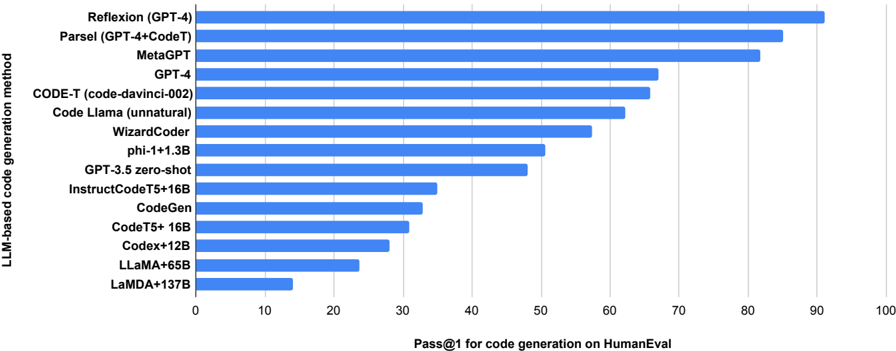
“At the time of writing, the best code generation model, Reflexion [76], can generate correct code for over 90% of the generation tasks.”
MethodCompetition-level code generation with AlphaCode
Li, Y., Choi, D., Chung, J., Kushman, N., Schrittwieser, J., Leblond, R., Eccles, T., Keeling, J., Gimeno, F., Dal Lago, A., et al. (2022) · Science · doi:10.1126/science.abq1158 · Cited by 1,043
Teaching Large Language Models to Self-Debug
Chen, X., Lin, M., Schärli, N., & Zhou, D. (2023) · arXiv · doi:10.48550/arxiv.2304.05128 · Cited by 812 · cited 1×
“Chen et al. [150] introduced SELF-DEBUGGING, which teaches an LLM to debug its predicted code via few-shot learning, SELF-DEBUGGING reports baseline accuracy improvements of up to 12%.”
MethodVaithilingam, P., Zhang, T., & Glassman, E. L. (2022) · CHI Conference on Human Factors in Computing Systems Extended Abstracts · doi:10.1145/3491101.3519665 · Cited by 660
Harnessing the power of llms in practice: a survey on chatGPT and beyond
Yang, J., Jin, H., Tang, R., Han, X., Feng, Q., Jiang, H., Zhong, S., Yin, B., & Hu, X. (2024) · ACM Transactions on Knowledge Discovery from Data · doi:10.1145/3649506 · Cited by 644
ReAct: Synergizing Reasoning and Acting in Language Models
Yao, S., Zhao, J., Yu, D., Du, N., Shafran, I., Narasimhan, K., & Cao, Y. (2022) · arXiv · doi:10.48550/arxiv.2210.03629 · Cited by 608
A systematic evaluation of large language models of code
Xu, F. F., Alon, U., Neubig, G., & Hellendoorn, V. J. (2022) · Proceedings of the 6th ACM SIGPLAN International Symposium on Machine Programming · doi:10.1145/3520312.3534862 · Cited by 540
Code Llama: Open Foundation Models for Code
Rozière, B., Gehring, J., Gloeckle, F., Sootla, S., Gat, I., Tan, X. E., Adi, Y., Liu, J., Sauvestre, R., Remez, T., et al. (2023) · arXiv · doi:10.48550/arxiv.2308.12950 · Cited by 531 · cited 1×
“On the 24 th. August 2023, Meta released open-sourced Code Llama [29], a state-of-the-art for publicly available LLMs on coding tasks.”
BackgroundA Categorical Archive of ChatGPT Failures
Borji, A. (2023) · doi:10.21203/rs.3.rs-2895792/v1 · Cited by 514
Le Goues, C., Pradel, M., & Roychoudhury, A. (2019) · Communications of the ACM · doi:10.1145/3318162 · Cited by 410
Liu, J., Xia, C. S., Wang, Y., & Zhang, L. (2023) · Advances in Neural Information Processing Systems 36 · doi:10.52202/075280-0943 · Cited by 384 · cited 1×
“Liu et al. [90] draw attention to the problem, showing how existing test suites can lead to high degrees of false positive conclusions (also a serious problem for online judge platforms [89]).”
BackgroundAn Empirical Study on Learning Bug-Fixing Patches in the Wild via Neural Machine Translation
Tufano, M., Watson, C., Bavota, G., Penta, M. D., White, M., & Poshyvanyk, D. (2019) · ACM Transactions on Software Engineering and Methodology · doi:10.1145/3340544 · Cited by 370
CodeGen: An Open Large Language Model for Code with Multi-Turn Program Synthesis
Nijkamp, E., Pang, B., Hayashi, H., Tu, L., Wang, H., Zhou, Y., Savarese, S., & Xiong, C. (2022) · arXiv · doi:10.48550/arxiv.2203.13474 · Cited by 330
Deng, Y., Xia, C. S., Peng, H., Yang, C., & Zhang, L. (2023) · Proceedings of the 32nd ACM SIGSOFT International Symposium on Software Testing and Analysis · doi:10.1145/3597926.3598067 · Cited by 326
An empirical evaluation of GitHub copilot's code suggestions
Nguyen, N., & Nadi, S. (2022) · Proceedings of the 19th International Conference on Mining Software Repositories · doi:10.1145/3524842.3528470 · Cited by 313 · cited 1×
“Evaluations have often relied on small programming problems from programming courses [86], synthetically generated problem sets [87], and online judging platforms such as Leetcode [28], [64], [88].”
BackgroundCodaMosa: Escaping Coverage Plateaus in Test Generation with Pre-trained Large Language Models
Lemieux, C., Inala, J. P., Lahiri, S. K., & Sen, S. (2023) · 2023 IEEE/ACM 45th International Conference on Software Engineering (ICSE) · doi:10.1109/icse48619.2023.00085 · Cited by 306 · cited 3×
“For example, Lemieux et al. [100] introduced CODAMOSA, an algorithm that combines Search-Based Software Testing (SBST) [5] and CodeX to generate high-coverage test cases for programs under test.”
BackgroundMethodThe Impact of AI on Developer Productivity: Evidence from GitHub Copilot
Peng, S., Kalliamvakou, E., Cihon, P., & Demirer, M. (2023) · arXiv · doi:10.48550/arxiv.2302.06590 · Cited by 287 · cited 1×
“Similarly, Peng et al. [39] reported that programmers could complete a non-trivial task (implementing an HTTP server in JavaScript) 56% faster when paired with GitHub Copilot, compared to the control group that did not receive any such support.”
MethodDenny, P., Kumar, V., & Giacaman, N. (2023) · Proceedings of the 54th ACM Technical Symposium on Computer Science Education V. 1 · doi:10.1145/3545945.3569823 · Cited by 287
Toward automatic program synthesis
Manna, Z., & Waldinger, R. J. (1971) · Communications of the ACM · doi:10.1145/362566.362568 · Cited by 285
WebGPT: Browser-assisted question-answering with human feedback
Nakano, R., Hilton, J., Balaji, S., Wu, J., Ouyang, L., Kim, C., Hesse, C., Jain, S., Kosaraju, V., Saunders, W., et al. (2021) · arXiv · doi:10.48550/arxiv.2112.09332 · Cited by 272
ChatGPT and Software Testing Education: Promises & Perils
Jalil, S., Rafi, S., LaToza, T. D., Moran, K., & Lam, W. (2023) · 2023 IEEE International Conference on Software Testing, Verification and Validation Workshops (ICSTW) · doi:10.1109/icstw58534.2023.00078 · Cited by 270 · cited 1×
“For example, Jalil et al. [212] explored opportunities for (and issues with) ChatGPT in software testing education.”
BackgroundAn Empirical Study of the Non-Determinism of ChatGPT in Code Generation
Ouyang, S., Zhang, J. M., Harman, M., & Wang, M. (2025) · ACM Transactions on Software Engineering and Methodology · doi:10.1145/3697010 · Cited by 258 · cited 3×
“LLMs are inherently nondeterministic: the same prompt produces different answers on different inference executions (unless the temperature is set to zero, which has often been found to be suboptimal over multiple executions) [9].”
BackgroundInfluentialSelf-citationSelf-collaboration code generation via ChatGPT
Dong, Y., Jiang, X., Jin, Z., & Li, G. (2024) · ACM Transactions on Software Engineering and Methodology · doi:10.1145/3672459 · Cited by 256 · cited 1×
“Dong et al. [72] treated LLMs as agents, letting multiple LLMs play distinct roles in addressing code generation tasks collaboratively and interactively.”
BackgroundInvestigating Explainability of Generative AI for Code through Scenario-based Design
Sun, J., Liao, Q. V., Muller, M., Agarwal, M., Houde, S., Talamadupula, K., & Weisz, J. D. (2022) · 27th International Conference on Intelligent User Interfaces · doi:10.1145/3490099.3511119 · Cited by 219 · cited 1×
“Sun et al. [82] focus on users’ explainability needs for generative AI in three software engineering use cases: code generation based on natural language description (with Copilot), translation between different programming languages (with Transcoder), and code autocompletion (with Copilot).”
MethodA Large-Scale Survey on the Usability of AI Programming Assistants: Successes and Challenges
Liang, J. T., Yang, C., & Myers, B. A. (2023) · arXiv · doi:10.48550/arxiv.2303.17125 · Cited by 206
A Large-Scale Survey on the Usability of AI Programming Assistants: Successes and Challenges
Liang, J. T., Yang, C., & Myers, B. A. (2024) · Proceedings of the IEEE/ACM 46th International Conference on Software Engineering · doi:10.1145/3597503.3608128 · Cited by 203
InCoder: A Generative Model for Code Infilling and Synthesis
Fried, D., Aghajanyan, A., Lin, J., Wang, S., Wallace, E., Shi, F., Zhong, R., Yih, W.-T., Zettlemoyer, L., & Lewis, M. (2022) · arXiv · doi:10.48550/arxiv.2204.05999 · Cited by 187 · cited 1×
“For example, Murali et al. [37] reported the experience of deploying CodeCompose, a code completion tool based on the Incoder LLM [38], at Meta.”
MethodTowards Human-Bot Collaborative Software Architecting with ChatGPT
Ahmad, A., Waseem, M., Liang, P., Fahmideh, M., Aktar, M. S., & Mikkonen, T. (2023) · Proceedings of the 27th International Conference on Evaluation and Assessment in Software Engineering · doi:10.1145/3593434.3593468 · Cited by 168
Taking Flight with Copilot: Early insights and opportunities of AI-powered pair-programming tools
Bird, C., Ford, D., Zimmermann, T., Forsgren, N., Kalliamvakou, E., Lowdermilk, T., & Gazit, I. (2022) · Queue · doi:10.1145/3582083 · Cited by 158
Effective test generation using pre-trained Large Language Models and mutation testing
Dakhel, A. M., Nikanjam, A., Majdinasab, V., Khomh, F., & Desmarais, M. C. (2024) · Information and Software Technology · doi:10.1016/j.infsof.2024.107468 · Cited by 157
Learning Performance-Improving Code Edits
Shypula, A., Madaan, A., Zeng, Y., Alon, U., Gardner, J., Hashemi, M., Neubig, G., Ranganathan, P., Bastani, O., & Yazdanbakhsh, A. (2023) · arXiv · doi:10.48550/arxiv.2302.07867 · Cited by 146 · cited 1×
“In the work by Madaan et al. [169], the authors use CODEGEN and CodeX to suggest functionally correct, Performance-Improving Edits (PIEs), improving execution time of Python and C++ (already pre-optimised with the maximally optimising compiler option -O3 ).”
MethodGunasekar, S., Zhang, Y., Aneja, J., Mendes, C. C. T., Del Giorno, A., Gopi, S., Javaheripi, M., Kauffmann, P., de Rosa, G., Saarikivi, O., et al. (2023) · arXiv · doi:10.48550/arxiv.2306.11644 · Cited by 138
Wei, Y., Xia, C. S., & Zhang, L. (2023) · Proceedings of the 31st ACM Joint European Software Engineering Conference and Symposium on the Foundations of Software Engineering · doi:10.1145/3611643.3616271 · Cited by 115
SWE-bench: Can Language Models Resolve Real-World GitHub Issues?
Jimenez, C. E., Yang, J., Wettig, A., Yao, S., Pei, K., Press, O., & Narasimhan, K. (2023) · arXiv · doi:10.48550/arxiv.2310.06770 · Cited by 72 · cited 1×
“It also proposed 4 types of features for generative AI: AI documentation, model uncertainty, attention distribution, and social trans-parency (i.e., making visible the socio-organizational factors that govern the use of AI).”
BackgroundLarge Language Models (GPT) Struggle to Answer Multiple-Choice Questions about Code
Savelka, J., Agarwal, A., Bogart, C., & Sakr, M. (2023) · arXiv · doi:10.48550/arxiv.2303.08033 · Cited by 56
Large Language Models in Fault Localisation
Wu, Y., Li, Z., Zhang, J. M., Papadakis, M., Harman, M., & Liu, Y. (2023) · arXiv · doi:10.48550/arxiv.2308.15276 · Cited by 28
Self-citationImproving Code Autocompletion with Transfer Learning
Zhou, W., Kim, S., Murali, V., & Aye, G. A. (2021) · arXiv · doi:10.48550/arxiv.2105.05991 · cited 1×
“For example, transfer learning has been proposed as a way to improve code completion performance when the volume of training examples for a specific programming language is inadequate [91].”
Background
Research works printed but not linked: 195
- Ma, 2023, The scope of ChatGPT in software engineering: A thorough investigation
- 10.1016/j.jss.2013.02.061 · DOI
- 10.1145/2408776.2408795 · DOI
- 10.1109/ICST.2015.7102580 · DOI
- 10.1109/TSE.2014.2372785 · DOI · Paper page
- Shin, 2023, Assessing evaluation met-rics for neural test oracle generation, arXiv preprint
- 10.1109/TEVC.2017.2693219 · DOI
- Cantino, 2021, Prompt engineering tips and tricks with GPT-3
- Ouyang, 2023, Llm is like a box of chocolates: the non-determinism of chatgpt in code generation, arXiv prnote
- 10.1145/1321631.1321749 · DOI
- 10.1145/2379776.2379787 · DOI
- 10.1145/1985793.1985795 · DOI
- 10.1007/978-3-642-25231-0_1 · DOI
- Hou, 2023, Large language models for software engineering: A systematic literature review, arXiv prnote
- Goyal, 2023, News summarization and evaluation in the era of gpt-3
- Xie, 2023, A survey for biomedical text summarization: From pre-trained to large language models
- Kheiri, 2023, Sentimentgpt: Exploiting gpt for advanced sentiment analysis and its departure from current machine learning
- Vaswani, 2017, Attention is all you need
- Zhao, Github Copilot now has a better AI model and new capabilities
- 2023, GitHub CEO says Copilot will write 80% of code sooner than later
- 2023, OpenAI, GPT-4 Technical report
- Bubeck, 2023, Sparks of Artificial General Intelligence: Early experiments with GPT-4
- 10.1109/MS.2003.1241365 · DOI
- 10.1007/978-3-540-69062-7_8 · DOI
- 10.1109/icngn59831.2023.10396810 · DOI
- 10.1145/3551349.3560417 · DOI
- Luitel, 2023, Improving requirements completeness: Automated assistance through large language models, arXiv prnote
- 10.1145/1595696.1595728 · DOI
- Murali, 2023, Codecompose: A large-scale industrial deployment of ai-assisted code authoring
- 10.1561/2500000010 · DOI
- 10.1109/ICSE.2012.6227135 · DOI · Paper page
- 10.1145/2635868.2635898 · DOI
- 10.1145/1882291.1882315 · DOI
- 10.1145/321992.321996 · DOI
- Nijkamp, 2023, Codegen2: Lessons for training llms on programming and natural languages
- 10.1145/3491102.3501870 · DOI · Paper page
- 10.1615/JMachLearnModelComput.2023048492 · DOI
- 10.1109/CAIN58948.2023.00031 · DOI
- Li, 2023, Towards Enhancing In-Context Learning for Code Generation
- Doderlein, 2023, Pi-loting Copilot and Codex: Hot Temperature, Cold Prompts, or Black Magic?
- He, 2023, Controlling Large Language Models to Generate Secure and Vulnerable Code
- White, 2023, ChatGPT Prompt Patterns for Improving Code Quality, Refactoring, Requirements Elicitation, and Software Design
- 10.1109/ICSE48619.2023.00179 · DOI · Paper page
- 10.1109/iccad57390.2023.10323812 · DOI
- Jiang, 2023, Selfevolve: A code evolution framework via large language models, arXiv prnote
- 10.18653/v1/2023.acl-long.45 · DOI
- Ahmed, 2023, Improving Few-Shot Prompts with Relevant Static Analysis Products
- Shin, 2023, Prompt engineering or fine tuning: An empirical assessment of large language models in automated software engineering tasks, arXiv preprint
- Zhang, 2023, Planning with large language models for code generation, arXiv prnote
- Jiang, 2023, Self-planning Code Generation with Large Language Model
- Zhang, 2023, Toolcoder: Teach code generation models to use api search tools
- Chen, 2023, CODET: Code Generation With Generated Tests
- Inala, 2022, Fault-aware neural code rankers
- 10.1145/3510003.3510203 · DOI
- Poldrack, 2023, AI-assisted coding: Experiments with GPT-4
- Yetistiren, 2023, Evaluating the Code Quality of AI-Assisted Code Generation Tools: An Empirical Study on GitHub Copilot, Amazon CodeWhisperer, and ChatGPT
- Dinh, 2023, Large language models of code fail at completing code with potential bugs
- 10.1109/BotSE59190.2023.00008 · DOI
- Yan, 2023, Coco: Testing code generation systems via concretized instructions
- 10.1145/3545945.3569785 · DOI · Paper page
- Noever, 2023, Chatbots as fluent polyglots: Revisiting breakthrough code snippets
- Mohammadkhani, 2022, Ex-plainable ai for pre-trained code models: What do they learn? when they do not work?, arXiv preprint
- Hajipour, 2023, Systematically Finding Security Vulnerabilities in Black-Box Code Generation Models
- 10.1109/SMC53992.2023.10394237 · DOI · Paper page
- 10.1145/3611643.3617845 · DOI
- 10.1145/3587102.3588792 · DOI · Paper page
- Liu, 2023, A comprehensive evalu-ation of ChatGPTs zero-shot Text-to-SQL capability
- 10.1145/3597926.3598060 · DOI
- 10.1145/3510457.3513061 · DOI
- Turing, Checking a large routine, 67
- 10.1109/tse.2024.3368208/mm1 · DOI
- 10.1109/ICSE48619.2023.00178 · DOI
- Yuan, 2023, No More Manual Tests? Evaluating and Improving ChatGPT for Unit Test Generation
- BareiB, 2022, Code generation tools (almost) for free? a study of few-shot, pre-trained language models on code, arXiv prnote
- 10.1145/1297846.1297902 · DOI
- Hashtroudi, 2023, Automated test case generation using code models and domain adaptation, arXiv preprint
- Siddiq, 2023, Exploring the Effectiveness of Large Language Models in Generating Unit Tests
- Hu, 2023, Augmenting greybox fuzzing with generative ai
- Xia, 2023, Universal fuzzing via large language models, arXiv preprint
- 10.1145/3597926.3598067 · DOI · Paper page
- Li, 2023, Finding Failure-Inducing Test Cases with ChatGPT
- Sun, 2023, Automatic code summarization via ChatGPT: How far are we
- 10.1109/icse48619.2023.00194 · DOI · Paper page
- 10.1145/3597503.3608137 · DOI
- Yuan, 2023, No more manual tests? evaluating and improving chatgpt for unit test generation
- Schafer, 2023, Adaptive Test Generation Using a Large Language Model
- Xie, 2023, ChatUniTest: a ChatGPT-based automated unit test generation tool
- 10.1145/3377811.3380420 · DOI
- 10.1145/3510003.3510206 · DOI
- Wang, 2023, Self-consistency improves chain of thought rea-soning in language models
- 10.1145/120807.120814 · DOI
- 10.1109/FOSE.2007.25 · DOI
- 10.1109/TSE.2010.62 · DOI
- 10.1016/bs.adcom.2018.03.015 · DOI
- 10.1109/ICSE.2017.61 · DOI
- Khanfir, 2023, Efficient mutation testing via pre-trained language models
- Garg, 2023, Vulnerability Mimicking Mutants
- 10.1007/978-3-031-48796-5_13 · DOI
- Pan, 2023, LTM: Scalable and Black-box Similarity-based Test Suite Minimization based on Language Models
- 10.18653/v1/2023.findings-acl.308 · DOI
- 10.1109/SCAM.2018.00009 · DOI
- 10.1109/AST58925.2023.00018 · DOI
- 10.1109/tse.2022.3201209 · DOI
- Fatima, 2023, Black-box prediction of flaky test fix categories using language models
- 10.1109/ASE.2008.32 · DOI
- 10.1002/stvr.435 · DOI
- 10.1002/stvr.1696 · DOI
- 10.1145/2568225.2568314 · DOI
- 10.1109/ASE56229.2023.00148 · DOI · Paper page
- Kang, 2023, A preliminary evaluation of llm-based fault localization
- 10.1145/3597503.3608137 · DOI
- 10.1609/aaai.v37i4.25642 · DOI · Paper page
- Wu, 2023, Condefects: A new dataset to address the data leakage concern for llm-based fault localization and program repair
- 10.1109/ISSRE59848.2023.00055 · DOI
- 10.1109/tse.2011.104 · DOI
- Huang, 2023, A sur-vey on automated program repair techniques
- 10.1109/ICSE-SEIP.2019.00039 · DOI
- 10.1145/3524459.3527353 · DOI
- 10.1145/3105906 · DOI
- 10.1016/S0950-5849(01)00189-6 · DOI
- 10.1145/3540250.3549101 · DOI · Paper page
- 10.1109/ICSE48619.2023.00129 · DOI · Paper page
- Xia, 2023, Conversational Automated Program Repair
- Xia, 2023, Keep the Conversation Going: Fixing 162 out of 337 bugs for $0.42 each using ChatGPT
- 10.1109/sp46215.2023.10179420 · DOI
- Charalambous, 2023, A new era in software security: Towards self-healing software via large language models and formal verification
- Cao, 2023, A study on Prompt Design, Advantages and Limitations of ChatGPT for Deep Learning Program Repair
- Fakhoury, 2023, Towards Generating Functionally Correct Code Edits from Natural Language Issue Descriptions
- 10.1109/ICSE48619.2023.00149 · DOI · Paper page
- 10.1109/ICSE48619.2023.00125 · DOI · Paper page
- 10.1145/3611643.3613892 · DOI · Paper page
- Berabi, 2021, TFix: Learning to fix coding errors with a text-to-text transformer, 139, 780
- Xia, 2023, Revisiting the plastic surgery hypothesis via large language models
- Kang, 2023, Explainable automated debugging via large language model-driven scientific debugging
- 10.1007/978-3-031-48796-5_12 · DOI
- Lovelace, Sketch of the analytical engine invented by Charles Babbage by L. F. Menabrea of Turin, officer of the military engineers, with notes by the translator, 1843, translation with notes on article in italian in Bibliotheque Universelle de Geneve
- Aho, 1986, Compilers: Principles, techniques and tools
- 10.1007/BF00263742 · DOI
- 10.1007/978-3-642-46490-4_27 · DOI
- Koza, 1992, Genetic Programming: On the Programming of Computers by Means of Natural Selection
- 10.1145/1629575.1629585 · DOI
- 10.1145/2593929.2600116 · DOI
- 10.1109/tevc.2013.2281544 · DOI
- 10.1145/3540250.3549096 · DOI · Paper page
- 10.1109/GI59320.2023.00013 · DOI
- Garg, 2023, Rapgen: An approach for fixing code inefficiencies in zero-shot
- Chen, 2023, Supersonic: Learning to generate source code optimisations in c/c++
- Cummins, 2023, Large language models for compiler optimization
- 10.1145/130844.130856 · DOI
- 10.1109/ICSE-Companion58688.2023.00013 · DOI
- 10.1016/j.jss.2023.111796 · DOI
- 10.18653/v1/2023.findings-acl.678 · DOI · Paper page
- 10.1016/j.infsof.2016.11.009 · DOI
- Halstead, 1977, Elements of Software Science
- 10.1109/TSE.1976.233837 · DOI · Paper page
- 10.1109/TSE.2018.2827066 · DOI
- 10.1145/2568225.2568321 · DOI
- 10.1145/1389095.1389437 · DOI
- 10.1145/2739480.2754648 · DOI
- 10.1145/2351676.2351678 · DOI
- Gamma, 1995, Design Patterns
- 10.1109/TSE.2021.3067156 · DOI
- Sun, 2023, Automatic Code Summarization via ChatGPT: How Far Are We
- Geng, 2023, An Empirical Study on Using Large Language Models for Multi-Intent Comment Generation
- 10.1145/3597503.3608134 · DOI
- 10.1109/MS.2013.86 · DOI
- 10.1109/FOSM.2008.4659248 · DOI
- 10.1109/TSE.2016.2630689 · DOI · Paper page
- 10.1109/MS.2018.290111035 · DOI
- 10.1142/9789812775245_0014 · DOI
- 10.1007/978-1-4471-2239-5 · DOI
- 10.1109/MS.2017.4541027 · DOI
- 10.1145/24574.24583 · DOI
- 10.1109/MC.2008.541 · DOI
- 10.1109/COMPSAC57700.2023.00117 · DOI · Paper page
- Pressman, 1992, Software Engineering: A Practitioners Approach
- 10.1145/3475716.3484196 · DOI
- Cornes, 1995, The coq proof assistant, reference manual, version 5.10
- 10.1109/ICSM.1992.242538 · DOI
- 10.1109/ICSM.1989.65225 · DOI
- 10.1145/3581641.3584037 · DOI
- Tian, 2023, Is ChatGPT the Ultimate Programming Assistant - How far is it?
- Meckler, 2022, Teachers are on alert for inevitable cheating after release of ChatGPT, The Washington post
- Heaven, 2023, ChatGPT is going to change education, not destroy it, MIT Technology review
- 10.5220/0011996900003470 · DOI
- 10.1145/3501385.3543957 · DOI · Paper page
- 10.1145/3597503.3608140 · DOI
- Rae, 2022, Scaling language models: Methods, analysis & insights from training gopher
- Henderson, 2020, Towards the systematic reporting of the energy and carbon footprints of machine learning, J. Mach. Learn. Res., 21
- Hoffmann, 2022, Training compute-optimal large language models
- Polino, 2018, Model compression via distillation and quantization
- Manes, 2018, The art, science, and engineering of fuzzing: A survey, CoRR, abs/1812.00140 · arXiv
- 10.1109/ESEM56168.2023.10304803 · DOI
- Tang, 2023, ChatGPT vs SBST: A comparative assessment of unit test suite generation
- 10.18653/v1/2022.emnlp-main.823 · DOI · Paper page
Cited by
Sorted by citations
A survey on large language model (LLM) security and privacy: The Good, The Bad, and The Ugly
Yao, Y., Duan, J., Xu, K., Cai, Y., Sun, Z., & Zhang, Y. (2024) · High-Confidence Computing · doi:10.1016/j.hcc.2024.100211 · Cited by 1,083
A Survey on the Memory Mechanism of Large Language Model-based Agents
Zhang, Z., Dai, Q., Bo, X., Ma, C., Li, R., Chen, X., Zhu, J., Dong, Z., & Wen, J.-R. (2025) · ACM Transactions on Information Systems · doi:10.1145/3748302 · Cited by 592
Software Testing With Large Language Models: Survey, Landscape, and Vision
Wang, J., Huang, Y., Chen, C., Liu, Z., Wang, S., & Wang, Q. (2024) · IEEE Transactions on Software Engineering · doi:10.1109/tse.2024.3368208 · Cited by 573
Generative AI in cybersecurity: A comprehensive review of LLM applications and vulnerabilities
Ferrag, M. A., Alwahedi, F., Battah, A., Cherif, B., Mechri, A., Tihanyi, N., Bisztray, T., & Debbah, M. (2025) · Internet of Things and Cyber-Physical Systems · doi:10.1016/j.iotcps.2025.01.001 · Cited by 148
Generative AI for self-adaptive systems: State of the art and research roadmap
Li, J., Zhang, M., Li, N., Weyns, D., Jin, Z., & Tei, K. (2024) · ACM Transactions on Autonomous and Adaptive Systems · doi:10.1145/3686803 · Cited by 77
Metadata
- Authors
- Fan, A., Gokkaya, B., Harman, M., Lyubarskiy, M., Sengupta, S., Yoo, S., & Zhang, J. M.
- Affiliations
- Meta (United States) (US)
- Meta (United Kingdom) (GB)
- Korea Advanced Institute of Science and Technology (KR)
- King's College London (GB)
- Venue
- 2023 IEEE/ACM International Conference on Software Engineering: Future of Software Engineering (ICSE-FoSE)
- Publisher
- IEEE
- Published
- 2023-05-14
- Pages
- 31-53
- OpenAlex
- W4392414327
- Cited by
- 650
- References
- 45
- Citations by year
- 2026: 227 · 2025: 266 · 2024: 153 · 2023: 4
- FWCI
- 150.01
- Type
- conference paper
- Language
- en
- Open access
- green
- arxiv.org
- Locations
- IEEE/ACM International Conference on Software Engineering: Future of Software Engineering (ICSE-FoSE) (publishedVersion)
- arXiv (Cornell University) (submittedVersion, cc-by)
- UCL Discovery (University College London) (submittedVersion)
- arXiv (Cornell University) (cc-by)
- Topics
- Physical Sciences › Computer Science › Information Systems › Software Engineering Research
- Physical Sciences › Computer Science › Information Systems › Software Engineering Techniques and Practices
- Physical Sciences › Computer Science › Software › Advanced Software Engineering Methodologies
- Keywords
- large language models, software engineering, code generation, program repair, refactoring, requirements engineering, software documentation, performance improvement, hallucination mitigation, hybrid technique, emergent properties
About these checks
Registry, retraction, Cites and statistics results are computed, not judged, with one exception: a printed reference that no index lists is read once by a model before it counts as a citation error. Claims are extracted by a model and kept only when their quote appears verbatim in the text; each cited source is then checked, with a model’s help, for whether it says what the claim relies on. Those verdicts can be wrong — read the claim’s quote and the cited source before relying on one.
Statistics and arithmetic are recomputed, not judged.
Confidence bands are shown only for fields calibrated on our annotated test set. None is calibrated yet, so no band is shown.
What counts as a claim ›How we measure confidence ›How we check this ›
Are you an author, or do you see a problem with this page? Request a review
