

The DOI matches its Crossref record; 13 of the 13 references it cites were found in a registry or an index.
How Fast Do Algorithms Improve? [Point of View]
Abstract
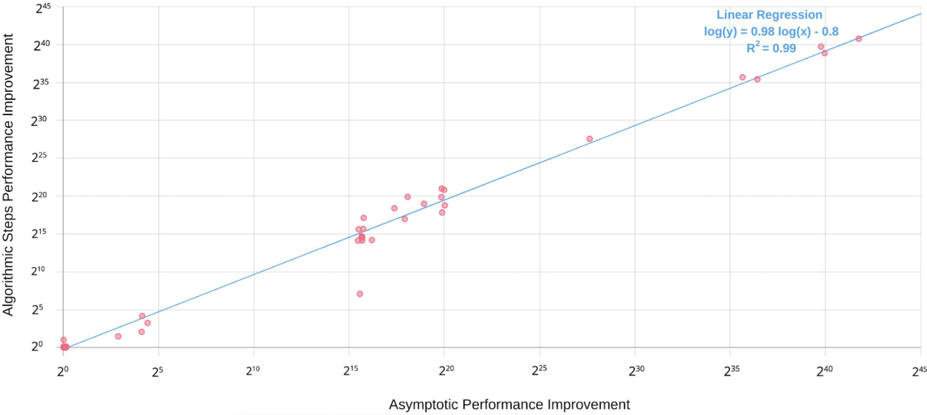
Algorithms determine which calculations computers use to solve problems and are one of the central pillars of computer science. As algorithms improve, they enable scientists to tackle larger problems and explore new domains and new scientific techniques[1],[2]. Bold claims have been made about the pace of algorithmic progress. For example, the President’s Council of Advisors on Science and Technology (PCAST), a body of senior scientists that advise the U.S. President, wrote in 2010 that “in many areas, performance gains due to improvements in algorithms have vastly exceeded even the dramatic performance gains due to increased processor speed”[3]. However, this conclusion was supported based on data from progress in linear solvers[4], which is just a single example. With no guarantee that linear solvers are representative of algorithms in general, it is unclear how broadly conclusions, such as PCAST’s, should be interpreted. Is progress faster in most algorithms? Just some? How much on average?
Overview
The claims and statistics of this paper haven’t been checked yet.
Run the check — free, no account needed. It reads the open-access text and checks the sources it cites.
Integrity signals
Registry
Cites
Statistics
Figures
Verification
Claims the paper makes
The claims and statistics of this paper haven’t been checked yet.
Run the check — free, no account needed. It reads the open-access text and checks the sources it cites.
Claims other papers make about this one
Each is checked against this paper’s own text: does it say what the citing paper says it does?
In the citing paper
“This estimate falls within the range of confidence intervals of the estimated rates of algorithmic progress in computer vision (Erdil and Besiroglu 2022), sample efficiency improvements in reinforcement learning (Dorner 2021), and the rates observed for common algorithm families (Sherry and Thompson 2021) for certain input sizes.”
From Algorithmic progress in language models (2024) · cites this paper as Sherry and Thompson 2021
Self-check
Percentages, sums and reported differences re-computed from the paper’s own numbers.
The self-check needs the paper’s full text.
Citations
Cites
Adhi Harmoko, S., M.Komp, Jacquard, J. M., Zuse, K., & Eniac (2005) · Cited by 18,035
Computer Architecture: A Quantitative Approach
Hennessy, J. L., & Patterson, D. A. (1989) · UCLA - Biblioteca de Ciencias y Tecnologia Felix Morales Bueno · Cited by 9,370
Grossman, P. (2009) · Discrete Mathematics for Computing · doi:10.1007/978-0-230-37405-8_1 · Cited by 8,834
Research, Patenting, and Technological Change
Kortum, S. S. (1997) · Econometrica · doi:10.2307/2171741 · Cited by 916
There’s plenty of room at the Top: What will drive computer performance after Moore’s law?
Leiserson, C. E., Thompson, N. C., Emer, J. S., Kuszmaul, B. C., Lampson, B. W., Sanchez, D., & Schardl, T. B. (2020) · Science · doi:10.1126/science.aam9744 · Cited by 469
Self-citationKnuth, D. E. (1971) · Acta Informatica · doi:10.1007/bf00264289 · Cited by 443
Solving Real-World Linear Programs: A Decade and More of Progress
Bixby, R. E. (2002) · Operations Research · doi:10.1287/opre.50.1.3.17780 · Cited by 386
Optimal Computer Search Trees and Variable-Length Alphabetical Codes
Hu, T. C., & Tucker, A. C. (1971) · SIAM Journal on Applied Mathematics · doi:10.1137/0121057 · Cited by 287
Bentley, J. L. (1984) · Communications of the ACM · doi:10.1145/358234.381162 · Cited by 247
Faster Algorithms for Rectangular Matrix Multiplication
Gall, F. L. (2012) · Annual Symposium on Foundations of Computer Science · doi:10.1109/focs.2012.80 · Cited by 154
Research works printed but not linked: 8
- thompson, 2020, The computation limits of deep learning, arXiv 2007 05558
- manohara, 2018, Netflix Optimized Encodes
- ismail, 0, Why Algorithms Are the Future of Business Success
- bentley, 2006, Programming Pearls
- holdren, 2010, President Council of Advisors on Science and Technology
- 0, Division of Physics Computational and Data-Enabled Science and Engineering (CDS&E)—National Science Foundation
- 0, Division of Computing and Communication Foundations CCF Algorithmic Foundations (AF)—National Science Foundation
- 2018, TopUniversities QS World Rankings
Cited by
The Computational Limits of Deep Learning
Thompson, N. C., Greenewald, K., Lee, K., & Manso, G. F. (2020) · arXiv · doi:10.48550/arxiv.2007.05558 · Cited by 538
Self-citationLearning Performance-Improving Code Edits
Shypula, A., Madaan, A., Zeng, Y., Alon, U., Gardner, J., Hashemi, M., Neubig, G., Ranganathan, P., Bastani, O., & Yazdanbakhsh, A. (2023) · arXiv · doi:10.48550/arxiv.2302.07867 · Cited by 146
“…2022; Kumar et al., 2022), auto-vectorize code (Nuzman et al., 2006; Mendis et al., 2019), optimize GPU code (Liou et al., 2020; Cummins et al., 2021), and automatically select algorithms (Kotthoff, 2016; Kerschke et al., 2019). and room at the top (Leiserson et al., 2020; Sherry & Thompson, 2021).”
MethodAlgorithmic progress in language models
Ho, A., Besiroglu, T., Erdil, E., Owen, D., Rahman, R., Guo, Z. C., Atkinson, D., Thompson, N., & Sevilla, J. (2024) · arXiv · doi:10.48550/arxiv.2403.05812 · Cited by 16
Self-citation
Metadata
- Authors
- Sherry, Y., & Thompson, N. C.
- ORCID
- Thompson, Neil C.
- Venue
- Proceedings of the IEEE
- Published
- 2021-11
- Volume
- 109
- Issue
- 11
- Pages
- 1768-1777
- ISSN
- 0018-9219
- 1558-2256
- Cited by
- 14
- References
- 13
About these checks
Registry, retraction, Cites and statistics results are computed, not judged, with one exception: a printed reference that no index lists is read once by a model before it counts as a citation error. Claims are extracted by a model and kept only when their quote appears verbatim in the text; each cited source is then checked, with a model’s help, for whether it says what the claim relies on. Those verdicts can be wrong — read the claim’s quote and the cited source before relying on one.
Statistics and arithmetic are recomputed, not judged.
Confidence bands are shown only for fields calibrated on our annotated test set. None is calibrated yet, so no band is shown.
What counts as a claim ›How we measure confidence ›How we check this ›
Are you an author, or do you see a problem with this page? Request a review
Data sources
Bibliographic data: Semantic Scholar, OpenAlex, Crossref.
Contains information from the Semantic Scholar Academic Graph Datasets, made available under the ODC Attribution License (ODC-BY 1.0).
Semantic Scholar’s data is described in: Kinney, R., et al. (2023). The Semantic Scholar Open Data Platform. arXiv:2301.10140.
