

Backscatter Characteristics of Snow Avalanches for Mapping With Local Resolution Weighting
Open accessThe DOI matches its Crossref record; 29 of the 29 references it cites were found in a registry or an index; none of the 43 sources its claims cite is checked for support yet.
Abstract
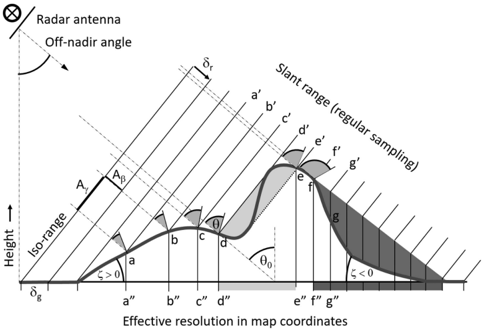
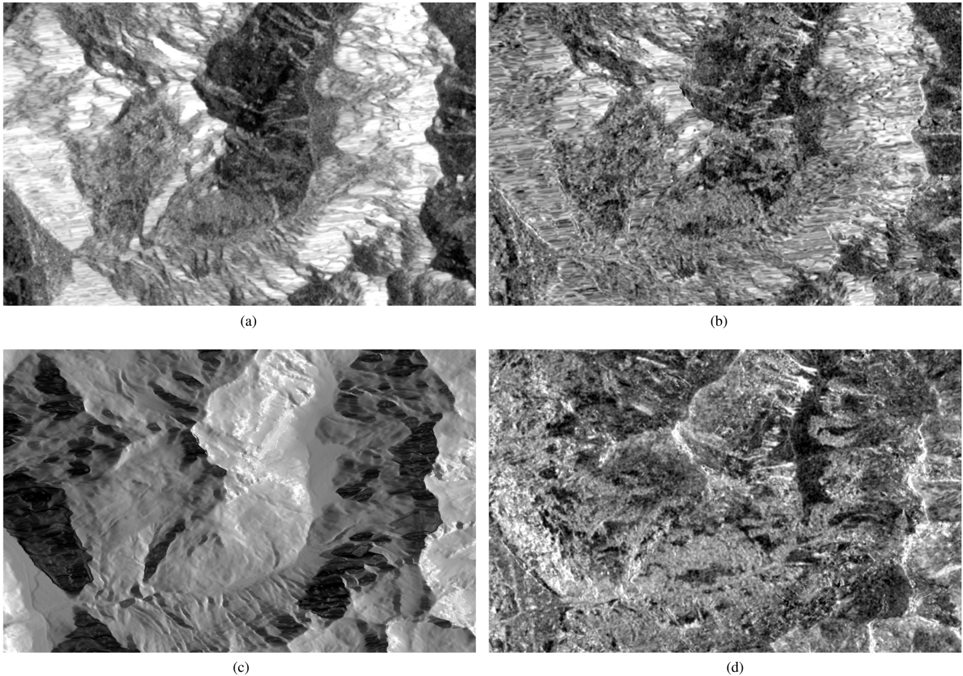
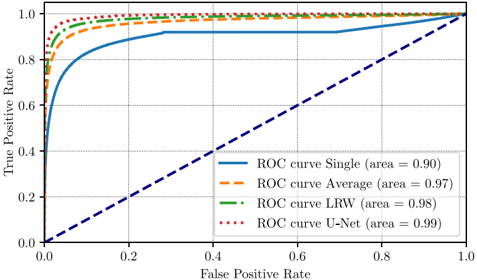
Snow avalanches cause a sudden change of snow properties making them detectable with synthetic aperture radar (SAR). However, steep alpine terrain combined with the slant view geometry of SAR sensors complicates detection: the avalanche brightness depends on the incidence angle and the observed area is limited by radar layover and shadow. Likewise, the spatial resolution varies strongly with the local incidence angle relative to the terrain. To increase the avalanche brightness and to improve the imaging coverage and resolution we apply local resolution weighting (LRW) on Sentinel-1 (S1) backscatter images from ascending and descending orbits. LRW merges acquisitions by averaging them, weighted with the local ground-range resolution. To analyze the relative avalanche brightness with respect to the local incidence angle and polarization, and to quantify the benefit of LRW, we created a dataset of 914 manually drawn avalanche outlines based on S1 imagery of an extreme avalanche event on January 4, 2018 in the Swiss Alps. We show that avalanches appear brightest at slopes facing away from the radar at local incidence angles of$55\pm 20^\circ$; such slopes are weighted considerably stronger through LRW. With a processing pipeline for avalanche segmentation using a fixed threshold on the backscatter difference we obtain a higher F1 score (0.75) with LRW compared to an unweighted orbit average (F1 = 0.68) or single orbit acquisitions (F1 = 0.5). For automatic segmentation, we used the manually drawn dataset for training and testing of a deep neural U-Net and achieved a F1 score of 0.81 on LRW backscatter differences.
Overview
CoChat Summary
TL;DR
The paper evaluates local resolution weighting (LRW) for Sentinel-1 avalanche mapping by merging ascending and descending backscatter images weighted by local ground-range resolution. Using 914 manually drawn avalanche outlines from the 4 January 2018 Swiss Alps event, it finds avalanches are brightest at local incidence angles around 55 ± 20° and that LRW improves both threshold and U-Net segmentation.
Key findings
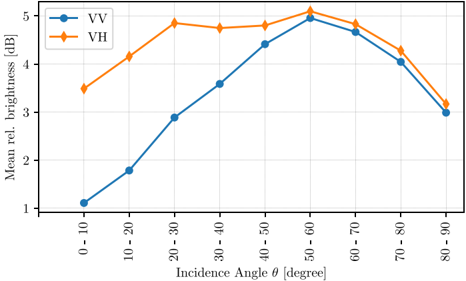
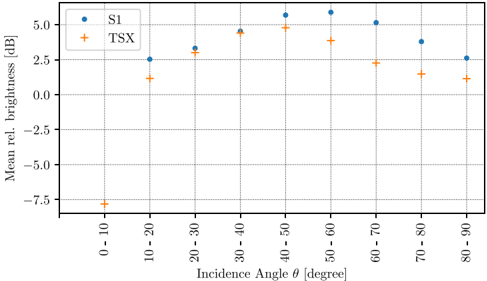
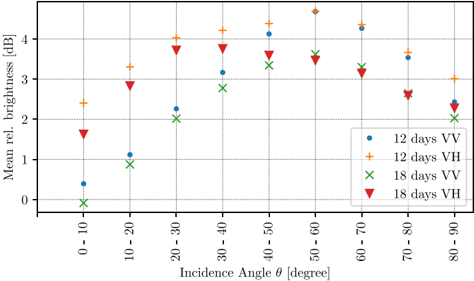
- Avalanche relative brightness peaks between 40° and 70° local incidence angle for VV and VH; VV brightness drops by up to 4 dB at small angles near layover, while VH is about 2 dB brighter at small angles; brightness also decreases for θ > 70°.
- Threshold segmentation on LRW images achieved F1 = 0.75, compared with F1 = 0.68 for an unweighted orbit average and F1 = 0.5 for single-orbit acquisitions.
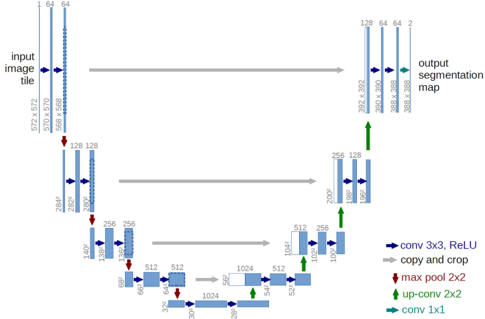
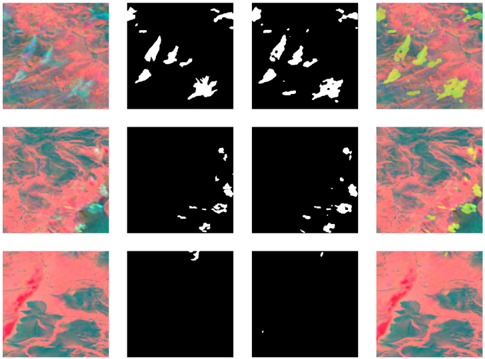
- A U-Net trained on LRW difference images (VV, VH, DEM slope) achieved F1 = 0.81 on the test set.
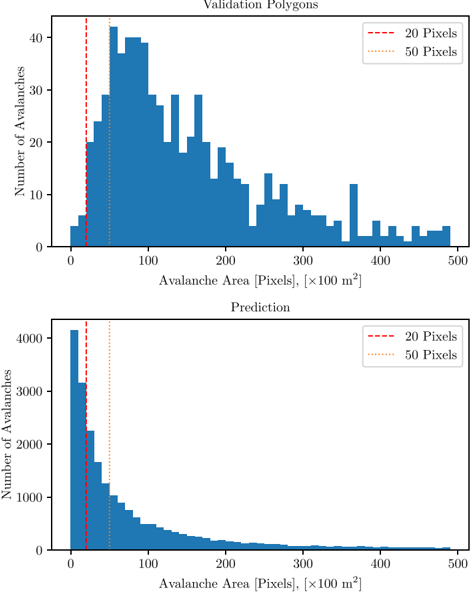
- For the 4 January 2018 event, the U-Net counted 9636 avalanches larger than 50 pixels across the Swiss Alps, while a previous manual count reported 7361.
Methods
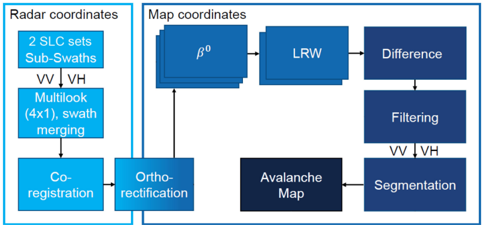
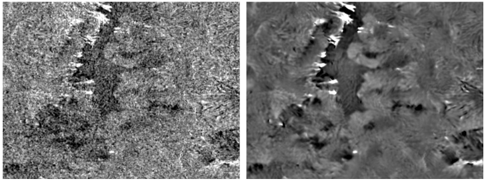
- Sentinel-1 IW SLC images (VV/VH) from ascending and descending orbits were multilooked (4×1), coregistered, orthorectified to 10 m using a DEM, radiometrically terrain corrected, and merged with LRW using weights inversely proportional to illuminated area; pre/post differences were computed in dB and filtered with nonlocal mean and high-pass filters.
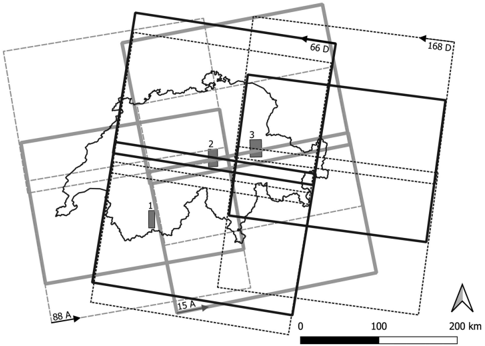
- Dataset: 914 manually drawn avalanche outlines in three Swiss Alps study areas (Wallis, Central CH, East of CH) for the extreme avalanche event on 4 January 2018; avalanches covered about 2% of the area.
- Analyses: relative avalanche brightness versus local incidence angle using a surrounding-ring median; threshold segmentation with training/test tiles (1:2 split) to optimize F1; U-Net segmentation with 256×256 tiles split 60:30:10, trained for 100 epochs with SGD (lr 10⁻⁴, momentum 0.99) and binary cross-entropy.
Limitations
- The authors state the dataset covers only wet snow conditions, though they believe results hold qualitatively for dry snow; LRW reduces temporal resolution because merged ascending/descending frames can be up to 2.5 days apart, so exact release time is not determinable and avalanches occurring between merged acquisitions may lose contrast or become undetectable.
- The authors note the U-Net can be improved (e.g., transfer learning, weighted loss for the 2% class imbalance) and that predictions are biased toward small avalanches/fragmented patches; they suggest a 20-pixel lower bound and 50-pixel threshold to reduce false predictions, and note S1 cannot detect avalanches below 2000 m² (20 pixels).
- Evident from the text: the U-Net advantage over threshold was not extremely large (F1 0.81 vs. 0.75), and the dataset is less varied in snow conditions than some prior work; appendix comparisons with TerraSAR-X used a smaller dataset, one study area, and had layover/shadow exclusions and up to one-day timing differences.
Model-written summary. Check it against the paper before relying on it.
Integrity signals
Registry
Cites
Statistics
Figures


Verification
Claims the paper makes
0 Valid · 3 Not valid · 35 Not checked · 100 Own results and interpretations
A result the paper reports from its own data — it cites no other source for it, so there is none to check. The quote shows it is in the paper.
In the paper
“For automatic segmentation, we used the manually drawn dataset for training and testing of a deep neural U-Net and achieved a F1 score of 0.81 on LRW backscatter differences.”
§ Backscatter Characteristics of Snow Avalanches for Mapping With Local Resolution Weighting > Abstract
plain- Asserted: passes — The authors put it forward as true.
- Checkable: passes — It can be checked against evidence.
- Load-bearing: passes — The paper’s conclusions depend on it.
- Based: passes — The paper gives a reason why it holds.
- Rests on an assumption not shown here.
A result the paper reports from its own data — it cites no other source for it, so there is none to check. The quote shows it is in the paper.
In the paper
“We show that avalanches appear brightest at slopes facing away from the radar at local incidence angles of 55 ± 20 • ; such slopes are weighted considerably stronger through LRW.”
§ Backscatter Characteristics of Snow Avalanches for Mapping With Local Resolution Weighting > Abstract
plainstates an association- Asserted: passes — The authors put it forward as true.
- Checkable: passes — It can be checked against evidence.
- Load-bearing: passes — The paper’s conclusions depend on it.
- Based: passes — The paper gives a reason why it holds.
- Rests on an assumption not shown here.
A result the paper reports from its own data — it cites no other source for it, so there is none to check. The quote shows it is in the paper.
In the paper
“However, relative to the drawn polygons, the prediction's avalanche area distribution has a strong bias toward small avalanches, as shown by the histograms in Fig. 10.”
§ Backscatter Characteristics of Snow Avalanches for Mapping With Local Resolution Weighting > D. Avalanches Count in the Swiss Alps for January 4, 2018
boostedstates an association- Asserted: passes — The authors put it forward as true.
- Checkable: passes — It can be checked against evidence.
- Load-bearing: unclear — It is unclear whether the paper’s conclusions depend on it.
- Based: passes — The paper gives a reason why it holds.
A result the paper reports from its own data — it cites no other source for it, so there is none to check. The quote shows it is in the paper.
In the paper
“The relative brightness of avalanches is maximal between 40 • and 70 • for both polarizations.”
§ Backscatter Characteristics of Snow Avalanches for Mapping With Local Resolution Weighting > A. Avalanche Brightness Versus Incidence Angle
plainstates an association- Asserted: passes — The authors put it forward as true.
- Checkable: passes — It can be checked against evidence.
- Load-bearing: passes — The paper’s conclusions depend on it.
- Based: passes — The paper gives a reason why it holds.
- Rests on an assumption not shown here.
A result the paper states — it cites no source for it, so there is none to check. The quote shows it is in the paper.
In the paper
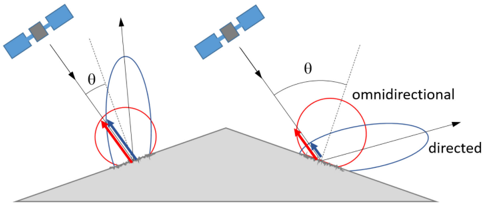
“For the VH polarization, avalanches appear around 2 dB brighter at small incidence angles, likely because the VH polarization does not detect the strong specular reflected radiation in the preimage.”
§ Backscatter Characteristics of Snow Avalanches for Mapping With Local Resolution Weighting > A. Avalanche Brightness Versus Incidence Angle
hedgedstates an association- Asserted: passes — The authors put it forward as true.
- Checkable: passes — It can be checked against evidence.
- Load-bearing: unclear — It is unclear whether the paper’s conclusions depend on it.
- Based: passes — The paper gives a reason why it holds.
- Rests on an assumption not shown here.
61 more claims
Create a free account to see all 138 claims and every source verdict.
- It may state two separate claims as one. 45
- Probably not a substantial claim. 39
Self-check
Percentages, sums and reported differences re-computed from the paper’s own numbers.
Each contradiction between two passages listed here was confirmed by an independent check.
Rated minor: it would not touch a result — a value no result rests on, a p-value that stays on the same side of the significance level, or a conflict that is clerical, resolved elsewhere in the paper, or outside its own findings.
In the paper
§ Backscatter Characteristics of Snow Avalanches for Mapping With Local Resolution Weighting > B. Avalanche Brightness Degradation Over Time
“Figure: 10 Fig. 10 . Fig. 10.Histogram of the number of manually outlined avalanches in the validation polygons (top) and obtained with automatic mapping (bottom) with respect to the area in pixels for the entire Swiss Alps for August 4, 2018.”
§ Backscatter Characteristics of Snow Avalanches for Mapping With Local Resolution Weighting > D. Avalanches Count in the Swiss Alps for January 4, 2018
“## D. Avalanches Count in the Swiss Alps for January 4, 2018”
Rated minor: it would not touch a result — a value no result rests on, a p-value that stays on the same side of the significance level, or a conflict that is clerical, resolved elsewhere in the paper, or outside its own findings.
In the paper
§ Backscatter Characteristics of Snow Avalanches for Mapping With Local Resolution Weighting > Abstract
“Bianchi et al. applied a U-Net on S1 images of Norway and achieved an F1 score of 66% at mapping avalanches [15].”
§ Backscatter Characteristics of Snow Avalanches for Mapping With Local Resolution Weighting > E. Avalanche Segmentation With a U-Net
“That our F1 score of 0.81 is a lot higher than the 0.61 produced in [15] can have two reasons.”
Citations
Cites
U-Net: Convolutional Networks for Biomedical Image Segmentation
Ronneberger, O., Fischer, P., & Brox, T. (2015) · Lecture notes in computer science · doi:10.1007/978-3-319-24574-4_28 · Cited by 99,404
A Non-Local Algorithm for Image Denoising
Buades, A., Coll, B., & Morel, J.-M. (2005) · 2005 IEEE Computer Society Conference on Computer Vision and Pattern Recognition (CVPR'05) · doi:10.1109/cvpr.2005.38 · Cited by 7,616 · cited 2×
“For an edge-preserving reduction of speckle noise-reduction, we apply a nonlocal mean filter [23] to the difference LRWdiff,dB, which is illustrated in Fig.”
MethodSynthetic aperture radar interferometry
Rosen, P. A., Hensley, S., Joughin, I. R., Li, F. K., Madsen, S. N., Rodriguez, E., & Goldstein, R. M. (2000) · Proceedings of the IEEE · doi:10.1109/5.838084 · Cited by 2,670
An empirical model and an inversion technique for radar scattering from bare soil surfaces
Oh, Y., Sarabandi, K., & Ulaby, F. T. (1992) · IEEE Transactions on Geoscience and Remote Sensing · doi:10.1109/36.134086 · Cited by 1,495 · cited 3×
“As TSX has a smaller wavelength λ, for a given rms height of the roughness s, the EM surface roughness ks = 2π λ s [18] is larger for TSX than for S1.”
BackgroundMicrowave Radar and Radiometric Remote Sensing
Ulaby, F., & Long, D. (2014) · University of Michigan Press eBooks · doi:10.3998/0472119356 · Cited by 1,415 · cited 2×
“[17] scattering from very small surface roughness is predominantly (forward)”
BackgroundFlattening Gamma: Radiometric Terrain Correction for SAR Imagery
Small, D. (2011) · IEEE Transactions on Geoscience and Remote Sensing · doi:10.1109/tgrs.2011.2120616 · Cited by 577 · cited 3×
“In a first step, the terrain dependent backscatter amplitudes are radiometrically terrain corrected (flattened, [20]) by dividing pixel-wise the backscatter intensity by the actual terrain area illuminated per pixel of the SAR sensor.”
BackgroundMethodInfluentialDeep learning approaches to biomedical image segmentation
Rizwan I Haque, I., & Neubert, J. (2020) · Informatics in Medicine Unlocked · doi:10.1016/j.imu.2020.100297 · Cited by 456 · cited 3×
“We trained the network with a binary cross entropy loss function [32] and then used it to produce an avalanche map for each study area in Switzerland.”
BackgroundMethodInfluentialRemote sensing of snow avalanches: Recent advances, potential, and limitations
Eckerstorfer, M., Bühler, Y., Frauenfelder, R., & Malnes, E. (2015) · Cold Regions Science and Technology · doi:10.1016/j.coldregions.2015.11.001 · Cited by 170
Satellite InSAR Data: Reservoir Monitoring from Space (EET 9)
Ferretti, A. (2014) · EAGE Publications bv eBooks · doi:10.3997/9789073834712 · Cited by 136
Bühler, Y., Hafner, E. D., Zweifel, B., Zesiger, M., & Heisig, H. (2019) · The Cryosphere · doi:10.5194/tc-13-3225-2019 · Cited by 101 · cited 3×
“Because the manual mapping of avalanche outlines from satellite images on pixel level is extremely laborious [2], the development of”
BackgroundSnow Avalanche Segmentation in SAR Images With Fully Convolutional Neural Networks
Bianchi, F. M., Grahn, J., Eckerstorfer, M., Malnes, E., & Vickers, H. (2020) · IEEE Journal of Selected Topics in Applied Earth Observations and Remote Sensing · doi:10.1109/jstars.2020.3036914 · Cited by 76 · cited 4×
“On the one hand, our dataset is less varied in snow conditions than that of [15], which used”
BackgroundMethodInfluentialEckerstorfer, M., Malnes, E., & Müller, K. (2017) · Cold Regions Science and Technology · doi:10.1016/j.coldregions.2017.08.004 · Cited by 73
Eckerstorfer, M., Vickers, H., Malnes, E., & Grahn, J. (2019) · Remote Sensing · doi:10.3390/rs11232863 · Cited by 72
Raney, R. K., Freeman, T., Hawkins, R., & Bamler, R. (2005) · IEEE International Geoscience and Remote Sensing Symposium (IGARSS) · doi:10.1109/igarss.1994.399352 · Cited by 72 · cited 1×
“The SLC files of the S1 subswaths are multilooked (4x1) and merged to a single swath radar brightness image β [22].”
BackgroundManual detection of snow avalanche debris using high-resolution Radarsat-2 SAR images
Eckerstorfer, M., & Malnes, E. (2015) · Cold Regions Science and Technology · doi:10.1016/j.coldregions.2015.08.016 · Cited by 66 · cited 2×
“This supports qualitative arguments presented in previous work [16], [7].”
BackgroundResultLeinss, S., Wicki, R., Holenstein, S., Baffelli, S., & Bühler, Y. (2020) · Natural hazards and earth system sciences · doi:10.5194/nhess-20-1783-2020 · Cited by 52
Self-citationVickers, H., Eckerstorfer, M., Malnes, E., Larsen, Y., & Hindberg, H. (2016) · Earth and Space Science · doi:10.1002/2016ea000168 · Cited by 49 · cited 2×
“bodies, forests, and other areas with a very small probability of avalanches [10], [8].”
BackgroundAutomatic detection of snow avalanche debris in central Svalbard using C-band SAR data
Wesselink, D. S., Malnes, E., Eckerstorfer, M., & Lindenbergh, R. (2017) · Polar Research · doi:10.1080/17518369.2017.1333236 · Cited by 43
Avalanche Detection in Sar Images Using Deep Learning
Waldeland, A. U., Reksten, J. H., & Salberg, A.-B. (2018) · IEEE International Geoscience and Remote Sensing Symposium (IGARSS) · doi:10.1109/igarss.2018.8517536 · Cited by 41 · cited 1×
“Random forests and convolutional neural networks are used to improve the classification of potential avalanche areas obtained from adaptive backscatter thresholds [11], [12].”
MethodSAR backscatter multitemporal compositing via local resolution weighting
Small, D. (2012) · IEEE International Geoscience and Remote Sensing Symposium (IGARSS) · doi:10.1109/igarss.2012.6350465 · Cited by 31 · cited 4×
“Further benefits of the method are the higher coverage, reduced noise level, and increased and homogeneous local resolution [19].”
BackgroundMethodInfluentialFirst Sentinel-1 detections of avalanche debrisPreprint
Malnes, E., Eckerstorfer, M., & Vickers, H. (2015) · doi:10.5194/tcd-9-1943-2015 · Cited by 29
Radiometric Terrain Correction Incorporating Local Antenna Gain
Small, D., Jehle, M., Meier, E. H., & Nüesch, D. (2004) · Cited by 19
Automatic detection and mapping of avalanches in SAR images
Hamar, J. B., Salberg, A.-B., & Ardelean, F. (2016) · IEEE International Geoscience and Remote Sensing Symposium (IGARSS) · doi:10.1109/igarss.2016.7729173 · Cited by 18 · cited 1×
“Random forests and convolutional neural networks are used to improve the classification of potential avalanche areas obtained from adaptive backscatter thresholds [11], [12].”
MethodDetecting Avalanche Deposits using Variational Autoencoder on Sentinel-1 Satellite Imagery
Sinha, S., Giffard‐Roisin, S., Karbou, F., Deschâtres, M., Karas, A., Eckert, N., & Monteleoni, C. (2019) · HAL · Cited by 13
SPOT6 Avalanche outlines 24 January 2018
Hafner, E. D., & Bühler, Y. (2019) · doi:10.16904/envidat.77 · Cited by 10
SPOT6 Avalanche outlines 16 January 2019
Hafner, E. D., & Bühler, Y. (2021) · doi:10.16904/envidat.235 · Cited by 9
Contributors (2020) · Canadian Jewish Studies / Études juives canadiennes · doi:10.25071/1916-0925.40177
Leinss, S., Wicki, R., Holenstein, S., Baffelli, S., & Bühler, Y. (2020) · doi:10.5194/nhess-2019-373 · cited 7×
“Larger incidence angles, favored by LRW, provide not only a higher spatial resolution, but it has also been qualitatively argued that larger incidence angles should lead to a stronger brightness of avalanches [7].”
BackgroundMethodResultInfluentialSelf-citationEckerstorfer, M., Vickers, H., Malnes, E., & Grahn, J. (2019) · doi:10.20944/preprints201910.0341.v1 · cited 4×
“bodies, forests, and other areas with a very small probability of avalanches [10], [8].”
BackgroundMethodInfluential
Research works printed but not linked: 3
- S. Sinha et al., "Detecting avalanche deposits using variational autoen- coder on Sentinel-1 satellite imagery," in Proc. NeurIPS Workshop: Tack- ling Climate Change Mach. Learn. NeurIPS Workshop, Dec. 2019.
- F. Karbou et al., "Monitoring avalanche debris in the french mountains using SAR observations from Sentinel-1 satellites," in Proc. Int. Snow Sci. Workshop, vol. 1, no. 1, 2018, pp. 344-347.
- SLF, "Avalanche Bulletin," 2018. [Online]. Available: https://www.slf.ch/ en/avalanche-bulletin-and-snow-situation.htmlavalanchedanger
Cited by
Karas, A., Karbou, F., Giffard‐Roisin, S., Durand, P., & Eckert, N. (2021) · IEEE Transactions on Geoscience and Remote Sensing · doi:10.1109/tgrs.2021.3131853 · Cited by 56
“[22] proved that a segmentation with a fixed threshold was more accurate on LRW images (F1 = 0.”
BackgroundMethodInfluentialDenissova, N., Nurakynov, S., Petrova, O., Chepashev, D., Daumova, G., & Yelisseyeva, A. (2024) · Atmosphere · doi:10.3390/atmos15111343 · Cited by 36
Caiserman, A., Sidle, R. C., & Gurung, D. R. (2022) · The Cryosphere · doi:10.5194/tc-16-3295-2022 · Cited by 32
“This technology seems very promising for avalanche detection (Eckerstorfer et al., 2017; Malnes et al., 2015; Martinez-Vazquez and Fortuny-Guasch, 2008; Schaffhauser et al., 2008; Tompkin and Leinss, 2021; Yang et al., 2020) .”
Automated snow avalanche monitoring for Austria: State of the art and roadmap for future work
Kapper, K. L., Goelles, T., Muckenhuber, S., Trügler, A., Abermann, J., Schlager, B., Gaisberger, C., Eckerstorfer, M., Grahn, J., Malnes, E., et al. (2023) · Frontiers in Remote Sensing · doi:10.3389/frsen.2023.1156519 · Cited by 29
“Steep mountainous terrain together with the slant view geometry of the SAR sensor makes detection more difficult (Tompkin and Leinss, 2021).”
BackgroundMapping and characterization of avalanches on mountain glaciers with Sentinel-1 satellite imagery
Kneib, M., Dehecq, A., Brun, F., Karbou, F., Charrier, L., Leinss, S., Wagnon, P., & Maussion, F. (2024) · The Cryosphere · doi:10.5194/tc-18-2809-2024 · Cited by 25
Self-citation
Metadata
- Authors
- Tompkin, C., & Leinss, S.
- Affiliations
- ETH Zurich (CH)
- Corresponding author
- Tompkin, Cedric
- Venue
- IEEE Journal of Selected Topics in Applied Earth Observations and Remote Sensing
- Published
- 2021
- Volume
- 14
- Pages
- 4452-4464
- ISSN
- 1939-1404 (ISSN-L)
- 2151-1535
- OpenAlex
- W3159303707
- Semantic Scholar
- 04b19040f839acced222aae998aad49f39c22eca
- Cited by
- 27
- References
- 26
- Citations by year
- 2026: 1 · 2025: 2 · 2024: 7 · 2023: 4 · 2022: 10 · 2021: 3
- FWCI
- 3.04
- Type
- journal article
- Language
- en
- Open access
- gold
- doi.org
- Locations
- IEEE Journal of Selected Topics in Applied Earth Observations and Remote Sensing (publishedVersion, cc-by)
- Repository for Publications and Research Data (ETH Zurich) (publishedVersion, cc-by)
- DOAJ (DOAJ: Directory of Open Access Journals) (submittedVersion)
- ETH Zürich Research Collection (cc-by)
- Funders
- ETH Zürich
- Topics
- Physical Sciences › Earth and Planetary Sciences › Geophysics › Synthetic Aperture Radar (SAR) Applications and Techniques
- Physical Sciences › Environmental Science › Management, Monitoring, Policy and Law › Landslides and related hazards
- Physical Sciences › Earth and Planetary Sciences › Atmospheric Science › Cryospheric studies and observations
- Keywords
- avalanches, avalanche detection, Sentinel-1, SAR backscatter, angle of incidence, U-Net, alpine terrain
About these checks
Registry, retraction, Cites and statistics results are computed, not judged, with one exception: a printed reference that no index lists is read once by a model before it counts as a citation error. Claims are extracted by a model and kept only when their quote appears verbatim in the text; each cited source is then checked, with a model’s help, for whether it says what the claim relies on. Those verdicts can be wrong — read the claim’s quote and the cited source before relying on one.
A language model drew the claims from the paper on 2026-11-23, under version 3 of the claim definition (model deepseek-v4.1-flash, prompt extract-v3).
A second model labelled each claim on 2026-11-23 (model jev-1.13-20260917, definition revision gold-guideline-v0.2).
Statistics and arithmetic are recomputed, not judged.
Confidence bands are shown only for fields calibrated on our annotated test set. None is calibrated yet, so no band is shown.
What counts as a claim ›How we measure confidence ›How we check this ›
Are you an author, or do you see a problem with this page? Request a review
Data sources
Bibliographic data: Semantic Scholar, OpenAlex, Crossref.
Contains information from the Semantic Scholar Academic Graph Datasets, made available under the ODC Attribution License (ODC-BY 1.0).
Semantic Scholar’s data is described in: Kinney, R., et al. (2023). The Semantic Scholar Open Data Platform. arXiv:2301.10140.
