

The DOI matches its Crossref record; 29 of the 30 references it cites were found in a registry or an index; none of the 32 sources its claims cite is checked for support yet.
Noise Morphing for Audio Time Stretching
Open accessAbstract
This letter introduces an innovative method to enhance the quality of audio time stretching by precisely decomposing a sound into sines, transients, and noise and by improving the processing of the latter component. While there are established methods for time-stretching sines and transients with high quality, the manipulation of noise or residual components has lacked robust solutions in prior research. The proposed method combines sound decomposition with previous techniques for audio spectral resynthesis. The time-stretched noise component is achieved by morphing its time-interpolated spectral magnitude with a white-noise excitation signal. This method stands out for its simplicity, efficiency, and audio quality. The results of a subjective experiment affirm the superiority of this approach over current state-of-the-art methods across all evaluated stretch factors. The proposed technique notably excels in extreme stretching scenarios, signifying a substantial elevation in performance. The proposed method holds promise for a wide range of applications in slow-motion media content, such as music or sports video production.
Overview
CoChat Summary
TL;DR
This letter proposes Noise Morphing (NM), a method for time-stretching the noise component of audio after sines-transients-noise (STN) decomposition by modulating white-noise spectra with time-interpolated log-magnitude spectra. A subjective listening test found NM generally superior to baseline time-scale modification methods across stretch factors, especially at extreme stretching.
Key findings
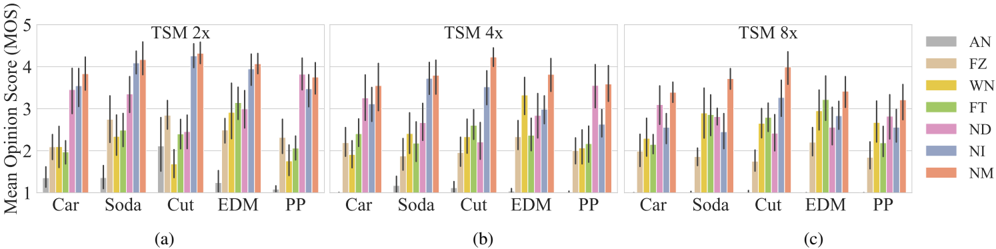
- The proposed NM method consistently achieved the highest Mean Opinion Scores (MOS) across all examples and TSM factors except one, according to the reported listening test.
- For α = 2, NM and the magnitude-replacement ablation (NI) performed similarly; for α = 4 and α = 8, NI received significantly lower scores in most examples.
- Noise morphing without transient decomposition (ND) performed poorly on examples with clear and frequent transients, such as Cut and EDM.
- The recommended Wilcoxon signed-rank test showed a general trend of statistical significance, despite occasional overlap in some distributions.
Methods
- The method first decomposes audio into sines, transients, and noise using soft spectral masking with median filtering and a two-stage STN decomposition; sines are stretched with a phase vocoder with identity phase locking, and transients are segmented and repositioned.
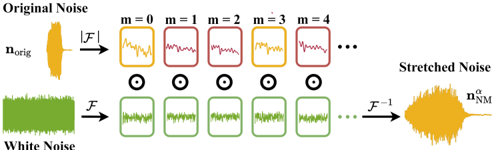
- For the noise component, the algorithm computes the STFT with a Hann window of 2048 samples (46 ms) and hop size of 1024 samples (23 ms) at 44.1 kHz, linearly interpolates log-magnitude spectra by the stretch factor α, generates a white Gaussian excitation signal of matching output length, normalizes its STFT by window energy, multiplies the noise spectral frames by the interpolated magnitude spectra, and applies inverse STFT.
- Evaluation used a variation of the MUSHRA test with 15 trials, 7 stimuli per set, 5 trials for each α = 2, 4, and 8, and 5 representative mono audio excerpts; 13 volunteers aged 26–35 with no hearing impairments participated. Baselines included a standard phase vocoder (AN), fuzzy phase vocoder (FZ), fuzzy phase vocoder with transient preservation (FT), a neural-synthesizer noise method (WN), and ablations ND and NI.
Limitations
- The paper states that qualitative comparison with Élastique commercial software was not directly addressed because third-party software was needed, precluding direct quantitative comparison in the controlled test environment.
- The paper states that only 5 representative audio excerpts were used because including more would have made the listening test lengthy and tiring.
- The paper states future work is needed to expand the method to stereo and multichannel audio signals.
- Evident from the text: the listening test used only 13 volunteers and 5 short mono excerpts, which limits generalizability; the text also notes there is no clear objective metric for audio time stretching.
Model-written summary. Check it against the paper before relying on it.
Integrity signals
Registry
Cites
Statistics
Figures
Verification
Claims the paper makes
0 Valid · 0 Not valid · 18 Not checked · 20 Own results and interpretations
A result the paper reports from its own data — it cites no other source for it, so there is none to check. The quote shows it is in the paper.
In the paper
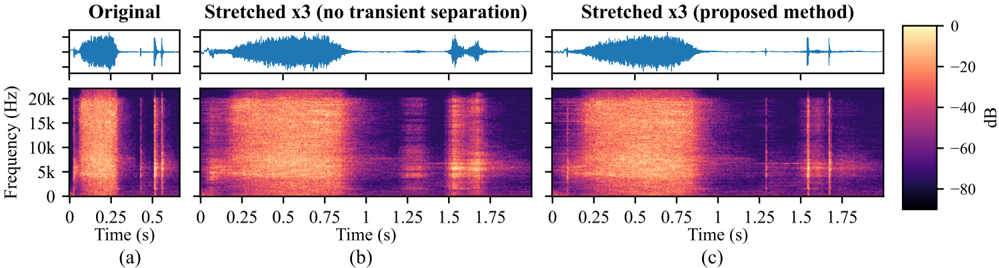
“In striking contrast, Fig. 2(c) showcases the proposed method's performance by preserving the transients between 1.5 and 1.75 s during the time-stretching process.”
boostedstates a causeSingle case- Asserted: passes — The authors put it forward as true.
- Checkable: passes — It can be checked against evidence.
- Load-bearing: passes — The paper’s conclusions depend on it.
- Based: passes — The paper gives a reason why it holds.
A result the paper reports from its own data — it cites no other source for it, so there is none to check. The quote shows it is in the paper.
In the paper
“Our observations suggest that the modulation approach of (7) yields a more organic effect, as the stochastic variations in the magnitude of the white-noise signal contribute to a perceptually smoother and less artifactprone sound.”
hedgedstates a cause- Asserted: passes — The authors put it forward as true.
- Checkable: passes — It can be checked against evidence.
- Load-bearing: passes — The paper’s conclusions depend on it.
- Based: passes — The paper gives a reason why it holds.
A result the paper reports from its own data — it cites no other source for it, so there is none to check. The quote shows it is in the paper.
In the paper
“For α = 2, NM and NI exhibited similar performance.”
plain- Asserted: passes — The authors put it forward as true.
- Checkable: passes — It can be checked against evidence.
- Load-bearing: unclear — It is unclear whether the paper’s conclusions depend on it.
- Based: passes — The paper gives a reason why it holds.
A result the paper reports from its own data — it cites no other source for it, so there is none to check. The quote shows it is in the paper.
In the paper
“However, as the stretching factor increased to α = 4 and α = 8, NI received significantly lower scores in most examples.”
plainstates an association- Asserted: passes — The authors put it forward as true.
- Checkable: passes — It can be checked against evidence.
- Load-bearing: passes — The paper’s conclusions depend on it.
- Based: passes — The paper gives a reason why it holds.
A result the paper reports from its own data — it cites no other source for it, so there is none to check. The quote shows it is in the paper.
In the paper
“The stretched noise is highlighted in Fig. 2(b), as well as the need for transient preservation: when the signal is stretched by a factor of 3, transients between 1.5 and 1.75 s are clearly smeared over time, resulting in a characteristic undesirable effect.”
boostedstates a causeSingle case- Asserted: passes — The authors put it forward as true.
- Checkable: passes — It can be checked against evidence.
- Load-bearing: passes — The paper’s conclusions depend on it.
- Based: passes — The paper gives a reason why it holds.
15 more claims
Create a free account to see all 38 claims and to verify the 32 references still open.
- It may state two separate claims as one. 15
- Probably not a substantial claim. 7
- The quote only partly states this claim. 1
Citations
Cites
Pitch-synchronous waveform processing techniques for text-to-speech synthesis using diphones
Moulines, E., & Charpentier, F. (1990) · Speech Communication · doi:10.1016/0167-6393(90)90021-z · Cited by 1,244
Serra, X., & Smith, J. (1990) · Computer Music Journal · doi:10.2307/3680788 · Cited by 338
Non-parametric techniques for pitch-scale and time-scale modification of speech
Moulines, É., & Laroche, J. (1995) · Speech Communication · doi:10.1016/0167-6393(94)00054-e · Cited by 289
Improved phase vocoder time-scale modification of audio
Laroche, J., & Dolson, M. (1999) · IEEE Transactions on Speech and Audio Processing · doi:10.1109/89.759041 · Cited by 276
webMUSHRA — A Comprehensive Framework for Web-based Listening Tests
Schoeffler, M., Bartoschek, S., Stöter, F.-R., Roess, M., Westphal, S., Edler, B., & Herre, J. (2018) · Journal of Open Research Software · doi:10.5334/jors.187 · Cited by 236
Automatic Technique in Frequency Domain for Near-Lossless Time-Scale Modification of Audio
Bonada, J. (2000) · Cited by 77
A Review of Time-Scale Modification of Music Signals
Driedger, J., & Müller, M. (2016) · Applied Sciences · doi:10.3390/app6020057 · Cited by 71
Extending Harmonic-Percussive Separation Of Audio Signals.
Driedger, J., Müller, M., & Disch, S. (2014) · doi:10.5281/zenodo.1415225 · Cited by 69
Improving Time-Scale Modification of Music Signals Using Harmonic-Percussive Separation
Driedger, J., Muller, M., & Ewert, S. (2014) · IEEE Signal Processing Letters · doi:10.1109/lsp.2013.2294023 · Cited by 64
Tachibana, H., Ono, N., & Sagayama, S. (2013) · IEEE/ACM Transactions on Audio Speech and Language Processing · doi:10.1109/taslp.2013.2287052 · Cited by 53
Research works printed but not linked: 8
- Vlimki, 2018, Creating endless sounds, 32
- Moinet, 2013, Slowdio: Audio time-scaling for slow motion sports videos
- Rbel, 2010, A shape-invariant phase vocoder for speech transformation, 298
- Verma, 1998, Time scale modification using a sines transients noise signal model, 49
- Moinet, 2013, Audio time-scaling for slow motion sports videos, 2
- Apel, 2014, Sinusoidality analysis and noise synthesis in phase vocoder based timestretching, 7
- 2015, BS.1534: Method for the Subjective Assessment of Intermediate Quality Levels of Coding Systems
- Mendona, 2018, Statistical tests with MUSHRA data, 10006
Cited by
IndieFake Dataset: A Benchmark Dataset for Audio Deepfake DetectionPreprint
Kumar, A., Verma, K., & More, O. (2025) · arXiv (Cornell University) · doi:10.48550/arxiv.2506.19014 · Cited by 2
Kao, S.-L., & Liu, Y.-W. (2025) · The Journal of the Acoustical Society of America · doi:10.1121/10.0037080 · Cited by 1
Metadata
- Authors
- Moliner, E., Fierro, L., Wright, A., Hämäläinen, M. S., & Välimäki, V.
- Affiliations
- Aalto University (FI)
- Nokia (Finland) (FI)
- Venue
- IEEE Signal Processing Letters
- Published
- 2024
- Volume
- 31
- Pages
- 1144-1148
- ISSN
- 1070-9908 (ISSN-L)
- 1558-2361
- OpenAlex
- W4394586068
- Semantic Scholar
- 77e6f4434246236ed82ac70a24925b14e70e31b1
- Cited by
- 2
- References
- 30
- Citations by year
- 2025: 2
- FWCI
- 0.31
- Type
- journal article
- Language
- en
- Open access
- hybrid
- dx.doi.org
- Locations
- IEEE Signal Processing Letters (publishedVersion, cc-by)
- arXiv (Cornell University) (submittedVersion, cc-by)
- Aaltodoc (Aalto University) (submittedVersion)
- Aaltodoc (Aalto University) (submittedVersion, cc-by)
- Edinburgh Research Explorer (University of Edinburgh) (submittedVersion, cc-by)
- arXiv (Cornell University) (cc-by)
- Funders
- Sähkötekniikan Korkeakoulu, Aalto-yliopisto
- Nokia Technologies
- Aalto-Yliopisto (400610)
- NordForsk (86892)
- Topics
- Physical Sciences › Computer Science › Signal Processing › Music and Audio Processing
- Physical Sciences › Computer Science › Signal Processing › Speech and Audio Processing
- Social Sciences › Arts and Humanities › Music › Music Technology and Sound Studies
- Keywords
- transients, white noise excitation
About these checks
Registry, retraction, Cites and statistics results are computed, not judged, with one exception: a printed reference that no index lists is read once by a model before it counts as a citation error. Claims are extracted by a model and kept only when their quote appears verbatim in the text; each cited source is then checked, with a model’s help, for whether it says what the claim relies on. Those verdicts can be wrong — read the claim’s quote and the cited source before relying on one.
A language model drew the claims from the paper on 2026-11-14, under version 3 of the claim definition (model deepseek-v4.1-flash, prompt extract-v3).
A second model labelled each claim on 2026-11-14 (model jev-1.13-20260917, definition revision gold-guideline-v0.2).
Statistics and arithmetic are recomputed, not judged.
Confidence bands are shown only for fields calibrated on our annotated test set. None is calibrated yet, so no band is shown.
What counts as a claim ›How we measure confidence ›How we check this ›
Are you an author, or do you see a problem with this page? Request a review
Data sources
Bibliographic data: Semantic Scholar, OpenAlex, Crossref.
Contains information from the Semantic Scholar Academic Graph Datasets, made available under the ODC Attribution License (ODC-BY 1.0).
Semantic Scholar’s data is described in: Kinney, R., et al. (2023). The Semantic Scholar Open Data Platform. arXiv:2301.10140.
