

RRSIS: Referring Remote Sensing Image Segmentation
Open accessThe DOI matches its Crossref record; 64 of the 64 references it cites were found in a registry or an index.
Abstract
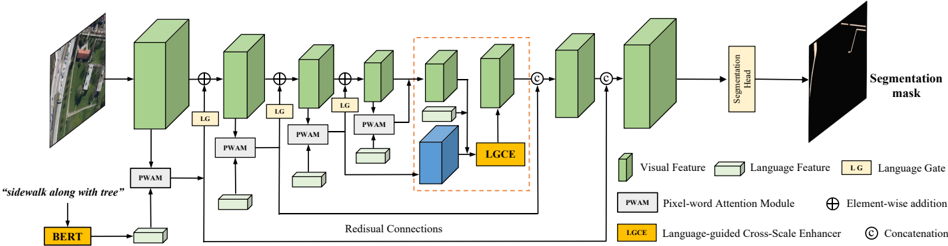
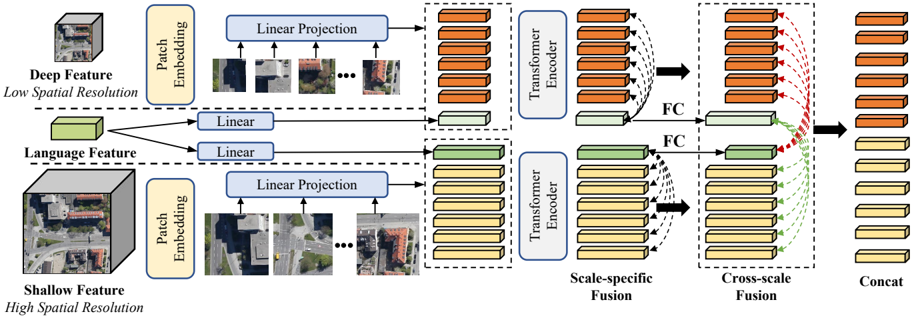
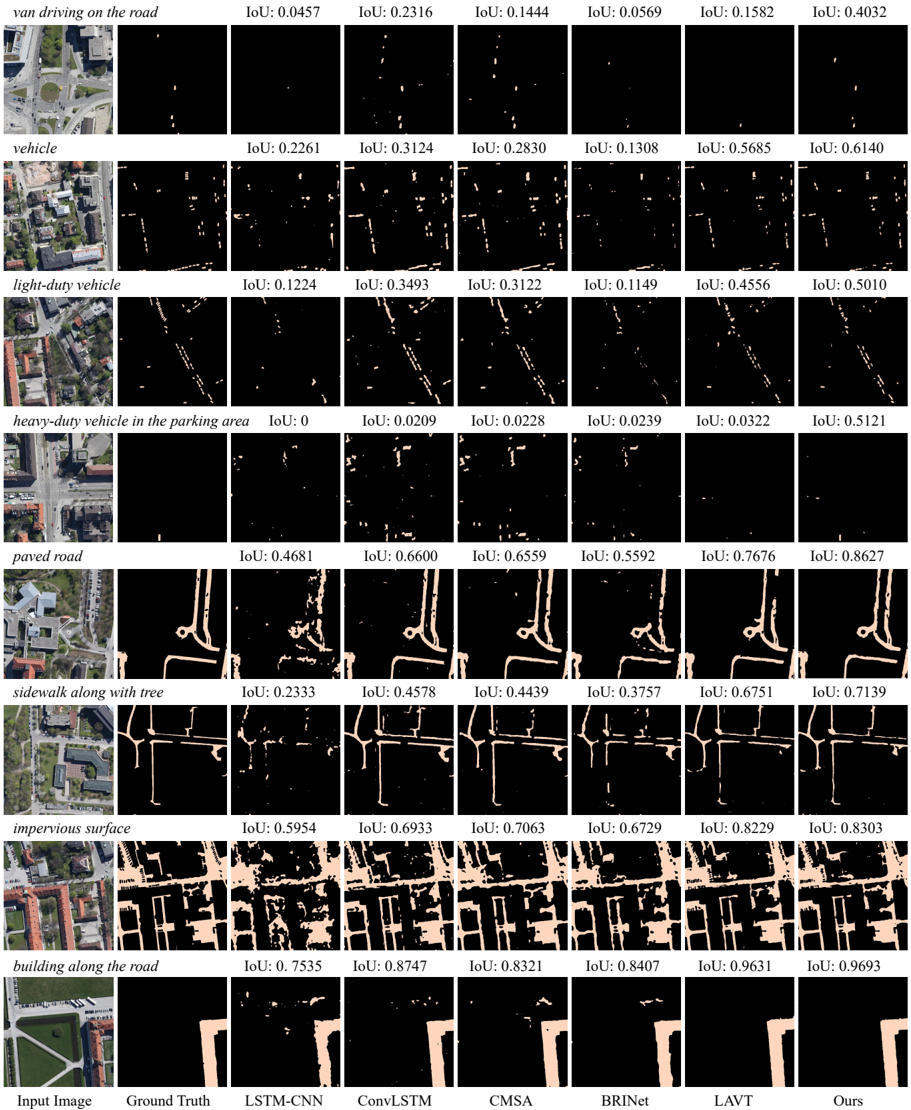
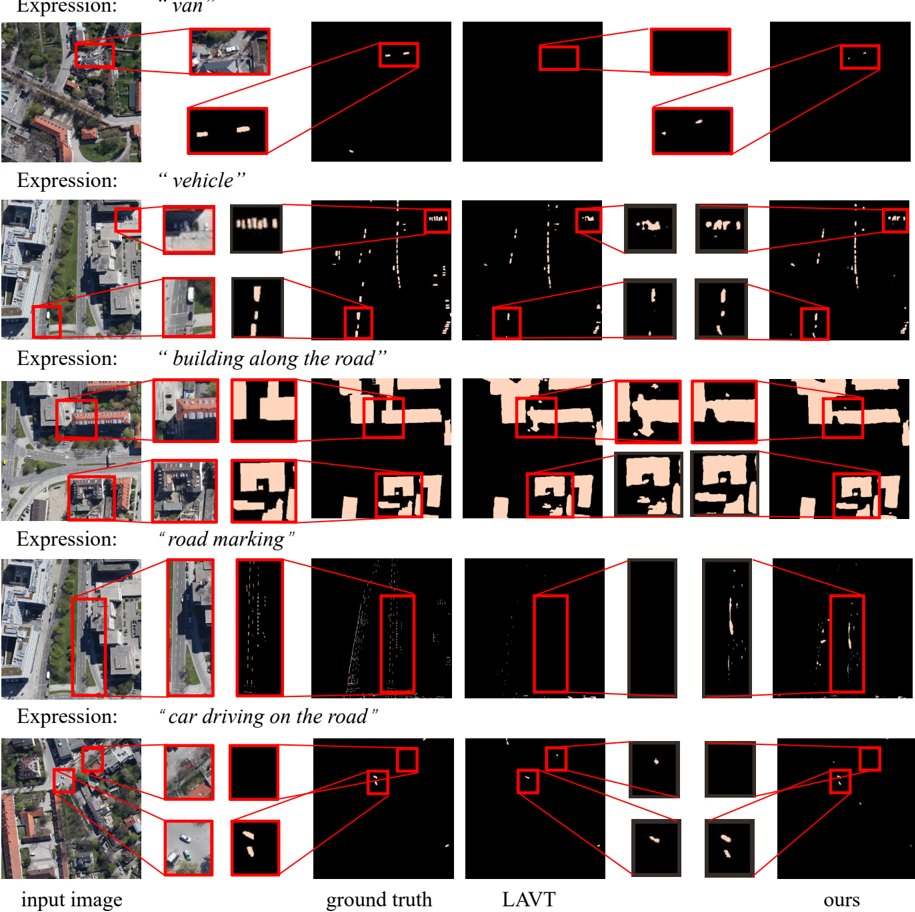
Localizing desired objects from remote sensing images is of great use in practical applications. Referring image segmentation, which aims at segmenting out the objects to which a given expression refers, has been extensively studied in natural images. However, almost no research attention is given to this task of remote sensing imagery. Considering its potential for real-world applications, in this paper, we introduce referring remote sensing image segmentation (RRSIS) to fill in this gap and make some insightful explorations. Specifically, we create a new dataset, called RefSegRS, for this task, enabling us to evaluate different methods. Afterward, we benchmark referring image segmentation methods of natural images on the RefSegRS dataset and find that these models show limited efficacy in detecting small and scattered objects. To alleviate this issue, we propose a language-guided cross-scale enhancement (LGCE) module that utilizes linguistic features to adaptively enhance multi-scale visual features by integrating both deep and shallow features. The proposed dataset, benchmarking results, and the designed LGCE module provide insights into the design of a better RRSIS model. The dataset and code will be available at https://gitlab.lrz.de/ai4eo/reasoning/rrsis.
Overview
The claims and statistics of this paper haven’t been checked yet.
Free: it reads the open-access text and checks the first 5 claims that cite a source we can check. Create a free account to check every claim.
Integrity signals
Registry
Cites
Statistics
Figures




Verification
Claims the paper makes
The claims and statistics of this paper haven’t been checked yet.
Free: it reads the open-access text and checks the first 5 claims that cite a source we can check. Create a free account to check every claim.
Claims other papers make about this one
Each is checked against this paper’s own text: does it say what the citing paper says it does?
The cited source doesn’t support the claim as written.
In the citing paper
“This higher instance density in DOTA-v2 offers a more challenging and diverse training environment compared to existing remote sensing visual grounding datasets, such as DIOR-RSVG [19] and RRSIS-D [35], that are typically sourced from the DIOR dataset.”
From VRSBench: A Versatile Vision-Language Benchmark Dataset for Remote Sensing Image Understanding (2024) · cites this paper as [35]
Checked by a reasoning model — may be wrong.
Experimental — accuracy not yet measured
Self-check
Percentages, sums and reported differences re-computed from the paper’s own numbers.
The self-check needs the paper’s full text.
Citations
Cites
Deep Residual Learning for Image Recognition
He, K., Zhang, X., Ren, S., & Sun, J. (2016) · 2016 IEEE Conference on Computer Vision and Pattern Recognition (CVPR) · doi:10.1109/cvpr.2016.90 · Cited by 235,474 · cited 2×
“Convolutional neural networks (CNNs) such as VGG [10], ResNet [11], and ConvNext [12] achieve human-competitive accuracy in image classification on large-scale Z. Yuan and L. Mou are with the Chair of Data Science in Earth Observation, Technical University of Munich, 80333 Munich, Germany.”
MethodVaswani, A., Shazeer, N., Parmar, N., Uszkoreit, J., Jones, L., Gomez, A. N., Kaiser, L., & Polosukhin, I. (2017) · arXiv · doi:10.48550/arxiv.1706.03762 · Cited by 120,404 · cited 5×
“More recently, Transformers have also been explored in this task.”
BackgroundInfluentialVery Deep Convolutional Networks for Large-Scale Image Recognition
Simonyan, K., & Zisserman, A. (2014) · arXiv · doi:10.48550/arxiv.1409.1556 · Cited by 114,148 · cited 2×
“Convolutional neural networks (CNNs) such as VGG [10], ResNet [11], and ConvNext [12] achieve human-competitive accuracy in image classification on large-scale Z. Yuan and L. Mou are with the Chair of Data Science in Earth Observation, Technical University of Munich, 80333 Munich, Germany.”
MethodHochreiter, S., & Schmidhuber, J. (1997) · Neural Computation · doi:10.1162/neco.1997.9.8.1735 · Cited by 102,318 · cited 2×
“The pioneer work can be found in [22], where a long short-term memory (LSTM) [31] network is employed to encode referring expressions into vectors, and a CNN is used to learn visual features.”
BackgroundMethodU-Net: Convolutional Networks for Biomedical Image Segmentation
Ronneberger, O., Fischer, P., & Brox, T. (2015) · Lecture notes in computer science · doi:10.1007/978-3-319-24574-4_28 · Cited by 99,404
Exploiting Generative AI to Scale up Intelligent Tutoring Systems
Jakubův, J., Chvalovský, K., Goertzel, Z., Kaliszyk, C., Olšák, M., Piotrowski, B., Schulz, S., Suda, M., & Urban, J. (2023) · DROPS (Schloss Dagstuhl – Leibniz Center for Informatics) · doi:10.4230/lipics.itp.2023.19 · Cited by 76,658
BERT: Pre-training of Deep Bidirectional Transformers for Language Understanding
Devlin, J., Chang, M.-W., Lee, K., & Toutanova, K. (2018) · arXiv · doi:10.48550/arxiv.1810.04805 · Cited by 73,173 · cited 5×
“LAVT [26] employs bidirectional encoder representations from Transformers (BERT) [38] and a novel Transformer network for referring image segmentation.”
BackgroundMethodInfluentialBERT: Pre-training of Deep Bidirectional Transformers for Language Understanding
Devlin, J., Chang, M.-W., Lee, K., & Toutanova, K. (2019) · Proceedings of the 2019 Conference of the North American Chapter of the Association for Computational Linguistics: Human Language Technologies, Volume 1 (Long and Short Papers) · doi:10.18653/v1/n19-1423 · Cited by 54,325 · cited 5×
“LAVT [26] employs bidirectional encoder representations from Transformers (BERT) [38] and a novel Transformer network for referring image segmentation.”
BackgroundMethodInfluentialYou Only Look Once: Unified, Real-Time Object Detection
Redmon, J., Divvala, S., Girshick, R., & Farhadi, A. (2016) · 2016 IEEE Conference on Computer Vision and Pattern Recognition (CVPR) · doi:10.1109/cvpr.2016.91 · Cited by 53,803 · cited 1×
“Moreover, object detection in remote sensing images has witnessed a dramatic improvement in accuracy with the emergence of models like Faster R-CNN [15], YOLO [16], and DETR [17].”
MethodAn Image is Worth 16x16 Words: Transformers for Image Recognition at Scale
Dosovitskiy, A., Beyer, L., Kolesnikov, A., Weissenborn, D., Zhai, X., Unterthiner, T., Dehghani, M., Minderer, M., Heigold, G., Gelly, S., et al. (2020) · arXiv · doi:10.48550/arxiv.2010.11929 · Cited by 47,472
Fully convolutional networks for semantic segmentation
Long, J., Shelhamer, E., & Darrell, T. (2015) · 2015 IEEE Conference on Computer Vision and Pattern Recognition (CVPR) · doi:10.1109/cvpr.2015.7298965 · Cited by 38,834
Swin Transformer: Hierarchical Vision Transformer using Shifted Windows
Liu, Z., Lin, Y., Cao, Y., Hu, H., Wei, Y., Zhang, Z., Lin, S., & Guo, B. (2021) · 2021 IEEE/CVF International Conference on Computer Vision (ICCV) · doi:10.1109/iccv48922.2021.00986 · Cited by 35,534 · cited 4×
“Following it, we use Swin Transformer [14] as the backbone network for extracting visual features from the input image.”
BackgroundMethodInfluentialGirshick, R. (2015) · 2015 IEEE International Conference on Computer Vision (ICCV) · doi:10.1109/iccv.2015.169 · Cited by 28,105
Chen, L.-C., Papandreou, G., Kokkinos, I., Murphy, K., & Yuille, A. L. (2018) · IEEE Transactions on Pattern Analysis and Machine Intelligence · doi:10.1109/tpami.2017.2699184 · Cited by 22,392 · cited 1×
“Simultaneously, the task of semantic segmentation has also benefited immensely from deep learning techniques, with models like FCN [18], U-Net [19], Deeplab [20], and Segformer [21] attaining remarkable performance, allowing for pixel-level interpretation of remote sensing imagery.”
MethodEnd-to-End Object Detection with Transformers
Carion, N., Massa, F., Synnaeve, G., Usunier, N., Kirillov, A., & Zagoruyko, S. (2020) · Lecture Notes in Computer Science · doi:10.1007/978-3-030-58452-8_13 · Cited by 18,285
End-to-End Object Detection with Transformers
Carion, N., Massa, F., Synnaeve, G., Usunier, N., Kirillov, A., & Zagoruyko, S. (2020) · arXiv · doi:10.48550/arxiv.2005.12872 · Cited by 18,253 · cited 1×
“Moreover, object detection in remote sensing images has witnessed a dramatic improvement in accuracy with the emergence of models like Faster R-CNN [15], YOLO [16], and DETR [17].”
MethodLearning Transferable Visual Models From Natural Language Supervision
Radford, A., Kim, J. W., Hallacy, C., Ramesh, A., Goh, G., Agarwal, S., Sastry, G., Askell, A., Mishkin, P., Clark, J., et al. (2021) · arXiv · doi:10.48550/arxiv.2103.00020 · Cited by 15,293 · cited 1×
“Besides, inspired by the success of contrastive language-image pretraining (CLIP) [36], Wang et al. [37] proposed a CLIP-driven framework for transferring knowledge obtained from CLIP to achieve text-to-pixel alignment.”
MethodDecoupled Weight Decay Regularization
Loshchilov, I., & Hutter, F. (2017) · arXiv · doi:10.48550/arxiv.1711.05101 · Cited by 12,522
SLIC Superpixels Compared to State-of-the-Art Superpixel Methods
Achanta, R., Shaji, A., Smith, K., Lucchi, A., Fua, P., & Süsstrunk, S. (2012) · IEEE Transactions on Pattern Analysis and Machine Intelligence · doi:10.1109/tpami.2012.120 · Cited by 9,201 · cited 1×
“Additionally, unanimously accepted classical methods, including JSEG [4], graph cuts [5], watershed [6], superpixels [7], and EM-based algorithms [8], are developed and actively applied to the segmentation of remote sensing images.”
MethodLiu, Z., Mao, H., Wu, C.-Y., Feichtenhofer, C., Darrell, T., & Xie, S. (2022) · 2022 IEEE/CVF Conference on Computer Vision and Pattern Recognition (CVPR) · doi:10.1109/cvpr52688.2022.01167 · Cited by 8,494 · cited 1×
“Convolutional neural networks (CNNs) such as VGG [10], ResNet [11], and ConvNext [12] achieve human-competitive accuracy in image classification on large-scale Z. Yuan and L. Mou are with the Chair of Data Science in Earth Observation, Technical University of Munich, 80333 Munich, Germany.”
MethodFast approximate energy minimization via graph cuts
Boykov, Y., Veksler, O., & Zabih, R. (2001) · IEEE Transactions on Pattern Analysis and Machine Intelligence · doi:10.1109/34.969114 · Cited by 6,988
SegFormer: Simple and Efficient Design for Semantic Segmentation with Transformers
Xie, E., Wang, W., Yu, Z., Anandkumar, A., Alvarez, J. M., & Luo, P. (2021) · arXiv · doi:10.48550/arxiv.2105.15203 · Cited by 5,090 · cited 1×
“Simultaneously, the task of semantic segmentation has also benefited immensely from deep learning techniques, with models like FCN [18], U-Net [19], Deeplab [20], and Segformer [21] attaining remarkable performance, allowing for pixel-level interpretation of remote sensing imagery.”
MethodGaussian Error Linear Units (GELUs)
Hendrycks, D., & Gimpel, K. (2016) · arXiv · doi:10.48550/arxiv.1606.08415 · Cited by 3,537 · cited 1×
“Then, a multi-layer perceptron with the Gaussian error linear unit (GELU) non-linearity [42] is employed to generate the output of the Transformer block.”
MethodBag-of-visual-words and spatial extensions for land-use classification
Yang, Y., & Newsam, S. (2010) · Proceedings of the 18th SIGSPATIAL International Conference on Advances in Geographic Information Systems · doi:10.1145/1869790.1869829 · Cited by 2,969 · cited 1×
“During the early stages, traditional approaches, such as bag-of-words-based methods [1], are widely used in tasks including image classification [2] and object detection [3].”
MethodObject detection in optical remote sensing images: A survey and a new benchmark
Li, K., Wan, G., Cheng, G., Meng, L., & Han, J. (2020) · ISPRS Journal of Photogrammetry and Remote Sensing · doi:10.1016/j.isprsjprs.2019.11.023 · Cited by 2,317
Unsupervised segmentation of color-texture regions in images and video
Deng, Y., & Manjunath, B. S. (2001) · IEEE Transactions on Pattern Analysis and Machine Intelligence · doi:10.1109/34.946985 · Cited by 1,389 · cited 1×
“Additionally, unanimously accepted classical methods, including JSEG [4], graph cuts [5], watershed [6], superpixels [7], and EM-based algorithms [8], are developed and actively applied to the segmentation of remote sensing images.”
MethodThe Watershed Transform: Definitions, Algorithms and Parallelization Strategies
Roerdink, J. B. T. M., & Meijster, A. (2000) · Fundamenta Informaticae · doi:10.3233/fi-2000-411207 · Cited by 1,372 · cited 1×
“In addition, unani-mously accepted classical methods, including JSEG [4], graph cuts [5], watershed [6], superpixels [7], and expectation-maximization (EM)-based algorithms [8], are developed and actively applied to the segmentation of remote sensing images.”
Evaluating bag-of-visual-words representations in scene classification
Yang, J., Jiang, Y.-G., Hauptmann, A. G., & Ngo, C.-W. (2007) · Proceedings of the international workshop on Workshop on multimedia information retrieval · doi:10.1145/1290082.1290111 · Cited by 825 · cited 1×
“During the early stages, traditional approaches, such as bag-of-words-based methods [1], are widely used in tasks including image classification [2] and object detection [3].”
MethodExploring Models and Data for Remote Sensing Image Caption Generation
Lu, X., Wang, B., Zheng, X., & Li, X. (2018) · IEEE Transactions on Geoscience and Remote Sensing · doi:10.1109/tgrs.2017.2776321 · Cited by 647 · cited 1×
“Subsequently, [51] provides a comprehensive review of using handcrafted and deep features in this task.”
BackgroundBigearthnet: A Large-Scale Benchmark Archive for Remote Sensing Image Understanding
Sumbul, G., Charfuelan, M., Demir, B., & Markl, V. (2019) · IGARSS 2019 - 2019 IEEE International Geoscience and Remote Sensing Symposium · doi:10.1109/igarss.2019.8900532 · Cited by 534 · cited 1×
“established on top of the BigEarthNet dataset [21] to further”
BackgroundCross-Modal Self-Attention Network for Referring Image Segmentation
Ye, L., Rochan, M., Liu, Z., & Wang, Y. (2019) · 2019 IEEE/CVF Conference on Computer Vision and Pattern Recognition (CVPR) · doi:10.1109/cvpr.2019.01075 · Cited by 532
Belongie, S., Carson, C., Greenspan, H., & Malik, J. (2002) · Sixth International Conference on Computer Vision (IEEE Cat. No.98CH36271) · doi:10.1109/iccv.1998.710790 · Cited by 474 · cited 1×
“Additionally, unanimously accepted classical methods, including JSEG [4], graph cuts [5], watershed [6], superpixels [7], and EM-based algorithms [8], are developed and actively applied to the segmentation of remote sensing images.”
MethodSegmentation from Natural Language Expressions
Hu, R., Rohrbach, M., & Darrell, T. (2016) · Lecture Notes in Computer Science · doi:10.1007/978-3-319-46448-0_7 · Cited by 438 · cited 8×
“• LSTM-CNN [4]: It consists of an LSTM network for natural language encoding, a CNN backbone for visual feature extraction, and a fully convolutional upsampling module for pixel-wise segmentation.”
BackgroundMethodInfluentialLAVT: Language-Aware Vision Transformer for Referring Image Segmentation
Yang, Z., Wang, J., Tang, Y., Chen, K., Zhao, H., & Torr, P. H. S. (2022) · 2022 IEEE/CVF Conference on Computer Vision and Pattern Recognition (CVPR) · doi:10.1109/cvpr52688.2022.01762 · Cited by 406 · cited 8×
“Thus, we base our baseline method on a Transformer-based model LAVT [26].”
BackgroundMethodInfluentialCRIS: CLIP-Driven Referring Image Segmentation
Wang, Z., Lu, Y., Li, Q., Tao, X., Guo, Y., Gong, M., & Liu, T. (2022) · 2022 IEEE/CVF Conference on Computer Vision and Pattern Recognition (CVPR) · doi:10.1109/cvpr52688.2022.01139 · Cited by 404 · cited 1×
“Besides, inspired by the success of contrastive language-image pretraining (CLIP) [36], Wang et al. [37] proposed a CLIP-driven framework for transferring knowledge obtained from CLIP to achieve text-to-pixel alignment.”
MethodDeep semantic understanding of high resolution remote sensing image
Qu, B., Li, X., Tao, D., & Lu, X. (2016) · 2016 International Conference on Computer, Information and Telecommunication Systems (CITS) · doi:10.1109/cits.2016.7546397 · Cited by 350 · cited 1×
“Qu et al. [50] first introduced this task in remote sensing and utilized a CNN and an RNN to extract visual features and generate words, respectively.”
MethodRSVQA: Visual Question Answering for Remote Sensing Data
Lobry, S., Marcos, D., Murray, J., & Tuia, D. (2020) · IEEE Transactions on Geoscience and Remote Sensing · doi:10.1109/tgrs.2020.2988782 · Cited by 305 · cited 1×
“[19] first introduce VQA into remote sensing by creating two datasets for this task.”
BackgroundPolyFormer: Referring Image Segmentation as Sequential Polygon Generation
Liu, J., Ding, H., Cai, Z., Zhang, Y., Satzoda, R. K., Mahadevan, V., & Manmatha, R. (2023) · IEEE Computer Society Conference on Computer Vision and Pattern Recognition/Proceedings - IEEE Computer Society Conference on Computer Vision and Pattern Recognition/Proceedings · doi:10.1109/cvpr52729.2023.01789 · Cited by 293
Referring Image Segmentation via Recurrent Refinement Networks
Li, R., Li, K., Kuo, Y.-C., Shu, M., Qi, X., Shen, X., & Jia, J. (2018) · 2018 IEEE/CVF Conference on Computer Vision and Pattern Recognition · doi:10.1109/cvpr.2018.00602 · Cited by 275 · cited 6×
“Nevertheless, the mIoU of our method can still outperform that of ConvLSTM by 16%.”
MethodInfluentialRecurrent Multimodal Interaction for Referring Image Segmentation
Liu, C., Lin, Z., Shen, X., Yang, J., Lu, X., & Yuille, A. (2017) · 2017 IEEE International Conference on Computer Vision (ICCV) · doi:10.1109/iccv.2017.143 · Cited by 272 · cited 2×
“This inspires subsequent works, such as using DeepLab [23], [30] to learn better image representations and utilizing simple recurrent units (SRUs) [32] or bi-directional gated recurrent units (GRUs) [33] to extract better linguistic features from texts.”
MethodLocate then Segment: A Strong Pipeline for Referring Image Segmentation
Jing, Y., Kong, T., Wang, W., Wang, L., Li, L., & Tan, T. N. (2021) · IEEE Computer Society Conference on Computer Vision and Pattern Recognition/Proceedings - IEEE Computer Society Conference on Computer Vision and Pattern Recognition/Proceedings · doi:10.1109/cvpr46437.2021.00973 · Cited by 222 · cited 1×
“This inspires subsequent works, such as using DeepLab [23], [30] to learn better image representations and utilizing simple recurrent units (SRUs) [32] or bi-directional gated recurrent units (GRUs) [33] to extract better linguistic features from texts.”
MethodSun, H., Sun, X., Wang, H., Li, Y., & Li, X. (2012) · IEEE Geoscience and Remote Sensing Letters · doi:10.1109/lgrs.2011.2161569 · Cited by 219 · cited 1×
“During the early stages, traditional approaches, such as bag-of-words-based methods [1], are widely used in tasks including image classification [2] and object detection [3].”
MethodBi-Directional Relationship Inferring Network for Referring Image Segmentation
Hu, Z., Feng, G., Sun, J., Zhang, L., & Lu, H. (2020) · 2020 IEEE/CVF Conference on Computer Vision and Pattern Recognition (CVPR) · doi:10.1109/cvpr42600.2020.00448 · Cited by 203 · cited 8×
“• BRINet [7]: It employs a CNN to encode visual features”
BackgroundMethodInfluentialDynamic Multimodal Instance Segmentation Guided by Natural Language Queries
Margffoy-Tuay, E., Pérez, J. C., Botero, E., & Arbeláez, P. (2018) · Lecture Notes in Computer Science · doi:10.1007/978-3-030-01252-6_39 · Cited by 189
RSVG: Exploring Data and Models for Visual Grounding on Remote Sensing Data
Zhan, Y., Xiong, Z., & Yuan, Y. (2023) · IEEE Transactions on Geoscience and Remote Sensing · doi:10.1109/tgrs.2023.3250471 · Cited by 179 · cited 2×
“Another work [16] also creates a dataset, which”
BackgroundKey-Word-Aware Network for Referring Expression Image Segmentation
Shi, H., Li, H., Meng, F., & Wu, Q. (2018) · Lecture Notes in Computer Science · doi:10.1007/978-3-030-01231-1_3 · Cited by 178 · cited 1×
“In terms of the multimodal feature fusion, a range of attention mechanisms [12], [6], [7], [13] are studied to model the relationship between language and image modalities.”
BackgroundEncoder Fusion Network with Co-Attention Embedding for Referring Image Segmentation
Feng, G., Hu, Z., Zhang, L., & Lu, H. (2021) · 2021 IEEE/CVF Conference on Computer Vision and Pattern Recognition (CVPR) · doi:10.1109/cvpr46437.2021.01525 · Cited by 178 · cited 1×
“In terms of multimodal feature fusion, a range of attention mechanisms [24], [25], [34], [35] are studied to model the relationship between language and image modalities.”
BackgroundMutual Attention Inception Network for Remote Sensing Visual Question Answering
Zheng, X., Wang, B., Du, X., & Lu, X. (2022) · IEEE Transactions on Geoscience and Remote Sensing · doi:10.1109/tgrs.2021.3079918 · Cited by 159 · cited 1×
“The work [45] employs an attention mechanism and a bilinear technique to improve the alignment between visual and textual modalities.”
MethodRemote-Sensing Image Captioning Based on Multilayer Aggregated Transformer
Liu, C., Zhao, R., & Shi, Z. (2022) · IEEE Geoscience and Remote Sensing Letters · doi:10.1109/lgrs.2022.3150957 · Cited by 125 · cited 1×
“A multilayer aggregated Transformer is designed in [58] to leverage multiscale features in the decoder.”
BackgroundTruncation Cross Entropy Loss for Remote Sensing Image Captioning
Li, X., Zhang, X., Huang, W. F., & Wang, Q. (2020) · IEEE Transactions on Geoscience and Remote Sensing · doi:10.1109/tgrs.2020.3010106 · Cited by 117 · cited 1×
“Encoder–decoder architectures are used in multiple works [52], [53], [54], [55], where an encoder learns visual features from the input images and a decoder transfers the features to textual descriptions.”
BackgroundChappuis, C., Zermatten, V., Lobry, S., Saux, B. L., & Tuia, D. (2022) · IEEE/CVF Conference on Computer Vision and Pattern Recognition Workshops (CVPRW) · doi:10.1109/cvprw56347.2022.00143 · Cited by 111 · cited 1×
“[25] propose to extract context information from the visual input and inject it into a language model to obtain answers.”
BackgroundHigh-Resolution Remote Sensing Image Captioning Based on Structured Attention
Zhao, R., Shi, Z., & Zou, Z. (2022) · IEEE Transactions on Geoscience and Remote Sensing · doi:10.1109/tgrs.2021.3070383 · Cited by 109 · cited 2×
“For example, Zhao et al. [53] developed a structured attention-based method, in order to use structural features in semantic information.”
BackgroundMethodSkyScapes Fine-Grained Semantic Understanding of Aerial Scenes
Azimi, S. M., Henry, C., Sommer, L. W., Schumann, A., & Vig, E. (2019) · IEEE/CVF International Conference on Computer Vision (ICCV) · doi:10.1109/iccv.2019.00749 · Cited by 106 · cited 3×
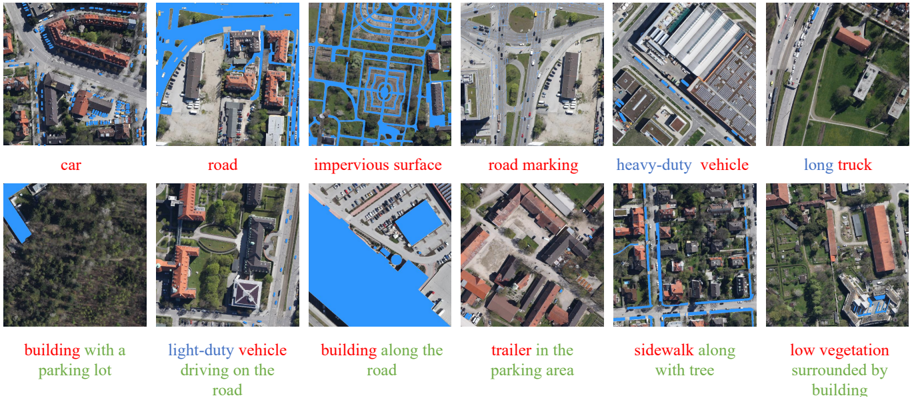
“We collect images by cropping large tiles from the SkyScapes dataset [29], which consists of 16 RGB tiles.”
MethodInfluentialMulti-Modal Mutual Attention and Iterative Interaction for Referring Image Segmentation
Liu, C., Ding, H., Zhang, Y., & Jiang, X. (2023) · IEEE Transactions on Image Processing · doi:10.1109/tip.2023.3277791 · Cited by 106 · cited 1×
“Although referring image segmentation has been extensively studied in natural images [22]–[28], almost no attention has been given to this task in the context of remote sensing images.”
BackgroundPhraseCut: Language-Based Image Segmentation in the Wild
Wu, C., Lin, Z., Cohen, S., Bui, T., & Maji, S. (2020) · 2020 IEEE/CVF Conference on Computer Vision and Pattern Recognition (CVPR) · doi:10.1109/cvpr42600.2020.01023 · Cited by 104 · cited 2×
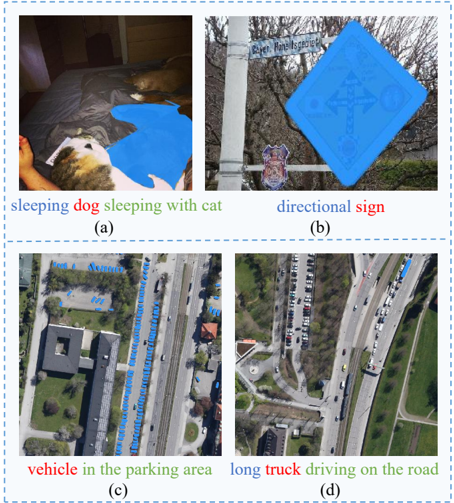
“Examples from the VGPhraseCut dataset [2] and the RefSegRS dataset.”
BackgroundMethodBi-Modal Transformer-Based Approach for Visual Question Answering in Remote Sensing Imagery
Bazi, Y., Rahhal, M. M. A., Mekhalfi, M. L., Zuair, M., & Melgani, F. (2022) · IEEE Transactions on Geoscience and Remote Sensing · doi:10.1109/tgrs.2022.3192460 · Cited by 99 · cited 1×
“Bazi et al. [46] designed a bi-modal Transformer-based method to learn powerful multimodal features.”
MethodChange Detection Meets Visual Question Answering
Yuan, Z., Mou, L., Xiong, Z., & Zhu, X. X. (2022) · IEEE Transactions on Geoscience and Remote Sensing · doi:10.1109/tgrs.2022.3203314 · Cited by 93 · cited 1×
“In addition, the work [49] introduces a change detection-based VQA model to extend this task to a multitemporal domain.”
MethodSelf-citationA Spatial Hierarchical Reasoning Network for Remote Sensing Visual Question Answering
Zhang, Z., Jiao, L., Li, L., Liu, X., Chen, P., Liu, F., Li, Y., & Guo, Z. (2023) · IEEE Transactions on Geoscience and Remote Sensing · doi:10.1109/tgrs.2023.3237606 · Cited by 86 · cited 1×
“In [47], a spatial hierarchical reasoning network is designed toward a better fusion of visual and language features.”
BackgroundVisual Grounding in Remote Sensing Images
Sun, Y., Feng, S., Li, X., Ye, Y., Kang, J., & Huang, X. (2022) · Proceedings of the 30th ACM International Conference on Multimedia · doi:10.1145/3503161.3548316 · Cited by 81 · cited 1×
“Sun et al. [40] collected a remote sensing visual grounding dataset and proposed a method consisting of a language encoder, a vision encoder, and a fusion module.”
MethodRecurrent Attention and Semantic Gate for Remote Sensing Image Captioning
Li, Y., Zhang, X., Gu, J., Li, C., Wang, X., Tang, X., & Jiao, L. (2022) · IEEE Transactions on Geoscience and Remote Sensing · doi:10.1109/tgrs.2021.3102590 · Cited by 78
LAM: Remote Sensing Image Captioning with Label-Attention Mechanism
Zhang, Z., Diao, W., Zhang, W., Yan, M., Gao, X., & Sun, X. (2019) · Remote Sensing · doi:10.3390/rs11202349 · Cited by 68 · cited 1×
“Encoder-decoder architectures are used in multiple works [52]–[55], where an encoder learns visual features from the input images and a decoder transfers the features to textual descriptions.”
BackgroundExploring Transformer and Multilabel Classification for Remote Sensing Image Captioning
Kandala, H., Saha, S., Banerjee, B., & Zhu, X. X. (2022) · IEEE Geoscience and Remote Sensing Letters · doi:10.1109/lgrs.2022.3198234 · Cited by 60 · cited 1×
“[57] exploits a Transformer network as an encoder-decoder and an auxiliary decoder to address the limited data issue.”
Self-citationRSVQA Meets Bigearthnet: A New, Large-Scale, Visual Question Answering Dataset for Remote Sensing
Lobry, S., Demir, B., & Tuia, D. (2021) · 2021 IEEE International Geoscience and Remote Sensing Symposium IGARSS · doi:10.1109/igarss47720.2021.9553307 · Cited by 53 · cited 1×
“Sub-sequently, a large-scale dataset named RSVQAxBEN [43] is established on top of the BigEarthNet dataset [44] to further advance the research on this task.”
BackgroundMulti-Source Interactive Stair Attention for Remote Sensing Image Captioning
Zhang, X., Li, Y., Wang, X. E., Liu, F., Wu, Z., Cheng, X., & Jiao, L. (2023) · Remote Sensing · doi:10.3390/rs15030579 · Cited by 34 · cited 1×
“[35] propose a multi-source interactive attention network to investigate the impact of the semantic attribute and contextual information of generated words in producing descriptions.”
Background
Research works printed but not linked: 3
- Sergey Ioffe and Christian Szegedy, "Batch normalization: Accelerating deep network training by reducing internal covariate shift," in Interna- tional conference on machine learning. pmlr, 2015, pp. 448-456. · doi:10.5555/3045118.3045167
- Ilya Loshchilov and Frank Hutter, "Decoupled weight decay regulariza- tion," in International Conference on Learning Representations, 2018.
- Zhenghang Yuan (Student Member, IEEE) received the B.E. degree and M.E. degree from the North- western Polytechnical University, Xi'an, China, in 2017 and 2020, respectively. She is currently pursu- ing the Ph.D. degree with the Technical University of Munich, Munich, Germany. Her research interests include remote sensing, computer vision, and deep learning.
Cited by
Rotated Multi-Scale Interaction Network for Referring Remote Sensing Image Segmentation
Liu, S., Ma, Y., Zhang, X., Wang, H., Ji, J., Sun, X., & Ji, R. (2024) · IEEE Computer Society Conference on Computer Vision and Pattern Recognition/Proceedings - IEEE Computer Society Conference on Computer Vision and Pattern Recognition/Proceedings · doi:10.1109/cvpr52733.2024.02517 · Cited by 222
Deep learning for wildfire risk prediction: Integrating remote sensing and environmental data
Xu, Z., Li, J., Cheng, S. L., Xue, R., Zhao, Y., He, H., Guan, H., Sharma, A., Erxleben, M., Chang, R., et al. (2025) · ISPRS Journal of Photogrammetry and Remote Sensing · doi:10.1016/j.isprsjprs.2025.06.002 · Cited by 130
Liu, R., Wu, J., Lu, W., Miao, Q., Zhang, H., Liu, X., Lu, Z., & Li, L. (2024) · Remote Sensing · doi:10.3390/rs16122056 · Cited by 113
“Yuan et al. [106] proposed RRSIS, a model that generates segmentation masks from natural language descriptions using a Transformer-based LAVT model with an LGCE module for better detection of small targets.”
MethodEarthNets: Empowering artificial intelligence for Earth observation
Xiong, Z., Zhang, F., Wang, Y., Shi, Y., & Zhu, X. X. (2024) · IEEE Geoscience and Remote Sensing Magazine · doi:10.1109/mgrs.2024.3466998 · Cited by 129
“Datasets for RS VG [330] are constructed to enable specific object detection guided by natural language [344].”
Self-citationExploring Fine-Grained Image-Text Alignment for Referring Remote Sensing Image Segmentation
Lei, S., Xiao, X., Zhang, T., Li, H.-C., Shi, Z., & Zhu, Q. (2024) · IEEE Transactions on Geoscience and Remote Sensing · doi:10.1109/tgrs.2024.3522293 · Cited by 115
“For this point, in the past year, many researchers have focused on the RRSIS task and established two datasets for remote sensing including RefSegRS [1] and RRSIS-D [26], which promotes the development of the field of RRSIS.”
BackgroundMethodInfluential
Metadata
- Authors
- Yuan, Z., Mou, L., Hua, Y., & Zhu, X. X.
- Affiliations
- Technical University of Munich (DE)
- Shenzhen University (CN)
- Munich Center for Machine Learning (DE)
- Venue
- IEEE Transactions on Geoscience and Remote Sensing
- Published
- 2024
- Volume
- 62
- Pages
- 1-12
- ISSN
- 0196-2892 (ISSN-L)
- 1558-0644
- OpenAlex
- W4392397297
- Semantic Scholar
- 2c536e0d90cd31afdbf81211a1094b1bb43775fa
- Cited by
- 81
- References
- 61
- Citations by year
- 2026: 34 · 2025: 37 · 2024: 9
- FWCI
- 13.20
- Type
- journal article
- Language
- en
- Open access
- hybrid
- doi.org
- Licence
- Locations
- IEEE Transactions on Geoscience and Remote Sensing (publishedVersion, cc-by-nc-nd)
- arXiv (Cornell University) (submittedVersion)
- arXiv (Cornell University)
- Funders
- Bundesministerium f?r Bildung und Forschung (01DD20001)
- Bundesministerium f?r Wirtschaft und Technologie (50EE2201C)
- Topics
- Physical Sciences › Computer Science › Computer Vision and Pattern Recognition › Remote-Sensing Image Classification
- Physical Sciences › Computer Science › Computer Vision and Pattern Recognition › Advanced Neural Network Applications
- Physical Sciences › Computer Science › Computer Vision and Pattern Recognition › Multimodal Machine Learning Applications
- Keywords
- referring image segmentation, remote sensing images, multi-scale feature enhancement, small object detection
About these checks
Registry, retraction, Cites and statistics results are computed, not judged, with one exception: a printed reference that no index lists is read once by a model before it counts as a citation error. Claims are extracted by a model and kept only when their quote appears verbatim in the text; each cited source is then checked, with a model’s help, for whether it says what the claim relies on. Those verdicts can be wrong — read the claim’s quote and the cited source before relying on one.
Statistics and arithmetic are recomputed, not judged.
Confidence bands are shown only for fields calibrated on our annotated test set. None is calibrated yet, so no band is shown.
What counts as a claim ›How we measure confidence ›How we check this ›
Are you an author, or do you see a problem with this page? Request a review
Data sources
Bibliographic data: Semantic Scholar, OpenAlex, Crossref.
Contains information from the Semantic Scholar Academic Graph Datasets, made available under the ODC Attribution License (ODC-BY 1.0).
Semantic Scholar’s data is described in: Kinney, R., et al. (2023). The Semantic Scholar Open Data Platform. arXiv:2301.10140.
