

The DOI matches its Crossref record; 16 of the 16 references it cites were found in a registry or an index.
The management and outcomes of placenta accreta, increta, and percreta in the UK: a population‐based descriptive study
Open accessAbstract
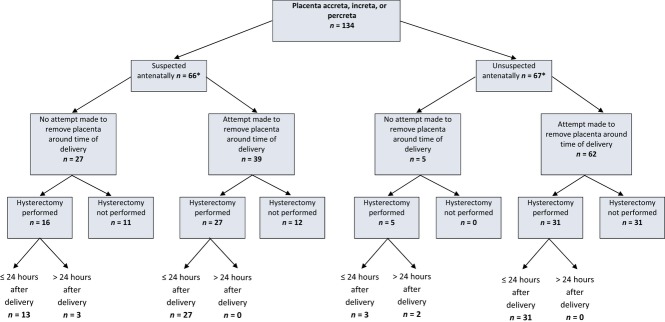
Objective: To describe the management and outcomes of placenta accreta, increta, and percreta in the UK. Design: A population‐based descriptive study using the UK O bstetric S urveillance S ystem (UKOSS). Setting: All 221 UK hospitals with obstetrician‐led maternity units. Population: All women diagnosed with placenta accreta, increta, and percreta in the UK between May 2010 and April 2011. Methods: Prospective case identification through the monthly mailing of UKOSS. Main outcome measures: Median estimated blood loss, transfusion requirements. Results: A cohort of 134 women were identified with placenta accreta, increta, or percreta: 50% (66/133) were suspected to have this condition antenatally. In women with a final diagnosis of placenta increta or percreta, antenatal diagnosis was associated with reduced levels of haemorrhage (median estimated blood loss 2750 versus 6100 ml, P = 0.008) and a reduced need for blood transfusion (59 versus 94%, P = 0.014), possibly because antenatally diagnosed women were more likely to have preventative therapies for haemorrhage (74 versus 52%, P = 0.007), and were less likely to have an attempt made to remove their placenta (59 versus 93%, P < 0.001). Making no attempt to remove any of the placenta, in an attempt to conserve the uterus or prior to hysterectomy, was associated with reduced levels of haemorrhage (median estimated blood loss 1750 versus 3700 ml, P = 0.001) and a reduced need for blood transfusion (57 versus 86%, P < 0.001). Conclusions: Women with placenta accreta, increta, or percreta who have no attempt to remove any of their placenta, with the aim of conserving their uterus, or prior to hysterectomy, have reduced levels of haemorrhage and a reduced need for blood transfusion, supporting the recommendation of this practice.
Overview
The claims and statistics of this paper haven’t been checked yet.
Run the check — free, no account needed. It reads the open-access text and checks the sources it cites.
Integrity signals
Registry
Cites
Statistics
Figures
Verification
Claims the paper makes
The claims and statistics of this paper haven’t been checked yet.
Run the check — free, no account needed. It reads the open-access text and checks the sources it cites.
Claims other papers make about this one
Each is checked against this paper’s own text: does it say what the citing paper says it does?
In the citing paper
“PAS becomes a clinical problem after birth, when the placenta does not physiologically detach from the uterus and the forcible removal of the placenta is followed by massive obstetric haemorrhage (MOH), leading to further morbidity and risk of maternal death.”
From Placenta accreta spectrum – variations in clinical practice and maternal morbidity between the UK and France: a population‐based comparative study (2022) · cites this paper as [3]
Self-check
Percentages, sums and reported differences re-computed from the paper’s own numbers.
The self-check needs the paper’s full text.
Citations
Cites
Placenta Previa, Placenta Accreta, and Vasa Previa
Oyelese, Y., & Smulian, J. C. (2006) · Obstetrics and Gynecology · doi:10.1097/01.aog.0000207559.15715.98 · Cited by 967
Optimal management strategies for placenta accreta
Eller, A., Porter, T., Soisson, P., & Silver, R. (2009) · BJOG: An International Journal of Obstetrics & Gynaecology · doi:10.1111/j.1471-0528.2008.02037.x · Cited by 578
Maternal Outcome After Conservative Treatment of Placenta Accreta
Sentilhes, L., Ambroselli, C., Kayem, G., Provansal, M., Fernandez, H., Perrotin, F., Winer, N., Pierre, F., Benachi, A., Dreyfus, M., et al. (2010) · Obstetrics & Gynecology · doi:10.1097/aog.0b013e3181d066d4 · Cited by 515
ACOG Practice Bulletin No. 76: Postpartum Hemorrhage
(2006) · Obstetrics and Gynecology · doi:10.1097/00006250-200610000-00046 · Cited by 496
Urgency of caesarean section: A new classification
Lucas, D. N., Yentis, S. M., Kinsella, S. M., Holdcroft, A., May, A. E., Wee, M., & Robinson, P. N. (2000) · Journal of the Royal Society of Medicine · doi:10.1177/014107680009300703 · Cited by 465
Fitzpatrick, K. E., Sellers, S., Spark, P., Kurinczuk, J. J., Brocklehurst, P., & Knight, M. (2012) · PLoS ONE · doi:10.1371/journal.pone.0052893 · Cited by 463
Self-citationA prospective national study of acute fatty liver of pregnancy in the UK
Knight, M., Nelson‐Piercy, C., Kurinczuk, J. J., Spark, P., & Brocklehurst, P. (2008) · Gut · doi:10.1136/gut.2008.148676 · Cited by 373
Self-citationAntenatal diagnosis of placenta accreta: a review
Comstock, C. H. (2005) · Ultrasound in Obstetrics and Gynecology · doi:10.1002/uog.1926 · Cited by 327
Cesarean Delivery and Peripartum Hysterectomy
Knight, M., Kurinczuk, J. J., Spark, P., & Brocklehurst, P. (2008) · Obstetrics and Gynecology · doi:10.1097/01.aog.0000296658.83240.6d · Cited by 293
Self-citationConservative Versus Extirpative Management in Cases of Placenta Accreta
Kayem, G., Davy, C., Goffinet, F., Thomas, C., Clément, D., & Cabrol, D. (2004) · Obstetrics & Gynecology · doi:10.1097/01.aog.0000136086.78099.0f · Cited by 283
Research works printed but not linked: 5
- Office for National Statistics, 2011, Birth Summary Tables, England and Wales 2010
- General Register Office for Scotland, 2011, Vital Events Reference Tables 2010
- Northern Ireland Statistics and Research Agency, 2011, Registrar General Annual Report 2010
- Centre for Maternal and Child Enquiries, 2010, Perinatal Mortality 2008
- Royal College of Obstetricians and Gynaecologists, 2011, Green‐top Guideline No. 27: Placenta Praevia, Placenta Praevia Accreta and Vasa Praevia: Diagnosis and Management
Cited by
Sorted by citations
Jauniaux, E., Collins, S., & Burton, G. J. (2018) · American Journal of Obstetrics and Gynecology · doi:10.1016/j.ajog.2017.05.067 · Cited by 775
Abnormal Placentation: Placenta Previa, Vasa Previa, and Placenta Accreta
Silver, R. M. (2015) · Obstetrics & Gynecology · doi:10.1097/aog.0000000000001005 · Cited by 519
FIGO consensus guidelines on placenta accreta spectrum disorders: Epidemiology,
Jauniaux, E., Chantraine, F., Silver, R. M., Langhoff‐Roos, J., & Panel, F. T. F. P. A. D. A. M. E. C. (2018) · International Journal of Gynecology & Obstetrics · doi:10.1002/ijgo.12407 · Cited by 498
FIGO consensus guidelines on placenta accreta spectrum disorders: Prenatal diagnosis and screening,
Jauniaux, E. R. M., Bhide, A., Kennedy, A., Woodward, P. J., Hubinont, C., Collins, S., & Panel, F. T. F. P. A. D. A. M. E. C. (2018) · International Journal of Gynecology & Obstetrics · doi:10.1002/ijgo.12408 · Cited by 385
Thurn, L., Lindqvist, P., Jakobsson, M., Colmorn, L., Klungsoyr, K., Bjarnadóttir, R., Tapper, A., Børdahl, P., Gottvall, K., Petersen, K., et al. (2016) · BJOG: An International Journal of Obstetrics & Gynaecology · doi:10.1111/1471-0528.13547 · Cited by 367
Metadata
- Authors
- Fitzpatrick, K., Sellers, S., Spark, P., Kurinczuk, J., Brocklehurst, P., & Knight, M.
- Affiliations
- University of Oxford (GB)
- University Hospitals Bristol NHS Foundation Trust (GB)
- National Perinatal Epidemiology Unit University of Oxford Oxford UK
- University College London (GB)
- Corresponding author
- Fitzpatrick, KE
- Venue
- BJOG: An International Journal of Obstetrics & Gynaecology
- Publisher
- Wiley
- Published
- 2013-08-07
- Volume
- 121
- Issue
- 1
- Pages
- 62-71
- ISSN
- 0306-5456 (ISSN-L)
- 1470-0328
- 1471-0528
- PMC
- PMC3906842
- OpenAlex
- W2024611038
- Cited by
- 357
- References
- 16
- Citations by year
- 2026: 19 · 2025: 17 · 2024: 23 · 2023: 28 · 2022: 30 · 2021: 48 · 2020: 39 · 2019: 28 · 2018: 36 · 2017: 32 · 2016: 19 · 2015: 18 · 2014: 14 · 2013: 4
- FWCI
- 17.08
- Type
- journal article
- Language
- en
- Open access
- hybrid
- doi.org
- Licence
- Locations
- BJOG An International Journal of Obstetrics & Gynaecology (publishedVersion, cc-by-nc)
- Europe PMC (PubMed Central) (publishedVersion, cc-by)
- PubMed Central (publishedVersion, cc-by)
- PubMed (publishedVersion)
- UCL Discovery (University College London) (submittedVersion)
- University of Birmingham Research Portal (University of Birmingham) (submittedVersion, cc-by-nc)
- Funders
- National Institute for Health and Care Research (RP-PG-0608-10038)
- Topics
- Health Sciences › Medicine › Pediatrics, Perinatology and Child Health › Maternal and fetal healthcare
- Health Sciences › Medicine › Hematology › Blood transfusion and management
- Health Sciences › Medicine › Obstetrics and Gynecology › Uterine Myomas and Treatments
- Keywords
- placenta accreta, placenta increta, placenta percreta, prenatal diagnosis, uterine preservation, hysterectomy, obstetric hemorrhage, blood transfusion, estimated blood loss, placenta removal, UK Obstetric Surveillance System
- MeSH terms
- Blood Transfusion, Cesarean Section, Ergonovine, Female, United Kingdom, Postpartum Hemorrhage, Humans, Hysterectomy, Oxytocics, Oxytocin, Placenta Accreta, Pregnancy, Prospective Studies, Dinoprost, Cohort Studies, Misoprostol, Treatment Outcome, Uterine Artery Embolization
About these checks
Registry, retraction, Cites and statistics results are computed, not judged, with one exception: a printed reference that no index lists is read once by a model before it counts as a citation error. Claims are extracted by a model and kept only when their quote appears verbatim in the text; each cited source is then checked, with a model’s help, for whether it says what the claim relies on. Those verdicts can be wrong — read the claim’s quote and the cited source before relying on one.
Statistics and arithmetic are recomputed, not judged.
Confidence bands are shown only for fields calibrated on our annotated test set. None is calibrated yet, so no band is shown.
What counts as a claim ›How we measure confidence ›How we check this ›
Are you an author, or do you see a problem with this page? Request a review
