

The DOI matches its Crossref record; 23 of the 23 references it cites were found in a registry or an index.
From Visualization to Legal Design: A Collaborative and Creative Process
Open accessAbstract
The digital revolution has prompted a strong and accelerating interest in "visualization"-the use of images, photos, icons, diagrams, charts, or videos to enhance or supplant printed language. Although the law remains predominately focused on the written word, the appeal of images to clarify and persuade suggests that legal visualization will be increasingly explored in research and legal practice in coming years. As Michael D. Murray writes, "socio-epistemic and law and society studies affirm that as modern culture becomes increasingly visual, discourse of every kind must follow suit."\nPioneering visualization studies have been groundbreaking and expansive. Murray provides a helpful overview of many vectors that contribute to the understanding and growing use of visualization: "the scholarship of popular culture, cognitive studies and brain science, data visualization studies, modern argument theory in rhetoric, the rapid development of technology in the production of documents, and technology in the reading and reception of documents." Some studies are more psychological or philosophical, analyzing images distinctly from words. These contributions contrast the cognitive processing, emotional impacts, or sociological implications of pictures with texts, and they help explain the potential benefits and dangers of "visual law" in the digital age. Other studies examine how images might function within traditional legal systems, focusing on how they may be used persuasively within litigation.\nGiven the extent to which technology is advancing, permitting a range of legal visualizations to enter both legal research and practice, this article explores this evolving field with a focus on the process of visualization development, rather than the product-the image itself. The article contributes to the existing literature on legal visualization in multiple ways: first, it offers guidelines for using images in conjunction with words, rather than in isolation, as much of the cognitive-oriented legal visualization research suggests. Realistically, legal visualization is almost always used in hybrid ways-combinations of words and images to enhance the effectiveness of communication. That seems unlikely to change, given the need for detail and refinement when the law imposes duties on people. Second, we examine the use of images in business documents and in statutes, rather than in advocacy, which is the focus of much of the "visual law" literature mentioned above. Moving away from adversarial settings permits us to illustrate the use of images in a broader range of practical legal applications. It also enables us to analyze the value of visualization as a means to enhance user experience and organizational effectiveness. Finally, we analyze variables surrounding choices and consequences about the process of generating, transmitting, and using images to accompany legal language, which we call "Legal Design." Legal Design goes beyond visualization. While it includes the use of graphic communication tools, it is not limited to document design or visualization. Rather, it merges legal and design thinking. It includes using design methods and tools other than graphics for legal purposes. Legal Design focuses on the way in which visual tools are created and effectively used in a legal transaction or legislative drafting. Examining this dynamic can deepen our understanding of the information conveyed. It can also reveal the potential of Legal Design to create spillover value for businesses or regulatory agencies that employ the images' effectiveness in line with strategic and proactive approaches to lawyering and the law.'
Overview
The claims and statistics of this paper haven’t been checked yet.
Run the check — free, no account needed. It reads the open-access text and checks the sources it cites.
Integrity signals
Registry
Cites
Statistics
Figures

Verification
Claims the paper makes
The claims and statistics of this paper haven’t been checked yet.
Run the check — free, no account needed. It reads the open-access text and checks the sources it cites.
Claims other papers make about this one
Each is checked against this paper’s own text: does it say what the citing paper says it does?
The source backs part of the claim, not all of it — or backs it for a different population, condition or comparison.
In the citing paper
“Legal design has the same mindset as the proactive law approach: the attitude of being preventive and proactive, human-centered and promoting multiprofessional collaboration in the design of legal processes, systems, services, solutions, documents and information focusing on the needs, behaviors and experiences of the people who use them.”
From Access to justice in public procurement: improving judicial review through lean thinking, proactive law and legal design (2025) · cites this paper as Berger-Walliser, Barton and Haapio, 2017
Experimental — accuracy not yet measuredThe cited source says what the claim attributes to it.
In the citing paper
“Legal design has roots in design thinking.”
From Access to justice in public procurement: improving judicial review through lean thinking, proactive law and legal design (2025) · cites this paper as Berger-Walliser, Barton and Haapio, 2017
The cited source says what the claim attributes to it.
In the citing paper
“This covers making legal processes and documents user-centered, accessible, usable and understandable, as well as improving communication and knowledge sharing between stakeholders (Berger-Walliser, Barton and Haapio, 2017; Hagan, no date; Passera, 2017).”
From Access to justice in public procurement: improving judicial review through lean thinking, proactive law and legal design (2025) · cites this paper as Berger-Walliser, Barton and Haapio, 2017
The cited source says what the claim attributes to it.
In the citing paper
“Although the concept of design and design thinking has been around for decades, there is no unambiguous definition of design thinking, as it varies depending on the author's academic background and the context in which the concept is used (Berger-Walliser, Barton and Haapio, 2017, pp. 355-360;Buchanan, 1992;Johansson-Sköldberg, Woodilla and Çetinkaya, 2013).”
From Access to justice in public procurement: improving judicial review through lean thinking, proactive law and legal design (2025) · cites this paper as Berger-Walliser, Barton and Haapio, 2017
The cited source says what the claim attributes to it.
In the citing paper
“The aim is to make them more accessible, effective, understandable and user-friendly for non-experts, laypersons such as clients and even legal professionals (Berger-Walliser, Barton and Haapio, 2017;Corrales Compagnucci et al., 2021;Doherty et al., 2021).”
From Access to justice in public procurement: improving judicial review through lean thinking, proactive law and legal design (2025) · cites this paper as Berger-Walliser, Barton and Haapio, 2017
Self-check
Percentages, sums and reported differences re-computed from the paper’s own numbers.
The self-check needs the paper’s full text.
Citations
Cites
A perspective on judgment and choice: mapping bounded rationality.
Kahneman, D. (2003) · American Psychologist · doi:10.1037/0003-066x.58.9.697 · Cited by 5,540
The empirical case for two systems of reasoning.
Sloman, S. A. (1996) · Psychological Bulletin · doi:10.1037/0033-2909.119.1.3 · Cited by 3,982
Wicked Problems in Design Thinking
Buchanan, R. (1992) · Design Issues · doi:10.2307/1511637 · Cited by 3,539
Individual differences in reasoning: Implications for the rationality debate?
Stanovich, K. E., & West, R. F. (2000) · Behavioral and Brain Sciences · doi:10.1017/s0140525x00003435 · Cited by 2,762
Design Thinking: Past, Present and Possible Futures
Johansson‐Sköldberg, U., Woodilla, J., & Çetinkaya, M. (2013) · Creativity and Innovation Management · doi:10.1111/caim.12023 · Cited by 1,163
Innovation as a Learning Process: Embedding Design Thinking
Beckman, S. L., & Barry, M. (2007) · California Management Review · doi:10.2307/41166415 · Cited by 863
Perspective—Making Doubt Generative: Rethinking the Role of Doubt in the Research Process
Locke, K., Golden‐Biddle, K., & Feldman, M. S. (2008) · Organization Science · doi:10.1287/orsc.1080.0398 · Cited by 682
The Need for Design Thinking in Business Schools
Glen, R., Suciu, C., & Baughn, C. C. (2014) · Academy of Management Learning and Education · doi:10.5465/amle.2012.0308 · Cited by 336
Rethinking Design Thinking: Part II
Kimbell, L. (2012) · Design and Culture · doi:10.2752/175470812x13281948975413 · Cited by 331
Cognitive Strategies in Architectural Design
Lawson, B. (1979) · Ergonomics · doi:10.1080/00140137908924589 · Cited by 260
Research works printed but not linked: 7
- Helena Haapio Lawyers as Designers Engineers and Innovators: Better Legal Documents Through Information Design and Visualization inTransparency: Proceedings of the17thInternationalLegalInformaticsSymposium551 (Erich Schweighofer et al. eds. 2014) http://ssrn.com/abstract=2651066.
- For information about the movement toward using design methods and tools in the legal context see Brunschwig supranote 3; Kevin Conboy Diagramming Transactions: Some Modest Proposals and a Few Suggested Rules 16 Tenn. J. Bus. L. 91 (2014); Wolfgang Kahlig Visualisierungstypologie des Deutschen Privatrechts inJusletterIT 24 (2011) (in German describing efforts to visualize the German Civil Code); Mark Szabo Design Thinking in Legal Practice Management DesignMgmt. Rev. Sept. 2010 at 44; MargaretHagan http://www.margarethagan.com(last visited May 2 2016).
- SeeBoland et al. supranote 23 at 15 (reporting on observations from a “Managing as Designing” workshop with designer Frank O. Gehry).
- See Know Before You Owe ConsumerFin. ProtectionBureau http://www.consumerfinance.gov/credit-cards/knowbeforeyouowe/(last visited May 5 2016);see alsoMultidisciplinary Project Plain‐Language Writers Designers Usability Experts and Lawyers Put Their Heads Together 65 Clarity24 26–27 (2011) http://www.clarity-international.net/journals/65clarityjournal.pdf(reporting on the simplification of Gautrain's liability disclaimer). For commercial contracts see HelenaHaapio NextGenerationContracts: A ParadigmShift(2013); Helena Haapio Good Contracts: Bringing Design Thinking into Contract Design inProceedings of the2013 IACCM AcademicForum forIntegratingLaw andContractManagement: Proactive Preventive andStrategicApproaches supranote 12 at 95 114–17; Stefania Passera & Helena Haapio Transforming Contracts from Legal Rules to User‐Centered Communication Tools: A Human‐Information Interaction Challenge 1 Comm. DesignQ. 38 (2013) http://sigdoc.acm.org/wp-content/uploads/2012/09/CDQ-April-1-3-FINAL.pdf.
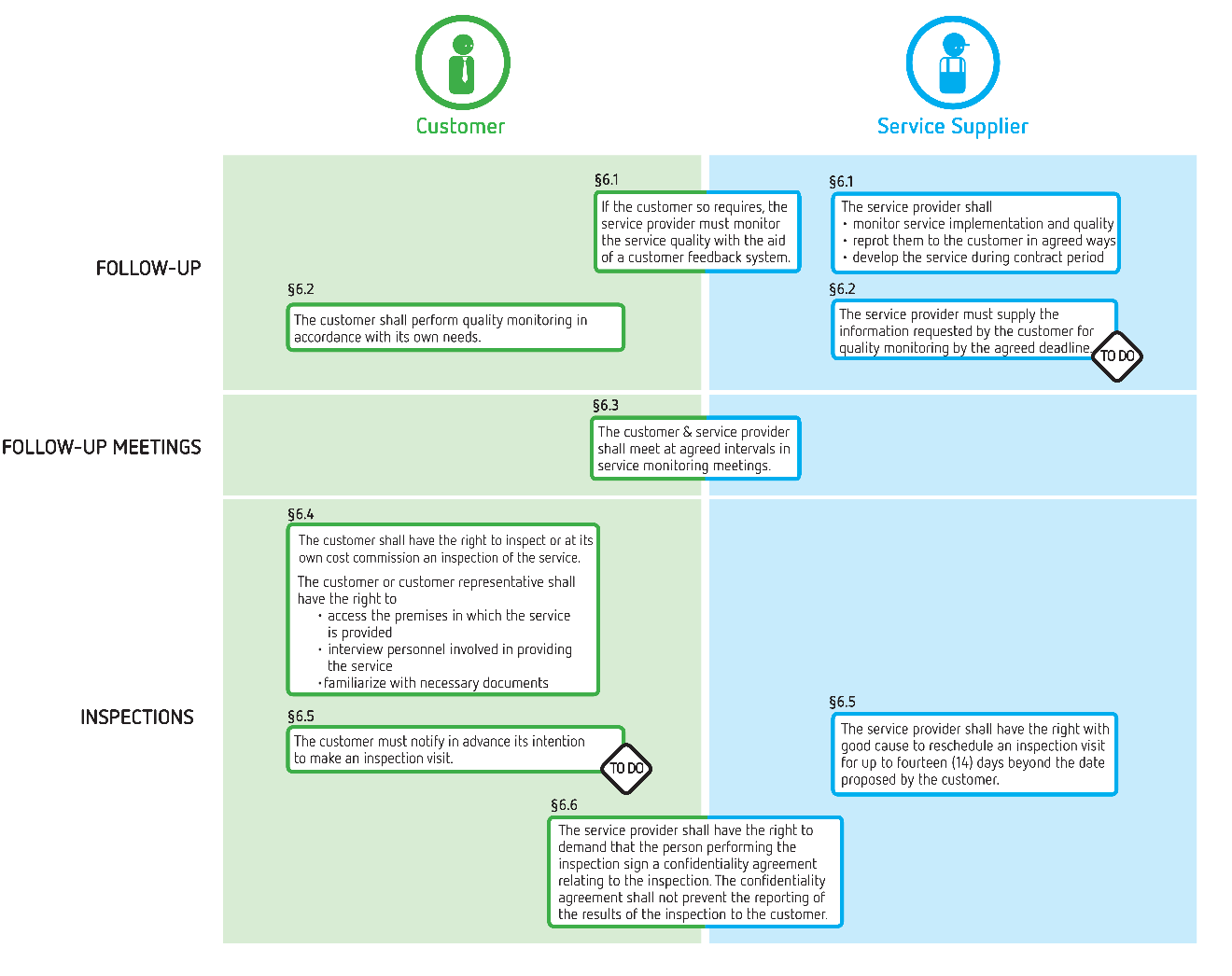
- Swim lanes are often used in process flow diagrams or flowcharts that illustrate roles and responsibilities for different parts of a process. The swim lanes may be named for example Customer and Supplier or Sales Finance and Legal with one lane for each party or function.See e.g. infraFigure 3.
- Mahler supranote 3 at 324. On the prospects for computerized generation and analysis of visualized contracts see for example Stefania Passera et al. Making the Meaning of Contracts Visible—Automating Contract Visualization inTransparency: Proceedings of the17thInternationalLegalInformaticsSymposium supranote 2 at 443 https://papers.ssrn.com/sol3/papers.cfm?abstract_id=2630609(combining information design user experience readability visualization and natural language processing); Meng Weng Wong et al. Computational Contract Collaboration and Construction inCo‐Operation: Proceedings of the18thInternationalLegalInformaticsSymposium505 (Erich Schweighofer et al. eds. 2015) https://papers.ssrn.com/sol3/papers.cfm?abstract_id=2613869(analyzing a four‐part framework of automation visualization collaboration and formalization in an effort to merge computing with “do‐it‐yourself” law and envisioning an automated contract generation toolkit which expands term sheets into long forms); Primavera de Filippi Legal Framework for Crypto‐Ledger Transactions P2P Found. Wiki(Feb. 28 2015 2:16 PM) http://p2pfoundation.net/Legal_Framework_For_Crypto-Ledger_Transactions(discussing the prospect for “smart” contracts). The idea of “smart contracts” that can evaluate themselves for compliance and trigger business events was presented by Nick Szabo more than twenty years ago.SeeMichael Gord Smart Contracts Described by Nick Szabo 20 Years Ago Now Becoming Reality BitcoinMag. (Apr. 26 2016) https://bitcoinmagazine.com/articles/smart-contracts-described-by-nick-szabo-years-ago-now-becoming-reality-1461693751.Laterresearch has developed these ideas further.See e.g. Harry Surden Computable Contracts 46 U.C. DavisL. Rev. 629 (2012) (describing computable contracts and their relevance to computerized finance with an emphasis on machine‐readable data elements); Mark D. Flood & Oliver R. Goodenough Contract as Automaton: The Computational Representation of Financial Agreements(Office of Fin. Research Working Paper No. 15–04 2015) http://ssrn.com/abstract=2648460.
- SeeMichael Curtotti et al. Interdisciplinary Cooperation in Legal Design and Communication inCo‐Operation: Proceedings of the18thInternationalLegalInformaticsSymposium supranote 178 at 455 458–60 http://ssrn.com/abstract=2630953(contrasting the democratizing function of legal design to a “command theory of the law”);see alsoSherwin et al. supranote 1 at 267–68.
Cited by
Wulf, A. J., & Seizov, O. (2022) · AI & Society · doi:10.1007/s00146-022-01424-z · Cited by 112
Milkaite, I., & Lievens, E. (2019) · Journal of Children and Media · doi:10.1080/17482798.2019.1701055 · Cited by 46
Sulkowski, A. J. (2018) · SSRN Electronic Journal · doi:10.2139/ssrn.3262291 · Cited by 45
Effective dispute prevention and resolution through proactive contract design
Hietanen-Kunwald, P., & Haapio, H. (2021) · Journal of Strategic Contracting and Negotiation · doi:10.1177/20555636211016878 · Cited by 39
Self-citationWhat is “wildlife”? Legal definitions that matter to conservation
Tian, M., Potter, G., & Phelps, J. (2023) · Biological Conservation · doi:10.1016/j.biocon.2023.110339 · Cited by 35
Metadata
- Authors
- Berger‐Walliser, G., Barton, T. D., & Haapio, H.
- Affiliations
- University of Connecticut (US)
- California Western School of Law (US)
- University of Vaasa (FI)
- ORCID
- Haapio, Helena
- Venue
- American Business Law Journal
- Publisher
- Wiley
- Published
- 2017-04-21
- Volume
- 54
- Issue
- 2
- Pages
- 347-392
- ISSN
- 0002-7766 (ISSN-L)
- 1744-1714
- OpenAlex
- W2530373926
- Cited by
- 62
- References
- 23
- Citations by year
- 2026: 3 · 2025: 13 · 2024: 4 · 2023: 13 · 2022: 12 · 2021: 4 · 2020: 2 · 2019: 4 · 2018: 3 · 2017: 1
- FWCI
- 28.16
- Type
- journal article
- Language
- en
- Open access
- green
- osuva.uwasa.fi
- Licence
- Locations
- American Business Law Journal (publishedVersion)
- Osuva (University of Vaasa) (submittedVersion, cc-by-sa)
- bepress Legal Repository (submittedVersion)
- SSRN Electronic Journal (submittedVersion)
- Osuva (University of Vaasa) (submittedVersion)
- Topics
- Social Sciences › Law › Law in Society and Culture
- Social Sciences › Law › Legal Education and Practice Innovations
- Social Sciences › Law › Legal Language and Interpretation
- Keywords
- legal visualization, legal design, graphic communication, visual law, business documents, statutory interpretation, user experience, organizational effectiveness, legal communication, co-design
About these checks
Registry, retraction, Cites and statistics results are computed, not judged, with one exception: a printed reference that no index lists is read once by a model before it counts as a citation error. Claims are extracted by a model and kept only when their quote appears verbatim in the text; each cited source is then checked, with a model’s help, for whether it says what the claim relies on. Those verdicts can be wrong — read the claim’s quote and the cited source before relying on one.
Statistics and arithmetic are recomputed, not judged.
Confidence bands are shown only for fields calibrated on our annotated test set. None is calibrated yet, so no band is shown.
What counts as a claim ›How we measure confidence ›How we check this ›
Are you an author, or do you see a problem with this page? Request a review
How to cite
Cite CoChat for the checks on this page, and the paper for its own findings.
- This page
- CoChat. (2026). Citation check: From Visualization to Legal Design: A Collaborative and Creative Process. https://app.cochat.ai/papers/10.1111/ablj.12101
- The paper
- Berger‐Walliser, G., Barton, T. D., & Haapio, H. (2017). From Visualization to Legal Design: A Collaborative and Creative Process. American Business Law Journal. https://doi.org/10.1111/ablj.12101
Data sources
Bibliographic data: Semantic Scholar, OpenAlex, Crossref.
Contains information from the Semantic Scholar Academic Graph Datasets, made available under the ODC Attribution License (ODC-BY 1.0).
Semantic Scholar’s data is described in: Kinney, R., et al. (2023). The Semantic Scholar Open Data Platform. arXiv:2301.10140.
