

Navigating Home Care Packages: A Content and Usability Analysis of Consumer‐Facing Information on Aged Care Provider Websites
Open accessThe DOI matches its Crossref record; 36 of the 36 references it cites were found in a registry or an index; none of the 55 sources its claims cite is checked for support yet.
Abstract
Objectives: The global population of people aged 60 years and above is growing. With this, there is a rising need for home care services and demand for online health information to facilitate the decision‐making among older adults and promote consumer‐directed care. This exploratory study aimed to examine how aged care provider websites present and structure information about Home Care Packages (HCPs) to support consumer decision‐making. Methods: A web‐based content analysis of Australian provider websites was conducted by accessing websites using Google Chrome in incognito mode and using an evaluation tool that assessed language readability (Flesch Reading Ease and Flesch–Kincaid Grade Level scores), usability features Web Content (Accessibility Guidelines V2.0) and the relevance and depth of HCP information. Descriptive statistics were calculated using SPSSv.29. Qualitative data were analysed using deductive content analysis. Data were extracted into Microsoft Excel and deductively coded using the structured evaluation tool developed for this study. Coded content was then narratively synthesised, augmented by researcher notes and illustrative quotes. Results: From 25 systematically sampled websites, the median Flesch Reading Ease score was 52.5 (IQR 12.52) corresponding to a high school reading level of 10th–12th grade. Most sites featured small text ( n = 21) and inconsistent information regarding services, pricing and case management. None of the websites in this analysis was found to be both user‐friendly and comprehensive in their HCP content. Conclusions: Poor usability and inconsistent information may limit older adults' ability to access and understand HCP details, reducing engagement with these online resources.
Overview
CoChat Summary
TL;DR
This exploratory content and usability analysis of 25 Australian aged care provider websites found that consumer-facing information about Home Care Packages (HCPs) was written at a Grade 10–12 reading level, was inconsistently presented across key topics, and was paired with usability features poorly suited to older adults. No website in the sample was both user-friendly and comprehensive in its HCP content.
Key findings
- Readability was well above the recommended Grade 7 benchmark: median Flesch Reading Ease score was 52.5 (IQR 12.52), corresponding to a Grade 10–12 reading level, with scores ranging from 25.65 (college graduate level) to 76.20 (Grade 7 level). Only 2 of 25 websites met the Grade 7 benchmark; 18 fell at Grade 10–12 or above.
- Usability issues were common: 21 websites used small text with no option to increase font size, and 6 used headings inconsistently or ineffectively. Most sites used a consistent top menu (n = 23) and drop-down menus (n = 19); 15 had a search function; all 25 were mobile-friendly; 16 had adequate contrast or adjustable contrast; 11 of 13 sites with video included captions; 8 offered other languages and 2 offered in-person interpreters, while 15 lacked CALD accommodations.
- HCP content was inconsistent: 11 websites gave no information on HCP levels, 12 gave no information on the application process, and case management information was absent from 15 of 25. Pricing was included on 17 sites, absent on 8, and difficult to locate on 3; package management costs appeared on 16 sites but were hard to find on 4.
- No website in the analysis was found to be both user-friendly and comprehensive in its HCP content.
Methods
- Exploratory, cross-sectional web-based content analysis of Australian aged care provider websites, underpinned by a realist-constructivist approach with a critical interpretivist lens, reported per STROBE guidelines; ethics approval not required as data were publicly available.
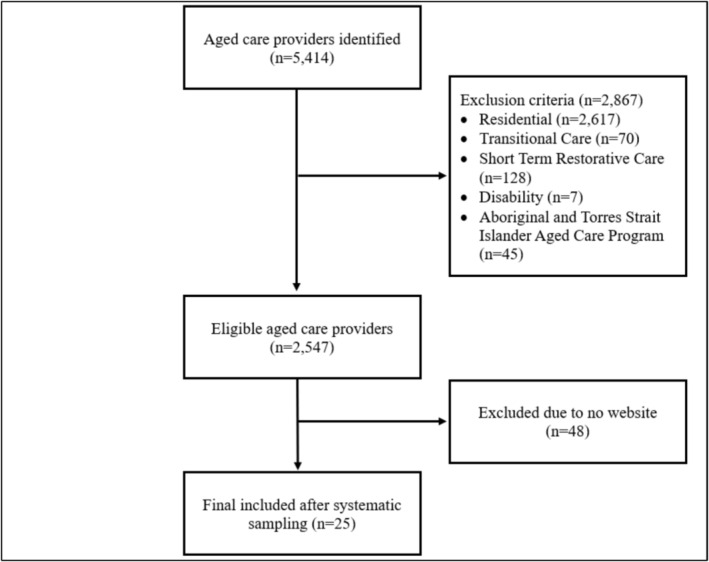
- Sampling frame was the GEN Aged Care Data list (5414 providers, 30 June 2024); after exclusions, 2547 eligible providers remained, and systematic sampling selected every 100th provider. Forty-eight selected providers without a website (all government-run, in inner regional, outer regional, remote or very remote areas) were replaced, yielding a final sample of 25.
- Websites were accessed via Google Chrome in incognito mode between 22 October and 25 November 2024. A purpose-built extraction tool adapted from WCAG 2.0 and prior web-based analyses assessed general provider information, usability, readability (FRE/FKGL on two random paragraphs per site) and depth of HCP content. Descriptive statistics were calculated in SPSS v.29; qualitative data were analysed using Elo and Kyngäs' deductive content analysis and narratively synthesised.
Limitations
- Stated by the authors: the evaluation tool was not validated; the sample was small (less than 1% of HCP providers) and predominantly major city and inner regional providers; providers specifically catering to Aboriginal and Torres Strait Islander peoples were excluded because the team deemed it inappropriate to analyse them without a First Nations researcher; and the exploratory, non-participatory design meant consumer and expert perspectives (older adults, carers, web designers) were not included.
- Evident from the text: the study captures websites as they stood in late 2024, before HCPs transitioned to the Support at Home program on 1 November 2025, so the specific program content assessed has since been superseded. Readability was estimated from only two randomly selected paragraphs per website, and the authors note FRE/FKGL do not account for prior knowledge, layout/typography, jargon or reader motivation.
Model-written summary. Check it against the paper before relying on it.
Integrity signals
Registry
Cites
Statistics
Figures
Verification
Claims the paper makes
0 Valid · 1 Not valid · 41 Not checked · 62 Own results and interpretations
A result the paper reports from its own data — it cites no other source for it, so there is none to check. The quote shows it is in the paper.
In the paper
“This approach yielded a final sample of 25 aged care providers (Figure 1).”
§ Navigating Home Care Packages: A Content and Usability Analysis of Consumer‐Facing Information on Aged Care Provider Websites > Results > Sample Selection
plain- Asserted: passes — The authors put it forward as true.
- Checkable: passes — It can be checked against evidence.
- Load-bearing: passes — The paper’s conclusions depend on it.
- Based: passes — The paper gives a reason why it holds.
A result the paper reports from its own data — it cites no other source for it, so there is none to check. The quote shows it is in the paper.
In the paper
“For multimedia accessibility, 11 of the 13 websites with video content included captions for users with impaired hearing.”
§ Navigating Home Care Packages: A Content and Usability Analysis of Consumer‐Facing Information on Aged Care Provider Websites > Results > Usability
plain- Asserted: passes — The authors put it forward as true.
- Checkable: passes — It can be checked against evidence.
- Load-bearing: unclear — It is unclear whether the paper’s conclusions depend on it.
- Based: passes — The paper gives a reason why it holds.
A result the paper reports from its own data — it cites no other source for it, so there is none to check. The quote shows it is in the paper.
In the paper
“Information on case management was absent from 15 of the 25 websites.”
§ Navigating Home Care Packages: A Content and Usability Analysis of Consumer‐Facing Information on Aged Care Provider Websites > Results > HCP Information
plain- Asserted: passes — The authors put it forward as true.
- Checkable: passes — It can be checked against evidence.
- Load-bearing: unclear — It is unclear whether the paper’s conclusions depend on it.
- Based: passes — The paper gives a reason why it holds.
A result the paper reports from its own data — it cites no other source for it, so there is none to check. The quote shows it is in the paper.
In the paper
“Most websites either listed basic services (n = 14) or provided comprehensive descriptions (n = 9).”
§ Navigating Home Care Packages: A Content and Usability Analysis of Consumer‐Facing Information on Aged Care Provider Websites > Results > HCP Information
plainn = 14- Asserted: passes — The authors put it forward as true.
- Checkable: passes — It can be checked against evidence.
- Load-bearing: unclear — It is unclear whether the paper’s conclusions depend on it.
- Based: passes — The paper gives a reason why it holds.
A result the paper reports from its own data — it cites no other source for it, so there is none to check. The quote shows it is in the paper.
In the paper
“inconsistent information regarding services, pricing and case management”
§ Navigating Home Care Packages: A Content and Usability Analysis of Consumer‐Facing Information on Aged Care Provider Websites > Abstract > Results
plainn = 21- Asserted: passes — The authors put it forward as true.
- Checkable: passes — It can be checked against evidence.
- Load-bearing: passes — The paper’s conclusions depend on it.
- Based: passes — The paper gives a reason why it holds.
30 more claims
Create a free account to see all 104 claims and to verify the 54 references still open.
- It may state two separate claims as one. 38
- Probably not a substantial claim. 43
Citations
Cites
The qualitative content analysis process
Elo, S., & Kyngäs, H. (2008) · Journal of Advanced Nursing · doi:10.1111/j.1365-2648.2007.04569.x · Cited by 22,617
von Elm, E., Altman, D. G., Egger, M., Pocock, S. J., Gøtzsche, P. C., & Vandenbroucke, J. P. (2008) · Journal of Clinical Epidemiology · doi:10.1016/j.jclinepi.2007.11.008 · Cited by 17,893
Applying critical realism in qualitative research: Methodology meets method
Fletcher, A. J. (2017) · International Journal of Social Research Methodology · doi:10.1080/13645579.2016.1144401 · Cited by 1,343
Darwin Holmes, A. G. (2020) · Shanlax International Journal of Education · doi:10.34293/education.v8i4.3232 · Cited by 1,341
Digital literacy as a new determinant of health: A scoping review
Arias López, M. D. P., Ong, B. A., Borrat Frigola, X., Fernández, A. L., Hicklent, R. S., Obeles, A. J. T., Rocimo, A. M., & Celi, L. A. (2023) · PLOS Digital Health · doi:10.1371/journal.pdig.0000279 · Cited by 422
Introduction to positivism, interpretivism and critical theory
Ryan, G. (2018) · Nurse Researcher · doi:10.7748/nr.2018.e1466 · Cited by 379
Assessing reading levels of health information: uses and limitations of flesch formula
Jindal, P., & MacDermid, J. (2017) · Education for Health · doi:10.4103/1357-6283.210517 · Cited by 275
Disability incidence and functional decline among older adults with major chronic diseases
Fong, J. H. (2019) · BMC Geriatrics · doi:10.1186/s12877-019-1348-z · Cited by 270
(1979) · Harper & Row eBooks · Cited by 224
Hong, Y. A., & Cho, J. (2016) · The Journals of Gerontology Series B: Psychological Sciences and Social Sciences · doi:10.1093/geronb/gbw100 · Cited by 181
Health literacy and the Internet: a study on the readability of Australian online health information
Cheng, C., & Dunn, M. (2015) · Australian and New Zealand Journal of Public Health · doi:10.1111/1753-6405.12341 · Cited by 158
Usability of Health Web Sites for Older Adults: A Preliminary Study
NAHM, E.-S., PREECE, J., RESNICK, B., & MILLS, M. E. (2004) · CIN: Computers, Informatics, Nursing · doi:10.1097/00024665-200411000-00007 · Cited by 108
Older Cancer Patients’ User Experiences With Web-Based Health Information Tools: A Think-Aloud Study
Bolle, S., Romijn, G., Smets, E. M. A., Loos, E. F., Kunneman, M., & van Weert, J. C. M. (2016) · Journal of Medical Internet Research · doi:10.2196/jmir.5618 · Cited by 107
Cole, A. C., Adapa, K., Khasawneh, A., Richardson, D. R., & Mazur, L. M. (2022) · BMJ Open · doi:10.1136/bmjopen-2021-058390 · Cited by 66
Robertson-Lang, L., Major, S., & Hemming, H. (2011) · Canadian Journal on Aging / La Revue canadienne du vieillissement · doi:10.1017/s071498081100050x · Cited by 66
Readability Formulas and User Perceptions of Electronic Health Records Difficulty: A Corpus Study
Zheng, J., & Yu, H. (2017) · Journal of Medical Internet Research · doi:10.2196/jmir.6962 · Cited by 47
Mac, O. A., Thayre, A., Tan, S., & Dodd, R. H. (2020) · Journal of Medical Internet Research · doi:10.2196/16701 · Cited by 35 · cited 1×
“These findings are consistent with other research analysing the readability of health-related information online, which typically report readability levels equating to Grades 10–12, a level considered ‘ fairly difficult’ for the average reader [40, 41].”
Web accessibility for older users: successes and opportunities (keynote)
Arch, A. (2009) · Proceedings of the 2009 International Cross-Disciplinary Conference on Web Accessibililty (W4A) · doi:10.1145/1535654.1535655 · Cited by 32
How Do Clients in Australia Experience Consumer Directed Care?
Gill, L., Bradley, S. L., Cameron, I. D., & Ratcliffe, J. (2018) · BMC Geriatrics · doi:10.1186/s12877-018-0838-8 · Cited by 29
Bellhouse, D. R. (2005) · Wiley eBooks · doi:10.1002/0470011815.b2a16077 · Cited by 25
Nayak, L., Priest, L., Stuart-Hamilton, I., & White, A. (2006) · Universal Access in the Information Society · doi:10.1007/s10209-006-0029-9 · Cited by 23
Nattam, A., Vithala, T., Wu, T.-C., Bindhu, S., Bond, G., Liu, H., Thompson, A., & Wu, D. T. Y. (2023) · Journal of Medical Internet Research · doi:10.2196/46346 · Cited by 22
Phillipson, L., Low, L. F., & Dreyfus, S. (2019) · Australian Journal of Social Issues · doi:10.1002/ajs4.66 · Cited by 21
A Support to Evaluate Web Accessibility and Usability Issues for Older Adults
Rodrigues, S. S., Scuracchio, P. E., & de Mattos Fortes, R. P. (2018) · Proceedings of the 8th International Conference on Software Development and Technologies for Enhancing Accessibility and Fighting Info-exclusion · doi:10.1145/3218585.3218597 · Cited by 20
Lowndes, A., & Connelly, D. M. (2023) · Digital Health · doi:10.1177/20552076231167004 · Cited by 19
Walsh, L., Hill, S., Allan, M., Balandin, S., Georgiou, A., Higgins, I., Kraal, B., McCarthy, S., & Hemsley, B. (2018) · Health Information Management Journal · doi:10.1177/1833358317712200 · Cited by 17
Haslam, R. L., Clarke, E. D., Gray, S., Gearon, R., & Pursey, K. (2021) · Journal of Eating Disorders · doi:10.1186/s40337-021-00512-7 · Cited by 10
Lee, J., Nguyen, J., & O’Leary, F. (2022) · Dietetics · doi:10.3390/dietetics1030015 · Cited by 9
Website Design: Technical, Social and Medical Issues for Self‐Reporting by Elderly Patients
Taylor, M. J., Stables, R., Matata, B., Lisboa, P. J., Laws, A., & Almond, P. (2014) · Health Informatics Journal · doi:10.1177/1460458213488382 · Cited by 8
Hunter, N. J. R., Wells, Y., Clune, S. J., Ayala Quintanilla, B. P., & Johnstone, E. (2021) · Ageing and Society · doi:10.1017/s0144686x19001065 · Cited by 6
Decision‐Making in Home Care Package Spending
Rowland, D., & Joyce, C. M. (2020) · Australasian Journal on Ageing · doi:10.1111/ajag.12838 · Cited by 5
Tan, Z. K. S., Pashley, A., Ball, L., Wright, O. R. L., & Bartrim, K. (2025) · Australasian Journal on Ageing · doi:10.1111/ajag.13388 · Cited by 4
Ng, C. P., Singh, D. K. A., Tan, M. P., & Kumar, S. (2021) · Jurnal Sains Kesihatan Malaysia · doi:10.17576/jskm-2021-1902-13 · Cited by 3
(2007) · PubMed
(2008) · Travesía (Ministerio de Educación, Cultura y Deporte)
(1998) · PubMed
Research works printed but not linked: 2
- Australian Institute of Health and Welfare, GEN Aged Care Data (Australian Government, 2024), https://www.gen‐agedcaredata.gov.au/getmedia/2fbaacd8‐1fbf‐4ef5‐ab1c‐72dfc4c727bf/People‐using‐aged‐care‐fact‐sheet‐2023.
- IBM SPSS Statistics for Windows (IBM Corp, 2023).
Cited by
Still being checked.
Metadata
- Authors
- Parker, A., Lawless, M., Thomas, J., & Yaxley, A.
- Affiliations
- Flinders University (AU)
- Corresponding author
- Thomas, Jolene
- Venue
- Australasian Journal on Ageing
- Publisher
- Wiley
- Published
- 2026-06
- Volume
- 45
- Issue
- 2
- Pages
- e70201-e70201
- ISSN
- 0726-4240 (ISSN-L)
- 1440-6381
- 1741-6612
- PMC
- PMC13304273
- OpenAlex
- W7166040078
- Semantic Scholar
- c0a600ecc52578917b6473c8fd76fb0a2b1509ee
- Cited by
- 0
- References
- 36
- FWCI
- 0.00
- Type
- journal article
- Language
- en
- Open access
- hybrid
- doi.org
- Licence
- cc-by-nc-nd
- creativecommons.org/licenses/by-nc-nd/4.0/ (vor, 24 d)
- doi.wiley.com/10.1002/tdm_license_1.1 (tdm)
- Locations
- Australian Journal on Ageing (publishedVersion, cc-by-nc-nd)
- PubMed Central (publishedVersion, cc-by-nc-nd)
- PubMed (publishedVersion)
- Funders
- Flinders University
- Topics
- Health Sciences › Health Professions › General Health Professions › Health Literacy and Information Accessibility
- Health Sciences › Medicine › Geriatrics and Gerontology › Technology Use by Older Adults
- Social Sciences › Human Factors and Ergonomics › Digital Accessibility for Disabilities
- Keywords
- home care packages, purchase decision, older adults, website usability, readability, online health information, consumer-directed care, case management, service pricing, web accessibility
- MeSH terms
- Aged, Australia, Health Services for the Aged, Home Care Services, Humans, Internet, Access to Information, Comprehension, Consumer Health Information, Health Literacy
About these checks
Registry, retraction, Cites and statistics results are computed, not judged, with one exception: a printed reference that no index lists is read once by a model before it counts as a citation error. Claims are extracted by a model and kept only when their quote appears verbatim in the text; each cited source is then checked, with a model’s help, for whether it says what the claim relies on. Those verdicts can be wrong — read the claim’s quote and the cited source before relying on one.
A language model drew the claims from the paper on 2026-11-24, under version 3 of the claim definition (model deepseek-v4.1-flash, prompt extract-v3).
A second model labelled each claim on 2026-11-24 (model jev-1.13-20260917, definition revision gold-guideline-v0.2).
Statistics and arithmetic are recomputed, not judged.
Confidence bands are shown only for fields calibrated on our annotated test set. None is calibrated yet, so no band is shown.
What counts as a claim ›How we measure confidence ›How we check this ›
Are you an author, or do you see a problem with this page? Request a review
Data sources
Bibliographic data: Semantic Scholar, OpenAlex, Crossref.
Contains information from the Semantic Scholar Academic Graph Datasets, made available under the ODC Attribution License (ODC-BY 1.0).
Semantic Scholar’s data is described in: Kinney, R., et al. (2023). The Semantic Scholar Open Data Platform. arXiv:2301.10140.
