

The DOI matches its Crossref record; 36 of the 36 references it cites were found in a registry or an index.
Introduction ‐ The heritage and decoloniality nexus: Global exchanges and unresolved questions in sedimented landscapes of injustice
Abstract
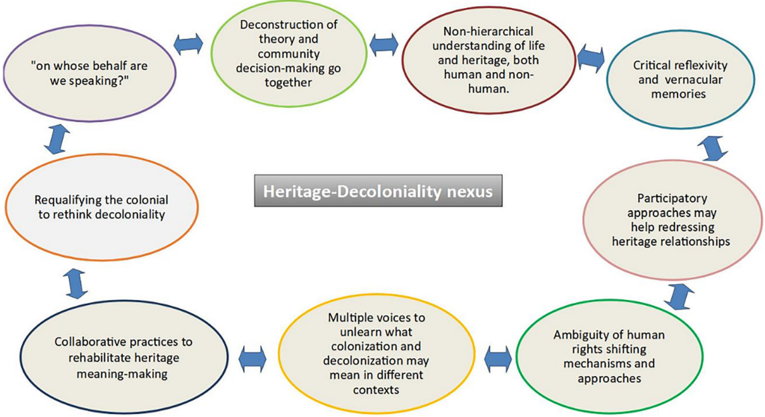
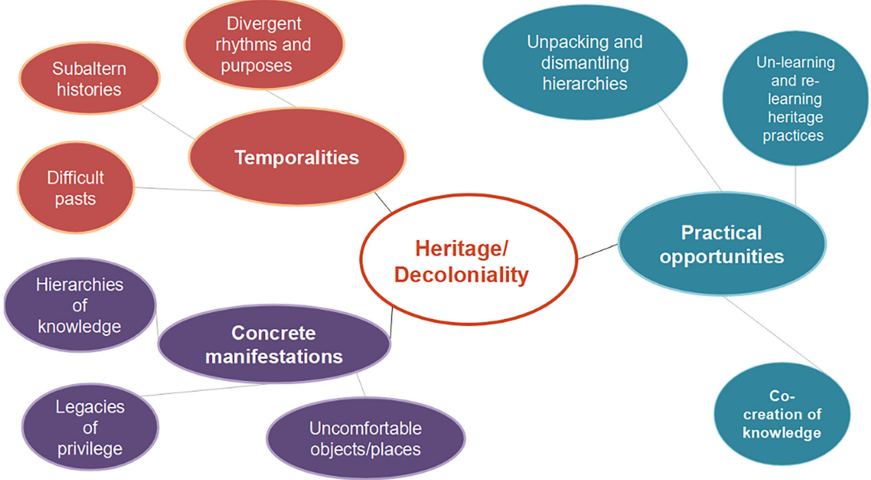
More than ever, heritage narratives, policies, and objects are being questioned because of the colonial legacies that still permeate public spaces (e.g., Knudsen et al., 2022).From the eruption of protests and claims to heritage objects, places, and monuments in former colonial powers, to the emergence of Indigenous peoples' heritage curatorship of land, and resources activism, new efforts are challenging racialized social orders and persistent exclusionary regimes.Protests echo long-running questions about social structure, voice, and ability to shape lives and the future, linking heritage to broader questions of rights, resources, and redistribution.Both academic scholarship and grassroots politics prompt us to interrogate the entrenched politics of representation, socio-material interactions, and the unfinished business of decolonizing heritage institutions and practices.This conversation started within the framework of a networking seed grant project promoted by the University of Geneva and the University of Exeter. 1 The project aimed to broaden the conversation on the intersections of cultural heritage, identity, and landscape sustainability by bringing together scholars addressing different configurations of heritage regimes, discourses, and practices from various regions of the world (Figure 1).Focusing on the connections, as well as contradictions, that characterize social spaces caught up between local and global policies and practices, this led to a powerful interdisciplinary and comparative outlook on the complexities of decoloniality.The anthropologically informed multiregional focus enabled us to explore the entanglements between place-based research, long-term practices of inhabiting and remembering, and the transnational valuations and expectations underpinning official heritage management (see Dominguez, 2017).The complexity of "authorized heritage discourse," as originally defined by Smith (2006), is arguably augmented in contemporary frictional spaces of developmentalism, from the widening of global extractive frontiers on natural, cultural, and intellectual materials, to the spaces into which Indigenous peoples and ethnic or rural minorities are pressured to conform to international organizations' and state-sponsored development models (e.g., Coombe and Baird, 2016;Larsen et al., 2022).The collective effort, as this dossier reveals, led to the identification of unexpected commonalities as well as new horizons for collaboration across disciplines, areas of practice, and diverse perspectives.The exchanges on heritage and decoloniality taking place across several meetings revealed a common aspiration to unpack heritage politics through their multiple historical, juridical, emotional, and spatial dimensions.Colonial heritage matters are not merely historical events and material remains of the past that can simply be acknowledged or rejected.Rather, they emerge from the remediation of difficult pasts that radically challenge the hierarchical taxonomies and practices used to categorize people, objects, and landscapes.This discussion resonates with the call for "a rhizomatic cosmopolitics" (Papailias and Gupta, 2021, 964) to the extent that it aspires to disclose opportunities for more equitable worldings through anthropological knowledge.
Overview
The claims and statistics of this paper haven’t been checked yet.
Run the check — free, no account needed. It reads the open-access text and checks the sources it cites.
Integrity signals
Registry
Cites
Statistics
Figures
Verification
Claims the paper makes
The claims and statistics of this paper haven’t been checked yet.
Run the check — free, no account needed. It reads the open-access text and checks the sources it cites.
Claims other papers make about this one
Each is checked against this paper’s own text: does it say what the citing paper says it does?
In the citing paper
“As we adopt transcultural research methodologies that enable local communities' increased autonomy in heritage management [72], an integrated remote sensing approach combined with ground-truthing via field methods can contribute to the understanding of changes and continuities in patterns of aggregation and dispersion.”
From Andean landscape legacies: comprehensive remote sensing mapping and GIS analysis of long-term settlement and land use for sustainable futures (NW argentina) (2024) · cites this paper as [72]
Self-check
Percentages, sums and reported differences re-computed from the paper’s own numbers.
The self-check needs the paper’s full text.
Citations
Cites
(2012) · TSpace (University of Toronto) · Cited by 4,953
Staying with the Trouble: Making Kin in the Chthulucene
Haraway, D. J. (2016) · Duke University Press eBooks · doi:10.1215/9780822373780 · Cited by 4,796
Smith, L. (2006) · doi:10.4324/9780203602263 · Cited by 4,094
COLONIALITY AND MODERNITY/RATIONALITY
Quijano, A. (2007) · Cultural Studies · doi:10.1080/09502380601164353 · Cited by 3,747
Maldonado-Torres, N. G. E. (2007) · Cultural Studies · doi:10.1080/09502380601162548 · Cited by 3,399
On Decoloniality: Concepts, Analytics, Praxis
Mignolo, W. D., & Walsh, C. E. (2018) · doi:10.1215/9780822371779 · Cited by 1,783
Todd, Z. (2016) · Journal of Historical Sociology · doi:10.1111/johs.12124 · Cited by 1,480
Globalization and the Decolonial Option
(2013) · Routledge eBooks · doi:10.4324/9781315868448 · Cited by 870
Decolonizing posthumanist geographies
Sundberg, J. (2014) · cultural geographies · doi:10.1177/1474474013486067 · Cited by 844
Postcolonial and decolonial dialogues
Bhambra, G. K. (2014) · Postcolonial Studies · doi:10.1080/13688790.2014.966414 · Cited by 801
Research works printed but not linked: 5
- Fanon F., 1963, The Wretched of the Earth
- Knudsen B. T., 2022, Decolonizing Colonial Heritage: New Agendas, Actors, Practices in and beyond Europe
- Orlandi F.2022. “Heritage Cosmopolitics: Archaeology Indigeneity and Rights in Bolivia and Argentina.” PhD dissertation University of Exeter.https://hdl.handle.net/10871/129335
- Rivera Cusicanqui S., 2014, The Potosí Principle: Another View of Totality, E‐Misférica, 11
- 10.1007/978-1-349-19059-1_20 · DOI
Cited by
Lazzari, M., Oltean, I., Oyaneder Rodríguez, A., Scattolin, M. C., & Pereyra Domingorena, L. (2024) · Remote Sensing · doi:10.3390/rs16203795 · Cited by 4
Self-citation
Metadata
- Authors
- Lazzari, M., Larsen, P. B., & Orlandi, F.
- Affiliations
- University of Exeter
- University of Geneva
- Venue
- American Anthropologist
- Publisher
- Wiley
- Published
- 2024-02-26
- Volume
- 126
- Issue
- 2
- Pages
- 311-316
- ISSN
- 0002-7294
- 1548-1433
- Cited by
- 5
- References
- 36
- Language
- en
About these checks
Registry, retraction, Cites and statistics results are computed, not judged, with one exception: a printed reference that no index lists is read once by a model before it counts as a citation error. Claims are extracted by a model and kept only when their quote appears verbatim in the text; each cited source is then checked, with a model’s help, for whether it says what the claim relies on. Those verdicts can be wrong — read the claim’s quote and the cited source before relying on one.
Statistics and arithmetic are recomputed, not judged.
Confidence bands are shown only for fields calibrated on our annotated test set. None is calibrated yet, so no band is shown.
What counts as a claim ›How we measure confidence ›How we check this ›
Are you an author, or do you see a problem with this page? Request a review
Data sources
Bibliographic data: Semantic Scholar, OpenAlex, Crossref.
Contains information from the Semantic Scholar Academic Graph Datasets, made available under the ODC Attribution License (ODC-BY 1.0).
Semantic Scholar’s data is described in: Kinney, R., et al. (2023). The Semantic Scholar Open Data Platform. arXiv:2301.10140.
