

Sampling bias exaggerates a textbook example of a trophic cascade
Open accessPublished version of a preprint
The DOI matches its Crossref record; 77 of the 77 references it cites were found in a registry or an index.
Abstract
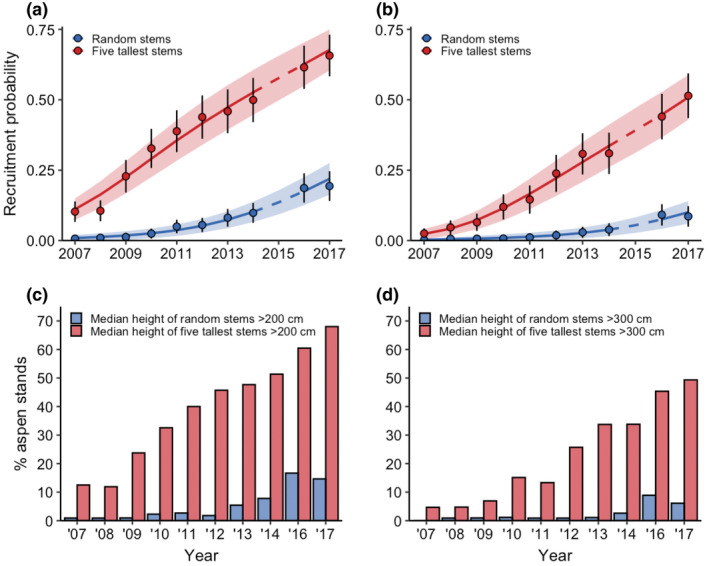
Understanding trophic cascades in terrestrial wildlife communities is a major challenge because these systems are difficult to sample properly. We show how a tradition of non‐random sampling has confounded this understanding in a textbook system (Yellowstone National Park) where carnivore [ Canis lupus (wolf)] recovery is associated with a trophic cascade involving changes in herbivore [ Cervus canadensis (elk)] behaviour and density that promote plant regeneration. Long‐term data indicate a practice of sampling only the tallest young plants overestimated regeneration of overstory aspen ( Populus tremuloides ) by a factor of 4–7 compared to random sampling because it favoured plants taller than the preferred browsing height of elk and overlooked non‐regenerating aspen stands. Random sampling described a trophic cascade, but it was weaker than the one that non‐random sampling described. Our findings highlight the critical importance of basic sampling principles (e.g. randomisation) for achieving an accurate understanding of trophic cascades in terrestrial wildlife systems.
Overview
The claims and statistics of this paper haven’t been checked yet.
Free: it reads the open-access text and checks the first 5 claims that cite a source we can check. Create a free account to check every claim.
Integrity signals
Registry
Cites
Statistics
Figures
Verification
Claims the paper makes
The claims and statistics of this paper haven’t been checked yet.
Free: it reads the open-access text and checks the first 5 claims that cite a source we can check. Create a free account to check every claim.
Claims other papers make about this one
Each is checked against this paper’s own text: does it say what the citing paper says it does?
In the citing paper
“Our original conclusion that random sampling described a trophic cascade that was weaker than the one described by non-random sampling is unchanged.”
From Non‐random sampling measures the occurrence but not the strength of a textbook trophic cascade (2024) · cites this paper as Brice et al., 2022
In the citing paper
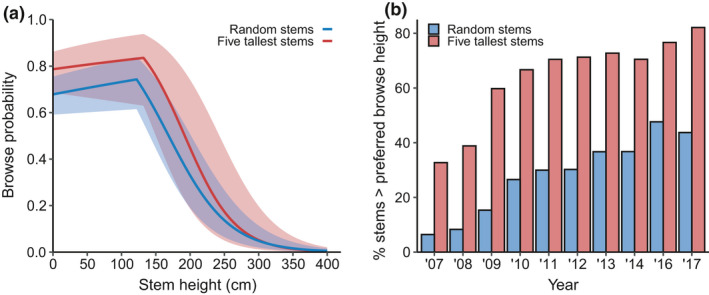
“Our study quantified the extent of this bias, revealing, for example, that 5T sampling overestimated regeneration of overstory aspen by a factor of 4-7 compared to random sampling (Brice et al., 2022: figure 5).”
From Non‐random sampling measures the occurrence but not the strength of a textbook trophic cascade (2024) · cites this paper as Brice et al., 2022
In the citing paper
“Although sampling the five tallest young aspen in a stand is useful for detecting the occurrence of any aspen recruitment, this technique overestimates the population response of aspen to wolf reintroduction.”
From Non‐random sampling measures the occurrence but not the strength of a textbook trophic cascade (2024) · cites this paper as Brice et al., 2022
Self-check
Percentages, sums and reported differences re-computed from the paper’s own numbers.
The self-check needs the paper’s full text.
Citations
Cites
Model selection and multimodel inference: a practical information-theoretic approach.
Guthery, F. S., Burnham, K. P., & Anderson, D. R. (2003) · The Journal of Wildlife Management · doi:10.2307/3802723 · Cited by 41,495
Trophic Downgrading of Planet Earth
Estes, J. A., Terborgh, J., Brashares, J. S., Power, M. E., Berger, J., Bond, W. J., Carpenter, S. R., Essington, T. E., Holt, R. D., Jackson, J. B. C., et al. (2011) · Science · doi:10.1126/science.1205106 · Cited by 4,087 · cited 1×
“…how ecosystems respond to the loss and/or addition of large predators is vital to resolving broader debates about the forces that structure food webs, determine species abundance and deliver ecosystem services (Atkins et al., 2019; Dobson, 2014; Estes et al., 2011; Ripple et al., 2014).”
Status and Ecological Effects of the World’s Largest Carnivores
Ripple, W. J., Estes, J. A., Beschta, R. L., Wilmers, C. C., Ritchie, E. G., Hebblewhite, M., Berger, J., Elmhagen, B., Letnic, M., Nelson, M. P., et al. (2014) · Science · doi:10.1126/science.1241484 · Cited by 3,667
Principles of Terrestrial Ecosystem Ecology
Chapin, F. S., Matson, P. A., & Vitousek, P. M. (2011) · Springer eBooks · doi:10.1007/978-1-4419-9504-9 · Cited by 1,793
Wolves, elk, and bison: reestablishing the "landscape of fear" in Yellowstone National Park, U.S.A.
Laundré, J. W., Hernández, L., & Altendorf, K. B. (2001) · Canadian Journal of Zoology · doi:10.1139/z01-094 · Cited by 1,216
Trophic cascades in Yellowstone: The first 15years after wolf reintroduction
Ripple, W. J., & Beschta, R. L. (2012) · Biological Conservation · doi:10.1016/j.biocon.2011.11.005 · Cited by 884
Aspen: Ecology and management in the western United States
DeByle, N. V., & Winokur, R. P. (1985) · doi:10.2737/rm-gtr-119 · Cited by 457
Trophic cascades among wolves, elk and aspen on Yellowstone National Park’s northern range
Ripple, W. J., Larsen, E. J., Renkin, R. A., & Smith, D. W. (2001) · Biological Conservation · doi:10.1016/s0006-3207(01)00107-0 · Cited by 452
Self-citationLarge predators and trophic cascades in terrestrial ecosystems of the western United States
Beschta, R. L., & Ripple, W. J. (2009) · Biological Conservation · doi:10.1016/j.biocon.2009.06.015 · Cited by 451
Questionable research practices in ecology and evolution
Fraser, H., Parker, T., Nakagawa, S., Barnett, A., & Fidler, F. (2018) · PLOS ONE · doi:10.1371/journal.pone.0200303 · Cited by 346 · cited 1×
“Growing concerns about the reliability of research findings in ecology (e.g. Fidler et al., 2017; Fraser et al., 2018; O’Grady, 2020) emphasise the vital importance of basic sampling principles for studies of trophic cascades and other ecological phenomena.”
Research works printed but not linked: 9
- Bangs, E.E. & Fritts, S.H. (1996) Reintroducing the Gray wolf to central Idaho and Yellowstone National Park. Wildlife Society Bulletin, 24, 402– 413.
- Cassidy, K.A., Smith, D.W., Stahler, D.R., MacNulty, D.R., Stahler, E.E. & Metz, M.C. (2020) Territoriality and competition between wolf packs. In: Smith, D.W., Stahler, D.R. & MacNulty, D.R. (Eds.) Yellowstone wolves: science and discovery in the world’s first national park. Chicago, IL: University of Chicago Press, pp. 61– 76.
- Jones, J.R. & DeByle, N.V. (1985) Climates. In: DeByle, N.V. & Winokur, R.P. (Eds.) Aspen: ecology and management in the western United States. USDA Forest Service general technical report RM‐119. Ft. Collins, CO: Rocky Mountain Forest Range Experiment Station, p. 294.
- MacNulty, D.R., Stahler, D.R., Wyman, T., Ruprecht, J., Smith, L.M., Kohl, M.T. et al. (2020) Population dynamics of northern Yellowstone elk after wolf reintroduction. In: Smith, D.W., Stahler, D.R. & MacNulty, D.R. (Eds.) Yellowstone wolves: science and discovery in the world’s first national park. Chicago, IL: University of Chicago Press, pp. 184– 199.
- Metz, M.C., Hebblewhite, M., Smith, D.W., Stahler, D.R., MacNulty, D.R., Tallian, A. et al. (2020) What wolves eat and why. In: Smith, D.W., Stahler, D.R. & Macnulty, D.R. (Eds.) Yellowstone wolves: science and discovery in the world’s first national park. Chicago, IL: University of Chicago Press, pp. 156– 168.
- Mueggler, W.F. (1985). Vegetation associations. In: DeByle, N.V. & Winokur, R.P. (Eds.) Aspen: ecology and management in the western United States. USDA Forest Service general technical report RM‐119. Ft. Collins, CO, USA: Rocky Mountain Forest Range Experiment Station, p. 294.
- Peterson, R.O., Beschta, R.L., Cooper, D.J., Hobbs, N.T., Johnston, D.B., Larsen, E.J. et al. (2020) Indirect effects of carnivore restoration on vegetation. In: Smith, D.W., Stahler, D.R. & Macnulty, D.R. (Eds.) Yellowstone wolves: science and discovery in the world’s first national park. Chicago, IL: University of Chicago Press, pp. 205– 222.
- Rhodes, A.C., Anderson, V. & St Clair, S.B. (2017) Ungulate herbivory alters leaf functional traits and recruitment of regenerating aspen. Tree Physiology, 37, 402– 413. 28338915
- Yellowstone National Park (1997) Yellowstone’s northern range: complexity and change in a wildland ecosystem. Mammoth Hot Springs, WY: National Park Service.
Cited by
Impacts of large herbivores on terrestrial ecosystems
Pringle, R. M., Abraham, J. O., Anderson, T. M., Coverdale, T. C., Davies, A. B., Dutton, C. L., Gaylard, A., Goheen, J. R., Holdo, R. M., Hutchinson, M. C., et al. (2023) · Current Biology · doi:10.1016/j.cub.2023.04.024 · Cited by 239
Hobbs, N. T., Johnston, D. B., Marshall, K. N., Wolf, E. C., & Cooper, D. J. (2024) · Ecological Monographs · doi:10.1002/ecm.1598 · Cited by 52
Non‐random sampling measures the occurrence but not the strength of a textbook trophic cascade
MacNulty, D. R., Brice, E. M., & Larsen, E. J. (2024) · Ecology Letters · doi:10.1111/ele.14344 · Cited by 6
Self-citationRevisiting trophic cascades and aspen recovery in northern Yellowstone
Beschta, R. L., Painter, L. E., & Ripple, W. J. (2023) · Food Webs · doi:10.1016/j.fooweb.2023.e00276 · Cited by 6
Kauffman, J. B., Cummings, D. L., Beschta, R. L., & Ripple, W. J. (2025) · Ecosphere · doi:10.1002/ecs2.70410 · Cited by 5
Metadata
- Authors
- Brice, E. M., Larsen, E. J., & MacNulty, D. R.
- Affiliations
- Utah State University (US)
- University of Wisconsin–Stevens Point (US)
- Corresponding author
- Brice, Elaine M.
- Venue
- Ecology Letters
- Publisher
- Wiley
- Published
- 2021-11-08
- Volume
- 25
- Issue
- 1
- Pages
- 177-188
- ISSN
- 1461-023X (ISSN-L)
- 1461-0248
- PMC
- PMC9298920
- OpenAlex
- W3213327662
- Cited by
- 56
- References
- 77
- Citations by year
- 2026: 8 · 2025: 15 · 2024: 8 · 2023: 14 · 2022: 7 · 2021: 3
- FWCI
- 4.32
- Type
- journal article
- Language
- en
- Open access
- hybrid
- doi.org
- Licence
- Locations
- Ecology Letters (publishedVersion, cc-by-nc)
- bioRxiv (Cold Spring Harbor Laboratory) (acceptedVersion, cc-by-nc-nd)
- PubMed Central (publishedVersion, cc-by-nc)
- PubMed (publishedVersion)
- Digital Commons - USU (Utah State University) (submittedVersion, cc-by-nc)
- Zenodo (CERN European Organization for Nuclear Research)
- Funders
- National Science Foundation (DGE‐1633756)
- Utah State University
- Topics
- Physical Sciences › Environmental Science › Ecology › Wildlife Ecology and Conservation
- Physical Sciences › Environmental Science › Ecology › Animal Ecology and Behavior Studies
- Physical Sciences › Environmental Science › Ecology › Rangeland and Wildlife Management
- Keywords
- trophic cascades, sampling bias, non-probability sampling, random sampling, wolf recovery, elk browsing, aspen regeneration, Populus tremuloides, herbivore behavior, plant regeneration, Yellowstone National Park, wolf, elk
- MeSH terms
- Animals, Deer, Predatory Behavior, Selection Bias, Wolves, Populus, Herbivory
About these checks
Registry, retraction, Cites and statistics results are computed, not judged, with one exception: a printed reference that no index lists is read once by a model before it counts as a citation error. Claims are extracted by a model and kept only when their quote appears verbatim in the text; each cited source is then checked, with a model’s help, for whether it says what the claim relies on. Those verdicts can be wrong — read the claim’s quote and the cited source before relying on one.
Statistics and arithmetic are recomputed, not judged.
Confidence bands are shown only for fields calibrated on our annotated test set. None is calibrated yet, so no band is shown.
What counts as a claim ›How we measure confidence ›How we check this ›
Are you an author, or do you see a problem with this page? Request a review
How to cite
Cite CoChat for the checks on this page, and the paper for its own findings.
- This page
- CoChat. (2026). Citation check: Sampling bias exaggerates a textbook example of a trophic cascade. https://app.cochat.ai/papers/10.1111/ele.13915
- The paper
- Brice, E. M., Larsen, E. J., & MacNulty, D. R. (2022). Sampling bias exaggerates a textbook example of a trophic cascade. Ecology Letters. https://doi.org/10.1111/ele.13915
Data sources
Bibliographic data: Semantic Scholar, OpenAlex, Crossref.
Contains information from the Semantic Scholar Academic Graph Datasets, made available under the ODC Attribution License (ODC-BY 1.0).
Semantic Scholar’s data is described in: Kinney, R., et al. (2023). The Semantic Scholar Open Data Platform. arXiv:2301.10140.
