

The DOI matches its Crossref record; 1 of the 1 references it cites were found in a registry or an index.
Cultural Humility in Action: Learning From Refugee and Migrant Women and Healthcare Providers to Improve Maternal Health Services in Australia
Open accessAbstract
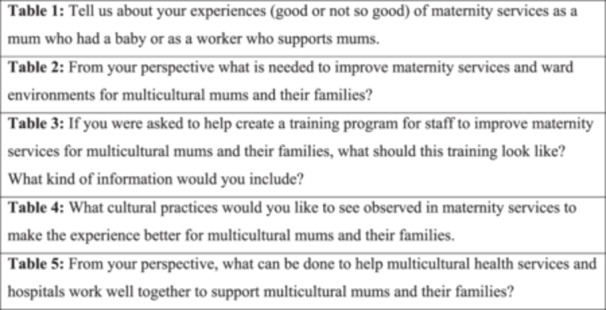
Introduction: Access to culturally appropriate healthcare is vital to ensure refugee and migrant women receive optimal care, particularly during the perinatal period. Refugee and migrant women report lower satisfaction with pregnancy care due to language barriers and a perceived lack of understanding of their needs. The aim of this study is to explore how to improve the experiences of migrant and refugee women with maternal health services through the lens of cultural humility. Methods: Working collaboratively with maternal health service providers and managers and local refugee and migrant women, this research project used a World Café methodology to provide these stakeholders with an opportunity to discuss maternal healthcare in the region. World Café participants ( n = 34) included women from multicultural backgrounds ( n = 20), maternal healthcare providers such as midwives, social workers and management ( n = 5) multicultural healthcare providers ( n = 7) and a community‐based birth educator ( n = 1). Data were analysed thematically. Results: A key finding of the World Café was the need for staff training that is co‐designed and co‐delivered with members of multicultural communities and healthcare providers to enhance the practice of cultural humility. Training should focus on women's stories that capture the cultural nuances around pregnancy and birthing, their support needs including trauma‐informed care, and the importance of effective cross‐cultural communication. Conclusion: This research gave refugee and migrant women a voice in future decision‐making, specifically in maternal health staff training. The refugee and migrant women shared their perspectives on how to enhance cultural humility practices in maternity services for them. The research has led to opportunities such as community‐based antenatal classes and improvements in maternity services development strategies. Public Contribution: The project actively engaged with maternal healthcare providers, multicultural and refugee healthcare providers and women from multicultural communities in the design of the project and as participants. Their expertise and experience have been invaluable and have informed pilot programmes that emerged from this study.
Overview
The claims and statistics of this paper haven’t been checked yet.
Run the check — free, no account needed. It reads the open-access text and checks the sources it cites.
Integrity signals
Registry
Cites
Statistics
Figures
Verification
Claims the paper makes
The claims and statistics of this paper haven’t been checked yet.
Run the check — free, no account needed. It reads the open-access text and checks the sources it cites.
Self-check
Percentages, sums and reported differences re-computed from the paper’s own numbers.
The self-check needs the paper’s full text.
Citations
Cites
From Mastery to Accountability: Cultural Humility as an Alternative to Cultural Competence
Fisher-Borne, M., Cain, J. M., & Martin, S. L. (2015) · Social Work Education · doi:10.1080/02615479.2014.977244 · Cited by 658
Research works printed but not linked: 54
- 10.1371/journal.pone.0211685 · DOI
- Sullivan C., 2020, Migrant and Refugee Women's Mental Health in Australia: A Literature Review. School of Population and Global Health
- De Maio J., 2017, Empowering Migrant and Refugee Women: Supporting and Empowering Women Beyond Five‐Year Post‐settlement
- 10.1186/s12884-014-0392-0 · DOI
- 10.1111/birt.12272 · DOI
- 10.1016/j.midw.2015.03.001 · DOI
- Australian Government Department of Health & Aged Care, 2020, Clinical Practice Guidelines: Pregnancy Care
- New South Wales Ministry of Health, 2019, NSW Plan for Healthy Culturally and Linguistically Diverse Communities: 2019–2023
- 10.1186/s12913-023-09066-7 · DOI
- 10.1353/hpu.2010.0233 · DOI · Paper page
- 10.1002/capr.12481 · DOI
- 10.1891/2156-5287.5.4.188 · DOI
- 10.1176/appi.focus.20190041 · DOI · Paper page
- 10.1016/j.mnl.2021.08.017 · DOI
- 10.1097/JPN.0b013e31827e478d · DOI
- 10.1111/jonm.13429 · DOI
- Australian Bureau of Statistics, 2021, Australia's Population by Country of Birth
- Australian Government Department of Home Affairs, 2024, Refugee and Humanitarian Program
- Australian Government Department of Home Affairs, 2024, Migration Program Planning Levels
- Australian Institute of Health and Welfare, 2020, Perinatal Statistics Series no. 36. Cat. no. PER 108
- 10.1071/SH15235 · DOI
- 10.1192/bjo.2020.54 · DOI
- 10.1016/j.wombi.2011.01.002 · DOI
- 10.1111/jan.12139 · DOI · Paper page
- 10.5694/mja12.10125 · DOI
- 10.1186/s12916-018-1064-0 · DOI
- 10.1111/hex.12629 · DOI
- 10.1177/1049732319861381 · DOI
- 10.1016/j.wombi.2021.08.005 · DOI
- 10.1016/j.wombi.2023.04.003 · DOI
- 10.1186/2046-4053-4-13 · DOI
- 10.1111/inm.12916 · DOI
- 10.1186/1472-6963-12-117 · DOI
- New South Wales Health, 2022, NSW Refuge Action Plan 2022–2027
- Brown J., 2005, The World Café: Shaping Our Futures Through Conversations That Matter
- 10.29060/TAPS.2019-4-1/SC2000 · DOI
- 10.1093/fampra/cmw104 · DOI
- 10.1111/hex.13703 · DOI
- 10.1186/s12889-019-7183-5 · DOI
- 10.1016/j.apnr.2013.06.008 · DOI
- 10.1177/1609406920916976 · DOI
- 10.1007/978-981-10-5251-4_103 · DOI · Paper page
- 10.1080/10401334.2020.1813585 · DOI
- 10.1007/978-3-030-04342-1 · DOI
- NSW Government, 2020, Safety Fundamentals for Patient Centred Care Teach Back, Clinical Excellence Commission
- NSW Government, 2024, NSW Health Care Interpreting Services
- Australian Government Department of Home Affairs, 2022, Translating and Interpreting Service
- 10.1186/s12939-018-0865-2 · DOI
- 10.1186/s12889-019-7378-9 · DOI
- 10.1177/1049732314521902 · DOI
- 10.7748/en.2020.e1990 · DOI
- Substance Abuse and Mental Health Services Administration (SAMHSA), 2014, SAMHSA'S Concept of Trauma and Guidance for a Trauma‐Informed Approach
- 10.3109/01612840.2015.1025319 · DOI
- 10.1080/15325024.2015.1084854 · DOI
Metadata
- Authors
- Rambaldini‐Gooding, D., Olcoń, K., Molloy, L., Pitts, L., Lema, S., Baghdadi, E., Williams, J., & Degeling, C.
- Affiliations
- University of Wollongong (AU)
- Illawarra Shoalhaven Local Health District (AU)
- Corresponding author
- Rambaldini‐Gooding, Delia
- Venue
- Health Expectations
- Publisher
- Wiley
- Published
- 2024-11-21
- Volume
- 27
- Issue
- 6
- Pages
- e70106-e70106
- ISSN
- 1369-6513 (ISSN-L)
- 1369-7625
- PMC
- PMC11581955
- OpenAlex
- W4404622462
- Cited by
- 10
- References
- 1
- Citations by year
- 2026: 7 · 2025: 3
- FWCI
- 7.15
- Type
- journal article
- Language
- en
- Open access
- gold
- doi.org
- Licence
- Locations
- Health Expectations (publishedVersion, cc-by)
- PubMed Central (publishedVersion, cc-by)
- PubMed (publishedVersion)
- DOAJ (DOAJ: Directory of Open Access Journals) (submittedVersion)
- Funders
- University of Wollongong
- Topics
- Health Sciences › Medicine › Public Health, Environmental and Occupational Health › Cultural Competency in Health Care
- Social Sciences › Psychology › Clinical Psychology › Migration, Health and Trauma
- Social Sciences › Sociology and Political Science › Migration, Identity, and Health
- Keywords
- cultural humility, refugee women, migrant women, obstetric care, perinatal care, World Café, co-design, employee training, intercultural communication, trauma-informed care, Australia
- MeSH terms
- Adult, Australia, Female, Health Personnel, Health Services Accessibility, Humans, Maternal Health Services, Pregnancy, Refugees, Transients and Migrants, Cultural Diversity, Cultural Competency
About these checks
Registry, retraction, Cites and statistics results are computed, not judged, with one exception: a printed reference that no index lists is read once by a model before it counts as a citation error. Claims are extracted by a model and kept only when their quote appears verbatim in the text; each cited source is then checked, with a model’s help, for whether it says what the claim relies on. Those verdicts can be wrong — read the claim’s quote and the cited source before relying on one.
Statistics and arithmetic are recomputed, not judged.
Confidence bands are shown only for fields calibrated on our annotated test set. None is calibrated yet, so no band is shown.
What counts as a claim ›How we measure confidence ›How we check this ›
Are you an author, or do you see a problem with this page? Request a review
How to cite
Cite CoChat for the checks on this page, and the paper for its own findings.
- This page
- CoChat. (2026). Citation check: Cultural Humility in Action: Learning From Refugee and Migrant Women and Healthcare Providers to Improve Maternal Health Services in Australia. https://app.cochat.ai/papers/10.1111/hex.70106
- The paper
- Rambaldini‐Gooding, D., Olcoń, K., Molloy, L., Pitts, L., Lema, S., Baghdadi, E., Williams, J., & Degeling, C. (2024). Cultural Humility in Action: Learning From Refugee and Migrant Women and Healthcare Providers to Improve Maternal Health Services in Australia. Health Expectations. https://doi.org/10.1111/hex.70106
