

The DOI matches its Crossref record; 1 of the 1 references it cites were found in a registry or an index.
Massive dominance of Epsilonproteobacteria in formation waters from a Canadian oil sands reservoir containing severely biodegraded oil
Abstract
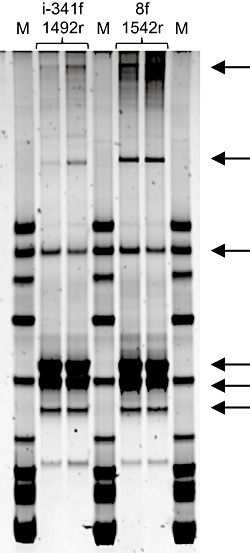
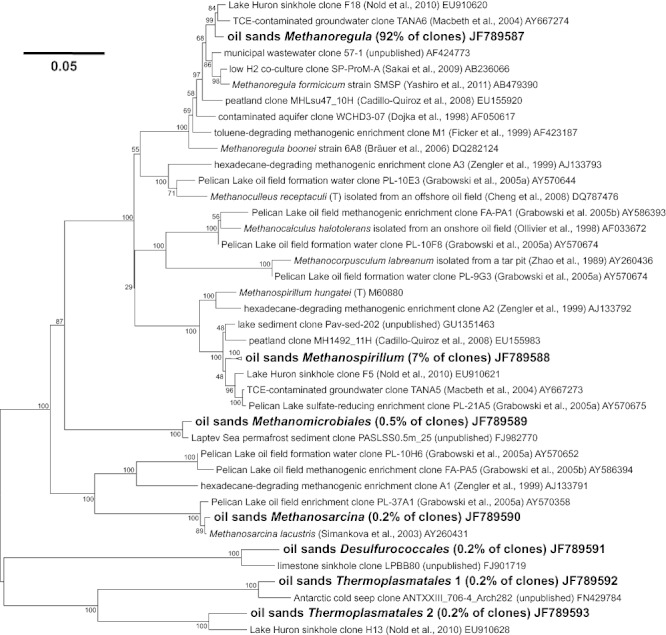
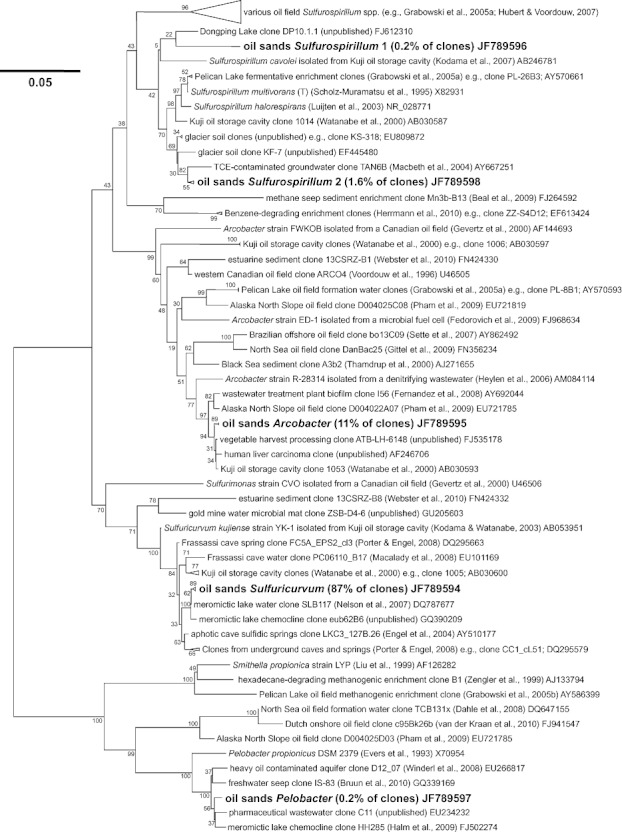
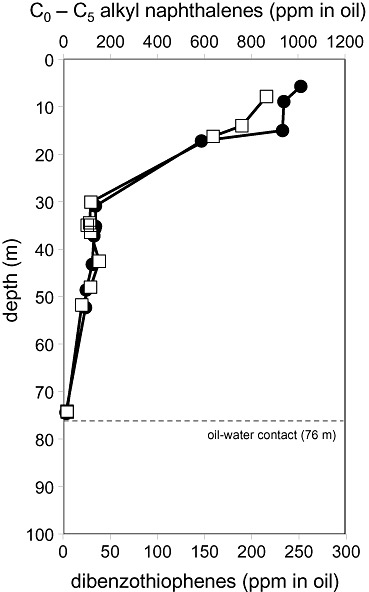
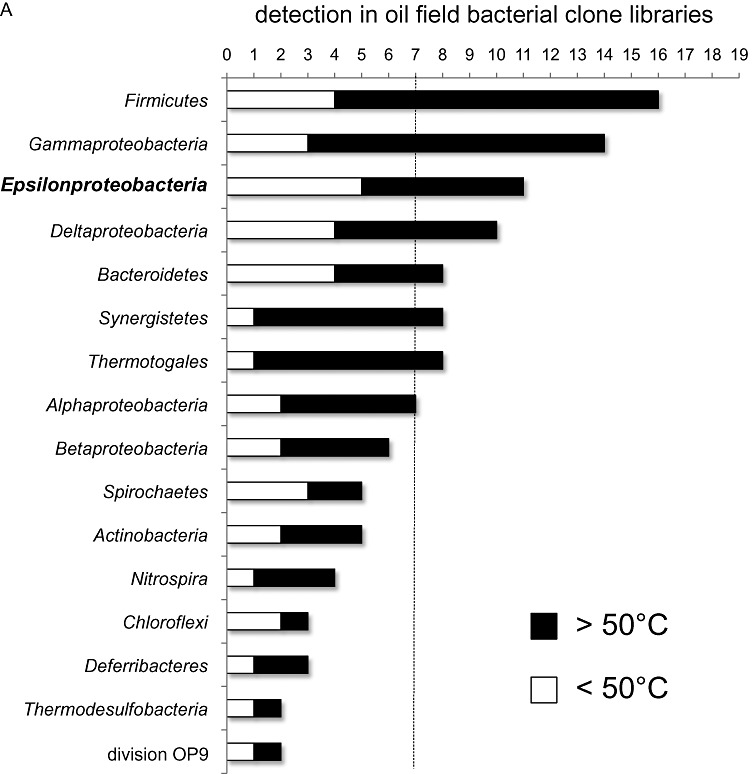
Summary: The subsurface microbiology of an Athabasca oil sands reservoir in western Canada containing severely biodegraded oil was investigated by combining 16S rRNA gene‐ and polar lipid‐based analyses of reservoir formation water with geochemical analyses of the crude oil and formation water. Biomass was filtered from formation water, DNA was extracted using two different methods, and 16S rRNA gene fragments were amplified with several different primer pairs prior to cloning and sequencing or community fingerprinting by denaturing gradient gel electrophoresis (DGGE). Similar results were obtained irrespective of the DNA extraction method or primers used. Archaeal libraries were dominated by Methanomicrobiales (410 of 414 total sequences formed a dominant phylotype affiliated with a Methanoregula sp.), consistent with the proposed dominant role of CO 2 ‐reducing methanogens in crude oil biodegradation. In two bacterial 16S rRNA clone libraries generated with different primer pairs, > 99% and 100% of the sequences were affiliated with Epsilonproteobacteria ( n = 382 and 72 total clones respectively). This massive dominance of Epsilonproteobacteria sequences was again obtained in a third library (99% of sequences; n = 96 clones) using a third universal bacterial primer pair (inosine‐341f and 1492r). Sequencing of bands from DGGE profiles and intact polar lipid analyses were in accordance with the bacterial clone library results. Epsilonproteobacterial OTUs were affiliated with Sulfuricurvum , Arcobacter and Sulfurospirillum spp. detected in other oil field habitats. The dominant organism revealed by the bacterial libraries (87% of all sequences) is a close relative of Sulfuricurvum kujiense – an organism capable of oxidizing reduced sulfur compounds in crude oil. Geochemical analysis of organic extracts from bitumen at different reservoir depths down to the oil water transition zone of these oil sands indicated active biodegradation of dibenzothiophenes, and stable sulfur isotope ratios for elemental sulfur and sulfate in formation waters were indicative of anaerobic oxidation of sulfur compounds. Microbial desulfurization of crude oil may be an important metabolism for Epsilonproteobacteria indigenous to oil reservoirs with elevated sulfur content and may explain their prevalence in formation waters from highly biodegraded petroleum systems.
Overview
The claims and statistics of this paper haven’t been checked yet.
Run the check — free, no account needed. It reads the open-access text and checks the sources it cites.
Integrity signals
Registry
Cites
Statistics
Figures
Verification
Claims the paper makes
The claims and statistics of this paper haven’t been checked yet.
Run the check — free, no account needed. It reads the open-access text and checks the sources it cites.
Claims other papers make about this one
Each is checked against this paper’s own text: does it say what the citing paper says it does?
In the citing paper
“In contrast, PG may promote growth of other acetotrophs pertaining to the Epsilonproteobacteria (Figure 3), such as Arcobacter spp. (Hubert et al., 2012; Roalkvam et al., 2015).”
From Microbial Diversity in Sulfate-Reducing Marine Sediment Enrichment Cultures Associated with Anaerobic Biotransformation of Coastal Stockpiled Phosphogypsum (Sfax, Tunisia) (2017) · cites this paper as Hubert et al., 2012
Self-check
Percentages, sums and reported differences re-computed from the paper’s own numbers.
The self-check needs the paper’s full text.
Citations
Cites
A RAPID METHOD OF TOTAL LIPID EXTRACTION AND PURIFICATION
Bligh, E. G., & Dyer, W. J. (1959) · Canadian Journal of Biochemistry and Physiology · doi:10.1139/o59-099 · Cited by 54,751
Research works printed but not linked: 101
- 10.1016/0016-7037(88)90335-3 · DOI
- 10.1016/S0022-2836(05)80360-2 · DOI · Paper page
- 10.1126/science.1169984 · DOI · Paper page
- 10.1021/ac9910482 · DOI
- 10.1139/y59-099 · DOI · Paper page
- 10.1038/nature04810 · DOI
- Bräuer S.L. Cadillo‐Quiroz H. Ward R.J. Yavitt J.B. andZinder S.H.(2011)Methanoregula booneigen. nov. sp. nov. an acidiphilic methanogen isolated from an acidic peat bog.Int J Syst Appl Microbiol61:45–52. · DOI
- 10.1080/01490450903232165 · DOI
- 10.1128/AEM.02222-07 · DOI
- 10.1038/nrmicro1414 · DOI
- 10.1111/j.1574-6968.2008.01212.x · DOI
- Cole J.R., 2007, The ribosomal database project (RDP‐II): introducing myRDP space and quality controlled public data, Nucleic Acid Res, 35, D169, 10.1093/nar/gkl889 · DOI
- 10.1007/s10482-007-9177-z · DOI
- 10.1128/AEM.64.10.3869-3877.1998 · DOI
- 10.1146/annurev.biochem.66.1.199 · DOI
- 10.1021/es9013932 · DOI
- 10.1093/nar/17.19.7843 · DOI
- 10.1016/j.femsec.2004.07.004 · DOI
- 10.1016/S0723-2020(11)80470-4 · DOI
- 10.1128/AEM.01345-09 · DOI
- Fernandez N., 2008, Analysis of Microbial Community during Biofilm Development in an Anaerobic Wastewater Treatment Reactor, Mol Ecol, 56, 121
- Ficker M., 1999, Molecular characterization of a toluene‐degrading methanogenic consortium, Appl Environ Microbiol, 65, 5576, 10.1128/AEM.65.12.5576-5585.1999 · DOI
- 10.1080/01490450902724832 · DOI
- Fustic M., 2011, Heavy Oil/Bitumen Petroleum Systems in Alberta & Beyond
- 10.1128/AEM.66.6.2491-2501.2000 · DOI
- 10.1128/AEM.01123-09 · DOI
- 10.1016/j.resmic.2005.03.009 · DOI
- 10.1016/j.resmic.2005.03.009 · DOI
- 10.1007/s00792-009-0237-3 · DOI
- 10.1016/S0065-2164(10)72005-0 · DOI
- 10.1196/annals.1419.004 · DOI
- 10.1007/s00299-001-0399-7 · DOI
- 10.1111/j.1462-2920.2009.01917.x · DOI
- 10.1264/jsme2.23.118 · DOI
- 10.1038/nature02134 · DOI
- 10.1007/978-3-540-77587-4_232 · DOI
- 10.1111/j.1462-2920.2009.02077.x · DOI
- 10.1128/AEM.72.4.2637-2643.2006 · DOI
- 10.1128/AEM.02332-06 · DOI
- 10.1016/j.gca.2009.03.025 · DOI
- 10.1128/9781555817589.ch4 · DOI
- 10.1038/nature06484 · DOI
- 10.1016/S0198-0149(10)80025-1 · DOI
- 10.1128/AEM.69.1.107-112.2003 · DOI
- 10.1099/ijs.0.63243-0 · DOI
- 10.1099/ijs.0.64823-0 · DOI
- 10.1111/j.1574-6941.2009.00813.x · DOI
- 10.1016/S0146-6380(02)00240-1 · DOI
- 10.1306/01270605130 · DOI
- 10.2118/08-01-52 · DOI
- 10.1128/AEM.54.1.124-129.1988 · DOI
- 10.1111/j.1574-6968.2006.00149.x · DOI
- 10.1111/j.1574-6941.2006.00266.x · DOI
- 10.1128/AEM.72.4.2679-2690.2006 · DOI
- 10.1099/00207713-49-2-545 · DOI
- 10.1099/ijs.0.02417-0 · DOI
- 10.1038/ismej.2008.25 · DOI
- 10.1128/AEM.70.12.7329-7341.2004 · DOI
- Marcano N.(2011)Isotopic and molecular studies of biodegraded oils and the development of chemical proxies for monitoring in situ upgrading of bitumen. PhD Thesis. Calgary Canada: University of Calgary.
- 10.1128/9781555817589.ch2 · DOI
- 10.1016/S0022-2836(61)80047-8 · DOI
- 10.1371/journal.pone.0001358 · DOI
- Nazina T.N., 2006, Phylogenetic diversity and activity of anaerobic microorganisms of high‐temperature horizons of the Dagang oil field (P.R. China), Microbiologiya, 75, 70
- 10.1007/s00248-006-9195-9 · DOI
- 10.1016/j.jglr.2010.02.014 · DOI
- 10.1021/ac8025515 · DOI
- 10.1128/9781555817589.ch5 · DOI
- Ollivier B., 1998, Methanocalculus halotolerans gen. nov., sp. nov., isolated from an oil‐producing well, Int J Syst Evol Microbiol, 48, 821
- 10.1128/AEM.66.2.700-711.2000 · DOI
- 10.1111/j.1462-2920.2008.01751.x · DOI
- 10.1128/AEM.02915-07 · DOI
- 10.1093/nar/gkm864 · DOI
- 10.1111/j.1574-6941.2003.tb01059.x · DOI
- 10.1128/AEM.02835-08 · DOI
- 10.1007/BF00406127 · DOI
- 10.1016/j.gca.2011.01.016 · DOI
- 10.1007/BF00262203 · DOI
- 10.1111/j.1462-2920.2009.01999.x · DOI
- 10.1007/s10482-006-9115-5 · DOI
- 10.1111/j.1472-4669.2007.00123.x · DOI
- 10.1078/072320203322346173 · DOI
- 10.1128/AEM.02341-07 · DOI
- Strausz O.P., 2003, The Chemistry of Alberta Oil Sands Bitumens and Heavy Oils
- 10.1002/rcm.1378 · DOI
- 10.1093/molbev/msm092 · DOI
- 10.1128/aem.63.5.1785-1793.1997 · DOI
- 10.1128/AEM.66.7.2888-2897.2000 · DOI
- 10.1029/98WR00311 · DOI
- 10.1128/AEM.69.11.6481-6488.2003 · DOI
- Voordouw G., 1990, Distribution of hydrogenase genes in Desulfovibrio spp. and their use in identification of species from the oil field environment, Appl Environ Microbiol, 56, 3748, 10.1128/aem.56.12.3748-3754.1990 · DOI
- Voordouw G., 1996, Characterization of 16S rRNA genes from oil field microbial communities indicates the presence of a variety of sulfate‐reducing, fermentative, and sulfide oxidizing bacteria, Appl Environ Microbiol, 62, 1623, 10.1128/aem.62.5.1623-1629.1996 · DOI
- 10.1016/j.orggeochem.2007.08.003 · DOI
- 10.1128/AEM.66.11.4803-4809.2000 · DOI
- 10.1186/1471-2180-2-23 · DOI
- 10.1111/j.1574-6941.2010.00848.x · DOI
- 10.1111/j.1574-6968.2010.02023.x · DOI
- 10.1128/AEM.01951-07 · DOI
- 10.1099/ijs.0.014811-0 · DOI
- 10.1016/S0065-2164(08)00806-X · DOI
- 10.1038/45777 · DOI
- 10.1099/00207713-39-1-10 · DOI
Cited by
Sorted by citations
Zouch, H., Karray, F., Armougom, F., Chifflet, S., Hirschler-Réa, A., Kharrat, H., Kamoun, L., Ben Hania, W., Ollivier, B., Sayadi, S., et al. (2017) · Frontiers in Microbiology · doi:10.3389/fmicb.2017.01583 · Cited by 37
Metadata
- Authors
- Hubert, C. R. J., Oldenburg, T. B. P., Fustic, M., Gray, N. D., Larter, S. R., Penn, K., Rowan, A. K., Seshadri, R., Sherry, A., Swainsbury, R., Voordouw, G., Voordouw, J. K., & Head, I. M.
- Venue
- Environmental Microbiology
- Publisher
- Wiley
- Published
- 2011-08-08
- Volume
- 14
- Issue
- 2
- Pages
- 387-404
- ISSN
- 1462-2912
- 1462-2920
- PMC
- PMC3490369
- Cited by
- 124
- References
- 1
- Language
- en
About these checks
Registry, retraction, Cites and statistics results are computed, not judged, with one exception: a printed reference that no index lists is read once by a model before it counts as a citation error. Claims are extracted by a model and kept only when their quote appears verbatim in the text; each cited source is then checked, with a model’s help, for whether it says what the claim relies on. Those verdicts can be wrong — read the claim’s quote and the cited source before relying on one.
Statistics and arithmetic are recomputed, not judged.
Confidence bands are shown only for fields calibrated on our annotated test set. None is calibrated yet, so no band is shown.
What counts as a claim ›How we measure confidence ›How we check this ›
Are you an author, or do you see a problem with this page? Request a review
