

The DOI matches its Crossref record.
Impact of wound microbiology on limb preservation in patients with diabetic foot infection
Abstract
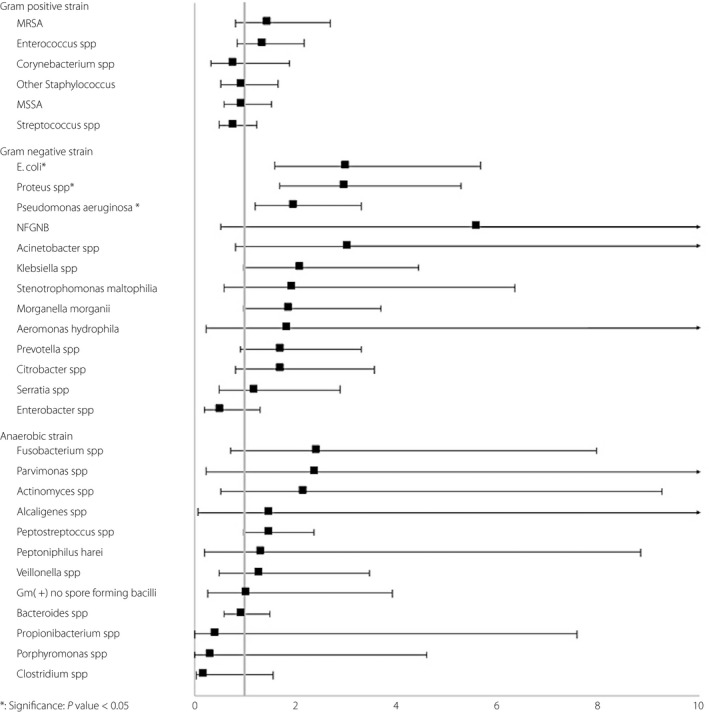
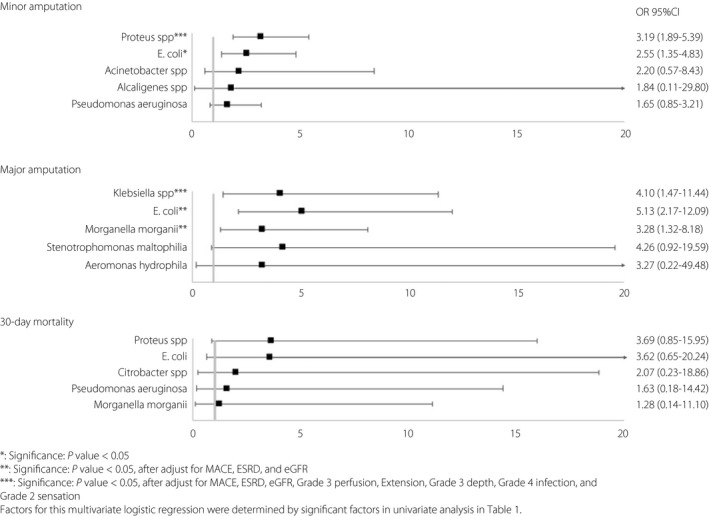
Aims/Introduction: To investigate the association between specific bacterial pathogens and treatment outcome in patients with limb‐threatening diabetic foot infection (LT‐DFI). Materials and Methods: Consecutive patients treated for LT‐DFI in a major diabetic foot center in Taiwan were analyzed between the years 2014 and 2017. Patients with positive wound culture results at first aid were enrolled. Clinical factors, laboratory data, and wound culture results were compared. Lower‐extremity amputations and in‐hospital mortality were defined as a poor outcome. Results: Among the 558 patients, 272 (48.7%) patients had lower extremity amputation and 22 (3.9%) patients had in‐hospital mortality. Gram‐negative bacterial (GNB) infection was the independent factor following factors adjustment. When all the 31 microorganisms were analyzed, only E. coli(adjusted odds ratio [aOR], 3.01; 95% CI, 1.60–5.65),Proteus spp. (aOR, 2.99; 95% CI, 1.69–5.29), and Pseudomonas aeruginosa(aOR, 2.00; 95% CI 1.20–3.32) were associated with poor outcome. The analysis of specific GNB species in association with major‐ or minor‐ amputation have been reported. No specific pathogen was associated with cause of death in patients with mortality within 30 days. The antimicrobial‐resistant strains were not associated with a poor treatment outcome. Conclusions: The presence of GNB was associated with limb amputations. This study provides insight into more timely and appropriate management of the diabetic foot infection.
Overview
The claims and statistics of this paper haven’t been checked yet.
Run the check — free, no account needed. It reads the open-access text and checks the sources it cites.
Integrity signals
Registry
Cites
Statistics
Figures
Verification
Claims the paper makes
The claims and statistics of this paper haven’t been checked yet.
Run the check — free, no account needed. It reads the open-access text and checks the sources it cites.
Claims other papers make about this one
Each is checked against this paper’s own text: does it say what the citing paper says it does?
In the citing paper
“Pathogens isolated from diabetic foot wounds are frequently characterized by a high degree of antimicrobial resistance (22).”
From Multifactorial Insights into Chronic Leg Ulcers: Experience from a Tertiary Wound Care Center (2025) · cites this paper as [22]
Self-check
Percentages, sums and reported differences re-computed from the paper’s own numbers.
The self-check needs the paper’s full text.
Citations
Cites
No references could be resolved yet.
Research works printed but not linked: 38
- 10.1136/bmjdrc-2019-000795 · DOI
- 10.1186/s13047-017-0243-0 · DOI
- 10.2337/dc19-1614 · DOI
- 10.1016/S2213-8587(15)00252-1 · DOI
- Monteiro‐Soares M, 2020, Diabetic foot ulcer classifications: a critical review, Diabetes Metab Res Rev, 36, 10.1002/dmrr.3272 · DOI
- 10.1161/CIRCULATIONAHA.119.040672 · DOI · Paper page
- 10.3390/jcm8101538 · DOI
- 10.2337/dc05-2425 · DOI
- Lipsky BA, 2020, Guidelines on the diagnosis and treatment of foot infection in persons with diabetes (IWGDF 2019 update), Diabetes Metab Res Rev, 36, 10.1002/dmrr.3280 · DOI
- 10.2337/dc11-0331 · DOI
- 10.1046/j.1464-5491.2002.00696_1.x · DOI
- 10.1093/cid/cis346 · DOI
- 10.4103/0377-4929.41685 · DOI
- 10.1016/j.jcjd.2014.11.002 · DOI
- 10.1002/dmrr.464 · DOI
- 10.2147/VHRM.S125065 · DOI
- 10.1016/j.diabres.2013.03.017 · DOI
- 10.1016/j.ijid.2015.09.023 · DOI
- 10.1086/424846 · DOI
- 10.1371/journal.pone.0091105 · DOI
- 10.1128/JCM.00551-07 · DOI
- 10.1186/cc8898 · DOI
- 10.1177/1534734616661058 · DOI
- 10.1086/432803 · DOI · Paper page
- 10.1177/153857440503900506 · DOI
- 10.2337/dc18-2294 · DOI
- 10.3390/jcm8111935 · DOI
- 10.1186/s13099-019-0290-0 · DOI
- 10.1016/j.jfma.2015.07.011 · DOI
- 10.1016/j.jgar.2018.08.008 · DOI
- 10.1093/cid/cis565 · DOI
- 10.1093/infdis/169.5.1155 · DOI
- 10.1097/01.prs.0000222737.09322.77 · DOI · Paper page
- 10.1007/s00125-008-1131-8 · DOI
- 10.3947/ic.2018.50.1.11 · DOI
- 10.1177/1534734614550311 · DOI
- 10.1093/ofid/ofaa161 · DOI
- 10.1007/s10096-015-2544-1 · DOI
Cited by
Sorted by citations
Multifactorial Insights into Chronic Leg Ulcers: Experience from a Tertiary Wound Care Center
Akyürek, M., Kaya, B., & Bolca, A. (2025) · Meandros Medical And Dental Journal · doi:10.69601/meandrosmdj.1738164
Metadata
- Authors
- Hung, S., Chiu, C., Huang, C., Lin, C., Yeh, J., Yang, H., & Huang, Y.
- Venue
- Journal of Diabetes Investigation
- Publisher
- Wiley
- Published
- 2021-09-08
- Volume
- 13
- Issue
- 2
- Pages
- 336-343
- ISSN
- 2040-1116
- 2040-1124
- PMC
- PMC8847138
- Cited by
- 16
- References
- 0
- Language
- en
- Funders
- Ministry of Science and Technology, Taiwan (MOST 109‐2314‐B‐182A‐128)
About these checks
Registry, retraction, Cites and statistics results are computed, not judged, with one exception: a printed reference that no index lists is read once by a model before it counts as a citation error. Claims are extracted by a model and kept only when their quote appears verbatim in the text; each cited source is then checked, with a model’s help, for whether it says what the claim relies on. Those verdicts can be wrong — read the claim’s quote and the cited source before relying on one.
Statistics and arithmetic are recomputed, not judged.
Confidence bands are shown only for fields calibrated on our annotated test set. None is calibrated yet, so no band is shown.
What counts as a claim ›How we measure confidence ›How we check this ›
Are you an author, or do you see a problem with this page? Request a review
How to cite
Cite CoChat for the checks on this page, and the paper for its own findings.
- This page
- CoChat. (2026). Citation check: Impact of wound microbiology on limb preservation in patients with diabetic foot infection. https://app.cochat.ai/papers/10.1111/jdi.13649
- The paper
- Hung, S., Chiu, C., Huang, C., Lin, C., Yeh, J., Yang, H., & Huang, Y. (2022). Impact of wound microbiology on limb preservation in patients with diabetic foot infection. Journal of Diabetes Investigation. https://doi.org/10.1111/jdi.13649
