

The DOI matches its Crossref record; 35 of the 35 references it cites were found in a registry or an index.
Life Cycle Impacts and Benefits of Wood along the Value Chain: The Case of Switzerland
Open accessAbstract
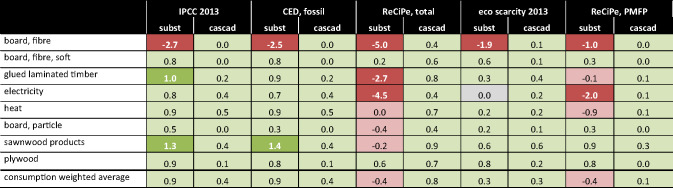
Summary: Sustainable use of wood may contribute to coping with energy and material resource challenges. The goal of this study is to increase knowledge of the environmental effects of wood use by analyzing the complete value chain of all wooden goods produced or consumed in Switzerland. We start from a material flow analysis of current wood use in Switzerland. Environmental impacts related to the material flows are evaluated using life cycle assessment–based environmental indicators. Regarding climate change, we find an overall average benefit of 0.5 tonnes carbon dioxide equivalent per cubic meter of wood used. High environmental benefits are often achieved when replacing conventional heat production and energy‐consuming materials in construction and furniture. The environmental performance of wood is, however, highly dependent on its use and environmental indicators. To exploit the mitigation potential of wood, we recommend to (1) apply its use where there are high substitution benefits like the replacement of fossil fuels for energy or energy‐intensive building materials, (2) take appropriate measures to minimize negative effects like particulate matter emissions, and (3) keep a systems perspective to weigh effects like substitution and cascading against each other in a comprehensive manner. The results can provide guidance for further in‐depth studies and prospective analyses of wood‐use scenarios.
Overview
The claims and statistics of this paper haven’t been checked yet.
Run the check — free, no account needed. It reads the open-access text and checks the sources it cites.
Integrity signals
Registry
Cites
Statistics
Figures
Verification
Claims the paper makes
The claims and statistics of this paper haven’t been checked yet.
Run the check — free, no account needed. It reads the open-access text and checks the sources it cites.
Claims other papers make about this one
Each is checked against this paper’s own text: does it say what the citing paper says it does?
The source backs part of the claim, not all of it — or backs it for a different population, condition or comparison.
In the citing paper
“Similarly, Suter et al. (2017) conclude that when forests are underexploited, an increased cascading use would lead to an underutilization of their full carbon storage potential.”
From Transforming the bio-based sector towards a circular economy: What can we learn from wood cascading? (2020) · cites this paper as Suter et al., 2017
Experimental — accuracy not yet measuredThe source backs part of the claim, not all of it — or backs it for a different population, condition or comparison.
In the citing paper
“A similar problem arises when accounting for biogenic carbon emissions, as their impacts are negligible in the long term (Suter et al., 2017).”
From Transforming the bio-based sector towards a circular economy: What can we learn from wood cascading? (2020) · cites this paper as Suter et al., 2017
Experimental — accuracy not yet measuredThe cited source says what the claim attributes to it.
In the citing paper
“Prioritizing one use over the other depends on many factors and in general varies with the selected evaluation criteria (Bais-Moleman et al., 2018;Suter et al., 2017;Werner et al., 2010).”
From Transforming the bio-based sector towards a circular economy: What can we learn from wood cascading? (2020) · cites this paper as Suter et al., 2017
Self-check
Percentages, sums and reported differences re-computed from the paper’s own numbers.
The self-check needs the paper’s full text.
Citations
Cites
The ecoinvent database version 3 (part I): overview and methodology
Wernet, G., Bauer, C., Steubing, B., Reinhard, J., Moreno-Ruiz, E., & Weidema, B. (2016) · The International Journal of Life Cycle Assessment · doi:10.1007/s11367-016-1087-8 · Cited by 5,564
Self-citationGlobal Forest Resources Assessment 2020
(2020) · FAO eBooks · doi:10.4060/ca8753en · Cited by 2,039
Tomppo, E., Katila, M., Mäkisara, K., ̈asaari, J. P., Malimbwi, R. E., Chamuya, N., Otieno, J., Dalsgaard, S., & Leppanen, M. (2010) · Cited by 870
CHERUBINI, F., PETERS, G. P., BERNTSEN, T., STRØMMAN, A. H., & HERTWICH, E. (2011) · GCB Bioenergy · doi:10.1111/j.1757-1707.2011.01102.x · Cited by 645 · cited 2×
“The effect of biogenic CO 2 emissions depends strongly on the time horizon considered: Whereas their impact is considerable in time frames of 100 years or less (Cherubini et al. 2011), the long-term effects are negligible in comparison to fossil CO 2 .”
The International Journal of Life Cycle Assessment
(2013) · The International Journal of Life Cycle Assessment · doi:10.1007/11367.1614-7502 · Cited by 552
Meta-analysis of greenhouse gas displacement factors of wood product substitution
Sathre, R., & O’Connor, J. (2010) · Environmental Science & Policy · doi:10.1016/j.envsci.2009.12.005 · Cited by 537
Impact of Forest Management on Species Richness: Global Meta-Analysis and Economic Trade-Offs
Chaudhary, A., Buřivalová, Z., Koh, L. P., & Hellweg, S. (2016) · Scientific Reports · doi:10.1038/srep23954 · Cited by 429
Self-citationChaudhary, A., Verones, F., de Baan, L., & Hellweg, S. (2015) · Environmental Science & Technology · doi:10.1021/acs.est.5b02507 · Cited by 384
Self-citationBiogenic Carbon and Temporary Storage Addressed with Dynamic Life Cycle Assessment
Levasseur, A., Lesage, P., Margni, M., & Samson, R. (2013) · Journal of Industrial Ecology · doi:10.1111/j.1530-9290.2012.00503.x · Cited by 312
Implementation of Life Cycle Impact Assessment Methods. ecoinvent report No. 3, v2.2
Hischier, R., Weidema, B. P., Althaus, H., Bauer, C., Doka, G., Dones, R., Frischknecht, R., Hellweg, S., Humbert, S., Jungbluth, N., et al. (2010) · Cited by 233
Self-citationDominant impact of residential wood burning on particulate matter in Alpine valleys during winter
Szidat, S., Prévôt, A. S. H., Sandradewi, J., Alfarra, M. R., Synal, H., Wacker, L., & Baltensperger, U. (2007) · Geophysical Research Letters · doi:10.1029/2006gl028325 · Cited by 190
Werner, F., Taverna, R., Hofer, P., Thürig, E., & Kaufmann, E. (2010) · Environmental Science & Policy · doi:10.1016/j.envsci.2009.10.004 · Cited by 189 · cited 4×
“This result is in line with other studies (e.g., Werner et al. 2010).”
InfluentialSirkin, T., & ten Houten, M. (1994) · Resources Conservation and Recycling · doi:10.1016/0921-3449(94)90016-7 · Cited by 162
Höglmeier, K., Weber-Blaschke, G., & Richter, K. (2013) · Resources, Conservation and Recycling · doi:10.1016/j.resconrec.2013.07.004 · Cited by 139
Environmental Impact of Buildings─What Matters?
Heeren, N., Mutel, C. L., Steubing, B., Ostermeyer, Y., Wallbaum, H., & Hellweg, S. (2015) · Environmental Science & Technology · doi:10.1021/acs.est.5b01735 · Cited by 128
Self-citationSustainable strategies analysis through Life Cycle Assessment: a case study in a furniture industry
Iritani, D. R., Silva, D. A. L., Saavedra, Y. M. B., Grael, P. F. F., & Ometto, A. R. (2015) · Journal of Cleaner Production · doi:10.1016/j.jclepro.2014.05.029 · Cited by 125
Cascade utilization of biomass: strategies for a more efficient use of a scarce resource
Haberl, H., & Geissler, S. (2000) · Ecological Engineering · doi:10.1016/s0925-8574(00)00059-8 · Cited by 125
Energy and carbon balances of wood cascade chains
Sathre, R., & Gustavsson, L. (2006) · Resources, Conservation and Recycling · doi:10.1016/j.resconrec.2005.12.008 · Cited by 124
LCA-based optimization of wood utilization under special consideration of a cascading use of wood
Höglmeier, K., Steubing, B., Weber-Blaschke, G., & Richter, K. (2015) · Journal of Environmental Management · doi:10.1016/j.jenvman.2015.01.018 · Cited by 123
Self-citationHöglmeier, K., Weber-Blaschke, G., & Richter, K. (2014) · The International Journal of Life Cycle Assessment · doi:10.1007/s11367-014-0774-6 · Cited by 106
Environmental performance assessment of hardboard manufacture
González‐García, S., Feijóo, G., Widsten, P., Kandelbauer, A., Zikulnig‐Rusch, E. M., & Moreira, M. T. (2009) · The International Journal of Life Cycle Assessment · doi:10.1007/s11367-009-0099-z · Cited by 103
Cherubini, F., Guest, G., & Strømman, A. H. (2012) · GCB Bioenergy · doi:10.1111/j.1757-1707.2011.01156.x · Cited by 94
Energy and CO2 analysis of wood substitution in construction
Gustavsson, L., & Sathre, R. (2010) · Climatic Change · doi:10.1007/s10584-010-9876-8 · Cited by 92
Silva, D. A. L., Pavan, A. L. R., de Oliveira, J. A., & Ometto, A. R. (2015) · Journal of Cleaner Production · doi:10.1016/j.jclepro.2015.01.030 · Cited by 75
Life cycle assessment (LCA) of wood-based building materials
Sathre, R., & González-García, S. (2014) · Eco-efficient Construction and Building Materials · doi:10.1533/9780857097729.2.311 · Cited by 70
Steubing, B. R. P., Mutel, C., Suter, F., & Hellweg, S. (2016) · The International Journal of Life Cycle Assessment · doi:10.1007/s11367-015-1015-3 · Cited by 65
Self-citationGlobal spatially explicit CO2 emission metrics for forest bioenergy
Cherubini, F., Huijbregts, M. A. J., Kindermann, G., van Zelm, R., van der Velde, M., Stadler, K., & Strømman, A. H. (2016) · Scientific Reports · doi:10.1038/srep20186 · Cited by 57
Including Indoor Offgassed Emissions in the Life Cycle Inventories of Wood Products
Chaudhary, A., & Hellweg, S. (2014) · Environmental Science & Technology · doi:10.1021/es5045024 · Cited by 46
Self-citationSirkin, T., & ten Houten, M. (1994) · Resources Conservation and Recycling · doi:10.1016/0921-3449(94)90015-9 · Cited by 27
Baseline effects on carbon footprints of biofuels: The case of wood
Johnson, E. P., & Tschudi, D. (2012) · Environmental Impact Assessment Review · doi:10.1016/j.eiar.2012.06.005 · Cited by 23
Palosuo, T., Suominen, T., Werhahn-Mees, W., García-Gonzalo, J., & Lindner, M. (2010) · Ecological Modelling · doi:10.1016/j.ecolmodel.2010.03.020 · Cited by 19
Is e-reading environmentally more sustainable than conventional reading?
Jeswani, H. K., & Azapagic, A. (2014) · Clean Technologies and Environmental Policy · doi:10.1007/s10098-014-0851-3 · Cited by 15
Dodoo, A., Gustavsson, L., & Sathre, R. (2014) · Elsevier eBooks · doi:10.1016/b978-0-12-396459-5.00011-8 · Cited by 15
Die Ökobilanz der energetischen Holzverwertung: Faktoren für einen hohen ökologischen Nutzen
Steubing, B. R. P. (2013) · Schweizerische Zeitschrift fur Forstwesen · doi:10.3188/szf.2013.0408 · Cited by 8
Self-citation
Research works printed but not linked: 23
- BAFU (Bundesamt für Umwelt), 2012, Jahrbuch Wald und Holz
- BAFU (Bundesamt für Umwelt), 2013, Inländische Wertschöpfung bei der stofflichen und energetischen Verwendung von Holz
- BAFU (Bundesamt für Umwelt), 2014, Jahrbuch Wald und Holz
- BAFU (Bundesamt für Umwelt), 2015, Forest report 2015
- BAFU (Bundesamt für Umwelt) and BFE (Bundesamt für Energie), 2014, Transformation der Abfallverwertung in der Schweiz für eine hohe und zeitlich optimierte Energieausnutzung
- BAFU (Bundesamt für Umwelt) and BFH (Berner Fachhochschule), 2012, Holzendverbrauch Schweiz—Bauwesen, Holz im Aussenbereich, Möbel und Innenausbau, Verpackung sowie Holzwaren für das Jahr 2009
- BFE (Bundesamt für Energie), 2012, Schweizerische Holzenergiestatistik—Erhebung für das Jahr 2011
- BFE (Bundesamt für Energie), 2012, Teilstatistik Spezielle energetische Holznutzungen: Feuerungen und Motoren für erneuerbare Abfälle Erhebungsjahr 2011
- Boucher J., 2014, Assessing waste streams of building demolition and renovation in the City of Zurich
- BUWAL (Bundesamt für Umwelt, Wald und Landschaft), 2004, Branchenprofil der Wald‐ und Holzwirtschaft 2001
- CEPI (Confederation of European Paper Industries), 2013, CEPI sustainability report 2013
- Frischknecht R., 2013, Swiss Eco‐Factors 2013 according to the Ecological Scarcity Method
- Gärtner S., 2013, Gesamtökologische Bewertung der Kaskadennutzung von Holz—Umweltauswirkungen stofflicher und energetischer Holznutzungssysteme im Vergleich
- Goedkoop M., 2009, ReCiPE 2008: A life cycle impact assessment method which comprises harmonised category indicators at the midpoint and the endpoint level
- Hischier R., 2010, Implementation of life cycle impact assessment methods (ecoinvent report)
- IPCC (Intergovernmental Panel on Climate Change), 2013, Climate change 2013: The physical science basis
- Lehner L., 2014, Branchenanalyse—Analyse und Synthese der Wertschöpfungskette (WSK) Wald und Holz in der Schweiz
- UBA (Umweltbundesamt), 2015, Treibhausgasemissionen des stofflichen und energetischen Einsatzes von Holz in Österreich im Vergleich zu Substitutionsstoffen
- Walz A., 2010, Holz nutzen ist wirksamer als Vorräte anhäufen [Use of wood is more effective than the accumulation of stocks], Wald Und Holz, 10, 37
- Wenker J. L.2015. Ökobilanzierung komplexer Holzprodukte am Beispiel industriell hergestellter Möbel [LCA of complex wood products using the example of industrially produced furniture]. Ph.D. thesis Technische Universität München Munich Germany.
- Windsperger A., 2010, Optimierung der Ressourceneffizienz der Holznutzung
- ZPK (Verband der Schweizerischen Zellstoff‐, Papier‐ und Kartonindustrie), 2011, Jahresbericht 2011
- ZPK (Verband der Schweizerischen Zellstoff‐, Papier‐ und Kartonindustrie), 2014, Jahresbericht 2014
Cited by
Sorted by citations
Rissman, J., Bataille, C., Masanet, E., Aden, N., Morrow, W. R., Zhou, N., Elliott, N., Dell, R., Heeren, N., Huckestein, B., et al. (2020) · Applied Energy · doi:10.1016/j.apenergy.2020.114848 · Cited by 1,040
The Activity Browser — An open source LCA software building on top of the brightway framework
Steubing, B. R. P., de Koning, D., Haas, A., & Mutel, C. (2019) · Software Impacts · doi:10.1016/j.simpa.2019.100012 · Cited by 345
Self-citationSubstitution effects of wood-based products in climate change mitigation
Leskinen, P., Cardellini, G., González‐García, S., Hurmekoski, E., Sathre, R., Seppälä, J., Smyth, C. E., Stern, T., & Verkerk, P. J. (2018) · From science to policy · doi:10.36333/fs07 · Cited by 259
Life-cycle assessment to guide solutions for the triple planetary crisis
Hellweg, S., Benetto, E., Huijbregts, M. A. J., Verones, F., & Wood, R. A. (2023) · Nature Reviews Earth & Environment · doi:10.1038/s43017-023-00449-2 · Cited by 283
Self-citationTransforming the bio-based sector towards a circular economy: What can we learn from wood cascading?
Jarre, M., Petit-Boix, A., Priefer, C., Meyer, R., & Leipold, S. (2020) · Forest Policy and Economics · doi:10.1016/j.forpol.2019.01.017 · Cited by 166
“In addition, the material use of wood is dismissed in favor of the energy conversion because of the wood material losses that could occur within waste sorting facilities and during recycling operations (Höglmeier et al., 2017; Höglmeier et al., 2015a; Suter et al., 2017).”
Background
Metadata
- Authors
- Suter, F., Steubing, B., & Hellweg, S.
- Affiliations
- ETH Zurich (CH)
- Corresponding author
- Suter, Florian
- Venue
- Journal of Industrial Ecology
- Published
- 2016-09-26
- Volume
- 21
- Issue
- 4
- Pages
- 874-886
- ISSN
- 1088-1980 (ISSN-L)
- 1530-9290
- PMC
- PMC13061803
- OpenAlex
- W2529157349
- Cited by
- 109
- References
- 35
- Citations by year
- 2026: 10 · 2025: 9 · 2024: 14 · 2023: 16 · 2022: 7 · 2021: 14 · 2020: 16 · 2019: 8 · 2018: 12 · 2017: 2 · 2016: 1
- FWCI
- 4.79
- Type
- journal article
- Language
- en
- Open access
- hybrid
- doi.org
- Licence
- Locations
- Journal of Industrial Ecology (publishedVersion, cc-by)
- PubMed Central (publishedVersion, cc-by)
- PubMed (publishedVersion)
- Leiden Repository (Leiden University) (submittedVersion, cc-by)
- Leiden Repository (Leiden University) (submittedVersion)
- Repository for Publications and Research Data (ETH Zurich) (submittedVersion, cc-by)
- Data Archiving and Networked Services (DANS) (submittedVersion, cc-by)
- ETH Zürich Research Collection (cc-by)
- Funders
- Schweizerischer Nationalfonds zur Förderung der Wissenschaftlichen Forschung (136612)
- Topics
- Physical Sciences › Environmental Science › Environmental Engineering › Environmental Impact and Sustainability
- Physical Sciences › Environmental Science › Environmental Engineering › Sustainability and Ecological Systems Analysis
- Life Sciences › Agricultural and Biological Sciences › Forestry › Forest Management and Policy
- Keywords
- wood utilization, wood value chain, climate change mitigation, CO2 emissions, material flow analysis, life cycle assessment, wood substitute, building materials, furniture, particulate emissions, cascading effects, Switzerland
About these checks
Registry, retraction, Cites and statistics results are computed, not judged, with one exception: a printed reference that no index lists is read once by a model before it counts as a citation error. Claims are extracted by a model and kept only when their quote appears verbatim in the text; each cited source is then checked, with a model’s help, for whether it says what the claim relies on. Those verdicts can be wrong — read the claim’s quote and the cited source before relying on one.
Statistics and arithmetic are recomputed, not judged.
Confidence bands are shown only for fields calibrated on our annotated test set. None is calibrated yet, so no band is shown.
What counts as a claim ›How we measure confidence ›How we check this ›
Are you an author, or do you see a problem with this page? Request a review
