

The DOI matches its Crossref record; 57 of the 57 references it cites were found in a registry or an index; 3 of the 69 sources its claims cite were checked for support.
Swear(ING) ain't play(ING): The interaction of taboo language and the sociolinguistic variable
Open accessAbstract
Swearwords influence social evaluation of a speaker in a variety of ways depending on social context (Jay & Janschewitz (2008), The pragmatics of swearing. Journal of Politeness Research. Language, Behaviour, Culture, 4(2), 267–288). Little attention has been paid to the role of linguistic variation in social perceptions of swearing, however. This paper presents two experiments that test the role of sociolinguistic variation in the social evaluation of swearing. Experiment 1 is a variant categorization task, in which participants categorized acoustically ambiguous swearwords and phonetically matching neutral and nonwords as ending in either “-ing” or “-in.” Results suggest that swearwords led participants to hear “-ing” on ambiguous items. Experiment 2 is a matched-guise task in which listeners heard a passage featuring a mix of swearwords and neutral “-ing” words in one of four conditions: fully velar (All-ing), fully alveolar (All-in), only swearwords as velar (Swear-ing), or only neutral words as velar (Swear-in). Participants rated speakers on Likert scales (Schleef et al. (2017), Regional diversity in social perceptions of (ING). Language Variation and Change, 29(1), 29–56). Participants again displayed a tendency towards hearing “-ing” on swearwords. As a result, responses to the Swear-in guises were similar to those for the All-ing guises. The consequences for our understanding of swearing, sociolinguistic perception and cognition, and style, are discussed.
Overview
AI snapshot
Written from the paper’s full text.
TL;DR
Two experiments test whether variable (ING) interacts with swearwords in speech perception and social evaluation. Contrary to prediction, swearwords biased listeners toward velar “-ing,” and in matched-guise ratings Swear-in guises patterned like All-ing while Swear-ing guises patterned like All-in on several traits.
Key findings
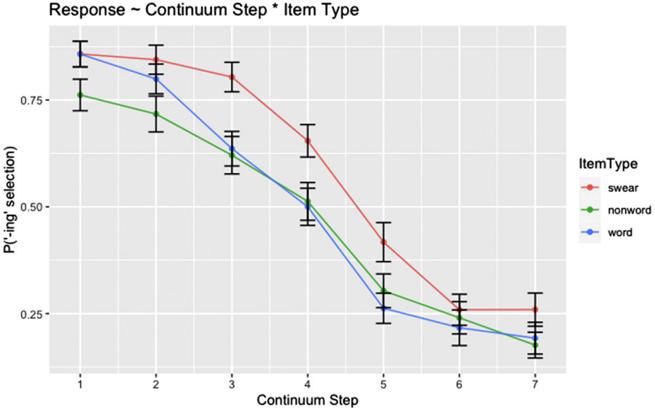
- Experiment 1 found swearwords received the most “-ing” responses (58%), followed by neutral words (50.7%) and nonwords (46.1%). In the logistic mixed model, relative to swearwords, nonwords had a significant negative effect on “-ing” selection (β = −0.74, p < 0.01) and neutral words also did (β = −0.54, p < 0.05); Continuum Step was significant (β = −1.20, p < 0.001). Reaction-time analysis found neutral words were responded to faster than swearwords (β = −0.21, p = 0.023), with no significant swearword–nonword difference, and slower responses as the continuum became more alveolar (β = −0.03, p = 0.001).
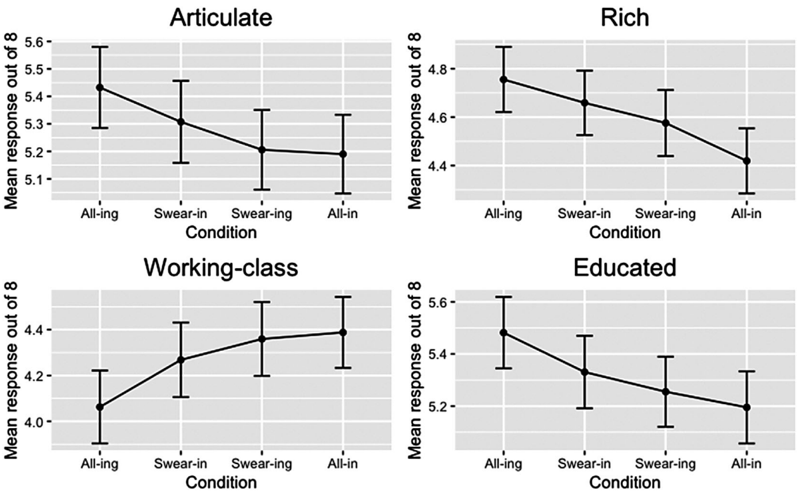
- Experiment 2 found All-in guises were rated significantly less articulate, rich, posh, and educated, and more working-class than All-ing guises. Swear-ing guises showed the same pattern on articulate, rich, working class, and educated, while Swear-in guises did not differ significantly from All-ing on those four scales.
- For posh, significant effects appeared for All-in (B = −0.41, p < 0.001), Swear-ing (B = −0.27, p = 0.005), and Swear-in (B = −0.22, p = 0.025). There were no significant main effects for hard-working or casual.
- The paper concludes that swearwords affected how an (ING) variant was perceived, rather than the (ING) variant simply affecting how swearwords were perceived.
Methods
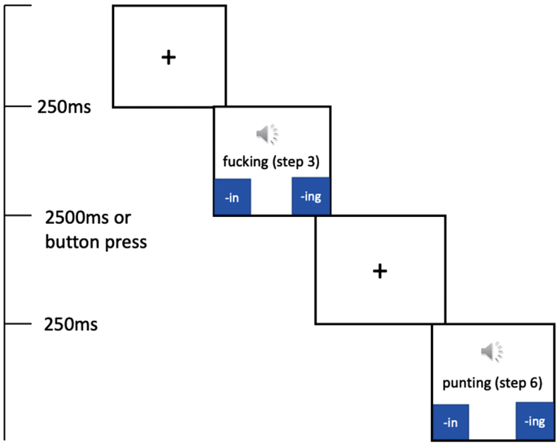
- Experiment 1: a forced-choice single-word variant categorization task with 456 recruited British English speakers; after exclusions, 385 remained, with model N = 380. Stimuli were 27 test words (9 swearwords, 9 neutral words, 9 nonwords) turned into seven-step nasal continua from velar to alveolar, yielding 189 test stimuli plus 50 fillers; responses were analyzed with logistic and linear mixed-effects models.
- Experiment 2: a matched-guise task with 200 recruited British English speakers; after eight failed catch trials, 192 were analyzed. Four Standard Southern British English speakers recorded a passage containing mixed swearwords and neutral (ING) words, manipulated into four conditions: All-ing, All-in, Swear-ing, and Swear-in; participants rated speakers on 1–8 Likert scales, analyzed with linear mixed-effects models.
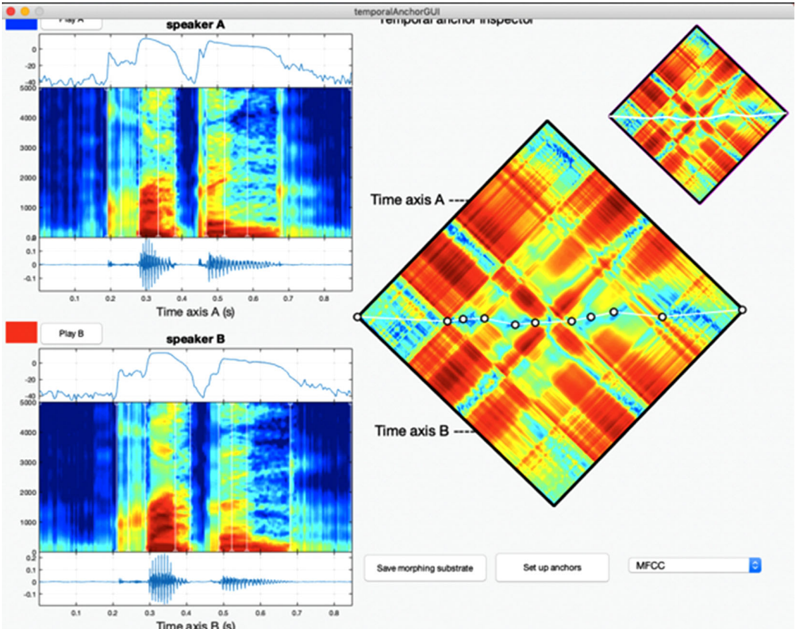
- Stimuli in Experiment 1 were created with TANDEM-STRAIGHT morphing; Experiment 2 recordings were manipulated in Praat by copying velar or alveolar tokens into base recordings.
Limitations
- The paper states that the mechanism behind the velar bias for swearwords is unclear, with two speculative explanations: a socioindexical/register association between swearing and velar [ɪŋ], or increased attentional resources required by swearwords.
- The paper notes that the similarity between All-ing and Swear-in responses was not absolute, suggesting the effect is not equally strong for all swearwords and/or participants.
- The paper states there is no direct production evidence linking swearing with alveolar [ɪn], and that read speech is less authentic, though it cites work validating read speech in matched-guise tasks; it also notes COVID-19 limitations on face-to-face recording. Evident from the text: only four speakers were used in Experiment 2, and both experiments rely on online British English participants and a limited set of swearwords.
Model-written summary. Check it against the paper before relying on it.
Integrity signals
Registry
Cites
Statistics
Figures

Verification
Claims the paper makes
27 Own result · 26 No full text of the sources · 19 Own interpretation · 14 Not checked yet · 11 Own method · 4 No basis given · 3 Sources not found · 1 Supported · 1 Supported so far · 1 Couldn’t confirm · accuracy not yet measured
The cited sources that could be checked couldn’t confirm or dispute this claim.
In the paper
“Furthermore, in the British National Corpus (BNC), swearing is more frequent in the spoken section than the written section (McEnery, 2004;Love, 2017Love, , 2021)).”
§ Swear(ING) ain't play(ING): The interaction of taboo language and the sociolinguistic variable > 3 EXPERIMENT 1: TESTING SOCIAL EXPECTATION
What the sources say
- Not checked — no full text of the sourcecites McEnery, 2004 source
- Not checked — no full text of the sourcecites Love, 2017
- Could not verifycites Love, 2021 sourceExperimental — accuracy not yet measured
The Introduction and section 4.1 compare swearing in spoken BNC data from the 1990s and 2010s, not the spoken and written sections. The Conclusion proposes comparing speech with writing as future research. Searches for a spoken-versus-written frequency comparison found no such result in our copy. (LLM, conf=0.77)
plaincorrelational- Asserted: passes — The authors put it forward as true.
- Checkable: passes — It can be checked against evidence.
- Load-bearing: passes — The paper’s conclusions depend on it.
- Based: passes — The paper gives a reason why it holds.
The sources with a verdict support this claim; the rest weren’t checked yet, have no full text we could read, or their verdicts aren’t rated yet.
In the paper
“Swearwords take up increased attentional resources compared to neutral words, as occurs in tasks where participant concentration is on a nonlinguistic stimulus, including modified Stroop tasks.”
§ Swear(ING) ain't play(ING): The interaction of taboo language and the sociolinguistic variable > 3.3 Interim discussion
What the sources say
- Not checked — no full text of the sourcecites Eilola & Havelka, 2011 source
- Supportedcites MacKay et al., 2004 source
In Materials (page not supplied), participants named the font color of taboo and neutral words while ignoring their meaning. The Results and Discussion report that limited-capacity attentional resources were allocated to taboo words in the Stroop task, and Experiment 1 found slower color naming for taboo than neutral words. The paper specifies that this effect is task-specific, not present in lexical decision. (LLM, conf=0.90)
plaindirect- Asserted: passes — The authors put it forward as true.
- Checkable: passes — It can be checked against evidence.
- Load-bearing: passes — The paper’s conclusions depend on it.
- Based: passes — The paper gives a reason why it holds.
The paper states this without a source or data behind it here, so there is nothing to check it against. The quote shows it is in the paper.
In the paper
“As a result, responses to the Swear-in guises were similar to those for the All-ing guises.”
§ Swear(ING) ain't play(ING): The interaction of taboo language and the sociolinguistic variable > Abstract
plain- Asserted: passes — The authors put it forward as true.
- Checkable: passes — It can be checked against evidence.
- Load-bearing: passes — The paper’s conclusions depend on it.
- Based: passes — The paper gives a reason why it holds.
A result the paper reports from its own data — it cites no other source for it, so there is none to check. The quote shows it is in the paper.
In the paper
“There was also a significant main effect for Continuum Step (β = -0.03,p = 0.001), such that, as the continuum step increased (i.e., became more alveolar), reaction times also increased.”
§ Swear(ING) ain't play(ING): The interaction of taboo language and the sociolinguistic variable > 3.2.1 Reaction time data
plaindirect- Asserted: passes — The authors put it forward as true.
- Checkable: passes — It can be checked against evidence.
- Load-bearing: unclear — It is unclear whether the paper’s conclusions depend on it.
- Based: passes — The paper gives a reason why it holds.
A result the paper reports from its own data — it cites no other source for it, so there is none to check. The quote shows it is in the paper.
In the paper
“Where multiple variables improved model fit, interactions between these variables were also tested; no interactions improved model fit for any scale.”
§ Swear(ING) ain't play(ING): The interaction of taboo language and the sociolinguistic variable > 4.2 Results
plain- Asserted: passes — The authors put it forward as true.
- Checkable: passes — It can be checked against evidence.
- Load-bearing: passes — The paper’s conclusions depend on it.
- Based: passes — The paper gives a reason why it holds.
A result the paper reports from its own data — it cites no other source for it, so there is none to check. The quote shows it is in the paper.
In the paper
“Contrary to the experimental hypothesis, swearwords did not bias listeners to hear alveolar [ɪn] when the (ING) token was ambiguous.”
§ Swear(ING) ain't play(ING): The interaction of taboo language and the sociolinguistic variable > 3.3 Interim discussion
plain- Asserted: passes — The authors put it forward as true.
- Checkable: passes — It can be checked against evidence.
- Load-bearing: passes — The paper’s conclusions depend on it.
- Based: passes — The paper gives a reason why it holds.
A result the paper reports from its own data — it cites no other source for it, so there is none to check. The quote shows it is in the paper.
In the paper
“For working class, the model was significantly improved by including Participant Social Class.”
§ Swear(ING) ain't play(ING): The interaction of taboo language and the sociolinguistic variable > 4.2 Results
plaincorrelational- Asserted: passes — The authors put it forward as true.
- Checkable: passes — It can be checked against evidence.
- Load-bearing: unclear — It is unclear whether the paper’s conclusions depend on it.
- Based: passes — The paper gives a reason why it holds.
A result the paper reports from its own data — it cites no other source for it, so there is none to check. The quote shows it is in the paper.
In the paper
“For working class, there were significant main effects for Condition: All-in (B = 0.32, p < 0.01), Condition: Swear-ing (B = 0.29, p < 0.01) and Social Class: Middle (B = -0.4,p < 0.001).”
§ Swear(ING) ain't play(ING): The interaction of taboo language and the sociolinguistic variable > 4.2 Results
plaincorrelational- Asserted: passes — The authors put it forward as true.
- Checkable: passes — It can be checked against evidence.
- Load-bearing: unclear — It is unclear whether the paper’s conclusions depend on it.
- Based: passes — The paper gives a reason why it holds.
A result the paper reports from its own data — it cites no other source for it, so there is none to check. The quote shows it is in the paper.
In the paper
“For all scales except for articulate and working class, only Condition significantly improved model fit.”
§ Swear(ING) ain't play(ING): The interaction of taboo language and the sociolinguistic variable > 4.2 Results
plain- Asserted: passes — The authors put it forward as true.
- Checkable: passes — It can be checked against evidence.
- Load-bearing: passes — The paper’s conclusions depend on it.
- Based: passes — The paper gives a reason why it holds.
In the paper
“Unlike Schleef et al., variable (ING) had no effect on the scales hard-working or casual.”
§ Swear(ING) ain't play(ING): The interaction of taboo language and the sociolinguistic variable > 5 DISCUSSION AND CONCLUSIONS
What the sources say
- Not checked — no full text of the sourcecites Schleef et al. (2017) source
plain- Asserted: passes — The authors put it forward as true.
- Checkable: passes — It can be checked against evidence.
- Load-bearing: passes — The paper’s conclusions depend on it.
- Based: passes — The paper gives a reason why it holds.
- Probably not a substantial claim. 29
- The quote only partly states this claim. 1
- It may state two separate claims as one. 29
Every source the paper cites for this claim was checked and supports it.
In the paper
“It is widely accepted that social information and linguistic knowledge are retained in memory alongside one another (Foulkes, 2010).”
§ Swear(ING) ain't play(ING): The interaction of taboo language and the sociolinguistic variable > 3 EXPERIMENT 1: TESTING SOCIAL EXPECTATION
What the sources say
- Supportedcites Foulkes, 2010 source
The Introduction states almost exactly that social information is retained in memory alongside linguistic knowledge, and describes this conclusion as uncontroversial. This supports the citing sentence’s characterization of it as widely accepted. (LLM, conf=0.95)
boostedcorrelational- Asserted: passes — The authors put it forward as true.
- Checkable: passes — It can be checked against evidence.
- Load-bearing: passes — The paper’s conclusions depend on it.
- Based: passes — The paper gives a reason why it holds.
Probably not a substantial claim.
- Supported
A result the paper reports from its own data — it cites no other source for it, so there is none to check. The quote shows it is in the paper.
In the paper
“The results of Experiment 1 suggest that, in isolation, listeners tended towards the velar [ɪŋ] variant for swearwords.”
§ Swear(ING) ain't play(ING): The interaction of taboo language and the sociolinguistic variable > 4 EXPERIMENT 2: TESTING SOCIAL EVALUATION
hedgeddirect- Asserted: passes — The authors put it forward as true.
- Checkable: passes — It can be checked against evidence.
- Load-bearing: passes — The paper’s conclusions depend on it.
- Based: passes — The paper gives a reason why it holds.
The quote only partly states this claim.
A result the paper reports from its own data — it cites no other source for it, so there is none to check. The quote shows it is in the paper.
In the paper
“There were significant main effects for Continuum Step (β = -1.2,p < 0.001), Item Type: Nonword (β = -0.74,p < 0.01), Item Type: Neutral Word (β = -0.54,p < 0.05) and Participant Gender: Other 4 (β = 0.9, p < 0.01).”
§ Swear(ING) ain't play(ING): The interaction of taboo language and the sociolinguistic variable > 3.2 Results
plaincorrelational- Asserted: passes — The authors put it forward as true.
- Checkable: passes — It can be checked against evidence.
- Load-bearing: passes — The paper’s conclusions depend on it.
- Based: passes — The paper gives a reason why it holds.
It may state two separate claims as one.
A result the paper reports from its own data — it cites no other source for it, so there is none to check. The quote shows it is in the paper.
In the paper
“There was a significant main effect for Item Type: Neutral Word (β = -0.21,p = 0.023), such that, compared to swearwords, responses to neutral words were significantly faster; there was no significant difference in reaction time between swearwords and nonwords.”
§ Swear(ING) ain't play(ING): The interaction of taboo language and the sociolinguistic variable > 3.2.1 Reaction time data
plain- Asserted: passes — The authors put it forward as true.
- Checkable: passes — It can be checked against evidence.
- Load-bearing: unclear — It is unclear whether the paper’s conclusions depend on it.
- Based: passes — The paper gives a reason why it holds.
It may state two separate claims as one.
A result the paper reports from its own data — it cites no other source for it, so there is none to check. The quote shows it is in the paper.
In the paper
“Listeners were instead more likely to hear the velar [ɪŋ] variant for swearwords compared with their neutral counterparts.This was also true for swearwords compared with nonwords (to an even greater extent).”
§ Swear(ING) ain't play(ING): The interaction of taboo language and the sociolinguistic variable > 3.3 Interim discussion
hedgedcorrelational- Asserted: passes — The authors put it forward as true.
- Checkable: passes — It can be checked against evidence.
- Load-bearing: passes — The paper’s conclusions depend on it.
- Based: passes — The paper gives a reason why it holds.
It may state two separate claims as one.
A result the paper reports from its own data — it cites no other source for it, so there is none to check. The quote shows it is in the paper.
In the paper
“There were no significant main effects for hard-working or casual.”
§ Swear(ING) ain't play(ING): The interaction of taboo language and the sociolinguistic variable > 4.2 Results
plain- Asserted: passes — The authors put it forward as true.
- Checkable: passes — It can be checked against evidence.
- Load-bearing: unclear — It is unclear whether the paper’s conclusions depend on it.
- Based: passes — The paper gives a reason why it holds.
It may state two separate claims as one.
In the paper
“Swearwords influence social evaluation of a speaker in a variety of ways depending on social context (Jay & Janschewitz (2008), The pragmatics of swearing.”
§ Swear(ING) ain't play(ING): The interaction of taboo language and the sociolinguistic variable > Abstract
What the sources say
- Not checked — no full text of the sourcecites Jay & Janschewitz (2008) source
plaindirect- Asserted: passes — The authors put it forward as true.
- Checkable: passes — It can be checked against evidence.
- Load-bearing: passes — The paper’s conclusions depend on it.
- Based: passes — The paper gives a reason why it holds.
Probably not a substantial claim.
The paper states this without a source or data behind it here, so there is nothing to check it against. The quote shows it is in the paper.
In the paper
“Missing from these studies is a focus on internal linguistic variation.In social evaluation tasks, swearing is simply present or absent with the individual swearwords typically treated as unvarying entities.”
§ Swear(ING) ain't play(ING): The interaction of taboo language and the sociolinguistic variable > 1 BACKGROUND
plain- Asserted: passes — The authors put it forward as true.
- Checkable: passes — It can be checked against evidence.
- Load-bearing: passes — The paper’s conclusions depend on it.
- Based: passes — The paper gives a reason why it holds.
It may state two separate claims as one.
None of the sources cited for this claim have been checked yet.
In the paper
“How swearing is perceived also varies as a function of contextual factors, with speaker gender (Beers Fägersten, 2012), ethnicity (Jacobi, 2014), and social status (Jay & Janschewitz, 2008) influencing how swearing is perceived.”
§ Swear(ING) ain't play(ING): The interaction of taboo language and the sociolinguistic variable > 1 BACKGROUND
What the sources say
- Not checked — no full text of the sourcecites Beers Fägersten, 2012
- Not matchedcites Jacobi, 2014
Couldn’t be matched to a paper in Crossref, so it can’t be checked.
- Not checked — no full text of the sourcecites Jay & Janschewitz, 2008 source
plaincorrelational- Asserted: passes — The authors put it forward as true.
- Checkable: passes — It can be checked against evidence.
- Load-bearing: passes — The paper’s conclusions depend on it.
- Based: passes — The paper gives a reason why it holds.
Probably not a substantial claim.
What the paper did — it cites no source for this, so there is none to check. The quote shows it is in the paper.
In the paper
“Pairwise t-tests in R (R Core Team, 2018) showed no significant difference in midpoint F1 and F2 between the different Item Types (all p values > 0.05), ensuring that word-level response differences would not result from acoustic cues from the prenasal vowel.”
§ Swear(ING) ain't play(ING): The interaction of taboo language and the sociolinguistic variable > 3.1.1 Stimuli
plain- Asserted: passes — The authors put it forward as true.
- Checkable: passes — It can be checked against evidence.
- Load-bearing: passes — The paper’s conclusions depend on it.
- Based: passes — The paper gives a reason why it holds.
It may state two separate claims as one.
None of the sources cited for this claim have been checked yet.
In the paper
“Swearing is often considered to index particularly working-class masculinities (Baruch & Jenkins, 2007;Eckert & McConnell-Ginet, 2013), potentially as a way of avoiding effeminacy (De Klerk, 1997).”
§ Swear(ING) ain't play(ING): The interaction of taboo language and the sociolinguistic variable > 3 EXPERIMENT 1: TESTING SOCIAL EXPECTATION
What the sources say
hedgedcorrelational- Asserted: passes — The authors put it forward as true.
- Checkable: passes — It can be checked against evidence.
- Load-bearing: passes — The paper’s conclusions depend on it.
- Based: passes — The paper gives a reason why it holds.
Probably not a substantial claim. It may state two separate claims as one.
None of the sources cited for this claim have been checked yet.
In the paper
“In the UK, the variable's social conditioning is region dependent, as there is a significant North-South divide with respect to variable (ING) production in England.In Northern varieties, there is little social stratification (Tagliamonte, 2004).In Southern varieties, however, there is significant social stratification, with [ɪn] more common in working class speech (Houston, 1985;Schleef, Meyerhof”
§ Swear(ING) ain't play(ING): The interaction of taboo language and the sociolinguistic variable > 2 VARIABLE (ING)
What the sources say
- Not matchedcites Tagliamonte, 2004
Couldn’t be matched to a paper in Crossref, so it can’t be checked.
- Not checked yetcites Houston, 1985
Checked before — its earlier verdict is held back until a new check runs.
- Not matchedcites Trudgill, 1974
Couldn’t be matched to a paper in Crossref, so it can’t be checked.
plaincorrelational- Asserted: passes — The authors put it forward as true.
- Checkable: passes — It can be checked against evidence.
- Load-bearing: unclear — It is unclear whether the paper’s conclusions depend on it.
- Based: passes — The paper gives a reason why it holds.
It may state two separate claims as one.
- Not matched
What the paper did — it cites no source for this, so there is none to check. The quote shows it is in the paper.
In the paper
“All items were phonetically matched to the swearwords and the swearing and neutral items were coded for log lexical frequency and part-of-speech dominance (Dom POS) using the UK SUBTLEX database.”
§ Swear(ING) ain't play(ING): The interaction of taboo language and the sociolinguistic variable > 3.1.1 Stimuli
plain- Asserted: passes — The authors put it forward as true.
- Checkable: passes — It can be checked against evidence.
- Load-bearing: passes — The paper’s conclusions depend on it.
- Based: passes — The paper gives a reason why it holds.
Probably not a substantial claim. It may state two separate claims as one.
The paper states this without a source or data behind it here, so there is nothing to check it against. The quote shows it is in the paper.
In the paper
“While there is no direct production evidence linking swearing with alveolar [ɪn], largely due to the scarcity of freely available, phonetically transcribed corpora and the relative lack of swearwords in corpora full stop, 1 they are nonetheless stylistically and socioindexically linked.”
§ Swear(ING) ain't play(ING): The interaction of taboo language and the sociolinguistic variable > 3 EXPERIMENT 1: TESTING SOCIAL EXPECTATION
plain- Asserted: passes — The authors put it forward as true.
- Checkable: passes — It can be checked against evidence.
- Load-bearing: passes — The paper’s conclusions depend on it.
- Based: unclear — It is unclear why the paper says it holds.
It may state two separate claims as one.
What the paper did — it cites no source for this, so there is none to check. The quote shows it is in the paper.
In the paper
“Incomplete trials (n = 400) and responses below 500 ms (n = 39) were discarded.”
§ Swear(ING) ain't play(ING): The interaction of taboo language and the sociolinguistic variable > 3.2 Results
plainn = 400- Asserted: passes — The authors put it forward as true.
- Checkable: passes — It can be checked against evidence.
- Load-bearing: fails — The paper’s conclusions may not depend on it.
- Based: passes — The paper gives a reason why it holds.
Probably not a substantial claim. The paper’s conclusions may not depend on it. It may state two separate claims as one.
In the paper
“After measuring the duration of the /ʌ/ vowels in occurrences of fuck in The Wire, Gold, and McIntyre found that a longer duration could indicate a surprised or disbelieving use of fuck, whereas a shorter duration could reflect an idiomatic usage.”
§ Swear(ING) ain't play(ING): The interaction of taboo language and the sociolinguistic variable > 1 BACKGROUND
What the sources say
- Not checked — no full text of the sourcecites Gold & McIntyre, 2016 source
hedgedcorrelational- Asserted: passes — The authors put it forward as true.
- Checkable: passes — It can be checked against evidence.
- Load-bearing: passes — The paper’s conclusions depend on it.
- Based: passes — The paper gives a reason why it holds.
Probably not a substantial claim. It may state two separate claims as one.
In the paper
“Using a more fine-grained scale of social class used by the Office for National Statistics (2010), with 1 being the highest and 8 being the lowest, Love (2017) finds the highest frequency of swearing in the 4-7 range.”
§ Swear(ING) ain't play(ING): The interaction of taboo language and the sociolinguistic variable > 3 EXPERIMENT 1: TESTING SOCIAL EXPECTATION
What the sources say
- Not checked — no full text of the sourcecites Love (2017)
plaincorrelational- Asserted: passes — The authors put it forward as true.
- Checkable: passes — It can be checked against evidence.
- Load-bearing: fails — The paper’s conclusions may not depend on it.
- Based: passes — The paper gives a reason why it holds.
Probably not a substantial claim. The paper’s conclusions may not depend on it.
In the paper
“The prime influenced participants' perceptual boundary between /ʃ/ and /s/.The female face pushed the boundary further towards /s/, while the male face pushed the boundary further towards /ʃ/, in-line with production trends for men and women.”
§ Swear(ING) ain't play(ING): The interaction of taboo language and the sociolinguistic variable > 3 EXPERIMENT 1: TESTING SOCIAL EXPECTATION
What the sources say
- Not checked — no full text of the sourcecites Strand (1999) source
plaindirect- Asserted: passes — The authors put it forward as true.
- Checkable: passes — It can be checked against evidence.
- Load-bearing: passes — The paper’s conclusions depend on it.
- Based: passes — The paper gives a reason why it holds.
It may state two separate claims as one.
What the paper did — it cites no source for this, so there is none to check. The quote shows it is in the paper.
In the paper
“Four participants were excluded for being timed-out on over 25% of trials.One participant was excluded for selecting the same button for all 80 trials.”
§ Swear(ING) ain't play(ING): The interaction of taboo language and the sociolinguistic variable > 3.2 Results
plainn = 4- Asserted: passes — The authors put it forward as true.
- Checkable: passes — It can be checked against evidence.
- Load-bearing: fails — The paper’s conclusions may not depend on it.
- Based: passes — The paper gives a reason why it holds.
Probably not a substantial claim. The paper’s conclusions may not depend on it. It may state two separate claims as one.
In the paper
“Swearing occurs more frequently in unstructured conversations, compared to task-orientated discussions (Bayard & Krishnayya, 2001).”
§ Swear(ING) ain't play(ING): The interaction of taboo language and the sociolinguistic variable > 3 EXPERIMENT 1: TESTING SOCIAL EXPECTATION
What the sources say
- Not matchedcites Bayard & Krishnayya, 2001
Couldn’t be matched to a paper in Crossref, so it can’t be checked.
plaincorrelational- Asserted: passes — The authors put it forward as true.
- Checkable: passes — It can be checked against evidence.
- Load-bearing: passes — The paper’s conclusions depend on it.
- Based: passes — The paper gives a reason why it holds.
Probably not a substantial claim.
- Not matched
In the paper
“While women in the middle classes have historically avoided swearing, swearing indexes localized norms of communicating for working-class women (Hughes, 1992).”
§ Swear(ING) ain't play(ING): The interaction of taboo language and the sociolinguistic variable > 3 EXPERIMENT 1: TESTING SOCIAL EXPECTATION
What the sources say
- Not checked — no full text of the sourcecites Hughes, 1992 source
plaincorrelational- Asserted: passes — The authors put it forward as true.
- Checkable: passes — It can be checked against evidence.
- Load-bearing: passes — The paper’s conclusions depend on it.
- Based: passes — The paper gives a reason why it holds.
Probably not a substantial claim.
A claim is checked only against the cited paper’s full text, never its abstract, and none is available for its sources.
In the paper
“Swearing is associated with a multiplicity of meanings outside of offensiveness, including toughness (Hughes, 1992), intimacy or trust (Stapleton, 2003), humor (Stapleton, 2010), trustworthiness and intelligence (DeFrank & Kahlbaugh, 2019), and increased persuasiveness (Cavazza & Guidetti, 2014).”
§ Swear(ING) ain't play(ING): The interaction of taboo language and the sociolinguistic variable > 1 BACKGROUND
What the sources say
plaincorrelational- Asserted: passes — The authors put it forward as true.
- Checkable: passes — It can be checked against evidence.
- Load-bearing: fails — The paper’s conclusions may not depend on it.
- Based: passes — The paper gives a reason why it holds.
Probably not a substantial claim. The paper’s conclusions may not depend on it. It may state two separate claims as one.
None of the sources cited for this claim have been checked yet.
In the paper
“swearing continues to be ubiquitous across the majority of languages and cultures (Jay, 2009).”
§ Swear(ING) ain't play(ING): The interaction of taboo language and the sociolinguistic variable > 1 BACKGROUND
What the sources say
- Not checked yetcites Jay, 2009 source
Checked before — its earlier verdict is held back until a new check runs.
plain- Asserted: passes — The authors put it forward as true.
- Checkable: passes — It can be checked against evidence.
- Load-bearing: fails — The paper’s conclusions may not depend on it.
- Based: passes — The paper gives a reason why it holds.
Probably not a substantial claim. The paper’s conclusions may not depend on it.
- Not checked yet
What the paper did — it cites no source for this, so there is none to check. The quote shows it is in the paper.
In the paper
“Observations for three participants are missing for the working class model due to missing data for the Social Class survey question.”
§ Swear(ING) ain't play(ING): The interaction of taboo language and the sociolinguistic variable > 4.2 Results
plainn = 3- Asserted: passes — The authors put it forward as true.
- Checkable: passes — It can be checked against evidence.
- Load-bearing: fails — The paper’s conclusions may not depend on it.
- Based: passes — The paper gives a reason why it holds.
Probably not a substantial claim. The paper’s conclusions may not depend on it.
What the paper did — it cites no source for this, so there is none to check. The quote shows it is in the paper.
In the paper
“Participants were randomly assigned two of the four test blocks, meaning that each participant heard exactly two recordings per speaker and two recordings per condition.”
§ Swear(ING) ain't play(ING): The interaction of taboo language and the sociolinguistic variable > 4.1.2 Procedure
plain- Asserted: passes — The authors put it forward as true.
- Checkable: passes — It can be checked against evidence.
- Load-bearing: passes — The paper’s conclusions depend on it.
- Based: passes — The paper gives a reason why it holds.
Probably not a substantial claim.
A conclusion the paper draws from its own results — it cites no other source for it, so there is none to check. The quote shows it is in the paper.
In the paper
“Regarding research into sociolinguistic perception more generally, the results of this study shed further light on the complex nature of the sociolinguistic variable.”
§ Swear(ING) ain't play(ING): The interaction of taboo language and the sociolinguistic variable > 5 DISCUSSION AND CONCLUSIONS
plain- Asserted: passes — The authors put it forward as true.
- Checkable: fails — It may be too vague to check against evidence.
- Load-bearing: fails — The paper’s conclusions may not depend on it.
- Based: passes — The paper gives a reason why it holds.
Probably not a substantial claim. It may be too vague to check against evidence. The paper’s conclusions may not depend on it.
A conclusion the paper draws from its own results — it cites no other source for it, so there is none to check. The quote shows it is in the paper.
In the paper
“The results of Experiment 2 further suggest that participants notice the relationship when conducting social evaluation of the speaker, with the same effect occurring when they were embedded in full sentences, which in turn influenced the social information they extracted from the speech signal to inform their judgments about the speaker.”
§ Swear(ING) ain't play(ING): The interaction of taboo language and the sociolinguistic variable > 5 DISCUSSION AND CONCLUSIONS
hedgeddirect- Asserted: passes — The authors put it forward as true.
- Checkable: passes — It can be checked against evidence.
- Load-bearing: passes — The paper’s conclusions depend on it.
- Based: passes — The paper gives a reason why it holds.
It may state two separate claims as one.
What the paper did — it cites no source for this, so there is none to check. The quote shows it is in the paper.
In the paper
“Participants were presented two recordings per speaker, rather than one, to increase the statistical power of the experiment.”
§ Swear(ING) ain't play(ING): The interaction of taboo language and the sociolinguistic variable > 4.1.2 Procedure
plaindirect- Asserted: passes — The authors put it forward as true.
- Checkable: passes — It can be checked against evidence.
- Load-bearing: passes — The paper’s conclusions depend on it.
- Based: passes — The paper gives a reason why it holds.
Probably not a substantial claim.
In the paper
“Finally, this study further motivates the need for an integrated model of sociolinguistic cognition, with language and social processing occurring in parallel, rather than having an independent model of grammar that feeds into the social system (Campbell-Kibler, 2016).”
§ Swear(ING) ain't play(ING): The interaction of taboo language and the sociolinguistic variable > 5 DISCUSSION AND CONCLUSIONS
What the sources say
- Not checked — no full text of the sourcecites Campbell-Kibler, 2016 source
plaincorrelational- Asserted: passes — The authors put it forward as true.
- Checkable: unclear — It is unclear whether it could be checked against evidence.
- Load-bearing: passes — The paper’s conclusions depend on it.
- Based: passes — The paper gives a reason why it holds.
It may state two separate claims as one.
- Rests on an assumption: People have a social knowledge of swearwords.
- Rests on an assumption: People know why particular topics are societally taboo and have expectations about the types of people who are more likely to swear and the situations in which swearing is most likely to occur.
- Rests on an assumption: People's previous experiences include both the linguistic aspects and the social aspects of the swearword they heard.
- Rests on an assumption: What makes swearwords taboo is societally dictated.
- Rests on an assumption: Their deployment in conversation is socially motivated; with the exception of people with certain neurodevelopmental disorders, one always has the choice not to swear, but people do so to achieve particular social goals.
A conclusion the paper draws from its own results — it cites no other source for it, so there is none to check. The quote shows it is in the paper.
In the paper
“In each of these examples, the additional attentional resources required to process swearwords impeded the performance of another cognitive task.”
§ Swear(ING) ain't play(ING): The interaction of taboo language and the sociolinguistic variable > 3.3 Interim discussion
plaindirect- Asserted: passes — The authors put it forward as true.
- Checkable: passes — It can be checked against evidence.
- Load-bearing: passes — The paper’s conclusions depend on it.
- Based: passes — The paper gives a reason why it holds.
Probably not a substantial claim.
What the paper did — it cites no source for this, so there is none to check. The quote shows it is in the paper.
In the paper
“The order of trials within each block was randomized between participants but kept constant between blocks within each participant; if a participant heard speaker 1 first in their first block, they heard speaker 1 first in their second block.”
§ Swear(ING) ain't play(ING): The interaction of taboo language and the sociolinguistic variable > 4.1.2 Procedure
plain- Asserted: passes — The authors put it forward as true.
- Checkable: passes — It can be checked against evidence.
- Load-bearing: fails — The paper’s conclusions may not depend on it.
- Based: passes — The paper gives a reason why it holds.
Probably not a substantial claim. The paper’s conclusions may not depend on it. It may state two separate claims as one.
A conclusion the paper draws from its own results — it cites no other source for it, so there is none to check. The quote shows it is in the paper.
In the paper
“In reality, rather than the presence of a particular (ING) variant affecting how the swearword was perceived, the presence of a swearword, rather than a neutral word, affected how an (ING) variant was perceived.”
§ Swear(ING) ain't play(ING): The interaction of taboo language and the sociolinguistic variable > 5 DISCUSSION AND CONCLUSIONS
plaindirect- Asserted: passes — The authors put it forward as true.
- Checkable: passes — It can be checked against evidence.
- Load-bearing: passes — The paper’s conclusions depend on it.
- Based: passes — The paper gives a reason why it holds.
It may state two separate claims as one.
In the paper
“A similar effect was shown in the auditory domain for voice identification in French by Bertels et al. (2011).”
§ Swear(ING) ain't play(ING): The interaction of taboo language and the sociolinguistic variable > 3.3 Interim discussion
What the sources say
- Not checked — no full text of the sourcecites Bertels et al. (2011) source
plain- Asserted: passes — The authors put it forward as true.
- Checkable: passes — It can be checked against evidence.
- Load-bearing: fails — The paper’s conclusions may not depend on it.
- Based: passes — The paper gives a reason why it holds.
Probably not a substantial claim. The paper’s conclusions may not depend on it.
A conclusion the paper draws from its own results — it cites no other source for it, so there is none to check. The quote shows it is in the paper.
In the paper
“These results provide some support for both experimental hypotheses.”
§ Swear(ING) ain't play(ING): The interaction of taboo language and the sociolinguistic variable > 5 DISCUSSION AND CONCLUSIONS
hedged- Asserted: passes — The authors put it forward as true.
- Checkable: passes — It can be checked against evidence.
- Load-bearing: passes — The paper’s conclusions depend on it.
- Based: passes — The paper gives a reason why it holds.
It may state two separate claims as one.
A conclusion the paper draws from its own results — it cites no other source for it, so there is none to check. The quote shows it is in the paper.
In the paper
“Swearwords are an area of language in which the social is always present and for which an integrated model of sociolinguistic cognition is a must.”
§ Swear(ING) ain't play(ING): The interaction of taboo language and the sociolinguistic variable > 5 DISCUSSION AND CONCLUSIONS
plain- Asserted: passes — The authors put it forward as true.
- Checkable: fails — It may be too vague to check against evidence.
- Load-bearing: passes — The paper’s conclusions depend on it.
- Based: passes — The paper gives a reason why it holds.
Probably not a substantial claim. It may be too vague to check against evidence. It may state two separate claims as one.
- Rests on an assumption: What makes swearwords taboo is societally dictated.
- Rests on an assumption: Their deployment in conversation is socially motivated; with the exception of people with certain neurodevelopmental disorders, one always has the choice not to swear, but people do so to achieve particular social goals.
In the paper
“a recent matched-guise study by Vaughn (2021) on variable (ING) suggests that the typical grammatical category of a word ending with the alveolar [ɪn] variant can affect the perceived professionalism of a speaker; when the overall rate of [ɪn] was low, there was a bigger social penalty when alveolar [ɪn] appeared on words that were typically nouns than on those that were typically verbs.”
§ Swear(ING) ain't play(ING): The interaction of taboo language and the sociolinguistic variable > 5 DISCUSSION AND CONCLUSIONS
What the sources say
- Not matchedcites Vaughn (2021)
Couldn’t be matched to a paper in Crossref, so it can’t be checked.
hedgedconditional- Asserted: passes — The authors put it forward as true.
- Checkable: passes — It can be checked against evidence.
- Load-bearing: passes — The paper’s conclusions depend on it.
- Based: passes — The paper gives a reason why it holds.
It may state two separate claims as one.
- Not matched
None of the sources cited for this claim have been checked yet.
In the paper
“Use of [ɪn] on nouns is less frequent (Labov, 2001; see also Forrest, 2017) and therefore more marked.”
§ Swear(ING) ain't play(ING): The interaction of taboo language and the sociolinguistic variable > 5 DISCUSSION AND CONCLUSIONS
What the sources say
- Not matchedcites Labov, 2001
Couldn’t be matched to a paper in Crossref, so it can’t be checked.
- Not checked — no full text of the sourcecites Forrest, 2017 source
plaindirect- Asserted: passes — The authors put it forward as true.
- Checkable: passes — It can be checked against evidence.
- Load-bearing: passes — The paper’s conclusions depend on it.
- Based: passes — The paper gives a reason why it holds.
It may state two separate claims as one.
- Not matched
None of the sources cited for this claim have been checked yet.
In the paper
“It has been suggested that the alveolar [ɪn] variant activates social meanings related to lower intelligence, speakers in lower socioeconomic groups, and more casual speech in both the USA (Campbell-Kibler, 2005) and the UK (Schleef et al., 2017).”
§ Swear(ING) ain't play(ING): The interaction of taboo language and the sociolinguistic variable > 5 DISCUSSION AND CONCLUSIONS
What the sources say
- Not matchedcites Campbell-Kibler, 2005
Couldn’t be matched to a paper in Crossref, so it can’t be checked.
- Not checked — no full text of the sourcecites Schleef et al., 2017 source
hedgedcorrelational- Asserted: passes — The authors put it forward as true.
- Checkable: passes — It can be checked against evidence.
- Load-bearing: passes — The paper’s conclusions depend on it.
- Based: passes — The paper gives a reason why it holds.
Probably not a substantial claim. It may state two separate claims as one.
- Not matched
In the paper
“People have a linguistic knowledge of swearwords -they have an understanding of the criteria that make up a swearword (see e.g., Ljung, 2010) in order to differentiate them from neutral words, including the pragmatic functions of, for example, expressing emotion or verbal emphasis, and their knowledge of swearing consists of all their previous experiences of it.”
§ Swear(ING) ain't play(ING): The interaction of taboo language and the sociolinguistic variable > 5 DISCUSSION AND CONCLUSIONS
What the sources say
- Not checked — no full text of the sourcecites Ljung, 2010 source
plain- Asserted: passes — The authors put it forward as true.
- Checkable: passes — It can be checked against evidence.
- Load-bearing: fails — The paper’s conclusions may not depend on it.
- Based: passes — The paper gives a reason why it holds.
Probably not a substantial claim. The paper’s conclusions may not depend on it. It may state two separate claims as one.
In the paper
“They are perhaps the best example of stylistic choice that speakers make in order to place themselves in the social landscape, which is the focus of much third wave variationist research (Eckert, 2012).”
§ Swear(ING) ain't play(ING): The interaction of taboo language and the sociolinguistic variable > 5 DISCUSSION AND CONCLUSIONS
What the sources say
- Not checked — no full text of the sourcecites Eckert, 2012 source
hedged- Asserted: passes — The authors put it forward as true.
- Checkable: fails — It may be too vague to check against evidence.
- Load-bearing: passes — The paper’s conclusions depend on it.
- Based: passes — The paper gives a reason why it holds.
Probably not a substantial claim. It may be too vague to check against evidence.
What the paper did — it cites no source for this, so there is none to check. The quote shows it is in the paper.
In the paper
“The order and assignment of the blocks was randomized and counterbalanced between participants.”
§ Swear(ING) ain't play(ING): The interaction of taboo language and the sociolinguistic variable > 4.1.2 Procedure
plain- Asserted: passes — The authors put it forward as true.
- Checkable: passes — It can be checked against evidence.
- Load-bearing: fails — The paper’s conclusions may not depend on it.
- Based: passes — The paper gives a reason why it holds.
Probably not a substantial claim. The paper’s conclusions may not depend on it. It may state two separate claims as one.
What the paper did — it cites no source for this, so there is none to check. The quote shows it is in the paper.
In the paper
“Responses for eight participants were removed from the analysis for failing catch trials.”
§ Swear(ING) ain't play(ING): The interaction of taboo language and the sociolinguistic variable > 4.2 Results
plainn = 8- Asserted: passes — The authors put it forward as true.
- Checkable: passes — It can be checked against evidence.
- Load-bearing: fails — The paper’s conclusions may not depend on it.
- Based: passes — The paper gives a reason why it holds.
Probably not a substantial claim. The paper’s conclusions may not depend on it.
A conclusion the paper draws from its own results — it cites no other source for it, so there is none to check. The quote shows it is in the paper.
In the paper
“These effects trend in the expected direction.”
§ Swear(ING) ain't play(ING): The interaction of taboo language and the sociolinguistic variable > 5 DISCUSSION AND CONCLUSIONS
hedged- Asserted: passes — The authors put it forward as true.
- Checkable: passes — It can be checked against evidence.
- Load-bearing: fails — The paper’s conclusions may not depend on it.
- Based: passes — The paper gives a reason why it holds.
Probably not a substantial claim. The paper’s conclusions may not depend on it.
A conclusion the paper draws from its own results — it cites no other source for it, so there is none to check. The quote shows it is in the paper.
In the paper
“The results nonetheless have consequences for research on swearing and research on sociolinguistic perception more generally.”
§ Swear(ING) ain't play(ING): The interaction of taboo language and the sociolinguistic variable > 5 DISCUSSION AND CONCLUSIONS
plain- Asserted: passes — The authors put it forward as true.
- Checkable: fails — It may be too vague to check against evidence.
- Load-bearing: passes — The paper’s conclusions depend on it.
- Based: passes — The paper gives a reason why it holds.
Probably not a substantial claim. It may be too vague to check against evidence.
In the paper
“work by Tamminga (2017) using variable (ING) suggests that matched guise tasks using both speech styles can produce the same results, validating the use of read speech in sociolinguistic perception research.”
§ Swear(ING) ain't play(ING): The interaction of taboo language and the sociolinguistic variable > 4.1.1 Stimuli
What the sources say
- Not checked — no full text of the sourcecites Tamminga (2017) source
hedged- Asserted: passes — The authors put it forward as true.
- Checkable: passes — It can be checked against evidence.
- Load-bearing: passes — The paper’s conclusions depend on it.
- Based: passes — The paper gives a reason why it holds.
It may state two separate claims as one.
A conclusion the paper draws from its own results — it cites no other source for it, so there is none to check. The quote shows it is in the paper.
In the paper
“Swearwords are socially salient to the extent that they can affect how other linguistic sources of social information are perceived, which can make them central to a person's speech style.”
§ Swear(ING) ain't play(ING): The interaction of taboo language and the sociolinguistic variable > 5 DISCUSSION AND CONCLUSIONS
plainconditional- Asserted: passes — The authors put it forward as true.
- Checkable: passes — It can be checked against evidence.
- Load-bearing: passes — The paper’s conclusions depend on it.
- Based: unclear — It is unclear why the paper says it holds.
It may state two separate claims as one.
- Rests on an assumption: Swearwords convey their own social meanings independent of how they are pronounced.
A conclusion the paper draws from its own results — it cites no other source for it, so there is none to check. The quote shows it is in the paper.
In the paper
“The current study suggests that the presence of a swearword may have a similar effect, although this is less directly linked to patterns of usage than grammatical category.”
§ Swear(ING) ain't play(ING): The interaction of taboo language and the sociolinguistic variable > 5 DISCUSSION AND CONCLUSIONS
hedgedconditional- Asserted: passes — The authors put it forward as true.
- Checkable: passes — It can be checked against evidence.
- Load-bearing: passes — The paper’s conclusions depend on it.
- Based: passes — The paper gives a reason why it holds.
It may state two separate claims as one.
A conclusion the paper draws from its own results — it cites no other source for it, so there is none to check. The quote shows it is in the paper.
In the paper
“By some mechanism, the alveolar variant is more noticeable on neutral words.”
§ Swear(ING) ain't play(ING): The interaction of taboo language and the sociolinguistic variable > 5 DISCUSSION AND CONCLUSIONS
hedgedconditional- Asserted: passes — The authors put it forward as true.
- Checkable: passes — It can be checked against evidence.
- Load-bearing: passes — The paper’s conclusions depend on it.
- Based: fails — The paper may give no reason why it holds.
Probably not a substantial claim. The paper may give no reason why it holds.
The paper relies on this without support.
People are much more likely to encounter fucking, shitting and pissing as used in full sentences.
“People are much more likely to encounter fucking, shitting and pissing as used in full sentences.”
The paper relies on this without support.
The conditions of Experiment 2 more closely matched those of real life.
“The conditions of Experiment 2 more closely matched those of real life.”
The paper relies on this without support.
Not all of the nine swearwords used in Experiment 1 appear equally frequently in naturally occurring speech.
“Although Experiment 1 used 9 swearwords, not all of these appear equally as frequently in naturally occurring speech.”
The paper relies on this without support.
Swearwords convey their own social meanings independent of how they are pronounced.
“which convey their own social meanings independent of how they are pronounced”
The paper relies on this without support.
People have a social knowledge of swearwords.
“People also have a social knowledge of swearwords.”
The paper relies on this without support.
People know why particular topics are societally taboo and have expectations about the types of people who are more likely to swear and the situations in which swearing is most likely to occur.
“They know why particular topics are societally taboo and they have an expectation of the types of people who are more likely to swear than others and the situations in which swearing is most likely to occur.”
The paper relies on this without support.
People's previous experiences include both the linguistic aspects and the social aspects of the swearword they heard.
“People's previous experiences include both the linguistic aspects (e.g., the specific word, its pronunciation, and the other words around it) and the social aspects (e.g., the speaker and the setting) of the swearword they heard.”
The paper relies on this without support.
What makes swearwords taboo is societally dictated.
“What makes swearwords taboo is societally dictated.”
The paper relies on this without support.
Their deployment in conversation is socially motivated; with the exception of people with certain neurodevelopmental disorders, one always has the choice not to swear, but people do so to achieve particular social goals.
“Their deployment in conversation is socially motivated-with the exception of people with certain neurodevelopmental disorders, one always has the choice not to swear, but people do so to achieve particular social goals.”
Self-check
Percentages, sums and reported differences re-computed from the paper’s own numbers.
Each contradiction between two passages listed here was confirmed by an independent check.
Rated major: it would touch a result — a value a result rests on, reported and recomputed p-values on opposite sides of the significance level, two passages that conflict with no sign which is right, or a cited work retracted before this paper was published.
In the paper
§ Swear(ING) ain't play(ING): The interaction of taboo language and the sociolinguistic variable > 3.2 Results
“Continuum step 0.03 -3.30 0.001”
§ Swear(ING) ain't play(ING): The interaction of taboo language and the sociolinguistic variable > 3.2.1 Reaction time data
“There was also a significant main effect for Continuum Step (β = -0.03,p = 0.001), such that, as the continuum step increased (i.e., became more alveolar), reaction times also increased.”
Rated major: it would touch a result — a value a result rests on, reported and recomputed p-values on opposite sides of the significance level, two passages that conflict with no sign which is right, or a cited work retracted before this paper was published.
In the paper
§ Swear(ING) ain't play(ING): The interaction of taboo language and the sociolinguistic variable > 4.2 Results
“For posh, there were significant main effects for Condition: All-in (B = -0.41,p < 0.001), Condition: Swear-ing (B = -0.27,p = 0.005) and Condition: Swear-in (B = -0.22,p = 0.025).”
§ Swear(ING) ain't play(ING): The interaction of taboo language and the sociolinguistic variable > 4.2 Results
“Condition: Swear-in -0.03 -0.43 0.668 0.16 1.52 0.128 -0.41 -4.24 <0.001 Condition: Swear-ing -0.02 -0.31 0.759 0.20 1.85 0.064 -0.27 -2.84 0.005 Condition: All-in 0.03 0.43 0.669 0.08 0.77 0.438 -0.22 -2.24 0.025”
Rated minor: it would not touch a result — a value no result rests on, a p-value that stays on the same side of the significance level, or a conflict that is clerical, resolved elsewhere in the paper, or outside its own findings.
In the paper
“Participants completed 52 test trials, including two trials per item.”
§ Swear(ING) ain't play(ING): The interaction of taboo language and the sociolinguistic variable > 3.1.1 Stimuli
Reported 52 · recomputed 54
Rated minor: it would not touch a result — a value no result rests on, a p-value that stays on the same side of the significance level, or a conflict that is clerical, resolved elsewhere in the paper, or outside its own findings.
In the paper
§ Swear(ING) ain't play(ING): The interaction of taboo language and the sociolinguistic variable > 4.2 Results
“Observations for three participants are missing for the working class model due to missing data for the Social Class survey question.”
§ Swear(ING) ain't play(ING): The interaction of taboo language and the sociolinguistic variable > 4.2 Results
“N Participants 192 192 192 192 N Speakers 4 4 4 4 Observations 1536 1536 1536 1536”
Rated minor: it would not touch a result — a value no result rests on, a p-value that stays on the same side of the significance level, or a conflict that is clerical, resolved elsewhere in the paper, or outside its own findings.
In the paper
§ Swear(ING) ain't play(ING): The interaction of taboo language and the sociolinguistic variable > 3.1.1 Stimuli
“In the test phase, participants completed 77 trials (27 test trials, 50 fillers).”
§ Swear(ING) ain't play(ING): The interaction of taboo language and the sociolinguistic variable > 3.2 Results
“One participant was excluded for selecting the same button for all 80 trials.”
Rated minor: it would not touch a result — a value no result rests on, a p-value that stays on the same side of the significance level, or a conflict that is clerical, resolved elsewhere in the paper, or outside its own findings.
In the paper
§ Swear(ING) ain't play(ING): The interaction of taboo language and the sociolinguistic variable > 4.2 Results
“For articulate, there were significant main effects for Condition: All-in (B = -0.24,p < 0.01)”
§ Swear(ING) ain't play(ING): The interaction of taboo language and the sociolinguistic variable > 4.2 Results
“Condition: All-in 0.24 -2.89 0.004”
Rated minor: it would not touch a result — a value no result rests on, a p-value that stays on the same side of the significance level, or a conflict that is clerical, resolved elsewhere in the paper, or outside its own findings.
In the paper
“This resulted in nine minimal triplets, totaling 27 test words (see Appendix A).”
§ Swear(ING) ain't play(ING): The interaction of taboo language and the sociolinguistic variable > 3.1.1 Stimuli
Reported 27 · recomputed 26
Citations
Cites
Fitting Linear Mixed-Effects Models Using lme4
Bates, D., Mächler, M., Bolker, B., & Walker, S. (2015) · Journal of Statistical Software · doi:10.18637/jss.v067.i01 · Cited by 86,835
The Role of Consciousness in Second Language Learning1
SCHMIDT, R. W. (1990) · Applied Linguistics · doi:10.1093/applin/11.2.129 · Cited by 5,435
Gorilla in our midst: An online behavioral experiment builder
Anwyl-Irvine, A. L., Massonnié, J., Flitton, A., Kirkham, N. Z., & Evershed, J. K. (2019) · Behavior Research Methods · doi:10.3758/s13428-019-01237-x · Cited by 2,087
Variation and the indexical field 1
Eckert, P. (2008) · Journal of Sociolinguistics · doi:10.1111/j.1467-9841.2008.00374.x · Cited by 2,046
Norms of valence, arousal, and dominance for 13,915 English lemmas
Warriner, A. B., Kuperman, V., & Brysbaert, M. (2013) · Behavior Research Methods · doi:10.3758/s13428-012-0314-x · Cited by 1,959
Evaluational reactions to spoken languages.
Lambert, W. E., Hodgson, R. C., Gardner, R. C., & Fillenbaum, S. (1960) · Journal of Abnormal & Social Psychology · doi:10.1037/h0044430 · Cited by 1,628
Pierrehumbert, J. B. (2001) · Typological studies in language · doi:10.1075/tsl.45.08pie · Cited by 1,516
Subtlex-UK: A New and Improved Word Frequency Database for British English
van Heuven, W. J. B., Mandera, P., Keuleers, E., & Brysbaert, M. (2013) · Quarterly Journal of Experimental Psychology · doi:10.1080/17470218.2013.850521 · Cited by 1,271
Three Waves of Variation Study: The Emergence of Meaning in the Study of Sociolinguistic Variation
Eckert, P. (2012) · Annual Review of Anthropology · doi:10.1146/annurev-anthro-092611-145828 · Cited by 896
Factors influencing speech perception in the context of a merger-in-progress
Hay, J. B., Warren, P., & Drager, K. (2006) · Journal of Phonetics · doi:10.1016/j.wocn.2005.10.001 · Cited by 586
Research works printed but not linked: 12
- Bayard D., 2001, Gender, expletive use, and context: Male and female expletive use in structured and unstructured conversation among New Zealand university students, Women and Language, 24, 1
- Campbell‐Kibler K., 2005, Listener perceptions of sociolinguistic variables: The case of (ING) (Unpublished doctoral dissertation)
- De Klerk V., 1997, The role of expletives in the construction of masculinity, Language and Masculinity, 144
- Eckert P., 2000, Language variation as social practice: The linguistic construction of identity in Belten High
- Labov W., 1972, Sociolinguistic patterns (No. 4)
- Labov W., 2001, Principles of linguistic change volume 2: Social factors, 29
- Ofcom (Office of Communications), 2016, Attitudes to potentially offensive language and gestures on TV and radio: Quick reference guide
- Oxford English Dictionary. (2020). Oxford University Press.
- R Core Team, 2018, R: A language and environment for statistical computing [Computer software manual]
- Tagliamonte S., 2004, Someth[in]’s go[ing] on!: Variable ING at ground zero, Language Variation in Europe: Papers from ICLAVE, 2, 390
- Trudgill P., 1974, The social differentiation of English in Norwich (Vol. 13)
- Vaughn C.(2021).Internal constrains and the sociolinguistic monitor. Retrieved fromhttps://nors.ku.dk/english/calendar/2021/5th‐variation‐and‐language‐processing‐conference/(5th Variation and Language Processing Conference)
Cited by
Sorted by citations
Javanese and Sundanese Swear Words in the Film Yowis Ben 2: A Sociopragmatic Study
Febriyatko, A., Ambarwati, A., Osman, Z., & Rahmawati, C. D. (2023) · KEMBARA Journal of Scientific Language Literature and Teaching · doi:10.22219/kembara.v9i2.25194 · Cited by 4
Alshalan, R. F., Farghal, M., & Haider, A. S. (2025) · Studies in Linguistics Culture and FLT · doi:10.46687/bcay5747 · Cited by 3
Interference of Thai Language on Dialectal Variations of Jawi Malay in Narathiwat
Rambe, I. H., Sohnui, S., Khairunnisah, K., Hasibuan, N. S., & Harahap, E. M. (2024) · Journal of Languages and Language Teaching · doi:10.33394/jollt.v12i2.10947 · Cited by 2
Sari, P., & Gunawan, H. (2026) · English Review Journal of English Education · doi:10.25134/englishreview.v14i2.278 · Cited by 1
Seli, S., Oktaviani, A., & Triyogo, A. (2026) · Indonesian Journal of Innovation Multidisipliner Research · doi:10.69693/ijim.v4i2.1030
Metadata
- Authors
- Hunt, M., Cotter, C., Pearson, H., & Stockall, L.
- Affiliations
- University of Southampton (GB)
- Queen Mary University of London (GB)
- Corresponding author
- Hunt, Matthew
- Venue
- Journal of Sociolinguistics
- Publisher
- Wiley
- Published
- 2022-09-12
- Volume
- 27
- Issue
- 2
- Pages
- 136-158
- ISSN
- 1360-6441 (ISSN-L)
- 1467-9841
- OpenAlex
- W4295257236
- Cited by
- 5
- References
- 55
- Citations by year
- 2026: 2 · 2025: 1 · 2024: 1 · 2023: 1
- FWCI
- 1.12
- Type
- journal article
- Language
- en
- Open access
- hybrid
- doi.org
- Licence
- Locations
- Journal of Sociolinguistics (publishedVersion, cc-by)
- ePrints Soton (University of Southampton) (acceptedVersion)
- Queen Mary Research Online (Queen Mary University of London) (submittedVersion, cc-by)
- Funders
- Economic and Social Research Council (ES/P000703/1)
- Topics
- Social Sciences › Communication › Swearing, Euphemism, Multilingualism
- Social Sciences › Linguistics and Language › Linguistic Variation and Morphology
- Social Sciences › Linguistics and Language › Linguistic and Sociocultural Studies
- Keywords
- swearing, taboo words, sociolinguistic variation, phonetic perception, speaker perception, language style
About these checks
Registry, retraction, Cites and statistics results are computed, not judged, with one exception: a printed reference that no index lists is read once by a model before it counts as a citation error. Claims are extracted by a model and kept only when their quote appears verbatim in the text; each cited source is then checked, with a model’s help, for whether it says what the claim relies on. Those verdicts can be wrong — read the claim’s quote and the cited source before relying on one.
A language model drew the claims from the paper on 2026-11-10, under version 3 of the claim definition (model deepseek-v4.1-flash, prompt extract-v3).
A second model labelled each claim on 2026-11-10 (model jev-1.13-20260917, definition revision gold-guideline-v0.2).
Cited sources are checked with a language model’s help (gpt-6-sol).
Statistics and arithmetic are recomputed, not judged.
Confidence bands are shown only for fields calibrated on our annotated test set. None is calibrated yet, so no band is shown.
What counts as a claim ›How we measure confidence ›How we check this ›
Are you an author, or do you see a problem with this page? Request a review
How to cite
Cite CoChat for the checks on this page, and the paper for its own findings.
- This page
- CoChat. (2026). Citation check: Swear(ING) ain't play(ING): The interaction of taboo language and the sociolinguistic variable. https://app.cochat.ai/papers/10.1111/josl.12588
- The paper
- Hunt, M., Cotter, C., Pearson, H., & Stockall, L. (2023). Swear(ING) ain't play(ING): The interaction of taboo language and the sociolinguistic variable. Journal of Sociolinguistics. https://doi.org/10.1111/josl.12588
