

The DOI matches its Crossref record; 123 of the 123 references it cites were found in a registry or an index; none of the 67 sources its claims cite is checked for support yet.
Earth orbital rhythms links timing of Deccan trap volcanism phases and global climate change
Open accessAbstract
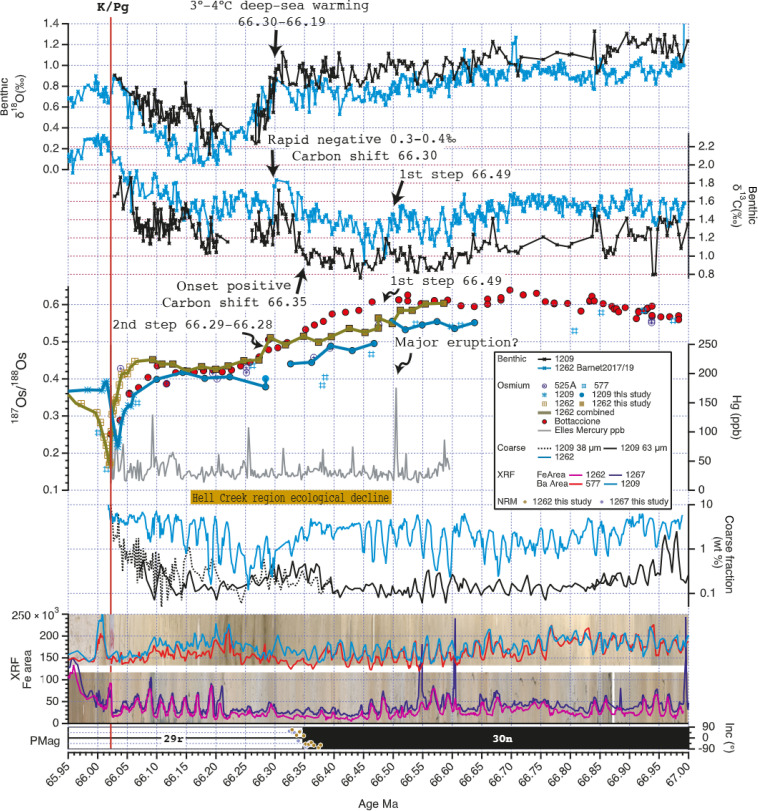
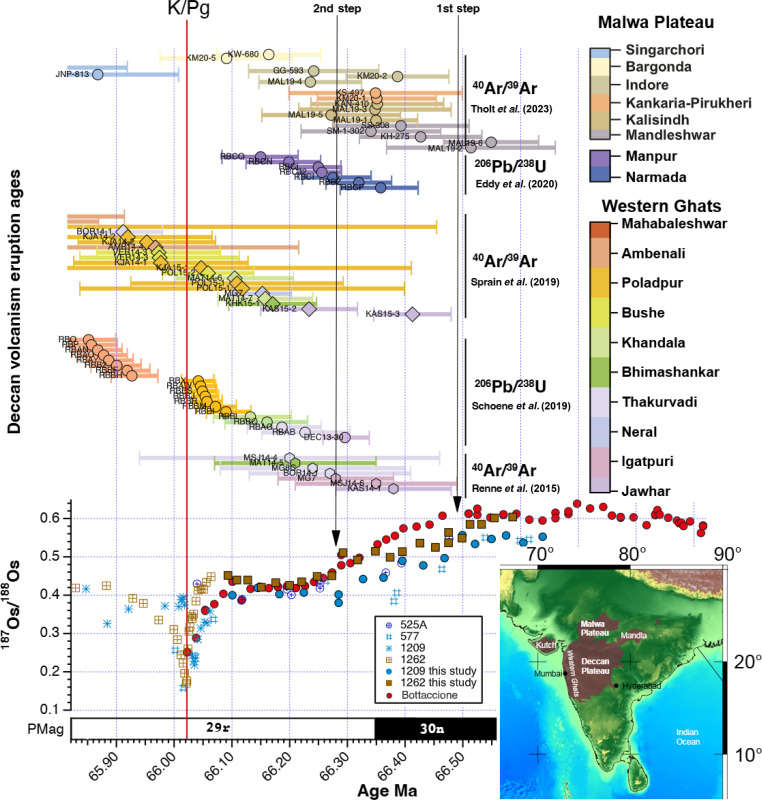
At the end of the Cretaceous, the massive Deccan trap (DT) volcanic eruptions are regarded as the primary driver of global climate deterioration. Accurate age models are key to unravel the sequence of events related to DT volcanism onset and effects on the global climate system. We establish a direct geochemical link between DT volcanism as recorded in marine osmium isotopic data and global climate change documented in benthic foraminifera carbon and oxygen isotope records. Based on our state-of-the-art astronomically calibrated age model, two major shifts in marine 187 Os/ 188 Os at 66.49 and 66.28 million years ago are contemporaneous with major eruption phases of the DT and disruptions of the global carbon cycle. Geochemical records and modeling suggest larger erupted volumes with high volatile emissions for the early phase of DT volcanism and point to differing emissions of SO 2 and CO 2 during the observed marine osmium shifts with diverse effects on the global climate system.
Overview
CoChat Summary
Written by AI from the paper’s full text.
TL;DR
New astronomically calibrated marine records link two major late Maastrichtian shifts in seawater 187Os/188Os at 66.49 and 66.28 Ma to Deccan trap eruption phases and synchronous global carbon-cycle and climate changes. The authors argue for earlier, larger, and compositionally distinct Deccan volatile emissions, including a sulfur-rich phase before the main warming.
Key findings
- Two major decreases in marine 187Os/188Os occur at 66.49 Ma and 66.29 to 66.28 Ma, contemporaneous with Deccan trap eruption phases and disruptions of the global carbon cycle.
- The first Os shift at 66.49 Ma coincides with a major Hg peak at 66.50 Ma and a negative 0.2‰ benthic δ18O shift from 66.50 to 66.45 Ma, indicating a maximum 1°C deep-sea warming.
- From 66.30 to 66.28 Ma, a rapid 0.3‰ to 0.4‰ shift toward lighter benthic δ13C is synchronous with the second Os decrease; deep-sea warming of 3° to 4°C starts at 66.30 Ma and culminates at 66.19 Ma, marking the late Maastrichtian warming event.
- A positive benthic δ13C shift from 66.35 to 66.30 Ma is attributed to an especially sulfur-rich Deccan phase; Os box modeling requires weathering of 1.2 × 10^5 to 1.8 × 10^5 km3 basalt for the first shift and 4.4 × 10^5 to 6.6 × 10^5 km3 for the second.
Methods
- The study integrates new and published data from Pacific DSDP/ODP Sites 577, 1209, and 1210 and South Atlantic DSDP/ODP Sites 525, 527, 528, 1262, and 1267, plus the Tunisian Elles section, using XRF core scanning, benthic δ13C and δ18O, Os isotopes, magnetostratigraphy, and cyclostratigraphy.
- New measurements include 404 benthic foraminifer stable isotope samples, 18 Os isotope samples at Site 1209 and 23 at Site 1262, and 32 oriented paleomagnetic cube specimens; records were correlated at the precession-cycle level, counting 85 precession cycles back from the K/Pg boundary and using 111 tie points between Shatsky Rise and Walvis Ridge.
- The authors use an astronomically calibrated age model and cyclostratigraphic age model, plus LOSCAR carbon-cycle experiments with 10,000 GtC, 10,000 GtS, and combined C+S emissions over 100 kyr, and a simple 1-box marine Os cycle model.
Limitations
- The paper states that the lack of narrow constraints on both Os concentration and isotopic composition in Deccan trap basalt propagates into notable uncertainties in modeled eruptive volumes, and that it is difficult to assess whether the required Os was supplied by basalt weathering because the basalts are in the lowermost Deccan sequence.
- The paper states that some data were digitized from graphs, introducing uncertainty, though it says this did not affect any conclusion; it also notes that sedimentation rates diverge in the older interval likely because of a missing precession cycle around 276.5-m composite depth at Site 1209, with no correction implemented for the oldest part.
- Evident from the text: the Os box model depends on assumed Os concentrations and isotopic compositions, and the orbital solutions for short eccentricity are described as never precise beyond 60 Ma, so the chronology relies on long-eccentricity tuning and precession-cycle counting.
Model-written summary. Check it against the paper before relying on it.
Integrity signals
Registry
Cites
Statistics
Figures
Verification
Claims the paper makes
26 Check pending · 17 Own result · 15 Own method · 15 Own interpretation · 6 No full text of the sources · 3 Not checked yet · 1 No basis given
A result the paper reports from its own data — it cites no other source for it, so there is none to check. The quote shows it is in the paper.
In the paper
“two major shifts in marine 187Os/188Os at 66.49 and 66.28 million years ago are contemporaneous with major eruption phases of the DT and disruptions of the global carbon cycle”
- Also stated in: § RESULTS · plain
“From 67 Ma toward the K/Pg boundary at 66 Ma, Os isotopes show two marked decreases at 66.49 Ma and 66.29 to 66.28 Ma (tables S5 and S6), before dropping off (19, 21) into the K/Pg boundary event.”
§ Earth orbital rhythms links timing of Deccan trap volcanism phases and global climate change > Abstract
plain- Asserted: passes — The authors put it forward as true.
- Checkable: passes — It can be checked against evidence.
- Load-bearing: passes — The paper’s conclusions depend on it.
- Based: passes — The paper gives a reason why it holds.
- Also stated in: § RESULTS · plain
A result the paper reports from its own data — it cites no other source for it, so there is none to check. The quote shows it is in the paper.
In the paper
“The first step at 66.49 Ma is associated with a major peak in Hg concentration in the Tunisian Elles record at 66.50 Ma”
§ Earth orbital rhythms links timing of Deccan trap volcanism phases and global climate change > RESULTS
plainstates an association- Asserted: passes — The authors put it forward as true.
- Checkable: passes — It can be checked against evidence.
- Load-bearing: passes — The paper’s conclusions depend on it.
- Based: passes — The paper gives a reason why it holds.
A result the paper states — it cites no source for it, so there is none to check. The quote shows it is in the paper.
In the paper
“which is consistent with the observation that the positive benthic excursion is not associated with a coincident warming in benthic δ18O”
§ Earth orbital rhythms links timing of Deccan trap volcanism phases and global climate change > DISCUSSION
plain- Asserted: passes — The authors put it forward as true.
- Checkable: passes — It can be checked against evidence.
- Load-bearing: passes — The paper’s conclusions depend on it.
- Based: passes — The paper gives a reason why it holds.
A result the paper reports from its own data — it cites no other source for it, so there is none to check. The quote shows it is in the paper.
In the paper
“From 66.30 to 66.28 Ma, a very rapid 0.3‰ to 0.4‰ shift toward lighter δ13C values is synchronous with the second decreasing step in Os isotope data.”
§ Earth orbital rhythms links timing of Deccan trap volcanism phases and global climate change > RESULTS
plainstates an association- Asserted: passes — The authors put it forward as true.
- Checkable: passes — It can be checked against evidence.
- Load-bearing: passes — The paper’s conclusions depend on it.
- Based: passes — The paper gives a reason why it holds.
A result the paper reports from its own data — it cites no other source for it, so there is none to check. The quote shows it is in the paper.
In the paper
“and a negative 0.2 per mil (‰) shift in benthic δ18O from 66.50 to 66.45 Ma”
§ Earth orbital rhythms links timing of Deccan trap volcanism phases and global climate change > RESULTS
plainstates an association- Asserted: passes — The authors put it forward as true.
- Checkable: passes — It can be checked against evidence.
- Load-bearing: passes — The paper’s conclusions depend on it.
- Based: passes — The paper gives a reason why it holds.
- It may state two separate claims as one. 17
- Probably not a substantial claim. 24
Create a free account to see these claims.
Create a free account to see these assumptions.
39 more claims
Create a free account to see all 83 claims and to verify the 39 references still open.
Self-check
Percentages, sums and reported differences re-computed from the paper’s own numbers.
Each contradiction between two passages listed here was confirmed by an independent check.
Rated minor: it would not touch a result — a value no result rests on, a p-value that stays on the same side of the significance level, or a conflict that is clerical, resolved elsewhere in the paper, or outside its own findings.
In the paper
§ Earth orbital rhythms links timing of Deccan trap volcanism phases and global climate change > MATERIALS AND METHODS > Bulk and benthic stable carbon and oxygen isotope data
“1267 (47, 55).”
§ Earth orbital rhythms links timing of Deccan trap volcanism phases and global climate change > References
“55. L. Alegret, E. Thomas, Benthic foraminifera across the Cretaceous/Paleogene boundary in the Southern Ocean (ODP Site 690): Diversity, food and carbonate saturation.”
Citations
Cites
Trends, Rhythms, and Aberrations in Global Climate 65 Ma to Present
Zachos, J., Pagani, M., Sloan, L., Thomas, E., & Billups, K. (2001) · Science · doi:10.1126/science.1059412 · Cited by 10,458
Fisher, R. A. (1953) · Proceedings of the Royal Society A Mathematical Physical and Engineering Sciences · doi:10.1098/rspa.1953.0064 · Cited by 5,716
The least-squares line and plane and the analysis of palaeomagnetic data
Kirschvink, J. L. (1980) · Geophysical Journal International · doi:10.1111/j.1365-246x.1980.tb02601.x · Cited by 5,521
A long-term numerical solution for the insolation quantities of the Earth
Laskar, J., Robutel, P., Joutel, F., Gastineau, M., Correia, A. C. M., & Levrard, B. (2004) · Astronomy & Astrophysics · doi:10.1051/0004-6361:20041335 · Cited by 3,837
Westerhold, T., Marwan, N., Drury, A. J., Liebrand, D., Agnini, C., Anagnostou, E., Barnet, J. S. K., Bohaty, S. M., De Vleeschouwer, D., Florindo, F., et al. (2020) · Science · doi:10.1126/science.aba6853 · Cited by 1,946
Self-citationLarge igneous provinces: Crustal structure, dimensions, and external consequences
Coffin, M. F., & Eldholm, O. (1994) · Reviews of Geophysics · doi:10.1029/93rg02508 · Cited by 1,538
Re-Os Ages of Group IIA, IIIA, IVA, and IVB Iron Meteorites
Smoliar, M. I., Walker, R. J., & Morgan, J. W. (1996) · Science · doi:10.1126/science.271.5252.1099 · Cited by 1,355
Synchronizing Rock Clocks of Earth History
Kuiper, K. F., Deino, A., Hilgen, F. J., Krijgsman, W., Renne, P. R., & Wijbrans, J. R. (2008) · Science · doi:10.1126/science.1154339 · Cited by 1,345
Ocean Basin Evolution and Global-Scale Plate Reorganization Events Since Pangea Breakup
Müller, R. D., Seton, M., Zahirovic, S., Williams, S. E., Matthews, K. J., Wright, N. M., Shephard, G. E., Maloney, K. T., Barnett‐Moore, N., Hosseinpour, M., et al. (2016) · Annual Review of Earth and Planetary Sciences · doi:10.1146/annurev-earth-060115-012211 · Cited by 1,098
Basalt weathering laws and the impact of basalt weathering on the global carbon cycle
Dessert, C., Dupré, B., Gaillardet, J., François, L., & Allègre, C. J. (2003) · Chemical Geology · doi:10.1016/j.chemgeo.2002.10.001 · Cited by 1,042
Research works printed but not linked: 16
- T. D. Herbert I. Premoli-Silva E. Erba A. G. Fischer in Geochronology Time Scales and Global Stratigraphic Correlation W. A. Berggren D. V. Kent M. P. Aubry J. Hardenbol Eds. (SEPM Special Publications 1995) vol. 54 pp. 81–93.
- Shipboard Scientific Party Leg 198 summary in T. J. Bralower I. Premoli Silva M. J. Malone et al. Proc. ODP Init. Repts. 198: College Station TX (Ocean Drilling Program 2002) pp. 1–84.
- J. C. Zachos Proceedings of the Ocean Drilling Program; Initial Reports; Early Cenozoic Extreme Climates; the Walvis Ridge Transect; Covering Leg 208 of the Cruises of the Drilling Vessel JOIDES Resolution; Rio de Janeiro Brazil to Rio de Janeiro Brazil; Sites 1262-1267 6 March-6 May 2003 H. Neville K. Sherar Eds. (Texas A&M University Ocean Drilling Program 2004).
- A. J. Drury D. K. Kulhanek T. Westerhold A. C. Ravelo G. Mountain A. Holbourn Y. Rosenthal A. Schmitt J. B. Wurtzel J. Xu R. Wilkens U. Röhl Proceedings of the International Ocean Discovery Program Volume 363: Western Pacific Warm Pool Y. Rosenthal A. E. Holbourn D. K. Kulhanek Eds. the Expedition 363 Scientists (International Ocean Discovery Program 2021).
- N. J. Shackleton M. A. Hall U. Bleil in Init. Repts. DSDP 86: Washington (U.S. Govt. Printing Office) G. R. Heath L. H. Burckle et al. Eds. (1985) pp. 503-511.
- J. C. Zachos M. A. Arthur R. C. Thunell D. F. Williams E. J. Tappa in Initial Reports of the Deep Sea Drilling Project Volume 86 G. R. Heath L. H. Burckle Eds. (US Government Printing Office 1985) pp. 513–532.
- M. Roy-Barman thesis Paris Université de Paris VII (1993).
- A. D. Chave in Initial Reports of the Deep Sea Drilling Project Volume 74 T. C. Moore P. D. Rabinowitz Eds. (US Government Printing Office 1984) pp. 525–531.m.
- J. Bowles in Proc. ODP Sci. Results 208: College Station TX (Ocean Drilling Program) D. Kroon J. C. Zachos C. Richter Eds. (2006).
- U. Bleil in Initial Reports of the Deep Sea Drilling Project Volume 86 G. R. Heath L. H. Burckle Eds. (US Government Printing Office 1985) pp. 441–458.
- J. Laskar in Geologic Time Scale 2020 F. M. Gradstein J. G. Ogg M. D. Schmitz G. M. Ogg Eds. (Elsevier 2020) pp. 139–158.
- Shipboard Scientific Party in Proc. ODP Init. Repts. 208: College Station TX J. C. Zachos D. Kroon P. Blum et al. Eds. (Ocean Drilling Program 2004) vol. 208 pp. 1–92.
- Shipboard Scientific Party in Proc. ODP Init. Repts. 208: College Station TX J. C. Zachos D. Kroon P. Blum et al. Eds. (Ocean Drilling Program 2004) vol. 208 pp. 1–77.
- J. D. A. Zijderveld in Methods in Paleomagnetism D. W. Collinson K. M. Creer S. K. Runcorn Eds. (Elsevier 1967) pp. 254–286.
- M. Sharma in Encyclopedia of Ocean Sciences J. K. Cochran H. J. Bokuniewicz P. L. Yager Eds. (Academic Press 2019) pp. 174–180.
- A. Montanari C. Koeberl Impact Stratigraphy. The Italian Record Lecture Notes in Earth Sciences Series (Springer-Verlag 2000) vol. 93 pp. 364.
Cited by
Using Venus, Earth, and Mars to Understand Exoplanet Volatile and Climate Evolution
JAKOSKY, B. M., & Byrne, P. K. (2025) · Journal of Geophysical Research Planets · doi:10.1029/2024je008882 · Cited by 7
Luan, X., Wang, X., He, K., Zhang, P., Yang, C., & Bian, L. (2025) · Global and Planetary Change · doi:10.1016/j.gloplacha.2025.105107 · Cited by 6
Matsumoto, H., Watanabe, Y., Coccioni, R., Frontalini, F., Yoshimura, T., Kuroda, J., & Suzuki, K. (2026) · Science · doi:10.1126/science.adw8301 · Cited by 3
Self-citationSen, R., Polacci, M., Hartley, M. E., Burton, M. R., & Gupta, S. (2025) · Journal of Volcanology and Geothermal Research · doi:10.1016/j.jvolgeores.2025.108493 · Cited by 2
Radioisotopic age, osmium isotopes, and global correlation of the Albian-Cenomanian boundary
Singer, B. S., Takashima, R., Li, Y., Schmitz, M. D., Selby, D. S., Sageman, B. B., Podrecca, L. G., Nishi, H., Jicha, B. R., & Yamanaka, T. (2025) · Geological Society of America Bulletin · doi:10.1130/b38503.1 · Cited by 2
Metadata
- Authors
- Westerhold, T., Dallanave, E., Penman, D., Schoene, B., Röhl, U., Gussone, N., & Kuroda, J.
- Affiliations
- University of Bremen (DE)
- Utah State University (US)
- Princeton University (US)
- University of Münster (DE)
- Atmosphere and Ocean Research Institute, The University of Tokyo (JP)
- Corresponding author
- Westerhold, Thomas
- ORCID
- Venue
- Science Advances
- Published
- 2025-03-07
- Volume
- 11
- Issue
- 10
- Pages
- eadr8584-eadr8584
- ISSN
- 2375-2548 (ISSN-L)
- PMC
- PMC11887795
- OpenAlex
- W4408236055
- Cited by
- 17
- References
- 123
- Citations by year
- 2026: 10 · 2025: 7
- FWCI
- 9.10
- Type
- journal article
- Language
- en
- Open access
- gold
- doi.org
- Licence
- cc-by
- Locations
- Science Advances (publishedVersion, cc-by)
- PubMed Central (publishedVersion, other-oa)
- PubMed (publishedVersion)
- Digital Commons - USU (Utah State University) (submittedVersion, cc-by)
- Archivio Istituzionale della Ricerca (Universita Degli Studi Di Milano) (submittedVersion, other-oa)
- Funders
- Japan Society for the Promotion of Science (22K18426, 23K22613)
- Topics
- Physical Sciences › Earth and Planetary Sciences › Paleontology › Paleontology and Stratigraphy of Fossils
- Physical Sciences › Earth and Planetary Sciences › Atmospheric Science › Geology and Paleoclimatology Research
- Physical Sciences › Earth and Planetary Sciences › Geochemistry and Petrology › Geological and Geochemical Analysis
- Keywords
- Cretaceous-Paleogene boundary, mass extinction, osmium isotopes, benthic foraminifera, carbon isotopes, oxygen isotopes, orbital forcing, age model, carbon cycle, volcanic gas emissions, sulfur dioxide, carbon dioxide, climate change
About these checks
Registry, retraction, Cites and statistics results are computed, not judged, with one exception: a printed reference that no index lists is read once by a model before it counts as a citation error. Claims are extracted by a model and kept only when their quote appears verbatim in the text; each cited source is then checked, with a model’s help, for whether it says what the claim relies on. Those verdicts can be wrong — read the claim’s quote and the cited source before relying on one.
A language model drew the claims from the paper on 2026-11-12, under version 3 of the claim definition (model deepseek-v4.1-flash, prompt extract-v3).
A second model labelled each claim on 2026-11-12 (model jev-1.13-20260917, definition revision gold-guideline-v0.2).
Statistics and arithmetic are recomputed, not judged.
Confidence bands are shown only for fields calibrated on our annotated test set. None is calibrated yet, so no band is shown.
What counts as a claim ›How we measure confidence ›How we check this ›
Are you an author, or do you see a problem with this page? Request a review
How to cite
Cite CoChat for the checks on this page, and the paper for its own findings.
- This page
- CoChat. (2026). Citation check: Earth orbital rhythms links timing of Deccan trap volcanism phases and global climate change. https://app.cochat.ai/papers/10.1126/sciadv.adr8584
- The paper
- Westerhold, T., Dallanave, E., Penman, D., Schoene, B., Röhl, U., Gussone, N., & Kuroda, J. (2025). Earth orbital rhythms links timing of Deccan trap volcanism phases and global climate change. Science Advances. https://doi.org/10.1126/sciadv.adr8584
