

Paleolake geochronology supports Last Glacial Maximum (LGM) age for human tracks at White Sands, New Mexico
Open accessThe DOI matches its Crossref record; 53 of the 53 references it cites were found in a registry or an index; none of the 75 sources its claims cite is checked for support yet.
Abstract
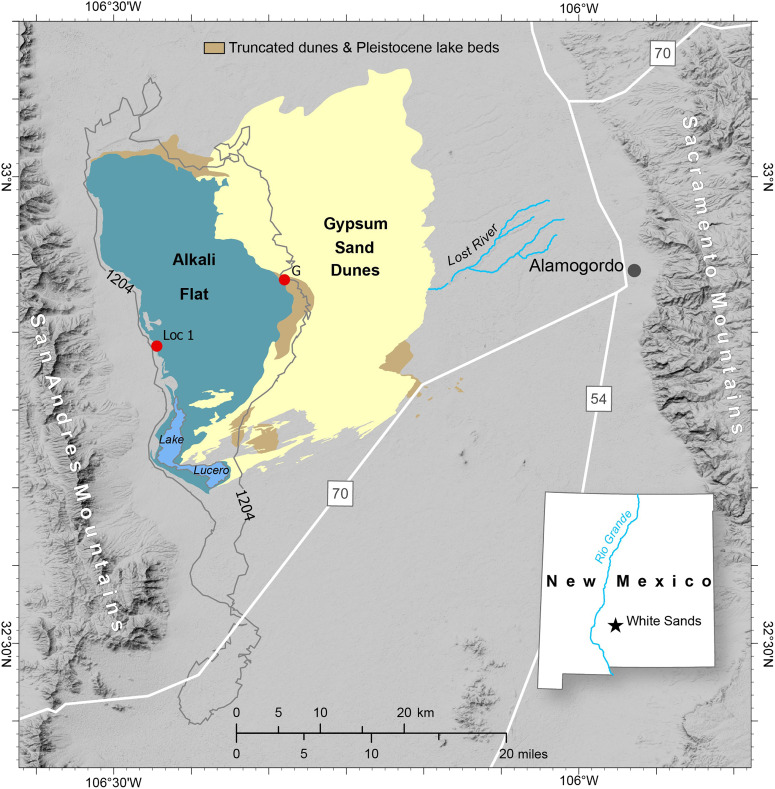
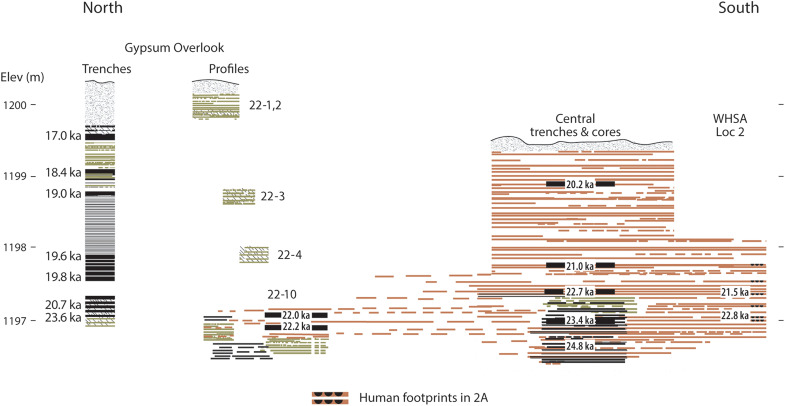
Discovery of human footprints in alluvium dated to the Last Glacial Maximum (LGM) at White Sands, New Mexico, was a notable step in understanding the initial peopling of the Americas, but that work was met with criticism focused on the reliability of the materials used in the radiocarbon dating (seeds of Ruppia and pollen). This paper reports on an independent study of the chronology of a previously unrecognized stratigraphic record of paleolake Otero that is directly traceable into the track-bearing alluvium. The stratigraphic data along with 26 additional radiocarbon dates on palustrine mud determined by two labs independent of the original investigations document an aggrading lake/wetland/stream record that includes the tracks and spans >23.6 thousand years to ~17.0 thousand calibrated years before present, providing another line of evidence further supporting the validity of an LGM age for the tracks.
Overview
CoChat Summary
TL;DR
An independent stratigraphic and radiocarbon study of paleolake Otero’s eastern margin at White Sands finds a lake/wetland/alluvial record spanning >23.6 ka to ~17.0 ka cal B.P. that directly correlates with the track-bearing alluvium, supporting an LGM age (~23–21 ka cal B.P.) for the human tracks.
Key findings
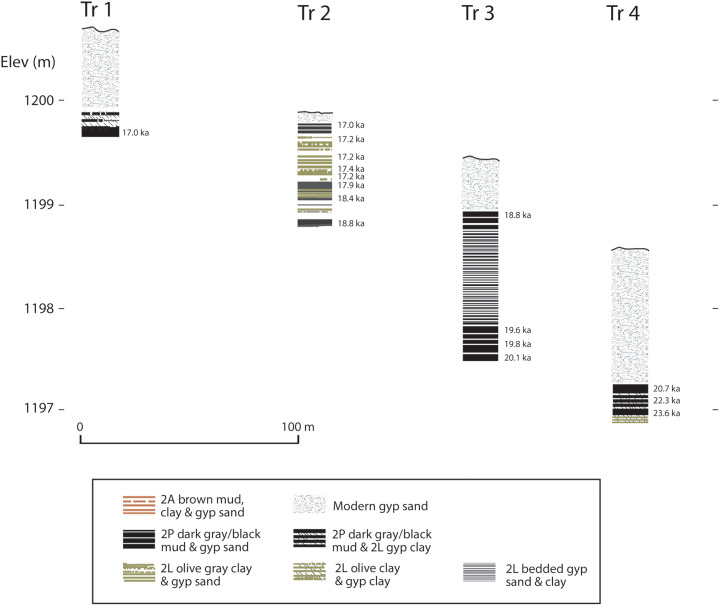
- 26 new radiocarbon dates (21 palustrine mud, 5 *Ruppia* seeds) from two independent labs document an aggrading lake/wetland/stream sequence spanning >23.6 ka to ~17.0 ka cal B.P.; new Gypsum Overlook dates of ~22.4–20.7 ka cal B.P. correlate stratigraphically and by elevation with WHSA Locality 2 track-bearing alluvium dated ~23.0–21.0 ka cal B.P.
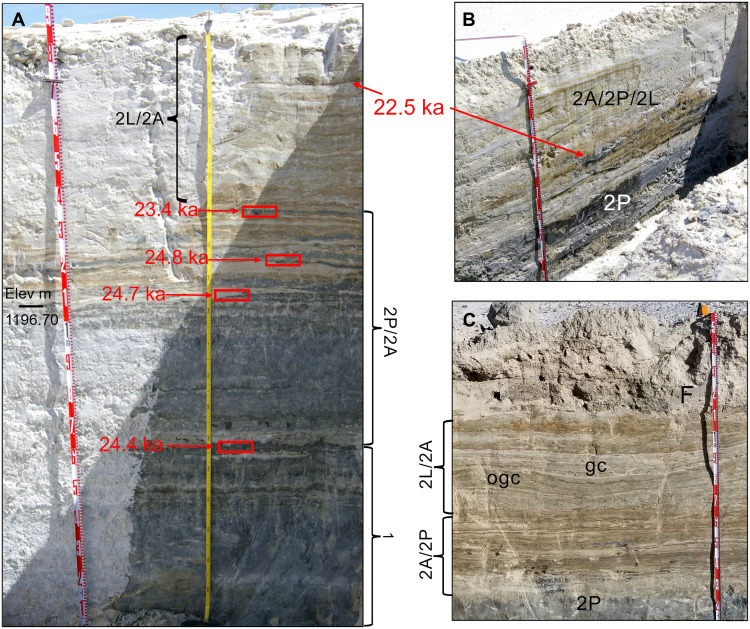
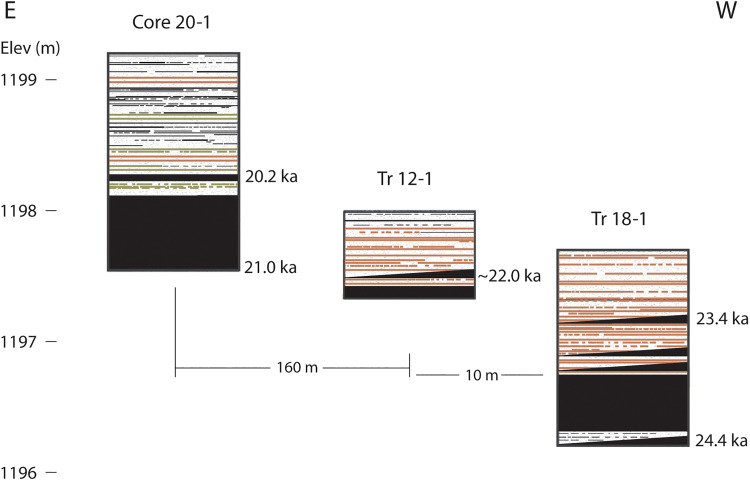
- A red-brown mud bed at 1196.8–1197.1 m in Gypsum Overlook can be traced ~1000 m southeast into WHSA Locality 2 track layers at 1196.8–1197.9 m, linking the dated lake/wetland strata to the human-track stratum (Stratum 2A).
- ∂13C data: of 19 bulk-sediment dates with ∂13C, 17 are −15.7‰ or lower (most <−17.0‰), while *Ruppia* seed values are −11.6‰ or higher; seed and mud dates generally align with no systematic offset, arguing against mud containing decomposed seeds.
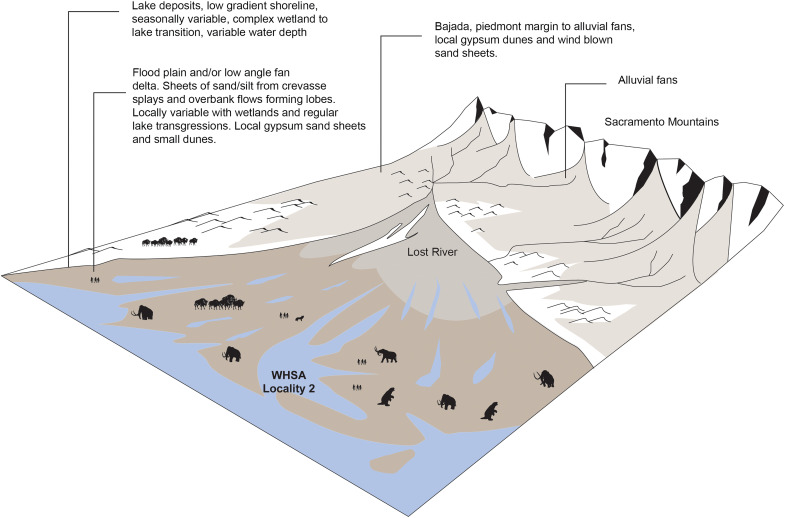
- The record indicates shallow water (<1 m), wetlands, and an alluvial plain; alluvial deposition peaked ~22.4–22.2 ka cal B.P., the lake did not transgress the immediate track area after ~22.5 ka cal B.P., and wetlands persisted until ~20.2 ka cal B.P.; three radiocarbon sources (*Ruppia* seeds, pollen, palustrine mud) agree.
Methods
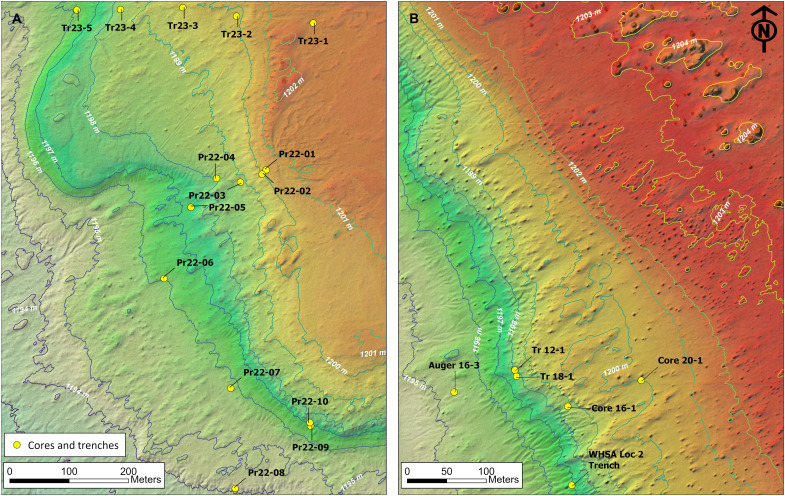
- Independent field study of a 3-km segment along the eastern escarpment of Alkali Flat, including WHSA Locality 2, a Central area, and Gypsum Overlook; methods included trenching, coring, stratigraphic mapping, LiDAR elevation measurement, and radiocarbon sampling.
- 26 new AMS radiocarbon dates on 21 palustrine mud and 5 *Ruppia* seeds, run by the University of Arizona AMS facility and Northern Arizona University’s Arizona Climate and Ecosystems Isotope Laboratory; calibration used CALIB 8.2 and IntCal20.
- Supporting analyses included pollen and ostracode extraction from selected samples; bulk sediment was pretreated with HCl and wet-sieved, and seeds were acid-base-acid pretreated.
Limitations
- The paper states that dating bulk organic-rich sediment is “not ideal” for radiocarbon chronology and can be contaminated by processes that might mix dates, though it argues those problems are not necessarily operative here.
- The paper states that Pleistocene deposits younger than ~17.0 ka cal B.P. are not exposed in the study area and may be buried under dunes; Holocene eolian deflation makes the paleolake history incomplete, and stratigraphic exposures are rare due to gypsum sand sheets and dunes.
- The paper notes some radiocarbon samples were redeposited, from an out-of-place block, or otherwise not acceptable (21 acceptable bulk dates reported); pollen counts were limited by organic debris, so typical 300+ grain counts were not possible and percentages were based on 100+ or 200+ counts. Evident from the text: this independent study dates correlative strata rather than directly dating the human tracks themselves.
Model-written summary. Check it against the paper before relying on it.
Integrity signals
Registry
Cites
Statistics
Figures
Verification
Claims the paper makes
0 Valid · 1 Not valid · 35 Not checked · 67 Own results and interpretations
A result the paper reports from its own data — it cites no other source for it, so there is none to check. The quote shows it is in the paper.
In the paper
“There is no evidence for substantial channel cutting during the evolution of Stratum 2A, although there might be evidence of very minor local channeling (Fig. 6C).”
§ Paleolake geochronology supports Last Glacial Maximum (LGM) age for human tracks at White Sands, New Mexico > RESULTS > Stratum 2
hedged- Asserted: passes — The authors put it forward as true.
- Checkable: passes — It can be checked against evidence.
- Load-bearing: unclear — It is unclear whether the paper’s conclusions depend on it.
- Based: passes — The paper gives a reason why it holds.
A result the paper reports from its own data — it cites no other source for it, so there is none to check. The quote shows it is in the paper.
In the paper
“This paper reports on an independent study of the chronology of a previously unrecognized stratigraphic record of paleolake Otero that is directly traceable into the track-bearing alluvium.”
- Also stated in: § INTRODUCTION · plain
“This record continues into the archaeological site and directly addresses the paleolake stratigraphy and chronology along with its relationship with the geochronology of the track-bearing alluvium.”
§ Paleolake geochronology supports Last Glacial Maximum (LGM) age for human tracks at White Sands, New Mexico > Abstract
plainstates an association- Asserted: passes — The authors put it forward as true.
- Checkable: passes — It can be checked against evidence.
- Load-bearing: passes — The paper’s conclusions depend on it.
- Based: passes — The paper gives a reason why it holds.
- Also stated in: § INTRODUCTION · plain
A result the paper reports from its own data — it cites no other source for it, so there is none to check. The quote shows it is in the paper.
In the paper
“Some lenses of red-brown clay and mud of Stratum 2A within Stratum 2L in the Gypsum Overlook area (1196.8- to 1197.1-m elevation; Profile 22-10; Table 1) can be traced ~1000 m to the southeast into WHSA Locality 2 track layers (1196.8- to 1197.9-m elevation; Fig. 5 and figs. S1 and S5).”
§ Paleolake geochronology supports Last Glacial Maximum (LGM) age for human tracks at White Sands, New Mexico > RESULTS > Stratum 2
plainstates an association- Asserted: passes — The authors put it forward as true.
- Checkable: passes — It can be checked against evidence.
- Load-bearing: passes — The paper’s conclusions depend on it.
- Based: passes — The paper gives a reason why it holds.
None of the sources cited for this claim have been checked yet.
In the paper
“These facies occur in distinct stratigraphic packages, identified here as Strata 1, 2A, 2P, and 2L (Figs. 3 to 7), following identification of two “stratigraphic sequences” (14, 15, 18) (a lower and an upper; Strata 1 and 2 here, respectively) along the northern and eastern exposures around Alkali Flat.”
§ Paleolake geochronology supports Last Glacial Maximum (LGM) age for human tracks at White Sands, New Mexico > RESULTS
What the sources say
- Not checked yetcites [14] S. G. Lucas, J. W. Hawley, “The Otero formation, pleistocene lacustrine strata in the Tularosa Basin, southern New Mexico” in Geology of White Sands, V. W. Lueth, K. A. Giles, S. G. Lucas, B. S. Kues, R. Myers, D. S. Ulmer-Scholle, Eds. (New Mexico Geological Society, 53rd Annual Fall Field Conference Guidebook, 2002), pp. 77–283. source
- Not checked yetcites [15] B. D. Allen, D. W. Love, R. G. Myers, Evidence for Late Pleistocene hydrologic and climatic change from Lake Otero, Tularosa Basin, south-central New Mexico. N. M. Geol. 31, 9– 25 (2009). doi:10.58799/nmg-v31n1.9
- Not checked yetcites [18] B. D. Allen, D. W. Love, D. Bustos, “Stratigraphic study of late Pleistocene fossil-track-bearing deposits on White Sands National Monument. Report to the National Park Service, White Sands National Monument, under Task Agreement No. P12AC71216” (New Mexico Bureau of Geology and Mineral Resources, New Mexico Tech University, 2014).
plain- Asserted: passes — The authors put it forward as true.
- Checkable: passes — It can be checked against evidence.
- Load-bearing: unclear — It is unclear whether the paper’s conclusions depend on it.
- Based: passes — The paper gives a reason why it holds.
A result the paper reports from its own data — it cites no other source for it, so there is none to check. The quote shows it is in the paper.
In the paper
“Elevations of individual beds show very low relief (<1 m across the ~1.5-km length of the exposure) on the basis of visual inspection and LiDAR data.”
§ Paleolake geochronology supports Last Glacial Maximum (LGM) age for human tracks at White Sands, New Mexico > RESULTS > Stratum 2
plain- Asserted: passes — The authors put it forward as true.
- Checkable: passes — It can be checked against evidence.
- Load-bearing: unclear — It is unclear whether the paper’s conclusions depend on it.
- Based: passes — The paper gives a reason why it holds.
43 more claims
Create a free account to see all 103 claims and to verify the 73 references still open.
- Probably not a substantial claim. 19
- It may state two separate claims as one. 43
- The quote only partly states this claim. 1
Claims other papers make about this one
Each is checked against this paper’s own text: does it say what the citing paper says it does?
In the citing paper
“Starting around ∼23.6 ka, the lithologic transition from lacustrine gypsiferous clays to alluvial silts and sands indicates that Lake Otero began to shrink and recede to the west of WHSA Locality 2 as temperatures began to rise (Fig. 4A), in agreement with an independent geomorphic record to the northwest (12).”
From Humans experienced abrupt environmental changes at White Sands during the Last Glacial Maximum (2026) · cites this paper as [12]
In the citing paper
“Although the veracity of the age estimates has been challenged (5–11), the chronology and supporting evidence remain conclusive (12–15).”
From Humans experienced abrupt environmental changes at White Sands during the Last Glacial Maximum (2026) · cites this paper as [12]
Self-check
Percentages, sums and reported differences re-computed from the paper’s own numbers.
Each contradiction between two passages listed here was confirmed by an independent check.
Rated minor: it would not touch a result — a value no result rests on, a p-value that stays on the same side of the significance level, or a conflict that is clerical, resolved elsewhere in the paper, or outside its own findings.
In the paper
§ Paleolake geochronology supports Last Glacial Maximum (LGM) age for human tracks at White Sands, New Mexico > RESULTS > Stratum 2
“| ACE5439 | 1199.15 | 63–70 | Bulk sed | 15,021 ± 181 | −16.3 | 18,377 | 18,641–18,426 | 18,736–17,928 |”
§ Paleolake geochronology supports Last Glacial Maximum (LGM) age for human tracks at White Sands, New Mexico > RESULTS > Stratum 2
“| Lab code | Elevation (m) | Depth below surface (cm) | Material dated | 14C age (yr B.P.) | ∂ 13C ‰ | Median age (cal yr B.P.) | 1σ cal range B.P. | 2σ cal range B.P. |”
Citations
Cites
The IntCal20 Northern Hemisphere Radiocarbon Age Calibration Curve (0–55 cal kBP)
Reimer, P. J., Austin, W. E. N., Bard, E., Bayliss, A., Blackwell, P. G., Bronk Ramsey, C., Butzin, M., Cheng, H., Edwards, R. L., Friedrich, M., et al. (2020) · Radiocarbon · doi:10.1017/rdc.2020.41 · Cited by 7,900
Extended 14C Data Base and Revised CALIB 3.0 14C Age Calibration Program
Stuiver, M., & Reimer, P. J. (1993) · Radiocarbon · doi:10.1017/s0033822200013904 · Cited by 7,786
Moore, P. D., Webb, J. A. W., & Collinson, M. E. (1991) · Cited by 4,515
Pollen Representation of Vegetation in Quaternary Sediments: Theory and Method in Patchy Vegetation
Sugita, S. (1994) · The Journal of Ecology · doi:10.2307/2261452 · Cited by 1,067
Evidence of humans in North America during the Last Glacial Maximum
Bennett, M. R., Bustos, D., Pigati, J. S., Springer, K. B., Urban, T. M., Holliday, V. T., Reynolds, S. C., Budka, M., Honke, J. S., Hudson, A. M., et al. (2021) · Science · doi:10.1126/science.abg7586 · Cited by 239
Self-citationYounger Dryas “black mats” and the Rancholabrean termination in North America
Haynes, C. V. (2008) · Proceedings of the National Academy of Sciences · doi:10.1073/pnas.0800560105 · Cited by 234
White Sands Dune Field, New Mexico: Age, dune dynamics and recent accumulations
Kocurek, G., Carr, M. M., Ewing, R. C., Havholm, K. G., Nagar, Y. C., & Singhvi, A. K. (2006) · Sedimentary Geology · doi:10.1016/j.sedgeo.2006.10.006 · Cited by 194
Paleoindian Geoarchaeology of the Southern High Plains
Holliday, V. T. (1997) · University of Texas Press eBooks · doi:10.7560/731097 · Cited by 168
Self-citationOstracodes as Quaternary paleoecological indicators
Delorme, L. D. (1969) · Canadian Journal of Earth Sciences · doi:10.1139/e69-151 · Cited by 151
Forester, R. M. (1983) · Geology · Cited by 145
Late Quaternary paleoclimate records from lacustrine ostracodes
Forester, R. M. (2015) · Geological Society of America eBooks · doi:10.1130/dnag-gna-k3.261 · Cited by 111
Buried Paleoindian-age landscapes in stream valleys of the central plains, USA
Mandel, R. D. (2008) · Geomorphology · doi:10.1016/j.geomorph.2008.05.031 · Cited by 80
Ecosystem and paleohydrological response to Quaternary climate change in the Bonneville Basin, Utah
Balch, D. P., Cohen, A. S., Schnurrenberger, D. W., Haskell, B. J., Valero-Garces, B. L., Beck, J., Cheng, H., & Edwards, R. L. (2005) · Palaeogeography Palaeoclimatology Palaeoecology · doi:10.1016/j.palaeo.2005.01.013 · Cited by 76
Independent age estimates resolve the controversy of ancient human footprints at White Sands
Pigati, J. S., Springer, K. B., Honke, J. S., Wahl, D., Champagne, M. R., Zimmerman, S. R. H., Gray, H. J., Santucci, V. L., Odess, D., Bustos, D., et al. (2023) · Science · doi:10.1126/science.adh5007 · Cited by 68
Essai sur le classement des animaux qui vivent sur la plage et dans les environs de Dunkerque
Terquem, O. (1875) · Cited by 63
Holliday, V. T., Mayer, J. H., & Fredlund, G. G. (2008) · Quaternary Research · doi:10.1016/j.yqres.2008.02.009 · Cited by 50
Self-citationDeltaic Environments of Deposition
Coleman, J. M., & Prior, D. B. (1982) · Sandstone Depositional Environments · doi:10.1306/m31424c7 · Cited by 50
Neogene (Plio-Pleistocene) Fresh-Water Ostracodes from the Central High Plains
Gutentag, E. D., & Benson, R. H. (1962) · Bulletin (Kansas Geological Survey) · doi:10.17161/kgsbulletin.no.i157.22170 · Cited by 43
The genus Ruppia L. (Ruppiaceae) in the Mediterranean region: An overview
Mannino, A. M., Menéndez, M., Obrador, B., Sfriso, A., & Triest, L. (2015) · Aquatic Botany · doi:10.1016/j.aquabot.2015.02.005 · Cited by 39
Potential Pitfalls of Pollen Dating
Neulieb, T., Levac, E., Southon, J. R., Lewis, M., Pendea, I. F., & Chmura, G. L. (2013) · Radiocarbon · doi:10.1017/s0033822200048050 · Cited by 39
Hawley, J. W. (1993) · doi:10.58799/ofr-391 · Cited by 29
Geoarchaeology of the Boca Negra Wash Area, Albuquerque Basin, New Mexico, USA
Holliday, V. T., Huckell, B. B., Mayer, J. H., Forman, S. L., & McFadden, L. D. (2006) · Geoarchaeology · doi:10.1002/gea.20139 · Cited by 28
Self-citationA Further Evaluation of the San Jon Site, New Mexico
Hill, M. G., Holliday, V. T., & Stanford, D. J. (1995) · Plains Anthropologist · doi:10.1080/2052546.1995.11931775 · Cited by 28
Self-citationCurry, B. B., Delorme, L. D., Smith, A. J., Palmer, D. F., & Stiff, B. J. (2012) · Developments in quaternary science · doi:10.1016/b978-0-444-53636-5.00006-8 · Cited by 26
Weir, J. E. (1965) · doi:10.3133/wsp1801 · Cited by 25
Oviatt, C. G., Madsen, D. B., Rhode, D., & Davis, L. G. (2023) · Quaternary Research · doi:10.1017/qua.2022.38 · Cited by 24
Schiller, C. M., Whitlock, C. L., Elder, K. L., Iverson, N. A., & Abbott, M. B. (2020) · Radiocarbon · doi:10.1017/rdc.2020.118 · Cited by 23
Haynes, C. V. (2022) · PaleoAmerica · doi:10.1080/20555563.2022.2039861 · Cited by 21
Response to Comment on “Evidence of humans in North America during the Last Glacial Maximum”
Pigati, J. S., Springer, K. B., Bennett, M. R., Bustos, D., Urban, T. M., Holliday, V. T., Reynolds, S. C., & Odess, D. (2022) · Science · doi:10.1126/science.abm6987 · Cited by 20
Self-citation(1995) · doi:10.1130/mem186 · Cited by 19
Self-citationOstracodes in Pleistocene Lake Bonneville, eastern Great Basin, North America
Oviatt, C. G. (2015) · Hydrobiologia · doi:10.1007/s10750-015-2483-y · Cited by 18
Pigati, J. S., Springer, K. B., Holliday, V. T., Bennett, M. R., Bustos, D. F., Urban, T. M., Reynolds, S. C., & Odess, D. (2022) · PaleoAmerica · doi:10.1080/20555563.2022.2039863 · Cited by 17
Self-citationGu, R., Zhou, Y., Song, X., Xu, S., Zhang, X., Lin, H., Xu, S., Yue, S., & Zhu, S. (2018) · Frontiers in Plant Science · doi:10.3389/fpls.2018.00221 · Cited by 17
Filling a Geographical Gap: New Paleoecological Reconstructions From the Desert Southwest, USA
Brunelle, A., Minckley, T. A., Shinker, J. J., & Heyer, J. (2018) · Frontiers in Earth Science · doi:10.3389/feart.2018.00106 · Cited by 16
Rachal, D. M., Dello-Russo, R., & Cuba, M. (2024) · Quaternary Research · doi:10.1017/qua.2023.74 · Cited by 14
Unresolved: Persistent Problems with the White Sands Locality 2 Geochronology
Rhode, D., Neudorf, C. M., Rachal, D., Davis, L. G., Madsen, D. B., & Dello-Russo, R. (2024) · PaleoAmerica · doi:10.1080/20555563.2024.2345979 · Cited by 14
Rachal, D. M., Zeigler, K., Dello-Russo, R., & Solfisburg, C. (2021) · Quaternary Science Advances · doi:10.1016/j.qsa.2021.100024 · Cited by 12
Rachal, D. M., Mead, J. I., Dello‐Russo, R., & Cuba, M. T. (2022) · Geoarchaeology · doi:10.1002/gea.21937 · Cited by 12
Hydrologic investigation at White Sands National Monument
Newton, B. T., & Allen, B. (2014) · doi:10.58799/ofr-559 · Cited by 11
Onset of dune construction based on archaeological evidence, White Sands, New Mexico
Holliday, V. T., Cuba, M. T., Lee, W., Windingstad, J. D., Fenerty, B., & Bustos, D. F. (2023) · Quaternary Research · doi:10.1017/qua.2023.22 · Cited by 9
Self-citationThe Geochronology of White Sands Locality 2 is Resolved
Pigati, J. S., Springer, K. B., Gray, H. J., Bennett, M. R., & Bustos, D. (2024) · PaleoAmerica · doi:10.1080/20555563.2024.2376298 · Cited by 8
Rachal, D. M., Taylor-Montoya, J., Goodwin, R. C., Berryman, S. R., & Bowman, J. (2016) · PaleoAmerica · doi:10.1080/20555563.2016.1138586 · Cited by 7
Self-citationLove, D. W., Allen, B. D., Morgan, G. S., & Myers, R. G. (2014) · doi:10.56577/ffc-65.135 · Cited by 5
The Otero Formation, Pleistocene lacustrine strata in the Tularosa Basin, southern New Mexico
Lucas, S. G., & Hawley, J. W. (2002) · Geology of White Sands · doi:10.56577/ffc-53.277 · Cited by 4
WHITE SAND AND WHITE LOESS IN SOUTHERN NEW MEXICO
Holliday, V. T., Windingstad, J. D., & Cuba, M. T. (2024) · Abstracts with programs - Geological Society of America · doi:10.1130/abs/2024am-402091 · Cited by 4
Self-citationBustos, D., Santucci, V. L., Odess, D., Martinez, P. J., & Connelly, C. J. (2024) · Parks Stewardship Forum · doi:10.5070/p540162922 · Cited by 3
Naus, C. A., Myers, R. G., Saleh, D. K., & Myers, N. C. (2014) · Data Series · doi:10.3133/ds810 · Cited by 3
Determining the Origins of Loess and Dust Associated with the White Sands Dune Field
Haber, S., Seiphoori, A., O'Shea, M., & Jerolmack, D. J. (2018) · AGU Fall Meeting Abstracts · Cited by 2
(2018) · doi:10.1126/sciadv.aar7621
Self-citation(2022) · doi:10.1126/science.abm4678
(2009) · doi:10.58799/nmg-v31n1.9
Potential Pitfalls of Pollen Dating
Neulieb, T. (2013) · Radiocarbon · doi:10.2458/azu_js_rc.55.16274
Holliday, V. T. (1995) · Memoir 186 Stratigraphy and Paleoenvironments of Late Quaternary Valley Fills on the Southern High Plains · doi:10.1130/0-8137-1186-x.1
Self-citation
Research works printed but not linked: 7
- C. L. Herrick, Lake Otero, an ancient salt lake in southeastern New Mexico. Am. Geol. 34, 174– 189 (1904).
- D. M. Rachal, R. Dello-Russo, A. Kurota, “Shoreline soil stratigraphy, landscape evolution, and application to archaeological studies, White Sands National Park, New Mexico” in White Sands National Park Archaeology Survey of the Paleoshoreline of Lake Otero, Doña Ana County, New Mexico, A. Kurota, C. Solfisburg, D. M. Rachal, R. Dello-Russo, Eds. (OCA/UNM Report No. 185-1241, Office of Contract Archeology, University of New Mexico, 2020), pp. 11-1–11-44.
- J. W. Hawley, “Five million years of landscape evolution in New Mexico” in New Mexico’s Ice Ages. New Mexico, S. G. Lucas, G. S. Morgan, K. E. Zeigler, Eds. (Albuquerque, Museum of Natural History and Science, Bulletin 28, 2005), pp. 9–93.
- R. D. Mandel, J. S. Jacob, L. C. Nordt, “Geomorphic investigations” in Archaeological and Paleoecological Investigations at the Richard Beene Site, South-central Texas, Vol. I: Paleoecological Studies, Cultural Contexts, and Excavation Strategies, A. V. Thoms, R. D. Mandel, Eds. (Texas A&M University, Center for Ecological Archaeology, Report of Investigations 8, 2007), pp. 27–59.
- V. T. Holliday, T. C. Gustavson, S. D. Hovorka, Lithostratigraphy and geochronology of fills in small playa basins on the Southern High Plains. Geol. Soc. Am. Bull. 108, 0953– 0965 (1996). · doi:10.1130/0016-7606(1996)108<0953:lagofi>2.3.co;2
- S. G. Lucas, B. D. Allen, G. S. Morgan, R. G. Myers, D. W. Love, D. Bustos, “Mammoth footprints from the upper Pleistocene of the Tularosa Basin, Doña Ana County, New Mexico” in Cenozoic Vertebrate Tracks and Traces, S. G. Lucas, J. A. Spielmann, M. G. Lockley, Eds. (New Mexico Museum of Natural History and Science, Bulletin 42, 2007), pp. 149–154.
- E. D. McKee, R. J. Moiola, Geometry and growth of the White Sands dune field, New Mexico. J. Res. U.S. Geol. Surv. 3, 59– 66 (1975).
Cited by
Characterizing the American Upper Paleolithic
Madsen, D. B., Davis, L. G., Williams, T. J., Izuho, M., & Iizuka, F. (2025) · Science Advances · doi:10.1126/sciadv.ady9545 · Cited by 12
Mulcahy, D. G., Reyes‐Velasco, J., Vázquez‐Arce, D. I., Cervantes‐Pasqualli, J. A., Martínez‐Gómez, J. E., & de Queiroz, K. (2025) · Ecology and Evolution · doi:10.1002/ece3.72366 · Cited by 3
Gypsum Overlook: an Early Holocene Occupation in the Northern Tularosa Basin, New Mexico
Cuba, M. T., Andrews, B. N., Boehm, A. R., Butler, J., Diehl, M. W., Holliday, V. T., Windingstad, J. D., & Meltzer, D. J. (2025) · Journal of Field Archaeology · doi:10.1080/00934690.2025.2541464 · Cited by 2
Self-citationWhat Uniparental Lineages Tell Us About the Prehistoric Human Colonization of the Americas
Cabrera, V. M. (2026) · Annals of Human Genetics · doi:10.1111/ahg.70053 · Cited by 1
Humans experienced abrupt environmental changes at White Sands during the Last Glacial Maximum
Springer, K. B., Pigati, J. S., Tierney, J. E., Honke, J. S., Jiménez-Moreno, G., Bustos, D., Urban, T. M., Odess, D., Jolie, E. A., Smith, A. J., et al. (2026) · Science Advances · doi:10.1126/sciadv.aeh0707 · Cited by 1
Metadata
- Authors
- Holliday, V. T., Windingstad, J. D., Bright, J., Phillips, B. G., Butler, J. B., Breslawski, R., & Bowman, J. E.
- Affiliations
- University of Arizona (US)
- Northern Arizona University (US)
- BGP Consulting, LLC, Flagstaff, AZ, USA.
- Westwood Professional Services, Plano, TX, USA.
- Southern Methodist University (US)
- Environmental Division, White Sands Missile Range, San Antonio, NM, USA.
- Corresponding author
- Holliday, Vance T.
- ORCID
- Venue
- Science Advances
- Published
- 2025-06-20
- Volume
- 11
- Issue
- 25
- Pages
- eadv4951-eadv4951
- ISSN
- 2375-2548 (ISSN-L)
- PMC
- PMC12175891
- OpenAlex
- W4411401743
- Cited by
- 13
- References
- 52
- Citations by year
- 2026: 8 · 2025: 5
- FWCI
- 13.11
- Type
- journal article
- Language
- en
- Open access
- gold
- doi.org
- Licence
- cc-by-nc
- Locations
- Science Advances (publishedVersion, cc-by-nc)
- PubMed Central (publishedVersion, cc-by-nc)
- PubMed (publishedVersion)
- Funders
- University of Arizona Foundation
- Southern Methodist University
- Topics
- Social Sciences › Archeology › Archaeology and ancient environmental studies
- Social Sciences › Anthropology › Pleistocene-Era Hominins and Archaeology
- Physical Sciences › Earth and Planetary Sciences › Atmospheric Science › Geology and Paleoclimatology Research
- Keywords
- human footprint, White Sands, Last Glacial Maximum, peopling of the Americas, stratigraphic record, radiocarbon dating, wetland history, alluvial deposits
- MeSH terms
- Archaeology, Humans, New Mexico, Paleontology, Radiometric Dating
About these checks
Registry, retraction, Cites and statistics results are computed, not judged, with one exception: a printed reference that no index lists is read once by a model before it counts as a citation error. Claims are extracted by a model and kept only when their quote appears verbatim in the text; each cited source is then checked, with a model’s help, for whether it says what the claim relies on. Those verdicts can be wrong — read the claim’s quote and the cited source before relying on one.
A language model drew the claims from the paper on 2026-11-23, under version 3 of the claim definition (model deepseek-v4.1-flash, prompt extract-v3).
A second model labelled each claim on 2026-11-23 (model jev-1.13-20260917, definition revision gold-guideline-v0.2).
Statistics and arithmetic are recomputed, not judged.
Confidence bands are shown only for fields calibrated on our annotated test set. None is calibrated yet, so no band is shown.
What counts as a claim ›How we measure confidence ›How we check this ›
Are you an author, or do you see a problem with this page? Request a review
Data sources
Bibliographic data: Semantic Scholar, OpenAlex, Crossref.
Contains information from the Semantic Scholar Academic Graph Datasets, made available under the ODC Attribution License (ODC-BY 1.0).
Semantic Scholar’s data is described in: Kinney, R., et al. (2023). The Semantic Scholar Open Data Platform. arXiv:2301.10140.
