Cited by 47

The DOI matches its Crossref record; 2 of the 2 references it cites were found in a registry or an index.

Polar Effects of Transposon Insertion into a Minimal Bacterial Genome

Hutchison, Clyde A., Merryman, Chuck, Sun, Lijie, Assad-Garcia, Nacyra, Richter, R. Alexander, Smith, Hamilton O., Glass, John I.·2019·Journal of Bacteriology

Abstract

In studies of the minimal genetic requirements for life, we used global transposon mutagenesis to identify genes needed for a minimal bacterial genome. Transposon insertion can disrupt the function of a gene but can also have polar effects on the expression of adjacent genes. In the Tn 5 -Puro r construct used in our studies, read-through transcription from Tn 5 -Puro r can drive expression of downstream genes. This results in a preference for Tn 5 -Puro r insertions transcribed toward a downstream essential or quasi-essential gene within the same operon. Such polar effects can have an impact on the classification of genes as essential, quasi-essential, or nonessential, but this has been observed in only a few cases. Also, polar effects of Tn 5 -Puro r insertion can sometimes give clues to gene function.

Overview

The claims and statistics of this paper haven’t been checked yet.

Run the check — free, no account needed. It reads the open-access text and checks the sources it cites.

A few free checks a day · papers already verified open instantly · results are public

Integrity signals

Registry

Crossref · 10.1128/jb.00185-19

Cites

2 of 2 references verified0 citation errors · 0 not checkable

Statistics

Figures

FIG 1 The Tn5-Puror construction used for insertional mutagenesis (2). Transcription of Puror is driven by the Ptuf promoter (6). Ptuf-Puror is flanked on both sides by a bidirectional transcription terminator (ter), sequencing primers SqPR and SqPF, and the 19-bp terminal repeats from transposon Tn5. The weights of the lines at the bottom of the diagram represent the predicted abundance of transcripts initiated at Ptuf and then attenuated by ter.
FIG 1 The Tn5-Puror construction used for insertional mutagenesis (2). Transcription of Puror is driven by the Ptuf promoter (6). Ptuf-Puror is flanked on both sides by a bidirectional transcription terminator (ter), sequencing primers SqPR and SqPF, and the 19-bp terminal repeats from transposon Tn5. The weights of the lines at the bottom of the diagram represent the predicted abundance of transcripts initiated at Ptuf and then attenuated by ter.CC BY · PubMed Central
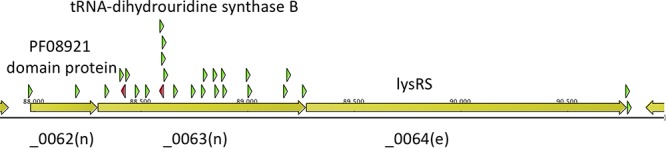
FIG 2 In some cases, read-through from Tn5-Puror is sufficient to drive a downstream essential gene. Results are shown for passage 6 following harvesting a pool of puromycin-resistant transformants. Green triangles represent insertions in the forward orientation, and red triangles indicate the reverse orientation.
FIG 2 In some cases, read-through from Tn5-Puror is sufficient to drive a downstream essential gene. Results are shown for passage 6 following harvesting a pool of puromycin-resistant transformants. Green triangles represent insertions in the forward orientation, and red triangles indicate the reverse orientation.CC BY · PubMed Central
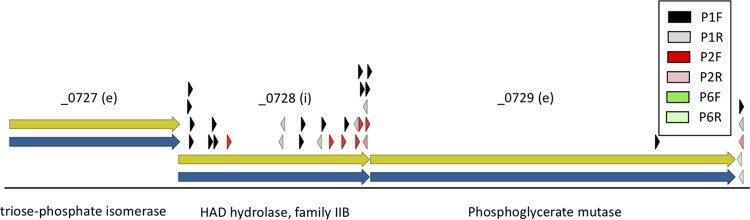
FIG 3 Gene _0728 appears quasi-essential (i), apparently due to a polar effect on expression of the downstream essential (e) gene _0729. The notation “(e)” indicates essential genes, and “(i)” indicates a quasi-essential gene. Arrowheads indicate the positions of Tn5-Puror insertions. In the color code shown, “P1” represents passage 1, “P2” indicates passage 2, and “P6” indicates passage 6. Right-pointing arrowheads indicate insertions in forward orientation, while left-pointing arrowheads indicate reverse orientation.
FIG 3 Gene _0728 appears quasi-essential (i), apparently due to a polar effect on expression of the downstream essential (e) gene _0729. The notation “(e)” indicates essential genes, and “(i)” indicates a quasi-essential gene. Arrowheads indicate the positions of Tn5-Puror insertions. In the color code shown, “P1” represents passage 1, “P2” indicates passage 2, and “P6” indicates passage 6. Right-pointing arrowheads indicate insertions in forward orientation, while left-pointing arrowheads indicate reverse orientation.CC BY · PubMed Central
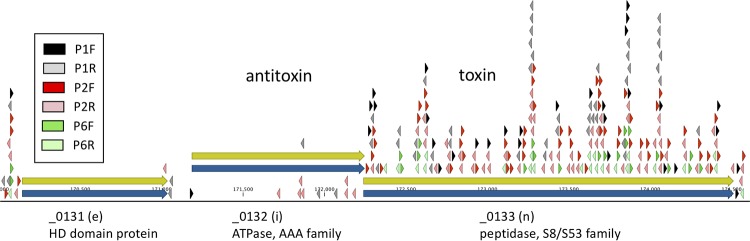
FIG 4 Gene _0132 shows an asymmetry in Tn5-Puror insertions that can be explained by a toxin-antitoxin system where _0133 is the toxin and _0132 is the antitoxin. The notation “(e)” indicates an essential gene, “(n)” indicates a nonessential gene, and “(i)” indicates a gene originally categorized as quasi-essential. Arrowheads indicate the positions of Tn5-Puror insertions. In the color code shown, “P1” represents passage 1, “P2” indicates passage 2, and “P6” indicates passage 6. Right-pointing arrowheads indicate insertions in forward orientation, while left-pointing arrows indicate reverse orientation.
FIG 4 Gene _0132 shows an asymmetry in Tn5-Puror insertions that can be explained by a toxin-antitoxin system where _0133 is the toxin and _0132 is the antitoxin. The notation “(e)” indicates an essential gene, “(n)” indicates a nonessential gene, and “(i)” indicates a gene originally categorized as quasi-essential. Arrowheads indicate the positions of Tn5-Puror insertions. In the color code shown, “P1” represents passage 1, “P2” indicates passage 2, and “P6” indicates passage 6. Right-pointing arrowheads indicate insertions in forward orientation, while left-pointing arrows indicate reverse orientation.CC BY · PubMed Central
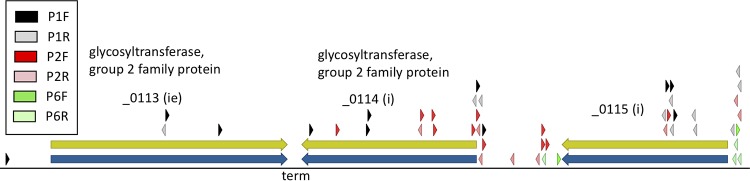
FIG 5 Gene _0114 shows an asymmetry in Tn5-Puror insertions that may result from the potential for a “train wreck” with the _0113 transcript. The notation “ie” indicates a gene on the borderline between essentiality and quasi-essentiality, and “i” indicates quasi-essential genes. Arrowheads indicate the positions of Tn5-Puror insertions. In the color code shown, “P1” represents passage 1, “P2” indicates passage 2, and “P6” indicates passage 6. Right-pointing arrowheads indicate insertions in forward orientation, while left-pointing arrowheads indicate reverse orientation. “term” indicates the location of a bidirectional stem-loop transcriptional terminator.
FIG 5 Gene _0114 shows an asymmetry in Tn5-Puror insertions that may result from the potential for a “train wreck” with the _0113 transcript. The notation “ie” indicates a gene on the borderline between essentiality and quasi-essentiality, and “i” indicates quasi-essential genes. Arrowheads indicate the positions of Tn5-Puror insertions. In the color code shown, “P1” represents passage 1, “P2” indicates passage 2, and “P6” indicates passage 6. Right-pointing arrowheads indicate insertions in forward orientation, while left-pointing arrowheads indicate reverse orientation. “term” indicates the location of a bidirectional stem-loop transcriptional terminator.CC BY · PubMed Central
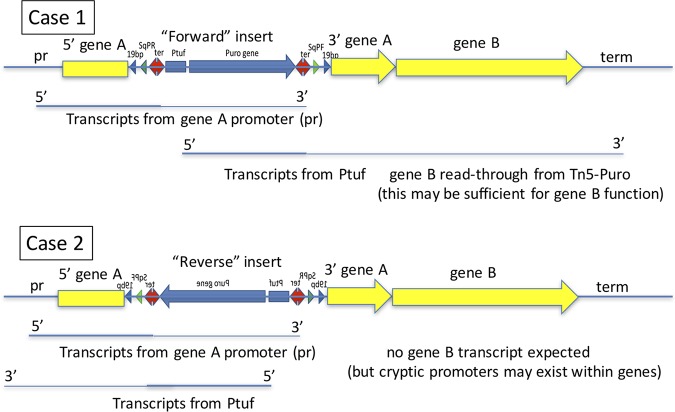
FIG 6 Consequences of “forward” and “reverse” insertion of Tn5-Puror. The Tn5-Puror sequence is shown inserted in gene A of hypothetical two-gene transcription unit AB in both orientations. Weights of lines represent relative transcript abundances, which change as a consequence of attenuation by ter.
FIG 6 Consequences of “forward” and “reverse” insertion of Tn5-Puror. The Tn5-Puror sequence is shown inserted in gene A of hypothetical two-gene transcription unit AB in both orientations. Weights of lines represent relative transcript abundances, which change as a consequence of attenuation by ter.CC BY · PubMed Central
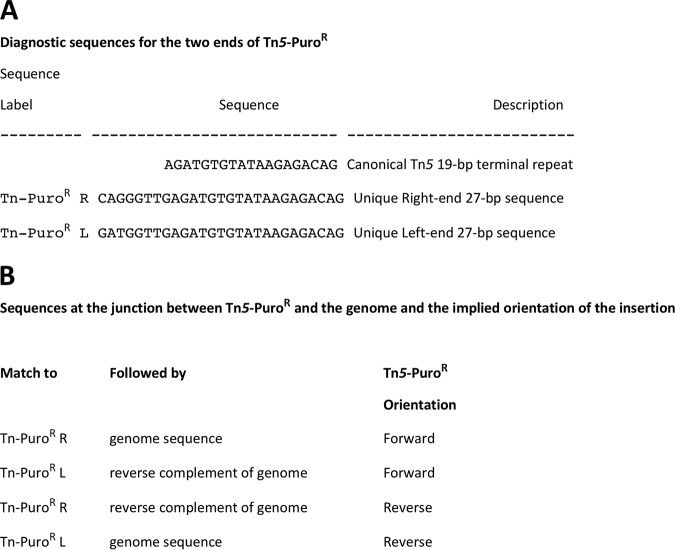
FIG 7 Unique 27-bp sequences at the ends of Tn5-Puror flank the junction with genomic sequence. The unique sequences from the right and left ends of Tn5-Puror are shown (see the supplemental material for reference 2 for the complete sequence). Sequences are all shown in the 5′ to 3′ orientation such that the Tn5-Puror L unique 27-bp sequence is the reverse complement of the Tn5-Puror sequence as conventionally written.
FIG 7 Unique 27-bp sequences at the ends of Tn5-Puror flank the junction with genomic sequence. The unique sequences from the right and left ends of Tn5-Puror are shown (see the supplemental material for reference 2 for the complete sequence). Sequences are all shown in the 5′ to 3′ orientation such that the Tn5-Puror L unique 27-bp sequence is the reverse complement of the Tn5-Puror sequence as conventionally written.CC BY · PubMed Central

Verification

Claims the paper makes

The claims and statistics of this paper haven’t been checked yet.

Run the check — free, no account needed. It reads the open-access text and checks the sources it cites.

A few free checks a day · papers already verified open instantly · results are public

Claims other papers make about this one

Each is checked against this paper’s own text: does it say what the citing paper says it does?

Self-check

Percentages, sums and reported differences re-computed from the paper’s own numbers.

The self-check needs the paper’s full text.

Citations

Cites

  • Design and synthesis of a minimal bacterial genome

    Hutchison, C. A., Chuang, R.-Y., Noskov, V. N., Assad-Garcia, N., Deerinck, T. J., Ellisman, M. H., Gill, J., Kannan, K., Karas, B. J., Ma, L., et al. (2016) · Science · doi:10.1126/science.aad6253 · Cited by 1,500 · cited 4×

    “Junctions between Tn5-Puror and the genome were amplified by an inverse PCR strategy and were subjected to deep sequencing (2).”
    BackgroundMethodInfluentialSelf-citation
  • Essential metabolism for a minimal cell

    Breuer, M., Earnest, E. E., Merryman, C., Wise, K. S., Sun, L., Lynott, M. R., Hutchison, C. A., Smith, H. O., Lapek, J. D., Gonzalez, D. J., et al. (2019) · eLife · doi:10.7554/elife.36842 · Cited by 190 · cited 2×

    “Gene _0132, genes _0132 and _0133, and gene _0728 were each knocked out from the syn3A genome (9) carried in yeast strain VL6-48N-Cas9 (a gift from Daniel G.”
    BackgroundSelf-citation

Show all 2 references

Research works printed but not linked: 11

  1. 10.1126/science.286.5447.2165 · DOI
  2. 10.1016/0092-8674(80)90305-0 · DOI
  3. 10.1038/nmeth.1377 · DOI
  4. 10.1128/AAC.00388-09 · DOI
  5. 10.1007/s00284-009-9455-2 · DOI
  6. 10.1016/0022-2836(92)90574-4 · DOI
  7. 10.1128/JB.00124-09 · DOI
  8. 10.1016/j.molcel.2018.01.003 · DOI
  9. 10.1371/journal.pcbi.1006946 · DOI
  10. 10.1126/science.1190719 · DOI · Paper page
  11. 10.1038/srep30714 · DOI

Cited by

Sorted by citations

Metadata

Authors
Hutchison, C. A., Merryman, C., Sun, L., Assad-Garcia, N., Richter, R. A., Smith, H. O., & Glass, J. I.
Affiliations
  • Synthetic Biology Group, J. Craig Venter Institute, La Jolla, California, USA
  • Synthetic Biology Group, J. Craig Venter Institute, Rockville, Maryland, USA
Venue
Journal of Bacteriology
Published
2019-10
Volume
201
Issue
19
ISSN
  • 0021-9193
  • 1098-5530
Cited by
47
References
2
Language
en
Funders
  • US National Science Foundation (MCB-1840320, MCB-1818344)
  • J. Craig Venter Institute

About these checks

Registry, retraction, Cites and statistics results are computed, not judged, with one exception: a printed reference that no index lists is read once by a model before it counts as a citation error. Claims are extracted by a model and kept only when their quote appears verbatim in the text; each cited source is then checked, with a model’s help, for whether it says what the claim relies on. Those verdicts can be wrong — read the claim’s quote and the cited source before relying on one.

Statistics and arithmetic are recomputed, not judged.

Confidence bands are shown only for fields calibrated on our annotated test set. None is calibrated yet, so no band is shown.

What counts as a claim ›How we measure confidence ›How we check this ›

Are you an author, or do you see a problem with this page? Request a review