

The DOI matches its Crossref record; 108 of the 108 references it cites were found in a registry or an index.
Multilaboratory Survey To Evaluate Salmonella Prevalence in Diarrheic and Nondiarrheic Dogs and Cats in the United States between 2012 and 2014
Open accessAbstract
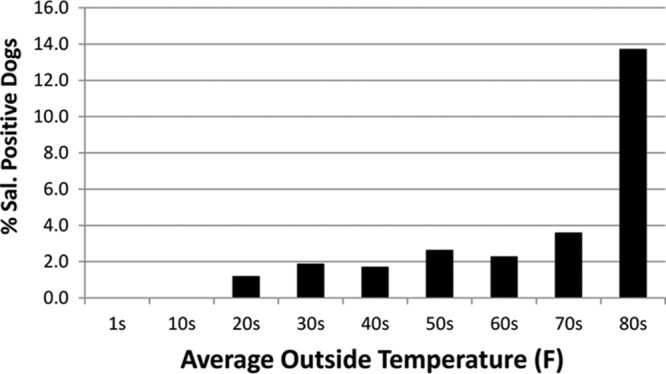
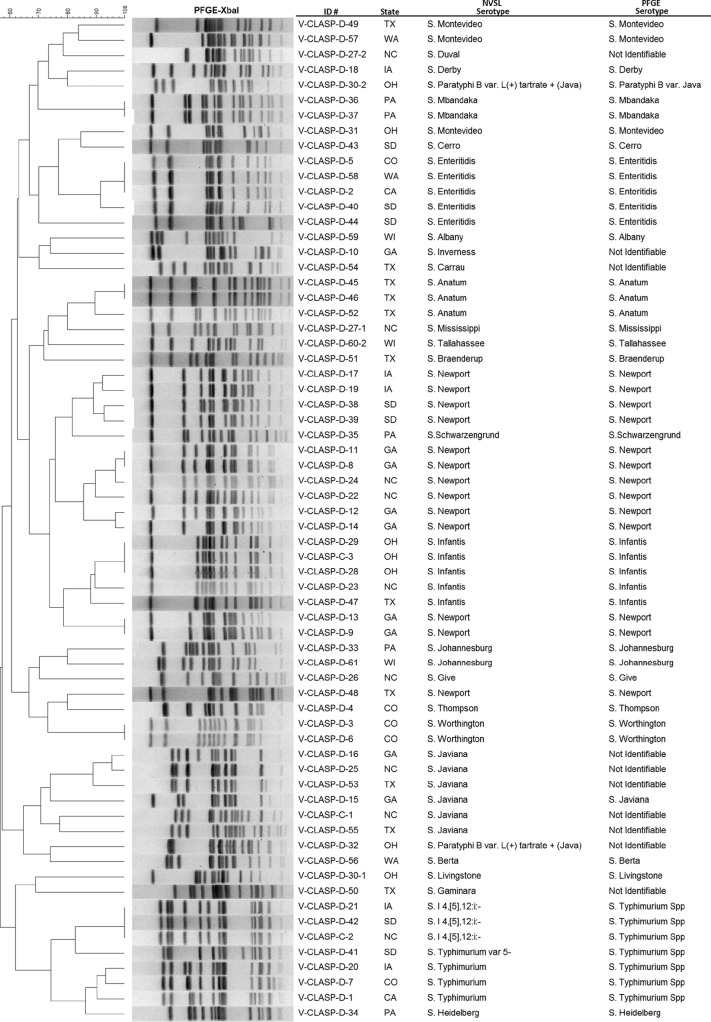
Eleven laboratories collaborated to determine the periodic prevalence of Salmonella in a population of dogs and cats in the United States visiting veterinary clinics. Fecal samples (2,965) solicited from 11 geographically dispersed veterinary testing laboratories were collected in 36 states between January 2012 and April 2014 and tested using a harmonized method. The overall study prevalence of Salmonella in cats (3 of 542) was <1%. The prevalence in dogs (60 of 2,422) was 2.5%. Diarrhea was present in only 55% of positive dogs; however, 3.8% of the all diarrheic dogs were positive, compared with 1.8% of the nondiarrheic dogs.Salmonella-positive dogs were significantly more likely to have consumed raw food (P= 0.01), to have consumed probiotics (P= 0.002), or to have been given antibiotics (P= 0.01). Rural dogs were also more likely to be Salmonella positive than urban (P= 0.002) or suburban (P= 0.001) dogs. In the 67 isolates, 27 unique serovars were identified, with three dogs having two serovars present. Antimicrobial susceptibility testing of 66 isolates revealed that only four of the isolates were resistant to one or more antibiotics. Additional characterization of the 66 isolates was done using pulsed-field gel electrophoresis and whole-genome sequencing (WGS). Sequence data compared well to resistance phenotypic data and were submitted to the National Center for Biotechnology Information (NCBI). This study suggests an overall decline in prevalence of Salmonella-positive dogs and cats over the last decades and identifies consumption of raw food as a major risk factor for Salmonella infection. Of note is that almost half of the Salmonella-positive animals were clinically nondiarrheic.
Overview
The claims and statistics of this paper haven’t been checked yet.
Run the check — free, no account needed. It reads the open-access text and checks the sources it cites.
Integrity signals
Registry
Cites
Statistics
Figures
Verification
Claims the paper makes
The claims and statistics of this paper haven’t been checked yet.
Run the check — free, no account needed. It reads the open-access text and checks the sources it cites.
Claims other papers make about this one
Each is checked against this paper’s own text: does it say what the citing paper says it does?
The source backs part of the claim, not all of it — or backs it for a different population, condition or comparison.
In the citing paper
“Diarrhoea does not appear to be a typical feature of Salmonella‐shedding dogs (Brisdon et al. 2006, Finley et al. 2007, Reimschuessel et al. 2017), although clinical salmonellosis has been reported in association with raw feeding (Morley et al. 2006).”
From Raw diets for dogs and cats: a review, with particular reference to microbiological hazards. (2019) · cites this paper as Reimschuessel et al. 2017
Experimental — accuracy not yet measuredThe cited source says what the claim attributes to it.
In the citing paper
“Indeed, studies in dogs have identified raw feeding as a major risk factor for Salmonella shedding (Leonard et al. 2011, Reimschuessel et al. 2017).”
From Raw diets for dogs and cats: a review, with particular reference to microbiological hazards. (2019) · cites this paper as Reimschuessel et al. 2017
The cited source says what the claim attributes to it.
In the citing paper
“Furthermore, such human‐associated serovars have commonly been isolated from the faeces of dogs (Reimschuessel et al. 2017), including raw‐fed dogs (Lefebvre et al. 2008, Lenz et al. 2009, Leonard et al. 2011).”
From Raw diets for dogs and cats: a review, with particular reference to microbiological hazards. (2019) · cites this paper as Reimschuessel et al. 2017
The cited source says what the claim attributes to it.
In the citing paper
“dogs and cats can shed Salmonella without exhibiting any clinical signs of disease.97,102,103”
From 2021 AAHA Nutrition and Weight Management Guidelines for Dogs and Cats (2021) · cites this paper as [102]
Self-check
Percentages, sums and reported differences re-computed from the paper’s own numbers.
The self-check needs the paper’s full text.
Citations
Cites
International Organization for Standardization
(2011) · Springer eBooks · doi:10.1007/springerreference_16847 · Cited by 12,504
Database resources of the National Center for Biotechnology Information: update
Wheeler, D. L. (2003) · Nucleic Acids Research · doi:10.1093/nar/gkh073 · Cited by 10,695
International Organization for Standardization
Gargaud, M., Irvine, W. M., Amils, R., Pinti, D. L., Cernicharo, J., Rouan, D., Spohn, T., Tirard, S., & Viso, M. (2015) · Encyclopedia of Astrobiology · doi:10.1007/978-3-662-44185-5_100574 · Cited by 6,716
Summary of product characteristics
(2013) · Pharmaceutical Medicine · doi:10.1093/med/9780199609147.003.0027 · Cited by 1,918
Database resources of the National Center for Biotechnology Information
Coordinators, N. R. (2015) · Nucleic Acids Research · doi:10.1093/nar/gkv1290 · Cited by 1,506
Database Resources of the National Center for Biotechnology Information
Coordinators, N. R. (2017) · Nucleic Acids Research · doi:10.1093/nar/gkw1071 · Cited by 817
Salmonella Serotype Determination Utilizing High-Throughput Genome Sequencing Data
Zhang, S., Yin, Y., Jones, M. B., Zhang, Z., Kaiser, B. L. D., Dinsmore, B. A., Fitzgerald, C., Fields, P. I., & Deng, X. (2015) · Journal of Clinical Microbiology · doi:10.1128/jcm.00323-15 · Cited by 432
Self-citationKovats, S. R., Edwards, S., Hajat, S., Armstrong, B., Ebi, K. L., & Menne, B. (2004) · Epidemiology and Infection · doi:10.1017/s0950268804001992 · Cited by 382
Whole-Genome Sequencing for Detecting Antimicrobial Resistance in Nontyphoidal Salmonella
McDermott, P. F., Tyson, G. H., Kabera, C., Chen, Y., Li, C., Folster, J. P., Ayers, S. L., Lam, C., Tate, H. P., & Zhao, S. (2016) · Antimicrobial Agents and Chemotherapy · doi:10.1128/aac.01030-16 · Cited by 379
Salmonella infections: An update on epidemiology, management, and prevention
Sánchez-Vargas, F. M., Abu‐El‐Haija, M. A., & Gomez-Duarte, O. G. (2011) · Travel Medicine and Infectious Disease · doi:10.1016/j.tmaid.2011.11.001 · Cited by 271
Research works printed but not linked: 8
- Osman FB Bahri LEL . 1970. Contribution a l'etude du reservoir animal de Salmonella. I. Enquete chez les chiens de differentes regions de Tunisie. Arch Inst Pasteur (Tunis)47:9.
- Sakazaki R Nakaya R . 1964. Epidemiological and ecological studies on salmonellae in Japan. End Dis Bull Nagasaki Univ6:9.
- Mayer H Kolb A Gehring H . 1976. Epidemiologische Untersuchungen bei einer Salmonellenzootie bei Diensthunden der Polizei. Prakt Tierarzt57:289–295.
- Clinical and Laboratory Standards Institute. 2013. Performance standards for antimicrobial disk and dilution susceptibility tests for bacteria isolated from animals; approved standard–4th ed. Document VET01-A4 (replaces M31-A3). CLSI, Wayne, PA.
- Clinical and Laboratory Standards Institute. 2012. Performance standards for antimicrobial susceptibility testing; 22nd informational supplement. Document M100-S22. CLSI, Wayne, PA.
- Clinical and Laboratory Standards Institute. 2008. Performance standards for antimicrobial disk and dilution susceptibility tests for bacteria isolated from animals; approved standard—3rd ed. Document M31-A3, p 116. CLSI, Wayne, PA.
- Clinical and Laboratory Standards Institute. 2013. Performance standards for antimicrobial disk and dilution susceptibility tests for bacteria isolated from animals; 2nd informational supplement. Document VET01-S2E. CLSI, Wayne, PA.
- Clinical and Laboratory Standards Institute. 2014. Performance standards for antimicrobial susceptibility testing; 24th informational supplement. Document M100-S24. CLSI, Wayne, PA.
Cited by
Sorted by citations
Moon, C. D., Young, W., Maclean, P. H., Cookson, A. L., & Bermingham, E. N. (2018) · MicrobiologyOpen · doi:10.1002/mbo3.677 · Cited by 302
Raw diets for dogs and cats: a review, with particular reference to microbiological hazards.
Davies, R. H., Lawes, J. R., & Wales, A. D. (2019) · Journal of Small Animal Practice · doi:10.1111/jsap.13000 · Cited by 195
“Furthermore, such human-associated serovars have commonly been isolated from the faeces of dogs (Reimschuessel et al. 2017), including raw-fed dogs (Lefebvre et al.”
Background2021 AAHA Nutrition and Weight Management Guidelines for Dogs and Cats
Cline, M. G., Burns, K. M., Coe, J. B., Downing, R., Durzi, T., Murphy, M., & Parker, V. (2021) · Journal of the American Animal Hospital Association · doi:10.5326/jaaha-ms-7232 · Cited by 107
Simpson, K. M. J., Hill-Cawthorne, G. A., Ward, M. P., & Mor, S. M. (2018) · BMC Infectious Diseases · doi:10.1186/s12879-018-3563-1 · Cited by 72
Zoonotic potential and prevalence of Salmonella serovars isolated from pets
Dróżdż, M., Małaszczuk, M., Paluch, E., & Pawlak, A. (2021) · Infection Ecology & Epidemiology · doi:10.1080/20008686.2021.1975530 · Cited by 89
Metadata
- Authors
- Reimschuessel, R., Grabenstein, M., Guag, J., Nemser, S. M., Song, K., Qiu, J., Clothier, K. A., Byrne, B. A., Marks, S. L., Cadmus, K., Pabilonia, K., Sanchez, S., Rajeev, S., Ensley, S., Frana, T. S., Jergens, A. E., Chappell, K. H., Thakur, S., Byrum, B., Cui, J., Zhang, Y., Erdman, M. M., Rankin, S. C., Daly, R., Das, S., Ruesch, L., Lawhon, S. D., Zhang, S., Baszler, T., Diaz-Campos, D., Hartmann, F., & Okwumabua, O.
- Affiliations
- Center for Veterinary Medicine (US)
- United States Food and Drug Administration (US)
- University of California, Davis (US)
- Colorado State University (US)
- College of Veterinary Medicine, Department of Infectious Disease, Athens Veterinary Diagnostic Laboratory, The University of Georgia, Athens, Georgia, USA
- University of Georgia (US)
- Iowa State University (US)
- North Carolina State University (US)
- Ohio Department of Agriculture (US)
- United States Department of Agriculture (US)
- University of Pennsylvania (US)
- South Dakota State University (US)
- Texas A&M University (US)
- Washington State University (US)
- University of Wisconsin–Madison (US)
- Corresponding author
- Reimschuessel, Renate
- ORCID
- Reimschuessel, Renate
- Guag, Jake
- Nemser, Sarah M.
- Qiu, Junshan
- Clothier, Kristin A.
- Byrne, Barbara A.
- Marks, Stanley L.
- Cadmus, Kyran
- Pabilonia, Kristy
- Rajeev, Sreekumari
- Jergens, Albert E.
- Thakur, Siddhartha
- Cui, Jing
- Zhang, Yan
- Rankin, Shelley C.
- Daly, Russell
- Das, Seema
- Ruesch, Laura
- Lawhon, Sara D.
- Zhang, Shuping
- Baszler, Timothy
- Diaz-Campos, Dubraska
- Hartmann, Faye
- Okwumabua, Ogi
- Venue
- Journal of Clinical Microbiology
- Publisher
- American Society for Microbiology
- Published
- 2017-05
- Volume
- 55
- Issue
- 5
- Pages
- 1350-1368
- ISSN
- 0095-1137 (ISSN-L)
- 1098-660X
- PMC
- PMC5405253
- OpenAlex
- W2589107924
- Cited by
- 105
- References
- 107
- Citations by year
- 2026: 4 · 2025: 13 · 2024: 12 · 2023: 11 · 2022: 11 · 2021: 22 · 2020: 19 · 2019: 3 · 2018: 7 · 2017: 3
- FWCI
- 9.85
- Type
- journal article
- Language
- en
- Open access
- hybrid
- doi.org
- Licence
- Locations
- Journal of Clinical Microbiology (publishedVersion, cc-by)
- PubMed Central (publishedVersion, cc-by)
- PubMed (publishedVersion)
- eScholarship (California Digital Library) (submittedVersion)
- eScholarship (California Digital Library) (submittedVersion, cc-by)
- OakTrust (Texas A&M University Libraries) (submittedVersion)
- Funders
- HHS | U.S. Food and Drug Administration
- Topics
- Life Sciences › Agricultural and Biological Sciences › Food Science › Salmonella and Campylobacter epidemiology
- Life Sciences › Agricultural and Biological Sciences › Food Science › Listeria monocytogenes in Food Safety
- Health Sciences › Medicine › Microbiology (medical) › Bacterial Identification and Susceptibility Testing
- Keywords
- Salmonella, dogs, cats, prevalence, diarrhea, raw food diet, probiotics, antibiotic use, serotypes, antimicrobial resistance, whole genome sequencing, pulsed-field gel electrophoresis, risk factors, urban-rural differences
- MeSH terms
- Animals, Animal Feed, Anti-Bacterial Agents, Cats, Cross-Sectional Studies, Dogs, Feces, Female, Foodborne Diseases, Male, Microbial Sensitivity Tests, Salmonella, Salmonella Infections, Animal, United States
About these checks
Registry, retraction, Cites and statistics results are computed, not judged, with one exception: a printed reference that no index lists is read once by a model before it counts as a citation error. Claims are extracted by a model and kept only when their quote appears verbatim in the text; each cited source is then checked, with a model’s help, for whether it says what the claim relies on. Those verdicts can be wrong — read the claim’s quote and the cited source before relying on one.
Statistics and arithmetic are recomputed, not judged.
Confidence bands are shown only for fields calibrated on our annotated test set. None is calibrated yet, so no band is shown.
What counts as a claim ›How we measure confidence ›How we check this ›
Are you an author, or do you see a problem with this page? Request a review
