

The DOI matches its Crossref record; 4 of the 4 references it cites were found in a registry or an index.
“Meet the Expert Interviews,” an Integrative Learning Experience for Microbiology and Anatomy & Physiology Undergraduate Students
Open accessAbstract
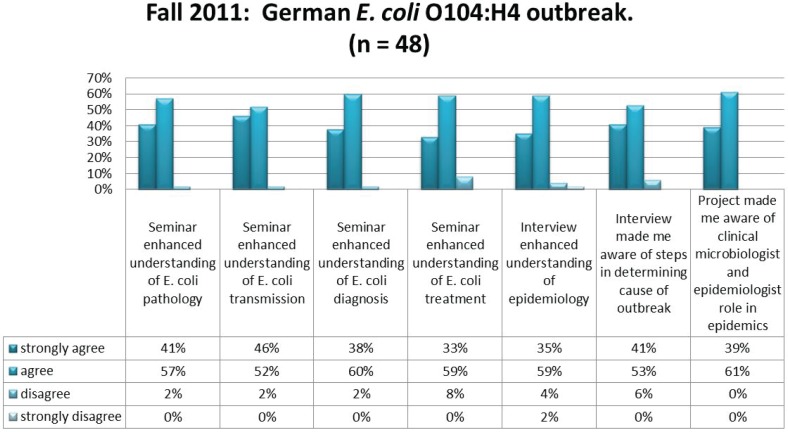
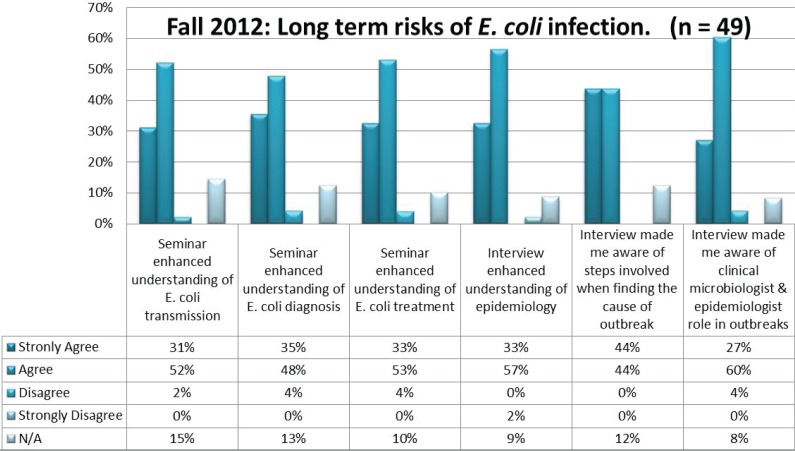
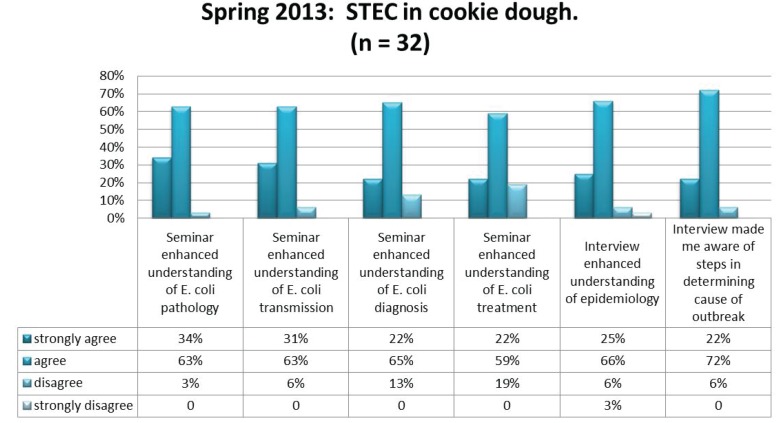
An important goal of higher education is to encourage students to integrate learning and apply skills to different situations. In the “Meet the Expert Interviews” students interviewed authors of research papers on Shiga Toxin Producing E. coli (STEC) outbreaks. Students attended seminars, analyzed STEC publications, created questions, and interviewed authors. We hypothesized that the project would enhance student understanding of STEC and encourage students to integrate and apply information to real world problems. The project was assessed by student surveys. The majority of 129 students surveyed agreed or strongly agreed that the seminar enhanced their understanding of E.coli transmission, diagnosis, and treatment; that the interview enhanced their understanding of epidemiology; and made them more aware of the steps involved in determining the cause of the outbreak. The project was engaging for students and faculty and provided a unique way for professional outreach to biology students. The project is an innovative example of an integrative method to enhance student learning and interaction with microbiology and epidemiology professionals.
Overview
The claims and statistics of this paper haven’t been checked yet.
Run the check — free, no account needed. It reads the open-access text and checks the sources it cites.
Integrity signals
Registry
Cites
Statistics
Figures
Verification
Claims the paper makes
The claims and statistics of this paper haven’t been checked yet.
Run the check — free, no account needed. It reads the open-access text and checks the sources it cites.
Claims other papers make about this one
Each is checked against this paper’s own text: does it say what the citing paper says it does?
The source backs part of the claim, not all of it — or backs it for a different population, condition or comparison.
In the citing paper
“Biology education often emphasizes coursework and labs, but real-world interactions build empathy and deepen student understanding of research subjects (1–4).”
From Using generative AI for interview simulations to enhance student research skills in biology education (2025) · cites this paper as [4]
Experimental — accuracy not yet measured
Self-check
Percentages, sums and reported differences re-computed from the paper’s own numbers.
The self-check needs the paper’s full text.
Citations
Cites
Epidemic Profile of Shiga-Toxin–Producing Escherichia coli O104:H4 Outbreak in Germany
Frank, C., Werber, D., Cramer, J. P., Askar, M., Faber, M., an der Heiden, M., Bernard, H., Fruth, A., Prager, R., Spode, A., et al. (2011) · New England Journal of Medicine · doi:10.1056/nejmoa1106483 · Cited by 1,139
Neil, K. P., Biggerstaff, G., MacDonald, J. K., Trees, E., Medus, C., Musser, K. A., Stroika, S. G., Zink, D. L., & Sotir, M. J. (2011) · Clinical Infectious Diseases · doi:10.1093/cid/cir831 · Cited by 154
Clark, W. F., Sontrop, J. M., Macnab, J. J., Salvadori, M. I., MOIST, L. M., Suri, R. S., & Garg, A. X. (2010) · BMJ · doi:10.1136/bmj.c6020 · Cited by 77
Davis, B. D., Flannery, M. E., & Payne, J. S. (2012) · Journal of Microbiology and Biology Education · doi:10.1128/jmbe.v13i1.385 · Cited by 3
Self-citation
Cited by
Sorted by citations
Millen, J. I. (2025) · Journal of Microbiology & Biology Education · doi:10.1128/jmbe.00122-25 · Cited by 8
“B iology education often emphasizes coursework and labs, but real-world interac tions build empathy and deepen student understanding of research subjects (1–4).”
Science Sound Bites, a Podcast for STEM Curriculum Supplementation
Johnson, M. D. L., & Ayers, K. A. (2016) · Journal of Microbiology and Biology Education · doi:10.1128/jmbe.v17i2.1058 · Cited by 6
Metadata
- Authors
- Davis, B. D., Flannery, M., Lowe, M., & Payne, J. S.
- Affiliations
- Bergen Community College (US)
- Corresponding author
- Davis, Barbara D.
- Venue
- Journal of Microbiology & Biology Education
- Publisher
- American Society for Microbiology
- Published
- 2014-05
- Volume
- 15
- Issue
- 1
- Pages
- 33-35
- ISSN
- 1935-7877 (ISSN-L)
- 1935-7885
- PMC
- PMC4004739
- OpenAlex
- W2084537831
- Cited by
- 2
- References
- 4
- Citations by year
- 2025: 1 · 2016: 1
- FWCI
- 1.71
- Type
- journal article
- Language
- en
- Open access
- gold
- doi.org
- Locations
- Journal of Microbiology and Biology Education (publishedVersion)
- Europe PMC (PubMed Central) (publishedVersion, other-oa)
- PubMed Central (publishedVersion, cc-by-nc-sa)
- PubMed (publishedVersion)
- DOAJ (DOAJ: Directory of Open Access Journals) (submittedVersion, cc-by-sa)
- DOAJ (DOAJ: Directory of Open Access Journals) (submittedVersion)
- Topics
- Social Sciences › Education › Problem and Project Based Learning
- Social Sciences › Education › Innovative Teaching Methods
- Social Sciences › Education › Science Education and Pedagogy
- Keywords
- Shiga toxin-producing Escherichia coli, expert interviews, integrative learning, microbiology education, anatomy and physiology education, epidemiology education, professional outreach, outbreak investigation, student engagement
About these checks
Registry, retraction, Cites and statistics results are computed, not judged, with one exception: a printed reference that no index lists is read once by a model before it counts as a citation error. Claims are extracted by a model and kept only when their quote appears verbatim in the text; each cited source is then checked, with a model’s help, for whether it says what the claim relies on. Those verdicts can be wrong — read the claim’s quote and the cited source before relying on one.
Statistics and arithmetic are recomputed, not judged.
Confidence bands are shown only for fields calibrated on our annotated test set. None is calibrated yet, so no band is shown.
What counts as a claim ›How we measure confidence ›How we check this ›
Are you an author, or do you see a problem with this page? Request a review
