

The DOI matches its Crossref record; 4 of the 4 references it cites were found in a registry or an index.
High osmolarity modulates bacterial cell size through reducing initiation volume in Escherichia coli.
Open accessAbstract
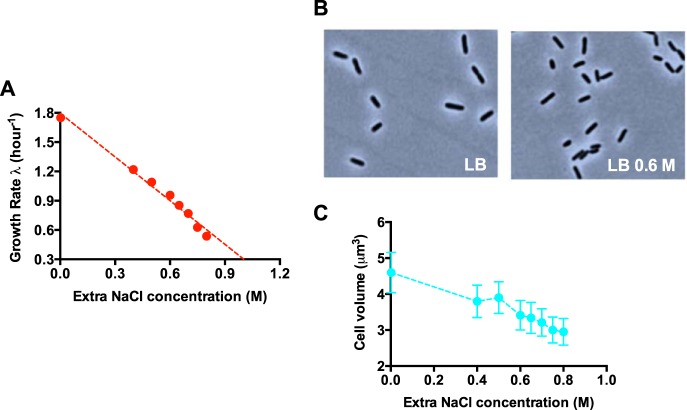
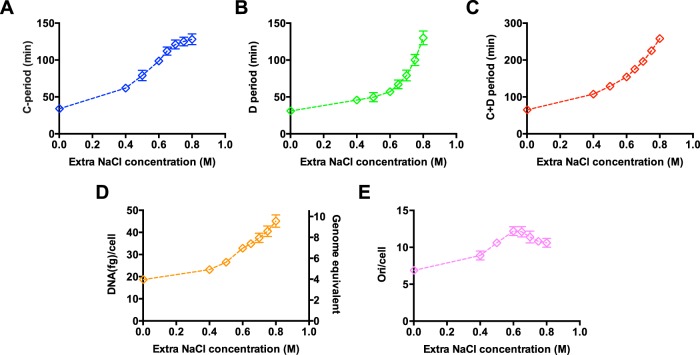
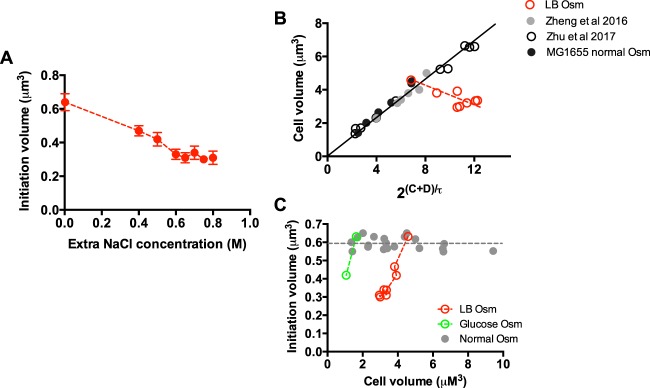
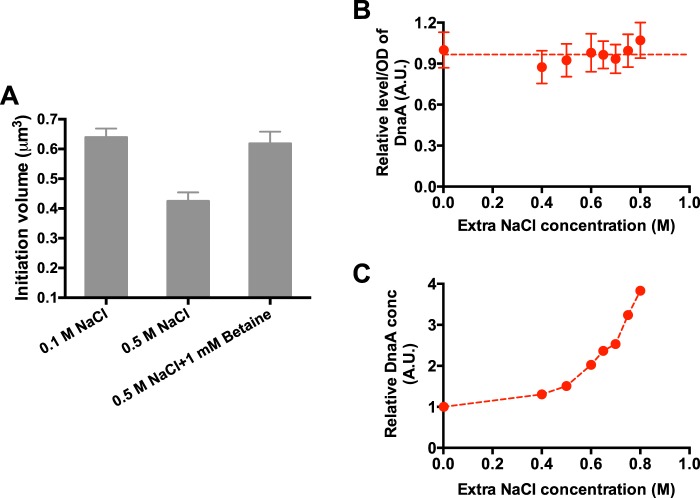
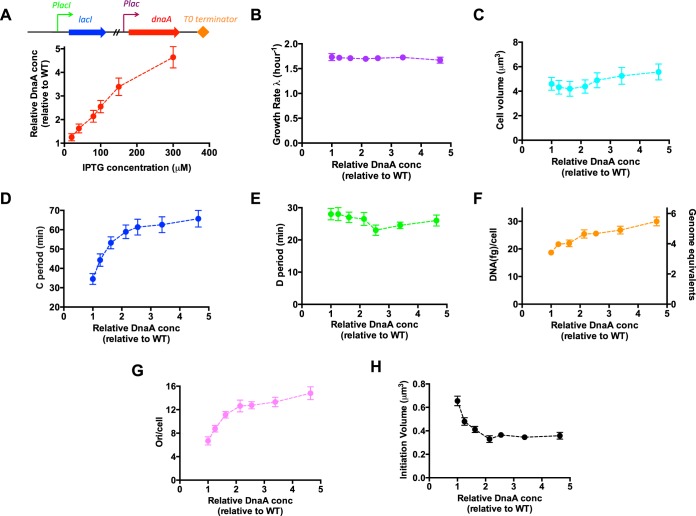
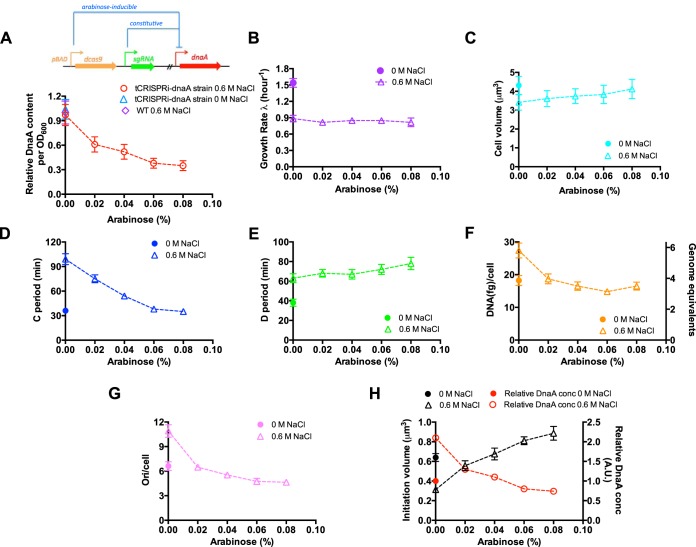
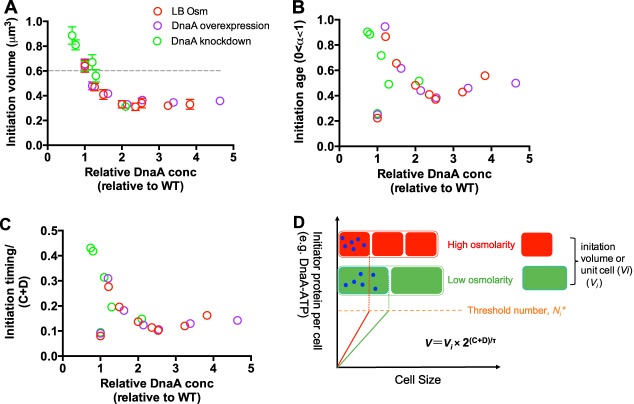
Bacterial cell size depends on growth rate, cell cycle progression, and the cell volume per origin upon initiating chromosome replication (initiation volume). Here, we perform the first systematic and quantitative study of the effect of hyperosmotic stress on the E. coli cell size and cell cycle. We find that hyperosmotic stress significantly reduces the initiation volume. The reduced initiation volume is attributed to the increased DnaA concentration caused by water loss at high osmolarity, indicating a fundamental role of water content in cell size and cell cycle regulation.
Overview
The claims and statistics of this paper haven’t been checked yet.
Run the check — free, no account needed. It reads the open-access text and checks the sources it cites.
Integrity signals
Registry
Cites
Statistics
Figures
Verification
Claims the paper makes
The claims and statistics of this paper haven’t been checked yet.
Run the check — free, no account needed. It reads the open-access text and checks the sources it cites.
Claims other papers make about this one
Each is checked against this paper’s own text: does it say what the citing paper says it does?
The source backs part of the claim, not all of it — or backs it for a different population, condition or comparison.
In the citing paper
“However, in order to maintain a physiologically adequate osmoprotective glycine betaine pool (and for that matter of other compatible solutes as well), the uptake rates for glycine betaine and its biosynthetic precursor choline must be adjusted to both the level of the imposed osmotic stress (Hoffmann et al., 2013) but concomitantly also to the dynamic increase in cell volume prior to division of”
From Two MarR-Type Repressors Balance Precursor Uptake and Glycine Betaine Synthesis in Bacillus subtilis to Provide Cytoprotection Against Sustained Osmotic Stress (2020) · cites this paper as Dai and Zhu, 2018
Experimental — accuracy not yet measured
Self-check
Percentages, sums and reported differences re-computed from the paper’s own numbers.
The self-check needs the paper’s full text.
Citations
Cites
Salt-responsive gut commensal modulates TH17 axis and disease
Wilck, N., Matus, M. G., Kearney, S. M., Olesen, S. W., Forslund, K., Bartolomaeus, H., Haase, S., Mähler, A., Balogh, A., Markó, L., et al. (2017) · Nature · doi:10.1038/nature24628 · Cited by 1,310
Quantitative proteomic analysis reveals a simple strategy of global resource allocation in bacteria
Hui, S., Silverman, J. M., Chen, S. S., Erickson, D. W., Basan, M., Wang, J., Hwa, T., & Williamson, J. R. (2015) · Molecular Systems Biology · doi:10.15252/msb.20145697 · Cited by 369
Responses of E. coli to osmotic stress: large changes in amounts of cytoplasmic solutes and water
Record Jr, M. T., Courtenay, E. S., Cayley, D. S., & Guttman, H. J. (1998) · Trends in Biochemical Sciences · doi:10.1016/s0968-0004(98)01196-7 · Cited by 357
The Synchronization of Replication and Division Cycles in Individual E. coli Cells
Wallden, M., Fange, D., Lundius, E. G., Baltekin, Ö., & Elf, J. (2016) · Cell · doi:10.1016/j.cell.2016.06.052 · Cited by 331
Research works printed but not linked: 39
- 10.1016/j.cub.2012.02.032 · DOI
- 10.1016/j.cub.2014.12.009 · DOI
- 10.1016/j.mib.2015.01.011 · DOI
- 10.1146/annurev-micro-090816-093803 · DOI
- 10.1016/j.cub.2017.05.076 · DOI
- 10.1128/ecosal.5.2.3 · DOI · Paper page
- 10.1038/nrmicro2202 · DOI
- 10.1038/2191077a0 · DOI
- 10.1016/j.cub.2017.03.022 · DOI
- 10.1073/pnas.1617932114 · DOI
- 10.15252/msb.20156178 · DOI
- 10.1128/mBio.01741-17 · DOI
- 10.1038/nchembio.1437 · DOI
- Durack DT. 1987. Detection, prevention and management of urinary tract infections. Lea and Febiger, Philadelphia, PA.
- 10.1038/nrmicro3432 · DOI
- Ross DL, Neely AE. 1983. Textbook of urinalysis and body fluids. Appleton & Lange, New York, NY.
- 10.1021/bi0347297 · DOI
- 10.1128/mr.53.1.121-147.1989 · DOI · Paper page
- 10.1128/MMBR.63.1.230-262.1999 · DOI
- 10.1128/mBio.02375-17 · DOI
- 10.1074/jbc.M103081200 · DOI
- 10.1016/0092-8674(89)90802-7 · DOI
- 10.1128/jb.175.20.6537-6545.1993 · DOI
- 10.3389/fmicb.2018.00319 · DOI
- 10.1038/srep39076 · DOI
- 10.1016/0022-2836(68)90425-7 · DOI
- 10.1099/00221287-19-3-592 · DOI · Paper page
- Nanninga N, Woldringh C. 1985. Cell growth, genome duplication and cell division in Escherichia coli. Academic Press, Inc., London, United Kingdom.
- 10.1016/S1369-5274(03)00026-2 · DOI
- 10.1088/1361-6633/aaa628 · DOI
- 10.1128/jb.173.16.5194-5199.1991 · DOI
- 10.1038/newbio241133a0 · DOI
- 10.1016/0923-2508(91)90025-6 · DOI
- 10.1111/j.1365-2958.2006.05493.x · DOI
- 10.1038/nmicrobiol.2016.231 · DOI
- 10.1128/mSphere.00095-18 · DOI
- 10.1371/journal.pgen.1002549 · DOI
- 10.1128/jb.130.3.1206-1213.1977 · DOI
- 10.1128/JB.180.2.265-273.1998 · DOI
Cited by
Warmbold, B., Ronzheimer, S., Freibert, S.-A., Seubert, A., Hoffmann, T., & Bremer, E. (2020) · Frontiers in Microbiology · doi:10.3389/fmicb.2020.01700 · Cited by 17
“…betaine and its biosynthetic precursor choline must be adjusted to both the level of the imposed osmotic stress (Hoffmann et al., 2013) but concomitantly also to the dynamic increase in cell volume prior to division of the B. subtilis cell (Dai and Zhu, 2018; Reyes-Lamothe and Sherratt, 2019).”
BackgroundIntegrative characterization of the near‐minimal bacterium Mesoplasma florum
Matteau, D., Lachance, J., Grenier, F., Gauthier, S., Daubenspeck, J. M., Dybvig, K., Garneau, D., Knight, T. F., Jacques, P., & Rodrigue, S. (2020) · Molecular Systems Biology · doi:10.15252/msb.20209844 · Cited by 16
“According to our analysis, M. flo-rum is expected to have a volume between 0.082 and 0.097 µ m 3 during the exponential phase, which is nearly 50 times smaller than E. coli growing in similar conditions ( ~ 4 µ m 3 ) (Volkmer & Heine-mann, 2011; Dai & Zhu, 2018).”
Influential
Metadata
- Authors
- Dai, X., & Zhu, M.
- Affiliations
- Central China Normal University (CN)
- Corresponding author
- Dai, Xiongfeng
- Zhu, Manlu
- Venue
- mSphere
- Publisher
- American Society for Microbiology
- Published
- 2018-10-31
- Volume
- 3
- Issue
- 5
- ISSN
- 2379-5042 (ISSN-L)
- PMC
- PMC6200984
- OpenAlex
- W2897980578
- Cited by
- 29
- References
- 4
- Citations by year
- 2026: 5 · 2025: 4 · 2024: 3 · 2023: 3 · 2022: 2 · 2021: 3 · 2020: 6 · 2019: 3
- FWCI
- 1.84
- Type
- journal article
- Language
- en
- Open access
- gold
- doi.org
- Licence
- Locations
- mSphere (publishedVersion, cc-by)
- Europe PMC (PubMed Central) (publishedVersion, cc-by)
- PubMed Central (publishedVersion, cc-by)
- PubMed (publishedVersion)
- DOAJ (DOAJ: Directory of Open Access Journals) (submittedVersion, cc-by-sa)
- Funders
- National Natural Science Foundation of China (31700039, 31700089, 31870028)
- Topics
- Life Sciences › Biochemistry, Genetics and Molecular Biology › Genetics › Bacterial Genetics and Biotechnology
- Life Sciences › Biochemistry, Genetics and Molecular Biology › Molecular Biology › Gene Regulatory Network Analysis
- Life Sciences › Immunology and Microbiology › Microbiology › Escherichia coli research studies
- Keywords
- hyperosmotic stress, bacterial cell size, Escherichia coli, chromosome replication initiation, cell cycle regulation, water loss, osmolarity
- MeSH terms
- Bacterial Proteins, Cell Cycle, Cell Division, DNA-Binding Proteins, Escherichia coli, Osmolar Concentration
About these checks
Registry, retraction, Cites and statistics results are computed, not judged, with one exception: a printed reference that no index lists is read once by a model before it counts as a citation error. Claims are extracted by a model and kept only when their quote appears verbatim in the text; each cited source is then checked, with a model’s help, for whether it says what the claim relies on. Those verdicts can be wrong — read the claim’s quote and the cited source before relying on one.
Statistics and arithmetic are recomputed, not judged.
Confidence bands are shown only for fields calibrated on our annotated test set. None is calibrated yet, so no band is shown.
What counts as a claim ›How we measure confidence ›How we check this ›
Are you an author, or do you see a problem with this page? Request a review
