

The DOI matches its Crossref record; 50 of the 50 references it cites were found in a registry or an index.
Endothelial-to-mesenchymal transition contributes to endothelial dysfunction and dermal fibrosis in systemic sclerosis
Open accessAbstract
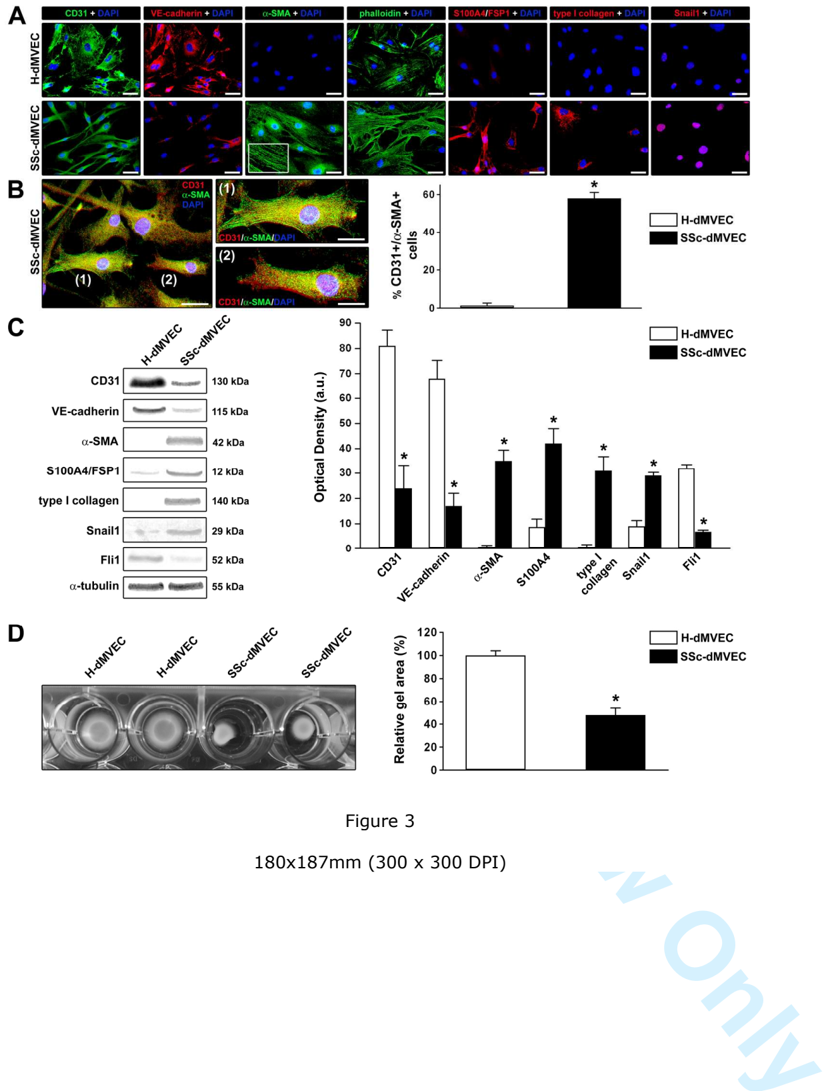
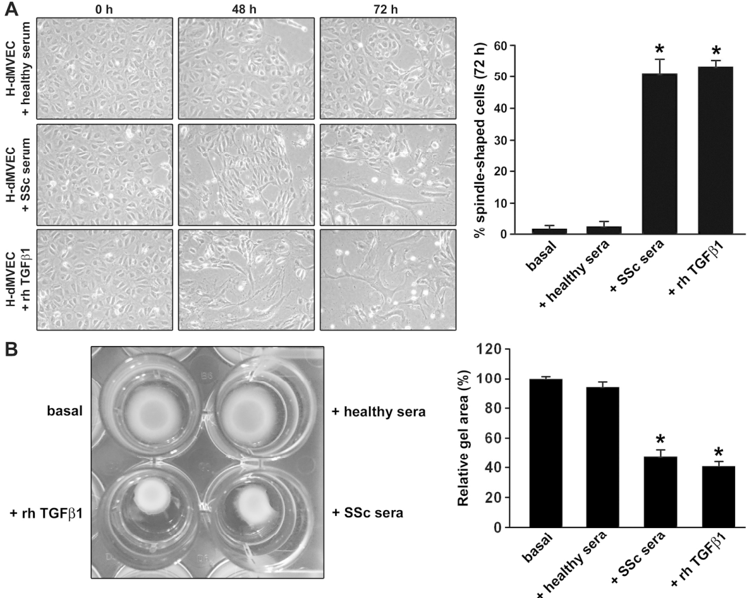
Objective Systemic sclerosis (SSc) features multiorgan fibrosis orchestrated predominantly by activated myofibroblasts. Endothelial-to-mesenchymal transition (EndoMT) is a transdifferentiation by which endothelial cells (ECs) lose their specific morphology/markers and acquire myofibroblast-like features. Here, we determined the possible contribution of EndoMT to the pathogenesis of dermal fibrosis in SSc and two mouse models. Methods Skin sections were immunostained for endothelial CD31 or vascular endothelial (VE)-cadherin in combination with α-smooth muscle actin (α-SMA) myofibroblast marker. Dermal microvascular ECs (dMVECs) were prepared from SSc and healthy skin (SSc-dMVECs and H-dMVECs). H-dMVECs were treated with transforming growth factor-β1 (TGFβ1) or SSc and healthy sera. Endothelial/mesenchymal markers were assessed by real-time PCR, immunoblotting and immunofluorescence. Cell contractile phenotype was assayed by collagen gel contraction. Results Cells in intermediate stages of EndoMT were identified in dermal vessels of either patients with SSc or bleomycin-induced and urokinase-type plasminogen activator receptor (uPAR)-deficient mouse models. At variance with H-dMVECs, SSc-dMVECs exhibited a spindle-shaped appearance, co-expression of lower levels of CD31 and VE-cadherin with myofibroblast markers (α-SMA+ stress fibres, S100A4 and type I collagen), constitutive nuclear localisation of the EndoMT driver Snail1 and an ability to effectively contract collagen gels. Treatment of H-dMVECs either with SSc sera or TGFβ1 resulted in the acquisition of a myofibroblast-like morphology and contractile phenotype and downregulation of endothelial markers in parallel with the induction of mesenchymal markers. Matrix metalloproteinase-12-dependent uPAR cleavage was implicated in the induction of EndoMT by SSc sera. Conclusions In SSc, EndoMT may be a crucial event linking endothelial dysfunction and development of dermal fibrosis.
Overview
The claims and statistics of this paper haven’t been checked yet.
Free: it reads the open-access text and checks the first 5 claims that cite a source we can check. Create a free account to check every claim.
Integrity signals
Registry
Cites
Statistics
Figures




Verification
Claims the paper makes
The claims and statistics of this paper haven’t been checked yet.
Free: it reads the open-access text and checks the first 5 claims that cite a source we can check. Create a free account to check every claim.
Claims other papers make about this one
Each is checked against this paper’s own text: does it say what the citing paper says it does?
The cited source says what the claim attributes to it.
In the citing paper
“In both processes, respectively epithelial and endothelial cells lose their phenotype and become myofibroblasts.”
From Unraveling SSc Pathophysiology; The Myofibroblast (2018) · cites this paper as [92]
The cited source says what the claim attributes to it.
In the citing paper
“Finally, two important sources of myofibroblasts in SSc are epithelial to mesenchymal transition (EMT) and endothelial to mesenchymal transition (EndoMT).”
From Unraveling SSc Pathophysiology; The Myofibroblast (2018) · cites this paper as [92]
In the citing paper
“EndoMT can be identified using immunohistochemistry by observing endothelial cells with both endothelial (cluster of differentiation (CD31, and VE-cadherin) and myofibroblast markers (αSMA), and has been observed in skin and in lungs of SSc patients (92, 93).”
From Unraveling SSc Pathophysiology; The Myofibroblast (2018) · cites this paper as [92]
In the citing paper
“Both processes can be observed in SSc.”
From Unraveling SSc Pathophysiology; The Myofibroblast (2018) · cites this paper as [92]
Self-check
Percentages, sums and reported differences re-computed from the paper’s own numbers.
The self-check needs the paper’s full text.
Citations
Cites
van den Hoogen, F., Khanna, D., Fransen, J., Johnson, S. R., Baron, M., Tyndall, A., Matucci-Cerinic, M., Naden, R. P., Medsger, T. A., Carreira, P. E., et al. (2013) · Annals of the Rheumatic Diseases · doi:10.1136/annrheumdis-2013-204424 · Cited by 2,886
Self-citationEndothelial-to-mesenchymal transition contributes to cardiac fibrosis
Zeisberg, E. M., Tarnavski, O., Zeisberg, M., Dorfman, A. L., McMullen, J. R., Gustafsson, E., Chandraker, A., Yuan, X., Pu, W. T., Roberts, A. B., et al. (2007) · Nature Medicine · doi:10.1038/nm1613 · Cited by 2,222
Hinz, B., Phan, S. H., Thannickal, V. J., Galli, A., Bochaton-Piallat, M.-L., & Gabbiani, G. (2007) · The American Journal of Pathology · doi:10.2353/ajpath.2007.070112 · Cited by 2,068
Gabrielli, A., Avvedimento, E. V., & Krieg, T. (2009) · New England Journal of Medicine · doi:10.1056/nejmra0806188 · Cited by 1,384
Recent Developments in Myofibroblast Biology
Hinz, B., Phan, S. H., Thannickal, V. J., Prunotto, M., Desmoulière, A., Varga, J., De Wever, O., Mareel, M., & Gabbiani, G. (2012) · The American Journal of Pathology · doi:10.1016/j.ajpath.2012.02.004 · Cited by 1,193
Fibroblasts in Kidney Fibrosis Emerge via Endothelial-to-Mesenchymal Transition
Zeisberg, E. M., Potenta, S. E., Sugimoto, H., Zeisberg, M., & Kalluri, R. (2008) · Journal of the American Society of Nephrology · doi:10.1681/asn.2008050513 · Cited by 876
Allanore, Y., Simms, R., Distler, O., Trojanowska, M., Pope, J., Denton, C. P., & Varga, J. (2015) · Nature Reviews Disease Primers · doi:10.1038/nrdp.2015.2 · Cited by 876
The myofibroblast: Paradigm for a mechanically active cell
Hinz, B. (2010) · Journal of Biomechanics · doi:10.1016/j.jbiomech.2009.09.020 · Cited by 698
The extracellular matrix and transforming growth factor-β1: Tale of a strained relationship
Hinz, B. (2015) · Matrix Biology · doi:10.1016/j.matbio.2015.05.006 · Cited by 608
Role of endothelial-mesenchymal transition (EndoMT) in the pathogenesis of fibrotic disorders
Piera-Velazquez, S., Li, Z., & Jimenez, S. A. (2011) · The American Journal of Pathology · doi:10.1016/j.ajpath.2011.06.001 · Cited by 580
Cited by
Endothelial to Mesenchymal Transition: Role in Physiology and in the Pathogenesis of Human Diseases
Piera-Velazquez, S., & Jimenez, S. A. (2019) · Physiological Reviews · doi:10.1152/physrev.00021.2018 · Cited by 662
“Although the mechanisms responsible for the exaggerated fibrotic process in SSc are quite complex and have not been fully established, recent interest has been focused on the role of EndMT in this process (143, 199, 224, 234, 252, 254).”
BackgroundEndothelial–mesenchymal transition in atherosclerosis
Souilhol, C., Harmsen, M. C., Evans, P. C., & Krenning, G. (2018) · Cardiovascular Research · doi:10.1093/cvr/cvx253 · Cited by 401
Ge, X., Tang, P., Rong, Y., Jiang, D., Lu, X., Ji, C., Wang, J., Huang, C., Duan, A., Liu, Y., et al. (2021) · Redox Biology · doi:10.1016/j.redox.2021.101932 · Cited by 196
Cracowski, J., & Roustit, M. (2020) · Comprehensive physiology · doi:10.1002/cphy.c190008 · Cited by 215
Xu, A., Deng, F., Chen, Y., Kong, Y., Pan, L., Liao, Q., Rao, Z., Xie, L., Yao, C., Li, S., et al. (2020) · Biomedicine & Pharmacotherapy · doi:10.1016/j.biopha.2020.110525 · Cited by 185
Metadata
- Authors
- Manetti, M., Romano, E., Rosa, I., Guiducci, S., Bellando-Randone, S., De Paulis, A., Ibba-Manneschi, L., & Matucci-Cerinic, M.
- Affiliations
- University of Florence (IT)
- Azienda Ospedaliero-Universitaria Careggi (IT)
- Corresponding author
- Manetti, Mirko
- Venue
- Annals of the Rheumatic Diseases
- Publisher
- Elsevier BV
- Published
- 2017-05
- Volume
- 76
- Issue
- 5
- Pages
- 924-934
- ISSN
- 0003-4967 (ISSN-L)
- OpenAlex
- W2567923794
- Cited by
- 278
- References
- 50
- Citations by year
- 2026: 24 · 2025: 38 · 2024: 34 · 2023: 28 · 2022: 43 · 2021: 27 · 2020: 30 · 2019: 27 · 2018: 16 · 2017: 11
- FWCI
- 18.04
- Type
- journal article
- Language
- en
- Open access
- green
- hdl.handle.net
- Licence
- cc-by
- www.elsevier.com/tdm/userlicense/1.0/ (tdm)
- www.elsevier.com/legal/tdmrep-license (tdm)
- Locations
- Annals of the Rheumatic Diseases (publishedVersion)
- PubMed (publishedVersion)
- Florence Research (University of Florence) (submittedVersion, cc-by)
- Archivio Istituzionale della Ricerca - Università Vita-Salute San Raffaele (submittedVersion)
- HighWire Press Open Archive (submittedVersion)
- Funders
- Strong
- Università degli Studi di Firenze
- Topics
- Health Sciences › Medicine › Rheumatology › Systemic Sclerosis and Related Diseases
- Life Sciences › Biochemistry, Genetics and Molecular Biology › Molecular Biology › TGF-β signaling in diseases
- Health Sciences › Medicine › Pulmonary and Respiratory Medicine › Pulmonary Hypertension Research and Treatments
- Keywords
- endothelial-to-mesenchymal transition, systemic sclerosis, skin fibrosis, endothelial dysfunction, myofibroblasts, dermal microvascular endothelial cells, SNAI1, matrix metalloproteinase-12, TGF-β1, bleomycin-induced skin fibrosis
- MeSH terms
- Snail Family Transcription Factors, S100 Calcium-Binding Protein A4, Actins, Animals, Bleomycin, Cells, Cultured, Disease Models, Animal, Endothelium, Fibrosis, Humans, Male, Mice, Inbred C57BL, Phenotype, Scleroderma, Systemic, Skin, Urokinase-Type Plasminogen Activator, Cadherins, Case-Control Studies, Mice, Knockout, Platelet Endothelial Cell Adhesion Molecule-1, Collagen Type I, Endothelial Cells, Serum, Mice, Matrix Metalloproteinase 12, Transforming Growth Factor beta1, Microvessels, Epithelial-Mesenchymal Transition
About these checks
Registry, retraction, Cites and statistics results are computed, not judged, with one exception: a printed reference that no index lists is read once by a model before it counts as a citation error. Claims are extracted by a model and kept only when their quote appears verbatim in the text; each cited source is then checked, with a model’s help, for whether it says what the claim relies on. Those verdicts can be wrong — read the claim’s quote and the cited source before relying on one.
Statistics and arithmetic are recomputed, not judged.
Confidence bands are shown only for fields calibrated on our annotated test set. None is calibrated yet, so no band is shown.
What counts as a claim ›How we measure confidence ›How we check this ›
Are you an author, or do you see a problem with this page? Request a review
How to cite
Cite CoChat for the checks on this page, and the paper for its own findings.
- This page
- CoChat. (2026). Citation check: Endothelial-to-mesenchymal transition contributes to endothelial dysfunction and dermal fibrosis in systemic sclerosis. https://app.cochat.ai/papers/10.1136/annrheumdis-2016-210229
- The paper
- Manetti, M., Romano, E., Rosa, I., Guiducci, S., Bellando-Randone, S., De Paulis, A., Ibba-Manneschi, L., & Matucci-Cerinic, M. (2017). Endothelial-to-mesenchymal transition contributes to endothelial dysfunction and dermal fibrosis in systemic sclerosis. Annals of the Rheumatic Diseases. https://doi.org/10.1136/annrheumdis-2016-210229
Data sources
Bibliographic data: Semantic Scholar, OpenAlex, Crossref.
Contains information from the Semantic Scholar Academic Graph Datasets, made available under the ODC Attribution License (ODC-BY 1.0).
Semantic Scholar’s data is described in: Kinney, R., et al. (2023). The Semantic Scholar Open Data Platform. arXiv:2301.10140.
