

The DOI matches its Crossref record.
Efficacy and safety of tocilizumab in patients with refractory Takayasu arteritis: results from a randomised, double-blind, placebo-controlled, phase 3 trial in Japan (the TAKT study)
Overview
The claims and statistics of this paper haven’t been checked yet.
Run the check — free, no account needed. It reads the open-access text and checks the sources it cites.
Integrity signals
Registry
Cites
Statistics
Figures
Verification
Claims the paper makes
The claims and statistics of this paper haven’t been checked yet.
Run the check — free, no account needed. It reads the open-access text and checks the sources it cites.
Claims other papers make about this one
Each is checked against this paper’s own text: does it say what the citing paper says it does?
The cited source doesn’t support the claim as written.
In the citing paper
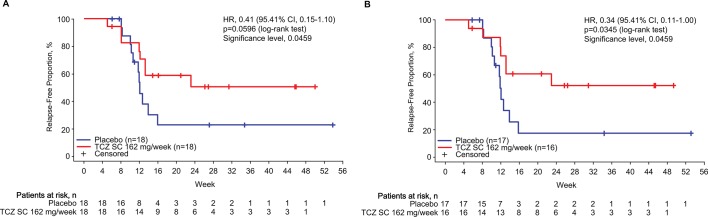
“but was 0.34 (95.41% CI 0.11–1.00; p = 0.0345) by per-protocol set analysis in 8 patients treated with tocilizumab and 11 treated with placebo.”
From Targeting Interleukin-6 Signaling in Clinic (2019) · cites this paper as Nakaoka et al., 2018
Checked by a reasoning model — may be wrong.
Experimental — accuracy not yet measuredIn the citing paper
“The hazard ratio for time to relapse was 0.41 (95.41% CI 0.15–1.10; p = 0.0596) by intent-to-treat analysis in 18 patients in the tocilizumab group and 18 patients in the placebo group”
From Targeting Interleukin-6 Signaling in Clinic (2019) · cites this paper as Nakaoka et al., 2018
Self-check
Percentages, sums and reported differences re-computed from the paper’s own numbers.
The self-check needs the paper’s full text.
Citations
Cites
No references could be resolved yet.
Research works printed but not linked: 39
- JCS Joint Working Group, 2011, Guideline for management of vasculitis syndrome (JCS 2008). Japanese Circulation Society, Circ J, 75, 474, 10.1253/circj.CJ-88-0007 · DOI
- Hall, 1985, Takayasu arteritis. A study of 32 North American patients, Medicine, 64, 89, 10.1097/00005792-198503000-00002 · DOI
- Kerr, 1994, Takayasu arteritis, Ann Intern Med, 120, 919, 10.7326/0003-4819-120-11-199406010-00004 · DOI
- Watanabe, 2015, Current clinical features of new patients with takayasu arteritis observed from cross-country research in Japan: age and sex specificity, Circulation, 132, 1701, 10.1161/CIRCULATIONAHA.114.012547 · DOI
- Johnston, 2002, Takayasu arteritis: a review, J Clin Pathol, 55, 481, 10.1136/jcp.55.7.481 · DOI
- Brunner, 2010, Takayasu arteritis in children and adolescents, Rheumatology, 49, 1806, 10.1093/rheumatology/keq167 · DOI
- Noris, 1999, Interleukin-6 and rantes in takayasu arteritis: a guide for therapeutic decisions?, Circulation, 100, 55, 10.1161/01.CIR.100.1.55 · DOI
- Park, 2006, Serum cytokine profiles and their correlations with disease activity in takayasu's arteritis, Rheumatology, 45, 545, 10.1093/rheumatology/kei266 · DOI
- Alibaz-Oner, 2015, Serum cytokine profiles in Takayasu's arteritis: search for biomarkers, Clin Exp Rheumatol, 33, S-32
- Saadoun, 2015, Th1 and Th17 cytokines drive inflammation in takayasu arteritis, Arthritis Rheumatol, 67, 1353, 10.1002/art.39037 · DOI
- Kong, 2016, The critical role of IL-6 in the pathogenesis of takayasu arteritis, Clin Exp Rheumatol, 34, S21
- Koster, 2016, Recent advances in the clinical management of giant cell arteritis and takayasu arteritis, Curr Opin Rheumatol, 28, 211, 10.1097/BOR.0000000000000265 · DOI
- Hoffman, 1994, Treatment of glucocorticoid-resistant or relapsing Takayasu arteritis with methotrexate, Arthritis Rheum, 37, 578, 10.1002/art.1780370420 · DOI
- Valsakumar, 2003, Role of immunosuppressive therapy on clinical, immunological, and angiographic outcome in active takayasu's arteritis, J Rheumatol, 30, 1793
- Shinjo, 2007, Mycophenolate mofetil reduces disease activity and steroid dosage in takayasu arteritis, Clin Rheumatol, 26, 1871, 10.1007/s10067-007-0596-z · DOI
- Nakaoka, 2013, Tocilizumab for the treatment of patients with refractory takayasu arteritis, Int Heart J, 54, 405, 10.1536/ihj.54.405 · DOI
- Mekinian, 2012, Efficacy and tolerance of infliximab in refractory takayasu arteritis: French multicentre study, Rheumatology, 51, 882, 10.1093/rheumatology/ker380 · DOI
- Clifford, 2014, Recent advances in the medical management of takayasu arteritis: an update on use of biologic therapies, Curr Opin Rheumatol, 26, 7, 10.1097/BOR.0000000000000004 · DOI
- Mekinian, 2015, Efficacy of biological-targeted treatments in takayasu arteritis: multicenter, retrospective study of 49 patients, Circulation, 132, 1693, 10.1161/CIRCULATIONAHA.114.014321 · DOI
- Schmidt, 2012, Tumor necrosis factor inhibitors in patients with Takayasu arteritis: experience from a referral center with long-term followup, Arthritis Care Res, 64, 1079, 10.1002/acr.21636 · DOI
- Nishimoto, 2008, Successful treatment of a patient with Takayasu arteritis using a humanized anti-interleukin-6 receptor antibody, Arthritis Rheum, 58, 1197, 10.1002/art.23373 · DOI
- Unizony, 2012, Tocilizumab for the treatment of large-vessel vasculitis (giant cell arteritis, Takayasu arteritis) and polymyalgia rheumatica, Arthritis Care Res, 64, 1720, 10.1002/acr.21750 · DOI
- Tombetti, 2013, Treatment of refractory takayasu arteritis with tocilizumab: 7 Italian patients from a single referral center, J Rheumatol, 40, 2047, 10.3899/jrheum.130536 · DOI
- Abisror, 2013, Tocilizumab in refractory Takayasu arteritis: a case series and updated literature review, Autoimmun Rev, 12, 1143, 10.1016/j.autrev.2013.06.019 · DOI
- Goel, 2013, Rapid control of disease activity by tocilizumab in 10 ‘difficult-to-treat’ cases of takayasu arteritis, Int J Rheum Dis, 16, 754, 10.1111/1756-185X.12220 · DOI
- Salvarani, 2012, Rescue treatment with tocilizumab for takayasu arteritis resistant to TNF-α blockers, Clin Exp Rheumatol, 30, S90
- Stubenrauch, 2010, Clin Ther, 32, 1597, 10.1016/j.clinthera.2010.07.021 · DOI
- Andrews, 2004, Non-invasive imaging in the diagnosis and management of takayasu's arteritis, Ann Rheum Dis, 63, 995, 10.1136/ard.2003.015701 · DOI
- Kato, 2015, Vessel wall inflammation of takayasu arteritis detected by contrast-enhanced magnetic resonance imaging: association with disease distribution and activity, PLoS One, 10, 10.1371/journal.pone.0145855 · DOI
- Misra, 2016, Increased circulating Th17 Cells, serum IL-17A, and IL-23 in takayasu arteritis, Autoimmune Dis, 2016, 1, 10.1155/2016/7841718 · DOI
- Villiger, 2016, Tocilizumab for induction and maintenance of remission in giant cell arteritis: a phase 2, randomised, double-blind, placebo-controlled trial, Lancet, 387, 1921, 10.1016/S0140-6736(16)00560-2 · DOI · Paper page
- Stone, 2017, Trial of tocilizumab in giant-cell arteritis, N Engl J Med, 377, 317, 10.1056/NEJMoa1613849 · DOI · Paper page
- Maksimowicz-McKinnon, 2009, Takayasu arteritis and giant cell arteritis: a spectrum within the same disease?, Medicine, 88, 221, 10.1097/MD.0b013e3181af70c1 · DOI
- Manel, 2008, The differentiation of human T(H)-17 cells requires transforming growth factor-beta and induction of the nuclear receptor RORgammat, Nat Immunol, 9, 641, 10.1038/ni.1610 · DOI
- Nishimoto, 2008, Mechanisms and pathologic significances in increase in serum interleukin-6 (il-6) and soluble il-6 receptor after administration of an anti-il-6 receptor antibody, tocilizumab, in patients with rheumatoid arthritis and castleman disease, Blood, 112, 3959, 10.1182/blood-2008-05-155846 · DOI
- Nishimoto, 2010, Safety and efficacy profiles of tocilizumab monotherapy in Japanese patients with rheumatoid arthritis: meta-analysis of six initial trials and five long-term extensions, Mod Rheumatol, 20, 222, 10.3109/s10165-010-0279-5 · DOI
- Koike, 2014, Effectiveness and safety of tocilizumab: postmarketing surveillance of 7901 patients with rheumatoid arthritis in Japan, J Rheumatol, 41, 15, 10.3899/jrheum.130466 · DOI
- Listing, 2013, The risk of infections associated with rheumatoid arthritis, with its comorbidity and treatment, Rheumatology, 52, 53, 10.1093/rheumatology/kes305 · DOI · Paper page
- Proven, 2003, Glucocorticoid therapy in giant cell arteritis: duration and adverse outcomes, Arthritis Rheum, 49, 703, 10.1002/art.11388 · DOI
Cited by
Sorted by citations
Targeting Interleukin-6 Signaling in Clinic
Kang, S., Tanaka, T., Narazaki, M., & Kishimoto, T. (2019) · Immunity · doi:10.1016/j.immuni.2019.03.026 · Cited by 904
IL-6 Revisited: From Rheumatoid Arthritis to CAR T Cell Therapy and COVID-19
Kishimoto, T., & Kang, S. (2022) · Annual Review of Immunology · doi:10.1146/annurev-immunol-101220-023458 · Cited by 140
Metadata
- Authors
- Nakaoka, Y., Isobe, M., Takei, S., Tanaka, Y., Ishii, T., Yokota, S., Nomura, A., Yoshida, S., & Nishimoto, N.
- Venue
- Annals of the Rheumatic Diseases
- Publisher
- Elsevier BV
- Published
- 2018-03
- Volume
- 77
- Issue
- 3
- Pages
- 348-354
- ISSN
- 0003-4967
- PMC
- PMC5867398
- Cited by
- 344
- References
- 0
- Language
- en
- Licence
- Funders
- Chugai Pharmaceutical Co., Ltd.
- F. Hoffmann-La Roche Ltd.
About these checks
Registry, retraction, Cites and statistics results are computed, not judged, with one exception: a printed reference that no index lists is read once by a model before it counts as a citation error. Claims are extracted by a model and kept only when their quote appears verbatim in the text; each cited source is then checked, with a model’s help, for whether it says what the claim relies on. Those verdicts can be wrong — read the claim’s quote and the cited source before relying on one.
Statistics and arithmetic are recomputed, not judged.
Confidence bands are shown only for fields calibrated on our annotated test set. None is calibrated yet, so no band is shown.
What counts as a claim ›How we measure confidence ›How we check this ›
Are you an author, or do you see a problem with this page? Request a review
