

The DOI matches its Crossref record.
Low dose, add-on prednisolone in patients with rheumatoid arthritis aged 65+: the pragmatic randomised, double-blind placebo-controlled GLORIA trial
Open accessAbstract
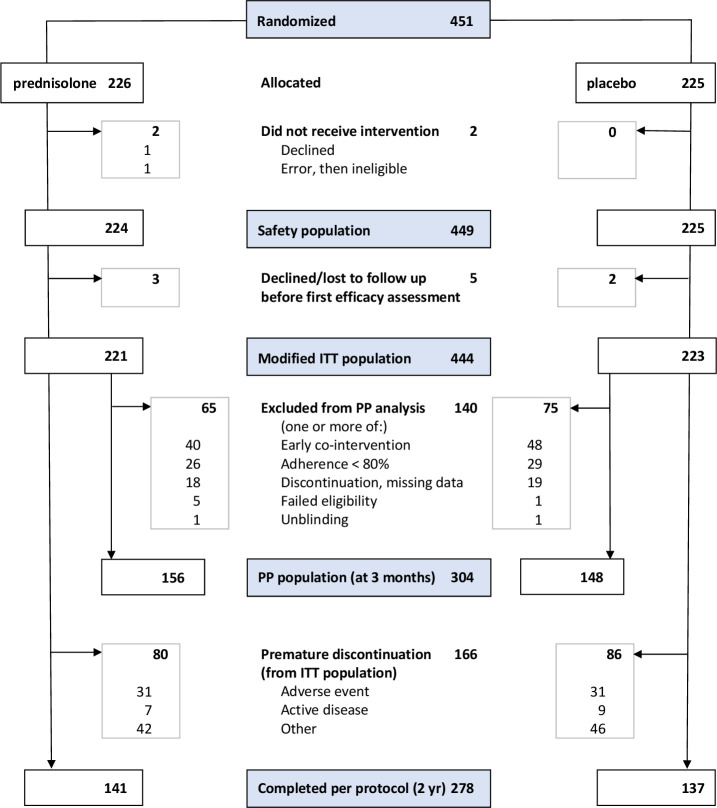
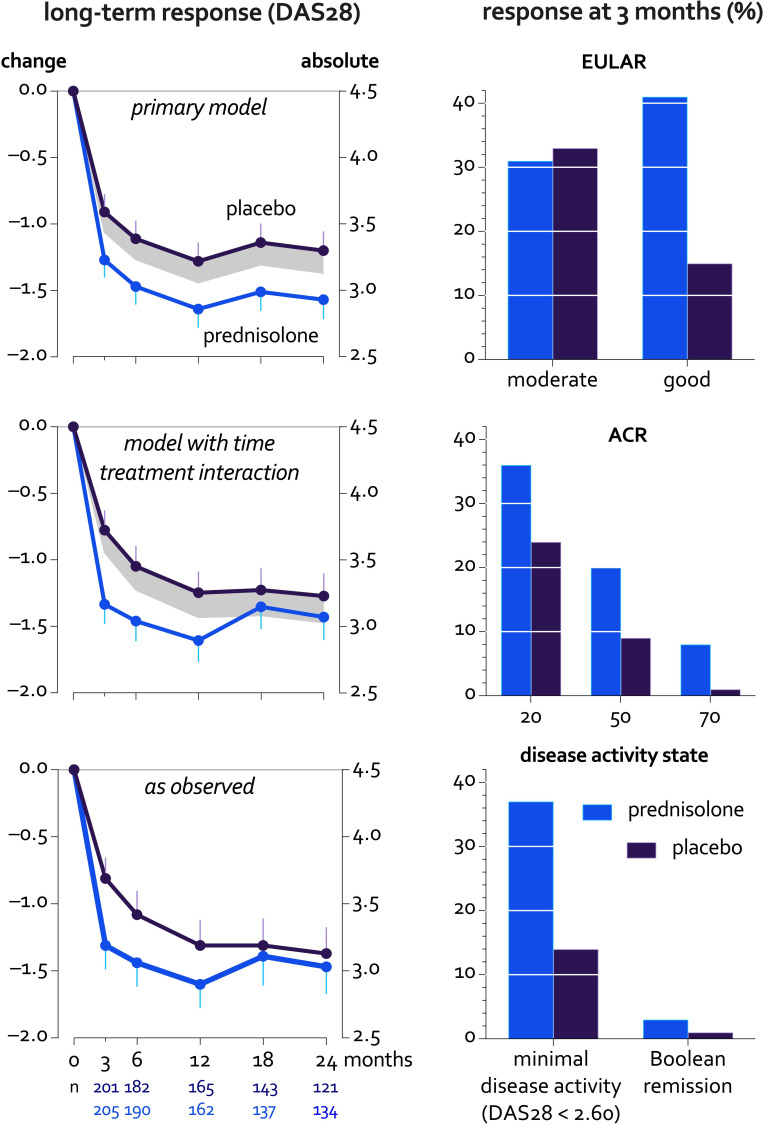
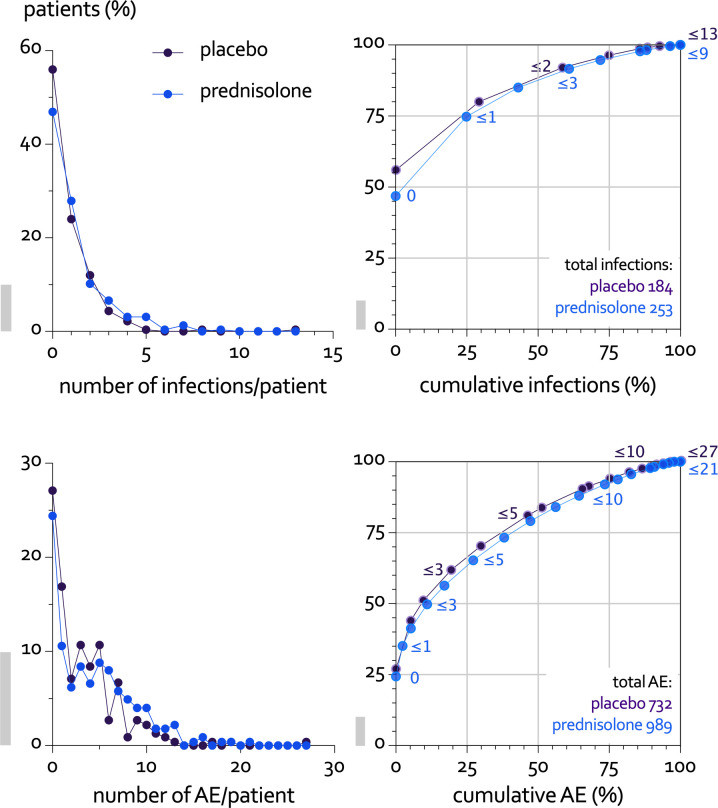
BACKGROUND: Low-dose glucocorticoid (GC) therapy is widely used in rheumatoid arthritis (RA) but the balance of benefit and harm is still unclear. METHODS: The GLORIA (Glucocorticoid LOw-dose in RheumatoId Arthritis) pragmatic double-blind randomised trial compared 2 years of prednisolone, 5 mg/day, to placebo in patients aged 65+ with active RA. We allowed all cotreatments except long-term open label GC and minimised exclusion criteria, tailored to seniors. Benefit outcomes included disease activity (disease activity score; DAS28, coprimary) and joint damage (Sharp/van der Heijde, secondary). The other coprimary outcome was harm, expressed as the proportion of patients with ≥1 adverse event (AE) of special interest. Such events comprised serious events, GC-specific events and those causing study discontinuation. Longitudinal models analysed the data, with one-sided testing and 95% confidence limits (95% CL). RESULTS: We randomised 451 patients with established RA and mean 2.1 comorbidities, age 72, disease duration 11 years and DAS28 4.5. 79% were on disease-modifying treatment, including 14% on biologics. 63% prednisolone versus 61% placebo patients completed the trial. Discontinuations were for AE (both, 14%), active disease (3 vs 4%) and for other (including covid pandemic-related disease) reasons (19 vs 21%); mean time in study was 19 months. Disease activity was 0.37 points lower on prednisolone (95% CL 0.23, p<0.0001); joint damage progression was 1.7 points lower (95% CL 0.7, p=0.003). 60% versus 49% of patients experienced the harm outcome, adjusted relative risk 1.24 (95% CL 1.04, p=0.02), with the largest contrast in (mostly non-severe) infections. Other GC-specific events were rare. CONCLUSION: Add-on low-dose prednisolone has beneficial long-term effects in senior patients with established RA, with a trade-off of 24% increase in patients with mostly non-severe AE; this suggests a favourable balance of benefit and harm. TRIAL REGISTRATION NUMBER: NCT02585258.
Overview
The claims and statistics of this paper haven’t been checked yet.
Run the check — free, no account needed. It reads the open-access text and checks the sources it cites.
Integrity signals
Registry
Cites
Statistics
Figures
Verification
Claims the paper makes
The claims and statistics of this paper haven’t been checked yet.
Run the check — free, no account needed. It reads the open-access text and checks the sources it cites.
Claims other papers make about this one
Each is checked against this paper’s own text: does it say what the citing paper says it does?
The source backs part of the claim, not all of it — or backs it for a different population, condition or comparison.
In the citing paper
“In the GLORIA trial (a pragmatic Glucocorticoid Low-dose Outcome in Rheumatoid Arthritis trial), researchers compared the results of 2 years of prednisone (5 mg/day, equivalent to a dosage of 20 mg hydrocortisone in replacement therapy) or placebo added to optimised standard care in patients with established RA, showing that prednisone, even in this low dose, significantly reduced disease activity”
From Diurnal production of cortisol and prediction of treatment response in rheumatoid arthritis: a 6-month, real-life prospective cohort study (2024) · cites this paper as [57]
Experimental — accuracy not yet measured
Self-check
Percentages, sums and reported differences re-computed from the paper’s own numbers.
The self-check needs the paper’s full text.
Citations
Cites
No references could be resolved yet.
Research works printed but not linked: 44
- Smolen, 2016, Rheumatoid arthritis, Lancet, 388, 2023, 10.1016/S0140-6736(16)30173-8 · DOI
- Criswell, 2000, Moderate-term, low-dose corticosteroids for rheumatoid arthritis, Cochrane Database Syst Rev
- Kirwan, 2007, Effects of glucocorticoids on radiological progression in rheumatoid arthritis, Cochrane Database Syst Rev, 10.1002/14651858.CD006356 · DOI
- Santiago, 2021, Patients' and rheumatologists' perspectives on the efficacy and safety of low-dose glucocorticoids in rheumatoid arthritis-an international survey within the GLORIA study, Rheumatology, 60, 3334, 10.1093/rheumatology/keaa785 · DOI
- Boers, 2017, Observational studies on glucocorticoids are harmful!, Lupus Sci Med, 4, 10.1136/lupus-2017-000219 · DOI
- Ravindran, 2009, Safety of medium- to long-term glucocorticoid therapy in rheumatoid arthritis: a meta-analysis, Rheumatology, 48, 807, 10.1093/rheumatology/kep096 · DOI
- Schwartz, 1967, Explanatory and pragmatic attitudes in therapeutical trials, J Chronic Dis, 20, 637, 10.1016/0021-9681(67)90041-0 · DOI · Paper page
- Sokka, 2007, QUEST-RA: quantitative clinical assessment of patients with rheumatoid arthritis seen in standard rheumatology care in 15 countries, Ann Rheum Dis, 66, 1491, 10.1136/ard.2006.069252 · DOI
- Hanly, 2021, Use of disease-modifying antirheumatic drugs, biologics, and corticosteroids in older patients with rheumatoid arthritis over 20 years, J Rheumatol, 48, 977, 10.3899/jrheum.200310 · DOI
- Hua, 2020, Glucocorticoids in rheumatoid arthritis: current status and future studies, RMD Open, 6, 10.1136/rmdopen-2017-000536 · DOI
- Woolf, 2003, Burden of major musculoskeletal conditions, Bull World Health Organ, 81, 646
- England, 2021, Burden and trajectory of multimorbidity in rheumatoid arthritis: a matched cohort study from 2006 to 2015, Ann Rheum Dis, 80, 286, 10.1136/annrheumdis-2020-218282 · DOI
- Forsat, 2020, Recruitment and retention of older people in clinical research: a systematic literature review, J Am Geriatr Soc, 68, 2955, 10.1111/jgs.16875 · DOI
- Hartman, 2018, Harm, benefit and costs associated with low-dose glucocorticoids added to the treatment strategies for rheumatoid arthritis in elderly patients (GLORIA trial): study protocol for a randomised controlled trial, Trials, 19, 67, 10.1186/s13063-017-2396-3 · DOI
- Arnett, 1988, The American rheumatism association 1987 revised criteria for the classification of rheumatoid arthritis, Arthritis Rheum, 31, 315, 10.1002/art.1780310302 · DOI
- Aletaha, 2010, Rheumatoid arthritis classification criteria: an American College of Rheumatology/European League against rheumatism collaborative initiative, Ann Rheum Dis, 2010, 1580, 10.1136/ard.2010.138461 · DOI
- Prevoo, 1995, Modified disease activity scores that include twenty-eight-joint counts. development and validation in a prospective longitudinal study of patients with rheumatoid arthritis, Arthritis Rheum, 38, 44, 10.1002/art.1780380107 · DOI
- Pocock, 1975, Sequential treatment assignment with balancing for prognostic factors in the controlled clinical trial, Biometrics, 31, 103, 10.2307/2529712 · DOI · Paper page
- Hartman, 2021, Medication adherence in older people with rheumatoid arthritis is lower according to electronic monitoring than according to pill count, Rheumatology, 60, 5239, 10.1093/rheumatology/keab207 · DOI
- Hartman, 2019, Outcome measures for adherence data from a medication event monitoring system: a literature review, J Clin Pharm Ther, 44, 1, 10.1111/jcpt.12757 · DOI
- van der Heijde, 1995, Radiographic progression on radiographs of hands and feet during the first 3 years of rheumatoid arthritis measured according to sharp's method (van der Heijde modification), J Rheumatol, 22, 1792
- Griffith JF, Genant HK,. Diagnosis and Classification of Vertebral Fracture. In: Primer on the metabolic bone diseases and disorders of mineral metabolism, 2018: 319–30. · DOI
- Bakker, 2012, Low-Dose prednisone inclusion in a methotrexate-based, tight control strategy for early rheumatoid arthritis: a randomized trial, Ann Intern Med, 156, 329, 10.7326/0003-4819-156-5-201203060-00004 · DOI
- Buttgereit, 2013, Low-Dose prednisone chronotherapy for rheumatoid arthritis: a randomised clinical trial (CAPRA-2), Ann Rheum Dis, 72, 204, 10.1136/annrheumdis-2011-201067 · DOI
- Benjamini, 1995, Controlling the false discovery rate: a practical and powerful approach to multiple testing, Journal of the Royal Statistical Society: Series B, 57, 289, 10.1111/j.2517-6161.1995.tb02031.x · DOI · Paper page
- Hartman, 2019, Remarkable international variability in reasons for ineligibility and non-participation in the GLORIA trial, Scand J Rheumatol, 48, 340, 10.1080/03009742.2018.1559880 · DOI
- Buttgereit, 2021, Barriers and potential solutions in the recruitment and retention of older patients in clinical trials-lessons learned from six large multicentre randomized controlled trials, Age Ageing, 50, 1988, 10.1093/ageing/afab147 · DOI
- Choy, 2005, A two year randomised controlled trial of intramuscular depot steroids in patients with established rheumatoid arthritis who have shown an incomplete response to disease modifying antirheumatic drugs, Ann Rheum Dis, 64, 1288, 10.1136/ard.2004.030908 · DOI
- Burmester, 2020, Continuing versus tapering glucocorticoids after achievement of low disease activity or remission in rheumatoid arthritis (SEMIRA): a double-blind, multicentre, randomised controlled trial, Lancet, 396, 267, 10.1016/S0140-6736(20)30636-X · DOI · Paper page
- Boers, 1997, Randomised comparison of combined step-down prednisolone, methotrexate and sulphasalazine with sulphasalazine alone in early rheumatoid arthritis [see comments] [published erratum appears in Lancet 1998 Jan 17;351(9097):220], Lancet, 350, 309, 10.1016/S0140-6736(97)01300-7 · DOI
- Heimans, 2014, A two-step treatment strategy trial in patients with early arthritis aimed at achieving remission: the improved study, Ann Rheum Dis, 73, 1356, 10.1136/annrheumdis-2013-203243 · DOI
- Verschueren, 2017, Ann Rheum Dis, 76, 511, 10.1136/annrheumdis-2016-209212 · DOI
- Strehl, 2016, Defining conditions where long-term glucocorticoid treatment has an acceptably low level of harm to facilitate implementation of existing recommendations: viewpoints from an EULAR Task force, Ann Rheum Dis, 75, 952, 10.1136/annrheumdis-2015-208916 · DOI
- Schäfer, 2021, Response to: ‘Correspondence on ‘Factors associated with COVID-19-related death in people with rheumatic diseases: results from the COVID-19 Global Rheumatology Alliance physician reported registry“ by Mulhearn et al, Ann Rheum Dis
- van den Oever, 2017, Cardiovascular risk management in rheumatoid arthritis patients still suboptimal: the implementation of cardiovascular risk management in rheumatoid arthritis project, Rheumatology, 56, 1472, 10.1093/rheumatology/kew497 · DOI
- Saag, 2006, Trends in prevention of glucocorticoid-induced osteoporosis, J Rheumatol, 33, 1651
- Singh, 2009, Biologics for rheumatoid arthritis: an overview of Cochrane reviews, Cochrane Database Syst Rev, 10.1002/14651858.CD007848 · DOI
- Murray, 2018, Systematic review and network meta-analysis: effect of biologics on radiographic progression in rheumatoid arthritis, J Comp Eff Res, 7, 959, 10.2217/cer-2017-0106 · DOI
- Fleischmann, 2017, Long-Term maintenance of Certolizumab pegol safety and efficacy, in combination with methotrexate and as monotherapy, in rheumatoid arthritis patients, Rheumatol Ther, 4, 57, 10.1007/s40744-017-0060-8 · DOI
- Ytterberg, 2022, Cardiovascular and cancer risk with tofacitinib in rheumatoid arthritis, N Engl J Med, 386, 316, 10.1056/NEJMoa2109927 · DOI
- Borren, 2019, Safety of biologic therapy in older patients with immune-mediated diseases: a systematic review and meta-analysis, Clin Gastroenterol Hepatol, 17, 1736, 10.1016/j.cgh.2018.12.032 · DOI
- Smolen, 2020, EULAR recommendations for the management of rheumatoid arthritis with synthetic and biological disease-modifying antirheumatic drugs: 2019 update, Ann Rheum Dis, 79, 685, 10.1136/annrheumdis-2019-216655 · DOI
- Singh, 2016, 2015 American College of rheumatology guideline for the treatment of rheumatoid arthritis, Arthritis Rheumatol, 68, 1, 10.1002/art.39480 · DOI
- Felson, 2011, American College of Rheumatology/European League against rheumatism provisional definition of remission in rheumatoid arthritis for clinical trials, Ann Rheum Dis, 70, 404, 10.1136/ard.2011.149765 · DOI
Cited by
Sorted by citations
Yavropoulou, M. P., Filippa, M. G., Vlachogiannis, N. I., Fragoulis, G. E., Laskari, K., Mantzou, A., Panopoulos, S., Fanouriakis, A., Bournia, V.-K., Evangelatos, G., et al. (2024) · RMD Open · doi:10.1136/rmdopen-2023-003575 · Cited by 13
“57 In the SEMIRA Study, 10 continuation of low-dose prednisone (5 mg/day) in patients who achieved low disease activity with tocilizumab was safe and demonstrated a better disease control than tapering.”
Metadata
- Authors
- Boers, M., Hartman, L., Opris-Belinski, D., Bos, R., Kok, M. R., Da Silva, J. A., Griep, E. N., Klaasen, R., Allaart, C. F., Baudoin, P., Raterman, H. G., Szekanecz, Z., Buttgereit, F., Masaryk, P., Klausch, L. T., Paolino, S., Schilder, A. M., Lems, W. F., Cutolo, M., Middelink, L., Dekker, V, van den Bulk, N., Pinto, R., Doerwald, L., Manger, S., Redol, J., Prinsen, K., Scholte-Voshaar, M., Jansen, T., Codreanu, C., Molenaar, E., van Laar, J., Ruiterman, Y., Boonen, A., Boonen, A., Micaelo, M., Costa, J., Sieburg, M., Spoorenberg, J., Prothmann, U., Saavedra, M., Silva, I., Nurmohamed, M., Jacobs, J., Tas, S., Bijlsma, J., Christensen, R., Smulders, Y., Ralston, S., van der Heijde, D., Marsman, A., Lems, W., Rusthoven, C., Bakkers, M., Frazão Mateus, E., Mendes, G., Elling-Audersch, C., Borucki, D., Celano, A., Corduta, P., Constantinescu, O., Richards, P., & Aanerud, G.
- Affiliations
- Amsterdam University Medical Centers (NL)
- Medisch Centrum Leeuwarden (NL)
- Maasstad Ziekenhuis (NL)
- Antonius Ziekenhuis (NL)
- Meander Medisch Centrum (NL)
- Leiden University Medical Center (NL)
- Noordwest Ziekenhuisgroep (NL)
- Charité – Universitätsmedizin Berlin (DE)
- National Institute of Rheumatic Diseases (SK)
- University of Genoa (IT)
- Corresponding author
- Boers, Maarten
- ORCID
- Venue
- Annals of the Rheumatic Diseases
- Publisher
- Elsevier BV
- Published
- 2022-07
- Volume
- 81
- Issue
- 7
- Pages
- 925-936
- ISSN
- 0003-4967 (ISSN-L)
- PMC
- PMC9209692
- OpenAlex
- W4282930667
- Cited by
- 169
- References
- 0
- Citations by year
- 2026: 29 · 2025: 33 · 2024: 48 · 2023: 43 · 2022: 15
- FWCI
- 25.30
- Type
- journal article
- Language
- en
- Open access
- hybrid
- doi.org
- Licence
- Locations
- Annals of the Rheumatic Diseases (publishedVersion, cc-by-nc)
- PubMed Central (publishedVersion, cc-by-nc)
- PubMed (publishedVersion)
- Leiden Repository (Leiden University) (submittedVersion, cc-by)
- Data Archiving and Networked Services (DANS) (submittedVersion, cc-by)
- University of Debrecen Electronic Archive (University of Debrecen) (submittedVersion, other-oa)
- CINECA IRIS Institutial Research Information System (University of Genoa) (submittedVersion, other-oa)
- Amsterdam UMC (VU Amsterdam) - Institutional Repository (submittedVersion, other-oa)
- Data Archiving and Networked Services (DANS) (submittedVersion, other-oa)
- Funders
- European Commission (Horizon 2020: 634886)
- Topics
- Health Sciences › Medicine › Rheumatology › Rheumatoid Arthritis Research and Therapies
- Health Sciences › Medicine › Hematology › Autoimmune and Inflammatory Disorders Research
- Health Sciences › Medicine › Rheumatology › Osteoarthritis Treatment and Mechanisms
- Keywords
- rheumatoid arthritis, prednisolone, low-dose glucocorticoids, older adults, disease activity, joint destruction, adverse events, infection, adjunctive therapy, benefit-harm balance, disease-modifying antirheumatic drugs, biologics, comorbidities, COVID-19 pandemic, trial discontinuation
- MeSH terms
- Aged, Arthritis, Rheumatoid, Double-Blind Method, Drug Therapy, Combination, Glucocorticoids, Humans, Methotrexate, Prednisolone, Treatment Outcome, Antirheumatic Agents
About these checks
Registry, retraction, Cites and statistics results are computed, not judged, with one exception: a printed reference that no index lists is read once by a model before it counts as a citation error. Claims are extracted by a model and kept only when their quote appears verbatim in the text; each cited source is then checked, with a model’s help, for whether it says what the claim relies on. Those verdicts can be wrong — read the claim’s quote and the cited source before relying on one.
Statistics and arithmetic are recomputed, not judged.
Confidence bands are shown only for fields calibrated on our annotated test set. None is calibrated yet, so no band is shown.
What counts as a claim ›How we measure confidence ›How we check this ›
Are you an author, or do you see a problem with this page? Request a review
How to cite
Cite CoChat for the checks on this page, and the paper for its own findings.
- This page
- CoChat. (2026). Citation check: Low dose, add-on prednisolone in patients with rheumatoid arthritis aged 65+: the pragmatic randomised, double-blind placebo-controlled GLORIA trial. https://app.cochat.ai/papers/10.1136/annrheumdis-2021-221957
- The paper
- Boers, M., Hartman, L., Opris-Belinski, D., Bos, R., Kok, M. R., Da Silva, J. A., Griep, E. N., Klaasen, R., Allaart, C. F., Baudoin, P., Raterman, H. G., Szekanecz, Z., Buttgereit, F., Masaryk, P., Klausch, L. T., Paolino, S., Schilder, A. M., Lems, W. F., Cutolo, M., . . . Aanerud, G. (2022). Low dose, add-on prednisolone in patients with rheumatoid arthritis aged 65+: the pragmatic randomised, double-blind placebo-controlled GLORIA trial. Annals of the Rheumatic Diseases. https://doi.org/10.1136/annrheumdis-2021-221957
