

Estimating discharge dates using routinely collected data: improving the preparedness of parents of preterm infants for discharge home
Open accessThe DOI matches its Crossref record; 5 of the 5 references it cites were found in a registry or an index.
Abstract
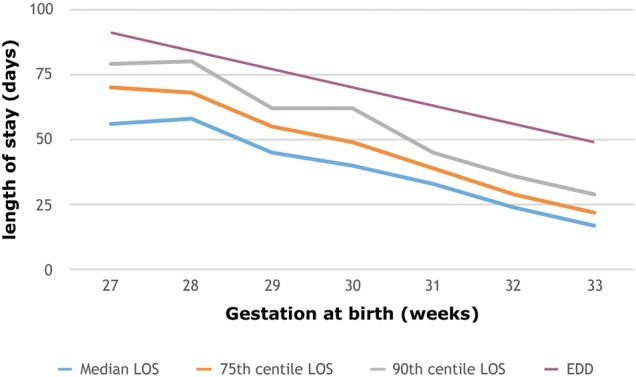
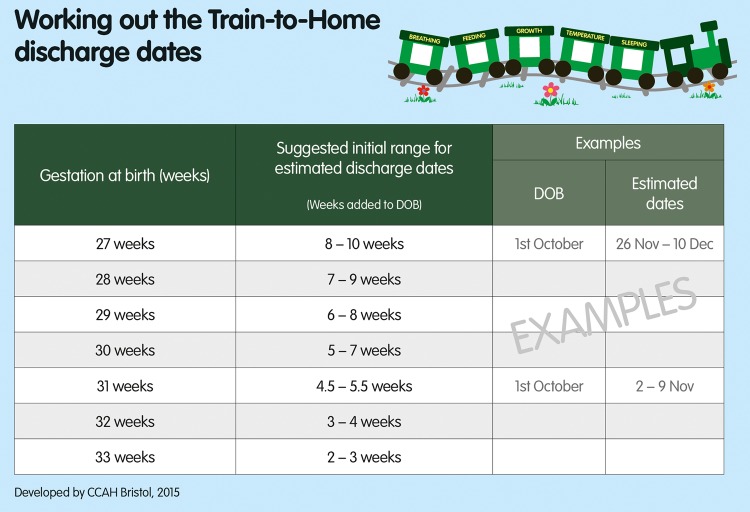
The length of stay for moderately preterm infants has progressively become shorter in the UK in recent years but staff still commonly inform parents that their baby will go home around their estimated date of delivery (EDD). Parents need as much notice as possible to prepare for the discharge of their baby, and to gain the necessary skills and knowledge to care for their infant safely. We report the use of routinely collected neonatal data to develop and implement a simple centile chart for date of discharge from hospital, which allows staff and parents to predict the likely discharge date more accurately for preterm infants, most of whom now go home more than 3 weeks before their EDD. This information allows better and timelier planning for discharge of such infants, by parents and staff.
Overview
The claims and statistics of this paper haven’t been checked yet.
Free: it reads the open-access text and checks the first 5 claims that cite a source we can check. Create a free account to check every claim.
Integrity signals
Registry
Cites
Statistics
Figures
Verification
Claims the paper makes
The claims and statistics of this paper haven’t been checked yet.
Free: it reads the open-access text and checks the first 5 claims that cite a source we can check. Create a free account to check every claim.
Claims other papers make about this one
Each is checked against this paper’s own text: does it say what the citing paper says it does?
The cited source says what the claim attributes to it.
In the citing paper
“This allowed staff and parents to predict the likely discharge date, in turn then enabling better and more timely planning for discharge home.”
From The transition home of extremely premature babies: An integrative review (2021) · cites this paper as Fleming et al., 2017
In the citing paper
“Another example of specific content is provided by Fleming et al (2017) who document outcomes from the development of a simple chart for date of discharge from hospital.”
From The transition home of extremely premature babies: An integrative review (2021) · cites this paper as Fleming et al., 2017
Self-check
Percentages, sums and reported differences re-computed from the paper’s own numbers.
The self-check needs the paper’s full text.
Citations
Cites
Accounting for variation in length of NICU stay for extremely low birth weight infants
Lee, H. C., Bennett, M. V., Schulman, J. D., & Gould, J. B. (2013) · Journal of Perinatology · doi:10.1038/jp.2013.92 · Cited by 75
Moderately preterm infants and determinants of length of hospital stay
Altman, M., Vanpée, M., Cnattingius, S., & Norman, M. (2009) · Archives of Disease in Childhood Fetal & Neonatal · doi:10.1136/adc.2008.153668 · Cited by 75
Neonatal intensive care unit: predictive models for length of stay
Bender, G. J., Koestler, D. C., Ombao, H., McCourt, M. F., Alskinis, B., Rubin, L. P., & Padbury, J. F. (2012) · Journal of Perinatology · doi:10.1038/jp.2012.62 · Cited by 73
Ingram, J. C., Powell, J. E., Blair, P. S., Pontin, D., Redshaw, M., Manns, S., Beasant, L., Burden, H., Johnson, D., Rose, C., et al. (2016) · BMJ Open · doi:10.1136/bmjopen-2015-010752 · Cited by 58
Self-citationEstimates of length of neonatal stay for very premature babies in the UK
Manktelow, B. N., Draper, E. S., Field, C., & Field, D. N. (2010) · Archives of Disease in Childhood Fetal & Neonatal · doi:10.1136/adc.2009.168633 · Cited by 36
Cited by
Risk factors for length of NICU stay of newborns: A systematic review
Fu, M., Song, W., Yu, G., Yu, Y., & Yang, Q. (2023) · Frontiers in Pediatrics · doi:10.3389/fped.2023.1121406 · Cited by 110
Estimating neonatal length of stay for babies born very preterm
Seaton, S. E., Barker, L. T., Draper, E. S., Abrams, K. R., Modi, N., & Manktelow, B. N. (2018) · Archives of Disease in Childhood Fetal & Neonatal · doi:10.1136/archdischild-2017-314405 · Cited by 102
The transition home of extremely premature babies: An integrative review
Green, J., Fowler, C., Petty, J., & Whiting, L. (2021) · Journal of Neonatal Nursing · doi:10.1016/j.jnn.2020.09.011 · Cited by 47
Murki, S., Vardhelli, V., Deshabhotla, S., Sharma, D., Pawale, D., Kulkarni, D., Kumar, P., Kabra, N. S., Sundaram, M., Plakkal, N., et al. (2020) · Journal of Paediatrics and Child Health · doi:10.1111/jpc.15031 · Cited by 42
Zhang, M., Wang, Y., Feng, J., Yu, A.-Z., Huang, J., Jiang, S., Gu, X., Sun, J., Cao, Y., Zhou, W., et al. (2022) · World Journal of Pediatrics · doi:10.1007/s12519-021-00494-1 · Cited by 19
Metadata
- Authors
- Fleming, P. J., Ingram, J., Johnson, D., & Blair, P. S.
- Affiliations
- University of Bristol (GB)
- Corresponding author
- Fleming, Peter J
- Venue
- Archives of Disease in Childhood - Fetal and Neonatal Edition
- Publisher
- BMJ
- Published
- 2016-10-03
- Volume
- 102
- Issue
- 2
- Pages
- F170-F172
- ISSN
- 1359-2998 (ISSN-L)
- 1468-2052
- PMC
- PMC5339560
- OpenAlex
- W2528516444
- Cited by
- 14
- References
- 5
- Citations by year
- 2026: 1 · 2025: 1 · 2023: 3 · 2022: 3 · 2021: 1 · 2020: 3 · 2019: 1 · 2018: 1
- FWCI
- 0.77
- Type
- journal article
- Language
- en
- Open access
- hybrid
- doi.org
- Licence
- cc-by
- Locations
- Archives of Disease in Childhood Fetal & Neonatal (publishedVersion, cc-by)
- Europe PMC (PubMed Central) (publishedVersion, cc-by)
- PubMed Central (publishedVersion, cc-by)
- PubMed (publishedVersion)
- Explore Bristol Research (submittedVersion, cc-by)
- HighWire Press Open Archive (submittedVersion)
- Bristol Research (University of Bristol) (submittedVersion, cc-by)
- Funders
- Health Services and Delivery Research Programme (11/1015/09)
- Topics
- Health Sciences › Medicine › Pediatrics, Perinatology and Child Health › Infant Development and Preterm Care
- Health Sciences › Medicine › Pulmonary and Respiratory Medicine › Neonatal Respiratory Health Research
- Health Sciences › Medicine › Pediatrics, Perinatology and Child Health › Maternal and Neonatal Healthcare
- Keywords
- preterm infants, hospital discharge, centile charts, parental preparation, neonatal length of stay, discharge planning, neonatal care
- MeSH terms
- Data Collection, United Kingdom, Humans, Infant, Newborn, Infant, Premature, Intensive Care Units, Neonatal, Length of Stay, Parents, Patient Discharge, Time Factors
About these checks
Registry, retraction, Cites and statistics results are computed, not judged, with one exception: a printed reference that no index lists is read once by a model before it counts as a citation error. Claims are extracted by a model and kept only when their quote appears verbatim in the text; each cited source is then checked, with a model’s help, for whether it says what the claim relies on. Those verdicts can be wrong — read the claim’s quote and the cited source before relying on one.
Statistics and arithmetic are recomputed, not judged.
Confidence bands are shown only for fields calibrated on our annotated test set. None is calibrated yet, so no band is shown.
What counts as a claim ›How we measure confidence ›How we check this ›
Are you an author, or do you see a problem with this page? Request a review
How to cite
Cite CoChat for the checks on this page, and the paper for its own findings.
- This page
- CoChat. (2026). Citation check: Estimating discharge dates using routinely collected data: improving the preparedness of parents of preterm infants for discharge home. https://app.cochat.ai/papers/10.1136/archdischild-2016-310944
- The paper
- Fleming, P. J., Ingram, J., Johnson, D., & Blair, P. S. (2017). Estimating discharge dates using routinely collected data: improving the preparedness of parents of preterm infants for discharge home. Archives of Disease in Childhood - Fetal and Neonatal Edition. https://doi.org/10.1136/archdischild-2016-310944
Data sources
Bibliographic data: Semantic Scholar, OpenAlex, Crossref.
Contains information from the Semantic Scholar Academic Graph Datasets, made available under the ODC Attribution License (ODC-BY 1.0).
Semantic Scholar’s data is described in: Kinney, R., et al. (2023). The Semantic Scholar Open Data Platform. arXiv:2301.10140.
