

The DOI matches its Crossref record; 62 of the 63 references it cites were found in a registry or an index.
How does light-intensity physical activity associate with adult cardiometabolic health and mortality? Systematic review with meta-analysis of experimental and observational studies
Open accessAbstract
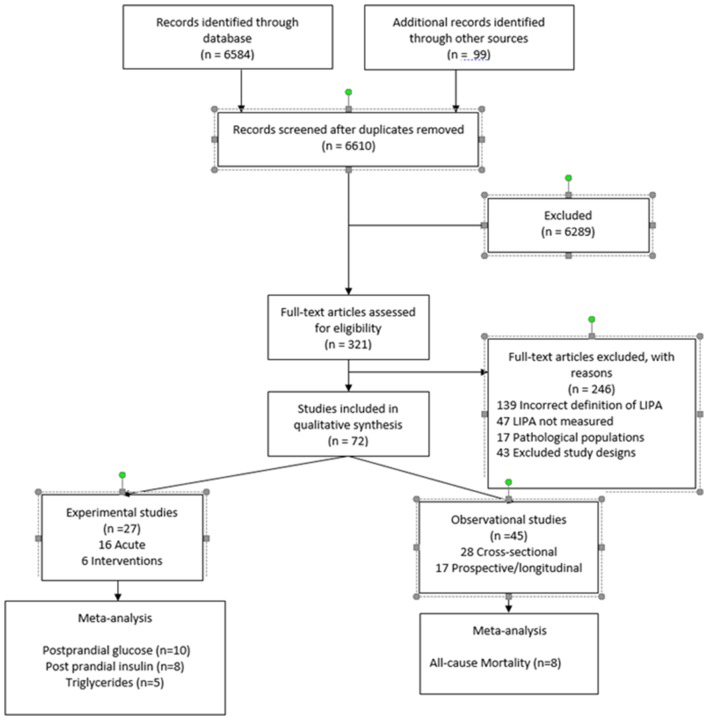
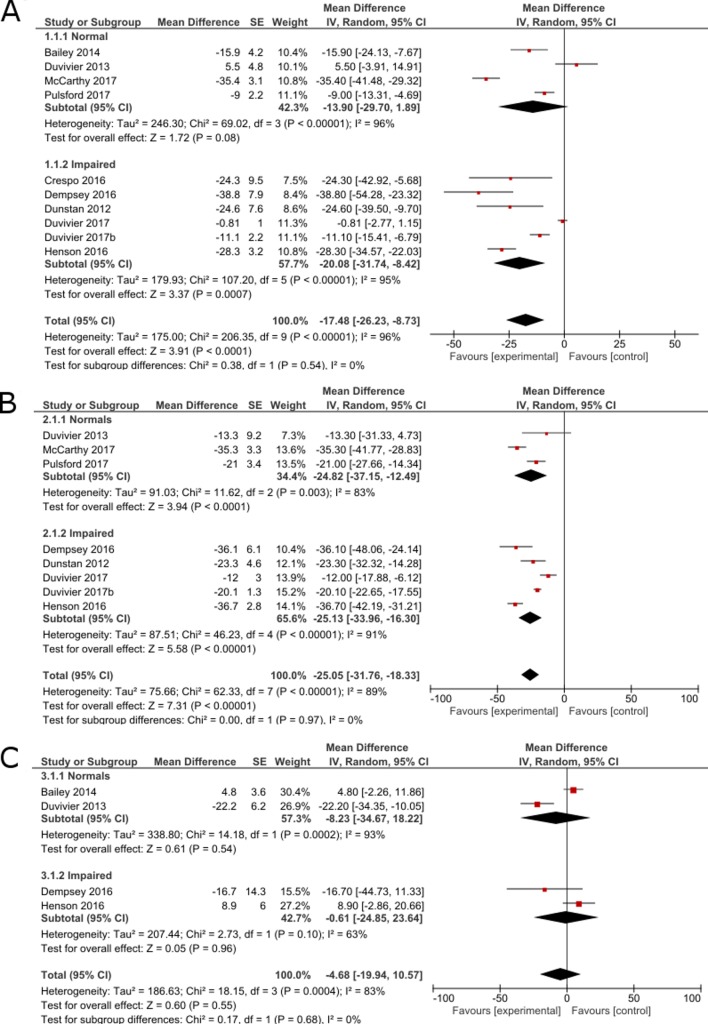
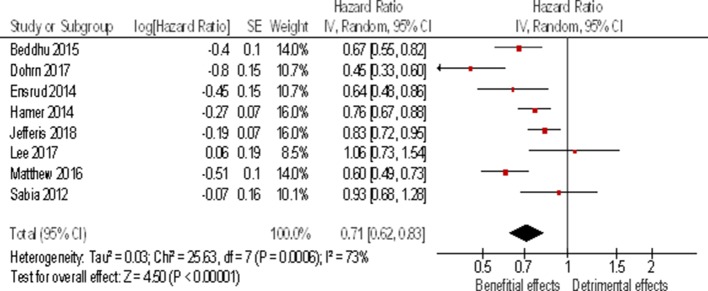
AIM: To assess the relationship between time spent in light physical activity and cardiometabolic health and mortality in adults. DESIGN: Systematic review and meta-analysis. DATA SOURCES: Searches in Medline, Embase, PsycInfo, CINAHL and three rounds of hand searches. ELIGIBILITY CRITERIA FOR SELECTING STUDIES: Experimental (including acute mechanistic studies and physical activity intervention programme) and observational studies (excluding case and case-control studies) conducted in adults (aged ≥18 years) published in English before February 2018 and reporting on the relationship between light physical activity (<3 metabolic equivalents) and cardiometabolic health outcomes or all-cause mortality. STUDY APPRAISAL AND SYNTHESIS: Study quality appraisal with QUALSYST tool and random effects inverse variance meta-analysis. RESULTS: Seventy-two studies were eligible including 27 experimental studies (and 45 observational studies). Mechanistic experimental studies showed that short but frequent bouts of light-intensity activity throughout the day reduced postprandial glucose (-17.5%; 95% CI -26.2 to -8.7) and insulin (-25.1%; 95% CI -31.8 to -18.3) levels compared with continuous sitting, but there was very limited evidence for it affecting other cardiometabolic markers. Three light physical activity programme intervention studies (n ranging from 12 to 58) reduced adiposity, improved blood pressure and lipidaemia; the programmes consisted of activity of >150 min/week for at least 12 weeks. Six out of eight prospective observational studies that were entered in the meta-analysis reported that more time spent in daily light activity reduced risk of all-cause mortality (pooled HR 0.71; 95% CI 0.62 to 0.83). CONCLUSIONS: Light-intensity physical activity could play a role in improving adult cardiometabolic health and reducing mortality risk. Frequent short bouts of light activity improve glycaemic control. Nevertheless, the modest volume of the prospective epidemiological evidence base and the moderate consistency between observational and laboratory evidence inhibits definitive conclusions.
Overview
The claims and statistics of this paper haven’t been checked yet.
Run the check — free, no account needed. It reads the open-access text and checks the sources it cites.
Integrity signals
Registry
Cites
Statistics
Figures
Verification
Claims the paper makes
The claims and statistics of this paper haven’t been checked yet.
Run the check — free, no account needed. It reads the open-access text and checks the sources it cites.
Claims other papers make about this one
Each is checked against this paper’s own text: does it say what the citing paper says it does?
The source backs part of the claim, not all of it — or backs it for a different population, condition or comparison.
In the citing paper
“Instead, undertaking accelerometer-measured light-intensity PA (LPA) at intensity levels lower than 3.0 metabolite equivalents (METs) could be an easier choice than MVPA for enhancing health.10, 11, 12”
From Accelerometer-measured physical activity, sedentary behavior, and incidence of macrovascular and microvascular events in individuals with type 2 diabetes mellitus and prediabetes (2025) · cites this paper as [10]
Experimental — accuracy not yet measured
Self-check
Percentages, sums and reported differences re-computed from the paper’s own numbers.
The self-check needs the paper’s full text.
Citations
Cites
Cochrane Handbook for Systematic Reviews of Interventions: Cochrane Book Series
(2008) · doi:10.1002/9780470712184 · Cited by 25,048
Dermyshi, E., Wang, Y., Yan, C., Hong, W., Qiu, G., Gong, X., & Zhang, T. (2017) · Neonatology · doi:10.1159/000454668 · Cited by 24,586
Meta-analysis of Observational Studies in Epidemiology<SUBTITLE>A Proposal for Reporting</SUBTITLE>
Stroup, D. F. (2000) · JAMA · doi:10.1001/jama.283.15.2008 · Cited by 20,623
Hutton, B., Salanti, G., Caldwell, D. M., Chaimani, A., Schmid, C. H., Cameron, C., Ioannidis, J. P. A., Straus, S., Thorlund, K., Jansen, J. P., et al. (2015) · Annals of Internal Medicine · doi:10.7326/m14-2385 · Cited by 8,269
Cochrane Handbook for Systematic Reviews of Interventions Version 5.0.1. The Cochrane Collaboration
Higgins, J., Green, S. R., & Higgins, J. (2008) · Cited by 5,544
HASKELL, W. L., LEE, I.-M., PATE, R. R., POWELL, K. E., BLAIR, S. N., FRANKLIN, B. A., MACERA, C. A., HEATH, G. W., THOMPSON, P. D., & BAUMAN, A. (2007) · Medicine & Science in Sports & Exercise · doi:10.1249/mss.0b013e3180616b27 · Cited by 4,616
Standard Quality Assessment Criteria for Evaluating Primary Research Papers from a Variety of Fields
Kmet, L. M., Cook, L. S., & Lee, R. C. (2004) · University of Alberta Library · doi:10.7939/r37m04f16 · Cited by 1,682
Arem, H., Moore, S. C., Patel, A., Hartge, P., Berrington de Gonzalez, A., Visvanathan, K., Campbell, P. T., Freedman, M., Weiderpass, E., Adami, H. O., et al. (2015) · JAMA Internal Medicine · doi:10.1001/jamainternmed.2015.0533 · Cited by 1,498
Kyu, H. H., Bachman, V. F., Alexander, L. T., Mumford, J. E., Afshin, A., Estep, K., Veerman, J. L., Delwiche, K., Iannarone, M. L., Moyer, M. L., et al. (2016) · BMJ · doi:10.1136/bmj.i3857 · Cited by 1,272
Research works printed but not linked: 3
- 10.1210/jc.81.10.3492 · DOI
- Bailey DP , Locke CD . Breaking up prolonged sitting with light-intensity walking improves postprandial glycemia, but breaking up sitting with standing does not. J Sci Med Sport 2015;18.doi:10.1016/j.jsams.2014.03.008 · DOI
- Zeigler, 2015, Walking workstation use reduces ambulatory blood pressure in adults with prehypertension, J Phys Act Health, 12, S119, 10.1123/jpah.2013-0487 · DOI
Cited by
Sorted by citations
2021 ESC Guidelines on cardiovascular disease prevention in clinical practice
Visseren, F. L. J., Mach, F., Smulders, Y. M., Carballo, D., Koskinas, K. C., Bäck, M., Benetos, A., Biffi, A., Boavida, J.-M., Capodanno, D., et al. (2021) · European Heart Journal · doi:10.1093/eurheartj/ehab484 · Cited by 6,485
Arnett, D. K., Blumenthal, R. S., Albert, M. A., Buroker, A. B., Goldberger, Z. D., Hahn, E. J., Himmelfarb, C. D., Khera, A., Lloyd-Jones, D., McEvoy, J. W., et al. (2019) · Circulation · doi:10.1161/cir.0000000000000678 · Cited by 4,536
(2019) · doi:10.1161/cir.0000000000000677 · Cited by 4,501
2019 ACC/AHA Guideline on the Primary Prevention of Cardiovascular Disease
Arnett, D. K., Blumenthal, R. S., Albert, M. A., Buroker, A. B., Goldberger, Z. D., Hahn, E. J., Himmelfarb, C. D., Khera, A., Lloyd-Jones, D., McEvoy, J. W., et al. (2019) · Journal of the American College of Cardiology · doi:10.1016/j.jacc.2019.03.010 · Cited by 1,896
Ekelund, U., Tarp, J., Steene-Johannessen, J., Hansen, B. H., Jefferis, B., Fagerland, M. W., Whincup, P., Diaz, K. M., Hooker, S. P., Chernofsky, A., et al. (2019) · BMJ · doi:10.1136/bmj.l4570 · Cited by 1,769
Ross, R., Chaput, J., Giangregorio, L., Janssen, I., Saunders, T. J., Kho, M. E., Poitras, V. J., Tomasone, J. R., El-Kotob, R., McLaughlin, E. C., et al. (2020) · Applied Physiology, Nutrition, and Metabolism · doi:10.1139/apnm-2020-0467 · Cited by 1,060
Self-citationSitting Time, Physical Activity, and Risk of Mortality in Adults
Stamatakis, E. A., Gale, J., Bauman, A. E., Ekelund, U., Hamer, M., & Ding, D. (2019) · Journal of the American College of Cardiology · doi:10.1016/j.jacc.2019.02.031 · Cited by 689
Self-citation2021 ESC Guidelines on cardiovascular disease prevention in clinical practice
Visseren, F. L. J., Mach, F., Smulders, Y. M., Carballo, D., Koskinas, K. C., Bäck, M., Bénétos, A., Biffi, A., Boavida, J.-M., Capodanno, D., et al. (2021) · European Journal of Preventive Cardiology · doi:10.1093/eurjpc/zwab154 · Cited by 586
Exercise/physical activity and health outcomes: an overview of Cochrane systematic reviews
Posadzki, P., Pieper, D., Bajpai, R. C., Makaruk, H., Könsgen, N., Neuhaus, A. L., & Semwal, M. (2020) · BMC Public Health · doi:10.1186/s12889-020-09855-3 · Cited by 579
Sedentary behaviour and health in adults: an overview of systematic reviews
Saunders, T. J., McIsaac, T., Douillette, K., Gaulton, N., Hunter, S., Rhodes, R. E., Prince, S. A., Carson, V., Chaput, J., CHASTIN, S. F. M., et al. (2020) · Applied Physiology, Nutrition, and Metabolism · doi:10.1139/apnm-2020-0272 · Cited by 518
Self-citationAshdown-Franks, G., Firth, J., Carney, R., Carvalho, A. F., Hallgren, M., Koyanagi, A., Rosenbaum, S., Schuch, F. B., Smith, L., Solmi, M., et al. (2020) · Sports Medicine · doi:10.1007/s40279-019-01187-6 · Cited by 460
Physical activity trajectories and mortality: population based cohort study
Mok, A., Khaw, K., Luben, R., Wareham, N. J., & Brage, S. (2019) · BMJ · doi:10.1136/bmj.l2323 · Cited by 409
Physiology of sedentary behavior
Pinto, A. J., Bergouignan, A., Dempsey, P. C., Roschel, H., Owen, N. G., Gualano, B., & Dunstan, D. W. (2023) · Physiological Reviews · doi:10.1152/physrev.00022.2022 · Cited by 442
Ekelund, U., Tarp, J., Fagerland, M. W., Johannessen, J. S., Hansen, B. H., Jefferis, B. J. M. H., Whincup, P. H., Diaz, K. M., Hooker, S. P., Howard, V. J., et al. (2020) · British Journal of Sports Medicine · doi:10.1136/bjsports-2020-103270 · Cited by 384
Wearable-device-measured physical activity and future health risk
Strain, T., Wijndaele, K., Dempsey, P. C., Sharp, S. J., Pearce, M., Jeon, J., Lindsay, T., Wareham, N., & Brage, S. (2020) · Nature Medicine · doi:10.1038/s41591-020-1012-3 · Cited by 355
Mijatovic-Vukas, J., Capling, L., Cheng, S., Stamatakis, E., Louie, J., Cheung, N. W., Markovic, T., Ross, G., Senior, A., Brand-Miller, J. C., et al. (2018) · Nutrients · doi:10.3390/nu10060698 · Cited by 315
Self-citationStamatakis, E., Ekelund, U., Ding, D., Hamer, M., Bauman, A. E., & Lee, I.-M. (2019) · British Journal of Sports Medicine · doi:10.1136/bjsports-2018-099131 · Cited by 284
Self-citationCheng, W., Zhang, Z., Cheng, W., Yang, C., Diao, L., & Liu, W. (2018) · European Journal of Preventive Cardiology · doi:10.1177/2047487318795194 · Cited by 221
Georgiou, M., Morison, G., Smith, N., Tieges, Z., & CHASTIN, S. F. M. (2021) · International Journal of Environmental Research and Public Health · doi:10.3390/ijerph18052486 · Cited by 229
Self-citationPhysical Activity Levels and New Public Transit: A Systematic Review and Meta-analysis
Xiao, C. S., Goryakin, Y., & Cecchini, M. (2019) · American Journal of Preventive Medicine · doi:10.1016/j.amepre.2018.10.022 · Cited by 189
Chastin, S., McGregor, D., Palarea-Albaladejo, J., Diaz, K. M., Hagströmer, M., Hallal, P. C., van Hees, V. T., Hooker, S., Howard, V. J., Lee, I.-M., et al. (2021) · British Journal of Sports Medicine · doi:10.1136/bjsports-2020-102345 · Cited by 162
Self-citationDing, D., Mutrie, N., Bauman, A. E., Pratt, M., Hallal, P. R. C., & Powell, K. E. (2020) · The Lancet · doi:10.1016/s0140-6736(20)32229-7 · Cited by 162
Blodgett, J. M., Ahmadi, M. N., Atkin, A. J., CHASTIN, S. F. M., Chan, H., Suorsa, K., Bakker, E. A., Hettiarcachchi, P., Johansson, P. J., Sherar, L. B., et al. (2023) · European Heart Journal · doi:10.1093/eurheartj/ehad717 · Cited by 151
Self-citationChinese Guideline on the Primary Prevention of Cardiovascular Diseases
Chinese Society of Cardiology of Chinese Medical Association, C. D. P. A. R. C. O. C. A. O. R. M. (2021) · Cardiology Discovery · doi:10.1097/cd9.0000000000000025 · Cited by 109
Changes in sedentary behaviour in European Union adults between 2002 and 2017
López‐Valenciano, A., Mayo, X., Liguori, G. A., Copeland, R. J., Lamb, M., & Jiménez, A. (2020) · BMC Public Health · doi:10.1186/s12889-020-09293-1 · Cited by 123
Physical activity and mortality: what is the dose response and how big is the effect?
Ekelund, U., Dalene, K. E., Tarp, J., & Lee, I.-M. (2020) · British Journal of Sports Medicine · doi:10.1136/bjsports-2019-101765 · Cited by 90
Sitting, squatting, and the evolutionary biology of human inactivity
Raichlen, D. A., Pontzer, H., Zderic, T. W., Harris, J. A., Mabulla, A. Z. P., Hamilton, M. T., & Wood, B. M. (2020) · Proceedings of the National Academy of Sciences · doi:10.1073/pnas.1911868117 · Cited by 99
McGregor, D. E., Carson, V., Palarea‐Albaladejo, J., Dall, P., Tremblay, M. S., & CHASTIN, S. F. M. (2018) · International Journal of Environmental Research and Public Health · doi:10.3390/ijerph15081779 · Cited by 97
Self-citationSagelv, E. H., Hopstock, L. A., Morseth, B., Hansen, B. H., Steene‐Johannessen, J., Johansson, J., Nordström, A., Saint‐Maurice, P. F., Løvsletten, O., Wilsgaard, T., et al. (2023) · British Journal of Sports Medicine · doi:10.1136/bjsports-2022-106568 · Cited by 97
Roux, E. L., Jong, N. P. D., Blanc, S., Simon, C., Bessesen, D. H., & Bergouignan, A. (2021) · The Journal of Physiology · doi:10.1113/jp281064 · Cited by 103
Miatke, A., Olds, T., Maher, C. A., Fraysse, F., Mellow, M. L., Smith, A. E., Pedišić, Ž., Grgić, J., & Dumuid, D. (2023) · International Journal of Behavioral Nutrition and Physical Activity · doi:10.1186/s12966-023-01526-x · Cited by 84
Chen, L.-J., Hamer, M., Lai, Y.-J., Huang, B.-H., Ku, P.-W., & Stamatakis, E. (2022) · Journal of Sport and Health Science · doi:10.1016/j.jshs.2021.03.001 · Cited by 82
Self-citationDogra, S., Copeland, J. L., Altenburg, T. M., Heyland, D. K., Owen, N. G., & Dunstan, D. W. (2021) · Patient Education and Counseling · doi:10.1016/j.pec.2021.09.019 · Cited by 91
Association of Physical Activity Level With Risk of Dementia in a Nationwide Cohort in Korea
Yoon, M., Yang, P., Jin, M., Yu, H. T., Kim, T., Jang, E., Uhm, J., Pak, H., Lee, M., & Joung, B. (2021) · JAMA Network Open · doi:10.1001/jamanetworkopen.2021.38526 · Cited by 88
McGregor, D. E., Palarea‐Albaladejo, J., Dall, P., Cruz, B. D. P., & CHASTIN, S. F. M. (2019) · European Journal of Preventive Cardiology · doi:10.1177/2047487319867783 · Cited by 78
Self-citationGuía ESC 2021 sobre la prevención de la enfermedad cardiovascular en la práctica clínica
Visseren, F. L. J., Mach, F., Smulders, Y. M., Carballo, D., Koskinas, K. C., Bäck, M., Bénétos, A., Biffi, A., Boavida, J. M., Capodanno, D., et al. (2022) · Revista Española de Cardiología · doi:10.1016/j.recesp.2021.10.016 · Cited by 89
Sedentary Behaviors, Light-Intensity Physical Activity, and Healthy Aging
Shi, H., Hu, F. B., Huang, T., Schernhammer, E. S., Willett, W. C., Sun, Q., & Wang, M. (2024) · JAMA Network Open · doi:10.1001/jamanetworkopen.2024.16300 · Cited by 82
Brierley, M. L., Chater, A., Smith, L. R., & Bailey, D. P. (2019) · Sports Medicine · doi:10.1007/s40279-019-01168-9 · Cited by 72
van Deutekom, A. W., & Lewandowski, A. J. (2020) · Pediatric Research · doi:10.1038/s41390-020-01194-8 · Cited by 71
Barriers to physical activity during the COVID-19 pandemic in adults: a cross-sectional study
Farah, B. Q., do Prado, W. L., Malik, N., Lofrano‐Prado, M. C., de Melo, P. H., Botero, J. P., Cucato, G. G., Correia, M. D. A., & Ritti‐Dias, R. M. (2021) · Sport Sciences for Health · doi:10.1007/s11332-020-00724-5 · Cited by 81
Device‐measured light‐intensity physical activity and mortality: A meta‐analysis
Ku, P., Hamer, M., Liao, Y., Hsueh, M., & Chen, L. (2019) · Scandinavian Journal of Medicine and Science in Sports · doi:10.1111/sms.13557 · Cited by 67
Self-citationDempsey, P. C., Hadgraft, N. T., WINKLER, E. A. H., Clark, B., Buman, M. P., Gardiner, P. A., Owen, N. G., Lynch, B. M., & Dunstan, D. W. (2018) · International Journal of Behavioral Nutrition and Physical Activity · doi:10.1186/s12966-018-0748-3 · Cited by 62
The Health Benefits of Exercise in Overweight and Obese Patients
Garber, C. E. (2019) · Current Sports Medicine Reports · doi:10.1249/jsr.0000000000000619 · Cited by 62
Powell, C., Browne, L., Carson, B. P., Dowd, K., Perry, I. J., Kearney, P. M., Harrington, J. M., & Donnelly, A. (2019) · Sports Medicine · doi:10.1007/s40279-019-01153-2 · Cited by 56
Félez-Nóbrega, M., Bort‐Roig, J., Ma, R., Romano, E., Faires, M., Stubbs, B., Stamatakis, E., Olaya, B., Haro, J. M., Smith, L., et al. (2021) · International Journal of Behavioral Nutrition and Physical Activity · doi:10.1186/s12966-021-01196-7 · Cited by 64
Self-citationPelclová, J., Štefelová, N., Dumuid, D., Pedišić, Ž., Hron, K., Gába, A., Olds, T., Pechová, J., Zając-Gawlak, I., & Tlučáková, L. (2020) · International Journal of Obesity · doi:10.1038/s41366-019-0514-x · Cited by 54
The accuracy of self-reported physical activity questionnaires varies with sex and body mass index
Quinlan, C., Rattray, B., Pryor, D. J., Northey, J. M., Anstey, K. J., Butterworth, P., & Cherbuin, N. (2021) · PLoS ONE · doi:10.1371/journal.pone.0256008 · Cited by 60
Farrahi, V., Kangas, M., Walmsley, R., Niemelä, M., Kiviniemi, A. M., Puukka, K. S., Collings, P. J., Korpelainen, R., & Jämsä, T. J. (2020) · Medicine & Science in Sports & Exercise · doi:10.1249/mss.0000000000002481 · Cited by 51
Public health importance of light intensity physical activity
Ross, R., Janssen, I., & Tremblay, M. S. (2024) · Journal of sport and health science/Journal of Sport and Health Science · doi:10.1016/j.jshs.2024.01.010 · Cited by 55
Cavallo, F. R., Golden, C., Pearson-Stuttard, J., Falconer, C., & Toumazou, C. (2022) · PLOS ONE · doi:10.1371/journal.pone.0268289 · Cited by 51
Peter‐Marske, K. M., Evenson, K. R., Moore, C. C., Cuthbertson, C. C., Howard, A. G., Shiroma, E. J., Buring, J. E., & Lee, I. (2023) · Journal of the American Heart Association · doi:10.1161/jaha.122.028180 · Cited by 50
“Current 1617 (10) 345 (9) 407 (10) 450 (11) 415 (10)”
Balducci, S., Haxhi, J., Sacchetti, M., Orlando, G., Cardelli, P., Vitale, M., Mattia, L., Iacobini, C., Bollanti, L., Conti, F., et al. (2022) · Diabetes Care · doi:10.2337/dc21-1505 · Cited by 50
Cruz, B. D. P., Ahmadi, M., Inan‐Eroglu, E., Huang, B., & Stamatakis, E. (2022) · Journal of the American Heart Association · doi:10.1161/jaha.121.023290 · Cited by 52
Self-citationCosentino, F., Verma, S., Ambery, P., Treppendahl, M. B., van Eickels, M., Anker, S. D., Cecchini, M., Fioretto, P., Groop, P., Hess, D. A., et al. (2023) · European Heart Journal · doi:10.1093/eurheartj/ehad445 · Cited by 66
Bi, S., Yuan, J., Wang, Y., Zhang, W., Zhang, L., Zhang, Y., Zhu, R., & Luo, L. (2024) · Journal of Medical Internet Research · doi:10.2196/51714 · Cited by 64
Mañas, A., Cruz, B. D. P., Rodríguez‐Gómez, I., Leal‐Martín, J., Losa‐Reyna, J., Rodríguez‐Mañas, L., García‐García, F. J., & Ara, I. (2019) · BMC Geriatrics · doi:10.1186/s12877-019-1284-y · Cited by 45
Sánchez-Lastra, M. A., Ding, D., Cruz, B. D. P., Dalene, K. E., Pérez, C. A., Ekelund, U., & Tarp, J. (2023) · British Journal of Sports Medicine · doi:10.1136/bjsports-2023-107252 · Cited by 42
Amagasa, S., Fukushima, N., Kikuchi, H., Oka, K., CHASTIN, S. F. M., Tudor-Locke, C. E., Owen, N. G., & Inoue, S. (2020) · Journal of Epidemiology · doi:10.2188/jea.je20200080 · Cited by 40
Self-citationLight-Intensity Physical Activity and Life Expectancy: National Health and Nutrition Survey
Cruz, B. D. P., Biddle, S., Gardiner, P. A., & Ding, D. (2021) · American Journal of Preventive Medicine · doi:10.1016/j.amepre.2021.02.012 · Cited by 40
Wong, D. W., Lam, W., & Lee, W. C. C. (2019) · Clinical Biomechanics · doi:10.1016/j.clinbiomech.2019.11.023 · Cited by 40
Rosen, P., Dohrn, I., & Hagströmer, M. (2019) · Scandinavian Journal of Medicine and Science in Sports · doi:10.1111/sms.13561 · Cited by 39
Farrahi, V., Kangas, M., Kiviniemi, A. M., Puukka, K. S., Korpelainen, R., & Jämsä, T. J. (2021) · Scandinavian Journal of Medicine and Science in Sports · doi:10.1111/sms.13958 · Cited by 45
Aerobic or Muscle-Strengthening Physical Activity: Which Is Better for Health?
Brellenthin, A. G., Bennie, J. A., & Lee, D.-C. (2022) · Current Sports Medicine Reports · doi:10.1249/jsr.0000000000000981 · Cited by 37
Sedentary behaviour and disease risk
Henson, J. J., Craemer, M. D., & Yates, T. E. (2023) · BMC Public Health · doi:10.1186/s12889-023-16867-2 · Cited by 44
Chow, B. C., Choi, P. H. N., & Huang, Y. (2018) · International Journal of Environmental Research and Public Health · doi:10.3390/ijerph15071370 · Cited by 35
Stamatakis, E. A., Straker, L. M., Hamer, M., & Gebel, K. (2019) · Journal of Orthopaedic and Sports Physical Therapy · doi:10.2519/jospt.2019.0609 · Cited by 35
Self-citationQiu, S., Cai, X., Jia, L., Sun, Z., Wu, T., Wendt, J., Steinacker, J. M., & Schümann, U. (2020) · European Heart Journal - Quality of Care and Clinical Outcomes · doi:10.1093/ehjqcco/qcaa051 · Cited by 36
Courreges, A. D., Occelli, F., Muntaner, M., Amouyel, P., Meirhaeghe, A., & Dauchet, L. (2021) · The Science of The Total Environment · doi:10.1016/j.scitotenv.2020.144877 · Cited by 36
Agbaje, A. O. (2023) · The Journal of Clinical Endocrinology & Metabolism · doi:10.1210/clinem/dgad354 · Cited by 35
Yin, M., Li, Y., Aziz, A. R., Buffey, A. J., Bishop, D. J., Bao, D., Nassis, G. P., Islam, H., Wang, H., Fyfe, J. J., et al. (2025) · Journal of sport and health science/Journal of Sport and Health Science · doi:10.1016/j.jshs.2025.101088 · Cited by 36
Kudláček, M., Frömel, K., & Groffik, D. (2019) · Journal of Exercise Science & Fitness · doi:10.1016/j.jesf.2019.10.001 · Cited by 35
Roscoe, C., Sheridan, C., Geneshka, M., Hodgson, S., Vineis, P., Gulliver, J., & Fecht, D. (2022) · International Journal of Environmental Research and Public Health · doi:10.3390/ijerph19074247 · Cited by 37
Sedentary behavior and cardiovascular disease risk: An evolutionary perspective
Higgins, S., Pomeroy, A., Bates, L., Paterson, C. A., Gibbs, B. B., Pontzer, H., & Stoner, L. R. (2022) · Frontiers in Physiology · doi:10.3389/fphys.2022.962791 · Cited by 42
Sjöros, T., Laine, S., Garthwaite, T., Vähä‐Ypyä, H., Löyttyniemi, E., Koivumäki, M., Houttu, N., Laitinen, K., Kalliokoski, K. K., Sievänen, H. T., et al. (2022) · Medicine & Science in Sports & Exercise · doi:10.1249/mss.0000000000003054 · Cited by 31
Sleep Irregularity, Circadian Disruption, and Cardiometabolic Disease Risk
Huang, T. (2025) · Circulation Research · doi:10.1161/circresaha.125.325613 · Cited by 39
Are Japanese Women Less Physically Active Than Men? Findings From the DOSANCO Health Study
Amagasa, S., Inoue, S., Ukawa, S., Sasaki, S., Nakamura, K., Yoshimura, A., Tanaka, A., Kimura, T., Nakagawa, T., Imae, A., et al. (2020) · Journal of Epidemiology · doi:10.2188/jea.je20200185 · Cited by 31
Can colored sidewalk nudge city tourists to walk? An experimental study of the effect of nudges
Chen, J., Lehto, X., Lehto, M., & Day, J. (2023) · Tourism Management · doi:10.1016/j.tourman.2022.104683 · Cited by 31
Farrahi, V., Rostami, M., Nauha, L., Korpisaari, M., Niemelä, M., Jämsä, T. J., Korpelainen, R., & Oussalah, M. (2023) · Scandinavian Journal of Medicine and Science in Sports · doi:10.1111/sms.14323 · Cited by 30
Rahmati, M., Lee, H., Lee, H., Park, J., Vithran, D. T. A., Li, Y., Kazemi, A., Boyer, L., Fond, G. B., Smith, L., et al. (2025) · Journal of Cachexia Sarcopenia and Muscle · doi:10.1002/jcsm.13772 · Cited by 35
Wshah, A., Selzler, A., Hill, K., Brooks, D., & Goldstein, R. S. (2020) · COPD Journal of Chronic Obstructive Pulmonary Disease · doi:10.1080/15412555.2019.1708883 · Cited by 33
Cheng, S. W. M., Alison, J. A., Stamatakis, E. A., Dennis, S. M., & McKeough, Z. J. (2020) · COPD Journal of Chronic Obstructive Pulmonary Disease · doi:10.1080/15412555.2020.1740189 · Cited by 30
Self-citationPhysical activity: associations with health and summary of guidelines
Borodulin, K., & Anderssen, S. A. (2023) · Food & Nutrition Research · doi:10.29219/fnr.v67.9719 · Cited by 41
Physical activity and exercise in the management of type 2 diabetes: where to start?
Harrington, D., & Henson, J. (2021) · Practical Diabetes · doi:10.1002/pdi.2361 · Cited by 29
Biswas, R. K., Ahmadi, M. N., Bauman, A. E., Milton, K. E., Koemel, N. A., & Stamatakis, E. (2025) · Nature Communications · doi:10.1038/s41467-025-63475-2 · Cited by 32
Self-citationKoyama, T., Ozaki, E., Kuriyama, N., Tomida, S., Yoshida, T., Uehara, R., Tanaka, K., Hara, M., Hishida, A., Okada, R., et al. (2021) · Journal of the American Heart Association · doi:10.1161/jaha.120.018293 · Cited by 31
Amagasa, S., Inoue, S., Shibata, A., Ishii, K., Kurosawa, S., Owen, N. G., & Oka, K. (2022) · Journal of Physical Activity and Health · doi:10.1123/jpah.2022-0098 · Cited by 29
Farrahi, V., Rostami, M., Dumuid, D., CHASTIN, S. F. M., Niemelä, M., Korpelainen, R., Jämsä, T. J., & Oussalah, M. (2022) · Medicine & Science in Sports & Exercise · doi:10.1249/mss.0000000000003008 · Cited by 31
Self-citationAssociation between Physical Activity and Mortality in Patients with Claudication
Gardner, A. W., Addison, O. R., Katzel, L. I., Montgomery, P. S., Prior, S. J., Serra, M. C., & Sorkin, J. D. (2020) · Medicine & Science in Sports & Exercise · doi:10.1249/mss.0000000000002526 · Cited by 28
Hierarchical framework to improve individualised exercise prescription in adults: a critical review
Lehtonen, E., Gagnon, D. D., Eklund, D., Kaseva, K., & Peltonen, J. E. (2022) · BMJ Open Sport & Exercise Medicine · doi:10.1136/bmjsem-2022-001339 · Cited by 36
Sadiya, A., Jakapure, V., Shaar, G., Adnan, R., & Tesfa, Y. (2022) · BMC Pregnancy and Childbirth · doi:10.1186/s12884-022-04972-w · Cited by 33
Agbaje, A. O. (2023) · The Journal of Clinical Endocrinology & Metabolism · doi:10.1210/clinem/dgad688 · Cited by 28
Šuc, A., Einfalt, L., Šarabon, N., & Kastelic, K. (2024) · International Journal of Behavioral Nutrition and Physical Activity · doi:10.1186/s12966-024-01632-4 · Cited by 32
Mackie, P., Weerasekara, I., Crowfoot, G., Janssen, H., Holliday, E. G., Dunstan, D. W., & English, C. (2019) · PLoS ONE · doi:10.1371/journal.pone.0217981 · Cited by 27
Gothe, N. P. (2020) · Aging & Mental Health · doi:10.1080/13607863.2020.1768216 · Cited by 27
Wilson, D. K., Sweeney, A. M., Horn, M. L. V., Kitzman, H. E., Law, L. H., Loncar, H., Kipp, C., Brown, A., Quattlebaum, M. J., McDaniel, T. C., et al. (2022) · Annals of Behavioral Medicine · doi:10.1093/abm/kaab110 · Cited by 30
Qiu, S., Cai, X., Wu, T., Sun, Z., Guo, H., Kirsten, J., Wendt, J., Steinacker, J. M., & Schümann, U. (2020) · Cancer Epidemiology Biomarkers & Prevention · doi:10.1158/1055-9965.epi-19-1446 · Cited by 26
Cruz, B. D. P., McGregor, D. E., Cruz, J. D. P., Buman, M. P., Palarea‐Albaladejo, J., Alfonso‐Rosa, R. M., & CHASTIN, S. F. M. (2020) · American Journal of Epidemiology · doi:10.1093/aje/kwaa057 · Cited by 26
Self-citationThe Influence of Different Physical Activity Behaviours on the Gut Microbiota of Older Irish Adults
Zhong, X., Powell, C., Phillips, C. M., Millar, S., Carson, B. P., Dowd, K., Perry, I. J., Kearney, P. M., Harrington, J. M., O’Toole, P. W., et al. (2021) · The journal of nutrition health & aging · doi:10.1007/s12603-021-1630-6 · Cited by 26
Kastelic, K., Šarabon, N., Burnard, M., & Pedišić, Ž. (2022) · International Journal of Environmental Research and Public Health · doi:10.3390/ijerph19095362 · Cited by 27
Vaara, J. P., Vasankari, T. J., Wyss, T., Pihlainen, K., Ojanen, T., Raitanen, J. A., Vähä‐Ypyä, H., & Kyröläinen, H. (2020) · Frontiers in Sports and Active Living · doi:10.3389/fspor.2020.587789 · Cited by 25
Metadata
- Authors
- Chastin, S. F. M., De Craemer, M., De Cocker, K., Powell, L., Van Cauwenberg, J., Dall, P., Hamer, M., & Stamatakis, E.
- Affiliations
- Glasgow Caledonian University (GB)
- Department of Movement and Sport Sciences, Ghent University, Ghent, Belgium
- The University of Sydney (AU)
- Research Foundation Flanders, Brussels, Belgium
- Loughborough University (GB)
- Corresponding author
- Chastin, Sebastien F M
- Venue
- British Journal of Sports Medicine
- Publisher
- BMJ
- Published
- 2018-04-25
- Volume
- 53
- Issue
- 6
- Pages
- 370-376
- ISSN
- 0306-3674 (ISSN-L)
- 1473-0480
- PMC
- PMC6579499
- OpenAlex
- W2798148638
- Cited by
- 465
- References
- 63
- Citations by year
- 2026: 33 · 2025: 57 · 2024: 89 · 2023: 52 · 2022: 79 · 2021: 56 · 2020: 49 · 2019: 38 · 2018: 12
- FWCI
- 5.09
- Type
- journal article
- Language
- en
- Open access
- hybrid
- doi.org
- Licence
- cc-by-nc
- Locations
- British Journal of Sports Medicine (publishedVersion, cc-by-nc)
- Europe PMC (PubMed Central) (publishedVersion, cc-by-nc)
- PubMed Central (publishedVersion, cc-by-nc)
- PubMed (publishedVersion)
- ResearchOnline (acceptedVersion, cc-by-nc)
- ResearchOnline (Glasgow Caledonian University) (acceptedVersion, cc-by-nc)
- Adelaide Research & Scholarship (AR&S) (University of Adelaide) (submittedVersion, cc-by-nc)
- Ghent University Academic Bibliography (Ghent University) (submittedVersion, cc-by-nc)
- UniSA Research Outputs Repository (University of South Australia) (submittedVersion, other-oa)
- Dépôt institutionnel de l'Université libre de Bruxelles (Université Libre de Bruxelles) (submittedVersion, other-oa)
- Loughborough University Institutional Repository (Loughborough University) (submittedVersion, cc-by-nc)
- Loughborough University Research Repository (Loughborough University) (submittedVersion, cc-by-nc)
- HighWire Press Open Archive (submittedVersion)
- Funders
- University Hospitals of Leicester NHS Trust
- National Institute for Health and Care Research
- University of Leicester
- Loughborough University
- Fonds Wetenschappelijk Onderzoek (12I1117N, FWO11/PDO/097, FWO11, FWO 12I1117N)
- Vlaamse regering
- Medical Research Council
- National Health and Medical Research Council
- NIHR Leicester Biomedical Research Centre
- Topics
- Health Sciences › Medicine › Public Health, Environmental and Occupational Health › Physical Activity and Health
- Health Sciences › Medicine › Physiology (medical) › Cardiovascular and exercise physiology
- Health Sciences › Medicine › Public Health, Environmental and Occupational Health › Obesity, Physical Activity, Diet
- Keywords
- light physical activity, cardiometabolic health, all-cause mortality, postprandial blood glucose, insulin, sedentary behavior, physical activity interventions, adiposity, blood pressure, glycemic control
- MeSH terms
- Blood Glucose, Cardiovascular Diseases, Humans, Mortality, Exercise, Adiposity, Observational Studies as Topic
About these checks
Registry, retraction, Cites and statistics results are computed, not judged, with one exception: a printed reference that no index lists is read once by a model before it counts as a citation error. Claims are extracted by a model and kept only when their quote appears verbatim in the text; each cited source is then checked, with a model’s help, for whether it says what the claim relies on. Those verdicts can be wrong — read the claim’s quote and the cited source before relying on one.
Statistics and arithmetic are recomputed, not judged.
Confidence bands are shown only for fields calibrated on our annotated test set. None is calibrated yet, so no band is shown.
What counts as a claim ›How we measure confidence ›How we check this ›
Are you an author, or do you see a problem with this page? Request a review
