

Effectiveness of progressive tendon-loading exercise therapy in patients with patellar tendinopathy: a randomised clinical trial
Open accessThe DOI matches its Crossref record; 29 of the 30 references it cites were found in a registry or an index; none of the 10 sources its claims cite is checked for support yet.
Abstract
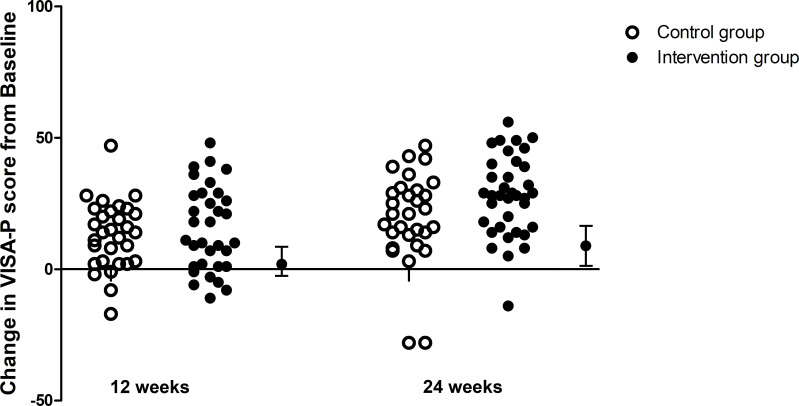
Objective: To compare the effectiveness of progressive tendon-loading exercises (PTLE) with eccentric exercise therapy (EET) in patients with patellar tendinopathy (PT). Methods: In a stratified, investigator-blinded, block-randomised trial, 76 patients with clinically diagnosed and ultrasound-confirmed PT were randomly assigned in a 1:1 ratio to receive either PTLE or EET. The primary end point was clinical outcome after 24 weeks following an intention-to-treat analysis, as assessed with the validated Victorian Institute of Sports Assessment for patellar tendons (VISA-P) questionnaire measuring pain, function and ability to play sports. Secondary outcomes included the return to sports rate, subjective patient satisfaction and exercise adherence. Results: Patients were randomised between January 2017 and July 2019. The intention-to-treat population (mean age, 24 years, SD 4); 58 (76%) male) consisted of patients with mostly chronic PT (median symptom duration 2 years). Most patients (82%) underwent prior treatment for PT but failed to recover fully. 38 patients were randomised to the PTLE group and 38 patients to the EET group. The improvement in VISA-P score was significantly better for PTLE than for EET after 24 weeks (28 vs 18 points, adjusted mean between-group difference, 9 (95% CI 1 to 16); p=0.023). There was a trend towards a higher return to sports rate in the PTLE group (43% vs 27%, p=0.13). No significant between-group difference was found for subjective patient satisfaction (81% vs 83%, p=0.54) and exercise adherence between the PTLE group and EET group after 24 weeks (40% vs 49%, p=0.33). Conclusions: In patients with PT, PTLE resulted in a significantly better clinical outcome after 24 weeks than EET. PTLE are superior to EET and are therefore recommended as initial conservative treatment for PT.
Overview
CoChat Summary
TL;DR
In patients with mostly chronic patellar tendinopathy, progressive tendon-loading exercises (PTLE) produced significantly better VISA-P improvement than eccentric exercise therapy (EET) at 24 weeks. PTLE is recommended as initial conservative treatment, although return-to-sports and satisfaction differences were not statistically significant.
Key findings
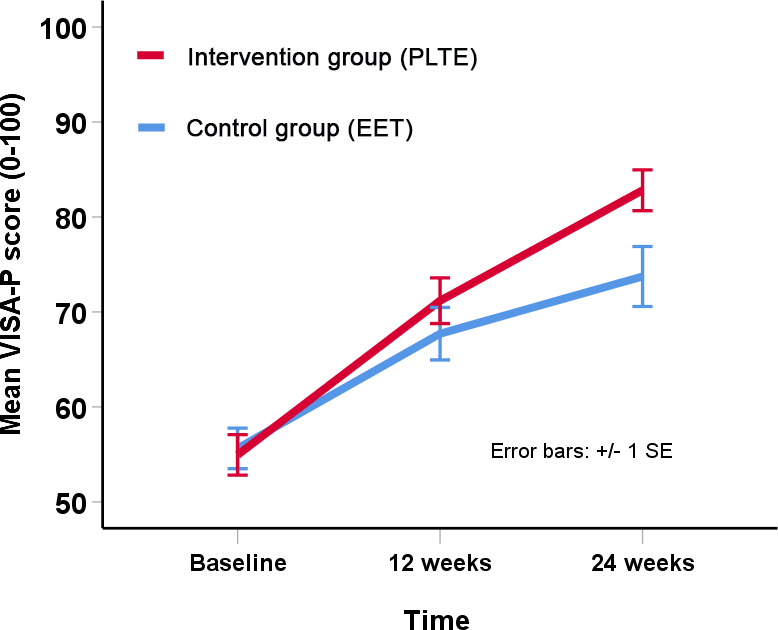
- VISA-P improvement was significantly better for PTLE than EET after 24 weeks (28 vs 18 points; adjusted mean between-group difference 9, 95% CI 1 to 16; p=0.023).
- There was a trend towards higher return to desired sports at preinjury level in the PTLE group (43% vs 27%; abstract p=0.13; results report p=0.16 for dichotomised return at 24 weeks).
- No significant between-group differences were found for subjective patient satisfaction (81% vs 83%, p=0.54) or exercise adherence (40% vs 49%, p=0.33) at 24 weeks, but excellent satisfaction was more frequent with PTLE (38% vs 10%, p=0.009).
- Exercise-related pain VAS at 24 weeks was significantly lower in PTLE than EET (estimated mean 2 vs 4; adjusted mean between-group difference 2, 95% CI 1 to 3; p=0.006).
Methods
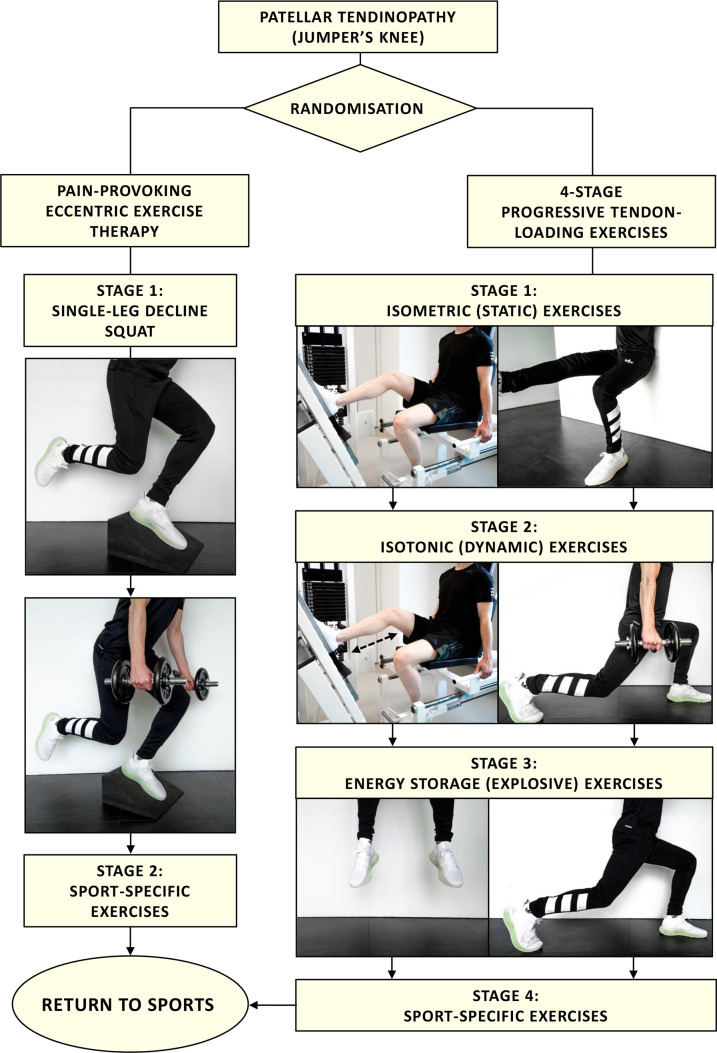
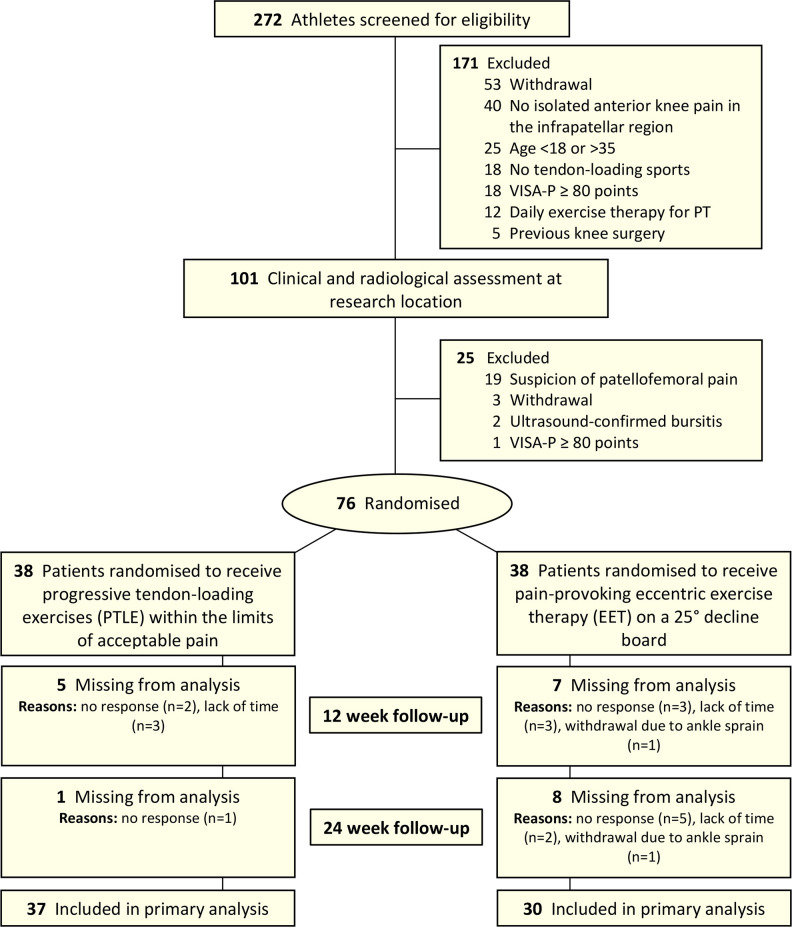
- Stratified, investigator-blinded, block-randomised controlled trial (JUMPER) at a university medical centre in The Netherlands; 76 patients with clinically diagnosed and ultrasound-confirmed PT were randomised 1:1 to PTLE or EET between January 2017 and July 2019.
- Primary outcome was the VISA-P questionnaire at 24 weeks; intention-to-treat analysis used generalised estimating equations with a study arm*visit interaction, adjusted for baseline age, sex, BMI, symptom duration and CSAS.
- Sample size was calculated at 76 patients to detect a minimum clinically important difference of 13 VISA-P points (power 0.80, two-sided significance 0.05, accounting for 10% lost to follow-up); population mean age was 24 years (SD 4), 58 (76%) were male, median symptom duration was 2 years, 42% had bilateral symptoms, and 82% had prior treatment for PT.
Limitations
- Stated: patient blinding was not possible; the worst-case sensitivity analysis for missing data would remove the significant advantage of PTLE; stratification for early versus longstanding PT was largely unfulfilled (only one patient had early tendinopathy); substantial individual variation was observed; the population mixed recreational and competitive athletes; and exercise therapy was unsupervised.
- Stated: less than half of PTLE patients returned to sports at preinjury level after 24 weeks, and satisfaction after 24 weeks was fairly low, suggesting room for improvement.
- Evident from the text: 9 patients (12%) were lost to follow-up (1 in PTLE, 8 in EET), and missing data were not imputed; sensitivity analyses except the worst-case scenario were consistent with the primary analysis.
Model-written summary. Check it against the paper before relying on it.
Integrity signals
Registry
Cites
Statistics
Figures
Verification
Claims the paper makes
0 Valid · 1 Not valid · 9 Not checked · 73 Own results and interpretations
A result the paper reports from its own data — it cites no other source for it, so there is none to check. The quote shows it is in the paper.
In the paper
“The adjusted mean between-group difference in VISA-P score was not significant at 12 weeks (1 (95% CI −6 to 8); p=0.69)”
§ Effectiveness of progressive tendon-loading exercise therapy in patients with patellar tendinopathy: a randomised clinical trial > Results > Primary outcome
plain- Asserted: passes — The authors put it forward as true.
- Checkable: passes — It can be checked against evidence.
- Load-bearing: passes — The paper’s conclusions depend on it.
- Based: passes — The paper gives a reason why it holds.
A result the paper reports from its own data — it cites no other source for it, so there is none to check. The quote shows it is in the paper.
In the paper
“The estimated mean VISA-P score improved significantly from 56 (95% CI 52 to 61) at baseline to 84 (95% CI 79 to 89); p<0.001 at 24 weeks in the PTLE group”
§ Effectiveness of progressive tendon-loading exercise therapy in patients with patellar tendinopathy: a randomised clinical trial > Results > Primary outcome
plainstates a cause- Asserted: passes — The authors put it forward as true.
- Checkable: passes — It can be checked against evidence.
- Load-bearing: passes — The paper’s conclusions depend on it.
- Based: passes — The paper gives a reason why it holds.
A result the paper reports from its own data — it cites no other source for it, so there is none to check. The quote shows it is in the paper.
In the paper
“No significant between-group difference was found for subjective patient satisfaction (81% vs 83%, p=0.54) and exercise adherence between the PTLE group and EET group after 24 weeks (40% vs 49%, p=0.33).”
§ Effectiveness of progressive tendon-loading exercise therapy in patients with patellar tendinopathy: a randomised clinical trial > Abstract > Results
plainn = 38- Asserted: passes — The authors put it forward as true.
- Checkable: passes — It can be checked against evidence.
- Load-bearing: unclear — It is unclear whether the paper’s conclusions depend on it.
- Based: passes — The paper gives a reason why it holds.
In the paper
“After 12 weeks, 16 patients (49%) in the PTLE group and 17 patients (55%) in the EET group achieved the previously reported MCID of 13 points or better for the VISA-P score.24”
§ Effectiveness of progressive tendon-loading exercise therapy in patients with patellar tendinopathy: a randomised clinical trial > Results > Primary outcome
What the sources say
- Not checked yetcites [24] Hernandez-Sanchez S, Hidalgo MD, Gomez A. Responsiveness of the VISA-P scale for Patellar tendinopathy in athletes. Br J Sports Med 2014; 48: 453– 7. 10.1136/bjsports-2012-091163 23012320 source
plainn = 16- Asserted: passes — The authors put it forward as true.
- Checkable: passes — It can be checked against evidence.
- Load-bearing: passes — The paper’s conclusions depend on it.
- Based: passes — The paper gives a reason why it holds.
A result the paper reports from its own data — it cites no other source for it, so there is none to check. The quote shows it is in the paper.
In the paper
“In our study, the major between-group difference was found in the latter half of the exercise programme.”
§ Effectiveness of progressive tendon-loading exercise therapy in patients with patellar tendinopathy: a randomised clinical trial > Discussion
plainstates an association- Asserted: passes — The authors put it forward as true.
- Checkable: passes — It can be checked against evidence.
- Load-bearing: passes — The paper’s conclusions depend on it.
- Based: passes — The paper gives a reason why it holds.
28 more claims
Create a free account to see all 83 claims and to verify the 8 references still open.
- Probably not a substantial claim. 34
- It may state two separate claims as one. 23
Self-check
Percentages, sums and reported differences re-computed from the paper’s own numbers.
Each contradiction between two passages listed here was confirmed by an independent check.
Rated minor: it would not touch a result — a value no result rests on, a p-value that stays on the same side of the significance level, or a conflict that is clerical, resolved elsewhere in the paper, or outside its own findings.
In the paper
“101 athletes were invited for eligibility assessment. Twenty-seven of these athletes were excluded, leaving 76 eligible patients remaining for inclusion”
§ Effectiveness of progressive tendon-loading exercise therapy in patients with patellar tendinopathy: a randomised clinical trial > Results
Reported 76 · recomputed 74
Rated minor: it would not touch a result — a value no result rests on, a p-value that stays on the same side of the significance level, or a conflict that is clerical, resolved elsewhere in the paper, or outside its own findings.
In the paper
§ Effectiveness of progressive tendon-loading exercise therapy in patients with patellar tendinopathy: a randomised clinical trial > Results
“An equal majority of the patients (82% in both groups) received therapy prior to the time of study commencement”
§ Effectiveness of progressive tendon-loading exercise therapy in patients with patellar tendinopathy: a randomised clinical trial > Results
“| Therapy prior to the time of study commencement, n (%) | | | | None | 6 (16) | 6 (16) |”
Rated minor: it would not touch a result — a value no result rests on, a p-value that stays on the same side of the significance level, or a conflict that is clerical, resolved elsewhere in the paper, or outside its own findings.
In the paper
§ Effectiveness of progressive tendon-loading exercise therapy in patients with patellar tendinopathy: a randomised clinical trial > Abstract > Results
“There was a trend towards a higher return to sports rate in the PTLE group (43% vs 27%, p=0.13).”
§ Effectiveness of progressive tendon-loading exercise therapy in patients with patellar tendinopathy: a randomised clinical trial > Results > Secondary outcomes
“The dichotomised return to sports was not statistically different between both groups at 12 weeks (p=0.13) and 24 weeks (p=0.16).”
Rated minor: it would not touch a result — a value no result rests on, a p-value that stays on the same side of the significance level, or a conflict that is clerical, resolved elsewhere in the paper, or outside its own findings.
In the paper
§ Effectiveness of progressive tendon-loading exercise therapy in patients with patellar tendinopathy: a randomised clinical trial > Abstract > Results
“No significant between-group difference was found for subjective patient satisfaction (81% vs 83%, p=0.54)”
§ Effectiveness of progressive tendon-loading exercise therapy in patients with patellar tendinopathy: a randomised clinical trial > Results > Secondary outcomes
“The dichotomised patient satisfaction was not statistically different between both groups at 12 weeks (p=0.18) and 24 weeks (p=0.81).”
Citations
Cites
Cook, J. L., & Purdam, C. R. (2009) · British Journal of Sports Medicine · doi:10.1136/bjsm.2008.051193 · Cited by 1,051
Prevalence of Jumper's Knee among Elite Athletes from Different Sports: A Cross-sectional Study
Lian, Ø. B., Engebretsen, L., & Bahr, R. (2005) · The American Journal of Sports Medicine · doi:10.1177/0363546504270454 · Cited by 908
Coombes, B. K., Bisset, L., & Vicenzino, B. (2010) · The Lancet · doi:10.1016/s0140-6736(10)61160-9 · Cited by 860
Platelet-Rich Plasma Injection for Chronic Achilles Tendinopathy: A Randomized Controlled Trial
de Vos, R. J., Weir, A., van Schie, H. T. M., Bierma-Zeinstra, S. M. A., Verhaar, J. A. N., Weinans, H., & Tol, J. L. (2010) · JAMA · doi:10.1001/jama.2009.1986 · Cited by 834
Accounting for missing data in statistical analyses: multiple imputation is not always the answer
Hughes, R. A., Heron, J., Sterne, J. A. C., & Tilling, K. (2019) · International Journal of Epidemiology · doi:10.1093/ije/dyz032 · Cited by 802
Crossley, K. M., Stefanik, J. J., Selfe, J., Collins, N. J., Davis, I. S., Powers, C. M., McConnell, J., Vicenzino, B., Bazett-Jones, D. M., Esculier, J.-F., et al. (2016) · British Journal of Sports Medicine · doi:10.1136/bjsports-2016-096384 · Cited by 619
Time to abandon the "tendinitis" myth
Khan, K. M. (2002) · BMJ · doi:10.1136/bmj.324.7338.626 · Cited by 478
Silbernagel, K. G., Thomeé, R., Eriksson, B. I., & Karlsson, J. (2007) · The American Journal of Sports Medicine · doi:10.1177/0363546506298279 · Cited by 415
Malliaras, P., Cook, J., Purdam, C., & Rio, E. (2015) · Journal of Orthopaedic & Sports Physical Therapy · doi:10.2519/jospt.2015.5987 · Cited by 339
Young, M. A., Cook, J. L., Purdam, C. R., Kiss, Z. S., & Alfredson, H. (2005) · British Journal of Sports Medicine · doi:10.1136/bjsm.2003.010587 · Cited by 317
Cited by
Challoumas, D., Pedret, C., Biddle, M., Ng, N. Y. B., Kirwan, P., Cooper, B., Nicholas, P., Wilson, S., Clifford, C., & Millar, N. L. (2021) · BMJ Open Sport & Exercise Medicine · doi:10.1136/bmjsem-2021-001110 · Cited by 146
Theodorou, A. J., Komnos, G. Α., & Hantes, M. E. (2023) · Archives of Orthopaedic and Trauma Surgery · doi:10.1007/s00402-023-04998-5 · Cited by 87
The emerging role of Piezo1 in the musculoskeletal system and disease
Lei, L., Wen, Z., Cao, M., Zhang, H., Ling, S. K.-K., Fu, S., Qin, L., Xu, J., & Yung, P. S. (2024) · Theranostics · doi:10.7150/thno.96959 · Cited by 86
Radovanović, G., Böhm, S., Peper, K. K., Arampatzis, A., & Legerlotz, K. (2022) · Sports Medicine - Open · doi:10.1186/s40798-022-00545-5 · Cited by 72
Challoumas, D., Crosbie, G., O’Neill, S., Pedret, C., & Millar, N. L. (2023) · Sports Medicine - Open · doi:10.1186/s40798-023-00616-1 · Cited by 63
Clinical Management of Patellar Tendinopathy
Rosen, A. B., Wellsandt, E. A., Nicola, M., & Tao, M. A. (2021) · Journal of Athletic Training · doi:10.4085/1062-6050-0049.21 · Cited by 60
Pavlova, A. V., Shim, J., Moss, R. A., MacLean, C., Brandie, D., Mitchell, L. E., Greig, L., Parkinson, E., Alexander, L., Brown, V. T., et al. (2023) · British Journal of Sports Medicine · doi:10.1136/bjsports-2022-105754 · Cited by 56
Cooper, K., Alexander, L., Brandie, D., Brown, V. T., Greig, L., Harrison, I., MacLean, C., Mitchell, L., Morrissey, D., Moss, R. A., et al. (2023) · Health Technology Assessment · doi:10.3310/tfws2748 · Cited by 56
Breda, S. J., de Vos, R., Krestin, G. P., & Oei, E. H. G. (2022) · Journal of science and medicine in sport · doi:10.1016/j.jsams.2022.01.002 · Cited by 38
Self-citationOwoeye, O. B. A., Palacios-Derflingher, L. M., Pasanen, K., HubkaRao, T., Wiley, P., & Emery, C. A. (2021) · International Journal of Environmental Research and Public Health · doi:10.3390/ijerph18189480 · Cited by 33
Uma análise das tendinopatias: tendinopatia de Aquiles e tendinopatia patelar
dos Santos, J. V. T. M., Rodrigues, G. M., Ferreira, R. M., & de Siqueira, E. C. (2024) · Revista Eletrônica Acervo Saúde · doi:10.25248/reas.e14574.2024 · Cited by 31
Song, K., Silva, R. S., Hullfish, T. J., Silbernagel, K. G., & Baxter, J. R. (2023) · The American Journal of Sports Medicine · doi:10.1177/03635465231175160 · Cited by 31
Burton, I., & McCormack, A. (2022) · Physical Therapy in Sport · doi:10.1016/j.ptsp.2022.03.002 · Cited by 31
The Epidemiology, Risk Factors, and Nonsurgical Treatment of Injuries Related to Endurance Running
Raghunandan, A., Charnoff, J. N., & Matsuwaka, S. T. (2021) · Current Sports Medicine Reports · doi:10.1249/jsr.0000000000000852 · Cited by 26
Hong, Q.-M., Wang, H., Liu, X., Zhou, W., Zhang, X., & Luo, X.-B. (2023) · BMC Musculoskeletal Disorders · doi:10.1186/s12891-023-07027-z · Cited by 24
Silva, R. S., Song, K., Hullfish, T. J., Sprague, A. L., Silbernagel, K. G., & Baxter, J. R. (2023) · Medicine & Science in Sports & Exercise · doi:10.1249/mss.0000000000003323 · Cited by 23
Núñez-Martínez, P., & Hernández‐Guillén, D. (2021) · Journal of Sport Rehabilitation · doi:10.1123/jsr.2021-0117 · Cited by 22
Auliffe, S. M., Bisset, L., Chester, R., Coombes, B. K., Fearon, A., Kirwan, P., McCreesh, K. M., Mitham, K., Morrissey, D., O’Neill, S., et al. (2022) · Journal of Orthopaedic and Sports Physical Therapy · doi:10.2519/jospt.2022.11005 · Cited by 22
Breda, S. J., de Vos, R., Poot, D. H. J., Krestin, G. P., Hernandez-Tamames, J. A., & Oei, E. H. G. (2021) · Journal of Magnetic Resonance Imaging · doi:10.1002/jmri.27751 · Cited by 23
Self-citationSwinton, P. A., Shim, J., Pavlova, A. V., Moss, R. A., MacLean, C., Brandie, D., Mitchell, L., Greig, L., Parkinson, E., Brown, V. T., et al. (2023) · BMJ Open Sport & Exercise Medicine · doi:10.1136/bmjsem-2022-001389 · Cited by 21
Heide, M., Røe, C., Mørk, M., Myhre, K., Brunborg, C., Brox, J. I., & Hoksrud, A. F. (2024) · British Journal of Sports Medicine · doi:10.1136/bjsports-2024-108139 · Cited by 21
Maximal Lower Limb Strength in Patellar Tendinopathy: A Systematic Review With Meta-Analysis
Obst, S. J., Peterson, B. J., & Heales, L. (2024) · Journal of Athletic Training · doi:10.4085/1062-6050-0662.22 · Cited by 18
Patellar Tendinopathy: Critical Analysis Review of Current Nonoperative Treatments
Marigi, E. M., Buckley, P., Razi, F., Abbas, M. J., Jildeh, T. R., Camp, C. L., Krych, A. J., & Okoroha, K. R. (2022) · JBJS Reviews · doi:10.2106/jbjs.rvw.21.00168 · Cited by 18
Soler, R., Rodas, G., Rius-Tarruella, J., Alomar, X., Balius, R., Ruíz-Cotorro, Á., Masci, L. A., Maffulli, N., & Orozco, L. (2023) · Orthopaedic Journal of Sports Medicine · doi:10.1177/23259671231184400 · Cited by 18
A Review of Patellar Tendinopathy in Athletes Involved in Jumping Sports
Walton, J., Kozina, E., Woo, F., & Jadidi, S. (2023) · Cureus · doi:10.7759/cureus.47459 · Cited by 18
Barker-Davies, R. M., Baker, P., Watson, J., Goodall, D., Wheeler, P. C., Nicol, A. M., Fong, D. T.-P., Lewis, M. P., & Bennett, A. N. (2022) · Orthopaedic Journal of Sports Medicine · doi:10.1177/23259671221088326 · Cited by 17
Agergaard, A., Svensson, R. B., Malmgaard‐Clausen, N. M., & Magnusson, S. P. (2024) · Orthopaedic Journal of Sports Medicine · doi:10.1177/23259671241280192 · Cited by 16
Tian, J., Zhou, F., Zhang, X., Wang, H. Y., Peng, S. H., Li, X., Cao, J., & Zhang, H. (2022) · Geriatric Nursing · doi:10.1016/j.gerinurse.2022.07.013 · Cited by 16
Plesek, J., Hamill, J., Burda, M., Elavsky, S., Skýpala, J., Urbaczka, J., Silvernail, J. F., Zahradník, D., Uchytil, J., & Jandačka, D. (2024) · Medicine & Science in Sports & Exercise · doi:10.1249/mss.0000000000003617 · Cited by 15
The Influence of Different Modes of Exercise on Healthy and Injured Tendons
Wang, K., & Zhao, L. (2022) · Stem Cells International · doi:10.1155/2022/3945210 · Cited by 15
Li, Y., Sun, D., Fang, Y., Lu, Z., Shi, F., Liu, G., & Gu, Y. (2024) · Heliyon · doi:10.1016/j.heliyon.2024.e39171 · Cited by 14
Deng, J., Li, L., Oosterhof, J. J., Malliaras, P., Silbernagel, K. G., Breda, S. J., Eygendaal, D., Oei, E. H., & de Vos, R.-J. (2025) · Musculoskeletal Science and Practice · doi:10.1016/j.msksp.2025.103275 · Cited by 12
Self-citationStandardized pain mapping for diagnosing Achilles tendinopathy
Visser, T. S., van Es, E. M., Meuffels, D. E., Verhaar, J. A. N., & de Vos, R. (2021) · Journal of science and medicine in sport · doi:10.1016/j.jsams.2021.10.010 · Cited by 13
Ballet Rehabilitation: A Novel Return to Sport Protocol
Glasser, L., Frey, M., Frias, G. C., Varghese, B. B., Melendez, J. X., Hawes, J., Escobar, J., & Katt, B. M. (2022) · Cureus · doi:10.7759/cureus.27896 · Cited by 12
Burton, I. (2022) · Rheumato · doi:10.3390/rheumato3010003 · Cited by 12
Deng, J. F., Breda, S. J., Eygendaal, D. E., Oei, E. H. G., & de Vos, R. (2023) · The American Journal of Sports Medicine · doi:10.1177/03635465231200241 · Cited by 12
Self-citationHjortshoej, M. H., Agergaard, A., Larsen, F. K., Thomsen, L. J. P., Svensson, R. B., Couppé, C., & Magnusson, S. P. (2024) · Journal of Clinical Ultrasound · doi:10.1002/jcu.23655 · Cited by 12
Gesù, M. D., Alito, A., Borzelli, D., Romeo, D., Bonomolo, F., Calafiore, D., & Alessandro de, S. I. R. E. (2024) · Journal of Back and Musculoskeletal Rehabilitation · doi:10.3233/bmr-230255 · Cited by 13
Achilles tendon structure is associated with regular running volume and biomechanics
Jandačka, D., Jandackova, V. K., Juráš, V., Vilímek, D., Skýpala, J., Elavsky, S., Uchytil, J., Monte, A., & Hamill, J. (2023) · Journal of Sports Sciences · doi:10.1080/02640414.2023.2214395 · Cited by 11
Shim, J., Pavlova, A. V., Moss, R. A., MacLean, C., Brandie, D., Mitchell, L. E., Greig, L., Parkinson, E., Brown, V. T., Morrissey, D., et al. (2023) · Physiotherapy · doi:10.1016/j.physio.2023.05.002 · Cited by 11
Xiao, L., Zhou, H., He, J., Liu, H., Li, Y., Liu, Z., & Hu, H. (2024) · BMC Sports Science Medicine and Rehabilitation · doi:10.1186/s13102-024-01004-2 · Cited by 10
Deng, J. F., Oosterhof, J. J., Eygendaal, D. E., Breda, S. J., Oei, E. H. G., & de Vos, R. (2025) · The American Journal of Sports Medicine · doi:10.1177/03635465251336466 · Cited by 10
Self-citationHjortshoej, M. H., Juneja, H., Svensson, R. B., Herzog, R. B., Lundgaard‐Nielsen, M., Nielsen, F. K., Wulff, M. W., Olesen, A. E., Nybing, J. D., Hansen, P., et al. (2025) · Scandinavian Journal of Medicine and Science in Sports · doi:10.1111/sms.70186 · Cited by 10
Conservative Treatments for Patellar Tendinopathy: A Review of Recent High-Quality Evidence
Čobec, J., & Kozinc, Ž. (2022) · BioMed · doi:10.3390/biomed2040028 · Cited by 10
Niering, M., & Muehlbauer, T. (2023) · The Journal of Strength and Conditioning Research · doi:10.1519/jsc.0000000000004467 · Cited by 10
Cordeiro, T. T. P., Rocha, E. A. B., & Silva, R. S. (2024) · Scientific Reports · doi:10.1038/s41598-024-53283-x · Cited by 10
Effects of Different Loading Programs on Finger Strength in Rock Climbers
Gilmore, N. K., Klimek, P., Abrahamsson, E., & Baar, K. (2024) · Sports Medicine - Open · doi:10.1186/s40798-024-00793-7 · Cited by 9
Exercise benefits yourself and your offspring: a mini-review
Wang, K., Zhao, J., Wang, Y., & Liu, M. (2025) · Frontiers in Cell and Developmental Biology · doi:10.3389/fcell.2025.1606790 · Cited by 9
Kim, D., Moon, H. Y., & Lee, M. C. (2025) · Research in Sports Medicine · doi:10.1080/15438627.2025.2568936 · Cited by 9
Deng, J. F., Runhaar, J., Breda, S. J., Oei, E. H. G., Eygendaal, D. E., & de Vos, R. (2024) · Journal of science and medicine in sport · doi:10.1016/j.jsams.2024.12.006 · Cited by 9
Self-citationA Critical Review of Trunk and Hip Exercise Prescription: Applying Evidence for a Modern Approach
Short, S., Short, G., Lehman, G., Friesen, J., & Johnson, B. (2025) · International Journal of Sports Physical Therapy · doi:10.26603/001c.129972 · Cited by 8
Exercise for patellar tendinopathy
Lópes, A. D., Rizzo, R. R. N., Hespanhol, L., Costa, L. O. P., & Kamper, S. J. (2025) · Cochrane Database of Systematic Reviews · doi:10.1002/14651858.cd013078.pub2 · Cited by 8
Yap, B. W. D., & Lim, E. C. W. (2025) · Journal of Back and Musculoskeletal Rehabilitation · doi:10.1177/10538127251339104 · Cited by 8
Rubin, E., Schmidt, A. M., Koff, M. F., Kogan, F., Gao, K. T., Majumdar, S., Potter, H. G., & Gold, G. E. (2023) · Journal of Magnetic Resonance Imaging · doi:10.1002/jmri.29019 · Cited by 8
Biese, K. M., Godejohn, A., Ament, K., Luedke, L. E., Schmidt, W. D., Wallace, B., & Sipes, R. C. (2024) · Journal of Sport Rehabilitation · doi:10.1123/jsr.2024-0007 · Cited by 7
Judd, A., Wild, K., Puxley, L., & Barker-Davies, R. M. (2025) · BMJ Military Health · doi:10.1136/military-2024-002893 · Cited by 7
Martin, J., Perraton, L. G., Gupta, A., Garofolini, A., & Malliaras, P. (2022) · Physical Therapy in Sport · doi:10.1016/j.ptsp.2022.12.002 · Cited by 7
Davis, J., Doyle, B., Ishii, H., & Jayanthi, N. A. (2023) · Current Reviews in Musculoskeletal Medicine · doi:10.1007/s12178-023-09874-8 · Cited by 7
Hong, Q.-M., Wang, H., Liu, X.-H., Zhou, W.-Q., & Luo, X.-B. (2024) · Trials · doi:10.1186/s13063-024-08203-9 · Cited by 7
Cordella, M., Pellicciari, L., Scopece, F., Fornaro, R., Giovannico, G., & Lanfranchi, E. (2023) · Journal of Hand Therapy · doi:10.1016/j.jht.2023.08.016 · Cited by 6
Sharif, F., Ahmad, A., Gilani, S. A., & Mahmood, D. (2025) · Frontiers in Rehabilitation Sciences · doi:10.3389/fresc.2024.1263295 · Cited by 6
Eccentric Training for Tendinopathies in Athletes: A Scoping Review and Evidence Gap Map
Trybulski, R., Olaniszyn, G., Matuszczyk, F., Gałęziok, K., Vovkanych, A., & Svyshch, Y. (2026) · Journal of Sports Science and Medicine · doi:10.52082/jssm.2026.34 · Cited by 5
Patellar Tendinopathy: Diagnosis and Management
Drakes, S. (2023) · Current Physical Medicine and Rehabilitation Reports · doi:10.1007/s40141-023-00407-5 · Cited by 6
La rééducation des tendinopathies du membre inférieur : que s’est-il passé depuis 40 ans ?
Gaspar, M., & Tamalet, B. (2022) · Journal de Traumatologie du Sport · doi:10.1016/j.jts.2021.12.002 · Cited by 6
van Dam, L., Terink, R., Mensink, M., de Vos, R., & Zwerver, J. (2023) · Trials · doi:10.1186/s13063-023-07783-2 · Cited by 6
Self-citationHagen, M., Chebly, J., Dhaen, B., Fassian, N., Salvalaggio, M., Catelli, D. S., Verschueren, S., & Vanrenterghem, J. (2024) · Clinical Biomechanics · doi:10.1016/j.clinbiomech.2024.106179 · Cited by 6
Deng, J. F., Breda, S. J., Fang, Y., Eygendaal, D. E., de Vos, R., & Oei, E. H. G. (2026) · Sports Health A Multidisciplinary Approach · doi:10.1177/19417381251401164 · Cited by 5
Self-citationFerreira, S. F. C. C., Bezerra, M. A., de Oliveira, R. R., & Lima, P. O. D. P. (2025) · Physical Therapy in Sport · doi:10.1016/j.ptsp.2025.03.005 · Cited by 5
Pérez, S. E. M., Pérez, I. M. M., Ramírez, P. L., Trujillo, A. J. R.-P., Cabrera, E. C., Romero, E. A. S., Sosa-Reina, M. D., Pérez, J. L. A., Villafañe, J. H., & Fernández‐Carnero, J. (2022) · Scientific Journal of Sport and Performance · doi:10.55860/pgma4758 · Cited by 5
Pires, F. S., da Silva, J. B., Pedroso, K. A., & Machado, M. R. (2022) · Research Society and Development · doi:10.33448/rsd-v11i14.36138 · Cited by 5
Roubea, I., & Korakakis, V. (2024) · Journal of Bodywork and Movement Therapies · doi:10.1016/j.jbmt.2024.01.031 · Cited by 5
Burton, I., & McCormack, A. (2022) · Clinical Rehabilitation · doi:10.1177/02692155221088767 · Cited by 5
Domínguez-Gavia, N. I., Luján, R. C., Candia-Sosa, K. F., Carreño, R. E. A., & Herrera-Covarrubias, C. I. (2024) · Retos · doi:10.47197/retos.v63.109368 · Cited by 4
Judd, A., Wild, K., Puxley, L., & Barker-Davies, R. M. (2025) · BMJ Military Health · doi:10.1136/military-2024-002892 · Cited by 4
Ilham, Tomoliyus, Sugiyanton, F., Kushartanti, W., Darni, Widiyanto, Syafrianto, D., Ayubi, N., Ndayisenga, J., Arovah, N. I., et al. (2024) · Journal of Physical Education and Sport · doi:10.7752/jpes.2024.09246 · Cited by 4
Hwangbo, S.-Y., Kim, Y.-J., Shin, D. G., An, S.-J., Choi, H., Lee, Y., Lee, Y. J., Kim, J. Y., & Ha, I. (2023) · Healthcare · doi:10.3390/healthcare11222939 · Cited by 4
Burton, I., & McCormack, A. (2022) · Translational Sports Medicine · doi:10.1155/2022/2561142 · Cited by 4
Mechanical Stimulation as Both the Cause and the Cure of Tendon and Ligament Injuries
Paschall, L., Pedaprolu, K., Carrozzi, S., Dhawan, A., & Szczesny, S. E. (2022) · Physiology in health and disease · doi:10.1007/978-3-030-95884-8_11 · Cited by 4
Fang, Y., Deng, J. F., Breda, S. J., de Vos, R., Oei, E. H. G., & Hirvasniemi, J. (2026) · European Journal of Radiology · doi:10.1016/j.ejrad.2026.112675 · Cited by 3
Self-citationAgergaard, A., Svensson, R. B., Hoeffner, R., Gillani, S. Z., & Magnusson, S. P. (2026) · Scandinavian Journal of Medicine and Science in Sports · doi:10.1111/sms.70235 · Cited by 3
Phadke, R. A., Salman, S., Patel, K., Wardeh, J., Marupudi, A., Kumar, R., Momin, A. A., & Tavakkoli, A. (2026) · Discover Neuroscience · doi:10.1186/s13064-026-00261-w · Cited by 3
The Future of Sport and Exercise Science Research in the Female Athlete
Kelly, R. K., & Ackerman, K. E. (2023) · Springer eBooks · doi:10.1007/978-3-031-21881-1_23 · Cited by 3
Guo, J., Zhang, T., Li, M., Wang, Q., & Ding, X. (2025) · Biomedical Materials · doi:10.1088/1748-605x/adc5c0 · Cited by 3
Ilham, Selviani, I., Azzahra, F., Teressa, F., & Safitri, M. (2024) · Journal of Physical Education and Sport · doi:10.7752/jpes.2024.12322 · Cited by 3
Rich, A., Cook, J. L., Hahne, A. J., & Ford, J. J. (2025) · International Journal of Sports Physical Therapy · doi:10.26603/001c.138308 · Cited by 3
Wheeler, P. C., Dudson, C., & Calver, R. (2023) · Muscles Ligaments and Tendons Journal · doi:10.32098/mltj.04.2023.03 · Cited by 3
A Narrative Review Current Physical Therapy Management for Patellar Tendinopathy
Dungkong, S. (2024) · Siriraj Medical Journal/San Sirirat · doi:10.33192/smj.v76i3.266586 · Cited by 3
Swinton, P. A., Shim, J., Pavlova, A. V., Moss, R. E., MacLean, C., Brandie, D., Brown, V. T., Greig, L., Parkinson, E., Alexander, L., et al. (2022) · doi:10.51224/srxiv.155 · Cited by 3
Feasibility of an early progressive resistance exercise program for acute Achilles tendon rupture
Christensen, M., Silbernagel, K. G., Zellers, J. A., Kjær, I. L., & Rathleff, M. S. (2024) · Pilot and Feasibility Studies · doi:10.1186/s40814-024-01494-4 · Cited by 2
Rehabilitation and Return to Sports of Lower Limb Tendinopathies
Silva, R. S., Bittencourt, N. F. N., Hanlon, S. L., Mendonça, L. D. M., & Silbernagel, K. G. (2024) · Springer eBooks · doi:10.1007/978-3-030-65430-6_210-1 · Cited by 2
Toustrup, J. L., Lyng, K. D., Hunniche, S. S., Mølgaard, K., Olesen, J. L., & Riel, H. (2024) · Disability and Rehabilitation · doi:10.1080/09638288.2024.2417765 · Cited by 2
Selvamoorthy, R., Arvanitidis, M., Negro, F., Pincheira, P. A., Evans, D. W., & Martinez‐Valdes, E. (2025) · BMJ Open · doi:10.1136/bmjopen-2024-092104 · Cited by 2
Invasive physiotherapy techniques in patellar tendinopathy. A Systematic Review
Aznar, D., Ortego, G., Espallargas, L. P., Al-Boloushi, Z., Carcasona-Otal, A., & Lapuente‐Hernández, D. (2025) · Invasive Physiotherapy and Musculoskeletal Medicine · doi:10.63360/ipmm.v1.e9 · Cited by 2
Rehabilitation Strategies and Pain Management in Athletes with Musculoskeletal Injuries - a review
Chowaniec-Rybka, K., Bujak, M., Sztajura, J., & Szot, A. (2026) · Journal of Education Health and Sport · doi:10.12775/jehs.2026.88.68251 · Cited by 2
Centro de Investigación en Medicina Ejercicio Deporte y Salud, C. M., Droppelmann, G., Torrez, A., García, N., Centro de Investigación en Medicina Ejercicio Deporte y Salud, C. M., Greene, C., & Centro de Investigación en Medicina Ejercicio Deporte y Salud, C. M. (2023) · Principles and Practice of Clinical Research Journal · doi:10.21801/ppcrj.2022.84.1 · Cited by 2
Murphy, M., & Rio, E. (2023) · Journal of Orthopaedic and Sports Physical Therapy · doi:10.2519/jospt.2023.12372 · Cited by 2
Concurrent Bilateral Patellar Tendon Ultrasonic Debridement in a Collegiate Athlete — A Case Report
Kruse, R. C., Krill, M., & Solsrud, E. (2022) · Current Sports Medicine Reports · doi:10.1249/jsr.0000000000000952 · Cited by 1
Introduction to MRI of Short- and Ultrashort-T2 Tissues
Du, J., & Bydder, G. M. (2023) · Springer eBooks · doi:10.1007/978-3-031-35197-6_1 · Cited by 1
Widanti, H. N., & Arti, W. (2024) · JURNAL PROFESIONAL FISIOTERAPI · doi:10.24127/fisioterapi.v3i2.6209 · Cited by 1
Vallance, P., Kidgell, D. J., & Malliaras, P. (2026) · European Journal of Applied Physiology · doi:10.1007/s00421-026-06166-0 · Cited by 1
Metadata
- Authors
- Breda, S. J., Oei, E. H. G., Zwerver, J., Visser, E., Waarsing, E., Krestin, G. P., & de Vos, R.-J.
- Affiliations
- Erasmus MC (NL)
- University Medical Center Groningen (NL)
- Corresponding author
- Breda, Stephan J
- ORCID
- Venue
- British Journal of Sports Medicine
- Publisher
- BMJ
- Published
- 2020-11-20
- Volume
- 55
- Issue
- 9
- Pages
- 501-509
- ISSN
- 0306-3674 (ISSN-L)
- 1473-0480
- PMC
- PMC8070614
- OpenAlex
- W3098426061
- Cited by
- 202
- References
- 30
- Citations by year
- 2026: 43 · 2025: 33 · 2024: 47 · 2023: 42 · 2022: 27 · 2021: 10
- FWCI
- 17.22
- Type
- journal article
- Language
- en
- Open access
- hybrid
- doi.org
- Licence
- Locations
- British Journal of Sports Medicine (publishedVersion, cc-by-nc)
- EUR Research Repository (Erasmus University Rotterdam) (publishedVersion, cc-by-nc)
- PubMed (publishedVersion)
- PubMed Central (publishedVersion, cc-by-nc)
- University of Groningen research database (University of Groningen / Centre for Information Technology) (publishedVersion, cc-by-nc)
- EUR Research Repository (Erasmus University Rotterdam) (submittedVersion, cc-by-nc)
- University of Groningen research database (University of Groningen / Centre for Information Technology) (submittedVersion, cc-by-nc)
- Funders
- National Basketball Association
- GE Healthcare
- Topics
- Health Sciences › Medicine › Orthopedics and Sports Medicine › Tendon Structure and Treatment
- Physical Sciences › Engineering › Biomedical Engineering › Lower Extremity Biomechanics and Pathologies
- Health Sciences › Medicine › Surgery › Knee injuries and reconstruction techniques
- Keywords
- patellar tendinopathy, exercise therapy, VISA-P score, return to sport, exercise adherence, patient satisfaction, conservative treatment
- MeSH terms
- Return to Sport, Adult, Exercise Therapy, Female, Humans, Male, Netherlands, Pain Measurement, Patella, Patient Compliance, Ultrasonography, Single-Blind Method, Treatment Outcome, Patient Satisfaction, Tendinopathy, Young Adult, Intention to Treat Analysis
About these checks
Registry, retraction, Cites and statistics results are computed, not judged, with one exception: a printed reference that no index lists is read once by a model before it counts as a citation error. Claims are extracted by a model and kept only when their quote appears verbatim in the text; each cited source is then checked, with a model’s help, for whether it says what the claim relies on. Those verdicts can be wrong — read the claim’s quote and the cited source before relying on one.
A language model drew the claims from the paper on 2026-11-19, under version 3 of the claim definition (model deepseek-v4.1-flash, prompt extract-v3).
A second model labelled each claim on 2026-11-19 (model jev-1.13-20260917, definition revision gold-guideline-v0.2).
Statistics and arithmetic are recomputed, not judged.
Confidence bands are shown only for fields calibrated on our annotated test set. None is calibrated yet, so no band is shown.
What counts as a claim ›How we measure confidence ›How we check this ›
Are you an author, or do you see a problem with this page? Request a review
Data sources
Bibliographic data: Semantic Scholar, OpenAlex, Crossref.
Contains information from the Semantic Scholar Academic Graph Datasets, made available under the ODC Attribution License (ODC-BY 1.0).
Semantic Scholar’s data is described in: Kinney, R., et al. (2023). The Semantic Scholar Open Data Platform. arXiv:2301.10140.
