

The DOI matches its Crossref record; 217 of the 218 references it cites were found in a registry or an index.
Efficacy of interventions to reduce long term opioid treatment for chronic non-cancer pain: systematic review and meta-analysis
Open accessAbstract
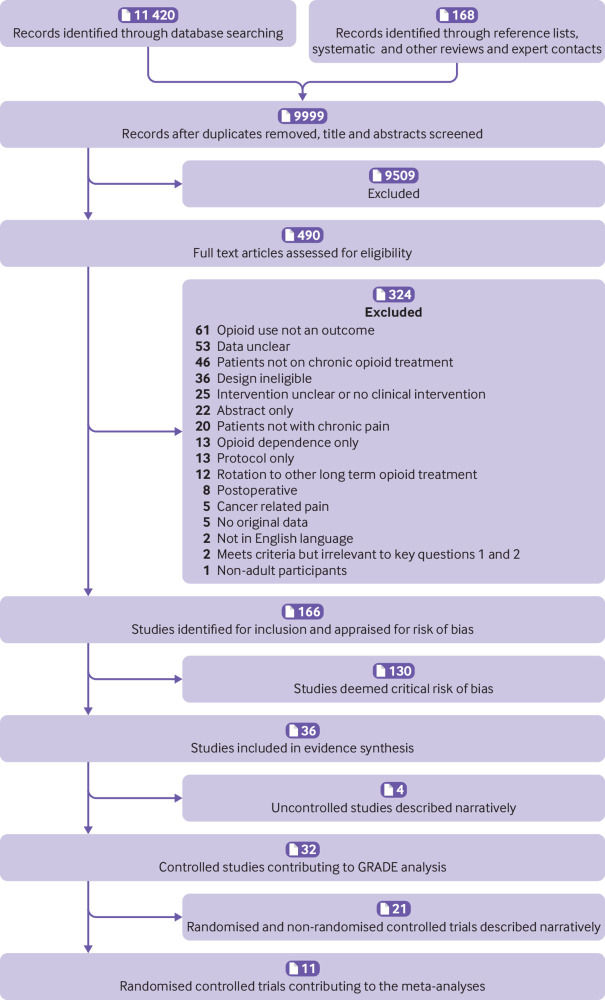
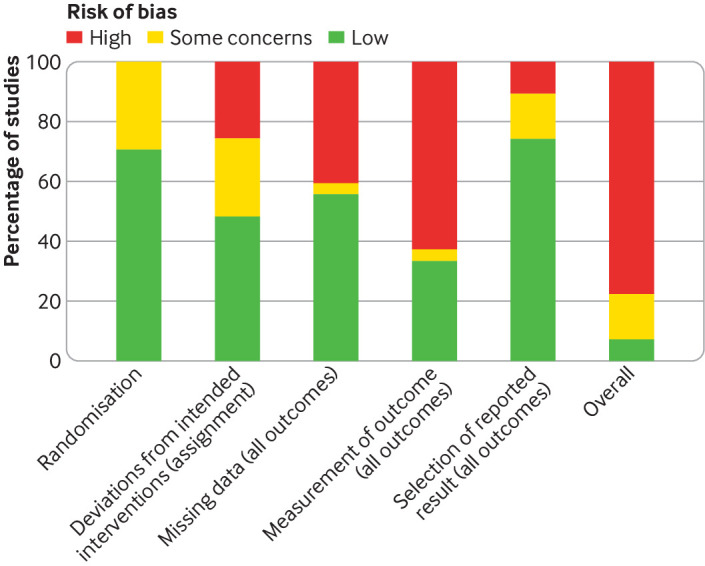
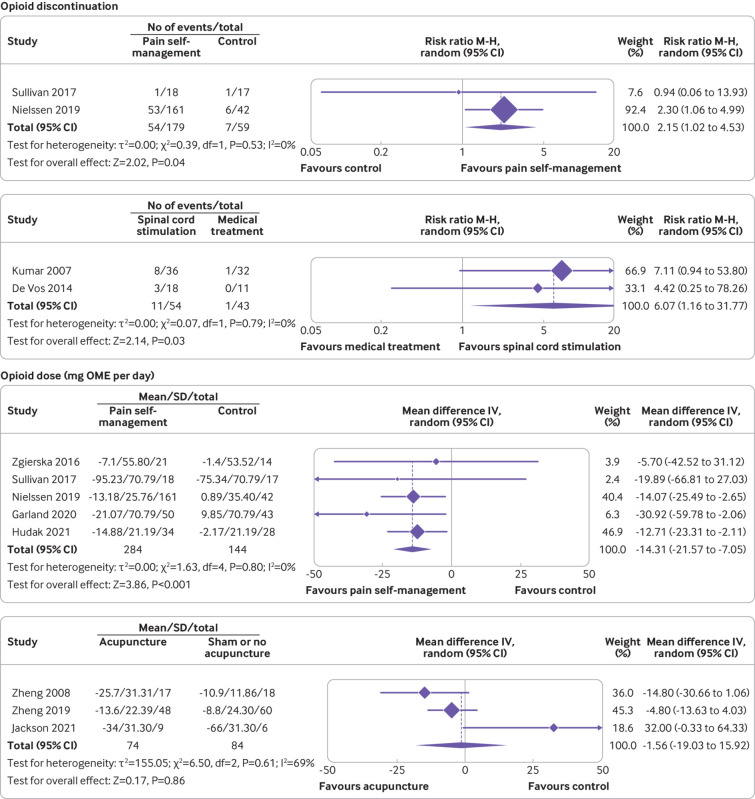
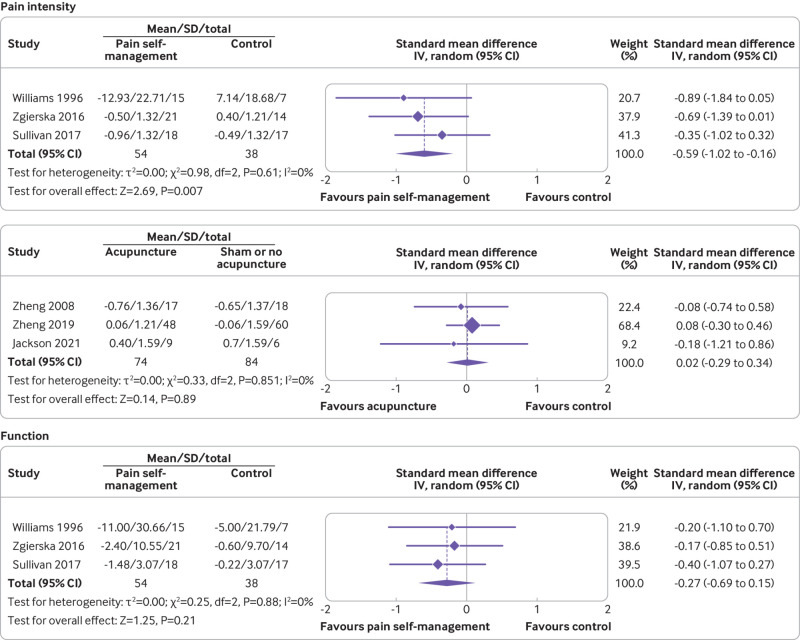
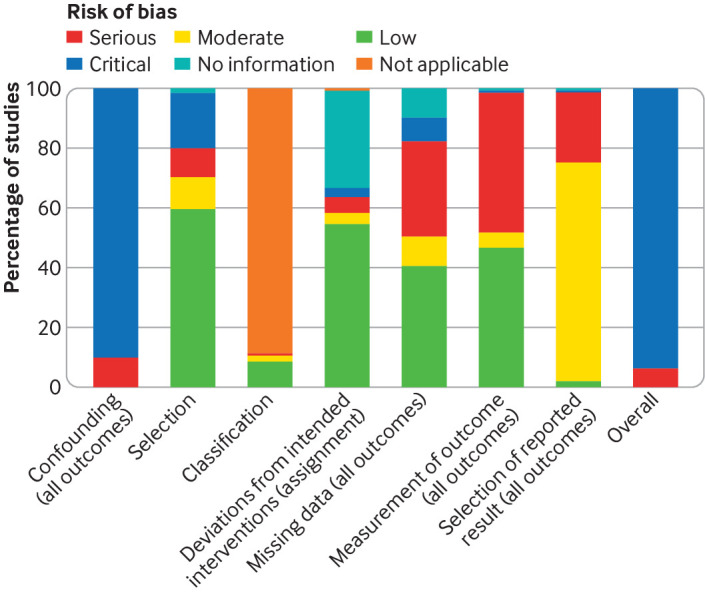
Abstract Objective To review interventions to reduce long term opioid treatment in people with chronic non-cancer pain, considering efficacy on dose reduction and discontinuation, pain, function, quality of life, withdrawal symptoms, substance use, and adverse events. Design Systematic review and meta-analysis of randomised controlled trials and non-randomised studies of interventions. Data sources Medline, Embase, PsycINFO, CINAHL, and the Cochrane Library searched from inception to July 2021. Reference lists and previous reviews were also searched and experts were contacted. Eligibility criteria for study selection Original research in English. Case reports and cross sectional studies were excluded. Data extraction and synthesis Two authors independently selected studies, extracted data, and used the Cochrane risk-of-bias tools for randomised and non-randomised studies (RoB 2 and ROBINS-I). Authors grouped interventions into five categories (pain self-management, complementary and alternative medicine, pharmacological and biomedical devices and interventions, opioid replacement treatment, and deprescription methods), estimated pooled effects using random effects meta-analytical models, and appraised the certainty of evidence using GRADE (grading of recommendations, assessment, development, and evaluation). Results Of 166 studies meeting inclusion criteria, 130 (78%) were considered at critical risk of bias and were excluded from the evidence synthesis. Of the 36 included studies, few had comparable treatment arms and sample sizes were generally small. Consequently, the certainty of the evidence was low or very low for more than 90% (41/44) of GRADE outcomes, including for all non-opioid patient outcomes. Despite these limitations, evidence of moderate certainty indicated that interventions to support prescribers’ adherence to guidelines increased the likelihood of patients discontinuing opioid treatment (adjusted odds ratio 1.5, 95% confidence interval 1.0 to 2.1), and that these prescriber interventions as well as pain self-management programmes reduced opioid dose more than controls (intervention v control, mean difference –6.8 mg (standard error 1.6) daily oral morphine equivalent, P<0.001; pain programme v control, −14.31 mg daily oral morphine equivalent, 95% confidence interval −21.57 to −7.05). Conclusions Evidence on the reduction of long term opioid treatment for chronic pain continues to be constrained by poor study methodology. Of particular concern is the lack of evidence relating to possible harms. Agreed standards for designing and reporting studies on the reduction of opioid treatment are urgently needed. Review registration PROSPERO CRD42020140943.
Overview
The claims and statistics of this paper haven’t been checked yet.
Run the check — free, no account needed. It reads the open-access text and checks the sources it cites.
Integrity signals
Registry
Cites
Statistics
Figures
Verification
Claims the paper makes
The claims and statistics of this paper haven’t been checked yet.
Run the check — free, no account needed. It reads the open-access text and checks the sources it cites.
Claims other papers make about this one
Each is checked against this paper’s own text: does it say what the citing paper says it does?
The source backs part of the claim, not all of it — or backs it for a different population, condition or comparison.
In the citing paper
“Nevertheless, most longitudinal studies have found that patients on opioid agonists are not able to successfully complete tapering attempts.6–8”
From Tapering and withdrawing opioids: guidance informed by fundamental principles to minimise withdrawal symptoms (2025) · cites this paper as [8]
Experimental — accuracy not yet measured
Self-check
Percentages, sums and reported differences re-computed from the paper’s own numbers.
The self-check needs the paper’s full text.
Citations
Cites
Items 201–217 of 217
Bienek, N., Maier, C., Kaisler, M., Michel‐Lauter, B., Schwarzer, A., & Meyer‐Frießem, C. H. (2018) · Pain Medicine · doi:10.1093/pm/pny320 · Cited by 13
Pearson, J. S., Pollard, C., & Whorwell, P. J. (2014) · Therapeutic Advances in Gastroenterology · doi:10.1177/1756283x14540028 · Cited by 12
Schumann, M. E., Lapid, M. I., Cunningham, J. L., Schluenz, L., & Gilliam, W. P. (2020) · Mayo Clinic Proceedings Innovations Quality & Outcomes · doi:10.1016/j.mayocpiqo.2020.01.004 · Cited by 12
Assessment of outcomes following high-dose opioid tapering in a Veterans Healthcare System
Hundley, L., Spradley, S. S., & Donelenko, S. (2018) · Journal of Opioid Management · doi:10.5055/jom.2018.0436 · Cited by 12
Przekop, P., Przekop, A., Haviland, M. G., & Oda, K. (2017) · Journal of Bodywork and Movement Therapies · doi:10.1016/j.jbmt.2017.08.009 · Cited by 11
Opioid use before and after completion of an online pain management program.
Nielssen, O. B., Karin, E., Staples, L., Titov, N., Gandy, M., Fogliati, V. J., & Dear, B. F. (2019) · Journal of Consulting and Clinical Psychology · doi:10.1037/ccp0000407 · Cited by 11
Buono, F. D., Savage, S. R., Cerrito, B., O'CONNELL, J. C., Garakani, A., Ackerman, S., & Cutter, C. J. (2020) · Journal of Pain Research · doi:10.2147/jpr.s250568 · Cited by 10
Cognitive Function During Opioid Tapering in Patients with Chronic Pain: A Prospective Cohort Study
Laigaard, J., Bache, N. J., Stottmeier, S., Mathiesen, O., & Estrup, S. (2020) · Journal of Pain Research · doi:10.2147/jpr.s273025 · Cited by 10
Barry, A. R., & Chris, C. E. (2019) · Canadian Pharmacists Journal / Revue des Pharmaciens du Canada · doi:10.1177/1715163519887766 · Cited by 9
Gudin, J. A., Brennan, M. J., Harris, E., Hurwitz, P. L., Dietze, D. T., & Strader, J. D. (2017) · Postgraduate Medicine · doi:10.1080/00325481.2018.1414551 · Cited by 9
Auricular Acupuncture to Facilitate Outpatient Opioid Weaning: A Randomized Pilot Study
Jackson, H., Walters, J. L., & Chandrasekhar, R. (2020) · Medical Acupuncture · doi:10.1089/acu.2020.1450 · Cited by 9
Oohata, M., Aoki, Y., Miyata, M., Mizobe, H., & Suzuki, K. S. (2017) · JA Clinical Reports · doi:10.1186/s40981-017-0130-5 · Cited by 8
Hayes, C. J., Krebs, E. E., Li, C., Brown, J. D., Hudson, T. J., & Martin, B. C. (2021) · Addiction · doi:10.1111/add.15689 · Cited by 8
Lee, D. W., & Huston, C. W. (2018) · PubMed · Cited by 6
Chong, J., Frei, M. Y., & Lubman, D. I. (2020) · Australian Journal of General Practice · doi:10.31128/ajgp-07-19-4994 · Cited by 3
The effects on patient retention after opioid weaning in an internal medicine residency clinic
Opperman, C., Butler, M. M., Stroud, A. K., & Sun, M. R. (2018) · Journal of Opioid Management · doi:10.5055/jom.2018.0438 · Cited by 1
Research works printed but not linked: 2
- National Academies of Sciences, Engineering, and Medicine; Health and Medicine Division; Board on Health Sciences Policy; Committee on Pain Management and Regulatory Strategies to Address Prescription Opioid Abuse; Phillips JK, Ford MA, Bonnie RJ, eds. Pain Management and the Opioid Epidemic: Balancing Societal and Individual Benefits and Risks of Prescription Opioid Use. 5: Evidence on strategies for addressing the opioid epidemic. Pain management and the opioid epidemic: balancing societal and individual benefits and risks of prescription opioid use. US National Academies Press, 2017. https://www.ncbi.nlm.nih.gov/books/NBK458653/.
- Walker, 2013, Opioid-induced hyperalgesia and monotherapy intrathecal ziconotide: experience with four cases, J Pain Manag, 6, 257
Cited by
Sorted by citations
Reducing Opioid Use for Chronic Pain With a Group-Based Intervention
Sandhu, H. K., Booth, K., Furlan, A. D., Shaw, J., Carnes, D., Taylor, S. J., Abraham, C., Alleyne, S., Balasubramanian, S., Betteley, L., et al. (2023) · JAMA · doi:10.1001/jama.2023.6454 · Cited by 68
Szymoniuk, M., Chin, J.-H., Domagalski, Ł., Biszewski, M., Jóźwik, K., & Kamieniak, P. (2023) · Neurosurgical Review · doi:10.1007/s10143-023-02032-1 · Cited by 32
Care Models to Improve Pain and Reduce Opioids Among Patients Prescribed Long-Term Opioid Therapy
Krebs, E. E., Becker, W. C., Nelson, D. B., DeRonne, B., Jensen, A., Kats, A. M., Morasco, B. J., Frank, J. W., Makris, U. E., Allen, K. D., et al. (2024) · JAMA Internal Medicine · doi:10.1001/jamainternmed.2024.6683 · Cited by 25
Dalavaye, N., Erridge, S., Nicholas, M., Pillai, M., Bapir, L., Holvey, C., Coomber, R., Rucker, J., Hoare, J. M., & Sodergren, M. H. (2022) · Expert Review of Gastroenterology & Hepatology · doi:10.1080/17474124.2022.2161046 · Cited by 23
Management of Chronic Non-Cancer Pain: a Framework
Nadeau, S. E., & Lawhern, R. A. (2022) · Pain Management · doi:10.2217/pmt-2022-0017 · Cited by 27
Metadata
- Authors
- Avery, N., McNeilage, A. G., Stanaway, F., Ashton-James, C. E., Blyth, F. M., Martin, R., Gholamrezaei, A., & Glare, P.
- Affiliations
- The University of Sydney (AU)
- Royal North Shore Hospital (AU)
- Corresponding author
- Glare, Paul
- ORCID
- Venue
- BMJ
- Publisher
- BMJ
- Published
- 2022-04-04
- Volume
- 377
- Pages
- e066375
- ISSN
- 1756-1833 (ISSN-L)
- PMC
- PMC8977989
- OpenAlex
- W4224236297
- Cited by
- 56
- References
- 218
- Citations by year
- 2026: 12 · 2025: 17 · 2024: 11 · 2023: 10 · 2022: 6
- FWCI
- 2.19
- Type
- journal article
- Language
- en
- Open access
- hybrid
- doi.org
- Licence
- Locations
- BMJ (publishedVersion, cc-by-nc)
- PubMed Central (publishedVersion, cc-by-nc)
- PubMed (publishedVersion)
- Funders
- Ernest Heine Family Foundation
- Topics
- Health Sciences › Medicine › Public Health, Environmental and Occupational Health › Opioid Use Disorder Treatment
- Health Sciences › Medicine › Anesthesiology and Pain Medicine › Pain Management and Opioid Use
- Health Sciences › Health Professions › Physical Therapy, Sports Therapy and Rehabilitation › Musculoskeletal pain and rehabilitation
- Keywords
- chronic non-cancer pain, opioid dose reduction, opioid discontinuation, opioid substitution therapy, complementary and alternative medicine, guideline adherence, withdrawal symptoms, quality of life, morphine milligram equivalents, patient-reported outcomes, substance use, adverse events
- MeSH terms
- Analgesics, Opioid, Cross-Sectional Studies, Humans, Quality of Life, Chronic Pain, Pain Management
About these checks
Registry, retraction, Cites and statistics results are computed, not judged, with one exception: a printed reference that no index lists is read once by a model before it counts as a citation error. Claims are extracted by a model and kept only when their quote appears verbatim in the text; each cited source is then checked, with a model’s help, for whether it says what the claim relies on. Those verdicts can be wrong — read the claim’s quote and the cited source before relying on one.
Statistics and arithmetic are recomputed, not judged.
Confidence bands are shown only for fields calibrated on our annotated test set. None is calibrated yet, so no band is shown.
What counts as a claim ›How we measure confidence ›How we check this ›
Are you an author, or do you see a problem with this page? Request a review
