

The DOI matches its Crossref record; 71 of the 71 references it cites were found in a registry or an index.
Long distance airborne transmission of SARS-CoV-2: rapid systematic review
Open accessPublished version of a preprint
Abstract
Objectives: To evaluate the potential for long distance airborne transmission of SARS-CoV-2 in indoor community settings and to investigate factors that might influence transmission. Design: Rapid systematic review and narrative synthesis. Data sources: Medline, Embase, medRxiv, Arxiv, and WHO COVID-19 Research Database for studies published from 27 July 2020 to 19 January 2022; existing relevant rapid systematic review for studies published from 1 January 2020 to 27 July 2020; and citation analysis in Web of Science and Cocites. Eligibility criteria for study selection: Observational studies reporting on transmission events in indoor community (non-healthcare) settings in which long distance airborne transmission of SARS-CoV-2 was the most likely route. Studies such as those of household transmission where the main transmission route was likely to be close contact or fomite transmission were excluded. Data extraction and synthesis: Data extraction was done by one reviewer and independently checked by a second reviewer. Primary outcomes were SARS-CoV-2 infections through long distance airborne transmission (>2 m) and any modifying factors. Methodological quality of included studies was rated using the quality criteria checklist, and certainty of primary outcomes was determined using the Grading of Recommendations, Assessment, Development, and Evaluation (GRADE) framework. Narrative synthesis was themed by setting. Results: 22 reports relating to 18 studies were identified (methodological quality was high in three, medium in five, and low in 10); all the studies were outbreak investigations. Long distance airborne transmission was likely to have occurred for some or all transmission events in 16 studies and was unclear in two studies (GRADE: very low certainty). In the 16 studies, one or more factors plausibly increased the likelihood of long distance airborne transmission, particularly insufficient air replacement (very low certainty), directional air flow (very low certainty), and activities associated with increased emission of aerosols, such as singing or speaking loudly (very low certainty). In 13 studies, the primary cases were reported as being asymptomatic, presymptomatic, or around symptom onset at the time of transmission. Although some of the included studies were well conducted outbreak investigations, they remain at risk of bias owing to study design and do not always provide the level of detail needed to fully assess transmission routes. Conclusion: This rapid systematic review found evidence suggesting that long distance airborne transmission of SARS-CoV-2 might occur in indoor settings such as restaurants, workplaces, and venues for choirs, and identified factors such as insufficient air replacement that probably contributed to transmission. These results strengthen the need for mitigation measures in indoor settings, particularly the use of adequate ventilation. Systematic review registration: PROSPERO CRD42021236762.
Overview
The claims and statistics of this paper haven’t been checked yet.
Run the check — free, no account needed. It reads the open-access text and checks the sources it cites.
Integrity signals
Registry
Cites
Statistics
Figures
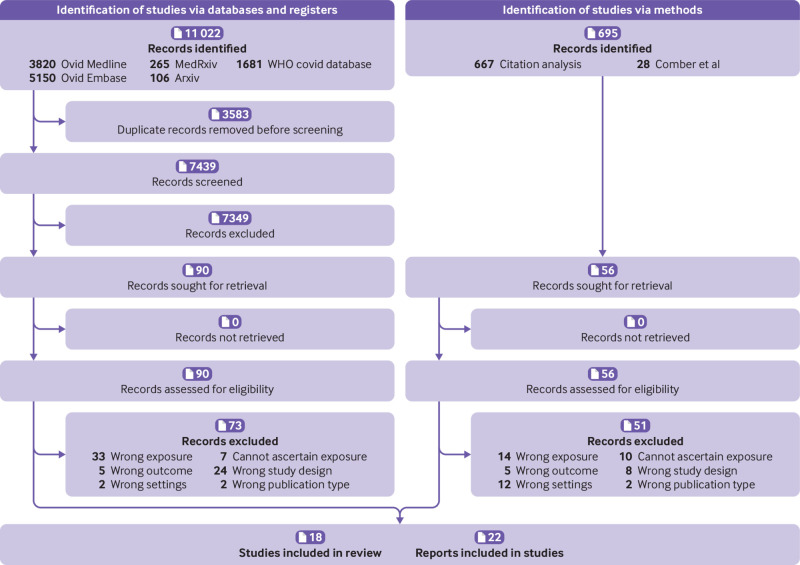
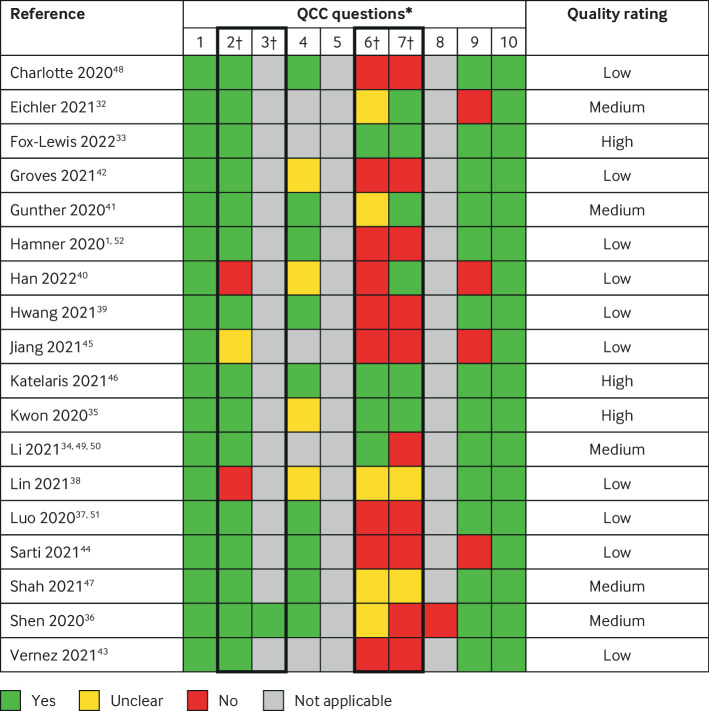
Verification
Claims the paper makes
The claims and statistics of this paper haven’t been checked yet.
Run the check — free, no account needed. It reads the open-access text and checks the sources it cites.
Claims other papers make about this one
Each is checked against this paper’s own text: does it say what the citing paper says it does?
In the citing paper
“Importantly, systematic reviews and randomised controlled trials may not be available for new healthcare interventions-for example, no randomised controlled trials were available on covid-19 during the early era of the pandemic but emerged as the pandemic evolved.36”
From Updated recommendations for the Cochrane rapid review methods guidance for rapid reviews of effectiveness (2024) · cites this paper as [36]
Self-check
Percentages, sums and reported differences re-computed from the paper’s own numbers.
The self-check needs the paper’s full text.
Citations
Cites
Rayyan-a web and mobile app for systematic reviews.
Ouzzani, M., Hammady, H., Fedorowicz, Z., & Elmagarmid, A. (2016) · Systematic Reviews · doi:10.1186/s13643-016-0384-4 · Cited by 26,092
Shea, B. J., Reeves, B. C., Wells, G., Thuku, M., Hamel, C., Moran, J., Moher, D., Tugwell, P., Welch, V., Kristjansson, E., et al. (2017) · BMJ · doi:10.1136/bmj.j4008 · Cited by 10,636
The PRISMA 2020 statement: An updated guideline for reporting systematic reviews
Page, M. J., McKenzie, J. E., Bossuyt, P. M., Boutron, I., Hoffmann, T. C., Mulrow, C. D., Shamseer, L., Tetzlaff, J. M., Akl, E. A., Brennan, S. E., et al. (2021) · PLoS Medicine · doi:10.1371/journal.pmed.1003583 · Cited by 5,148
Airborne transmission of respiratory viruses
Wang, C. C., Prather, K. A., Sznitman, J., Jimenez, J. L., Lakdawala, S. S., Tüfekçi, Z., & Marr, L. C. (2021) · Science · doi:10.1126/science.abd9149 · Cited by 1,631
How can airborne transmission of COVID-19 indoors be minimised?
Morawska, L., Tang, J. W., Bahnfleth, W., Bluyssen, P. M., Boerstra, A., Buonanno, G., Cao, J., Dancer, S., Floto, A., Franchimon, F., et al. (2020) · Environment International · doi:10.1016/j.envint.2020.105832 · Cited by 1,343
It is time to address airborne transmission of coronavirus disease 2019 (COVID-19)
Morawska, L., & Milton, D. K. (2020) · Clinical Infectious Diseases · doi:10.1093/cid/ciaa939 · Cited by 1,189
Ten scientific reasons in support of airborne transmission of SARS-CoV-2
Greenhalgh, T., Jimenez, J. L., Prather, K. A., Tufekci, Z., Fisman, D., & Schooley, R. (2021) · The Lancet · doi:10.1016/s0140-6736(21)00869-2 · Cited by 930
Aerosol Emission and Superemission during Human Speech Increase with Voice Loudness
Asadi, S., Wexler, A. S., Cappa, C. D., Barreda, S., Bouvier, N. M., & Ristenpart, W. D. (2019) · Scientific Reports · doi:10.1038/s41598-019-38808-z · Cited by 919
COVID-19 Outbreak Associated with Air Conditioning in Restaurant, Guangzhou, China, 2020
Lu, J., Gu, J., Li, K., Xu, C., Su, W., Lai, Z., DeQian, Z., Yu, C., Xu, B., & Yang, Z. (2020) · Emerging infectious diseases · doi:10.3201/eid2607.200764 · Cited by 880
Systems to rate the strength of scientific evidence.
West, S. L., King, V., Carey, T. S., Lohr, K. N., Mckoy, N. A., Sutton, S. F., & Lux, L. J. (2002) · PubMed Central · Cited by 873
Research works printed but not linked: 1
- Public Health Agency of Canada . Rapid Review on SARS-CoV-2 Aerosol Transmission, Update 2. 2021. www.nccmt.ca/covid-19/covid-19-evidence-reviews/418.
Cited by
Sorted by citations
Items 101–119 of 119
Katz, A. S., Li, T., James, L., Buhariwala, P., Osei-Twum, J.-A., Siegel, J. A., & O'Campo, P. J. (2024) · BMC Public Health · doi:10.1186/s12889-024-20151-2
Domino, K., Sochan, A., & Miszczak, J. A. (2024) · Journal of Computational Science · doi:10.1016/j.jocs.2024.102509
The impact of COVID-19 public health and social measures on years of potential life lost
Saullo, R., Jones, J., Thiese, M. S., Cox, C., Ogbonnaya, U. C., & Hegmann, K. T. (2024) · Journal of Emergency Management · doi:10.5055/jem.0843
The Spread of Respiratory Diseases among Middle School Students in Shatrah District, Iraq
Shalal, S. K. (2025) · European journal of ecology, biology and agriculture. · doi:10.59324/ejeba.2025.2(1).05
Nayak, S., Mayya, Y. S., Kondabagil, K. R., & Tirumkudulu, M. S. (2025) · bioRxiv (Cold Spring Harbor Laboratory) · doi:10.1101/2025.03.27.645702
Encarnação, S., Alves, J. R., Barbosa, T. M., Forte, P. M., Leite, L. B., & Monteiro, A. M. (2025) · Sport Sciences for Health · doi:10.1007/s11332-025-01469-9
Preventive measures against infections, including viruses in the workplace
Morimoto, Y., Higashi, H., Izumi, H., Tomonaga, T., Nishida, C., Yamato, H., Eguchi, H., Kawanami, S., Suzuki, K., & Yatera, K. (2025) · SANGYO EISEIGAKU ZASSHI · doi:10.1539/sangyoeisei.2025-018-a
Braeye, T., Cornelissen, L., Cauteren, D. V., van Loenhout, J. A. F., Kremer, C., Hens, N., Rosas, A., Taame, A., Blot, K. Y., & Hammami, N. (2025) · BMC Public Health · doi:10.1186/s12889-025-24572-5
pH-induced structural changes in SARS-CoV-2 spike variantsPreprint
Oliveira, A. S. F., Tulli, L., Kearns, F. L., Casalino, L., Rosenfeld, M. A., Berger, I., Schaffitzel, C., Davidson, A. D., Haddrell, A. E., Reid, J. P., et al. (2025) · bioRxiv (Cold Spring Harbor Laboratory) · doi:10.1101/2025.11.17.688702 · Cited by 1
Huang, R., Zou, Y., Zhou, L., & Jiang, T. (2025) · Frontiers in Public Health · doi:10.3389/fpubh.2025.1686843
Rakover, A., Galmiche, S., Charmet, T., Chény, O., Omar, F., David, C., Martin, S., Mailles, A., & Fontanet, A. L. (2024) · Figshare · doi:10.6084/m9.figshare.25107764
Ahmed, F., Shafer, L., Malla, P., Hopkins, R., Moreland, S. C., Zviedrite, N., & Uzicanin, A. (2024) · Figshare · doi:10.6084/m9.figshare.25464934
Duval, D., Pearce‐Smith, N., Palmer, J. C., Sarfo-Annin, J. K., Rudd, P., & Clark, R. (2024) · Figshare · doi:10.6084/m9.figshare.26578082
Self-citationCrombie, I. K. (2025) · Springer eBooks · doi:10.1007/978-981-95-2081-7_13
Oh, W. S., Bae, S., Kim, E., Kim, S., Lim, C., Lee, Y., Kim, Y., & Jeong, S. (2026) · Scandinavian Journal of Infectious Diseases · doi:10.1080/23744235.2026.2637791
Ali, A. S., Vanoli, E., Smati, M., Boudjemaa, A., Rodriguez, C., Guyot, C., Schortgen, F., Brehaut, P., Crawford, C., Andujar, P., et al. (2026) · International Journal of Infectious Diseases · doi:10.1016/j.ijid.2026.108697
Evolution of Understanding of COVID-19 Transmission
Dancer, S. J. (2026) · Atmosphere · doi:10.3390/atmos17050484
Tu, Y., Meng, X., & Zhu, H. (2026) · Communications in Nonlinear Science and Numerical Simulation · doi:10.1016/j.cnsns.2026.110823
Aganović, A. (2026) · Indoor Environments · doi:10.1016/j.indenv.2026.100198
Metadata
- Authors
- Duval, D., Palmer, J. C., Tudge, I., Pearce-Smith, N., O’Connell, E., Bennett, A., & Clark, R.
- Affiliations
- University of Bristol (GB)
- UK Health Security Agency (GB)
- COVID-19 Rapid Evidence Service, UK Health Security Agency, London, UK
- COVID-19 Advice and Guidance, UK Health Security Agency, London, UK
- Corresponding author
- Duval, Daphne
- Venue
- BMJ
- Publisher
- BMJ
- Published
- 2022-06-29
- Volume
- 377
- Pages
- e068743
- ISSN
- 1756-1833 (ISSN-L)
- PMC
- PMC9240778
- OpenAlex
- W4283720276
- Cited by
- 120
- References
- 71
- Citations by year
- 2026: 6 · 2025: 22 · 2024: 41 · 2023: 37 · 2022: 14
- FWCI
- 4.93
- Type
- journal article
- Language
- en
- Open access
- hybrid
- doi.org
- Licence
- Locations
- BMJ (publishedVersion, cc-by-nc)
- medRxiv (acceptedVersion, cc-by-nc-nd)
- PubMed Central (publishedVersion, cc-by-nc)
- PubMed (publishedVersion)
- Explore Bristol Research (submittedVersion, cc-by-nc)
- Bristol Research (University of Bristol) (submittedVersion, cc-by-nc)
- Funders
- British Heart Foundation (AA/18/7/34219)
- University of Bristol (MC_UU_00011/6)
- Medical Research Council (MC_UU_00011/6, COVID-19, MC_UU_00011)
- Topics
- Health Sciences › Medicine › Pulmonary and Respiratory Medicine › Infection Control and Ventilation
- Physical Sciences › Mathematics › Modeling and Simulation › COVID-19 epidemiological studies
- Physical Sciences › Environmental Science › Global and Planetary Change › COVID-19 impact on air quality
- Keywords
- SARS-CoV-2, airborne transmission, long-distance transmission, aerosols, airflow direction, asymptomatic transmission, pre-symptomatic transmission, transmission risk factors, outbreak investigation, COVID-19 pandemic, restaurants, workplace, choir, singing, loud speech, ventilation, indoor air quality, public health recommendations
- MeSH terms
- COVID-19, SARS-CoV-2, Aerosols, Disease Outbreaks, Humans
About these checks
Registry, retraction, Cites and statistics results are computed, not judged, with one exception: a printed reference that no index lists is read once by a model before it counts as a citation error. Claims are extracted by a model and kept only when their quote appears verbatim in the text; each cited source is then checked, with a model’s help, for whether it says what the claim relies on. Those verdicts can be wrong — read the claim’s quote and the cited source before relying on one.
Statistics and arithmetic are recomputed, not judged.
Confidence bands are shown only for fields calibrated on our annotated test set. None is calibrated yet, so no band is shown.
What counts as a claim ›How we measure confidence ›How we check this ›
Are you an author, or do you see a problem with this page? Request a review
