

The DOI matches its Crossref record; 50 of the 51 references it cites were found in a registry or an index; none of the 18 sources its claims cite is checked for support yet.
CONSORT 2025 statement: updated guideline for reporting randomised trials
Open accessAbstract
Background: Well designed and properly executed randomised trials are considered the most reliable evidence on the benefits of healthcare interventions. However, there is overwhelming evidence that the quality of reporting is not optimal. The CONSORT (Consolidated Standards of Reporting Trials) statement was designed to improve the quality of reporting and provides a minimum set of items to be included in a report of a randomised trial. CONSORT was first published in 1996, then updated in 2001 and 2010. Here, we present the updated CONSORT 2025 statement, which aims to account for recent methodological advancements and feedback from end users. Methods: We conducted a scoping review of the literature and developed a project-specific database of empirical and theoretical evidence related to CONSORT, to generate a list of potential changes to the checklist. The list was enriched with recommendations provided by the lead authors of existing CONSORT extensions (Harms, Outcomes, Non-pharmacological Treatment), other related reporting guidelines (TIDieR) and recommendations from other sources (eg, personal communications). The list of potential changes to the checklist was assessed in a large, international, online, three-round Delphi survey involving 317 participants and discussed at a two-day online expert consensus meeting of 30 invited international experts. Results: We have made substantive changes to the CONSORT checklist. We added seven new checklist items, revised three items, deleted one item, and integrated several items from key CONSORT extensions. We also restructured the CONSORT checklist, with a new section on open science. The CONSORT 2025 statement consists of a 30-item checklist of essential items that should be included when reporting the results of a randomised trial and a diagram for documenting the flow of participants through the trial. To facilitate implementation of CONSORT 2025, we have also developed an expanded version of the CONSORT 2025 checklist, with bullet points eliciting critical elements of each item. Conclusion: Authors, editors, reviewers, and other potential users should use CONSORT 2025 when writing and evaluating manuscripts of randomised trials to ensure that trial reports are clear and transparent.
Overview
AI snapshot
Written from the paper’s full text.
TL;DR
CONSORT 2025 is an updated reporting guideline for randomised trials, replacing CONSORT 2010 with a 30-item checklist, a participant flow diagram, and an expanded checklist. It adds seven items, revises three, deletes one, integrates items from key CONSORT extensions, and adds an open science section.
Key findings
- The update added seven new checklist items, revised three items, deleted one item, and integrated several items from key CONSORT extensions (Harms, Outcomes, Non-pharmacological Treatment) and TIDieR; it also restructured the checklist with a new open science section.
- CONSORT 2025 consists of a 30-item checklist and a flow diagram; an expanded checklist with bullet points eliciting critical elements of each item was also developed.
- New items include data sharing (item 4), author conflicts of interest (item 5b), patient/public involvement (item 8), eligibility criteria for sites and intervention deliverers (item 12b), harms assessment (item 15), analysis population and missing data handling (items 21b, 21c), and intervention/comparator delivery and concomitant care (items 24a, 24b).
- A Cochrane review cited in the paper found that 25 of 27 CONSORT checklist items were more completely reported in CONSORT-endorsing versus non-endorsing journals, based on 50 evaluations of 16,604 trials; the paper notes a causal effect cannot be proven.
Methods
- Guideline update followed EQUATOR Network guidance; methods included a scoping review, a project-specific database (SCEBdb), and recommendations from lead authors of key CONSORT extensions and TIDieR.
- Potential changes were assessed in a three-round international online Delphi survey with 317 participants in round 1, 303 in round 2, and 290 in round 3; participants rated inclusion on a 5-point Likert scale and could provide free-text comments.
- Results were discussed at a two-day online expert consensus meeting of 30 invited international experts (1–2 March 2023), followed by a two-day in-person executive writing meeting in Oxford (25–26 April 2023); Zoom polls were advisory and no formal consensus threshold was specified.
Limitations
- Stated: CONSORT 2025 and SPIRIT 2025 do not include recommendations for designing, conducting, or analysing trials, and CONSORT 2025 is not meant to be used as a quality assessment instrument.
- Stated: CONSORT 2025 provides guidance for all randomised trials but focuses on the most common type, the two-group parallel design; it also does not suggest a rigid structure for reporting.
- Stated: the paper notes that a causal effect cannot be proven for the association between journal endorsement of CONSORT and better reporting; consensus polls at the expert meeting were advisory and no formal consensus threshold was specified.
Model-written summary. Check it against the paper before relying on it.
Integrity signals
Registry
Cites
Statistics
Figures
Verification
Claims the paper makes
24 No basis given · 13 Not checked yet · 6 Own interpretation · 5 Own result · 4 Own method
A conclusion the paper draws from its own results — it cites no other source for it, so there is none to check. The quote shows it is in the paper.
In the paper
“However, a causal effect cannot be proven.”
§ CONSORT 2025 statement: updated guideline for reporting randomised trials > Introduction
plain- Asserted: passes — The authors put it forward as true.
- Checkable: passes — It can be checked against evidence.
- Load-bearing: unclear — It is unclear whether the paper’s conclusions depend on it.
- Based: passes — The paper gives a reason why it holds.
In the paper
“Similarly, having a clear and transparent trial protocol is important because it prespecifies the methods used in the trial, such as the primary outcome, thereby reducing the likelihood of undeclared post hoc changes.5”
§ CONSORT 2025 statement: updated guideline for reporting randomised trials > Introduction
What the sources say
- Not checked yetcites [5] COMPARE. Tracking switched outcomes in clinical trials. https://www.compare-trials.org/ [accessed 26 May 2021].
plaindirect- Asserted: passes — The authors put it forward as true.
- Checkable: passes — It can be checked against evidence.
- Load-bearing: unclear — It is unclear whether the paper’s conclusions depend on it.
- Based: passes — The paper gives a reason why it holds.
None of the sources cited for this claim have been checked yet.
In the paper
“The introduction of CONSORT within journals has been shown to be associated with improved quality of reports of randomised trials.”
- Also stated in: § Introduction · hedged
“Some evidence shows that journal endorsement of CONSORT is associated with better reporting and that reporting is improving over time.2 13 14 15”
§ CONSORT 2025 statement: updated guideline for reporting randomised trials > Introduction
What the sources say
plaincorrelational- Asserted: passes — The authors put it forward as true.
- Checkable: passes — It can be checked against evidence.
- Load-bearing: passes — The paper’s conclusions depend on it.
- Based: passes — The paper gives a reason why it holds.
- Also stated in: § Introduction · hedged
In the paper
“and that incomplete reporting may be associated with biased estimates of intervention effects.4”
§ CONSORT 2025 statement: updated guideline for reporting randomised trials > Introduction
What the sources say
- Not checked yetcites [4] source
hedgedcorrelational- Asserted: passes — The authors put it forward as true.
- Checkable: passes — It can be checked against evidence.
- Load-bearing: passes — The paper’s conclusions depend on it.
- Based: passes — The paper gives a reason why it holds.
None of the sources cited for this claim have been checked yet.
In the paper
“However, there is overwhelming evidence that the quality of reporting is not optimal.”
- Also stated in: § Introduction · boosted
“However, extensive evidence displays that the completeness of reporting of randomised trials is inadequate2 3”
§ CONSORT 2025 statement: updated guideline for reporting randomised trials > Abstract > Background
boosted- Asserted: passes — The authors put it forward as true.
- Checkable: passes — It can be checked against evidence.
- Load-bearing: passes — The paper’s conclusions depend on it.
- Based: passes — The paper gives a reason why it holds.
- Also stated in: § Introduction · boosted
None of the sources cited for this claim have been checked yet.
In the paper
“A Cochrane review of 50 evaluations of 16 604 trials assessed the association between journals’ endorsement of CONSORT and the reporting of trials they published; 25 of 27 CONSORT checklist items were more completely reported when a trial was published in a CONSORT endorsing as opposed to non-endorsing journal.2 14”
§ CONSORT 2025 statement: updated guideline for reporting randomised trials > Introduction
plaincorrelational- Asserted: passes — The authors put it forward as true.
- Checkable: passes — It can be checked against evidence.
- Load-bearing: passes — The paper’s conclusions depend on it.
- Based: passes — The paper gives a reason why it holds.
- Probably not a substantial claim. 46
- It may state two separate claims as one. 12
The paper states this without a source or data behind it here, so there is nothing to check it against. The quote shows it is in the paper.
In the paper
“Item 3: revised item to include where the statistical analysis plan can be accessed in addition to the trial protocol.”
§ CONSORT 2025 statement: updated guideline for reporting randomised trials > Main changes to CONSORT 2025 > Completely revised checklist items
plain- Asserted: passes — The authors put it forward as true.
- Checkable: passes — It can be checked against evidence.
- Load-bearing: fails — The paper’s conclusions may not depend on it.
- Based: passes — The paper gives a reason why it holds.
Probably not a substantial claim. The paper’s conclusions may not depend on it.
The paper states this without a source or data behind it here, so there is nothing to check it against. The quote shows it is in the paper.
In the paper
“Addition of items related to reporting of how harms24 were assessed and analysed (items 7, 15, 21a, 23a, 27), how outcomes25 were measured and analysed (items 14, 26), and how the intervention27 28 and comparator were actually administered and by whom (item 24).”
§ CONSORT 2025 statement: updated guideline for reporting randomised trials > Main changes to CONSORT 2025 > Integration of checklist items from key CONSORT extensions
plain- Asserted: passes — The authors put it forward as true.
- Checkable: passes — It can be checked against evidence.
- Load-bearing: passes — The paper’s conclusions depend on it.
- Based: passes — The paper gives a reason why it holds.
Probably not a substantial claim. It may state two separate claims as one.
The paper states this without a source or data behind it here, so there is nothing to check it against. The quote shows it is in the paper.
In the paper
“Item 26: revised item to specify for each primary and secondary outcome—the number of participants included in the analysis and the number of participants with available data at each time point for each treatment group.”
§ CONSORT 2025 statement: updated guideline for reporting randomised trials > Main changes to CONSORT 2025 > Completely revised checklist items
plain- Asserted: passes — The authors put it forward as true.
- Checkable: passes — It can be checked against evidence.
- Load-bearing: fails — The paper’s conclusions may not depend on it.
- Based: passes — The paper gives a reason why it holds.
Probably not a substantial claim. The paper’s conclusions may not depend on it.
The paper states this without a source or data behind it here, so there is nothing to check it against. The quote shows it is in the paper.
In the paper
“The CONSORT 2025 statement supersedes the CONSORT 2010 statement, which should no longer be used.”
§ CONSORT 2025 statement: updated guideline for reporting randomised trials > Scope of CONSORT 2025
plaindirect- Asserted: passes — The authors put it forward as true.
- Checkable: passes — It can be checked against evidence.
- Load-bearing: passes — The paper’s conclusions depend on it.
- Based: passes — The paper gives a reason why it holds.
Probably not a substantial claim.
The paper states this without a source or data behind it here, so there is nothing to check it against. The quote shows it is in the paper.
In the paper
“Item 21: added items to define who is included in each analysis (eg, all randomised participants) and in which group (item 21b), and how missing data were handled in the analysis (item 21c).”
§ CONSORT 2025 statement: updated guideline for reporting randomised trials > Main changes to CONSORT 2025 > Addition of new checklist items
plain- Asserted: passes — The authors put it forward as true.
- Checkable: passes — It can be checked against evidence.
- Load-bearing: passes — The paper’s conclusions depend on it.
- Based: passes — The paper gives a reason why it holds.
Probably not a substantial claim. It may state two separate claims as one.
The paper states this without a source or data behind it here, so there is nothing to check it against. The quote shows it is in the paper.
In the paper
“Item 8: added item on how patients and/or the public were involved in the design, conduct, and/or reporting of the trial.”
§ CONSORT 2025 statement: updated guideline for reporting randomised trials > Main changes to CONSORT 2025 > Addition of new checklist items
plain- Asserted: passes — The authors put it forward as true.
- Checkable: passes — It can be checked against evidence.
- Load-bearing: fails — The paper’s conclusions may not depend on it.
- Based: passes — The paper gives a reason why it holds.
Probably not a substantial claim. The paper’s conclusions may not depend on it.
The paper states this without a source or data behind it here, so there is nothing to check it against. The quote shows it is in the paper.
In the paper
“Clarified and simplified wording of some items.”
§ CONSORT 2025 statement: updated guideline for reporting randomised trials > Main changes to CONSORT 2025 > Structure and organisation of checklist items
plain- Asserted: passes — The authors put it forward as true.
- Checkable: passes — It can be checked against evidence.
- Load-bearing: fails — The paper’s conclusions may not depend on it.
- Based: passes — The paper gives a reason why it holds.
Probably not a substantial claim. The paper’s conclusions may not depend on it.
A result the paper reports from its own data — it cites no other source for it, so there is none to check. The quote shows it is in the paper.
In the paper
“We added seven new checklist items, revised three items, deleted one item, and integrated several items from key CONSORT extensions.”
§ CONSORT 2025 statement: updated guideline for reporting randomised trials > Abstract > Results
plain- Asserted: passes — The authors put it forward as true.
- Checkable: passes — It can be checked against evidence.
- Load-bearing: fails — The paper’s conclusions may not depend on it.
- Based: passes — The paper gives a reason why it holds.
Probably not a substantial claim. The paper’s conclusions may not depend on it.
The paper states this without a source or data behind it here, so there is nothing to check it against. The quote shows it is in the paper.
In the paper
“To facilitate implementation of CONSORT 2025, we have also developed an expanded version of the CONSORT 2025 checklist, with bullet points eliciting critical elements of each item.”
§ CONSORT 2025 statement: updated guideline for reporting randomised trials > Abstract > Results
plain- Asserted: passes — The authors put it forward as true.
- Checkable: passes — It can be checked against evidence.
- Load-bearing: fails — The paper’s conclusions may not depend on it.
- Based: passes — The paper gives a reason why it holds.
Probably not a substantial claim. The paper’s conclusions may not depend on it.
The paper states this without a source or data behind it here, so there is nothing to check it against. The quote shows it is in the paper.
In the paper
“The expanded checklist comprises an abridged version of elements presented in the CONSORT 2025 explanation and elaboration document,29 with examples and references removed (see appendix 2).”
§ CONSORT 2025 statement: updated guideline for reporting randomised trials > Main changes to CONSORT 2025 > Structure and organisation of checklist items
plain- Asserted: passes — The authors put it forward as true.
- Checkable: passes — It can be checked against evidence.
- Load-bearing: fails — The paper’s conclusions may not depend on it.
- Based: passes — The paper gives a reason why it holds.
Probably not a substantial claim. The paper’s conclusions may not depend on it.
The paper states this without a source or data behind it here, so there is nothing to check it against. The quote shows it is in the paper.
In the paper
“Aligned wording of some CONSORT checklist items with that of SPIRIT checklist items and vice versa.”
§ CONSORT 2025 statement: updated guideline for reporting randomised trials > Main changes to CONSORT 2025 > Structure and organisation of checklist items
plaincorrelational- Asserted: passes — The authors put it forward as true.
- Checkable: passes — It can be checked against evidence.
- Load-bearing: fails — The paper’s conclusions may not depend on it.
- Based: passes — The paper gives a reason why it holds.
Probably not a substantial claim. The paper’s conclusions may not depend on it.
The paper states this without a source or data behind it here, so there is nothing to check it against. The quote shows it is in the paper.
In the paper
“Deleted item on generalisability of trial findings, which is now incorporated under trial limitations (item 30).”
§ CONSORT 2025 statement: updated guideline for reporting randomised trials > Main changes to CONSORT 2025 > Deletion of checklist item
plain- Asserted: passes — The authors put it forward as true.
- Checkable: passes — It can be checked against evidence.
- Load-bearing: fails — The paper’s conclusions may not depend on it.
- Based: passes — The paper gives a reason why it holds.
Probably not a substantial claim. The paper’s conclusions may not depend on it. It may state two separate claims as one.
The paper states this without a source or data behind it here, so there is nothing to check it against. The quote shows it is in the paper.
In the paper
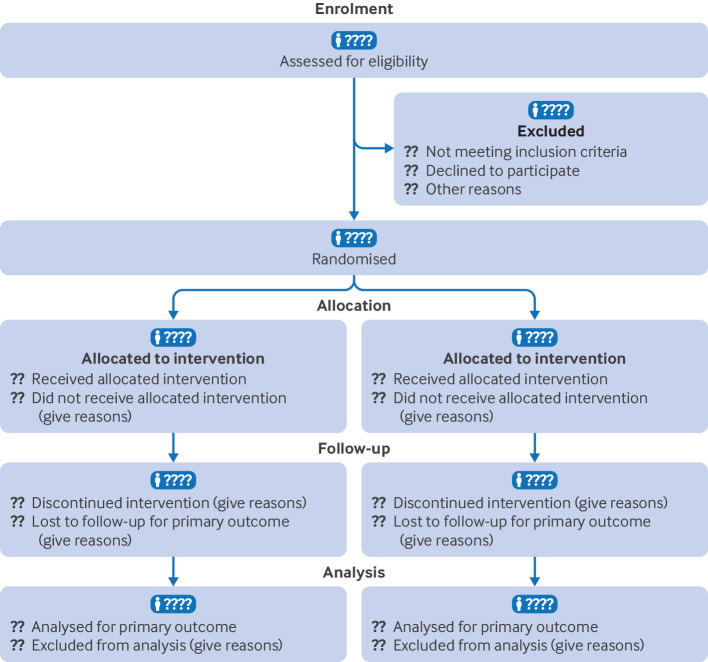
“The CONSORT 2025 statement consists of a 30-item checklist of essential items that should be included when reporting the results of a randomised trial and a diagram for documenting the flow of participants through the trial.”
- Also stated in: § Scope of CONSORT 2025 · plain
“The CONSORT 2025 statement comprises a 30-item checklist and provides a minimum set of items to be included in a report of a randomised trial (table 1) and a diagram for documenting the flow of participants through a trial (fig 1).”
§ CONSORT 2025 statement: updated guideline for reporting randomised trials > Abstract > Results
plain- Asserted: passes — The authors put it forward as true.
- Checkable: passes — It can be checked against evidence.
- Load-bearing: passes — The paper’s conclusions depend on it.
- Based: passes — The paper gives a reason why it holds.
Probably not a substantial claim. It may state two separate claims as one.
- Also stated in: § Scope of CONSORT 2025 · plain
None of the sources cited for this claim have been checked yet.
In the paper
“We have also updated the CONSORT explanation and elaboration document,29 which has been extensively revised and describes the rationale and scientific background for each CONSORT 2025 checklist item and provides published examples of good reporting.”
§ CONSORT 2025 statement: updated guideline for reporting randomised trials > Main changes to CONSORT 2025
plain- Asserted: passes — The authors put it forward as true.
- Checkable: passes — It can be checked against evidence.
- Load-bearing: fails — The paper’s conclusions may not depend on it.
- Based: passes — The paper gives a reason why it holds.
Probably not a substantial claim. The paper’s conclusions may not depend on it. It may state two separate claims as one.
A result the paper reports from its own data — it cites no other source for it, so there is none to check. The quote shows it is in the paper.
In the paper
“Item 4: added item on data sharing, including where and how individual de-identified participant data, statistical code, and any other materials can be accessed.”
§ CONSORT 2025 statement: updated guideline for reporting randomised trials > Main changes to CONSORT 2025 > Addition of new checklist items
plain- Asserted: passes — The authors put it forward as true.
- Checkable: passes — It can be checked against evidence.
- Load-bearing: fails — The paper’s conclusions may not depend on it.
- Based: passes — The paper gives a reason why it holds.
Probably not a substantial claim. The paper’s conclusions may not depend on it.
The paper states this without a source or data behind it here, so there is nothing to check it against. The quote shows it is in the paper.
In the paper
“CONSORT 2025 provides guidance for reporting all randomised trials but focuses on the most common type, the two-group parallel design.”
§ CONSORT 2025 statement: updated guideline for reporting randomised trials > Scope of CONSORT 2025
plain- Asserted: passes — The authors put it forward as true.
- Checkable: passes — It can be checked against evidence.
- Load-bearing: fails — The paper’s conclusions may not depend on it.
- Based: passes — The paper gives a reason why it holds.
Probably not a substantial claim. The paper’s conclusions may not depend on it. It may state two separate claims as one.
A result the paper reports from its own data — it cites no other source for it, so there is none to check. The quote shows it is in the paper.
In the paper
“We added seven new checklist items, revised three items, deleted one item, and integrated several items from key CONSORT extensions.”
§ CONSORT 2025 statement: updated guideline for reporting randomised trials > Abstract > Results
plain- Asserted: passes — The authors put it forward as true.
- Checkable: passes — It can be checked against evidence.
- Load-bearing: fails — The paper’s conclusions may not depend on it.
- Based: passes — The paper gives a reason why it holds.
Probably not a substantial claim. The paper’s conclusions may not depend on it.
The paper states this without a source or data behind it here, so there is nothing to check it against. The quote shows it is in the paper.
In the paper
“Item 12b: added item on eligibility criteria for sites and for individuals delivering the interventions, where applicable”
§ CONSORT 2025 statement: updated guideline for reporting randomised trials > Main changes to CONSORT 2025 > Addition of new checklist items
plain- Asserted: passes — The authors put it forward as true.
- Checkable: passes — It can be checked against evidence.
- Load-bearing: fails — The paper’s conclusions may not depend on it.
- Based: passes — The paper gives a reason why it holds.
Probably not a substantial claim. The paper’s conclusions may not depend on it.
The paper states this without a source or data behind it here, so there is nothing to check it against. The quote shows it is in the paper.
In the paper
“Item 5b: added item on financial and other conflicts of interest of manuscript authors.”
§ CONSORT 2025 statement: updated guideline for reporting randomised trials > Main changes to CONSORT 2025 > Addition of new checklist items
plain- Asserted: passes — The authors put it forward as true.
- Checkable: passes — It can be checked against evidence.
- Load-bearing: fails — The paper’s conclusions may not depend on it.
- Based: passes — The paper gives a reason why it holds.
Probably not a substantial claim. The paper’s conclusions may not depend on it.
The paper states this without a source or data behind it here, so there is nothing to check it against. The quote shows it is in the paper.
In the paper
“Item 15: added item on how harms and other unintended effects were assessed.”
§ CONSORT 2025 statement: updated guideline for reporting randomised trials > Main changes to CONSORT 2025 > Addition of new checklist items
plain- Asserted: passes — The authors put it forward as true.
- Checkable: passes — It can be checked against evidence.
- Load-bearing: fails — The paper’s conclusions may not depend on it.
- Based: passes — The paper gives a reason why it holds.
Probably not a substantial claim. The paper’s conclusions may not depend on it.
The paper states this without a source or data behind it here, so there is nothing to check it against. The quote shows it is in the paper.
In the paper
“We also restructured the CONSORT checklist, with a new section on open science, which includes items that are conceptually linked, such as trial registration (item 2), where the trial protocol and statistical analysis plan can be accessed (item 3), sharing of de-identified participant level data (item 4), and funding and conflicts of interest (item 5).”
§ CONSORT 2025 statement: updated guideline for reporting randomised trials > Main changes to CONSORT 2025
plain- Asserted: passes — The authors put it forward as true.
- Checkable: passes — It can be checked against evidence.
- Load-bearing: fails — The paper’s conclusions may not depend on it.
- Based: passes — The paper gives a reason why it holds.
Probably not a substantial claim. The paper’s conclusions may not depend on it.
A result the paper reports from its own data — it cites no other source for it, so there is none to check. The quote shows it is in the paper.
In the paper
“We added seven new checklist items, revised three items, deleted one item, and integrated several items from key CONSORT extensions.”
§ CONSORT 2025 statement: updated guideline for reporting randomised trials > Abstract > Results
plain- Asserted: passes — The authors put it forward as true.
- Checkable: passes — It can be checked against evidence.
- Load-bearing: fails — The paper’s conclusions may not depend on it.
- Based: passes — The paper gives a reason why it holds.
Probably not a substantial claim. The paper’s conclusions may not depend on it.
The paper states this without a source or data behind it here, so there is nothing to check it against. The quote shows it is in the paper.
In the paper
“Item 24: added item on intervention delivery, including how the intervention and comparator were actually administered (item 24a) and details of concomitant care received during the trial (item 24b).”
§ CONSORT 2025 statement: updated guideline for reporting randomised trials > Main changes to CONSORT 2025 > Addition of new checklist items
plain- Asserted: passes — The authors put it forward as true.
- Checkable: passes — It can be checked against evidence.
- Load-bearing: passes — The paper’s conclusions depend on it.
- Based: passes — The paper gives a reason why it holds.
Probably not a substantial claim. It may state two separate claims as one.
A result the paper reports from its own data — it cites no other source for it, so there is none to check. The quote shows it is in the paper.
In the paper
“We added seven new checklist items, revised three items, deleted one item, and integrated several items from key CONSORT extensions.”
§ CONSORT 2025 statement: updated guideline for reporting randomised trials > Abstract > Results
plain- Asserted: passes — The authors put it forward as true.
- Checkable: passes — It can be checked against evidence.
- Load-bearing: passes — The paper’s conclusions depend on it.
- Based: passes — The paper gives a reason why it holds.
Probably not a substantial claim.
The paper states this without a source or data behind it here, so there is nothing to check it against. The quote shows it is in the paper.
In the paper
“Item 10: revised item to include reporting of important changes to the trial after it commenced, including any outcomes or analyses that were not prespecified.”
§ CONSORT 2025 statement: updated guideline for reporting randomised trials > Main changes to CONSORT 2025 > Completely revised checklist items
plain- Asserted: passes — The authors put it forward as true.
- Checkable: passes — It can be checked against evidence.
- Load-bearing: fails — The paper’s conclusions may not depend on it.
- Based: passes — The paper gives a reason why it holds.
Probably not a substantial claim. The paper’s conclusions may not depend on it.
The paper states this without a source or data behind it here, so there is nothing to check it against. The quote shows it is in the paper.
In the paper
“Rather, the content of CONSORT 2025 focuses on reporting items related to the internal and external validity of randomised trials.”
§ CONSORT 2025 statement: updated guideline for reporting randomised trials > Implication and limitations
plain- Asserted: passes — The authors put it forward as true.
- Checkable: passes — It can be checked against evidence.
- Load-bearing: passes — The paper’s conclusions depend on it.
- Based: passes — The paper gives a reason why it holds.
Probably not a substantial claim.
The paper states this without a source or data behind it here, so there is nothing to check it against. The quote shows it is in the paper.
In the paper
“CONSORT urges clarity and transparency of reporting which reflects the actual trial design, conduct, and analysis.”
§ CONSORT 2025 statement: updated guideline for reporting randomised trials > Implication and limitations
plain- Asserted: passes — The authors put it forward as true.
- Checkable: passes — It can be checked against evidence.
- Load-bearing: passes — The paper’s conclusions depend on it.
- Based: passes — The paper gives a reason why it holds.
Probably not a substantial claim.
The paper states this without a source or data behind it here, so there is nothing to check it against. The quote shows it is in the paper.
In the paper
“With CONSORT 2025, we do not suggest a rigid structure for the reporting of randomised trials.”
§ CONSORT 2025 statement: updated guideline for reporting randomised trials > Implication and limitations
plain- Asserted: passes — The authors put it forward as true.
- Checkable: passes — It can be checked against evidence.
- Load-bearing: passes — The paper’s conclusions depend on it.
- Based: passes — The paper gives a reason why it holds.
Probably not a substantial claim.
The paper states this without a source or data behind it here, so there is nothing to check it against. The quote shows it is in the paper.
In the paper
“Importantly, however, CONSORT 2025 is not meant to be used as a quality assessment instrument.”
§ CONSORT 2025 statement: updated guideline for reporting randomised trials > Implication and limitations
plain- Asserted: passes — The authors put it forward as true.
- Checkable: passes — It can be checked against evidence.
- Load-bearing: passes — The paper’s conclusions depend on it.
- Based: passes — The paper gives a reason why it holds.
Probably not a substantial claim.
The paper states this without a source or data behind it here, so there is nothing to check it against. The quote shows it is in the paper.
In the paper
“It is important to note that CONSORT 2025 and SPIRIT 2025 do not include recommendations for designing, conducting, or analysing trials”
§ CONSORT 2025 statement: updated guideline for reporting randomised trials > Implication and limitations
plain- Asserted: passes — The authors put it forward as true.
- Checkable: passes — It can be checked against evidence.
- Load-bearing: passes — The paper’s conclusions depend on it.
- Based: passes — The paper gives a reason why it holds.
Probably not a substantial claim.
In the paper
“Updating the SPIRIT and CONSORT statements together was also an opportunity to align reporting in both checklists and to provide users with consistent guidance in the reporting of trial design, conduct, and analysis, from the trial protocol to final publication.”
§ CONSORT 2025 statement: updated guideline for reporting randomised trials > Implication and limitations
What the sources say
- Not checked yetcites [17] source
plaindirect- Asserted: passes — The authors put it forward as true.
- Checkable: passes — It can be checked against evidence.
- Load-bearing: fails — The paper’s conclusions may not depend on it.
- Based: passes — The paper gives a reason why it holds.
Probably not a substantial claim. The paper’s conclusions may not depend on it. It may state two separate claims as one.
What the paper did — it cites no source for this, so there is none to check. The quote shows it is in the paper.
In the paper
“This list of potential changes was presented to end users for feedback in a large international online Delphi survey, involving 317 participants who responded to round 1, 303 to round 2 and 290 to round 3.”
§ CONSORT 2025 statement: updated guideline for reporting randomised trials > Development of CONSORT 2025
plainn = 317- Asserted: passes — The authors put it forward as true.
- Checkable: passes — It can be checked against evidence.
- Load-bearing: fails — The paper’s conclusions may not depend on it.
- Based: passes — The paper gives a reason why it holds.
Probably not a substantial claim. The paper’s conclusions may not depend on it.
What the paper did — it cites no source for this, so there is none to check. The quote shows it is in the paper.
In the paper
“A broad range of end user roles were represented, the most frequent being statisticians/methodologists/epidemiologists (n=198), systematic reviewers/guideline developers (n=73), trial investigators (n=73), clinicians (n=58), journal editors (n=47), and patient representatives (n=17) (numbers not mutually exclusive).”
§ CONSORT 2025 statement: updated guideline for reporting randomised trials > Development of CONSORT 2025
plainn = 317- Asserted: passes — The authors put it forward as true.
- Checkable: passes — It can be checked against evidence.
- Load-bearing: fails — The paper’s conclusions may not depend on it.
- Based: passes — The paper gives a reason why it holds.
Probably not a substantial claim. The paper’s conclusions may not depend on it.
In the paper
“SPIRIT and CONSORT are living guidelines and it is vital that the statements are periodically updated to reflect new evidence, methodological advancements, and feedback from users; otherwise, their value and usefulness will diminish over time.16”
§ CONSORT 2025 statement: updated guideline for reporting randomised trials > Decision to update the SPIRIT and CONSORT statements
What the sources say
- Not checked yetcites [16] source
plaindirect- Asserted: passes — The authors put it forward as true.
- Checkable: fails — It may be too vague to check against evidence.
- Load-bearing: passes — The paper’s conclusions depend on it.
- Based: passes — The paper gives a reason why it holds.
Probably not a substantial claim. It may be too vague to check against evidence. It may state two separate claims as one.
In the paper
“The methods used to update the CONSORT statement followed the EQUATOR Network guidance for developers of health research guidelines19 and have been described in detail elsewhere.20 21”
§ CONSORT 2025 statement: updated guideline for reporting randomised trials > Development of CONSORT 2025
What the sources say
- Not checked yetcites [19] source
plain- Asserted: passes — The authors put it forward as true.
- Checkable: passes — It can be checked against evidence.
- Load-bearing: fails — The paper’s conclusions may not depend on it.
- Based: passes — The paper gives a reason why it holds.
Probably not a substantial claim. The paper’s conclusions may not depend on it.
None of the sources cited for this claim have been checked yet.
In the paper
“Extensions to CONSORT have been developed to tackle the methodological issues associated with reporting different types of trial designs, data, and interventions.”
§ CONSORT 2025 statement: updated guideline for reporting randomised trials > Scope of CONSORT 2025
What the sources say
plaincorrelational- Asserted: passes — The authors put it forward as true.
- Checkable: passes — It can be checked against evidence.
- Load-bearing: fails — The paper’s conclusions may not depend on it.
- Based: passes — The paper gives a reason why it holds.
Probably not a substantial claim. The paper’s conclusions may not depend on it.
In the paper
“Harmonising the reporting process should improve usability and adherence, and lead to more-complete reporting.17”
§ CONSORT 2025 statement: updated guideline for reporting randomised trials > Decision to update the SPIRIT and CONSORT statements
What the sources say
- Not checked yetcites [17] source
hedgeddirect- Asserted: passes — The authors put it forward as true.
- Checkable: fails — It may be too vague to check against evidence.
- Load-bearing: passes — The paper’s conclusions depend on it.
- Based: passes — The paper gives a reason why it holds.
Probably not a substantial claim. It may be too vague to check against evidence. It may state two separate claims as one.
What the paper did — it cites no source for this, so there is none to check. The quote shows it is in the paper.
In the paper
“The Delphi survey results were then presented and discussed at a two-day online expert consensus meeting via Zoom, on 1 and 2 March 2023, attended by 30 invited international participants representing the different stakeholder groups included in the Delphi survey.”
§ CONSORT 2025 statement: updated guideline for reporting randomised trials > Development of CONSORT 2025
plainn = 30- Asserted: passes — The authors put it forward as true.
- Checkable: passes — It can be checked against evidence.
- Load-bearing: fails — The paper’s conclusions may not depend on it.
- Based: passes — The paper gives a reason why it holds.
Probably not a substantial claim. The paper’s conclusions may not depend on it.
What the paper did — it cites no source for this, so there is none to check. The quote shows it is in the paper.
In the paper
“During the meeting, each new and modified CONSORT checklist item was discussed and agreement sought. An anonymous poll via Zoom was used to help establish the level of support for items where the discussion indicated differing opinions; these polls were advisory and no formal consensus threshold was specified.”
§ CONSORT 2025 statement: updated guideline for reporting randomised trials > Development of CONSORT 2025
plainn = 30- Asserted: passes — The authors put it forward as true.
- Checkable: passes — It can be checked against evidence.
- Load-bearing: fails — The paper’s conclusions may not depend on it.
- Based: passes — The paper gives a reason why it holds.
Probably not a substantial claim. The paper’s conclusions may not depend on it. It may state two separate claims as one.
In the paper
“High quality reporting is an important step when considering issues related to reproducibility.”
§ CONSORT 2025 statement: updated guideline for reporting randomised trials > Implication and limitations
What the sources say
- Not checked yetcites [50] source
plain- Asserted: passes — The authors put it forward as true.
- Checkable: fails — It may be too vague to check against evidence.
- Load-bearing: passes — The paper’s conclusions depend on it.
- Based: passes — The paper gives a reason why it holds.
Probably not a substantial claim. It may be too vague to check against evidence.
A conclusion the paper draws from its own results — it cites no other source for it, so there is none to check. The quote shows it is in the paper.
In the paper
“In addition, transparent reporting of trial results can reveal deficiencies in research if they exist and allow better estimates of their prevalence and severity.”
§ CONSORT 2025 statement: updated guideline for reporting randomised trials > Implication and limitations
plaindirect- Asserted: passes — The authors put it forward as true.
- Checkable: fails — It may be too vague to check against evidence.
- Load-bearing: passes — The paper’s conclusions depend on it.
- Based: fails — The paper may give no reason why it holds.
Probably not a substantial claim. It may be too vague to check against evidence. The paper may give no reason why it holds. It may state two separate claims as one.
A conclusion the paper draws from its own results — it cites no other source for it, so there is none to check. The quote shows it is in the paper.
In the paper
“but nevertheless the recommendations contained here can help researchers in the design, conduct, and analysis of their trial by highlighting key issues to consider.”
§ CONSORT 2025 statement: updated guideline for reporting randomised trials > Implication and limitations
plainconditional- Asserted: passes — The authors put it forward as true.
- Checkable: passes — It can be checked against evidence.
- Load-bearing: passes — The paper’s conclusions depend on it.
- Based: passes — The paper gives a reason why it holds.
Probably not a substantial claim.
In the paper
“An explicit description of what was done and what was found, without ambiguity or omission, best serves the interests of all readers.”
§ CONSORT 2025 statement: updated guideline for reporting randomised trials > Implication and limitations
What the sources say
- Not checked yetcites [9] source
plaindirect- Asserted: passes — The authors put it forward as true.
- Checkable: fails — It may be too vague to check against evidence.
- Load-bearing: passes — The paper’s conclusions depend on it.
- Based: passes — The paper gives a reason why it holds.
Probably not a substantial claim. It may be too vague to check against evidence.
A conclusion the paper draws from its own results — it cites no other source for it, so there is none to check. The quote shows it is in the paper.
In the paper
“Readers, peer reviewers, clinicians, guideline writers, patients and the public, and editors can also use CONSORT 2025 to help them appraise the reporting of randomised trials.”
§ CONSORT 2025 statement: updated guideline for reporting randomised trials > Implication and limitations
plain- Asserted: passes — The authors put it forward as true.
- Checkable: passes — It can be checked against evidence.
- Load-bearing: fails — The paper’s conclusions may not depend on it.
- Based: passes — The paper gives a reason why it holds.
Probably not a substantial claim. The paper’s conclusions may not depend on it.
A conclusion the paper draws from its own results — it cites no other source for it, so there is none to check. The quote shows it is in the paper.
In the paper
“Full data and code sharing offers another, higher level of transparency”
§ CONSORT 2025 statement: updated guideline for reporting randomised trials > Implication and limitations
plaindirect- Asserted: passes — The authors put it forward as true.
- Checkable: fails — It may be too vague to check against evidence.
- Load-bearing: fails — The paper’s conclusions may not depend on it.
- Based: fails — The paper may give no reason why it holds.
Probably not a substantial claim. It may be too vague to check against evidence. The paper’s conclusions may not depend on it. The paper may give no reason why it holds.
A conclusion the paper draws from its own results — it cites no other source for it, so there is none to check. The quote shows it is in the paper.
In the paper
“Thus, clear and transparent reports of trial protocols should in turn facilitate properly designed and well conducted trials.”
§ CONSORT 2025 statement: updated guideline for reporting randomised trials > Implication and limitations
hedgedconditional- Asserted: passes — The authors put it forward as true.
- Checkable: fails — It may be too vague to check against evidence.
- Load-bearing: passes — The paper’s conclusions depend on it.
- Based: fails — The paper may give no reason why it holds.
Probably not a substantial claim. It may be too vague to check against evidence. The paper may give no reason why it holds.
The paper relies on this without support.
Randomised trials, when appropriately designed, conducted, analysed, and reported, are generally considered the highest quality evidence in evaluating healthcare interventions.
“Well designed and properly executed randomised trials are considered the most reliable evidence on the benefits of healthcare interventions.”
“Randomised trials, when appropriately designed, conducted, analysed, and reported, are generally considered the highest quality evidence in evaluating healthcare interventions.”
The paper relies on this without support.
To interpret a randomised trial accurately, readers need complete and transparent information on its methods and findings.
“- To interpret a randomised trial accurately, readers need complete and transparent information on its methods and findings”
The paper relies on this without support.
Critical appraisal of the quality of randomised trials is possible only if their design, conduct, analysis, and results are thoroughly and accurately reported.
“Critical appraisal of the quality of randomised trials is possible only if their design, conduct, analysis, and results are thoroughly and accurately reported.”
Claims other papers make about this one
Each is checked against this paper’s own text: does it say what the citing paper says it does?
In the citing paper
“SPIRIT 2025 was developed in parallel with the updated CONSORT 2025 to harmonise recommendations and terminology.7 14”
From SPIRIT 2025 explanation and elaboration: updated guideline for protocols of randomised trials (2025) · cites this paper as [14]
Citations
Cites
The PRISMA 2020 statement: an updated guideline for reporting systematic reviews
Page, M. J., McKenzie, J. E., Bossuyt, P. M., Boutron, I., Hoffmann, T. C., Mulrow, C. D., Shamseer, L., Tetzlaff, J. M., Akl, E. A., Brennan, S. E., et al. (2021) · Systematic Reviews · doi:10.1186/s13643-021-01626-4 · Cited by 13,874
Self-citationHoffmann, T. C., Glasziou, P. P., Boutron, I., Milne, R., Perera, R., Moher, D., Altman, D. G., Barbour, V., Macdonald, H., Johnston, M., et al. (2014) · BMJ · doi:10.1136/bmj.g1687 · Cited by 10,548 · cited 2×
“We have added seven new checklist items, revised three items, deleted one item, and integrated several items from key CONSORT extensions (Harms, 24 Outcomes, 25 Non-pharmacological Treatment 27 ) and other related reporting guidelines (TIDieR 28 ).”
Self-citationMoher, D., Hopewell, S., Schulz, K. F., Montori, V., Gotzsche, P. C., Devereaux, P. J., Elbourne, D., Egger, M., & Altman, D. G. (2010) · BMJ · doi:10.1136/bmj.c869 · Cited by 8,883
Self-citationSPIRIT 2013 Statement: Defining Standard Protocol Items for Clinical Trials
Chan, A.-W., Tetzlaff, J. M., Altman, D. G., Laupacis, A., Gøtzsche, P. C., Krleža-Jerić, K., Hróbjartsson, A., Mann, H., Dickersin, K., Berlin, J. A., et al. (2013) · Annals of Internal Medicine · doi:10.7326/0003-4819-158-3-201302050-00583 · Cited by 7,363
Self-citationSPIRIT 2013 explanation and elaboration: guidance for protocols of clinical trials
Chan, A.-W., Tetzlaff, J. M., Gotzsche, P. C., Altman, D. G., Mann, H., Berlin, J. A., Dickersin, K., Hrobjartsson, A., Schulz, K. F., Parulekar, W. R., et al. (2013) · BMJ · doi:10.1136/bmj.e7586 · Cited by 6,251
Self-citationThe Revised CONSORT Statement for Reporting Randomized Trials: Explanation and Elaboration
Altman, D. G., Schulz, K. F., Moher, D., Egger, M., Davidoff, F., Elbourne, D., Gøtzsche, P. C., Lang, T., & for the CONSORT Group (2001) · Annals of Internal Medicine · doi:10.7326/0003-4819-134-8-200104170-00012 · Cited by 3,835
Self-citationCONSORT 2010 statement: updated guidelines for reporting parallel group randomized trials
Schulz, K. F., Altman, D. G., Moher, D., & for the CONSORT Group* (2010) · Annals of Internal Medicine · doi:10.7326/0003-4819-152-11-201006010-00232 · Cited by 3,824
Self-citationConsort 2010 statement: extension to cluster randomised trials
Campbell, M. K., Piaggio, G., Elbourne, D. R., Altman, D. G., & for the CONSORT Group (2012) · BMJ · doi:10.1136/bmj.e5661 · Cited by 3,510
Self-citationCONSORT 2010 statement: extension to randomised pilot and feasibility trials.
Eldridge, S. M., Chan, C. L., Campbell, M. J., Bond, C. M., Hopewell, S., Thabane, L., & Lancaster, G. A. (2016) · BMJ · doi:10.1136/bmj.i5239 · Cited by 3,404
Self-citationImproving the Quality of Reporting of Randomized Controlled Trials: The CONSORT Statement
Begg, C. (1996) · JAMA · doi:10.1001/jama.1996.03540080059030 · Cited by 3,127
Cited by
Sorted by citations
Items 501–600 of 1,001
Bakhshkandi, J. H., Javaherian, M., Çoban, O., Çınar, Ç., Aydoğdu, O., Aysal, G. Ç., & Sarı, Z. (2025) · Research Square · doi:10.21203/rs.3.rs-7648408/v1
Leunis, S., Criekinge, H. V., Vrancken, L., Vandecruys, M., Renier, M., Geest, S. D., Bogaerts, S., Smet, S. D., Craenenbroeck, A. H. V., Monbaliu, D. R. L., et al. (2025) · BMC Sports Science Medicine and Rehabilitation · doi:10.1186/s13102-025-01369-y
van Koppen, B., Zandwijk, P., van Mameren, H., Kant, I., & de Bie, R. A. (2025) · Physiotherapy Research International · doi:10.1002/pri.70125
Hopkin, G., Coole, H., Edelmann, F., powell, J. A., Salmon, M., & Cooper, S. (2025) · JMIR Mental Health · doi:10.2196/85635
Lepcha, J., Galhotra, V., Ravi, M., Dolker, T., Gandham, R., Rathod, P., & Rana, A. S. (2025) · Journal of Indian Society of Pedodontics and Preventive Dentistry · doi:10.4103/jisppd.jisppd_419_25
Hazarika, D., Khan, I. U., & Lahkar, M. (2025) · Cureus · doi:10.7759/cureus.97023
Pirie, W., Duncan, S., Gibbons, A., Jones, R. A., Stewart, T. I., & Harris, N. (2025) · Australian and New Zealand Journal of Public Health · doi:10.1016/j.anzjph.2025.100286
Gehring, M. B., Wolfe, B., Kalia, N., Helmkamp, L. J., Widner, J. L., Christian, N., Tevis, S. E. A., Murphy, C., Cohen, J. B., Winocour, J. S., et al. (2025) · Plastic & Reconstructive Surgery · doi:10.1097/prs.0000000000012615
Lux, S. H., Schwarzbach, C. P., Dippmann, T., Singer, J., & Mühlig, S. (2025) · International Journal of Sexual Health · doi:10.1080/19317611.2025.2573688
Yang, Q., Niu, C., Li, M., Wang, T., Wang, C., Han, L., Wei, L., Zhang, Y., Li, D., Yi, S., et al. (2025) · Frontiers in Cardiovascular Medicine · doi:10.3389/fcvm.2025.1670053
Erdil, A., Çelikkol, O., Caymaz, A., & Son, A. N. (2025) · BMC Oral Health · doi:10.1186/s12903-025-07243-0
Альфредовна, А. Д., Федоровна, Ш. Ю., Vladzymyrskyy, A. V., Mnatsakanyan, M. G., & Reshetnikov, R. V. (2025) · Almanac of Clinical Medicine · doi:10.18786/2072-0505-2025-53-016
Kaul, G., Mehra, P., & Verma, N. (2025) · Lasers in Medical Science · doi:10.1007/s10103-025-04768-2
Sanchís-Soria, V., Ferrer‐Torregrosa, J., Marti‐Martinez, L. M., Carratalà-Villarroya, G., Mampel, J. V., & Lorca‐Gutierrez, R. (2025) · Journal of Orthopaedic Surgery and Research · doi:10.1186/s13018-025-06456-x
Abdelsamea, G. A., Essa, S. A., Khalil, A. S. A., Zakaria, H. M., Mamoon, R. S., & Ali, M. G. (2025) · Healthcare · doi:10.3390/healthcare13233103
Valverde-Martínez, P., Olmedo-Gaya, M. V., Castro-Gaspar, C., Ocaña‐Peinado, F. M., Manzano‐Moreno, F. J., & Reyes‐Botella, C. (2025) · Antibiotics · doi:10.3390/antibiotics14121209
Chan, A. T. Y., Li, A. C. M., Tong, A. C. Y., Freeman, D. H., Koh, Y. M., & Mak, W. W. S. (2025) · Psychotherapy and Psychosomatics · doi:10.1159/000549113
Self-citationFrench, M. H., Meagher, G., Chen, C. R., Dee, F., Savage, L., Leitch, J. W., Loten, C., Watson, O., Inder, K., McIvor, D., et al. (2025) · medRxiv · doi:10.1101/2025.11.26.25341123
Puri, B. K., Lee, G. S., Tuckey, G., Wyness, L., Corley, R., Monaghan, L., & Arminen, S. J. (2025) · Medicina · doi:10.3390/medicina61122156
Zhang, L., Fang, H., Zhang, Y., Su, X., Zhang, J., He, L., Bo, C., Yan, Y., Liu, J., & Wang, F. (2025) · Frontiers in Oncology · doi:10.3389/fonc.2025.1685591
Dutta, H. K., Barman, M. P., Gupta, P., Kotoky, M. J., Acharyya, B. K., Gogoi, J., Sarmah, P. P., Chowdhury, P., Sabhapondit, S., Vora, R. M., et al. (2025) · BMJ Nutrition Prevention & Health · doi:10.1136/bmjnph-2025-001287
John, J. R., Pickup, W., Diaz, A. M., Cibralic, S., Heys, A., Schmied, V. A., Barnett, B. E. W., & Eapen, V. (2025) · International Journal of Environmental Research and Public Health · doi:10.3390/ijerph22121835
Scribante, A., Pellegrini, M., Chiesa, A., Crea, S., & Butera, A. (2025) · Oral · doi:10.3390/oral5040100
Liu, S., Yu, Y., Yang, J., Song, Z., Liang, S., Song, L., Mao, Y., & Qi, G. (2025) · Cognitive Therapy and Research · doi:10.1007/s10608-025-10692-0
Petridis, X., Tzanetakis, G. N., Jakovljević, A., Jaćimović, J., Koletsi, D., Nagendrababu, V., Duncan, H. F., & Dummer, P. M. H. (2025) · Australian Endodontic Journal · doi:10.1111/aej.70047
Brandtzäg, A. A., Eiberg, J., Taudorf, M., Lönn, L., & Resch, T. A. (2025) · Journal of Clinical Medicine · doi:10.3390/jcm14238507
Wenigmann, M., Neukel, C., Spieß, K., Bertsch, K., & Herpertz, S. C. (2025) · Psychopathology · doi:10.1159/000549876
Yuan, X., Zhang, L., Chen, K., Chu, Q., Lei, L., Li, J., Feng, W., Cheng, Z., Wang, X., Yang, Y., et al. (2025) · International Journal of Surgery · doi:10.1097/js9.0000000000004407
Georganakis, I., Koretsi, V., Eliades, T., & Koletsi, D. (2025) · European Journal of Orthodontics · doi:10.1093/ejo/cjaf105
Wang, Y., Zhang, N., Zhao, C., Ren, H., Ge, M., & Luo, F. (2025) · International Journal of Surgery · doi:10.1097/js9.0000000000004436
Chen, X., Yi, X., Liu, Y., Wang, X., Peng, Y., Wang, Q., Shuai, Y., & Zhang, H. (2025) · Frontiers in Pharmacology · doi:10.3389/fphar.2025.1718032
Overcoming Bias in a Fall Prevention Program in Resource-Limited Areas
Zhang, Q. (2025) · JAMA · doi:10.1001/jama.2025.21041
Ginzac, A., Bourbouloux, E., Rivoirard, R., Jouannaud, C., Hager, M.-O., Dubois, S., Kwiatkowski, F., Molnar, I., Thivat, É., & Durando, X. (2025) · BMC Geriatrics · doi:10.1186/s12877-025-06899-1
Georgeto, S. M., Andraus, R. A. C., de Oliveira, E., Fernandes, K., da Silva, R. A., & Ngomo, S. (2025) · International Journal of Therapy and Rehabilitation · doi:10.12968/ijtr.2023.0046
Effects of Long-Term Minimal Footwear Use on Fall-Risk and Fall Incidence in Older Adults
Futrell, E., & Chevan, J. (2025) · Gerontology · doi:10.1159/000550264
Havazyari, A., Kamroo, A., Bagherzadeh, S., Ranji, M., Roohollahi, F., Paeenmahali, A., Jouibari, M. F., Shafizadeh, M., Rubio, D. S., Saleh, D., et al. (2025) · Asian Journal of Neurosurgery · doi:10.1055/s-0045-1814442
Topical Modalities to Reduce Acute Post-Hemorrhoidectomy Pain: A Comparative Clinical Study
Orban, Y. A., Ellatif, T. E. A., Ramez, M. A. M., Abdelfattah, W. M. M., & Zakaria, R. (2025) · Journal of Coloproctology · doi:10.1055/s-0045-1812074
Chaudhary, S., & Singh, A. L. (2025) · Research Square · doi:10.21203/rs.3.rs-7801690/v1
New developments in women’s health research and implications for nursing
Kim, S. H. (2025) · Women s Health Nursing · doi:10.4069/whn.2025.12.16
Kraut, R. Y., Ono, C., Garrison, S., Kamal, O., Doroshuk, M., Vandermeer, B., Amanna, G., & Бабенко, О. (2026) · Frontiers in Psychiatry · doi:10.3389/fpsyt.2025.1646293
Yu, Z.-Y., Liu, Y., Huang, Z.-C., & Pan, D.-G. (2025) · American Journal of Clinical and Experimental Medicine · doi:10.11648/j.ajcem.20251306.14
Hall, J. J., Watson, S., Bishop, J., Wang, Y., Shaw, J. F., Taljaard, M., & Hemming, K. (2026) · Trials · doi:10.1186/s13063-025-09395-4
Jeanwiwattanavong, S., Sitaruno, S., Mahattanadul, S., & Sae-lim, O. (2026) · JACCP JOURNAL OF THE AMERICAN COLLEGE OF CLINICAL PHARMACY · doi:10.1002/jac5.70158
Wu, C., Zhang, W., Lin, J., Zhao, D., & Fang, J. (2026) · Medical Gas Research · doi:10.4103/mgr.medgasres-d-25-00060
Foley, M. P., Fahey, C., Byrne, A.-M., Leahy, R., Dempsey, L., Westby, D., & Walsh, S. R. (2025) · BJS Open · doi:10.1093/bjsopen/zraf159
Hajdarević, A., Čirgić, E., Jälevik, B., Robertson, A., Fagrell, T. G., Svensson, M., & Sabel, N. (2026) · BMC Oral Health · doi:10.1186/s12903-025-07633-4
Sass, H. C. R., Jensen, R. G., Johannesen, H. H., Löfgren, J., Loft, A., Andersen, T. L., Hansen, A. E., Cayé‐Thomasen, P., & Brink-Kjær, A. (2026) · EJNMMI Research · doi:10.1186/s13550-025-01362-z
Yan, K., Alamian, A., Owings, M., & Loerzel, V. W. (2026) · Cancer Care Research Online · doi:10.1097/cr9.0000000000000081
VİDEO DESTEKLİ TERS YÜZ ÖĞRENME SİSTEMİNİN HEMŞİRELİK ÖĞRENCİLERİNİN LABORATUVAR BECERİSİNE ETKİSİ
Kahraman, H. A. (2026) · Etkili Hemşirelik Dergisi · doi:10.46483/jnef.1421154
Ghesmati, M., Hajiloo, N., Behroozi-Lak, T., Karami, T., Pourasghary, S., Milani, A., & Zibarzani, K. (2026) · BMC Women s Health · doi:10.1186/s12905-025-04254-5
Acar, A. Ö., Amani, A., Ishani, S., Einollahi, K., & Babayeva, R. (2026) · Scientific Reports · doi:10.1038/s41598-025-34680-2
Hurtado, I. F., Pagès-Valle, N., Sarubbo, M. F., Claramonte-Bellmunt, O., Bradaschia, S. B., Cifuentes-Ródenas, J. A., & Serra‐Aracil, X. (2025) · British journal of surgery · doi:10.1093/bjs/znaf282
Blanco‐Carnero, J. E., Chatzakis, C., Williamson, C., Nicolaides, K. H., Matallana, C. D. P., & Charakida, M. (2026) · Journal of Clinical Medicine · doi:10.3390/jcm15020786
Liu, H.-F., Zhang, X.-Z., Li, P.-Y., Luo, Y.-L., Tao, X., Xiao, Y., Sui, M.-Z., Zhao, J., Zhang, C.-Y., Niu, R.-Y., et al. (2026) · International Journal of Surgery · doi:10.1097/js9.0000000000004635
Yao, Y., Liu, H., Chen, Y., Estill, J., & the RIGHT Working Group (2026) · Journal of Evidence-Based Medicine · doi:10.1111/jebm.70110
Montoya-Quintero, K. F., Valencia, S., Florián-Pérez, M. C., Visconti-Lopez, F. J., Marin-Hamburger, Y., & Lozada-Martínez, I. D. (2026) · BMC Gastroenterology · doi:10.1186/s12876-026-04629-4
Gonsalves, S. G., Zhao, J. J., Livinski, A. A., Steele, M. E., Ross, A., Fuss, T., Clevenger, K. A., & Saligan, L. N. (2026) · Physiological Measurement · doi:10.1088/1361-6579/ae3b96
Boey, J. Y., Ooi, X. T., Kuan, A. H. Y., Chuah, S. Y., Jhingan, A., Vardy, L. A., & Thng, S. T. G. (2026) · Dermatologic Therapy · doi:10.1155/dth/8828628
Ko, S., Kwak, S. G., & Kim, H. C. (2026) · Medicina · doi:10.3390/medicina62010225
Dai, W., Wang, X.-Y., & Yang, R. (2026) · Nature and Science of Sleep · doi:10.2147/nss.s571531
Zhu, T., Pan, D., Gui, L., YAN, W. J., Yang, L., Liao, W., Wang, S., & Sun, G. (2026) · Life · doi:10.3390/life16020198
Koca, N. T., Şıngar, E., Nacir, B., Çakıt, B. D., Burcu, A., & Genç, H. (2026) · Acupuncture & Electro-Therapeutics Research · doi:10.1177/03601293251415111
Sato, H., Uesaka, T., Suzuki, T., & Iwasaki, H. (2026) · Cureus · doi:10.7759/cureus.102536
Arnaud, N., Schulz, A.-L., Baldus, C., Harbs, J., Kunze, S., Thomasius, R., Daubmann, A., & Paschke, K. (2026) · Research Square · doi:10.21203/rs.3.rs-8394115/v1
Holtzman, L. P., Milinković, I., Vuckovic, M., Malpassi, C., Cuppini, M., Solderer, A., Aleksic, Z. M., & Cordaro, L. (2026) · Clinical Oral Implants Research · doi:10.1111/clr.70093
AI-based assessment of abstract quality in otorhinolaryngology journals
Bulut, K. S. (2026) · Praxis of Otorhinolaryngology · doi:10.5606/kbbu.2026.16768
Moretti, A., Liguori, S., Paoletta, M., Gimigliano, F., & Iolascon, G. (2026) · Nutrients · doi:10.3390/nu18030470
Virtual Reality Basic Life Support and Defibrillation (BLSD): A Pilot Randomized Controlled Trial
Gazzelloni, A., Calandrella, C., Piga, S., D’Elpidio, G., & Alvaro, R. (2026) · Lecture notes in networks and systems · doi:10.1007/978-3-032-15743-0_24
Kodama, A., Nogawa, T., Takayama, Y., Sakaguchi, K., & Yokoyama, A. (2026) · Dentistry Journal · doi:10.3390/dj14020088
Faurholt‐Jepsen, M., Dyreholt, M. S., Kyster, N. B., Iversen, N., Kortsen, E. M., Amann, B. L., Hogg, B., Gatto, D. L., de Córdoba, C., Petrovic, M., et al. (2026) · BMJ Open · doi:10.1136/bmjopen-2025-115773
Lepage, S., Flight, L., Totton, N., & Devane, D. (2026) · medRxiv · doi:10.64898/2026.02.05.26345698
Özen, E., Özen, M. S., & Mutlu, E. K. (2026) · Disability and Rehabilitation · doi:10.1080/09638288.2026.2627617
Morillas-Mingorance, Á., Gómez, A. G., García, I. G., Moreno, I. M., Ruiz-Cabello, F. J. S., & Maldonado, J. (2026) · Frontiers in Pediatrics · doi:10.3389/fped.2026.1732438
The Effect of Mindfulness-Based Art Therapy in Nursing Students: A Randomized Controlled Trial
Düzgün, N., & Ercan, F. (2026) · Journal of Nursing Education · doi:10.3928/01484834-20251119-01
Andrade, L. J. D. O., de Oliveira, G. C. M., Paraná, R., Bittencourt, A. M. V., Salles, O. J. D. M., & de Oliveira, L. M. (2026) · Research Square · doi:10.21203/rs.3.rs-8818597/v1
Comment on enhancing reproducibility in treat-to-target dose adjustment studies
Li, S. B. (2026) · British Journal of Dermatology · doi:10.1093/bjd/ljag053
Shen, L.-Y., Ge, Y., Wu, Z., Zhang, S., Wan, F., Zheng, X., Hou, H., Li, J., Wang, J., Zeng, Y., et al. (2026) · International Journal of Surgery · doi:10.1097/js9.0000000000004608
Tier, H., Verveer, J., Anderson, D., de Oliveira, C. Q., Bartley, N., Mehta, P., Pinto, R. Z., Verhagen, A. P., McCambridge, A. B., & Stubbs, P. W. (2026) · Cochrane Evidence Synthesis and Methods · doi:10.1002/cesm.70072
Angelsen, M. E., Najar, H., Svendsen, M., Thoresen, M., Peleikis, D. E., & Retterstøl, K. (2026) · Frontiers in Nutrition · doi:10.3389/fnut.2026.1700251
Shi, Z., Ying, X.-M., & Liu, W. (2026) · World Journal of Stem Cells · doi:10.4252/wjsc.v18.i2.114303
Zimmerman, B., Goldenberg, J. Z., & Marx, T. (2026) · medRxiv · doi:10.64898/2026.02.12.26345765
Umegaki, Y., Nakagawa, A., Todo, N., Baba, A., Mitsuda, D., Watkins, E. R., & Mullan, E. (2026) · BMC Psychology · doi:10.1186/s40359-026-04182-5
Performance of an indigenously developed high-flow nasal cannula device in healthy human volunteers
Soni, S. L., Puri, G. D., Ganesh, V., Singh, A. K., Banavathu, N. N., Kaloria, N., Singh, H., Vij, S., Pandey, A. K., & Shafiq, N. (2026) · BMC Anesthesiology · doi:10.1186/s12871-026-03703-4
Principles of Experimental Design
Kaltenbach, H. (2026) · Statistics for biology and health · doi:10.1007/978-3-032-15065-3_1
McNally, K. (2026) · Queensland University of Technology · doi:10.5204/thesis.eprints.263173
Ghosh, A., Said, S., Wittholz, K., Ricciardone, S. G., Evans, T., Walsh, C. J., Cook, L., Maiden, M. J., Villadangos, J. A., Stinear, T. P., et al. (2026) · Research Square · doi:10.21203/rs.3.rs-8897058/v1
Tokay, B., & Görücü, A. (2026) · BMC Sports Science Medicine and Rehabilitation · doi:10.1186/s13102-026-01591-2
Features of Spanish non-commercial non-pharmacological completed clinical trials in geriatrics
Dal‐Ré, R., García-Méndez, E., & Mahillo-Fernández, I. (2026) · Revista Española de Geriatría y Gerontología · doi:10.1016/j.regg.2026.101751
Shi, Q., Zheng, J., Xu, T., Chai, J., & Ma, R. (2026) · Journal of International Medical Research · doi:10.1177/03000605261417874
LAMA and ICS discontinuation in COPD: run-in to an exacerbation?
van den Borst, B., & van Geffen, W. H. (2026) · Thorax · doi:10.1136/thorax-2025-224687
Zhang, R., Lin, Y., Chen, S., Zhang, K., Xu, P., Xiaomei, F., Liu, F., Zhi, X., & Zhang, Z. (2026) · Scientific Reports · doi:10.1038/s41598-026-40294-z
Oomen, J. M. H., Schers, H. J., Das, E., Assendelft, W. J., Koëter, S., & den Ende, C. H. V. (2026) · BMC Family Practice · doi:10.1186/s12875-025-03162-9 · Cited by 1
Xu, J., He, B., Xu, X., & Liu, L. (2026) · Journal of International Medical Research · doi:10.1177/03000605261424046
Miranda, A. M., Lteif, C., Fofanova, I., Gawronski, B. E., Elwood, E. N., Norris, M. L., Cicali, E. J., Salloum, R. G., Nguyen, K. A., Jones, R. E., et al. (2026) · Clinical and Translational Science · doi:10.1111/cts.70502
Chen, X., Liu, Y., Li, H., Deng, X., Li, J., Zhang, H., Liang, F., & Xu, G. (2026) · Journal of Asthma and Allergy · doi:10.2147/jaa.s586197
Zhu, Y., Tang, R., Zhang, H., Wang, Y., Yu, Y., Qin, S., Zhang, Q., Tu, J., Liu, R., & Wang, F. (2026) · Stress and Health · doi:10.1002/smi.70156
Wunderlin, C., Bürgisser, F., Gemperli, A., Perret, C., & Widmer, M. (2026) · Methods and Protocols · doi:10.3390/mps9020031
Minu, J., Susila, A. V., & Veronica, A. K. (2026) · Endodontology · doi:10.4103/endo.endo_187_25
Al-Madhagy, G., & Darwich, K. M. A. (2026) · Research Square · doi:10.21203/rs.3.rs-8929065/v1
Zhao, X., Weng, Y., Huang, R., & Hu, Y. (2026) · Journal of Translational Medicine · doi:10.1186/s12967-026-07874-z
Metadata
- Authors
- Hopewell, S., Chan, A.-W., Collins, G. S., Hróbjartsson, A., Moher, D., Schulz, K. F., Tunn, R., Aggarwal, R., Berkwits, M., Berlin, J. A., Bhandari, N., Butcher, N. J., Campbell, M. K., Chidebe, R. C. W., Elbourne, D., Farmer, A., Fergusson, D. A., Golub, R. M., Goodman, S. N., Hoffmann, T. C., Ioannidis, J. P. A., Kahan, B. C., Knowles, R. L., Lamb, S. E., Lewis, S., Loder, E., Offringa, M., Ravaud, P., Richards, D. P., Rockhold, F. W., Schriger, D. L., Siegfried, N. L., Staniszewska, S., Taylor, R. S., Thabane, L., Torgerson, D., Vohra, S., White, I. R., & Boutron, I.
- Affiliations
- University of Oxford (GB)
- University of Toronto (CA)
- UK EQUATOR Centre, Centre for Statistics in Medicine, University of Oxford, Oxford, UK
- University of Southern Denmark (DK)
- Ottawa Hospital Research Institute (CA)
- University of North Carolina at Chapel Hill (US)
- Jawaharlal Institute of Post Graduate Medical Education and Research (IN)
- Centers for Disease Control and Prevention (US)
- Rutgers, The State University of New Jersey (US)
- Society for Applied Studies (IN)
- University of Aberdeen (GB)
- Miami University (US)
- London School of Hygiene & Tropical Medicine (GB)
- Northwestern University (US)
- Stanford University (US)
- Bond University (AU)
- MRC Clinical Trials Unit at UCL (GB)
- University College London (GB)
- University of Exeter (GB)
- University of Edinburgh (GB)
- Harvard University (US)
- Hospital for Sick Children (CA)
- Inserm (FR)
- MaRS (CA)
- Duke Medical Center (US)
- University of California, Los Angeles (US)
- South African Medical Research Council (ZA)
- University of Warwick (GB)
- MRC/CSO Social and Public Health Sciences Unit (GB)
- St. Joseph’s Healthcare Hamilton (CA)
- University of York (GB)
- University of Alberta (CA)
- Corresponding author
- Hopewell, Sally
- ORCID
- Hopewell, Sally
- Chan, An-Wen
- Collins, Gary S
- Hróbjartsson, Asbjørn
- Moher, David
- Schulz, Kenneth F
- Tunn, Ruth
- Aggarwal, Rakesh
- Berkwits, Michael
- Berlin, Jesse A
- Bhandari, Nita
- Butcher, Nancy J
- Campbell, Marion K
- Chidebe, Runcie C W
- Elbourne, Diana
- Farmer, Andrew
- Fergusson, Dean A
- Golub, Robert M
- Goodman, Steven N
- Hoffmann, Tammy C
- Ioannidis, John P A
- Kahan, Brennan C
- Knowles, Rachel L
- Lamb, Sarah E
- Lewis, Steff
- Loder, Elizabeth
- Offringa, Martin
- Ravaud, Philippe
- Richards, Dawn P
- Rockhold, Frank W
- Schriger, David L
- Siegfried, Nandi L
- Staniszewska, Sophie
- Taylor, Rod S
- Thabane, Lehana
- Torgerson, David
- Vohra, Sunita
- White, Ian R
- Boutron, Isabelle
- Venue
- BMJ
- Publisher
- BMJ
- Published
- 2025-04-14
- Volume
- 389
- Pages
- e081123
- ISSN
- 1756-1833 (ISSN-L)
- PMC
- PMC11995449
- OpenAlex
- W4409483458
- Semantic Scholar
- 7f1e783582c3c41e2044ce7c9caf2cdc7ec69d5f
- Cited by
- 1,195
- References
- 51
- Citations by year
- 2026: 904 · 2025: 290
- FWCI
- 755.57
- Type
- journal article
- Language
- en
- Open access
- hybrid
- doi.org
- Locations
- BMJ (publishedVersion, cc-by)
- Europe PMC (PubMed Central) (publishedVersion, cc-by)
- PubMed Central (publishedVersion, cc-by)
- PubMed (publishedVersion)
- University of Birmingham Research Portal (University of Birmingham) (publishedVersion, cc-by)
- ENLIGHTEN (Jurnal Bimbingan dan Konseling Islam) (acceptedVersion, cc-by-sa)
- Warwick Research Archive Portal (University of Warwick) (acceptedVersion)
- Aberdeen University Research Archive (Aberdeen University) (submittedVersion, cc-by)
- Pure Amsterdam UMC (submittedVersion, cc-by)
- University of Southern Denmark Research Portal (University of Southern Denmark) (submittedVersion, cc-by)
- Bond University Research Portal (Bond University) (submittedVersion, cc-by)
- Funders
- University of Miami
- Northwestern University
- Ottawa Hospital Research Institute
- London School of Hygiene and Tropical Medicine
- McMaster University
- Bond University
- University of Alberta
- University of Exeter
- University of Warwick
- University College London
- University of Oxford
- University of Glasgow
- University of Aberdeen
- South African Medical Research Council
- Hospital for Sick Children
- Centers for Disease Control and Prevention
- Medical Research Council
- Topics
- Social Sciences › Decision Sciences › Statistics, Probability and Uncertainty › Meta-analysis and systematic reviews
- Social Sciences › Sociology and Political Science › Delphi Technique in Research
- Physical Sciences › Mathematics › Statistics and Probability › Statistical Methods in Clinical Trials
- Keywords
- reporting guidelines, randomised trials, trial reporting quality, CONSORT checklist, CONSORT extension, harms reporting, non-pharmacological treatment, open science, TIDieR, Delphi consensus
- MeSH terms
- Delphi Technique, Humans, Publishing, Research Design, Randomized Controlled Trials as Topic, Guidelines as Topic, Checklist, Research Report
About these checks
Registry, retraction, Cites and statistics results are computed, not judged, with one exception: a printed reference that no index lists is read once by a model before it counts as a citation error. Claims are extracted by a model and kept only when their quote appears verbatim in the text; each cited source is then checked, with a model’s help, for whether it says what the claim relies on. Those verdicts can be wrong — read the claim’s quote and the cited source before relying on one.
A language model drew the claims from the paper on 2026-10-07, under version 3 of the claim definition (model deepseek-v4.1-flash, prompt extract-v3).
A second model labelled each claim on 2026-10-07 (model jev-1.13-20260917, definition revision gold-guideline-v0.2).
Statistics and arithmetic are recomputed, not judged.
Confidence bands are shown only for fields calibrated on our annotated test set. None is calibrated yet, so no band is shown.
What counts as a claim ›How we measure confidence ›How we check this ›
Are you an author, or do you see a problem with this page? Request a review
