

Sacituzumab tirumotecan versus docetaxel for previously treated EGFR -mutated advanced non-small cell lung cancer: multicentre, open label, randomised controlled trial
Open accessThe DOI matches its Crossref record; 29 of the 29 references it cites were found in a registry or an index; 3 of the 46 sources its claims cite were checked for support.
Abstract
Objective: To compare the efficacy and safety of sacituzumab tirumotecan (sac-TMT) with docetaxel in patients with locally advanced or metastatic epidermal growth factor receptor ( EGFR) -mutated non-small cell lung cancer (NSCLC) after previous treatment failure with EGFR-tyrosine kinase inhibitors and platinum based chemotherapy. Design: Multicentre, open label, randomised controlled trial. Setting: 48 centres in China, 1 September 2023 to 31 December 2024. Participants: 137 adults (aged 18-75 years) with EGFR -mutated advanced or metastatic NSCLC after previous treatment failure with EGFR-tyrosine kinase inhibitors and platinum based chemotherapy. Intervention: Patients were randomly assigned (2:1) to receive sac-TMT (5 mg/kg) on days 1 and 15 of each four week cycle, or docetaxel (75 mg/m 2 ) on day 1 of each three week cycle. Patients in the docetaxel group were permitted to crossover to sac-TMT treatment on disease progression. Main outcome measures: The primary endpoint was objective response rate as assessed by a blinded independent review committee (BIRC). The secondary endpoints included objective response rate assessed by the investigator; disease control rate, progression-free survival, time to response, and duration of response assessed by BIRC and the investigator; overall survival; and safety. Results: 137 patients were randomised to receive sac-TMT (n=91) or docetaxel (n=46). Median follow-up was 12.2 months at the data cut-off for efficacy (31 December 2024). BIRC assessed objective response rate was significantly higher in the sac-TMT group (45% (41/91)) v docetaxel (16% (7/45)), with a difference of 29% (95% confidence interval (CI) 15% to 43%; one sided P<0.001). Median progression-free survival was longer with sac-TMT than with docetaxel assessed by BIRC (6.9 v 2.8 months; hazard ratio 0.30, 95% CI 0.20 to 0.46; one sided P<0.001) and the investigator (7.9 v 2.8 months; hazard ratio 0.23, 0.15 to 0.36; one sided P<0.001). The 12 month overall survival rate was 73% with sac-TMT and 54% with docetaxel (hazard ratio 0.49, 0.27 to 0.88; one sided P=0.007). After adjustment for crossover using the rank-preserving structural failure time model, sac-TMT also showed improved overall survival (hazard ratio 0.36, 0.20 to 0.66). Grade ≥3 treatment related adverse events were less frequent with sac-TMT than with docetaxel (56% v 72%), with no new safety signals identified. Conclusions: Sac-TMT showed statistically significant and clinically meaningful improvements in objective response rate, progression-free survival, and overall survival compared with docetaxel, with a manageable safety profile in patients with EGFR -mutated locally advanced or metastatic NSCLC. Trial registration: ClinicalTrials.gov NCT05631262 .
Overview
CoChat Summary
## TL;DR
In this phase 2 multicentre open-label randomized trial in China, sacituzumab tirumotecan (sac-TMT) outperformed docetaxel in previously treated EGFR-mutated advanced NSCLC, improving objective response rate, progression-free survival, and overall survival. The safety profile was described as manageable, though treatment-related adverse events remained common in both groups.
## Key findings
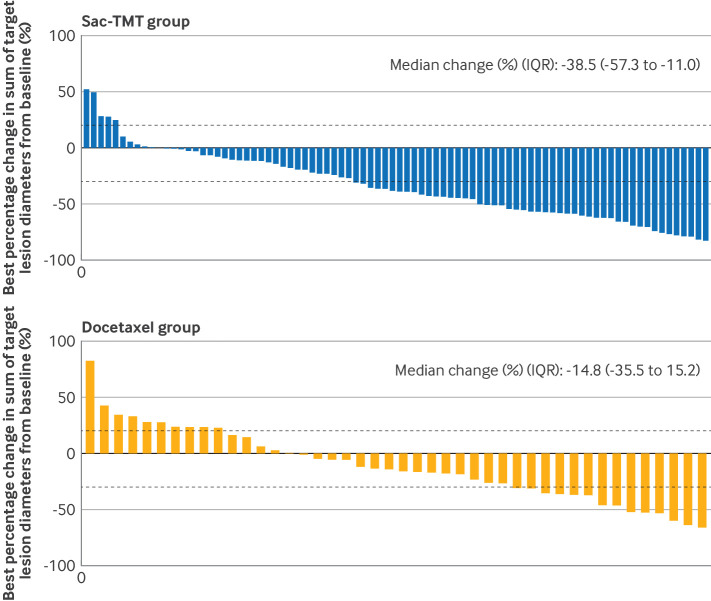
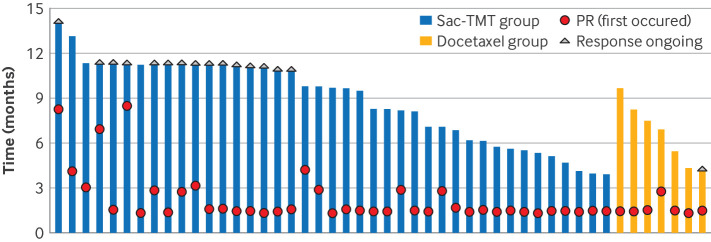
- Among 137 randomized patients, the BIRC-assessed objective response rate was 45% (41/91) with sac-TMT versus 16% (7/45) with docetaxel, a 29% absolute difference (95% CI 15% to 43%; one-sided P<0.001).
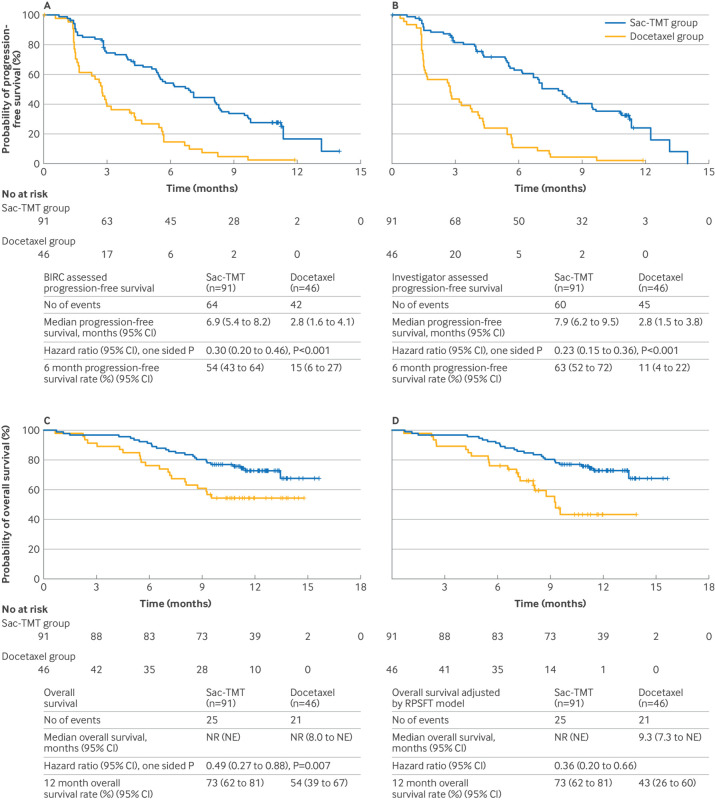
- Median BIRC-assessed progression-free survival was 6.9 months with sac-TMT versus 2.8 months with docetaxel (hazard ratio 0.30, 95% CI 0.20 to 0.46; one-sided P<0.001).
- At the interim overall survival analysis with 46 events (~34% maturity), the 12-month overall survival rate was 73% with sac-TMT versus 54% with docetaxel; the reported hazard ratio for death was 0.49 (95% CI 0.27 to 0.88; one-sided P=0.007).
- Safety was mixed: grade ≥3 treatment-related adverse events occurred in 56% (51/91) with sac-TMT versus 72% (33/46) with docetaxel; febrile neutropenia occurred in 0% versus 20%, respectively.
## Methods
- Design: Phase 2, multicentre, open-label, randomized controlled trial (OptiTROP-Lung03 part II) conducted at 48 centres in China; patients were randomized 2:1 to sac-TMT or docetaxel, stratified by brain metastases.
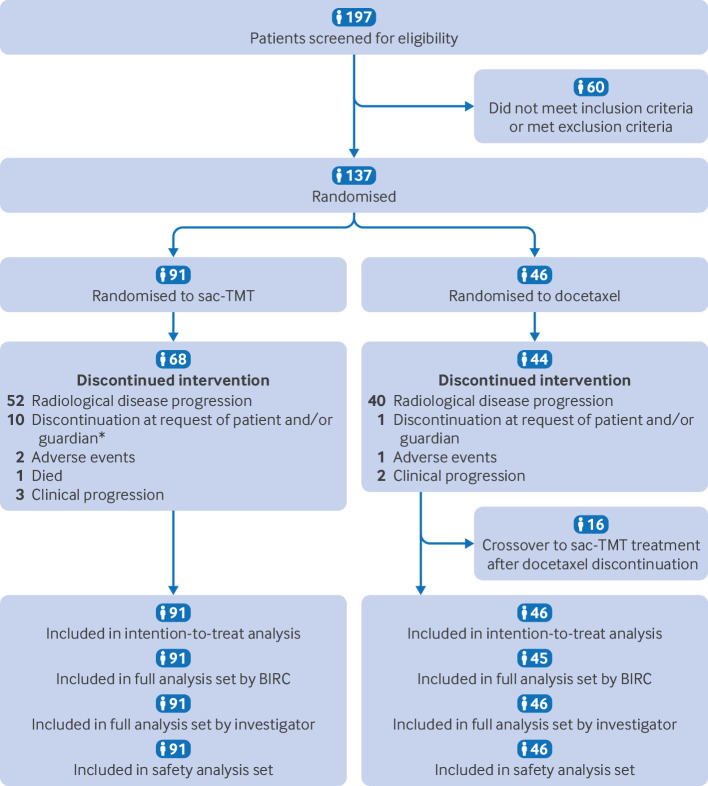
- Sample/data: 137 patients aged 18 to 75 years with histologically or cytologically confirmed non-squamous, locally advanced or metastatic EGFR-mutated NSCLC that had progressed after EGFR-TKIs and platinum chemotherapy; all 137 received at least one dose and were included in safety analyses.
- Main analysis: Primary endpoint was BIRC-assessed objective response rate; secondary endpoints included investigator-assessed response, disease control, progression-free survival, overall survival, and safety. Time-to-event outcomes were analyzed with Kaplan-Meier methods, stratified log-rank tests, and Cox models; overall survival was also adjusted for crossover using supplementary analyses.
## Limitations
- The paper states that the sample size was modest for a phase 2 trial and that all enrolled patients were Chinese, which may limit generalisability.
- The study used objective response rate as a surrogate primary endpoint, and the paper states it was not adequately powered for overall survival.
- The paper states that quality of life was not included; additionally, the open-label design makes treatment awareness unavoidable, although blinded central review was used for the primary endpoint.
Model-written summary. Check it against the paper before relying on it.
Integrity signals
Registry
Cites
Statistics
Figures
Verification
Claims the paper makes
2 Valid · 2 Not valid · 31 Not checked · 95 Own results and interpretations
The sources with a verdict support this claim; the rest weren’t checked yet, have no full text we could read, or their verdicts aren’t rated yet.
In the paper
“However, randomised phase 3 trials of sacituzumab govitecan and datopotamab deruxtecan in biomarker unselected patients with previously treated, advanced NSCLC (regardless of actionable genomic alterations) did not reach statistical significance for overall survival improvement.”
What the sources say
- Not checked yetcites [12] source
- Supportedcites [13] matched to “Datopotamab Deruxtecan Versus Docetaxel for Previously Treated Advanced or Metastatic Non–Small Cell Lung Cancer: The Randomized, Open-Label Phase III TROPION-Lung01 Study” (2025) source
The Knowledge Generated passage (page not supplied) reports that datopotamab deruxtecan's overall-survival improvement over docetaxel was not statistically significant (P = .530). The discussion (page not supplied) reports that the phase III EVOKE-01 trial of sacituzumab govitecan in a similar NSCLC population failed to meet its overall-survival endpoint. The Methods confirm that TROPION-Lung01 included patients with and without actionable genomic alterations. (LLM, conf=0.92)
plain- Asserted: passes — The authors put it forward as true.
- Checkable: passes — It can be checked against evidence.
- Load-bearing: passes — The paper’s conclusions depend on it.
- Based: passes — The paper gives a reason why it holds.
A result the paper reports from its own data — it cites no other source for it, so there is none to check. The quote shows it is in the paper.
In the paper
“Notably, the supplementary survival analysis adjusted using the rank-preserving structural failure time model to account for crossover showed that sac-TMT reduced the risk of death by 64% (adjusted median overall survival not reached versus 9.3 months; hazard ratio 0.36, 95% CI 0.20 to 0.66)”
plainstates a cause- Asserted: passes — The authors put it forward as true.
- Checkable: passes — It can be checked against evidence.
- Load-bearing: passes — The paper’s conclusions depend on it.
- Based: passes — The paper gives a reason why it holds.
- Rests on an assumption not shown here.
A result the paper reports from its own data — it cites no other source for it, so there is none to check. The quote shows it is in the paper.
In the paper
“The 12 month overall survival rate was 73% (95% CI 62% to 81%) in the sac-TMT group and 54% (39% to 67%) in the docetaxel group.”
plain- Asserted: passes — The authors put it forward as true.
- Checkable: passes — It can be checked against evidence.
- Load-bearing: passes — The paper’s conclusions depend on it.
- Based: passes — The paper gives a reason why it holds.
A result the paper reports from its own data — it cites no other source for it, so there is none to check. The quote shows it is in the paper.
In the paper
“The main reason for treatment discontinuation was disease progression (76% with sac-TMT (52/68) and 91% with docetaxel (40/44))”
plainn = 44- Asserted: passes — The authors put it forward as true.
- Checkable: passes — It can be checked against evidence.
- Load-bearing: unclear — It is unclear whether the paper’s conclusions depend on it.
- Based: passes — The paper gives a reason why it holds.
A result the paper reports from its own data — it cites no other source for it, so there is none to check. The quote shows it is in the paper.
In the paper
“as sac-TMT showed a statistically significant higher BIRC assessed objective response rate of 45% compared with 16% for docetaxel, with a difference of 29% (95% CI 15% to 43%).”
plainstates a cause- Asserted: passes — The authors put it forward as true.
- Checkable: passes — It can be checked against evidence.
- Load-bearing: passes — The paper’s conclusions depend on it.
- Based: passes — The paper gives a reason why it holds.
64 more claims
Create a free account to see all 130 claims and to verify the 43 references still open.
- Probably not a substantial claim. 31
- It may state two separate claims as one. 37
- The quote only partly states this claim. 2
Citations
Cites
Osimertinib in Untreated EGFR -Mutated Advanced Non–Small-Cell Lung Cancer
Soria, J.-C., Ohe, Y., Vansteenkiste, J., Reungwetwattana, T., Chewaskulyong, B., Lee, K. H., Dechaphunkul, A., Imamura, F., Nogami, N., Kurata, T., et al. (2018) · New England Journal of Medicine · doi:10.1056/nejmoa1713137 · Cited by 5,508 · cited 1×
“21 22 23-25 Options for patients with treatment failure after both EGFR-tyrosine kinase inhibitors and platinum based chemotherapy become increasingly restricted.”
Overall Survival with Osimertinib in Untreated, EGFR -Mutated Advanced NSCLC
Ramalingam, S. S., Vansteenkiste, J., Planchard, D., Cho, B. C., Gray, J. E., Ohe, Y., Zhou, C., Reungwetwattana, T., Cheng, Y., Chewaskulyong, B., et al. (2020) · New England Journal of Medicine · doi:10.1056/nejmoa1913662 · Cited by 2,914 · cited 1×
“21 22 23-25 Options for patients with treatment failure after both EGFR-tyrosine kinase inhibitors and platinum based chemotherapy become increasingly restricted.”
Thai, A. A., Solomon, B. J., Sequist, L. V., Gainor, J. F., & Heist, R. S. (2021) · The Lancet · doi:10.1016/s0140-6736(21)00312-3 · Cited by 2,576
Non–Small Cell Lung Cancer, Version 4.2024
Riely, G. J., Wood, D. E., Ettinger, D. S., Aisner, D. L., Akerley, W., Bauman, J. R., Bharat, A., Bruno, D. S., Chang, J. Y., Chirieac, L. R., et al. (2024) · Journal of the National Comprehensive Cancer Network · doi:10.6004/jnccn.2204.0023 · Cited by 855
Third-generation EGFR and ALK inhibitors: mechanisms of resistance and management
Cooper, A. J., Sequist, L. V., & Lin, J. J. (2022) · Nature Reviews Clinical Oncology · doi:10.1038/s41571-022-00639-9 · Cited by 508
Bardia, A., Messersmith, W. A., Kio, E. A., Berlin, J. D., Vahdat, L., Masters, G. A., Moroose, R., Santin, A. D., Kalinsky, K., Picozzi, V., et al. (2021) · Annals of Oncology · doi:10.1016/j.annonc.2021.03.005 · Cited by 400
Kawaguchi, T., Ando, M., Asami, K., Okano, Y., Fukuda, M., Nakagawa, H., Ibata, H., Kozuki, T., Endo, T., Tamura, A., et al. (2014) · Journal of Clinical Oncology · doi:10.1200/jco.2013.52.4694 · Cited by 260
Melosky, B., Kambartel, K., Häntschel, M., Bennetts, M., Nickens, D. J., Brinkmann, J., Kayser, A., Moran, M., & Cappuzzo, F. (2022) · Molecular Diagnosis & Therapy · doi:10.1007/s40291-021-00563-1 · Cited by 255
Yu, H. A., Goto, Y., Hayashi, H., Felip, E., Chih-Hsin Yang, J., Reck, M., Yoh, K., Lee, S.-H., Paz-Ares, L., Besse, B., et al. (2023) · Journal of Clinical Oncology · doi:10.1200/jco.23.01476 · Cited by 246 · cited 10×
“Taken together, these findings suggest that sac-TMT is a promising treatment option combining meaningful clinical efficacy with a manageable safety profile for patients with pre-treated, EGFR -mutated, locally advanced or metastatic NSCLC.”
InfluentialSelf-citationAhn, M.-J., Tanaka, K., Paz-Ares, L., Cornelissen, R., Girard, N., Pons-Tostivint, E., Vicente Baz, D., Sugawara, S., Cobo, M., Pérol, M., et al. (2025) · Journal of Clinical Oncology · doi:10.1200/jco-24-01544 · Cited by 244 · cited 3×
“13 However, patients with actionable genomic alterations, including those with EGFR mutations, showed better efficacy, with an objective response rate of 38%.”
Influential
Cited by
Survival with Osimertinib plus Chemotherapy in EGFR -Mutated Advanced NSCLC
Janne, P. A., Planchard, D., Kobayashi, K., Yang, J. C., Liu, Y. L., Valdiviezo, N., Kim, T. M., Jiang, L., Kagamu, H., Yanagitani, N., et al. (2025) · New England Journal of Medicine · doi:10.1056/nejmoa2510308 · Cited by 183
Self-citationSacituzumab Tirumotecan in EGFR-TKI–Resistant, EGFR -Mutated Advanced NSCLC
Fang, W., Wu, L., Meng, X., Yao, Y., Zuo, W., Yao, W., Xie, Y., Zhang, Y., Cui, J., Zhang, Y., et al. (2025) · New England Journal of Medicine · doi:10.1056/nejmoa2512071 · Cited by 107
Self-citationTreatment of NSCLC after chemoimmunotherapy — are we making headway?
Reck, M., Frost, N., Peters, S., Fox, B. A., Ferrara, R., Savai, R., & Barlési, F. (2025) · Nature Reviews Clinical Oncology · doi:10.1038/s41571-025-01061-7 · Cited by 70
“…in patients with NSCLC harbouring genomic alterations, as demonstrated in the phase III OptiTROP-Lung03 trial comparing sacituzumab tirumotecan with docetaxel in patients with EGFR -mutated NSCLC after disease progression on targeted therapies as well as platinum-doublet chemotherapy 247 .”
Zhong, J. Y., Wu, L., Song, Z., Xing, N., Cui, J., Li, X., Fei, K., Tang, D., Dang, Q., Liang, C., et al. (2025) · Cancer Cell · doi:10.1016/j.ccell.2025.09.012 · Cited by 16
Self-citationHong, S.-D., Wang, Y.-S., Zhao, H.-Y., Zhao, Y.-Y., Wang, Q.-M., Ma, Y., Li, Y.-S., Huang, Y., Yang, Y.-P., Fu, Z.-M., et al. (2026) · Annals of Oncology · doi:10.1016/j.annonc.2026.01.009 · Cited by 21
Self-citationXiong, A., Yao, W., Zheng, W., Yan, Y., Chen, P., Zhong, H., Ge, J., Wang, H., Chen, B., Wang, H., et al. (2026) · The Lancet · doi:10.1016/s0140-6736(26)00968-2 · Cited by 21
Self-citationXie, Z., Chen, X., Gao, R., Yang, M., Han, X., Sun, Y., & Shi, Y. (2026) · Chinese Medical Journal · doi:10.1097/cm9.0000000000004016 · Cited by 8
Roy, P. G., Reingold, D., Pathak, N., Verma, S., Gupta, A., Meti, N., Moltó, C., Malik, P. S., Linford, G., & Mittal, A. (2025) · Current Oncology · doi:10.3390/curroncol32080448 · Cited by 12
“Datopotamab deruxtecan (Dato-DXd) has received FDA Breakthrough Therapy designation for EGFR-mutated NSCLC that has progressed after Osimertinib and platinum chemotherapy based on the strength of data from the TROPION-Lung05 trial and the EGFR-mutant subset of TROPION-Lung01 [32,39].”
Zhou, Y., Huang, W., Hang, X., He, Y., He, R., & Gan, C. (2025) · Cancer Chemotherapy and Pharmacology · doi:10.1007/s00280-025-04834-0 · Cited by 7
“The incidence of infusion-related adverse reac - tions of sacituzumab tirumotecan is only 1.1%, while that of datopotamab deruxtecan is as high as 16.1% [48, 62].”
InfluentialClinical applications of antibody-drug conjugates in advanced non-small cell lung cancer
Guo, H., Xu, Z., Li, K., Guo, C., Lin, F., Pu, Q., & Wang, G. (2026) · Frontiers in Immunology · doi:10.3389/fimmu.2026.1787148 · Cited by 8
Yu, X., Fang, J., Xue, Y., Huang, Z., Wang, J., Zhu, X., Wang, X., Lv, T., & Wang, K. (2025) · Bioorganic Chemistry · doi:10.1016/j.bioorg.2025.109204 · Cited by 4
Antibody–drug conjugates in lung cancer: current landscape and future perspectives
Chen, X., & Zhou, C. (2025) · Current Opinion in Oncology · doi:10.1097/cco.0000000000001200 · Cited by 5
Melosky, B. L., Juergens, R. A., Chu, Q. S.-C., Cheema, P. K., Snow, S. L., Leighl, N. B., Blais, N., Ionescu, D. N., McLeod, D., Tsao, M., et al. (2026) · JNCI Journal of the National Cancer Institute · doi:10.1093/jnci/djag008 · Cited by 8
Zhou, H., Zhao, H., Hou, X., Wang, Y., He, Z., Li, Y., Ma, Y., Zhao, Y.-H., Huang, Y., Chen, L., et al. (2026) · Journal of Clinical Oncology · doi:10.1200/jco-25-01929 · Cited by 7
Self-citationOcular toxicity associated with antibody-drug conjugates in cancer therapy: a comprehensive review
Zhou, J., Wang, H., Xie, H., Xu, X., & Xiao, H. (2026) · Frontiers in Immunology · doi:10.3389/fimmu.2026.1698458 · Cited by 4
“In part II of the OptiTROP-Lung03 trial (117), 91 patients with locally advanced or metastatic EGFR-mutant NSCLC received sacituzumab tirumotecan at 5 mg/kg on days 1 and 15 every 4 weeks.”
Huang, Y., Huang, S., Yang, H., Tsai, C., Chang, H.-C., Chi, H., Chen, C., Lin, Y., & Wang, L. (2025) · Phytomedicine · doi:10.1016/j.phymed.2025.157212 · Cited by 5
Zhang, Y.-C., Luo, W., Li, J.-T., Wu, L., Chen, Z.-H., & Zhou, Q. H. (2026) · Journal of Controlled Release · doi:10.1016/j.jconrel.2026.114747 · Cited by 6
Shaping Precision Medicine: The Journey of Sequencing Technologies Across Human Solid Tumors
Li, W., Xiong, C., Chu, C., Zhang, Y., Wang, Z.-H., Wan, Z., Tang, P., Zhu, S., & Zhou, Y. (2025) · Biomedicines · doi:10.3390/biomedicines13112660 · Cited by 2
Zhang, L., Jia, H., & Niu, B. (2026) · BMC Cancer · doi:10.1186/s12885-025-15461-6 · Cited by 3
Self-citationKang, S., Yang, S. T., Jia, Y., & Zhao, S. (2026) · PLoS ONE · doi:10.1371/journal.pone.0343330 · Cited by 2
“Sacituzumab tirumotecan is a novel ADC drug that targeting trophoblast cell surface antigen 2, which designed using a proprietary Kthiol linker to conjugate the topoisomerase I inhibitor KL610023 [5,6].”
Antibody–Drug Conjugates in Non-small Cell Lung Cancer
Zullo, L., Bortolot, M., Ogliari, F. R., Saw, S. P. L., van Geel, R. M. J. M., ter Heine, R., Sadowska, A., Remón, J., & Hendriks, L. E. L. (2026) · Drugs · doi:10.1007/s40265-026-02331-z · Cited by 7
Ansab, M., Rath, S., Alam, U., Burhan, M., Siddiqui, H. T., & Desai, A. P. (2025) · Critical Reviews in Oncology/Hematology · doi:10.1016/j.critrevonc.2025.105093 · Cited by 2
Antibody–Drug Conjugates and Peptide–Drug Conjugates: Current Understandings and Future Perspectives
Zheng, R., Li, S., Zhang, Z., Niu, M., Fei, J., Zhang, J., Zhou, J., Wu, K., Yi, M., & Li, T. (2026) · MedComm · doi:10.1002/mco2.70897 · Cited by 1
“In patients with EGFR-mutated advanced or metastatic NSCLC after previous treatment failure with EGFR-tyrosine kinase inhibitors (EGFR-TKI) and platinum based chemotherapy, sacituzumab tirumotecan also demonstrated encouraging efficacy compared with docetaxel [ 167 ].”
Self-citationCurrent and Emerging Treatment Landscape of Common EGFR-Mutated Advanced Non-small Cell Lung Cancer
McMahon, D. J., John, A., & Popat, S. (2026) · Targeted Oncology · doi:10.1007/s11523-025-01196-8 · Cited by 1
Spagnuolo, A., Spagnoletti, I., Nuccio, E., & Gridelli, C. (2026) · Expert Opinion on Investigational Drugs · doi:10.1080/13543784.2026.2636928
“No cases of ILD were reported in the sac-TMT group [88].”
Chen, A., Xie, D.-J., Jhu, Y., Lin, Y.-J., Wu, D.-Y., Yan, S.-L., Chou, Y., & Ko, J. (2026) · Biomedicine & Pharmacotherapy · doi:10.1016/j.biopha.2026.119281
Sacituzumab Tirumotecan in the Evolving Landscape of Ovarian Cancer Treatment
Bose, C. K. (2026) · Indian Journal of Gynecologic Oncology · doi:10.1007/s40944-026-01115-3
Antibody-Drug Conjugates in Oncology: Mechanisms, Clinical Progress, and Future Directions
Zhu, Z., Wang, S., Hong, W., Zhong, Q., Wang, W., Wang, N., Bai, M., & Ji, Z. (2026) · Cancer Biome and Targeted Therapy · doi:10.66505/cbtt.v1i2.32
Wang, S., Yang, G., Zhang, Q., & Zhang, Y. (2026) · European Journal of Histochemistry · doi:10.4081/ejh.2026.4544
“2 However, while targeted therapies and immune checkpoint blockade have achieved monumental successes, the 5-year survival rate for advanced LUAD remains below 20%, which underscores the urgent need for novel therapeutic strategies and deeper mechanistic insights.”
Wang, C., Chen, J., Wang, X., et al. (2026) · Research Square · doi:10.21203/rs.3.rs-9220381/v1
Neue Strategien bei SCLC und NSCLC - Wichtige Therapieerfolge mit Designer-Molekülen
Arnheim, K. (2026) · Onkologische Welt · doi:10.1055/a-2845-6064
New biomarkers for antibody-drug conjugates in lung cancer the pathologist’s perspective
Hofman, V., Rignol, G., Mograbi, B., Ilié, M., Riudavets, M., López‐Ríos, F., Fusco, N., Malapelle, U., Popat, S., Stenzinger, A., et al. (2026) · Lung Cancer · doi:10.1016/j.lungcan.2026.109507 · Cited by 2
Chen, Y., Liu, Q.-P., Yang, S.-J., Ding, J., Lu, X.-Y., & Xie, H. (2026) · Acta Pharmacologica Sinica · doi:10.1038/s41401-026-01855-0 · Cited by 3
Antibody–drug conjugates in non-small cell lung cancer: current landscape and future directions
Chen, X., Wu, S., Li, F., Yao, C., Liu, Y., & Zhou, G. (2026) · Holistic Integrative Oncology · doi:10.1007/s44178-026-00276-7 · Cited by 2
“Specifically in EGFR-mutant NSCLC, after progression on ADCs, chemotherapy rechallenge remains a standard option, particularly when subsequent targeted therapy options are exhausted [34].”
InfluentialTROP-2 as a therapeutic target in NSCLC: The promise of Sacituzumab tirumotecan
Sofianidi, A. A., Papavassiliou, K. A., & Zagouri, F. (2026) · Critical Reviews in Oncology/Hematology · doi:10.1016/j.critrevonc.2026.105482
Peters, S., Meyer, M., André, F., Argilés, G., Azizi, A. A., Banerjee, S., Burgers, S., Curigliano, G., Drago, J. Z., Fontana, E., et al. (2026) · ESMO Open · doi:10.1016/j.esmoop.2026.108316 · Cited by 1
Ma, X., Li, G. H., & Li, H. (2026) · Frontiers in Oncology · doi:10.3389/fonc.2026.1832920 · Cited by 1
“Among the TROP2-targeting ADCs, three studies evaluated Sac-TMT (20, 37, 38) and one reported a pooled analysis of datopotamab deruxtecan (Dato-DXd) (39).”
Zullo, L., & Remón, J. (2026) · Cancers · doi:10.3390/cancers18142334
“…sensitizing EGFR -mutant NSCLC and previously treated with EGFR TKI, with or without chemotherapy, antibody–drug conjugates (ADCs) targeting TROP2 [55–57] have demonstrated clinically meaningful activity, and some agents such as datopotamab deruxtecan [57] have received FDA approval for patients…”
Recent advances in EGFR-targeted therapies for non-small cell lung cancer
Lucente, L., Barcellini, L., Pollone, B. R., Filipazzi, C. L., Coco, S., Puppo, M., Marconi, S., Santamaria, S., Tagliamento, M., Rossi, G., et al. (2026) · Expert Opinion on Pharmacotherapy · doi:10.1080/14656566.2026.2702380 · Cited by 1
“…95% CI 0.15–0.35) and a significant OS benefit of 20.0 (vs 13.5 months; HR 0.63, 95% CI 0.40–0.98 and 20.0 vs 11.2 months crossover-adjusted, HR 0.45) compared to docetaxel in patients previously treated with EGFR TKIs and with PBC, within the randomized phase II OptiTROP-Lung03 trial [198,199].”
InfluentialZhou, Y., Huang, W., Wang, H., Hang, X., Jin, H., He, R., & Gan, C. (2026) · Journal of Chemotherapy · doi:10.1080/1120009x.2026.2708448
Fan, L., Yin, Y., Zhuang, W., He, D., Wan, R., Sun, B., Bai, H., & Wang, J. (2026) · Drug Delivery · doi:10.1080/10717544.2026.2712694 · Cited by 1
Self-citationLi, Z., Zhou, Z., He, Z.-Y., Han, L., Fang, J., Sun, H.-M., Liu, H.-F., Wang, M.-X., Liu, Y.-B., Qu, X., et al. (2026) · Cancer Cell · doi:10.1016/j.ccell.2026.07.012 · Cited by 2
Self-citationLiu, Y., Tang, L., Han, X.-H., Song, Z.-Y., Liu, D.-R., Cheng, G., Xiao, W.-H., Zhang, S., Hu, Y., Zhang, L., et al. (2026) · Signal Transduction and Targeted Therapy · doi:10.1038/s41392-026-02994-w
Self-citationBai, X., & Yang, Z. (2026) · Holistic Integrative Oncology · doi:10.1007/s44178-026-00299-0
Fan, Y., Ouyang, Q., Yin, Y., 宋礼华, Wang, X., Li, W., Li, M., Yan, X., Wang, S., Sun, T., et al. (2026) · Breast Cancer Research · doi:10.1186/s13058-026-02339-z · Cited by 1
“In contrast, hematologic toxicities with sac-TMT were manageable, and the incidence of severe diarrhea was low in both the current study and previously reported studies [3, 25, 32–34].”
Self-citation
Metadata
- Authors
- Fang, W., Li, X., Wang, Q., Meng, X., Zheng, W., Sun, L., Yao, W., Zhuang, W., Fan, Y., Zhuo, M., Luo, Y., Zhang, Z., Song, X., Yang, R., Yang, J., Jin, X., Diao, Y., Ge, J., & Zhang, L.
- Affiliations
- Department of Medical Oncology, Sun Yat-sen University Cancer Centre, State Key Laboratory of Oncology in South China, Collaborative Innovation Centre for Cancer Medicine, Guangdong Provincial Clinical Research Centre for Cancer, Guangzhou, China
- First Affiliated Hospital of Zhengzhou University (CN)
- Zhengzhou University (CN)
- Shandong Tumor Hospital (CN)
- Sheng Jing Hospital (CN)
- First Affiliated Hospital of Nanchang University (CN)
- Sichuan Cancer Hospital (CN)
- Fujian Provincial Cancer Hospital (CN)
- Zhejiang Cancer Hospital (CN)
- Peking University Cancer Hospital (CN)
- Hunan Cancer Hospital (CN)
- First Affiliated Hospital of Henan University of Science and Technology (CN)
- Shanxi Provincial Cancer Hospital (CN)
- Kunming Medical University (CN)
- Kelun Group (China) (CN)
- National Engineering Research Centre of Targeted Biologics, Chengdu, China
- Sun Yat-sen University (CN)
- Corresponding author
- Zhang, Li
- ORCID
- Venue
- BMJ
- Publisher
- BMJ
- Published
- 2025-06-05
- Volume
- 389
- Pages
- e085680
- ISSN
- 1756-1833 (ISSN-L)
- PMC
- PMC12139608
- OpenAlex
- W4411054093
- Semantic Scholar
- f8a6574d5737670e2544e15fa14df0e2d2c3cbac
- Cited by
- 51
- References
- 29
- Citations by year
- 2026: 40 · 2025: 11
- FWCI
- 33.53
- Type
- journal article
- Language
- en
- Update notices
- correction (2025-11-03)
- Open access
- hybrid
- doi.org
- Licence
- Locations
- BMJ (publishedVersion, cc-by-nc)
- PubMed Central (publishedVersion, cc-by-nc)
- PubMed (publishedVersion)
- Topics
- Health Sciences › Medicine › Pulmonary and Respiratory Medicine › Lung Cancer Treatments and Mutations
- Health Sciences › Medicine › Pulmonary and Respiratory Medicine › Lung Cancer Diagnosis and Treatment
- Health Sciences › Medicine › Oncology › Lung Cancer Research Studies
- Keywords
- sacituzumab tirumotecan, docetaxel, EGFR-mutant non-small cell lung cancer, EGFR tyrosine kinase inhibitors, platinum-based chemotherapy, second-line therapy, objective response rate, progression-free survival, overall survival, treatment safety, EGFR tyrosine kinase inhibitor resistance
- MeSH terms
- Docetaxel, Adolescent, Adult, Aged, Antineoplastic Combined Chemotherapy Protocols, Carcinoma, Non-Small-Cell Lung, Female, Humans, Lung Neoplasms, Male, Middle Aged, Mutation, Young Adult, Antibodies, Monoclonal, Humanized, ErbB Receptors
About these checks
Registry, retraction, Cites and statistics results are computed, not judged, with one exception: a printed reference that no index lists is read once by a model before it counts as a citation error. Claims are extracted by a model and kept only when their quote appears verbatim in the text; each cited source is then checked, with a model’s help, for whether it says what the claim relies on. Those verdicts can be wrong — read the claim’s quote and the cited source before relying on one.
The claim verdicts this report counts are experimental: their accuracy is not yet measured.
A language model drew the claims from the paper on 2026-10-11, under version 3 of the claim definition (model deepseek-v4.1-flash, prompt extract-v3).
A second model labelled each claim on 2026-10-11 (model jev-1.13-20260917, definition revision gold-guideline-v0.2).
Cited sources are checked with a language model’s help (gpt-6-sol).
Statistics and arithmetic are recomputed, not judged.
Confidence bands are shown only for fields calibrated on our annotated test set. None is calibrated yet, so no band is shown.
What counts as a claim ›How we measure confidence ›How we check this ›
Are you an author, or do you see a problem with this page? Request a review
Data sources
Bibliographic data: Semantic Scholar, OpenAlex, Crossref.
Contains information from the Semantic Scholar Academic Graph Datasets, made available under the ODC Attribution License (ODC-BY 1.0).
Semantic Scholar’s data is described in: Kinney, R., et al. (2023). The Semantic Scholar Open Data Platform. arXiv:2301.10140.
