

The DOI matches its Crossref record; 67 of the 68 references it cites were found in a registry or an index.
Effect of calcium supplements on risk of myocardial infarction and cardiovascular events: meta-analysis
Open accessAbstract
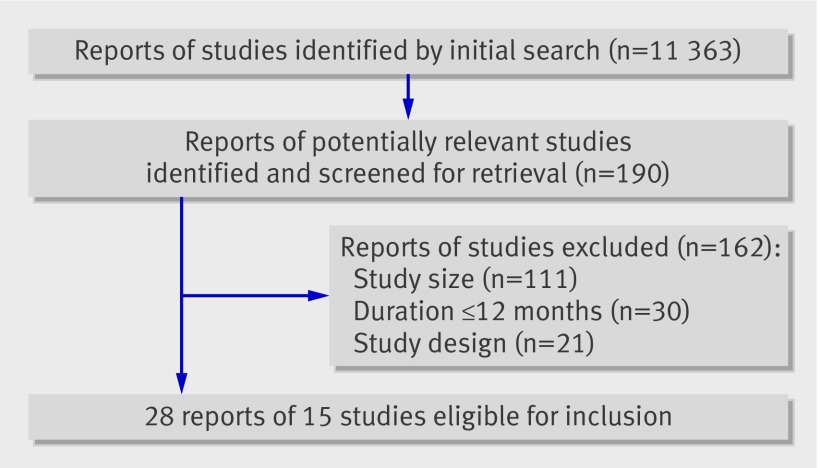
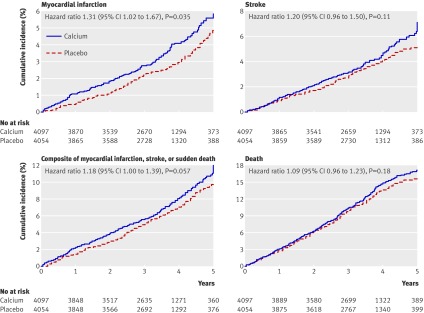
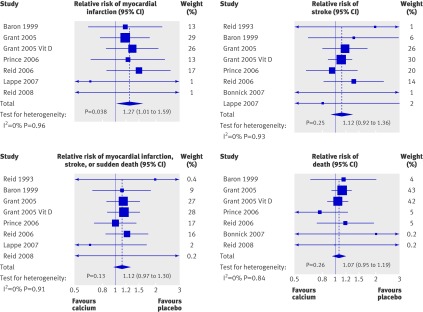
OBJECTIVE: To investigate whether calcium supplements increase the risk of cardiovascular events. DESIGN: Patient level and trial level meta-analyses. DATA SOURCES: Medline, Embase, and Cochrane Central Register of Controlled Trials (1966-March 2010), reference lists of meta-analyses of calcium supplements, and two clinical trial registries. Initial searches were carried out in November 2007, with electronic database searches repeated in March 2010. STUDY SELECTION: Eligible studies were randomised, placebo controlled trials of calcium supplements (>or=500 mg/day), with 100 or more participants of mean age more than 40 years and study duration more than one year. The lead authors of eligible trials supplied data. Cardiovascular outcomes were obtained from self reports, hospital admissions, and death certificates. RESULTS: 15 trials were eligible for inclusion, five with patient level data (8151 participants, median follow-up 3.6 years, interquartile range 2.7-4.3 years) and 11 with trial level data (11 921 participants, mean duration 4.0 years). In the five studies contributing patient level data, 143 people allocated to calcium had a myocardial infarction compared with 111 allocated to placebo (hazard ratio 1.31, 95% confidence interval 1.02 to 1.67, P=0.035). Non-significant increases occurred in the incidence of stroke (1.20, 0.96 to 1.50, P=0.11), the composite end point of myocardial infarction, stroke, or sudden death (1.18, 1.00 to 1.39, P=0.057), and death (1.09, 0.96 to 1.23, P=0.18). The meta-analysis of trial level data showed similar results: 296 people had a myocardial infarction (166 allocated to calcium, 130 to placebo), with an increased incidence of myocardial infarction in those allocated to calcium (pooled relative risk 1.27, 95% confidence interval 1.01 to 1.59, P=0.038). CONCLUSIONS: Calcium supplements (without coadministered vitamin D) are associated with an increased risk of myocardial infarction. As calcium supplements are widely used these modest increases in risk of cardiovascular disease might translate into a large burden of disease in the population. A reassessment of the role of calcium supplements in the management of osteoporosis is warranted.
Overview
The claims and statistics of this paper haven’t been checked yet.
Run the check — free, no account needed. It reads the open-access text and checks the sources it cites.
Integrity signals
Registry
Cites
Statistics
Figures
Verification
Claims the paper makes
The claims and statistics of this paper haven’t been checked yet.
Run the check — free, no account needed. It reads the open-access text and checks the sources it cites.
Claims other papers make about this one
Each is checked against this paper’s own text: does it say what the citing paper says it does?
In the citing paper
“Conjugated linoleic acid and calcium were proposed as potential mediators, but RCTs have demonstrated very small benefits or even adverse cardiometabolic effects of these factors.78–84”
From Components of a Cardioprotective Diet: New Insights (2011) · cites this paper as [84]
In the citing paper
“Evidence has accrued that most of these supplements have little CVD benefit, and that certain supplements including beta-carotene, calcium, and vitamin E may even be harmful.105-108, 111-113”
From Dietary and Policy Priorities for Cardiovascular Disease, Diabetes, and Obesity: A Comprehensive Review (2016) · cites this paper as [113]
Self-check
Percentages, sums and reported differences re-computed from the paper’s own numbers.
The self-check needs the paper’s full text.
Citations
Cites
Bias in meta-analysis detected by a simple, graphical test
Egger, M., Smith, G. D., Schneider, M., & Minder, C. (1997) · BMJ · doi:10.1136/bmj.315.7109.629 · Cited by 56,722
Goodman, W. G., Goldin, J. G., Kuizon, B. D., Yoon, C. S., Gales, B., Sider, D., Wang, Y., Chung, J., Emerick, A. M., Greaser, L. E., et al. (2000) · New England Journal of Medicine · doi:10.1056/nejm200005183422003 · Cited by 2,503
Vitamin D Deficiency and Risk of Cardiovascular Disease
Wang, T. J., Pencina, M. J., Booth, S. L., Jacques, P. F., Ingelsson, E., Lanier, K. J., Benjamin, E. J., D’Agostino, R. B., Wolf, M. S., & Vasan, R. S. (2008) · Circulation · doi:10.1161/circulationaha.107.706127 · Cited by 2,423
Oodman, W. I. G. G., Oldin, J. O. G., Uizon, D. K., Oon, C. H. Y., Ales, B. A. G., Ider, D. O. S., Ang, W. C., Oanie, J., Hung, C., Merick, A. L. E., et al. (2000) · Cited by 2,191
Calcium plus Vitamin D Supplementation and the Risk of Fractures
Jackson, R. D., LaCroix, A. Z., Gass, M. L. S., Wallace, R. B., Robbins, J. A., Lewis, C. E., Bassford, T. L., Beresford, S. A. A., Black, H. R., Blanchette, P. L., et al. (2006) · New England Journal of Medicine · doi:10.1056/nejmoa055218 · Cited by 1,876
Vitamin D and calcium supplementation reduces cancer risk: results of a randomized trial
Lappe, J. M., Travers‐Gustafson, D., Davies, K. M., Recker, R. R., & Heaney, R. P. (2007) · American Journal of Clinical Nutrition · doi:10.1093/ajcn/85.6.1586 · Cited by 1,445
Tang, B., Eslick, G., Nowson, C., Smith, C. A., & Bensoussan, A. (2007) · The Lancet · doi:10.1097/01.ogx.0000298339.68546.3c · Cited by 1,365
Tang, B. M., Eslick, G. D., Nowson, C., Smith, C., & Bensoussan, A. (2007) · The Lancet · doi:10.1016/s0140-6736(07)61342-7 · Cited by 1,248
Sambrook, P. N., & Cooper, C. C. (2006) · The Lancet · doi:10.1016/s0140-6736(06)68891-0 · Cited by 1,201
Autier, P. (2007) · Archives of Internal Medicine · doi:10.1001/archinte.167.16.1730 · Cited by 1,104
Cited by
Sorted by citations
Osteoporosis: now and the future
Rachner, T. D., Khosla, S., & Hofbauer, L. C. (2011) · The Lancet · doi:10.1016/s0140-6736(10)62349-5 · Cited by 2,696
Mozaffarian, D. (2016) · Circulation · doi:10.1161/circulationaha.115.018585 · Cited by 2,216
Papaioannou, A., Morin, S. N., Cheung, A. M., Atkinson, S. A., Brown, J. P., Feldman, S., Hanley, D. A., Hodsman, A. B., Jamal, S. A., Kaiser, S., et al. (2010) · Canadian Medical Association Journal · doi:10.1503/cmaj.100771 · Cited by 1,768
Camacho, P. M., Petak, S. M., Binkley, N., Diab, D. L., Eldeiry, L. S., Farooki, A., Harris, S. T., Hurley, D. L., Kelly, J., Lewiecki, E. M., et al. (2020) · Endocrine Practice · doi:10.4158/gl-2020-0524suppl · Cited by 1,182
Camacho, P. M., Petak, S. M., Binkley, N., Clarke, B. L., Harris, S. T., Hurley, D. L., Kleerekoper, M., Lewiecki, E. M., Miller, P. D., Narula, H. S., et al. (2016) · Endocrine Practice · doi:10.4158/ep161435.esgl · Cited by 1,140
Metadata
- Authors
- Bolland, M. J., Avenell, A., Baron, J. A., Grey, A., MacLennan, G. S., Gamble, G. D., & Reid, I. R.
- Affiliations
- University of Auckland (NZ)
- University of Aberdeen (GB)
- Dartmouth College (US)
- Corresponding author
- Reid, I. R.
- Venue
- BMJ
- Publisher
- BMJ
- Published
- 2010-07-29
- Volume
- 341
- Issue
- jul29 1
- Pages
- c3691-c3691
- ISSN
- 0007-1447 (ISSN-L)
- 0959-8138
- 1468-5833
- PMC
- PMC2912459
- OpenAlex
- W2143921117
- Cited by
- 1,099
- References
- 68
- Citations by year
- 2026: 13 · 2025: 21 · 2024: 25 · 2023: 35 · 2022: 29 · 2021: 34 · 2020: 53 · 2019: 55 · 2018: 59 · 2017: 59 · 2016: 73 · 2015: 81 · 2014: 114 · 2013: 134 · 2012: 112
- FWCI
- 17.25
- Type
- journal article
- Language
- en
- Open access
- hybrid
- doi.org
- Licence
- cc-by-nc
- Locations
- BMJ (publishedVersion, cc-by-nc)
- PubMed Central (publishedVersion, cc-by-nc)
- PubMed (publishedVersion)
- Aberdeen University Research Archive (Aberdeen University) (submittedVersion)
- ResearchSpace (University of Auckland) (submittedVersion)
- ResearchSpace (University of Auckland) (submittedVersion, cc-by-nc)
- Funders
- Scottish Government
- University of Auckland
- Fonterra Co-Operative Group
- Shire
- Chief Scientist Office, Scottish Government Health and Social Care Directorate
- Health Research Council of New Zealand
- National Cancer Institute (R01CA098286)
- Topics
- Health Sciences › Medicine › Endocrinology, Diabetes and Metabolism › Vitamin D Research Studies
- Health Sciences › Medicine › Public Health, Environmental and Occupational Health › Nutritional Studies and Diet
- Health Sciences › Medicine › Orthopedics and Sports Medicine › Bone health and osteoporosis research
- Keywords
- calcium supplements, myocardial infarction, cardiovascular events, stroke, sudden death, mortality, vitamin D, older adults, cardiovascular risk, individual patient data, risk of bias assessment, subgroup analysis
- MeSH terms
- Adult, Aged, Calcium, Dietary, Drug Therapy, Combination, Female, Humans, Male, Middle Aged, Myocardial Infarction, Osteoporosis, Risk Factors, Vitamin D, Randomized Controlled Trials as Topic, Dietary Supplements, Stroke, Bone Density Conservation Agents
About these checks
Registry, retraction, Cites and statistics results are computed, not judged, with one exception: a printed reference that no index lists is read once by a model before it counts as a citation error. Claims are extracted by a model and kept only when their quote appears verbatim in the text; each cited source is then checked, with a model’s help, for whether it says what the claim relies on. Those verdicts can be wrong — read the claim’s quote and the cited source before relying on one.
Statistics and arithmetic are recomputed, not judged.
Confidence bands are shown only for fields calibrated on our annotated test set. None is calibrated yet, so no band is shown.
What counts as a claim ›How we measure confidence ›How we check this ›
Are you an author, or do you see a problem with this page? Request a review
