

The DOI matches its Crossref record; 74 of the 76 references it cites were found in a registry or an index.
Mortality risk during and after opioid substitution treatment: systematic review and meta-analysis of cohort studies.
Open accessAbstract
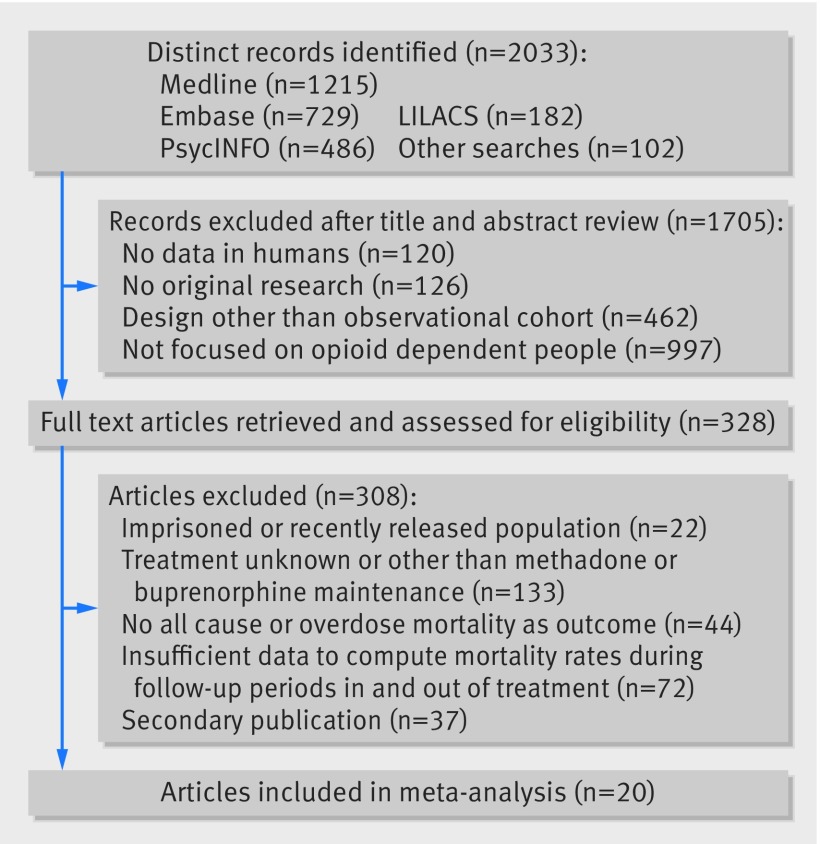
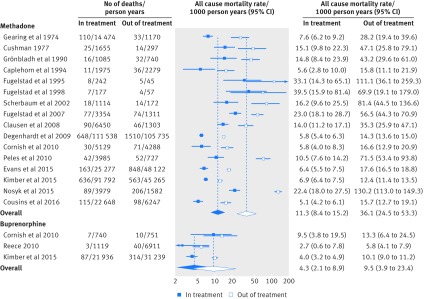
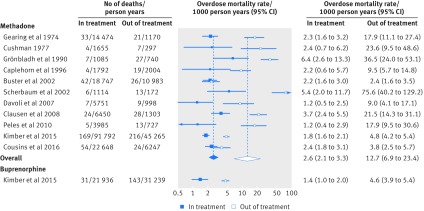
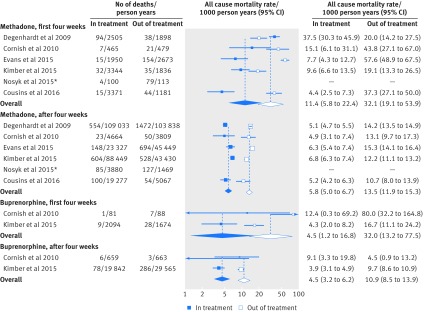
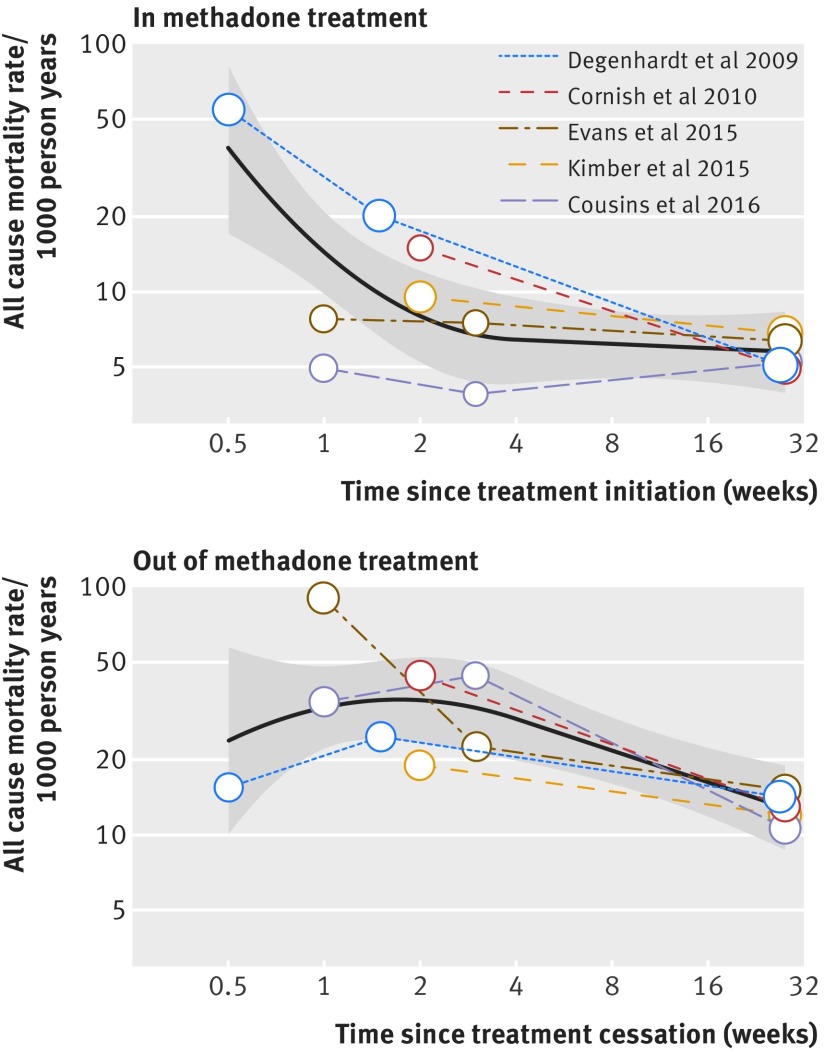
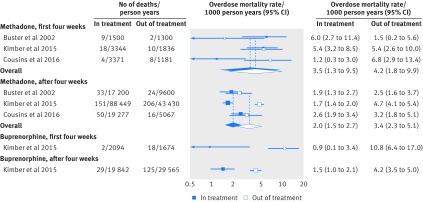
Objective To compare the risk for all cause and overdose mortality in people with opioid dependence during and after substitution treatment with methadone or buprenorphine and to characterise trends in risk of mortality after initiation and cessation of treatment. Design Systematic review and meta-analysis. Data sources Medline, Embase, PsycINFO, and LILACS to September 2016. Study selection Prospective or retrospective cohort studies in people with opioid dependence that reported deaths from all causes or overdose during follow-up periods in and out of opioid substitution treatment with methadone or buprenorphine. Data extraction and synthesis Two independent reviewers performed data extraction and assessed study quality. Mortality rates in and out of treatment were jointly combined across methadone or buprenorphine cohorts by using multivariate random effects meta-analysis. Results There were 19 eligible cohorts, following 122 885 people treated with methadone over 1.3-13.9 years and 15 831 people treated with buprenorphine over 1.1-4.5 years. Pooled all cause mortality rates were 11.3 and 36.1 per 1000 person years in and out of methadone treatment (unadjusted out-to-in rate ratio 3.20, 95% confidence interval 2.65 to 3.86) and reduced to 4.3 and 9.5 in and out of buprenorphine treatment (2.20, 1.34 to 3.61). In pooled trend analysis, all cause mortality dropped sharply over the first four weeks of methadone treatment and decreased gradually two weeks after leaving treatment. All cause mortality remained stable during induction and remaining time on buprenorphine treatment. Overdose mortality evolved similarly, with pooled overdose mortality rates of 2.6 and 12.7 per 1000 person years in and out of methadone treatment (unadjusted out-to-in rate ratio 4.80, 2.90 to 7.96) and 1.4 and 4.6 in and out of buprenorphine treatment. Conclusions Retention in methadone and buprenorphine treatment is associated with substantial reductions in the risk for all cause and overdose mortality in people dependent on opioids. The induction phase onto methadone treatment and the time immediately after leaving treatment with both drugs are periods of particularly increased mortality risk, which should be dealt with by both public health and clinical strategies to mitigate such risk. These findings are potentially important, but further research must be conducted to properly account for potential confounding and selection bias in comparisons of mortality risk between opioid substitution treatments, as well as throughout periods in and out of each treatment.
Overview
The claims and statistics of this paper haven’t been checked yet.
Run the check — free, no account needed. It reads the open-access text and checks the sources it cites.
Integrity signals
Registry
Cites
Statistics
Figures
Verification
Claims the paper makes
The claims and statistics of this paper haven’t been checked yet.
Run the check — free, no account needed. It reads the open-access text and checks the sources it cites.
Claims other papers make about this one
Each is checked against this paper’s own text: does it say what the citing paper says it does?
The source backs part of the claim, not all of it — or backs it for a different population, condition or comparison.
In the citing paper
“The monthly rate of overdose among individuals treated with transmucosal buprenorphine or extended-release buprenorphine is 2.72 per 1000 people.4,32”
From Economic Evaluation of Extended-Release Buprenorphine for Persons With Opioid Use Disorder (2023) · cites this paper as [4]
Experimental — accuracy not yet measuredThe cited source says what the claim attributes to it.
In the citing paper
“Evidence shows that medications for opioid use disorder (MOUD) are a tool that helps reduce opioid-related overdose mortality.2,3,4”
From Economic Evaluation of Extended-Release Buprenorphine for Persons With Opioid Use Disorder (2023) · cites this paper as [4]
Self-check
Percentages, sums and reported differences re-computed from the paper’s own numbers.
The self-check needs the paper’s full text.
Citations
Cites
Yaşlı Kadınlarda Üreme Sağlığı
Kokanalı, D., & Engin Üstün, Y. (n.d.) · DergiPark (Istanbul University) · Cited by 170,090
Preferred Reporting Items for Systematic Reviews and Meta-Analyses: the PRISMA statement
Moher, D., Liberati, A., Tetzlaff, J., Altman, D. G., & for the PRISMA Group (2009) · BMJ · doi:10.1136/bmj.b2535 · Cited by 83,823
Bias in meta-analysis detected by a simple, graphical test
Egger, M., Smith, G. D., Schneider, M., & Minder, C. (1997) · BMJ · doi:10.1136/bmj.315.7109.629 · Cited by 56,722
Preferred reporting items for systematic reviews and meta-analyses: the PRISMA Statement.
(2009) · PubMed Central · Cited by 44,859
(2014) · Medical Entomology and Zoology · Cited by 17,633
Correspondence - Tranexamic acid for traumatic brain injury
(2005) · London School of Economics and Political Science Theses Online (London School of Economics and Political Science) · doi:10.1016/s0140-6736 · Cited by 11,894
Marginal Structural Models and Causal Inference in Epidemiology
Robins, J. M., Hernán, M. Á., & Brumback, B. (2000) · Epidemiology · doi:10.1097/00001648-200009000-00011 · Cited by 5,581
Buprenorphine maintenance versus placebo or methadone maintenance for opioid dependence
Mattick, R. P., Breen, C. L., Kimber, J., & Davoli, M. (2014) · Cochrane Database of Systematic Reviews · doi:10.1002/14651858.cd002207.pub4 · Cited by 2,312
Increases in drug and opioid-involved overdose deaths – United States, 2010-2015
Rudd, R. A., Seth, P., David, F., & Scholl, L. (2016) · MMWR. Morbidity and Mortality Weekly Report · doi:10.15585/mmwr.mm655051e1 · Cited by 2,194
Methadone maintenance therapy versus no opioid replacement therapy for opioid dependence
Mattick, R. P., Breen, C., Kimber, J., & Davoli, M. (2009) · Cochrane Database of Systematic Reviews · doi:10.1002/14651858.cd002209.pub2 · Cited by 1,654
Research works printed but not linked: 1
- [15]Degenhardt L, Calabria B, Nelson P, et al, and Global Burden of Disease Mental Disorders and Illicit Drug Use Expert group. Methodology used in a systematic review of evidence on the prevalence of amphetamine use and dependence. 2009. Sydney, National Drug and Alcohol Research Centre, University of NSW. Illicit drugs discussion paper No.13.
Cited by
Sorted by citations
Larochelle, M. R., Bernson, D., Land, T., Stopka, T. J., Wang, N., Xuan, Z., Bagley, S. M., Liebschutz, J. M., & Walley, A. Y. (2018) · Annals of Internal Medicine · doi:10.7326/m17-3107 · Cited by 1,076
Comparative effectiveness of different treatment pathways for opioid use disorder.
Wakeman, S. E., Larochelle, M. R., Ameli, O., Chaisson, C. E., McPheeters, J. T., Crown, W. H., Azocar, F., & Sanghavi, D. M. (2020) · JAMA Network Open · doi:10.1001/jamanetworkopen.2019.20622 · Cited by 995
Global patterns of opioid use and dependence: harms to populations, interventions, and future action
Degenhardt, L. J., Grebely, J., Stone, J., Hickman, M., Vickerman, P. T., Marshall, B. D. L., Bruneau, J., Altice, F. L., Henderson, G., Rahimi‐Movaghar, A., et al. (2019) · The Lancet · doi:10.1016/s0140-6736(19)32229-9 · Cited by 886
Lee, J. D., Nunes, E. V., Novo, P., Bachrach, K., Bailey, G. L., Bhatt, S., Farkas, S., Fishman, M., Gauthier, P., Hodgkins, C. C., et al. (2018) · The Lancet · doi:10.1016/s0140-6736(17)32812-x · Cited by 700
Strang, J., Volkow, N. D., Degenhardt, L., Hickman, M., Johnson, K., Koob, G. F., Marshall, B. D. L., Tyndall, M., & Walsh, S. L. (2020) · Nature Reviews Disease Primers · doi:10.1038/s41572-019-0137-5 · Cited by 639
Metadata
- Authors
- Sordo, L., Barrio, G., Bravo, M. J., Indave, B. I., Degenhardt, L., Wiessing, L., Ferri, M., & Pastor-Barriuso, R.
- Affiliations
- Universidad Complutense de Madrid (ES)
- Instituto de Salud Carlos III (ES)
- The University of Melbourne (AU)
- European Monitoring Centre for Drugs and Drug Addiction (PT)
- Corresponding author
- Barrio, Gregorio
- Venue
- BMJ
- Publisher
- BMJ
- Published
- 2017-04-26
- Volume
- 357
- Pages
- j1550
- ISSN
- 1756-1833 (ISSN-L)
- 0959-8138
- PMC
- PMC5421454
- OpenAlex
- W2608446001
- Cited by
- 1,816
- References
- 76
- Citations by year
- 2026: 156 · 2025: 194 · 2024: 201 · 2023: 239 · 2022: 228 · 2021: 261 · 2020: 213 · 2019: 187 · 2018: 99 · 2017: 32
- FWCI
- 23.58
- Type
- journal article
- Language
- en
- Open access
- hybrid
- doi.org
- Licence
- Locations
- BMJ (publishedVersion, cc-by-nc)
- Europe PMC (PubMed Central) (publishedVersion, cc-by-nc)
- PubMed Central (publishedVersion, cc-by-nc)
- PubMed (publishedVersion)
- LA Referencia (Red Federada de Repositorios Institucionales de Publicaciones Científicas) (submittedVersion, cc-by-nc-sa)
- Minerva Access (University of Melbourne) (submittedVersion, cc-by-nc)
- HighWire Press Open Archive (submittedVersion)
- Topics
- Health Sciences › Medicine › Public Health, Environmental and Occupational Health › Opioid Use Disorder Treatment
- Health Sciences › Medicine › Epidemiology › Substance Abuse Treatment and Outcomes
- Health Sciences › Medicine › Epidemiology › HIV, Drug Use, Sexual Risk
- Keywords
- opioid substitution therapy, methadone, buprenorphine, opioid use disorder, all-cause mortality, drug overdose deaths, treatment retention, treatment discontinuation, harm reduction, opioid antagonists
- MeSH terms
- Buprenorphine, Humans, Methadone, Opioid-Related Disorders, Narcotics, Risk, Opiate Substitution Treatment, Drug Overdose
About these checks
Registry, retraction, Cites and statistics results are computed, not judged, with one exception: a printed reference that no index lists is read once by a model before it counts as a citation error. Claims are extracted by a model and kept only when their quote appears verbatim in the text; each cited source is then checked, with a model’s help, for whether it says what the claim relies on. Those verdicts can be wrong — read the claim’s quote and the cited source before relying on one.
Statistics and arithmetic are recomputed, not judged.
Confidence bands are shown only for fields calibrated on our annotated test set. None is calibrated yet, so no band is shown.
What counts as a claim ›How we measure confidence ›How we check this ›
Are you an author, or do you see a problem with this page? Request a review
