

The DOI matches its Crossref record; 50 of the 50 references it cites were found in a registry or an index.
Association between pre-diabetes and microvascular and macrovascular disease in newly diagnosed type 2 diabetes
Open accessAbstract
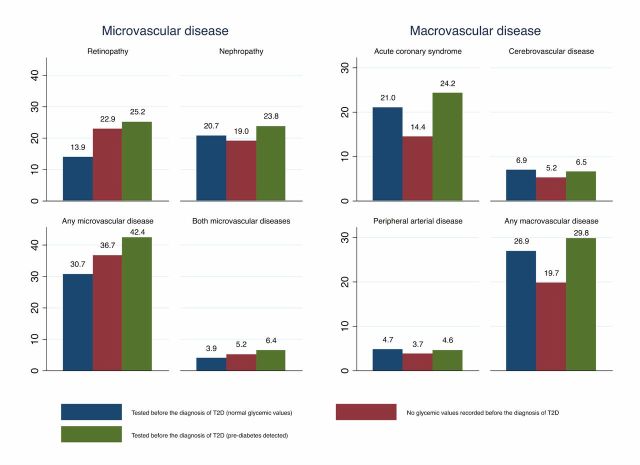
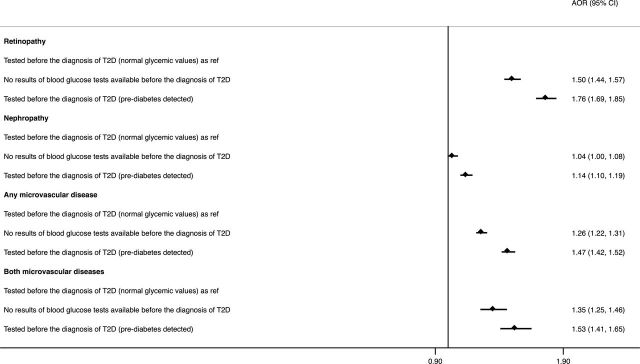
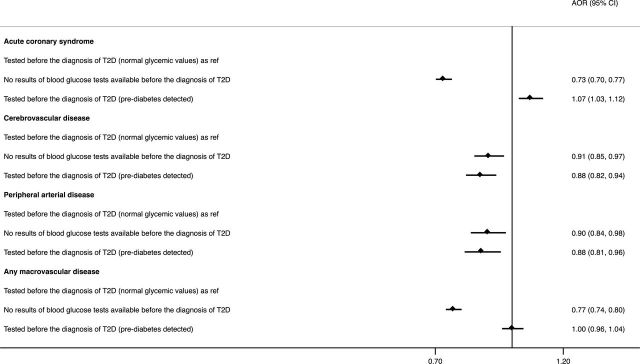
Objective: The associated risk of vascular disease following diagnosis of type 2 diabetes in people previously identified as having pre-diabetes in real-world settings is unknown. We examined the presence of microvascular and macrovascular disease in individuals with newly diagnosed type 2 diabetes by glycemic status within 3 years before diagnosis. Research design and methods: We identified 159 736 individuals with newly diagnosed type 2 diabetes from the UK Clinical Practice Research Datalink database in England between 2004 and 2017. We used logistic regression models to compare presence of microvascular (retinopathy and nephropathy) and macrovascular (acute coronary syndrome, cerebrovascular and peripheral arterial disease) disease at the time of type 2 diabetes diagnosis by prior glycemic status. Results: Half of the study population (49.9%) had at least one vascular disease, over one-third (37.4%) had microvascular disease, and almost a quarter (23.5%) had a diagnosed macrovascular disease at the time of type 2 diabetes diagnosis. Compared with individuals with glycemic values within the normal range, those detected with pre-diabetes before the diagnosis had 76% and 14% increased odds of retinopathy and nephropathy (retinopathy: adjusted OR (AOR) 1.76, 95% CI 1.69 to 1.85; nephropathy: AOR 1.14, 95% CI 1.10 to 1.19), and 7% higher odds of the diagnosis of acute coronary syndrome (OR 1.07, 95% CI 1.03 to 1.12) in fully adjusted models at time of diabetes diagnosis. Conclusions: Microvascular and macrovascular diseases are detected in 37%–24% of people with newly diagnosed type 2 diabetes. Pre-diabetes before diagnosis of type 2 diabetes is associated with increased odds of microvascular disease and acute coronary syndrome. Detection of pre-diabetes might represent an opportunity for reducing the burden of microvascular and macrovascular disease through heightened attention to screening for vascular complications.
Overview
The claims and statistics of this paper haven’t been checked yet.
Run the check — free, no account needed. It reads the open-access text and checks the sources it cites.
Integrity signals
Registry
Cites
Statistics
Figures
Verification
Claims the paper makes
The claims and statistics of this paper haven’t been checked yet.
Run the check — free, no account needed. It reads the open-access text and checks the sources it cites.
Claims other papers make about this one
Each is checked against this paper’s own text: does it say what the citing paper says it does?
The source backs part of the claim, not all of it — or backs it for a different population, condition or comparison.
In the citing paper
“Similar impact on diabetes complications was reported with screening, diagnosis, and comprehensive risk factor management in the U.K. Clinical Practice Research Datalink database (97).”
From 2. Diagnosis and Classification of Diabetes: Standards of Care in Diabetes—2024 (2024) · cites this paper as [97]
Experimental — accuracy not yet measuredThe cited source says what the claim attributes to it.
In the citing paper
“Risk models have explored the bene fi t, in general fi nding higher bene fi t of intervention in those at highest risk (96) (see Section 3, ' Prevention or Delay of Diabetes and Associated Comorbidities ' ) and reduce the risk of diabetes complications (97)”
From 2. Diagnosis and Classification of Diabetes: Standards of Care in Diabetes—2024 (2024) · cites this paper as [97]
In the citing paper
“However, many people in remission from type 2 diabetes remain in the pre-diabetes range of HbA1c, where cardiovascular disease risk begins to rise [92, 93].”
Self-check
Percentages, sums and reported differences re-computed from the paper’s own numbers.
The self-check needs the paper’s full text.
Citations
Cites
Diagnosis and Classification of Diabetes Mellitus
American Diabetes Association (2010) · Diabetes Care · doi:10.2337/dc11-s062 · Cited by 14,094
Data Analysis Using Regression and Multilevel/Hierarchical Models
Gelman, A., & Hill, J. (2006) · doi:10.1017/cbo9780511790942 · Cited by 13,597
Barnett, K., Mercer, S. W., Norbury, M., Watt, G., Wyke, S., & Guthrie, B. (2012) · The Lancet · doi:10.1016/s0140-6736(12)60240-2 · Cited by 6,972
Diagnosis and classification of diabetes mellitus
American Diabetes Association (2014) · Diabetes Care · doi:10.2337/dc14-s081 · Cited by 5,974
Diagnosis and Classification of diabetes mellitus
Rossi, G. (2014) · Diapedia.org eBooks · doi:10.14496/dia..20 · Cited by 3,212
International Expert Committee report on the role of the A1c assay in the diagnosis of diabetes
The International Expert Committee (2009) · Diabetes Care · doi:10.2337/dc09-9033 · Cited by 3,185
Prediabetes: a high-risk state for diabetes development
Tabák, A. G., Herder, C., Rathmann, W., Brunner, E. J., & Kivimäki, M. (2012) · The Lancet · doi:10.1016/s0140-6736(12)60283-9 · Cited by 2,958
Unwin, N. C. (2006) · Cited by 1,661
Huang, Y., Cai, X., Mai, W., Li, M., & Hu, Y. (2016) · BMJ · doi:10.1136/bmj.i5953 · Cited by 1,012
Tabák, A. G., Jokela, M., Akbaraly, T. N., Brunner, E. J., Kivimäki, M., & Witte, D. R. (2009) · The Lancet · doi:10.1016/s0140-6736(09)60619-x · Cited by 898
Research works printed but not linked: 1
- Ashra NB , Spong R , Carter P , et al . A systematic review and metaanalysis assessing the effectiveness of pragmatic lifestyle interventions for the prevention of type 2 diabetes mellitus in routine practice. London, the UK: Public Health England, 2015.
Cited by
Sorted by citations
Items 101–103 of 103
Kobra, K., Hossain, M. A., Bandegan, A., Rahman, M. M., Rabiee, A., & Rahimian, R. (2026) · Cells · doi:10.3390/cells15181680
Lontoh, S. O., Santoso, A. H., & Setiawan, F. V. (2026) · Science and Technology · doi:10.69930/scitec.v3i3.852
Metadata
- Authors
- Palladino, R., Tabak, A. G., Khunti, K., Valabhji, J., Majeed, A., Millett, C., & Vamos, E. P.
- Affiliations
- Imperial College London (GB)
- Department of Epidemiology and Public Health, University College London, London, UK
- University of Leicester (GB)
- Imperial College Healthcare NHS Trust (GB)
- Corresponding author
- Palladino, Raffaele
- ORCID
- Venue
- BMJ Open Diabetes Research & Care
- Publisher
- BMJ
- Published
- 2020-04
- Volume
- 8
- Issue
- 1
- Pages
- e001061
- ISSN
- 2052-4897 (ISSN-L)
- PMC
- PMC7202749
- OpenAlex
- W3019785267
- Cited by
- 98
- References
- 50
- Citations by year
- 2026: 12 · 2025: 11 · 2024: 25 · 2023: 15 · 2022: 18 · 2021: 10 · 2020: 7
- FWCI
- 9.43
- Type
- journal article
- Language
- en
- Open access
- gold
- doi.org
- Licence
- Locations
- BMJ Open Diabetes Research & Care (publishedVersion, cc-by-nc)
- PubMed Central (publishedVersion, cc-by-nc)
- PubMed (publishedVersion)
- DOAJ (DOAJ: Directory of Open Access Journals) (submittedVersion, cc-by-sa)
- UCL Discovery (University College London) (submittedVersion)
- Figshare (submittedVersion, cc-by-nc)
- Minerva Access (University of Melbourne) (submittedVersion, cc-by-nc)
- Spiral (Imperial College London) (submittedVersion, cc-by-nc)
- Funders
- National Institute for Health and Care Research
- Department of Health and Social Care
- Imperial College London
- Topics
- Health Sciences › Medicine › Endocrinology, Diabetes and Metabolism › Diabetes, Cardiovascular Risks, and Lipoproteins
- Health Sciences › Medicine › Endocrinology, Diabetes and Metabolism › Diabetes Management and Research
- Health Sciences › Medicine › Endocrinology, Diabetes and Metabolism › Diabetes Treatment and Management
- Keywords
- prediabetes, type 2 diabetes, newly diagnosed diabetes, microangiopathy, macroangiopathy, diabetic retinopathy, diabetic nephropathy, acute coronary syndrome, cerebrovascular disease, peripheral arterial disease, glycemic status, vascular complications, screening
- MeSH terms
- Blood Glucose, Diabetes Mellitus, Type 2, Diabetic Angiopathies, Humans, Prediabetic State, Vascular Diseases
About these checks
Registry, retraction, Cites and statistics results are computed, not judged, with one exception: a printed reference that no index lists is read once by a model before it counts as a citation error. Claims are extracted by a model and kept only when their quote appears verbatim in the text; each cited source is then checked, with a model’s help, for whether it says what the claim relies on. Those verdicts can be wrong — read the claim’s quote and the cited source before relying on one.
Statistics and arithmetic are recomputed, not judged.
Confidence bands are shown only for fields calibrated on our annotated test set. None is calibrated yet, so no band is shown.
What counts as a claim ›How we measure confidence ›How we check this ›
Are you an author, or do you see a problem with this page? Request a review
