

Ceramides and phospholipids are downregulated with liraglutide treatment: results from the LiraFlame randomized controlled trial
Open accessThe DOI matches its Crossref record; 42 of the 42 references it cites were found in a registry or an index.
Abstract
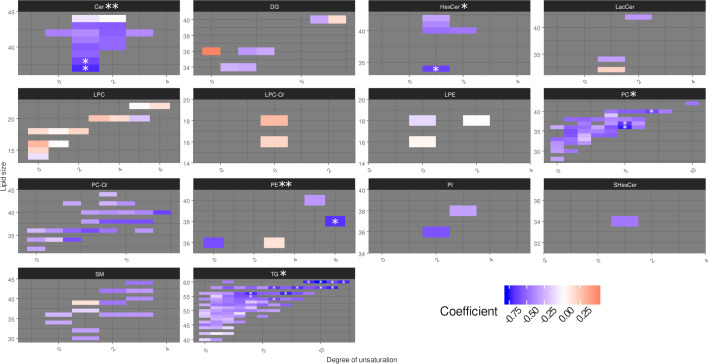
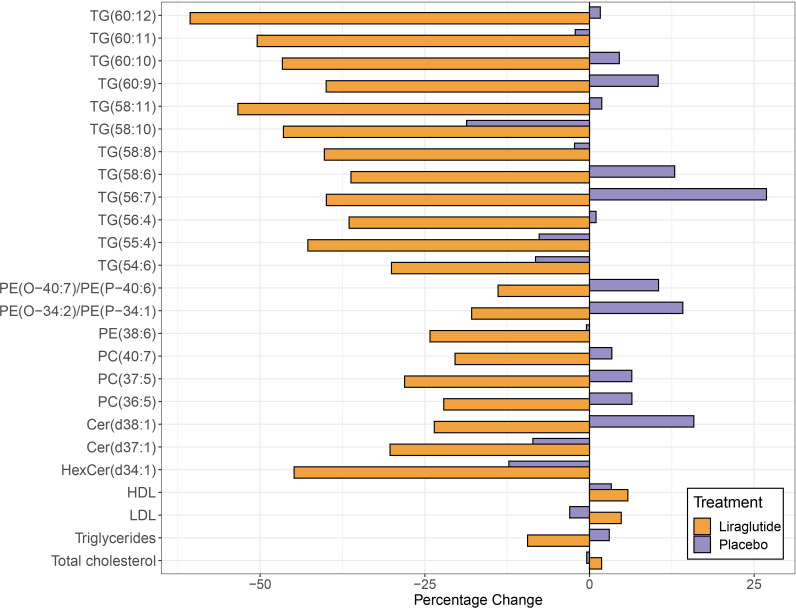
Introduction: Treatment with glucagon-like peptide-1 receptor agonists (GLP-1 RAs) can reduce risk of cardiovascular disease (CVD) in persons living with type 2 diabetes, however the mechanisms explaining this cardiovascular benefit are still debated. We investigated changes in the plasma lipidome following treatment with the GLP-1 RA liraglutide. Research design and methods: In a double-blind placebo-controlled trial, we randomized 102 persons with type 2 diabetes to liraglutide or placebo for 26 weeks. Fasting blood plasma was collected at baseline and at end-of-treatment. The lipidome was measured using liquid-chromatography-coupled mass-spectrometry as a secondary end point in the study. Treatment response of each lipid was tested with lipid-specific linear mixed-effect models comparing liraglutide with placebo. Bonferroni p<7.1e-03 was employed. The independence of the findings from clinical covariates was evaluated with adjustment for body mass index, HbA 1c, fasting status, lipid-lowering treatment and change in lipid-lowering treatment during the trial. Results: In total, 260 lipids were identified covering 11 lipid families. We observed significant decreases following liraglutide treatment compared with placebo in 21 lipids (p<7.1e-03) from the following lipid families: ceramides, hexocyl-ceramides, phosphatidylcholines, phosphatidylethanolamines and triglycerides. We confirmed these findings in adjusted models (p≤0.01). In the liraglutide-treated group, the individual lipids were reduced in the range of 14%–61% from baseline level, compared with 19% decrease to 27% increase from baseline level in the placebo group. Conclusions: Compared with placebo, liraglutide treatment led to a significant downregulation in ceramides, phospholipids and triglycerides, which all are linked to higher risk of CVD. These findings were independent of relevant clinical covariates. Our findings are hypothesis generating and shed light on the biological mechanisms underlying the cardiovascular benefits observed with GLP-1 RAs in outcome studies, and further strengthen the evidence base for recommending GLP-1 RAs to prevent CVD in type 2 diabetes. Trial registration number: NCT03449654.
Overview
The claims and statistics of this paper haven’t been checked yet.
Free: it reads the open-access text and checks the first 5 claims that cite a source we can check. Create a free account to check every claim.
Integrity signals
Registry
Cites
Statistics
Figures
Verification
Claims the paper makes
The claims and statistics of this paper haven’t been checked yet.
Free: it reads the open-access text and checks the first 5 claims that cite a source we can check. Create a free account to check every claim.
Claims other papers make about this one
Each is checked against this paper’s own text: does it say what the citing paper says it does?
In the citing paper
“Zobel et al.133 investigated the effect of liraglutide for 26 weeks compared with placebo, showing a significant decrease in 21 lipid species, mainly ceramides, PCs, and TAGs.”
From Lipid metabolism in MASLD and MASH: From mechanism to the clinic (2024) · cites this paper as [133]
Self-check
Percentages, sums and reported differences re-computed from the paper’s own numbers.
The self-check needs the paper’s full text.
Citations
Cites
Fitting Linear Mixed-Effects Models Using lme4
Bates, D., Mächler, M., Bolker, B., & Walker, S. (2015) · Journal of Statistical Software · doi:10.18637/jss.v067.i01 · Cited by 86,835
A SIMPLE METHOD FOR THE ISOLATION AND PURIFICATION OF TOTAL LIPIDES FROM ANIMAL TISSUES
Folch, J., Lees, M., & Stanley, G. H. S. (1957) · Journal of Biological Chemistry · doi:10.1016/s0021-9258(18)64849-5 · Cited by 65,189 · cited 1×
“Lipids were extracted using a modified Folch extraction method 9 and were analyzed by ultra- high-performance liquid chromatography coupled with quadrupole time- of-flight mass spectrometry.”
limma powers differential expression analyses for RNA-sequencing and microarray studies
Ritchie, M. E., Phipson, B., Wu, D., Hu, Y., Law, C. W., Shi, W., & Smyth, G. K. (2015) · Nucleic Acids Research · doi:10.1093/nar/gkv007 · Cited by 40,458
ggplot2: Elegant Graphics for Data Analysis
Wickham, H. (2009) · doi:10.1007/978-0-387-98141-3 · Cited by 14,447
Wickham, H. (2016) · Use R! · doi:10.1007/978-3-319-24277-4_9 · Cited by 12,516
Liraglutide and Cardiovascular Outcomes in Type 2 Diabetes
Marso, S. P., Daniels, G. H., Brown-Frandsen, K., Kristensen, P., Mann, J. F. E., Nauck, M. A., Nissen, S. E., Pocock, S., Poulter, N. R., Ravn, L. S., et al. (2016) · New England Journal of Medicine · doi:10.1056/nejmoa1603827 · Cited by 7,629
Semaglutide and Cardiovascular Outcomes in Patients with Type 2 Diabetes
Marso, S. P., Bain, S. C., Consoli, A., Eliaschewitz, F. G., Jódar, E., Leiter, L. A., Lingvay, I., Rosenstock, J., Seufert, J., Warren, M. L., et al. (2016) · New England Journal of Medicine · doi:10.1056/nejmoa1607141 · Cited by 6,900
mediation:R Package for Causal Mediation Analysis
Tingley, D., Yamamoto, T., Hirose, K., Keele, L., & Imai, K. (2014) · Journal of Statistical Software · doi:10.18637/jss.v059.i05 · Cited by 4,155
Pluskal, T., Castillo, S., Villar-Briones, A., & Orešič, M. (2010) · BMC Bioinformatics · doi:10.1186/1471-2105-11-395 · Cited by 3,845 · cited 1×
“The acquired data were preprocessed using MZmine 2 (V.2.28) 10 and postprocessed in R V.3.5.1 (R Core Team, Vienna, Austria) by normalization to internal standards, batch correction, truncation of outliers, imputation of missing values and log 10 transformation.”
InfluentialCardiovascular Risk Reduction with Icosapent Ethyl for Hypertriglyceridemia
Bhatt, D. L., Steg, P. G., Miller, M., Brinton, E. A., Jacobson, T. A., Ketchum, S. B., Doyle, R. T., Juliano, R. A., Jiao, L., Granowitz, C., et al. (2019) · New England Journal of Medicine · doi:10.1056/nejmoa1812792 · Cited by 3,317 · cited 1×
“…or secondary to weight loss or improved glycemic control following liraglutide treat-ment, an active comparator should have been included (ie, insulin as a comparator for liraglutides effect on glycemic control or diet-induced weight loss as a comparator for liraglutides effect on body weight).”
Cited by
Wong, C. K., McLean, B. A., Baggio, L. L., Koehler, J. A., Hammoud, R., Rittig, N., Yabut, J. M., Seeley, R. J., Brown, T. J., & Drucker, D. J. (2024) · Cell Metabolism · doi:10.1016/j.cmet.2023.11.009 · Cited by 304
“38 These lipid species may lower plasma cytokines, including TNF-a .”
BackgroundLipid metabolism in MASLD and MASH: From mechanism to the clinic
Carli, F., Della Pepa, G., Sabatini, S., Vidal Puig, A., & Gastaldelli, A. (2024) · JHEP Reports · doi:10.1016/j.jhepr.2024.101185 · Cited by 147
Ceramides as Mediators of Oxidative Stress and Inflammation in Cardiometabolic Disease
Gaggini, M., Ndreu, R., Michelucci, E., Rocchiccioli, S., & Vassalle, C. (2022) · International Journal of Molecular Sciences · doi:10.3390/ijms23052719 · Cited by 115
“Interestingly in this context, very recent data show that liraglutide (a GLP-1 receptor agonist) decreased ceramide levels, suggesting downstream effects of liraglutide on lipid metabolism that could benefit the cardiovascular profile in type 2 diabetes patients [77].”
BackgroundCeramide Acyl Chain Length and Its Relevance to Intracellular Lipid Regulation
Ho, Q. W. C., Zheng, X., & Ali, Y. (2022) · International Journal of Molecular Sciences · doi:10.3390/ijms23179697 · Cited by 71
“In a study looking at the effects of liraglutide treatment, a glucagon-like peptide-1 agonist known to reduce CVD risk in T2DM patients, plasma ceramides with acyl lengths of 19 and 20 carbon atoms were lowered by GLP-1 treatment, suggesting that the lowering of long acyl chain ceramides may contribute to reported GLP…”
BackgroundLe, R., Nguyen, M. T., Allahwala, M. A., Psaltis, J. P., Marathe, C. S., Marathe, J. A., & Psaltis, P. J. (2024) · Journal of Clinical Medicine · doi:10.3390/jcm13164674 · Cited by 66
“Moreover, detailed lipidomic analysis revealed that liraglutide significantly lowers blood concentrations of multiple lipid species, including ceramides, phosphatidylcholines, phosphatidylethanolamines and triglycerides [106].”
BackgroundZhang, L., Hu, Y., An, Y., Wang, Q., Liu, J., & Wang, G. (2022) · Frontiers in Endocrinology · doi:10.3389/fendo.2022.677202 · Cited by 38
Liraglutide reduces plasma dihydroceramide levels in patients with type 2 diabetes
Denimal, D., Bergas, V., de Barros, J.-P. P., Simoneau, I., Demizieux, L., Passilly‐Degrace, P., Bouillet, B., Petit, J., Rouland, A., Bataille, A., et al. (2023) · Cardiovascular Diabetology · doi:10.1186/s12933-023-01845-0 · Cited by 33
“To the best of our knowledge, only one study reported that liraglutide decreases circulating levels of 24:0 DhCer, but they did not provide data on other DhCer species [28].”
BackgroundRamos‐Molina, B., Rossell, J., de, A. P.-M., Pardina, E., Genua, I., Rojo-López, M. I., Julián, M. T., Alonso, N., Julve, J., & Mauricio, D. (2024) · Frontiers in Endocrinology · doi:10.3389/fendo.2024.1400961 · Cited by 33
Kalkman, H. O., & Smigielski, L. (2025) · Molecular Neurobiology · doi:10.1007/s12035-025-04989-0 · Cited by 30
Papazoglou, Α. S., Stalikas, N., Moysidis, D. V., Otountzidis, N., Κάρτας, Α., Karagiannidis, E., Giannakoulas, G. A., & Sianos, G. (2022) · Journal of clinical lipidology · doi:10.1016/j.jacl.2022.02.001 · Cited by 29
Pharmacometabolomic profiles in type 2 diabetic subjects treated with liraglutide or glimepiride
Jendle, J., Hyötyläinen, T., Orešič, M., & Nyström, T. (2021) · Cardiovascular Diabetology · doi:10.1186/s12933-021-01431-2 · Cited by 27
“Multiple sphingolipids, including glycoceramides, a class of bioactive sphingolipids, were found to be decreased in subjects treated with liraglutide [29].”
BackgroundCurrent Perspectives for Treating Adolescents with Obesity and Type 2 Diabetes: A Review
Niechciał, E., Wais, P., Bajtek, J., & Kędzia, A. W. (2024) · Nutrients · doi:10.3390/nu16234084 · Cited by 26
Tănase, D. M., Gosav, E. M., Petrov, D., Jucan, A. E., Lăcătușu, C.-M., Floria, M., Tărniceriu, C. C., Costea, C. F., Ciocoiu, M., & Rezuș, C. (2021) · Diagnostics · doi:10.3390/diagnostics11112053 · Cited by 26
How Ceramides Orchestrate Cardiometabolic Health—An Ode to Physically Active Living
Carrard, J., Gallart‐Ayala, H., Weber, N., Colledge, F., Streese, L., Hanssen, H., Schmied, C. M., Ivanišević, J., & Schmidt‐Trucksäss, A. (2021) · Metabolites · doi:10.3390/metabo11100675 · Cited by 23
“Strikingly, about one-half of NCD-related deaths are still attributable to cardiometabolic diseases (CMD), encompassing cardiovascular diseases (CVD), type 2 diabetes mellitus (T2DM) and non-alcoholic fatty liver disease (NAFLD) [3].”
BackgroundInfluentialWretlind, A., Curovic, V. R., de Zawadzki, A., Suvitaival, T., Xu, J., Zobel, E. H., von Scholten, B. J., Ripa, R. S., Kjær, A., Hansen, T. W., et al. (2023) · Lipids in Health and Disease · doi:10.1186/s12944-023-01922-z · Cited by 21
“…of Liraglutide on Vascular Inflammation in Type-2 Diabetes (LiraFlame26), that treatment with the glucagon-like peptide-1 receptor agonist (GLP-1RA) liraglutide (1.8 mg/d) downregulated several lipid species, including ceramides in individuals with T2D, using an untargeted lipidomic approach [27].”
BackgroundMethodInfluentialSelf-citationPepa, G. D., Patrício, B. G., Carli, F., Sabatini, S., Astiarraga, B., Ferrannini, E., Camastra, S., & Gastaldelli, A. (2024) · Diabetes · doi:10.2337/db23-0972 · Cited by 20
Metabolite profiles of diabetes mellitus and response to intervention in anti-hyperglycemic drugs
Liu, Y., Wang, D., & Liu, Y. (2023) · Frontiers in Endocrinology · doi:10.3389/fendo.2023.1237934 · Cited by 13
Goff, W. L., Bourron, O., Materne, C., Galier, S., Phan, F., Tan, S., Guillas, I., Hartemann, A., Salem, J., Redheuil, A. B., et al. (2025) · Cardiovascular Diabetology · doi:10.1186/s12933-025-02624-9 · Cited by 9
“New therapeutic strategies in T2D such as glucagon-like peptide-1 (GLP1) receptor agonists were reported to counteract some alterations of circulating lipidome in T2D, including sphingolipids [60, 61], and to reduce the risk of atherosclerotic cardiovascular risk in T2D [62].”
Benabdelkamel, H., Sebaa, R., AlMalki, R. H., Masood, A., Alfadda, A. A., & Rahman, A. M. A. (2024) · Saudi Pharmaceutical Journal · doi:10.1016/j.jsps.2024.102172 · Cited by 7
“In addition, mass-spectrometry-based untargeted lipidomics analyses of plasma samples collected from T2DM participant ( n = 102) treated either with Liraglutide or placebo revealed that Liraglutide decreased the levels of ceramides, phospho-lipids and triglycerides (Zobel et al., 2021).”
MethodResultLin, Z., Li, Z., & Jia, Q. (2025) · Journal of Stroke · doi:10.5853/jos.2025.00584 · Cited by 6
“48 Zhang et al. 58 and Zobel et al. 59 also found that GLP-1RAs (exenatide and liraglutide) significantly reduced ceramide, sphingomyelin, lysophosphatidylcholine, and lysophosphatidyl-ethanolamine levels in patients with T2DM, which are associated with metabolic abnormalities and insulin resistance in patients.”
Gaggini, M., Suman, A. F., & Vassalle, C. (2025) · Metabolites · doi:10.3390/metabo15030168 · Cited by 5
“A study focusing in vitro on animals and patients explored this tissue at different levels.”
Precision Medicine and/or Biomarker Based Therapy in T2DM: Ready for Prime Time?
Rossing, P. R., Frimodt‐Møller, M., & Persson, F. (2023) · Seminars in Nephrology · doi:10.1016/j.semnephrol.2023.151430 · Cited by 5
Self-citationWretlind, A., Zobel, E. H., de Zawadzki, A., Ripa, R. S., Curovic, V. R., von Scholten, B. J., Mattila, I. M., Hansen, T. W., Kjær, A., Vestergaard, H., et al. (2022) · Frontiers in Clinical Diabetes and Healthcare · doi:10.3389/fcdhc.2022.856485 · Cited by 4
“Lipidomic data from our previous work was added for these additional multi-layer analyses (18).”
BackgroundMethodInfluentialSelf-citation(Diaconu), C.-T. V., Chitu, M.-C., Salmen, T., Stoian, A. P., & Guja, C. (2026) · Diagnostics · doi:10.3390/diagnostics16111607 · Cited by 3
“…patients with T2D and NAFLD (MASLD) [25], potentially by reducing pro-atherogenic lipid species, such as ceramides and phospholipids, which accumulate in atherosclerotic plaques and promote lipoprotein retention and vascular inflammation, thereby supporting a potential anti-atherogenic effect [26].”
GLP-1 receptor agonism in cardiovascular disease prevention
Saleh, H. (2025) · Asia-Pacific Journal of Pharmacotherapy & Toxicology · doi:10.32948/ajpt.2024.11.22 · Cited by 1
Ceramide as a Biomarker for HFpEF in Women: Menopause, Aging, and Pregnancy
Magaye, R., Kaye, D. M., & Wang, B. H. (2025) · International Journal of Molecular Sciences · doi:10.3390/ijms262110800 · Cited by 1
Vanlaer, Y., Embo, N., Bochanen, N., Wilder, N. V., Vereecke, G., Wierckx, K., Verhaegen, A., Coremans, P., Philips, J., Lytrivi, M., et al. (2026) · BMJ Open · doi:10.1136/bmjopen-2026-118191 · Cited by 1
“52 53 These analyses aim to provide insights into underlying metabolic pathways and may support the development of more individualised follow-up and treatment strategies after GDM.”
Zhang, L., Zhou, Y., & Zhou, J. (2023) · medRxiv · doi:10.1101/2023.09.07.23295179
Denimal, D., Bergas, V., de Barros, J.-P. P., Simoneau, I., Demizieux, L., Passilly‐Degrace, P., Bouillet, B., Petit, J., Rouland, A., Bataille, A., et al. (2023) · Figshare · doi:10.6084/m9.figshare.22767305
Wretlind, A., Curovic, V. R., de Zawadzki, A., Suvitaival, T., Xu, J., Zobel, E. H., von Scholten, B. J., Ripa, R. S., Kjaer, A., Hansen, T. W., et al. (2024) · Figshare · doi:10.6084/m9.figshare.26619862
Self-citationJendle, J., Hyötyläinen, T., Orešič, M., & Nyström, T. (2021) · Figshare · doi:10.6084/m9.figshare.17273245
Lonardo, A., & Weiskirchen, R. (2026) · Metabolites · doi:10.3390/metabo16070499
“This prevention-oriented interpretation is consistent with other studies, including publications by Dalbeni et al. [27], Zobel et al. [28], Wretlind et al. [29] and Du et al [19].”
Inzucchi, S. E., Ghani, R. A., Deanfield, J. E., Emerson, S. S., Engelmann, M. D. M., Hovingh, G. K., Jeppesen, O. K., Kellerer, M., Mandavya, K., Mann, J. F. E., et al. (2026) · The Journal of Clinical Endocrinology & Metabolism · doi:10.1210/clinem/dgag290
Lipska, D., Suvitaival, T., Kienle, S. M., von Scholten, B. J., Ripa, R. S., Zobel, E. H., Størling, J., Blond, M. B., Ahluwalia, T. S., Hansen, T. W., et al. (2026) · medRxiv · doi:10.64898/2026.07.22.26358565
Self-citationPigsborg, K., Kienle, S. M., Wretlind, A., Curovic, V. R., Blond, M. B., Heerspink, H. J. L., Hansen, T. W., Persson, F., Sulek, K., Legido‐Quigley, C., et al. (2026) · Diabetes Obesity and Metabolism · doi:10.1111/dom.71130
Self-citationLefer, D., Polhemus, D. J., Elbatreek, M. H., Resch, C. T., Butt, A., Rahman, F., Drachenberg, C. B., Burk, D., Allerton, T. D., Ravandi, A., et al. (2026) · Research Square · doi:10.21203/rs.3.rs-10630296/v1
“These findings extend previous reports of reduced circulating ceramides following liraglutide treatment in patients with type 2 diabetes by demonstrating comparable sphingolipid remodeling under weight-neutral conditions [4, 5].”
Wretlind, A., Zobel, E. H., de Zawadzki, A., Ripa, R. S., Curovic, V. R., von Scholten, B. J., Mattila, I. M., Hansen, T. W., Kjær, A., Vestergaard, H., et al. (2022) · doi:10.3389/fcdhc.2022.856485.s001
Self-citationZhang, L., Hu, Y., An, Y., Wang, Q., Liu, J., & Wang, G. (2022) · doi:10.3389/fendo.2022.677202.s001
Metadata
- Authors
- Zobel, E. H., Wretlind, A., Ripa, R. S., Rotbain Curovic, V., von Scholten, B. J., Suvitaival, T., Hansen, T. W., Kjær, A., Legido-Quigley, C., & Rossing, P.
- Affiliations
- Steno Diabetes Center Copenhagen (DK)
- Rigshospitalet (DK)
- Steno Diabetes Center Copenhagen, Gentofte, Denmark
- Corresponding author
- Zobel, Emilie H
- ORCID
- Venue
- BMJ Open Diabetes Research & Care
- Publisher
- BMJ
- Published
- 2021-09
- Volume
- 9
- Issue
- 1
- Pages
- e002395
- ISSN
- 2052-4897 (ISSN-L)
- PMC
- PMC8451300
- OpenAlex
- W3199083247
- Semantic Scholar
- 989bd854f17dbde4fc9b0c9c3339aa89592c8e10
- Cited by
- 31
- References
- 42
- Citations by year
- 2026: 4 · 2025: 5 · 2024: 7 · 2023: 6 · 2022: 5 · 2021: 4
- FWCI
- 4.10
- Type
- journal article
- Language
- en
- Open access
- gold
- doi.org
- Licence
- Locations
- BMJ Open Diabetes Research & Care (publishedVersion, cc-by-nc)
- Europe PMC (PubMed Central) (publishedVersion, other-oa)
- PubMed Central (publishedVersion, cc-by-nc)
- PubMed (publishedVersion)
- Research at the University of Copenhagen (University of Copenhagen) (publishedVersion, cc-by-nc)
- DOAJ (DOAJ: Directory of Open Access Journals) (submittedVersion, cc-by-sa)
- Funders
- Novo Nordisk A/S
- Skibsreder Per Henriksen, R. og hustrus fund
- Steno Diabetes Center Copenhagen and Department of Clinical Physiology, Nuclear Medicine & PET, Rigshospitalet have provided internal funding
- Topics
- Health Sciences › Medicine › Endocrinology, Diabetes and Metabolism › Diabetes Treatment and Management
- Health Sciences › Medicine › Endocrinology, Diabetes and Metabolism › Diabetes, Cardiovascular Risks, and Lipoproteins
- Life Sciences › Biochemistry, Genetics and Molecular Biology › Molecular Biology › Sphingolipid Metabolism and Signaling
- Keywords
- liraglutide, GLP-1 receptor agonists, type 2 diabetes, plasma lipidome, ceramide, phospholipids, triglycerides, phosphatidylcholine, phosphatidylethanolamine, cardiovascular risk
- MeSH terms
- Liraglutide, Ceramides, Diabetes Mellitus, Type 2, Humans, Phospholipids, Glucagon-Like Peptide 1
About these checks
Registry, retraction, Cites and statistics results are computed, not judged, with one exception: a printed reference that no index lists is read once by a model before it counts as a citation error. Claims are extracted by a model and kept only when their quote appears verbatim in the text; each cited source is then checked, with a model’s help, for whether it says what the claim relies on. Those verdicts can be wrong — read the claim’s quote and the cited source before relying on one.
Statistics and arithmetic are recomputed, not judged.
Confidence bands are shown only for fields calibrated on our annotated test set. None is calibrated yet, so no band is shown.
What counts as a claim ›How we measure confidence ›How we check this ›
Are you an author, or do you see a problem with this page? Request a review
Data sources
Bibliographic data: Semantic Scholar, OpenAlex, Crossref.
Contains information from the Semantic Scholar Academic Graph Datasets, made available under the ODC Attribution License (ODC-BY 1.0).
Semantic Scholar’s data is described in: Kinney, R., et al. (2023). The Semantic Scholar Open Data Platform. arXiv:2301.10140.
