

The MomConnect helpdesk: how an interactive mobile messaging programme is used by mothers in South Africa
Open accessThe DOI matches its Crossref record; 16 of the 16 references it cites were found in a registry or an index.
Abstract
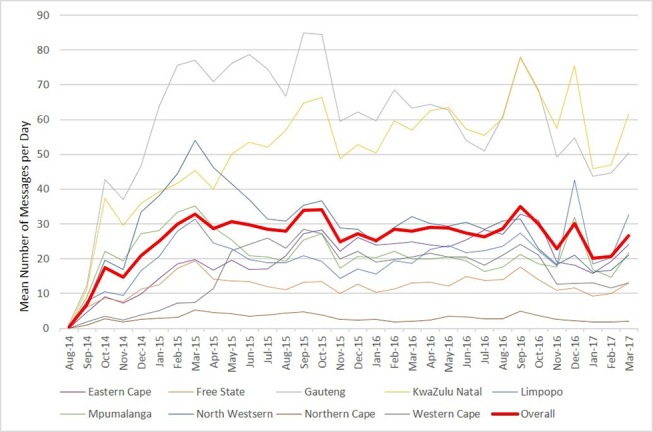
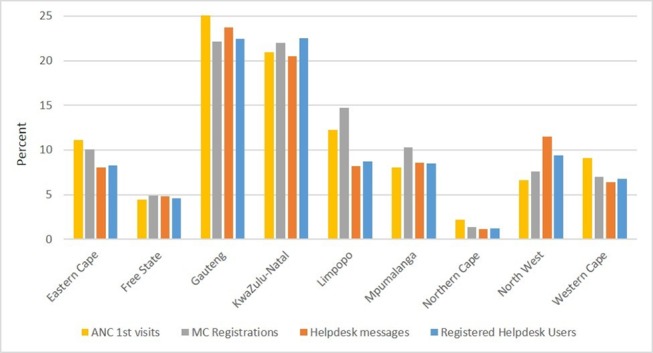
South Africa’s MomConnect mobile messaging programme, which aims to promote safe motherhood and improve pregnancy outcomes for South African women, includes a helpdesk feature which allows women registered on the system to ask maternal and child health (MCH)-related questions and to provide feedback on health services received at public health clinics. Messages sent to the helpdesk are answered by staff located at the National Department of Health. We examined event data from the MomConnect helpdesk database to identify any patterns in messages received, such as correlation of frequency or types of messages with location. We also explored what these data could tell us about the helpdesk’s effectiveness in improving health service delivery at public health clinics. We found that approximately 8% of registered MomConnect users used the helpdesk, and that usage was generally proportional to the use of antenatal care (ANC) services in provinces (as indicated by number of ANC first visits and number of MomConnect registrations), except in two provinces. Language, category and key topics of helpdesk messages were correlated with provinces. Most users accessed the helpdesk to seek maternal information, and where feedback about health services was provided, there were significantly more compliments than complaints. The MomConnect helpdesk is an important resource providing expectant mothers and mothers of infants with an interactive option for accessing MCH-related information—above that included in the standard MomConnect messages—and advances achievement of the health goals of the MomConnect programme.
Overview
The claims and statistics of this paper haven’t been checked yet.
Free: it reads the open-access text and checks the first 5 claims that cite a source we can check. Create a free account to check every claim.
Integrity signals
Registry
Cites
Statistics
Figures
Verification
Claims the paper makes
The claims and statistics of this paper haven’t been checked yet.
Free: it reads the open-access text and checks the first 5 claims that cite a source we can check. Create a free account to check every claim.
Claims other papers make about this one
Each is checked against this paper’s own text: does it say what the citing paper says it does?
In the citing paper
“A recent study in South Africa indicated that as little as 8% of MomConnect users used the web-based helpdesk provided [178], and other studies [102,179] highlighted the fact that more research is needed on the outcomes of SMS text message-based health interventions.”
From Digital Health Technologies for Maternal and Child Health in Africa and Other Low- and Middle-Income Countries: Cross-disciplinary Scoping Review With Stakeholder Consultation (2023) · doi:10.2196/42161 · cites this paper as [178]
Self-check
Percentages, sums and reported differences re-computed from the paper’s own numbers.
The self-check needs the paper’s full text.
Citations
Cites
South African National HIV Prevalence, Incidence and Behaviour Survey, 2012
Shisana, O., Rehle, T. M., Simbayi, L. C., Zuma, K. K., Jooste, S. E., Zungu, N. P., Labadarios, D., & Onoya, D. (2014) · Cited by 1,645
Lester, R. T., Ritvo, P., Mills, E. J., Kariri, A., Karanja, S., Chung, M. H., Jack, W., Habyarimana, J., Sadatsafavi, M., Najafzadeh, M., et al. (2010) · The Lancet · doi:10.1016/s0140-6736(10)61997-6 · Cited by 1,278
The Association between Job Strain and Atrial Fibrillation: Results from the Swedish WOLF Study
Fransson, E. I., Stadin, M., Nordin, M., Malm, D., Knutsson, A., Alfredsson, L., & Westerholm, P. J. M. (2015) · BioMed Research International · doi:10.1155/2015/371905 · Cited by 914
Agarwal, S., LeFevre, A. E., Lee, J., L’Engle, K., Mehl, G., Sinha, C., & Labrique, A. (2016) · BMJ · doi:10.1136/bmj.i1174 · Cited by 639
Lee, S. H., Nurmatov, U. B., Nwaru, B. I., Mukherjee, M., Grant, L., & Pagliari, C. (2016) · Journal of Global Health · doi:10.7189/jogh.06.010401 · Cited by 456 · cited 1×
“Less is known, however, about the effectiveness of mobile health (mHealth) programmes that provide two-way communication platforms.(4) Two-way communication systems can allow target populations to receive and respond to important health information, a potentially useful innovation in low-resource or sparsely populated…”
Gurman, T. A., Rubin, S. E., & Roess, A. A. (2012) · Journal of Health Communication · doi:10.1080/10810730.2011.649160 · Cited by 331
Mobile phones improve antenatal care attendance in Zanzibar: a cluster randomized controlled trial
Lund, S., Nielsen, B. B., Hemed, M., Boas, I. M., Said, A., Said, K., Makungu, M. H., & Rasch, V. (2014) · BMC Pregnancy and Childbirth · doi:10.1186/1471-2393-14-29 · Cited by 301 · cited 1×
“Comparably, in Zanzibar, a mobile phone intervention that provided MCH information via SMS and airtime vouchers for mothers (n=1311) to call health providers, found that 30% of mothers used the vouchers to call their providers for additional information in emergency and non-emergency situations.(16) No other informati…”
BackgroundWatterson, J. L., Walsh, J., & Madeka, I. (2015) · BioMed Research International · doi:10.1155/2015/153402 · Cited by 183
mHealth Interventions in Low-Income Countries to Address Maternal Health: A Systematic Review
Colaci, D., Chaudhri, S., & Vasan, A. (2017) · Annals of Global Health · doi:10.1016/j.aogh.2016.09.001 · Cited by 115
Conserve, D. F., Jennings, L., Aguiar, C., Shin, G., Handler, L., & Maman, S. (2017) · Journal of Telemedicine and Telecare · doi:10.1177/1357633x16639186 · Cited by 111
Cited by
Kruk, M. E., Lewis, T. P., Arsenault, C., Bhutta, Z. A., Irimu, G., Jeong, J., Lassi, Z. S., Sawyer, S. M., Vaivada, T., Waiswa, P., et al. (2022) · The Lancet · doi:10.1016/s0140-6736(21)02532-0 · Cited by 103
Barron, P., Peter, J., LeFevre, A. E., Sebidi, J., Bekker, M., Allen, R., Parsons, A. N., Benjamin, P., & Pillay, Y. (2018) · BMJ Global Health · doi:10.1136/bmjgh-2017-000559 · Cited by 136
Self-citationDoes women’s mobile phone ownership matter for health? Evidence from 15 countries
LeFevre, A. E., Shah, N., Bashingwa, J. J. H., George, A. S., & Mohan, D. (2020) · BMJ Global Health · doi:10.1136/bmjgh-2020-002524 · Cited by 93
(2023) · doi:10.2196/42161 · Cited by 106
“A recent study in South Africa indicated that as little as 8% of MomConnect users used the web-based helpdesk provided [178], and other studies [102,179] highlighted the fact that more research is needed on the outcomes of SMS text message–based health interventions.”
Background(2022) · doi:10.2196/preprints.42161 · Cited by 106
Mildon, A., & Sellen, D. (2019) · Journal of Global Health · doi:10.7189/jogh.09.020425 · Cited by 79
Taking digital health innovation to scale in South Africa: ten lessons from MomConnect
Peter, J., Benjamin, P., LeFevre, A. E., Barron, P., & Pillay, Y. G. (2018) · BMJ Global Health · doi:10.1136/bmjgh-2017-000592 · Cited by 55
“The helpdesk was used by 8% of MomConnect users who overwhelmingly (79%) ask questions about health topics.(12)The number of incoming helpdesk queries is markedly higher on days when outgoing SMS messages are sent, illustrating the positive inter-”
MethodMehl, G. L., Tamrat, T., Bhardwaj, S., Blaschke, S., & Labrique, A. B. (2018) · BMJ Global Health · doi:10.1136/bmjgh-2017-000626 · Cited by 49
Mbunge, E., & Sibiya, M. N. (2024) · Global Health Journal · doi:10.1016/j.glohj.2024.08.002 · Cited by 47
Digital health in South Africa: innovating to improve health
Pillay, Y., & Motsoaledi, P. A. (2018) · BMJ Global Health · doi:10.1136/bmjgh-2018-000722 · Cited by 35
Kabongo, E. M., Mukumbang, F. C., Delobelle, P., & Nicol, E. (2019) · BMJ Open · doi:10.1136/bmjopen-2019-029745 · Cited by 31
“26 The help desk service is mostly used to obtain information on maternal health rather than discussing the services received at a clinic.(26) Engelhard et al(27) demonstrated the feasibility and efficacy of the helpdesk in improving quality of care, but also emphasised the need to benchmark its performance and explor…”
MethodBerrueta, M., Ciapponi, A., Bardach, A., Cairoli, F. R., Castellano, F. J., Xiong, X., Stergachis, A. S., Zaraa, S., Meulen, A. S.-T., Buekens, P. M., et al. (2021) · BMC Pregnancy and Childbirth · doi:10.1186/s12884-021-03686-9 · Cited by 32
Klingberg, S., Motlhatlhedi, M., Mabena, G., Mooki, T., Verdezoto, N. X., Densmore, M., Norris, S. A., & on behalf of the CoMaCH network (2022) · PLOS Global Public Health · doi:10.1371/journal.pgph.0001280 · Cited by 25
“Indeed, a national evaluation of the interactive features of South Africa’s MomConnect mobile messaging programme found that only about 8% of registered users engaged with the programme’s features that enabled them to request specific health information [44].”
BackgroundMasoi, T. J., Kibusi, S. M., Bintabara, D., & Lilungulu, A. (2023) · PLOS Digital Health · doi:10.1371/journal.pdig.0000321 · Cited by 22
“This nding is supported by the study done in South Africa on Interactive mobile messaging programme to promote safe motherhood and improve pregnancy outcome by (18) who observed a signi cant increase in utilization of ANC services to the participants of that program.”
MethodCox, C. M., MASIANO, S. P., Mazenga, A. C., Stark, M., Udedi, M. M., Simon, K., Ahmed, S., Nyasulu, P., & Kim, M. H. (2023) · Cambridge Prisms Global Mental Health · doi:10.1017/gmh.2023.84 · Cited by 19
“In South Africa, MomConnect utilized phone messaging to share educational information with pregnant women as well as allowed interactive messaging through the help desk (Xiong et al., 2018).”
BackgroundBenedict, M. A., Steinberg, W. J., Claassen, F. M., & Mofolo, N. (2023) · South African Family Practice · doi:10.4102/safp.v65i1.5621 · Cited by 17
Mobile Device Usage by Gender Among High-Risk HIV Individuals in a Rural, Resource-Limited Setting
Campbell, B. R., Choi, K.-E., Neils, M. E. G., Canan, C. E., Moll, A. P., Dillingham, R., & Shenoi, S. (2021) · Telemedicine Journal and e-Health · doi:10.1089/tmj.2020.0218 · Cited by 16
Hearn, J., Phạm, Q., Schwartz, J. I., Ssinabulya, I., Akiteng, A. R., Ross, H. J., & Cafazzo, J. A. (2020) · Annals of Global Health · doi:10.5334/aogh.2905 · Cited by 12
Rothstein, J. D., Klemm, R., Niyeha, D., Smith, E., & Nordhagen, S. (2021) · Public Health Nutrition · doi:10.1017/s1368980020003742 · Cited by 7
“A recent evaluation found that although it was not widely advertised, approximately 8 % of over 95 000MomConnect users utilised the helpdesk, with the average response time being <24 h(56).”
BackgroundObasola, O. I. (2021) · Lincoln (University of Nebraska) · Cited by 4
Williams, L. A. (2023) · eScholarship (California Digital Library) · Cited by 3
Molala, M. (2023) · Africa Journal of Public Sector Development and Governance · doi:10.55390/ajpsdg.2023.6.1.4 · Cited by 2
Scaling Mhealth in Africa: Lessons From The Implementation of The MomConnect ProgramPreprint
Ezezika, O. C., Varatharajan, C., & Racine, S. (2020) · Research Square · doi:10.21203/rs.3.rs-103769/v1 · Cited by 2
“Studies have noted that with the complaints on the helpdesk have helped identify when systemic improvements within the drug system should be made (22).”
BackgroundCo-designing community-based digital innovations for Maternal and Child Health (MCH)
Coleman, T. L. (2023) · Open University of Cape Town (University of Cape Town) · Cited by 2
Coulibaly, S. (2022) · Queensland University of Technology · doi:10.5204/thesis.eprints.236175 · Cited by 1
Situating mHealth in the workplace: a coordination studies perspective
Wolff-Piggott, B. (2020) · Open University of Cape Town (University of Cape Town)
Cox, C. M. (2023) · Cambridge Prisms Global Mental Health · doi:10.1017/gmh.2023.84.pr12
Cox, C. M., Masiano, S., Mazenga, A., et al. (2023) · Cambridge Prisms Global Mental Health · doi:10.1017/gmh.2023.84.pr9
Cox, C. M., MASIANO, S. P., Mazenga, A. C., et al. (2023) · Cambridge Prisms Global Mental Health · doi:10.1017/gmh.2023.84.pr16
Cox, C. M., Masiano, S., Mazenga, A., et al. (2023) · Cambridge Prisms Global Mental Health · doi:10.1017/gmh.2023.84.pr15
Cox, C. M., MASIANO, S. P., Mazenga, A. C., et al. (2023) · Cambridge Prisms Global Mental Health · doi:10.1017/gmh.2023.84.pr10
Cox, C. M., Masiano, S., Mazenga, A., et al. (2023) · Cambridge Prisms Global Mental Health · doi:10.1017/gmh.2023.84.pr5
Cox, C. M., Masiano, S., Mazenga, A., et al. (2023) · Cambridge Prisms Global Mental Health · doi:10.1017/gmh.2023.84.pr6
Cox, C. M. (2023) · Cambridge Prisms Global Mental Health · doi:10.1017/gmh.2023.84.pr7
Cox, C. M., Masiano, S., Mazenga, A., et al. (2023) · Cambridge Prisms Global Mental Health · doi:10.1017/gmh.2023.84.pr14
Cox, C. M., Masiano, S., Mazenga, A., et al. (2023) · Cambridge Prisms Global Mental Health · doi:10.1017/gmh.2023.84.pr2
Cox, C. M., Masiano, S., Mazenga, A., et al. (2023) · Cambridge Prisms Global Mental Health · doi:10.1017/gmh.2023.84.pr11
Cox, C. M., Masiano, S., Mazenga, A., et al. (2023) · Cambridge Prisms Global Mental Health · doi:10.1017/gmh.2023.84.pr4
Cox, C. M., Masiano, S., Mazenga, A., et al. (2023) · Cambridge Prisms Global Mental Health · doi:10.1017/gmh.2023.84.pr3
Cox, C. M. (2023) · Cambridge Prisms Global Mental Health · doi:10.1017/gmh.2023.84.pr1
Cox, C. M., Masiano, S., Mazenga, A., et al. (2023) · Cambridge Prisms Global Mental Health · doi:10.1017/gmh.2023.84.pr8
Cox, C. M., Masiano, S., Mazenga, A., et al. (2023) · Cambridge Prisms Global Mental Health · doi:10.1017/gmh.2023.84.pr13
Okafor, U. B., Goon, D. T., & Niekerk, R. L. V. (2025) · Methods and Protocols · doi:10.3390/mps8020026
“MomConnect is one of the popular, phone-based technological maternal initiative health programs designed by the National Department of Health in South Africa to support and improve maternal health and child health services [34–37].”
Berrueta, M., Ciapponi, A., Bardach, A., Cairoli, F. R., Castellano, F. J., Xiong, X., Stergachis, A., Zaraa, S., Meulen, A. S.-T., & Buekens, P. M. (2021) · Figshare · doi:10.6084/m9.figshare.14234734
Information after recurring pregnancy loss
Maphosa, S. (2023) · UpSpace Institutional Repository (University of Pretoria) · doi:10.25403/upresearchdata.22040273
Berrueta, M., Ciapponi, A., Bardach, A., Cairoli, F. R., Castellano, F. J., Xiong, X., Stergachis, A., Zaraa, S., Meulen, A. S.-T., & Buekens, P. M. (2021) · Figshare · doi:10.6084/m9.figshare.14234731
Connecting End Users to Domain Experts With Universal Mobile Phones Services
Perrier, T. (2019) · ResearchWorks at the University of Washington (University of Washington)
Küresel Anne Sağlığında Dijital Hemşirelik Girişimleri: Tele-Sağlık ve Mobil Bakım Modelleri
Güllü, A. (2026) · Özgür Yayınları eBooks · doi:10.58830/ozgur.pub1254.c5101
Masoi, T. J., Kibusi, S. M., Mselle, L. T., Betuel, S., Macha, A., & Sirili, N. S. (2026) · BMC Digital Health · doi:10.1186/s44247-026-00266-9
“…system in Tanzania for improving antenatal care service utilization, all of which have demonstrated improved maternal health knowledge, service utilization, or care practices in maternal and newborn [16–19], but few have specifically targeted the reporting and prevention of obstetric violence.”
Chunxiang, W., Nasution, A. N., & Liena (2025) · Link Medical Journal · doi:10.61919/xnbxqz85
“Such tools are important because maternal decisions often involve uncertainty, including whether a symptom is dangerous, whether a facility visit is needed, or how to respond when relatives advise waiting at home [20].”
Melamed, N., Divakar, H., Choolani, M., McAuliffe, F. M., Foo, L. F., Shehata, H. A., Jones, G. D., Senikas, V., van der Beek, E. M., Palshetkar, N., et al. (2026) · International Journal of Gynecology & Obstetrics · doi:10.1002/ijgo.71156
“38,39 45–47”
Digital Health Africa (DHA 2025) – Conference Report
Maluleke, T., Waitt, C. J., Lorente, V. P.-F., Rosenkranz, B., Kampmann, B., Steinecke, K., & Pillai, G. C. (2026) · Frontiers in Pharmacology · doi:10.3389/fphar.2026.1909596
Metadata
- Authors
- Xiong, K., Kamunyori, J., & Sebidi, J.
- Affiliations
- University of North Carolina at Chapel Hill (US)
- MEASURE Evaluation Strategic Information for South Africa (MEval-SIFSA), ICF, Pretoria, South Africa
- Department of Health (ZA)
- Corresponding author
- Xiong, Khou
- ORCID
- Sebidi, Jane
- Venue
- BMJ Global Health
- Publisher
- BMJ
- Published
- 2018-04
- Volume
- 3
- Issue
- Suppl 2
- Pages
- e000578
- ISSN
- 2059-7908 (ISSN-L)
- PMC
- PMC5922474
- OpenAlex
- W2802181417
- Cited by
- 42
- References
- 16
- Citations by year
- 2026: 4 · 2025: 1 · 2024: 1 · 2023: 20 · 2022: 3 · 2021: 3 · 2020: 4 · 2019: 2 · 2018: 4
- Type
- conference abstract
- Language
- en
- Open access
- gold
- doi.org
- Licence
- cc-by-nc
- Locations
- BMJ Global Health (publishedVersion, cc-by-nc)
- Europe PMC (PubMed Central) (publishedVersion, other-oa)
- PubMed Central (publishedVersion, cc-by-nc)
- PubMed (publishedVersion)
- Funders
- United States Agency for International Development
- Topics
- Health Sciences › Health Professions › General Health Professions › Mobile Health and mHealth Applications
- Physical Sciences › Computer Science › Information Systems › ICT in Developing Communities
- Social Sciences › Health › Social Media in Health Education
- Keywords
- mobile health, help desk, maternal and child health, prenatal care, maternal health information, health care delivery, South Africa, user engagement
About these checks
Registry, retraction, Cites and statistics results are computed, not judged, with one exception: a printed reference that no index lists is read once by a model before it counts as a citation error. Claims are extracted by a model and kept only when their quote appears verbatim in the text; each cited source is then checked, with a model’s help, for whether it says what the claim relies on. Those verdicts can be wrong — read the claim’s quote and the cited source before relying on one.
Statistics and arithmetic are recomputed, not judged.
Confidence bands are shown only for fields calibrated on our annotated test set. None is calibrated yet, so no band is shown.
What counts as a claim ›How we measure confidence ›How we check this ›
Are you an author, or do you see a problem with this page? Request a review
Data sources
Bibliographic data: Semantic Scholar, OpenAlex, Crossref.
Contains information from the Semantic Scholar Academic Graph Datasets, made available under the ODC Attribution License (ODC-BY 1.0).
Semantic Scholar’s data is described in: Kinney, R., et al. (2023). The Semantic Scholar Open Data Platform. arXiv:2301.10140.
