

Unpacking the performance of a mobile health information messaging program for mothers (MomConnect) in South Africa: evidence on program reach and messaging exposure
Open accessThe DOI matches its Crossref record; 16 of the 17 references it cites were found in a registry or an index.
Abstract
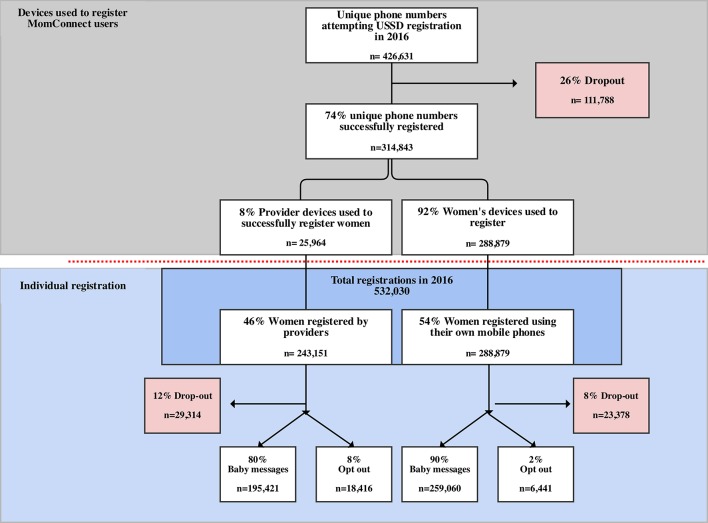
Despite calls to address broader evidence gaps in linking digital technologies to outcome and impact level health indicators, limited attention has been paid to measuring processes pertaining to the performance of programs. In this paper, we assess the program reach and message exposure of a mobile health information messaging program for mothers (MomConnect) in South Africa. In this descriptive study, we draw from system generated data to measure exposure to the program through registration attempts and conversions, message delivery, opt-outs and drop-outs. Using a logit model, we additionally explore determinants for early registration, opt-outs and drop-outs. From August 2014 to April 2017, 1 159 431 women were registered to MomConnect; corresponding to half of women attending antenatal care 1 (ANC1) and nearly 60% of those attending ANC1 estimated to own a mobile phone. In 2016, 26% of registrations started to get women onto MomConnect did not succeed. If registration attempts were converted to successful registrations, coverage of ANC1 attendees would have been 74% in 2016 and 86% in 2017. When considered as percentage of ANC1 attendees with access to a mobile phone, addressing conversion challenges bring registration coverage to an estimated 83%–89% in 2016 and 97%–100% in 2017. Among women registered, nearly 80% of expected short messaging service messages were received. While registration coverage and message delivery success rates exceed those observed for mobile messaging programs elsewhere, study findings highlight opportunities for program improvement and reinforce the need for rigorous and continuous monitoring of delivery systems.
Overview
The claims and statistics of this paper haven’t been checked yet.
Free: it reads the open-access text and checks the first 5 claims that cite a source we can check. Create a free account to check every claim.
Integrity signals
Registry
Cites
Statistics
Figures
Verification
Claims the paper makes
The claims and statistics of this paper haven’t been checked yet.
Free: it reads the open-access text and checks the first 5 claims that cite a source we can check. Create a free account to check every claim.
Claims other papers make about this one
Each is checked against this paper’s own text: does it say what the citing paper says it does?
The source backs part of the claim, not all of it — or backs it for a different population, condition or comparison.
In the citing paper
“The literature further highlighted the value of SMS text message deployment in terms of accessibility and cost [49,56,65,70,71,73].”
From Digital Health Technologies for Maternal and Child Health in Africa and Other Low- and Middle-Income Countries: Cross-disciplinary Scoping Review With Stakeholder Consultation (2023) · doi:10.2196/42161 · cites this paper as [70]
Experimental — accuracy not yet measured
Self-check
Percentages, sums and reported differences re-computed from the paper’s own numbers.
The self-check needs the paper’s full text.
Citations
Cites
Free, C., Phillips, G., Galli, L., Watson, L., Felix, L., Edwards, P., Patel, V., & Haines, A. (2013) · PLoS Medicine · doi:10.1371/journal.pmed.1001362 · Cited by 1,766
Free, C., Phillips, G., Watson, L., Galli, L., Felix, L., Edwards, P., Patel, V., & Haines, A. (2013) · PLoS Medicine · doi:10.1371/journal.pmed.1001363 · Cited by 1,187
The Association between Job Strain and Atrial Fibrillation: Results from the Swedish WOLF Study
Fransson, E. I., Stadin, M., Nordin, M., Malm, D., Knutsson, A., Alfredsson, L., & Westerholm, P. J. M. (2015) · BioMed Research International · doi:10.1155/2015/371905 · Cited by 914
Agarwal, S., LeFevre, A. E., Lee, J., L’Engle, K., Mehl, G., Sinha, C., & Labrique, A. (2016) · BMJ · doi:10.1136/bmj.i1174 · Cited by 639 · cited 1×
“bACkground Calls to improve the rigour and reporting of evidence on the effectiveness of digital health programs, including mobile health (mHealth), are emerging.(1) mHealth programs which aim to empower women and Key questions”
Self-citationMobile phones improve antenatal care attendance in Zanzibar: a cluster randomized controlled trial
Lund, S., Nielsen, B. B., Hemed, M., Boas, I. M., Said, A., Said, K., Makungu, M. H., & Rasch, V. (2014) · BMC Pregnancy and Childbirth · doi:10.1186/1471-2393-14-29 · Cited by 301
Watterson, J. L., Walsh, J., & Madeka, I. (2015) · BioMed Research International · doi:10.1155/2015/153402 · Cited by 183 · cited 1×
“In Zanzibar and Malawi, programs providing mobile health information messages to expectant mothers were associated with increases in the knowledge and utilisation of services across the continuum of care.(2) 18 19 While these findings are promising, the absence of details on individual level exposure to the program co…”
Barron, P., Peter, J., LeFevre, A. E., Sebidi, J., Bekker, M., Allen, R., Parsons, A. N., Benjamin, P., & Pillay, Y. (2018) · BMJ Global Health · doi:10.1136/bmjgh-2017-000559 · Cited by 136
Self-citationColeman, J., Bohlin, K. C., Thorson, A., Black, V., Mechael, P., Mangxaba, J., & Eriksen, J. (2017) · AIDS Care · doi:10.1080/09540121.2017.1280126 · Cited by 102
The MomConnect mHealth initiative in South Africa: Early impact on the supply side of MCH services
Barron, P., Pillay, Y., Fernandes, A., Sebidi, J., & Allen, R. (2016) · Journal of Public Health Policy · doi:10.1057/s41271-016-0015-2 · Cited by 90 · cited 1×
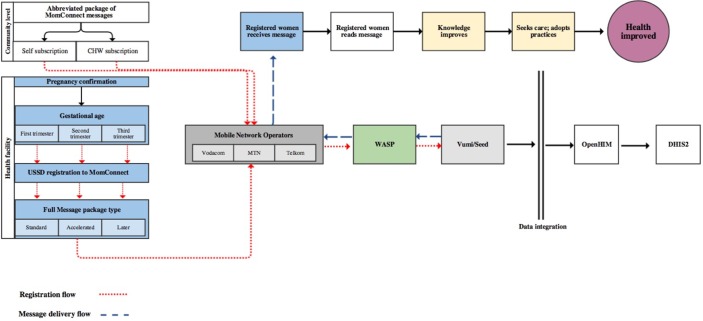
“WhAT is MoMConneCT? Details on the MomConnect program are presented elsewhere.(12) 13 In brief, MomConnect comprises two essential components: (1) maternal health information messaging and (2) a helpdesk.”
Self-citationLeFevre, A. E., Mohan, D., Hutchful, D., Jennings, L., Mehl, G., Labrique, A., Romano, K., & Moorthy, A. (2017) · BMC Medical Informatics and Decision Making · doi:10.1186/s12911-017-0421-9 · Cited by 76 · cited 3×
“For MOTECH in Ghana, while outcome level data were not available, analyses of IVR message delivery trends suggested that 25% or less of expected mobile health information messages were received by pregnant women, despite the majority (>77%) owning a private mobile phone.(6) For SMS programs like MomConnect, user engag…”
InfluentialSelf-citation
Research works printed but not linked: 2
- Seebregts C, Barron P, Tanna G, et al. MomConnect: an exemplar implementation of the Health Normative Standards Framework in South Africa. South African Health Review Health Systems Trust 2016:125-35.
- Robinson A, Dalious M. Evaluation of the Information and Communications Technology for Maternal, Newborn and Child Health Project" Invest in Knowledge Initiative. Malawi: Village Reach, 2014. on July 29, 2023 by guest. Protected by copyright. http://gh.bmj.com/ BMJ Glob Health: first published as 10.1136/bmjgh-2017-000583 on 24 April 2018. Downloaded from
Cited by
Erku, D., Khatri, R., Endalamaw, A., Wolka, E., Nigatu, F., Zewdie, A., & Assefa, Y. (2023) · International Journal of Environmental Research and Public Health · doi:10.3390/ijerph20196854 · Cited by 177
Barron, P., Peter, J., LeFevre, A. E., Sebidi, J., Bekker, M., Allen, R., Parsons, A. N., Benjamin, P., & Pillay, Y. (2018) · BMJ Global Health · doi:10.1136/bmjgh-2017-000559 · Cited by 136
Self-citationTiffin, N., George, A. S., & LeFevre, A. E. (2019) · BMJ Global Health · doi:10.1136/bmjgh-2019-001395 · Cited by 150
“unanticipated adaptations ► In 2016, over half of registrations occurred on a device other than the women’s personal mobile phone, including the healthcare provider or a facility-based data entry clerk.(12) ► High patient volumes, clinical demands on providers, coupled with the lengthy time required to register women…”
Self-citationMildon, A., & Sellen, D. (2019) · Journal of Global Health · doi:10.7189/jogh.09.020425 · Cited by 79
Swartz, A., LeFevre, A. E., Perera, S., Kinney, M. V., & George, A. S. (2021) · Globalization and Health · doi:10.1186/s12992-021-00716-1 · Cited by 63
Self-citationKarusala, N., Seeh, D. O., Mugo, C., Guthrie, B., Moreno, M. A., John-Stewart, G., Inwani, I., Anderson, R., & Ronen, K. (2021) · Proceedings of the 2021 CHI Conference on Human Factors in Computing Systems · doi:10.1145/3411764.3445313 · Cited by 50
Taking digital health innovation to scale in South Africa: ten lessons from MomConnect
Peter, J., Benjamin, P., LeFevre, A. E., Barron, P., & Pillay, Y. G. (2018) · BMJ Global Health · doi:10.1136/bmjgh-2017-000592 · Cited by 55
“This has resulted in one in four users dropping out of the registration process after initially attempting to register.(9) MomConnect is considering introducing several alternative ways for users to register to minimise failures.”
BackgroundSelf-citationMehl, G. L., Tamrat, T., Bhardwaj, S., Blaschke, S., & Labrique, A. B. (2018) · BMJ Global Health · doi:10.1136/bmjgh-2017-000626 · Cited by 49
Campbell, B. R., Ingersoll, K. S., Flickinger, T., & Dillingham, R. (2019) · Expert Review of Anti-infective Therapy · doi:10.1080/14787210.2019.1578649 · Cited by 58
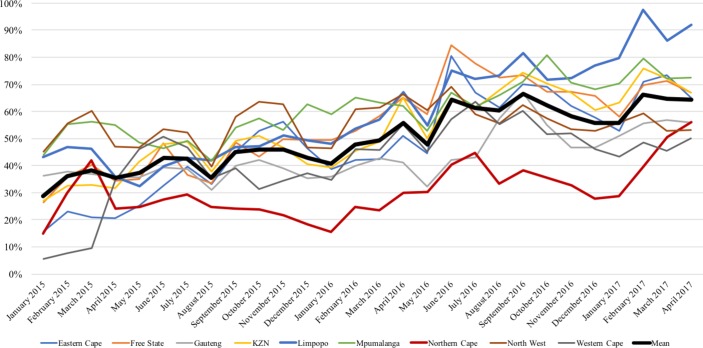
“As a measure of province population, impoverished and rural Limpopo consistently demonstrates the highest percentage of participants registered and completing the first antenatal visit with use of MomConnect, South Africa ’ s national text messaging program to support pregnant women [25].”
BackgroundKhan, T., Malik, S., Rafeekh, L., Halder, S., Desai, S., & Bhattacharya, S. D. (2024) · Human Vaccines & Immunotherapeutics · doi:10.1080/21645515.2024.2411823 · Cited by 44
“141 Further, mobile-based audio training course like Mobile Academy in India serves to expand and refresh the knowledge of frontline health workers (Accredited Social Health Activists, ASHA) and improve their communication skills.”
Digital health in South Africa: innovating to improve health
Pillay, Y., & Motsoaledi, P. A. (2018) · BMJ Global Health · doi:10.1136/bmjgh-2018-000722 · Cited by 35
Self-citationMuthelo, L., Mbombi, M. O., Bopape, M. A., Mothiba, T. M., Densmore, M., van Heerden, A. C., Norris, S. A., Verdezoto, N. X., Griffiths, P. L., & Mackintosh, N. J. (2023) · International Journal of Environmental Research and Public Health · doi:10.3390/ijerph20031842 · Cited by 39
“The issue of apps that require frequent downloads is consistent with findings reported in a study conducted in South Africa [31].”
BackgroundResultInfluentialKabongo, E. M., Mukumbang, F. C., Delobelle, P., & Nicol, E. (2019) · BMJ Open · doi:10.1136/bmjopen-2019-029745 · Cited by 31
LeFevre, A. E., Shah, N., Scott, K., Chamberlain, S., Ummer, O., Bashingwa, J. J. H., Chakraborty, A., Godfrey, A., Dutt, P., Ved, R. R., et al. (2022) · BMJ Global Health · doi:10.1136/bmjgh-2022-008838 · Cited by 33
Self-citationBerrueta, M., Ciapponi, A., Bardach, A., Cairoli, F. R., Castellano, F. J., Xiong, X., Stergachis, A. S., Zaraa, S., Meulen, A. S.-T., Buekens, P. M., et al. (2021) · BMC Pregnancy and Childbirth · doi:10.1186/s12884-021-03686-9 · Cited by 32
Maliwichi, P., Chigona, W., & Sowon, K. (2021) · JMIR mhealth and uhealth · doi:10.2196/22653 · Cited by 30
“[23,24,28,31]; user timeouts [26,28]; mobile phone skills [31-33]; and low literacy levels [23,31-33,35]”
InfluentialGibson, D. G., Tamrat, T., & Mehl, G. L. (2018) · Global Health Science and Practice · doi:10.9745/ghsp-d-18-00165 · Cited by 31
“registered 1,159,431 pregnancies, which corresponded to half of women attending their first antenatal care visit.(56)”
BackgroundInsaka: mobile phone support groups for adolescent pregnant women living with HIV
Simpson, N., Kydd, A., Phiri, M. M., Mbewe, M., Sigande, L. M., Gachie, T., Ngobeni, M., Monese, T., Figerova, Z., Schlesinger, H., et al. (2021) · BMC Pregnancy and Childbirth · doi:10.1186/s12884-021-04140-6 · Cited by 28
“Recent studies in sub-Saharan Africa have moved beyond the use of the mobile phone as an educative tool, and toward its potential as a device for behaviour change and psychosocial support for populations living with HIV [18, 19].”
BackgroundKlingberg, S., Motlhatlhedi, M., Mabena, G., Mooki, T., Verdezoto, N. X., Densmore, M., Norris, S. A., & on behalf of the CoMaCH network (2022) · PLOS Global Public Health · doi:10.1371/journal.pgph.0001280 · Cited by 25
“Our participants expressed more critical views of MomConnect than specific evaluations of the programme seem to have received, suggesting that the participants did not perceive the research team to be representing MomConnect, and felt more comfortable being critical about its shortcomings.”
ResultInfluentialSewpaul, R., Resnicow, K., Crutzen, R., Dukhi, N., Ellahebokus, A., & Reddy, P. S. (2023) · JMIR Research Protocols · doi:10.2196/43654 · Cited by 23
Tripathi, V., Arnoff, E., Bellows, B., & Sripad, P. (2020) · mHealth · doi:10.21037/mhealth.2019.12.04 · Cited by 22
“Should this IVR intervention be delivered at an expanded scale, it will be important to monitor population exposure and the process of implementation, to identify, as Lefevre and colleagues have emphasized, who the intervention is reaching, what dosage the intended target population is receiving, and where “critical b…”
BackgroundVerdezoto, N. X., Carpio-Arias, F. A., Carpio-Arias, T. V., Mackintosh, N. J., Eslambolchilar, P., Delgado, V., Andrade, C., & Merino, G. X. V. (2020) · Nordic Conference on Human-Computer Interaction · doi:10.1145/3419249.3420141 · Cited by 22
Neonatal, infant and child health in South Africa: Reflecting on the past towards a better future
Goga, A. E., Feucht, U. D., Zar, H. J., Vanker, A., Wiysonge, C. S., McKerrow, N., Wright, C., Loveday, M., Odendaal, W., Ramokolo, V., et al. (2019) · South African Medical Journal · doi:10.7196/samj.2019.v109i11b.14301 · Cited by 19
“[78-84] An exception is the NDoH’s MomConnect programme, which provides pregnant and postpartum women with health information via text messages twice a week, has a help desk for patient queries and serves as a platform for patient feedback to facilities.[85,86] It has reached approximately 63% of all pregnant women at…”
BackgroundSelf-citationBashingwa, J. J. H., Mohan, D., Chamberlain, S., Arora, S., Mendiratta, J., Rahul, S., Chauhan, V., Scott, K., Shah, N., Ummer, O., et al. (2021) · BMJ Global Health · doi:10.1136/bmjgh-2021-005213 · Cited by 27
Self-citationMohan, D., Bashingwa, J. J. H., Scott, K., Arora, S., Rahul, S., Mulder, N., Chamberlain, S., & LeFevre, A. E. (2022) · BMJ Global Health · doi:10.1136/bmjgh-2022-009395 · Cited by 15
Self-citationMohan, D., Bashingwa, J. J. H., Dane, P., Chamberlain, S., Tiffin, N., & LeFevre, A. E. (2019) · JMIR Research Protocols · doi:10.2196/11456 · Cited by 11
“However, very few evaluations have sought to incorporate machine learning algorithms [8], and broader guidelines on the monitoring and evaluation of digital health solutions have stopped short of outlining options for predictive modeling [15].”
InfluentialSelf-citationSayed, N., Burger, R., Harper, A. J., & Swart, R. (2021) · International Journal of Environmental Research and Public Health · doi:10.3390/ijerph19010351 · Cited by 11
“Data were generated from a national, cross-sectional survey, using mobile SMS for recruitment and data collection from pregnant women and mothers in the public health sector in South Africa using the MomConnect mhealth platform, which is estimated to have enrolled more than half of all women attending the public secto…”
MethodRothstein, J. D., Klemm, R., Niyeha, D., Smith, E., & Nordhagen, S. (2021) · Public Health Nutrition · doi:10.1017/s1368980020003742 · Cited by 7
“This, along with findings from other evaluations in sub-Saharan Africa(62,63), suggest that technical obstacles to message delivery are worth examining further.”
ResultInfluentialEzezika, O. C., Varatharajan, C., Racine, S., & Ameyaw, E. K. (2021) · African Journal of Science Technology Innovation and Development · doi:10.1080/20421338.2021.1985946 · Cited by 9
“…study and previous research, demonstrates that the interdisciplinary nature of these champions was critical in the sustainable and effective delivery of mHealth and telemedicine interventions (Barron et al. 2018; LeFevre et al. 2018; Jindal et al. 2019; Odendaal et al. 2020; Kolltveit et al. 2017).”
BackgroundResultPillay, N., Ncube, N., Moopelo, K., Mothoagae, G., Welte, O., Shogole, M., Gwiji, N., Scott, L. E., Moshani, N., Tiffin, N., et al. (2023) · Sexual and Reproductive Health Matters · doi:10.1080/26410397.2024.2302553 · Cited by 8
Self-citationA scoping review of mHealth use in South Africa
der Pol, N. V., Ntinga, X., Mkhize, M., & van Heerden, A. C. (2021) · Development Southern Africa · doi:10.1080/0376835x.2021.1904837 · Cited by 7
Sewpaul, R., Resnicow, K., Crutzen, R., Dukhi, N., & Reddy, P. S. (2025) · JMIR mhealth and uhealth · doi:10.2196/59144 · Cited by 7
“A fifth of participants changed their mobile phone number during the study, which is common in South Africa, where the majority of phones are prepaid [15].”
InfluentialObrocka, M., Copley, C., Gqaza, T., & Grant, E. (2019) · arXiv (Cornell University) · doi:10.48550/arxiv.1911.05636 · Cited by 6
“For this paper we focused on detecting code switching in English, isiXhosa and isiZulu, the three most common languages used in the MomConnect population [4].”
BackgroundMethodInfluentialSelf-citationSteyn, S., & Slabbert, M. (2025) · JMIR Formative Research · doi:10.2196/54216 · Cited by 6
LeFevre, A. E., Mendiratta, J., Jo, Y., Chamberlain, S., Ummer, O., Miller, M., Scott, K., Shah, N., Chakraborty, A., Godfrey, A., et al. (2023) · BMJ Global Health · doi:10.1136/bmjgh-2022-009553 · Cited by 7
Self-citationWomen’s mobile connectivity: improving ANC care utilisation in developing countries
Amir‐ud‐Din, R., Zobia, N. S., Zafar, S., Muhammad, K., & Atif, M. (2025) · Discover Health Systems · doi:10.1007/s44250-025-00230-w · Cited by 3
“Indonesia’s SOBUMIL app increased danger sign recognition by 58% through interactive checklists [21], while South Africa’s MomConnect achieved 89% message delivery rates through culturally tailored content [22].”
Unger, J. A., Kinuthia, J., Wandika, B., Hedstrom, A. B., Wetzler, E., Udren, J. I., Masinde, M., Choo, E. M., Schultes, O. L., Kithao, P., et al. (2025) · Nature Medicine · doi:10.1038/s41591-025-03576-z · Cited by 2
Williams, L., Ankrah, E. A., Draper, C. E., Cook, C. J., Cibrian, F. L., Beltran, J. A., Lakes, K. D., & Hayes, G. R. (2025) · African Human Computer Interaction Conference (AfriCHI) · doi:10.1145/3757232.3757235 · Cited by 1
“A number of pilot and feasibility studies [42, 66] have been conducted to evaluate the potential outcomes of this intervention.”
Ronen, K., Choo, E. M., Wandika, B., Udren, J., Osborn, L., Kinthao, P., Hedstrom, A. B., Masinde, M., Kumar, M., Wamalwa, D., et al. (2021) · Research Square · doi:10.21203/rs.3.rs-371505/v1 · Cited by 1
Mukami, V., Millham, R. C., Puckree, T., & Fong, S. J. (2021) · Lecture notes in networks and systems · doi:10.1007/978-981-33-4073-2_18
A framework to lower maternal mortality and morbidity rates in Kenya using mobile technology
Mukami, V. (2019) · DUT Open Scholar (Durban University of Technology) · doi:10.51415/10321/3674
Proportion of Reproductive Age Women Utilizing Mobile Maternal Health Services in Makueni County
Mumo, J., Tai, S., & Kipkalom, R. (2023) · Journal of Health Medicine and Nursing · doi:10.47604/jhmn.2076
Okafor, U. B., Goon, D. T., & Niekerk, R. L. V. (2025) · Methods and Protocols · doi:10.3390/mps8020026
“The program registers expectant mothers into a national pregnancy registry, sends weekly informational texts, and creates an interactive support desk [34–36].”
Peng, J., Wetzler, E., Wandika, B., Kithao, P., Moraa, J., Udren, J. I., Schultes, O. L., Akinyi, E., Osborn, L., Hedstrom, A. B., et al. (2025) · PLOS Digital Health · doi:10.1371/journal.pdig.0000968
“Literature specifically addressing engagement in text messaging in resource-limited settings is particularly sparse, with most studies reporting only response rates and basic engagement outcomes [18,30,31].”
Berrueta, M., Ciapponi, A., Bardach, A., Cairoli, F. R., Castellano, F. J., Xiong, X., Stergachis, A., Zaraa, S., Meulen, A. S.-T., & Buekens, P. M. (2021) · Figshare · doi:10.6084/m9.figshare.14234734
Berrueta, M., Ciapponi, A., Bardach, A., Cairoli, F. R., Castellano, F. J., Xiong, X., Stergachis, A., Zaraa, S., Meulen, A. S.-T., & Buekens, P. M. (2021) · Figshare · doi:10.6084/m9.figshare.14234731
App Your Health: Harnessing Digital Tools for Diabetes Prevention and Health Promotion
Mphasha, M. H. (2026) · IGI Global eBooks · doi:10.4018/979-8-3373-3531-5.ch004
Aivalli, P., Muthelo, L., Ngwenya, M., Adusei‐Mensah, F., Mphasha, M. H., Akinseinde, S., Badejo, J.-F., McAuliffe, F. M., & Phillips, C. M. (2026) · Current Developments in Nutrition · doi:10.1016/j.cdnut.2026.109542
“…report that women find the messages acceptable and trustworthy and act on some of them, and that they routinely relay the content to family members [29,30], whereas program evaluations document that reach and message exposure are considerably less even than facility coverage suggests [31,32].”
Hadi, M. A., & Falahuddin, Q. D. (2026) · Journal Medical Informatics Technology · doi:10.37034/medinftech.v4i3.167
“Demonstrates national-scale enrolment and, in [33], user comprehension and value; [31] shows registration and message exposure diverge.”
Influential
Metadata
- Authors
- LeFevre, A. E., Dane, P., Copley, C. J., Pienaar, C., Parsons, A. N., Engelhard, M., Woods, D., Bekker, M., Benjamin, P., Pillay, Y., Barron, P., Seebregts, C. J., & Mohan, D.
- Affiliations
- Johns Hopkins University (US)
- Jembi Health Systems (ZA)
- Duke University (US)
- Duke Department of Psychiatry & Behavioral Sciences, Durham, North Carolina, USA
- University of Cape Town (ZA)
- Praekelt Foundation (ZA)
- HealthEnabled, Cape Town, South Africa
- Department of Health (ZA)
- University of the Witwatersrand (ZA)
- Corresponding author
- LeFevre, Amnesty E
- ORCID
- Venue
- BMJ Global Health
- Publisher
- BMJ
- Published
- 2018-04
- Volume
- 3
- Issue
- Suppl 2
- Pages
- e000583
- ISSN
- 2059-7908 (ISSN-L)
- PMC
- PMC5922477
- OpenAlex
- W2799584589
- Cited by
- 48
- References
- 17
- Citations by year
- 2026: 2 · 2025: 6 · 2024: 2 · 2023: 6 · 2022: 3 · 2021: 13 · 2020: 3 · 2019: 8 · 2018: 5
- Type
- conference abstract
- Language
- en
- Open access
- gold
- doi.org
- Licence
- cc-by-nc
- Locations
- BMJ Global Health (publishedVersion, cc-by-nc)
- Europe PMC (PubMed Central) (publishedVersion, other-oa)
- PubMed Central (publishedVersion, cc-by-nc)
- PubMed (publishedVersion)
- Funders
- United States Agency for International Development
- U.S. President’s Emergency Plan for AIDS Relief
- Topics
- Health Sciences › Health Professions › General Health Professions › Mobile Health and mHealth Applications
- Physical Sciences › Computer Science › Information Systems › ICT in Developing Communities
- Social Sciences › Health › Social Media in Health Education
- Keywords
- mobile health, prenatal care, maternal health, program reach, message exposure, text messaging, program monitoring, South Africa
About these checks
Registry, retraction, Cites and statistics results are computed, not judged, with one exception: a printed reference that no index lists is read once by a model before it counts as a citation error. Claims are extracted by a model and kept only when their quote appears verbatim in the text; each cited source is then checked, with a model’s help, for whether it says what the claim relies on. Those verdicts can be wrong — read the claim’s quote and the cited source before relying on one.
Statistics and arithmetic are recomputed, not judged.
Confidence bands are shown only for fields calibrated on our annotated test set. None is calibrated yet, so no band is shown.
What counts as a claim ›How we measure confidence ›How we check this ›
Are you an author, or do you see a problem with this page? Request a review
Data sources
Bibliographic data: Semantic Scholar, OpenAlex, Crossref.
Contains information from the Semantic Scholar Academic Graph Datasets, made available under the ODC Attribution License (ODC-BY 1.0).
Semantic Scholar’s data is described in: Kinney, R., et al. (2023). The Semantic Scholar Open Data Platform. arXiv:2301.10140.
