

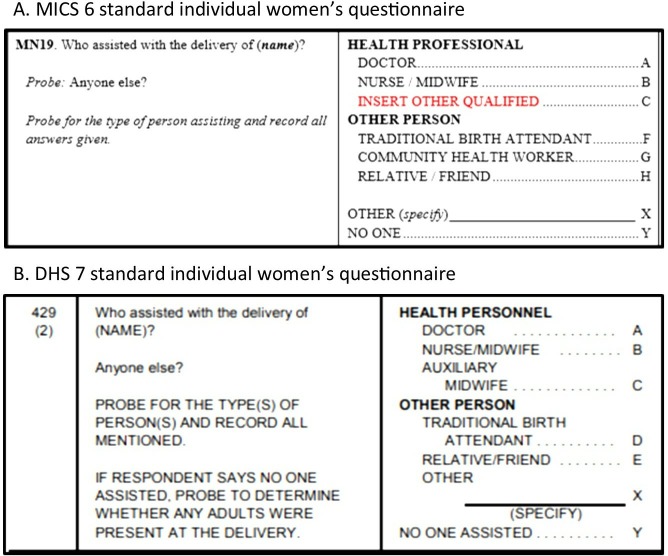
'Who assisted with the delivery of (NAME)?' Issues in estimating skilled birth attendant coverage through population-based surveys and implications for improving global tracking.
Open accessThe DOI matches its Crossref record; 28 of the 29 references it cites were found in a registry or an index.
Abstract
The percentage of live births attended by a skilled birth attendant (SBA) is a key global indicator and proxy for monitoring progress in maternal and newborn health. Yet, the discrepancy between rising SBA coverage and non-commensurate declines in maternal and neonatal mortality in many low-income and middle-income countries has brought increasing attention to the challenge of what the indicator of SBA coverage actually measures, and whether the indicator can be improved. In response to the 2018 revised definition of SBA and the push for improved measurement of progress in maternal and newborn health, this paper examines the evidence on what women can tell us about who assisted them during childbirth and methodological issues in estimating SBA coverage via population-based surveys. We present analyses based on Demographic and Health Surveys and Multiple Indicator Cluster Surveys conducted since 2015 for 23 countries. Our findings show SBA coverage can be reasonably estimated from population-based surveys in settings of high coverage, though women have difficulty reporting specific cadres. We propose improvements in how skilled cadres are classified and documented, how linkages can be made to facility-based data to examine the enabling environment and further ways data can be disaggregated to understand the complexity of delivery care. We also reflect on the limitations of what SBA coverage reveals about the quality and circumstances of childbirth care. While improvements to the indicator are possible, we call for the use of multiple indicators to inform local efforts to improve the health of women and newborns.
Overview
The claims and statistics of this paper haven’t been checked yet.
Free: it reads the open-access text and checks the first 5 claims that cite a source we can check. Create a free account to check every claim.
Integrity signals
Registry
Cites
Statistics
Figures
Verification
Claims the paper makes
The claims and statistics of this paper haven’t been checked yet.
Free: it reads the open-access text and checks the first 5 claims that cite a source we can check. Create a free account to check every claim.
Claims other papers make about this one
Each is checked against this paper’s own text: does it say what the citing paper says it does?
The source backs part of the claim, not all of it — or backs it for a different population, condition or comparison.
In the citing paper
“Skilled attendance at birth providing quality emergency obstetric and newborn care is an essential element for reducing the high burden of maternal and neonatal morbidity and mortality in resource-limited settings (RLS) 1, 2 .”
From A mixed methods evaluation of Advanced Life Support in Obstetrics (ALSO) and Basic Life Support in Obstetrics (BLSO) in a resource-limited setting on the Thailand-Myanmar border (2021) · cites this paper as [2]
Experimental — accuracy not yet measured
Self-check
Percentages, sums and reported differences re-computed from the paper’s own numbers.
The self-check needs the paper’s full text.
Citations
Cites
Ethiopia demographic and health survey, 2000
Central Statistical Agency, & Ethiopia (2017) · Cited by 3,873
Quality maternity care for every woman, everywhere: a call to action
Koblinsky, M., Moyer, C. A., Calvert, C., Campbell, J., Campbell, O. M. R., Feigl, A. B., Graham, W. J., Hatt, L., Hodgins, S., Matthews, Z., et al. (2016) · The Lancet · doi:10.1016/s0140-6736(16)31333-2 · Cited by 481
Self-citationThe scale, scope, coverage, and capability of childbirth care
Campbell, O. M. R., Calvert, C., Testa, A., Strehlow, M., Benova, L., Keyes, E., Donnay, F., Macleod, D., Gabrysch, S., Rong, L., et al. (2016) · The Lancet · doi:10.1016/s0140-6736(16)31528-8 · Cited by 307 · cited 2×
“Campbell and colleagues show that cross-tabulating the most skilled person attending the delivery with the place of delivery reported by women, generates a useful picture of maternity care services.(7) Linking what women can tell us in household surveys with what facility surveys can tell us yields an even more nuance…”
BackgroundSelf-citationHancioglu, A., & Arnold, F. (2013) · PLoS Medicine · doi:10.1371/journal.pmed.1001391 · Cited by 271 · cited 2×
“The resulting reduced time in completing the questionnaire may also improve data quality.(32) A denominator of all births would still enable disaggregation by live births for comparison to older survey estimates (ie, bridge coding).”
BackgroundResultHarvey, S. (2007) · Bulletin of the World Health Organization · doi:10.2471/blt.06.038455 · Cited by 240
Stanton, C. K., Rawlins, B., Drake, M., dos Anjos, M., Cantor, D., Chongo, L., Chavane, L., da Luz Vaz, M., & Ricca, J. (2013) · PLoS ONE · doi:10.1371/journal.pone.0060694 · Cited by 212 · cited 2×
“66).(23) The study also found high individual-level accuracy (AUC: 0.”
BackgroundThe Implications of Shortages of Health Professionals for Maternal Health in Sub-Saharan Africa
Gerein, N., Green, A., & Pearson, S. (2006) · Reproductive Health Matters · doi:10.1016/s0968-8080(06)27225-2 · Cited by 184
Maternal mortality, stillbirth and measures of obstetric care in developing and developed countries
McClure, E. M., Goldenberg, R. L., & Bann, C. M. (2007) · International Journal of Gynecology & Obstetrics · doi:10.1016/j.ijgo.2006.10.010 · Cited by 168
Assessing the validity of indicators of the quality of maternal and newborn health care in Kenya
Blanc, A. K., Warren, C., McCarthy, K. J., Kimani, J. K., Ndwiga, C., & RamaRao, S. (2016) · Journal of Global Health · doi:10.7189/jogh.06.010405 · Cited by 148 · cited 4×
“The limited evidence suggests that SBA coverage at the population level can be accurately estimated for an aggregate category of ‘skilled’ providers, but that women have difficulty accurately reporting distinct cadres of healthcare professionals and, according to Blanc and colleagues’ study in Kenya, women tend to und…”
BackgroundMethodResultInfluentialBlanc, A. K., Diaz, C., McCarthy, K. J., & Berdichevsky, K. (2016) · BMC Pregnancy and Childbirth · doi:10.1186/s12884-016-1047-0 · Cited by 143 · cited 1×
“For example, in the study observing deliveries in Mexico, researchers noted the ‘main provider’ to be the person who ‘caught’ the baby.(21) The tendency in the Kenya study for women to overreport attendance by doctors and higher-ranked providers compared with observers may have occurred because respondents understood…”
ResultMcCarthy, K. J., Blanc, A. K., Warren, C., Kimani, J. K., Mdawida, B., & Ndwidga, C. (2016) · Journal of Global Health · doi:10.7189/jogh.06.020502 · Cited by 135 · cited 2×
“Only one study used a longer recall period (up to 15 months) similar to household surveys; it showed some deterioration in the accuracy of women’s reporting.(19) Women use multiple ways to determine the cadre of their provider.”
BackgroundResultAdegoke, A., Utz, B., Msuya, S. E., & van den Broek, N. (2012) · PLoS ONE · doi:10.1371/journal.pone.0040220 · Cited by 131 · cited 1×
“There are concerns that the length and quality of training may be insufficient,(9) 12 that large gaps exist between international standards and actual provider competencies and practices(13) 14 and that the lack of standardisation in cadre names, training and competencies make cross-country comparisons challenging.(10…”
MethodA Regional Multilevel Analysis: Can Skilled Birth Attendants Uniformly Decrease Neonatal Mortality?
Singh, K., Brodish, P., & Suchindran, C. (2013) · Maternal and Child Health Journal · doi:10.1007/s10995-013-1260-7 · Cited by 114
Marchant, T., Tilley-Gyado, R. D., Tessema, T., Singh, K., Gautham, M., Umar, N., Berhanu, D., Cousens, S., & Armstrong Schellenberg, J. R. (2015) · PLOS ONE · doi:10.1371/journal.pone.0126840 · Cited by 112
Measures matter: A scoping review of maternal and newborn indicators
Moller, A., Newby, H., Hanson, C., Morgan, A., Arifeen, S. E., Chou, D., Diaz, T., Say, L., Askew, I., & Moran, A. C. (2018) · PLoS ONE · doi:10.1371/journal.pone.0204763 · Cited by 104 · cited 1×
“and is one of the five indicators tracked by leading maternal and newborn health global initiatives.(37) The SBA indicator is classed as a”
BackgroundJoseph, G., da Silva, I. C. M., Wehrmeister, F. C., Barros, A. J. D., & Victora, C. G. (2016) · Reproductive Health · doi:10.1186/s12978-016-0192-2 · Cited by 88 · cited 1×
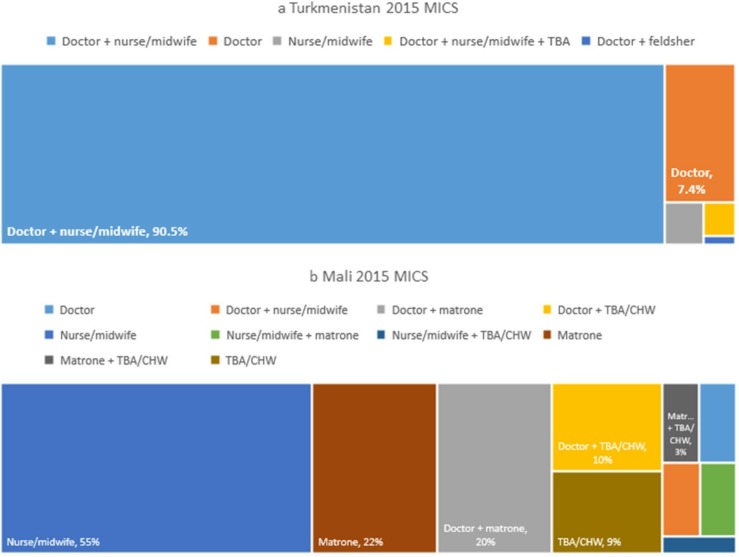
“Notably, Mali and Senegal had higher facility-based deliveries than SBA coverage estimates, indicating some women giving birth in facilities reported assistance by non-SBAs, namely with a ‘matrone’, an auxiliary cadre providing delivery care in many Francophone countries who may or may not be skilled.(28) In fact, the…”
BackgroundGrove, J., Claeson, M., Bryce, J., Amouzou, A., Boerma, T., Waiswa, P., & Victora, C. (2015) · The Lancet · doi:10.1016/s0140-6736(15)00517-6 · Cited by 73
Scott, S., & Ronsmans, C. (2009) · Tropical Medicine & International Health · doi:10.1111/j.1365-3156.2009.02402.x · Cited by 64
Utz, B., Siddiqui, G., Adegoke, A., & van den Broek, N. (2013) · Acta Obstetricia et Gynecologica Scandinavica · doi:10.1111/aogs.12166 · Cited by 52
Marchant, T., Bryce, J., Victora, C. G., Moran, A. C., Claeson, M., Requejo, J. H., Amouzou, A., Walker, N., Boerma, T., & Grove, J. T. (2016) · Journal of Global Health · doi:10.7189/jogh.06.010506 · Cited by 50 · cited 1×
“In light of the 2018 joint statement’s emphasis on the important role of the enabling environment, we echo Marchant and colleagues’ recommendations about the need to advance techniques to link population-based and provider-based data.(35) We encourage surveys and health management information systems to provide more d…”
BackgroundFootman, K., Beňová, L., Goodman, C. A., Macleod, D., Lynch, C. A., Penn‐Kekana, L., & Campbell, O. M. R. (2015) · Tropical Medicine & International Health · doi:10.1111/tmi.12471 · Cited by 49 · cited 3×
“This is less important if all the cadres in such combined categories are skilled; however, categorisations that combine skilled personnel with lowerlevel cadres who may not be considered skilled lead to inaccuracies in SBA coverage.(24) The question on DHS and MICS to capture SBA coverage reads: ‘Who assisted with del…”
BackgroundInfluentialSelf-citationMunos, M. K., Stanton, C. K., & Bryce, J. (2017) · Journal of Global Health · doi:10.7189/jogh.07.010801 · Cited by 48 · cited 1×
“We encourage surveys and health management information systems to provide more detail on the place of delivery, by level and sector, in order to facilitate linking population-based surveys to facility data.(36) This includes disaggregating private sector health facilities to distinguish hospitals from lower-level clin…”
MethodHobbs, A. J., Moller, A., Kachikis, A. B., Carvajal–Aguirre, L., Say, L., & Chou, D. (2019) · PLoS ONE · doi:10.1371/journal.pone.0211576 · Cited by 46
Christou, A., Dibley, M. J., & Raynes‐Greenow, C. H. (2016) · Tropical Medicine & International Health · doi:10.1111/tmi.12828 · Cited by 41 · cited 1×
“We recommend changing the denominator to be all births (live and stillbirths), while recognising that survey design changes may be needed to improve reporting.(31) For instance, evidence suggests women’s ability to accurately report birth attendants deteriorates somewhat over time.”
BackgroundArnold, F., & Khan, S. M. (2018) · Journal of Global Health · doi:10.7189/jogh.08.010606 · Cited by 32 · cited 1×
“9 To understand what this means in practice, we need to unpack what women can tell us and how the SBA indicator is currently generated via population-based surveys.(17) Then, we can consider the implications of the WHO definitions (2004 and 2018 versions) on meaningful measurement of SBA coverage and effective trackin…”
BackgroundHundley, V. A., Penney, G. C., Fitzmaurice, A. E., van Teijlingen, E., & Graham, W. J. (2002) · Midwifery · doi:10.1054/midw.2002.0306 · Cited by 24 · cited 1×
“In a study in Scotland, where women were allocated a midwife, obstetrician or general practitioner as a maternity care coordinator, less than half of women reported the same cadre as specified by staff.(22) A study in Mozambique found women’s recall of the number of health professionals assisting during delivery was i…”
BackgroundHow do women identify health professionals at birth in Ghana?
Hussein, J., Hundley, V. A., Bell, J. S., Abbey, M., Asare, G. Q., & Graham, W. J. (2005) · Midwifery · doi:10.1016/j.midw.2004.09.009 · Cited by 20 · cited 1×
“Hussein and colleagues found women in Ghana most often identified the cadre of providers by the activities they performed, by the colour of the uniform or by knowing the individual previously, though these means were frequently inaccurate.(20) Qualitative interviews by McCarthy and colleagues in Kenya found women diff…”
BackgroundThe Landscape of Cesarean Section in Sub-Saharan Africa and South and Southeast Asia
Beňová, L., Cavallaro, F. L., & Campbell, O. (2017) · LSHTM Research Online (London School of Hygiene and Tropical Medicine) · Cited by 9
Self-citation
Research works printed but not linked: 1
- Graham WJ, Bell JS, Bullough CH Can skilled attendance at delivery reduce maternal mortality in developing countries?: Brouwere D, Van Lerberghe W, Safe motherhood strategies: a review of the evidence. Studies in Health Services Organisation and Policy, 2001.
Cited by
Beňová, L., Owolabi, O., Radovich, E., Wong, K. L., Macleod, D., Langlois, É. V., & Campbell, O. M. R. (2019) · PLoS Medicine · doi:10.1371/journal.pmed.1002943 · Cited by 118
Self-citationBeňová, L., Moller, A., Hill, K. E., Vaz, L. M. E., Morgan, A., Hanson, C., Semrau, K. E. A., Arifeen, S., & Moran, A. C. (2020) · PLoS ONE · doi:10.1371/journal.pone.0233969 · Cited by 53
“[72] Several respondents emphasized that the process of assessing whether an indicator is “valid” should start with an understanding of not only the construct or phenomenon an indicator intends to measure, but also for whom and why.”
Sitefane, G. G., Banerjee, J., Mohan, D., Lee, C. S., Ricca, J., Betron, M. L., & Cuco, R. M. (2020) · BMC Pregnancy and Childbirth · doi:10.1186/s12884-020-02984-y · Cited by 33
“We chose institutional delivery rather than the presence of a skilled birth attendant because the overwhelming majority of deliveries in Mozambican health facilities are overseen by skilled birth attendants [1], and women often have difficulty accurately reporting distinct cadres of healthcare professionals as “skille…”
BackgroundMoller, A., Welsh, J., Ayebare, E. O., Chipeta, E. K., Groß, M. M., Houngbo, G., Hounkpatin, H., Kandeya, B., Mwilike, B. E., Nalwadda, G., et al. (2022) · PLOS Global Public Health · doi:10.1371/journal.pgph.0000605 · Cited by 30
Cavallaro, F. L., Beňová, L., Dioukhane, E. H., Wong, K. L., Sheppard, P., Faye, A., Radovich, E., Dumont, A., Mbengue, A. S., Ronsmans, C., et al. (2020) · BMJ Global Health · doi:10.1136/bmjgh-2019-001915 · Cited by 32
Self-citation
Metadata
- Authors
- Radovich, E., Benova, L., Penn-Kekana, L., Wong, K., & Campbell, O. M. R.
- Affiliations
- London School of Hygiene & Tropical Medicine (GB)
- Faculty of Epidemiology and Population Health, London School of Hygiene and Tropical Medicine, London, UK
- Corresponding author
- Radovich, Emma
- Venue
- BMJ Global Health
- Publisher
- BMJ
- Published
- 2019-04
- Volume
- 4
- Issue
- 2
- Pages
- e001367
- ISSN
- 2059-7908 (ISSN-L)
- PMC
- PMC6509598
- OpenAlex
- W2941905383
- Cited by
- 27
- References
- 29
- Citations by year
- 2026: 6 · 2025: 3 · 2024: 1 · 2023: 1 · 2022: 8 · 2021: 1 · 2020: 6 · 2019: 1
- FWCI
- 0.84
- Type
- journal article
- Language
- en
- Open access
- gold
- doi.org
- Licence
- cc-by-nc
- Locations
- BMJ Global Health (publishedVersion, cc-by-nc)
- Europe PMC (PubMed Central) (publishedVersion, cc-by-nc)
- PubMed Central (publishedVersion, cc-by-nc)
- PubMed (publishedVersion)
- LSHTM Research Online (London School of Hygiene and Tropical Medicine) (acceptedVersion)
- DOAJ (DOAJ: Directory of Open Access Journals) (submittedVersion)
- Topics
- Health Sciences › Medicine › Pediatrics, Perinatology and Child Health › Global Maternal and Child Health
- Health Sciences › Medicine › Obstetrics and Gynecology › Maternal and Perinatal Health Interventions
- Health Sciences › Medicine › Pediatrics, Perinatology and Child Health › Maternal and Neonatal Healthcare
- Keywords
- childbirth care, Demographic and Health Surveys, Multiple Indicator Cluster Surveys, low- and middle-income countries
About these checks
Registry, retraction, Cites and statistics results are computed, not judged, with one exception: a printed reference that no index lists is read once by a model before it counts as a citation error. Claims are extracted by a model and kept only when their quote appears verbatim in the text; each cited source is then checked, with a model’s help, for whether it says what the claim relies on. Those verdicts can be wrong — read the claim’s quote and the cited source before relying on one.
Statistics and arithmetic are recomputed, not judged.
Confidence bands are shown only for fields calibrated on our annotated test set. None is calibrated yet, so no band is shown.
What counts as a claim ›How we measure confidence ›How we check this ›
Are you an author, or do you see a problem with this page? Request a review
Data sources
Bibliographic data: Semantic Scholar, OpenAlex, Crossref.
Contains information from the Semantic Scholar Academic Graph Datasets, made available under the ODC Attribution License (ODC-BY 1.0).
Semantic Scholar’s data is described in: Kinney, R., et al. (2023). The Semantic Scholar Open Data Platform. arXiv:2301.10140.
