

Socioeconomic inequality in life expectancy in India
Open accessThe DOI matches its Crossref record; 40 of the 45 references it cites were found in a registry or an index; 3 of the 34 sources its claims cite were checked for support.
Abstract
Introduction: Concern for health inequalities is an important driver of health policy in India; however, much of the empirical evidence regarding health inequalities in the country is piecemeal focusing only on specific diseases or on access to particular treatments. This study estimates inequalities in health across the whole life course for the entire Indian population. These estimates are used to calculate the socioeconomic disparities in life expectancy at birth in the population. Methods: Population mortality data from the Indian Sample Registration System were combined with data on mortality rates by wealth quintile from the National Family Health Survey to calculate wealth quintile specific mortality rates. Results were calculated separately for males and females as well as for urban and rural populations. Life tables were constructed for each subpopulation and used to calculate distributions of life expectancy at birth by wealth quintile. Absolute gap and relative gap indices of inequality were used to quantify the health disparity in terms of life expectancy at birth between the richest and poorest fifths of households. Results: Life expectancy at birth was 65.1 years for the poorest fifth of households in India as compared with 72.7 years for the richest fifth of households. This constituted an absolute gap of 7.6 years and a relative gap of 11.7 %. Women had both higher life expectancy at birth and narrower wealth-related disparities in life expectancy than men. Life expectancy at birth was higher across the wealth distribution in urban households as compared with rural households with inequalities in life expectancy widest for men living in urban areas and narrowest for women living in urban areas. Conclusion: As India progresses towards Universal Health Coverage, the baseline social distributions of health estimated in this study will allow policy makers to target and monitor the health equity impacts of health policies introduced.
Overview
CoChat Summary
TL;DR
This study estimates socioeconomic inequality in life expectancy at birth in India by combining Sample Registration System life tables with National Family Health Survey wealth-quintile mortality data. It finds life expectancy at birth of 65.1 years for the poorest fifth of households versus 72.7 years for the richest fifth, an absolute gap of 7.6 years and a relative gap of 11.7%.
Key findings
- Life expectancy at birth was 65.1 years for the poorest fifth of households and 72.7 years for the richest fifth, giving an absolute gap of 7.6 years and a relative gap of 11.7%.
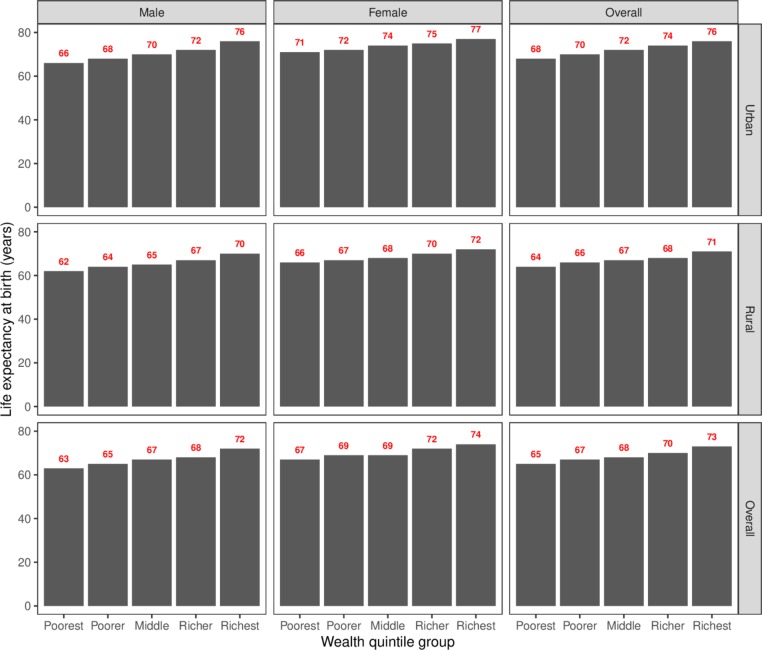
- Women had higher life expectancy at birth and narrower wealth-related disparities than men; inequalities were widest for men in urban areas (absolute gap 9.1 years, relative gap 13.8%) and narrowest for women in urban areas (6.2 years, 8.8%).
- Life expectancy was higher across the wealth distribution in urban than rural households; the lowest estimate was 62.2 years for men in the poorest rural quintile and the highest was 77.0 years for women in the richest urban quintile.
- A socioeconomic gradient in life expectancy was apparent within each subgroup, with those in wealthier households having higher life expectancies.
Methods
- Population mortality data from the Indian Sample Registration System (SRS) for 2011–2015 were combined with mortality rates by wealth quintile from National Family Health Survey (NFHS) round 4 (2015/16); NFHS collected data on 601,509 households and 74,945 deaths, of which 466 (0.6%) were missing details on one or more characteristics.
- Age-group, sex and geography-specific annual mortality rates by wealth quintile were calculated from NFHS and calibrated to SRS subgroup mortality rates using calibration factors assumed constant across wealth quintiles; life tables were constructed using the Chiang method to calculate life expectancy at birth by sex, geography and wealth quintile.
- Inequality was quantified using absolute gap (Q5−Q1) and relative gap ((Q5−Q1)/Q1) indices; analyses were conducted in Stata V.13 and Microsoft Excel 2016.
Limitations
- The paper states that it could not provide CIs for estimates because of the complexity of multiple calibration steps and links across datasets, and that refining methods to capture uncertainty is a key area for further research.
- The paper states that results are not adjusted for differential morbidity across wealth quintiles; it would ideally have estimated quality-adjusted or disability-adjusted life expectancy, and inequalities may widen once morbidity differentials are accounted for.
- The paper states concerns about SRS and NFHS data quality, including historical SRS under-recording of deaths by approximately 11% in women and 4% in men (1980–2010), and assumes SRS–NFHS differences are constant across wealth quintiles, which may miss wealth-patterned reporting biases; it also notes that caste and religion were not examined, though previous work suggests limited residual mortality effect after controlling for socioeconomic status. Evident from the text, the estimates are period life tables based on cross-sectional survey and vital statistics data, so they are not causal.
Model-written summary. Check it against the paper before relying on it.
Integrity signals
Registry
Cites
Statistics
Figures
Verification
Claims the paper makes
2 Valid · 0 Not valid · 15 Not checked · 34 Own results and interpretations
The cited sources support only part of this claim — read each source’s verdict below.
In the paper
“This is consistent with the literature suggesting that as countries undergo epidemiological transition, the greater access to healthcare and better nutrition found in urban settings begins to outweigh the higher potential risk of catching infectious diseases in these more densely populated environments tilting childhood mortality rates in favour of urban populations.31 32”
§ Socioeconomic inequality in life expectancy in India > Discussion
What the sources say
- Partly supportedcites [31] Fadel SA, Rasaily R, Awasthi S, et al Changes in cause-specific neonatal and 1–59-month child mortality in India from 2000 to 2015: a nationally representative survey. The Lancet 2017; 390: 1972– 80. 10.1016/S0140-6736(17)32162-1 PMC5677556 28939096 sourceExperimental — accuracy not yet measured
Our copy supports the empirical tail of the claim for one country only: the Results (p. 4, 'Neonatal mortality rates in rural and urban areas declined...') state rural neonatal rates stayed more than two-thirds above urban rates throughout 2000-15, and the Results (p. 3) give a rural-to-urban ratio of 1.7 falling to 1.3 at ages 1-59 months while rising to 2.1 for neonates, with the fastest neonatal declines in urban areas and richer states; the Discussion confirms 'neonatal mortality is still substantially higher in rural than in urban areas'. However, nothing in our copy offers the attributed mechanism or framing: the paper never invokes epidemiological transition across countries, never credits urban healthcare access or nutrition for the gradient, and it records pneumonia, diarrhoea and neonatal infection mortality falling in BOTH rural and urban settings rather than an infectious-disease penalty in dense urban areas being outweighed. The generalisation to 'countries undergoing epidemiological transition' and the causal explanation are not this India Million Death Study's findings. (LLM, conf=0.72)
- Could not verifycites [32] Bassani DG, Kumar R, Awasthi S, et al Causes of neonatal and child mortality in India: a nationally representative mortality survey. Lancet 2010; 376: 1853– 60. 10.1016/S0140-6736(10)61461-4 21075444 PMC3042727 sourceExperimental — accuracy not yet measured
Our copy of the India Million Death Survey paper reports cause-specific mortality stratified by region, state, gender and rural/urban (Methods, 'National and sub-national mortality rates'), and notes only that 'Most child deaths occurred in rural areas' and that 17% died in a health facility 'with large variations between rural and urban areas' (Results, opening paragraph), plus a Discussion remark that hospital deaths (mostly urban) differ in cause distribution and treatment patterns from rural home deaths. No passage states or discusses an urban survival advantage, better nutrition or greater healthcare access in urban settings, or epidemiological transition tilting childhood mortality in favour of urban populations. Searched: urban versus rural child mortality rates; epidemiological transition access to healthcare nutrition; urban areas lower mortality than rural areas health facility deaths. (LLM, conf=0.70)
hedgedstates a cause- Asserted: passes — The authors put it forward as true.
- Checkable: passes — It can be checked against evidence.
- Load-bearing: unclear — It is unclear whether the paper’s conclusions depend on it.
- Based: passes — The paper gives a reason why it holds.
- Partly supported
The cited sources support only part of this claim — read each source’s verdict below.
In the paper
“The relative shallowness of the socioeconomic mortality gradient for women may be explained by the substantial improvements in maternal mortality rates—improvements that have been more evident in urban than rural settings.35 36”
§ Socioeconomic inequality in life expectancy in India > Discussion
What the sources say
- Not checked yetcites [35] Registrar General of India Special Bulletin on maternal mortality in India: 2014-16. New Delhi: Sample Registration System, 2018.
- Partly supportedcites [36] Montgomery AL, Ram U, Kumar R, et al Maternal mortality in India: causes and healthcare service use based on a nationally representative survey. PLoS One 2014; 9 10.1371/journal.pone.0083331 PMC3893075 24454701 sourceExperimental — accuracy not yet measured
The Introduction (p. 1) supports the first half of the attributed point: India 'has experienced an estimated 4.7% annual decline in maternal mortality ratio (MMR)... While not on track to meet Millennium Development Goal number 5, India is making progress in reducing maternal mortality' — though the paper there reports estimates credited to its references [1] and [2] rather than generating them itself. The second half — that these improvements have been more evident in urban than rural settings — is absent from our copy: the paper's rural/urban material is a level comparison (rural poorer-state MMR 397 vs urban richer-state MMR 115; lower skilled-birth-attendance and emergency-obstetric uptake in rural poorer states, Results p. 6 / Figure 4), not a differential trend. The only trend statement in the Discussion runs the other way, noting that from 1999–2010 the proportion of safe deliveries rose annually at twice the rate in rural areas of poorer compared to richer states (8% versus 4%). (LLM, conf=0.78)
hedgedstates a possible cause- Asserted: passes — The authors put it forward as true.
- Checkable: passes — It can be checked against evidence.
- Load-bearing: passes — The paper’s conclusions depend on it.
- Based: passes — The paper gives a reason why it holds.
A result the paper reports from its own data — it cites no other source for it, so there is none to check. The quote shows it is in the paper.
In the paper
“Life expectancy at birth was 65.1 years for the poorest fifth of households in India as compared with 72.7 years for the richest fifth of households.”
§ Socioeconomic inequality in life expectancy in India > Abstract > Results
plain- Asserted: passes — The authors put it forward as true.
- Checkable: passes — It can be checked against evidence.
- Load-bearing: passes — The paper’s conclusions depend on it.
- Based: passes — The paper gives a reason why it holds.
A result the paper reports from its own data — it cites no other source for it, so there is none to check. The quote shows it is in the paper.
In the paper
“Life expectancy at birth was higher across the wealth distribution in urban households as compared with rural households with inequalities in life expectancy widest for men living in urban areas and narrowest for women living in urban areas.”
- Also stated in: § Results · plain
“Inequalities in life expectancy by wealth quintile measured in both absolute and relative terms are wider for men than for women and are widest for men living in urban areas and narrowest for women living in urban areas.”
§ Socioeconomic inequality in life expectancy in India > Abstract > Results
plainstates an association- Asserted: passes — The authors put it forward as true.
- Checkable: passes — It can be checked against evidence.
- Load-bearing: passes — The paper’s conclusions depend on it.
- Based: passes — The paper gives a reason why it holds.
- Also stated in: § Results · plain
A result the paper reports from its own data — it cites no other source for it, so there is none to check. The quote shows it is in the paper.
In the paper
“Life expectancy is higher for women than for men and higher in urban areas than in rural areas.”
§ Socioeconomic inequality in life expectancy in India > Results
plainstates an association- Asserted: passes — The authors put it forward as true.
- Checkable: passes — It can be checked against evidence.
- Load-bearing: passes — The paper’s conclusions depend on it.
- Based: passes — The paper gives a reason why it holds.
20 more claims
Create a free account to see all 51 claims and to verify the 29 references still open.
- It may state two separate claims as one. 12
- Probably not a substantial claim. 17
Citations
Cites
UNCERTAINTY AND THE WELFARE ECONOMICS OF MEDICAL CARE
Arrow, K. J. (2003) · Uncertain Times · doi:10.2307/j.ctv11sn34h.6 · Cited by 4,078
Closing the gap in a generation: health equity through action on the social determinants of health
Marmot, M., Friel, S., Bell, R., Houweling, T. A., & Taylor, S. (2008) · The Lancet · doi:10.1016/s0140-6736(08)61690-6 · Cited by 3,247
Uncertainty and The Welfare Economics of Medical Care
Arrow, K. J. (2001) · Journal of Health Politics, Policy and Law · doi:10.1215/03616878-26-5-851 · Cited by 1,467
A Single Index of Mortality and Morbidity
Sullivan, D. F. (1971) · HSMHA Health Reports · doi:10.2307/4594169 · Cited by 1,450
Health systems financing and the path to universal coverage
Evans, D. B., & Etienne, C. (2010) · Bulletin of the World Health Organization · doi:10.2471/blt.10.078741 · Cited by 1,279
Dandona, L., Dandona, R., Kumar, G. A., Shukla, D. K., Paul, V. K., Balakrishnan, K., Prabhakaran, D., Tandon, N., Salvi, S., Dash, A. P., et al. (2017) · The Lancet · doi:10.1016/s0140-6736(17)32804-0 · Cited by 1,059
Health care and equity in India
Balarajan, Y., Selvaraj, S., & Subramanian, S. (2011) · The Lancet · doi:10.1016/s0140-6736(10)61894-6 · Cited by 1,026
Rutstein, S. O., & Johnson, K. (2004) · doi:10.13140/2.1.2806.4809 · Cited by 977
E2F1 Regulates Cellular Growth by mTORC1 Signaling
Real, S., Meo-Evoli, N., Espada, L., & Tauler, A. (2011) · PLoS ONE · doi:10.1371/journal.pone.0016163 · Cited by 814
Causes of neonatal and child mortality in India: a nationally representative mortality survey
(2010) · The Lancet · doi:10.1016/s0140-6736(10)61461-4 · Cited by 550
Research works printed but not linked: 7
- Baru R, Acharya A, Acharya S, et al Inequities in access to health services in India. Econ Polit Wkly 2010; xlv: 49– 58.
- Caste BVK Religion, and health outcomes in India, 2004–14. Econ Polit Wkly 2018; lIiI: 65– 73.
- Saikia N, Kulkarni PM Data for research into health inequality in India do we have enough? Econ Polit Wkly 2016; 26 & 27: 111– 6.
- NFHS-4 Research Collaborators National family health Survey-4 (2015-16). Econ Polit Wkly 2017; LII: 66– 70.
- 10.2307/2284435 · doi:10.2307/2284435
- Yadav AK, Ram F Assessment of completeness of birth registrations (5+) by sample registration system (SRS) of India and major states. Demogr India 2015; 44: 111– 8.
- Registrar General of India Special Bulletin on maternal mortality in India: 2014-16. New Delhi: Sample Registration System, 2018.
Cited by
Epidemiology and transmission dynamics of COVID-19 in two Indian states
Laxminarayan, R., Wahl, B., Dudala, S. R., Gopal, K., Mohan B, C., Neelima, S., Jawahar Reddy, K. S., Radhakrishnan, J., & Lewnard, J. A. (2020) · Science · doi:10.1126/science.abd7672 · Cited by 485
The inverse care law re-examined: a global perspective
Cookson, R., Doran, T., Asaria, M., Gupta, I., & Mujica, F. P. (2021) · The Lancet · doi:10.1016/s0140-6736(21)00243-9 · Cited by 198
Self-citationModified Kuppuswamy socioeconomic scale 2023: stratification and updates
Radhakrishnan, M., & Nagaraja, S. B. (2023) · International Journal of Community Medicine and Public Health · doi:10.18203/2394-6040.ijcmph20233487 · Cited by 153
Vaishnav, L. M., Joshi, S. H., Joshi, A. U., & Mehendale, A. M. (2022) · Annals of Geriatric Medicine and Research · doi:10.4235/agmr.22.0062 · Cited by 114
Inequality in healthcare use among older people in Colombia
García-Ramírez, J. A., Nikoloski, Z., & Mossialos, E. A. (2020) · International Journal for Equity in Health · doi:10.1186/s12939-020-01241-0 · Cited by 90
Kuppusamy, P., Prusty, R. K., Chaaithanya, I. K., Gajbhiye, R., & Sachdeva, G. (2023) · BMC Pregnancy and Childbirth · doi:10.1186/s12884-023-05470-3 · Cited by 58
Kumari, M., & Mohanty, S. K. (2020) · BMJ Open · doi:10.1136/bmjopen-2019-035392 · Cited by 53
Prevalence of diabetic retinopathy in urban and rural India: A systematic review and meta-analysis
Brar, A. S., Sahoo, J., Behera, U. C., Jonas, J. B., Sivaprasad, S., & Das, T. (2022) · Indian Journal of Ophthalmology · doi:10.4103/ijo.ijo_2206_21 · Cited by 47
Global impact of population aging on vision loss prevalence: A population-based study
Chen, J., Zhu, Y., Li, Z., Chen, X., Chen, X., Huang, S., Xie, R., Zhang, Y., Ye, G., Luo, R., et al. (2023) · Global Transitions · doi:10.1016/j.glt.2023.12.003 · Cited by 41
Banerjee, S., & Chowdhury, I. R. (2020) · PLoS ONE · doi:10.1371/journal.pone.0241994 · Cited by 35
Early marriage and health among women at midlife: Evidence from India
Vikram, K. (2021) · Journal of Marriage and the Family · doi:10.1111/jomf.12793 · Cited by 34
Selvaraj, S., Karan, A., Mao, W., Farooqui, H. H., Bharali, I., Kumar, P., Ogbuoji, O., & Chaudhuri, C. (2021) · International Journal for Equity in Health · doi:10.1186/s12939-021-01489-0 · Cited by 33
Global Health Equity Requires Global Equity
Maani, N., Abdalla, S. M., Ettman, C. K., Parsey, L., Rhule, E., Allotey, P. A., & Galea, S. (2023) · Health Equity · doi:10.1089/heq.2022.0169 · Cited by 32
Christofi, M., Stylianou, I., Hadjielias, Ε., Massis, A. D., & Kastanakis, M. N. (2023) · Journal of Product Innovation Management · doi:10.1111/jpim.12662 · Cited by 31
Gutacker, N., Kinge, J. M., & Olsen, J. A. (2023) · BMC Public Health · doi:10.1186/s12889-023-15663-2 · Cited by 23
Green space, health, and wellbeing: considerations for South Asia
Adhikari, B., Mishra, S. R., & Dirks, K. N. (2020) · The Lancet Planetary Health · doi:10.1016/s2542-5196(20)30056-5 · Cited by 22
The Inequality in Healthcare Access in Bihar: Pattern and Determinants
Ahmed, S. (2024) · Arthaniti-Journal of Economic Theory and Practice · doi:10.1177/09767479241254423 · Cited by 20
Excess mortality in elderly hip fracture patients: An Indian experience
George, J., Sharma, V., Farooque, K., Trikha, V., Mittal, S., & Malhotra, R. (2023) · Chinese Journal of Traumatology · doi:10.1016/j.cjtee.2023.06.004 · Cited by 17
Healthy Ageing in India; A Quantile Regression Approach
Irshad, C. V., Dash, U., & Muraleedharan, V. R. (2021) · Journal of Population Ageing · doi:10.1007/s12062-021-09340-8 · Cited by 16
Nagai, K. (2023) · Medicina · doi:10.3390/medicina59030601 · Cited by 16
From Benefit–Cost Analysis to Social Welfare: A Pragmatic Approach
Ferranna, M., Hammitt, J. K., & Robinson, L. A. (2024) · Journal of Benefit-Cost Analysis · doi:10.1017/bca.2024.28 · Cited by 15
Panda, B. K., & Mishra, U. S. (2020) · Journal of Biosocial Science · doi:10.1017/s0021932020000231 · Cited by 15
Saxena, A., & Mendenhall, E. (2020) · Social Science & Medicine · doi:10.1016/j.socscimed.2020.113503 · Cited by 14
Lee, M., Ahn, S. H., Chan, H. L., Choudhry, A., Gani, R. A., Mohamed, R. B., Ong, J. P., Shukla, A., Tan, C., Tanwandee, T., et al. (2021) · Journal of Viral Hepatitis · doi:10.1111/jvh.13636 · Cited by 13
Swarnakar, R., & Santra, S. (2020) · Spinal Cord Series and Cases · doi:10.1038/s41394-020-00328-8 · Cited by 13
Quadri, M. F. A., John, T., Kaur, D., Nayeem, M., Ahmed, M. K., Kamel, A. M., Tadakamadla, S. K., Caponio, V. C. A., & Muzio, L. L. (2022) · BMC Public Health · doi:10.1186/s12889-022-13565-3 · Cited by 12
Wealth Status and Health Insurance Enrollment in India: An Empirical Analysis
Ambade, P., Gerald, J. K., & Rahman, T. (2023) · Healthcare · doi:10.3390/healthcare11091343 · Cited by 12
Effect of global atmospheric aerosol emission change on PM2.5-related health impacts
Seposo, X., Ueda, K., Park, S. S., Sudo, K., Takemura, T., & Nakajima, T. (2019) · Global Health Action · doi:10.1080/16549716.2019.1664130 · Cited by 12
Does inequality in urban population distribution lead to income inequality? Evidence from India
Tripathi, S., & Yenneti, K. (2024) · Asia-Pacific Journal of Regional Science · doi:10.1007/s41685-024-00345-7 · Cited by 11
The Lancet Commission on a citizen-centred health system for India
Patel, V. H., Kalita, A., Furtado, K. M., Mor, N., Bhadada, S., Albert, S., Ashraf, H., Balsari, S., Bhushan, I., Chandru, V., et al. (2026) · The Lancet · doi:10.1016/s0140-6736(25)02169-5 · Cited by 11
Chauhan, S., Kumar, S., Nath, N. J., Dosaya, D., & Patel, R. (2022) · Aging and Health Research · doi:10.1016/j.ahr.2022.100106 · Cited by 11
Healthy aging in India: evidence from a panel study
Irshad, C. V., & Dash, U. (2021) · Journal of Health Research · doi:10.1108/jhr-09-2020-0395 · Cited by 9
Ambade, P., Thavorn, K., & Pakhale, S. S. (2023) · Healthcare · doi:10.3390/healthcare11142112 · Cited by 7
Das, J., & Mohanty, S. K. (2024) · BMC Public Health · doi:10.1186/s12889-024-20966-z · Cited by 7
Health, Environment, And Inequality In India
Gupta, A. (2021) · ScholarlyCommons (University of Pennsylvania) · Cited by 7
Goyal, A. D., Gajjar, A. A., Muhammad, N., Wu, A. Q., Polavarapu, H., Tang, O. Y., Salem, M. M., Paliwoda, E. D., Gupta, N. K., Doad, J. S., et al. (2025) · Journal of Clinical Medicine · doi:10.3390/jcm14217807 · Cited by 6
Ugargol, A. P., Bailey, A., Hutter, I., & James, K. S. (2023) · Springer eBooks · doi:10.1007/978-981-16-1914-4_93-1 · Cited by 6
Eating to live well—Or worse? The role of vegan and vegetarian diets in mental health
Dobersek, U., Lavie, C. J., & Archer, E. (2025) · Nutrition and Health · doi:10.1177/02601060241300563 · Cited by 5
Gauging Class and Caste differences in Mortality: The Indian Experience
Mishra, U. S., Rinju, & Panda, B. K. (2020) · OMEGA - Journal of Death and Dying · doi:10.1177/0030222820959970 · Cited by 5
Socioeconomics and the Macro- and Micro-Level Determinants of Global Health Inequality
Permanyer, I., & Spijker, J. (2020) · Springer eBooks · doi:10.1007/978-3-030-05325-3_50-1 · Cited by 6
Cockerham, W. C. (2025) · Routledge eBooks · doi:10.4324/9781003569824 · Cited by 4
Lee, J. T., Hsu, S. H., Li, V. C.-S., Anindya, K., Chen, M. M., Wang, C. I., Shen, T. K.-B., Liu, V. T. N., Chen, H.-H., & Atun, R. A. (2025) · PLOS Digital Health · doi:10.1371/journal.pdig.0000951 · Cited by 4
Yadav, S., Kumar, A., Cunningham, S. A., Zuo, D., & Perianayagam, A. (2025) · Scientific Reports · doi:10.1038/s41598-025-21228-7 · Cited by 3
Kumar, A. (2025) · Frontiers in Public Health · doi:10.3389/fpubh.2025.1613516 · Cited by 3
Leave No One Behind: AI-Powered Inclusive Development for Viksit Bharat 2047
Anilkumar, P. (2024) · Ushus - Journal of Business Management · doi:10.12725/ujbm.68.2 · Cited by 3
Healthcare for All: Community Action and Public Systems for an Inclusive India
Reddy, K. S., Vaidyanathan, G., & Sinha, A. (2025) · Routledge eBooks · doi:10.4324/9781003664314 · Cited by 3
Behera, U. C., Salzman, B., Das, A. V., Prashanthi, G. S., Lalakia, P., Derman, R. J., & Panigrahy, B. (2021) · Indian Journal of Ophthalmology · doi:10.4103/ijo.ijo_621_21 · Cited by 3
Reduction of Heavy Metals in Wheat by Treatment with Citric Acid From Lemons
Kumari, P., Mishra, K. K., Sharma, D. C., Kumar, S., & Budhwar, S. (2025) · ChemistrySelect · doi:10.1002/slct.202504151 · Cited by 2
Introduction: Living arrangements and care in India
Bailey, M., & Hyde, K. S. (2022) · Policy Press eBooks · doi:10.1332/policypress/9781447357339.003.0001 · Cited by 2
Gone and forgotten? Predictors of birth history omissions in India
Sharma, S. P., Desai, S., Barik, D., & Sharma, O. P. (2024) · Demographic Research · doi:10.4054/demres.2024.50.32 · Cited by 2
Introduction: Living arrangements and care in India
Bailey, A., Hyde, M., & James, K. S. (2022) · Bristol University Press eBooks · doi:10.46692/9781447357414.003 · Cited by 2
Unhealthy Shock: Changes in Household Expenditures in the First Wave of COVID-19 in India
Balaji, A., & Tagat, A. (2023) · Journal of Health Management · doi:10.1177/09720634231153207 · Cited by 2
Continent Wise Intersectional Analysis on Ageing
Lama, P. (2023) · Springer eBooks · doi:10.1007/978-981-99-5772-9_1 · Cited by 2
SdG on health and Socio-economic Barriers: An Empirical Study in Bihar
Ahmed, S. (2023) · International Journal of Social Sciences · doi:10.46852/2249-6637.04.2022.2 · Cited by 1
Tupe, D., Bhave, K. A., & Pandit, P. R. (2024) · International Journal of Basic & Clinical Pharmacology · doi:10.18203/2319-2003.ijbcp20242417 · Cited by 1
Akif, M., & Salman, A. (2022) · National Journal of Community Medicine · doi:10.5455/njcm.20200806035409 · Cited by 1
Ageing Health and Socioeconomic Determinants: An Introspect
Ahmed, S. (2023) · Annals of Advanced Biomedical Sciences · doi:10.23880/aabsc-16000210 · Cited by 1
Retzer, A., Adab, P., Calvert, M., Campbell, N., Varney, J., Fisher, P., Arhin, D. C., Merriman, J., Harris, I. M., Khatsuria, F., et al. (2025) · Trials · doi:10.1186/s13063-025-09399-0 · Cited by 1
Lieber, J. (2021) · LSHTM Research Online (London School of Hygiene and Tropical Medicine) · doi:10.17037/pubs.04663604 · Cited by 1
Masese, P. (2024) · SU+ Digital Repository (Strathmore University) · Cited by 1
Rural Health: Developing, Attracting, Recruiting and Retaining Rural Health Workers
McIsaac, M. (2021) · Springer eBooks · doi:10.1007/978-3-030-05325-3_123-1
Socioeconomics and the Macro- and Micro-level Determinants of Global Health Inequality
Permanyer, I., & Spijker, J. (2021) · Springer eBooks · doi:10.1007/978-3-030-45009-0_50
Rural Health: Developing, Attracting, Recruiting, and Retaining Rural Health Workers
McIsaac, M. (2021) · Springer eBooks · doi:10.1007/978-3-030-45009-0_123
Bango, M. (2022) · Journal of Health Inequalities · doi:10.5114/jhi.2022.122112
Bangladesh Journal of Political Economy, Volume 37, Number 2, December 2021
(2021) · Bangladesh Journal of Political Economy · doi:10.56138/bjpe.dec2021.2
Inequality in Life Expectancy-Acceleration due to COVID-19
Matin, K. A. (2021) · Bangladesh Journal of Political Economy · doi:10.56138/bjpe.dec2112
Socioeconomic Inequalities in Adult Mortality in India, 1998–1999, 2015–2016, and 2019–2021
Dhakad, M., & Saikia, N. (2023) · Sustainable development goals series · doi:10.1007/978-981-99-0002-2_5
HEALTH INEQUALITIES RESEARCH IN INDIA: A SYNTHESIS OF RECENT LITERATURE
Kumar, A., & Sharma, A. (2023) · EPRA International Journal of Economic and Business Review · doi:10.36713/epra13723
Introduction: Living arrangements and care in India
Bailey, A., Hyde, M., & James, K. S. (2022) · Policy Press eBooks · doi:10.56687/9781447357414-007
Crafting Data-Driven Strategies to Disentangle Socioeconomic Disparities from Disease Spread
Paul, A. (2023) · Springer eBooks · doi:10.1007/978-981-99-1106-6_7
The Economic Impact of Ageing on Healthcare
Lama, P. (2023) · Springer eBooks · doi:10.1007/978-981-99-5772-9_4
Pal, A., Madhusudan, J. V., Kumari, D., & Kamal, V. K. (2023) · Children and Youth Services Review · doi:10.1016/j.childyouth.2023.107346
Divya, I., Sridharan, V., Washington, J. K., Syed, R., Surya, B. N., & Muthuchamy, V. (2024) · Texila international journal of public health · doi:10.21522/tijph.2013.12.03.art050
Health experience for pregnant stay-behind women in rural India: A study on NFHS-5 survey data
Ahmed, S., & Mahapatro, S. R. (2025) · Women & Health · doi:10.1080/03630242.2025.2459759
Inclusive Urban Health Systems and Universal Well-Being: Mirage or a Real Future?
Choudhary, B. K. (2025) · The urban book series · doi:10.1007/978-3-031-78162-9_6
Chakraborty, D., Roy, T., & Gangopadhyay, P. (2025) · Cureus · doi:10.7759/cureus.83661
Use of Distribution Function in Estimation of Mean of Some Demographic Duration Variables
Yadava, R. C., Tiwari, A. K., Patel, V. B., & Singh, P. K. (2025) · Journal of Reliability and Statistical Studies · doi:10.13052/jrss0974-8024.1818
Inequality in the Gain in Life Expectancy at Birth in India, 1976–2020
Chaurasia, A. R. (2025) · The Journal of Population and Sustainability · doi:10.3197/jps.63799977346503
Ugargol, A. P., Bailey, A., Hutter, I., & James, K. S. (2025) · Springer eBooks · doi:10.1007/978-981-99-7842-7_93
Mathew, M., Ramesh, M., Thippeswamy, T., Ravi, M. D., & Kumar, Y. S. R. (2025) · Journal of Primary Care & Community Health · doi:10.1177/21501319251380436
Additional file 3 of Inequality in healthcare use among older people in Colombia
García-Ramírez, J. A., Nikoloski, Z., & Mossialos, E. A. (2020) · Figshare · doi:10.6084/m9.figshare.13141622
Selvaraj, S., Karan, A., Mao, W., Hasan, H., Bharali, I., Kumar, P., Ogbuoji, O., & Chaudhuri, C. (2021) · Figshare · doi:10.6084/m9.figshare.14954589
Gutacker, N., Kinge, J. M., & Olsen, J. A. (2023) · Figshare · doi:10.6084/m9.figshare.22757194
Kuppusamy, P., Prusty, R. K., Chaaithanya, I. K., Gajbhiye, R. K., & Sachdeva, G. (2023) · Figshare · doi:10.6084/m9.figshare.22617764
Additional file 2 of Inequality in healthcare use among older people in Colombia
García-Ramírez, J. A., Nikoloski, Z., & Mossialos, E. A. (2020) · Figshare · doi:10.6084/m9.figshare.13141619
Quadri, M. F. A., John, T., Kaur, D., Nayeem, M., Ahmed, M. K., Kamel, A. M., Tadakamadla, S. K., Caponio, V. C. A., & Muzio, L. L. (2022) · Figshare · doi:10.6084/m9.figshare.20076569
Selvaraj, S., Karan, A., Mao, W., Hasan, H., Bharali, I., Kumar, P., Ogbuoji, O., & Chaudhuri, C. (2021) · Figshare · doi:10.6084/m9.figshare.14954592
Additional file 1 of Inequality in healthcare use among older people in Colombia
García-Ramírez, J. A., Nikoloski, Z., & Mossialos, E. A. (2020) · Figshare · doi:10.6084/m9.figshare.13141616
Gutacker, N., Kinge, J. M., & Olsen, J. A. (2023) · Figshare · doi:10.6084/m9.figshare.22757191
Quadri, M. F. A., John, T., Kaur, D., Nayeem, M., Ahmed, M. K., Kamel, A. M., Tadakamadla, S. K., Caponio, V. C. A., & Muzio, L. L. (2022) · Figshare · doi:10.6084/m9.figshare.20076572
Rao, C. K. (2026) · INTERNATIONAL JOURNAL OF PROFESSIONAL STUDIES · doi:10.37648/ijps.v21i02.002
Urban–Rural Differences in Life Expectancy and Healthy Survival: Scoping Review with ☸️SAIMSARA
SAIMSARA (2026) · SAIMSARA Journal · doi:10.62487/saimsara70cf7c47
Advanced Topics in Applied Mathematics and Computation
Saikia, B., & Ozah, J. (2026) · doi:10.70593/978-93-7185-296-8
A comparative study on geographic disparities in adolescent physiological profiles
Biswas, S., & Biswas, A. K. (2026) · International Journal of Physiology Nutrition and Physical Education · doi:10.22271/journalofsport.2026.v11.i5a.3239
Exploring the dynamics of income growth and healthy life expectancy in India
Dar, K. H., Showkat, M., & Raina, S. H. (2026) · Discover Public Health · doi:10.1186/s12982-026-02447-3
Bhuyan, H., Barman, B., Manjunatha, V. K., Talukdar, K., Ojah, M., Priya, N., V, Behera, S., Mohanty, J. R., Panda, P., & Pradhan, S. (2026) · Research Square · doi:10.21203/rs.3.rs-9761460/v1
The Global Future of Cardiovascular Kidney Metabolic Syndrome Care
Banerjee, D., & Jha, V. (2026) · Clinical Journal of the American Society of Nephrology · doi:10.2215/cjn.0000001222
Social and economic inequalities in adult mortality in India
Moradhvaj, & Saikia, N. (2026) · Demographic Research · doi:10.4054/demres.2026.55.16
Sengupta, A., & Das, S. (2026) · SSRN Electronic Journal · doi:10.2139/ssrn.7472618
Metadata
- Authors
- Asaria, M., Mazumdar, S., Chowdhury, S., Mazumdar, P., Mukhopadhyay, A., & Gupta, I.
- Affiliations
- London School of Economics and Political Science (GB)
- University of York (GB)
- Ambedkar University Delhi (IN)
- Indian Statistical Institute, Delhi Centre (IN)
- Institute of Economic Growth (IN)
- Corresponding author
- Asaria, Miqdad
- Venue
- BMJ Global Health
- Publisher
- BMJ
- Published
- 2019-05
- Volume
- 4
- Issue
- 3
- Pages
- e001445
- ISSN
- 2059-7908 (ISSN-L)
- PMC
- PMC6528758
- OpenAlex
- W2944241246
- Semantic Scholar
- 32f21c68e3a23d2f1bd81f77cc225d9368e21fd6
- Cited by
- 101
- References
- 45
- Citations by year
- 2026: 11 · 2025: 16 · 2024: 9 · 2023: 24 · 2022: 11 · 2021: 16 · 2020: 13 · 2019: 1
- FWCI
- 7.70
- Type
- journal article
- Language
- en
- Open access
- gold
- doi.org
- Licence
- cc-by
- Locations
- BMJ Global Health (publishedVersion, cc-by)
- Europe PMC (PubMed Central) (publishedVersion, cc-by)
- PubMed Central (publishedVersion, cc-by)
- PubMed (publishedVersion)
- London School of Economics and Political Science Research Online (London School of Economics and Political Science) (acceptedVersion, cc-by)
- White Rose Research Online (University of Leeds, The University of Sheffield, University of York) (acceptedVersion, cc-by)
- RePEc: Research Papers in Economics (submittedVersion)
- LSE Research Online Documents on Economics (submittedVersion)
- DOAJ (DOAJ: Directory of Open Access Journals) (submittedVersion)
- Funders
- Bill and Melinda Gates Foundation (OPP1087363)
- Topics
- Social Sciences › Health › Health disparities and outcomes
- Social Sciences › Health › Public Health and Social Inequalities
- Social Sciences › Demography › Insurance, Mortality, Demography, Risk Management
- Keywords
- socioeconomic disparities, life expectancy, health disparities, wealth quintiles, life tables, urban-rural disparities, sex differences in longevity, health equity, universal health coverage, India
About these checks
Registry, retraction, Cites and statistics results are computed, not judged, with one exception: a printed reference that no index lists is read once by a model before it counts as a citation error. Claims are extracted by a model and kept only when their quote appears verbatim in the text; each cited source is then checked, with a model’s help, for whether it says what the claim relies on. Those verdicts can be wrong — read the claim’s quote and the cited source before relying on one.
The claim verdicts this report counts are experimental: their accuracy is not yet measured.
A language model drew the claims from the paper on 2026-11-20, under version 3 of the claim definition (model deepseek-v4.1-flash, prompt extract-v3).
A second model labelled each claim on 2026-11-20 (model jev-1.13-20260917, definition revision gold-guideline-v0.2).
Cited sources are checked with a language model’s help (qwen3.8-omni-flash).
Statistics and arithmetic are recomputed, not judged.
Confidence bands are shown only for fields calibrated on our annotated test set. None is calibrated yet, so no band is shown.
What counts as a claim ›How we measure confidence ›How we check this ›
Are you an author, or do you see a problem with this page? Request a review
Data sources
Bibliographic data: Semantic Scholar, OpenAlex, Crossref.
Contains information from the Semantic Scholar Academic Graph Datasets, made available under the ODC Attribution License (ODC-BY 1.0).
Semantic Scholar’s data is described in: Kinney, R., et al. (2023). The Semantic Scholar Open Data Platform. arXiv:2301.10140.
