

The DOI matches its Crossref record; 36 of the 36 references it cites were found in a registry or an index.
The relatively young and rural population may limit the spread and severity of COVID-19 in Africa: a modelling study
Open accessPublished version of a preprint
Abstract
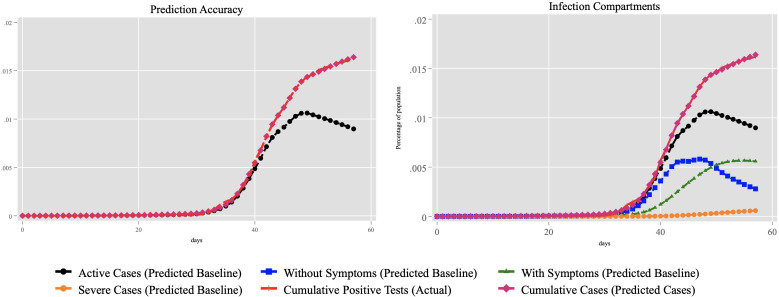
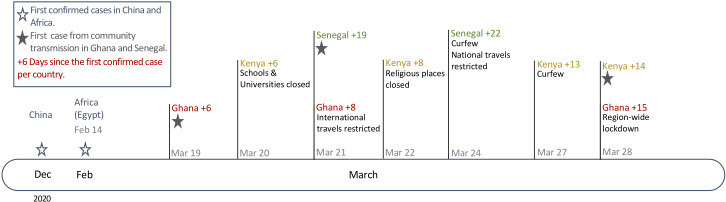
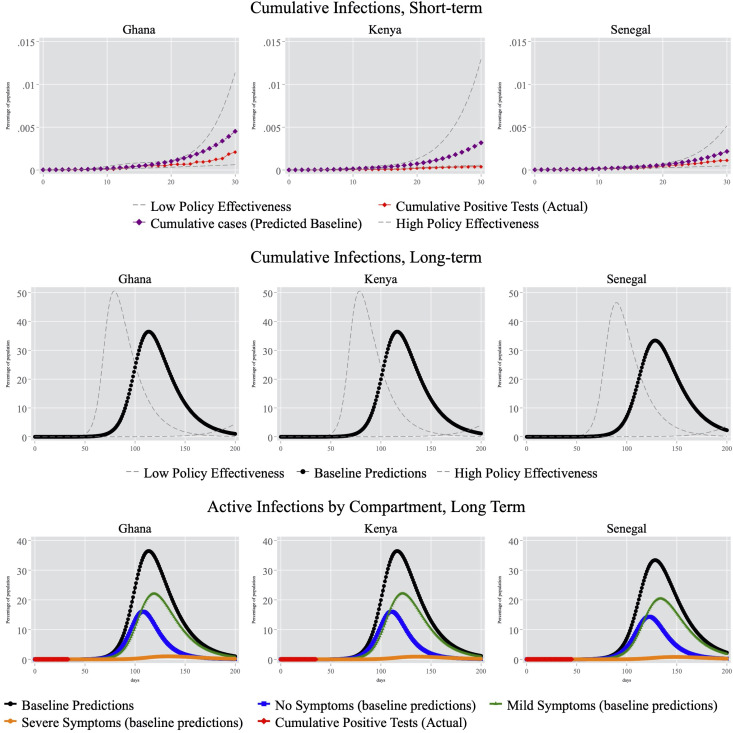
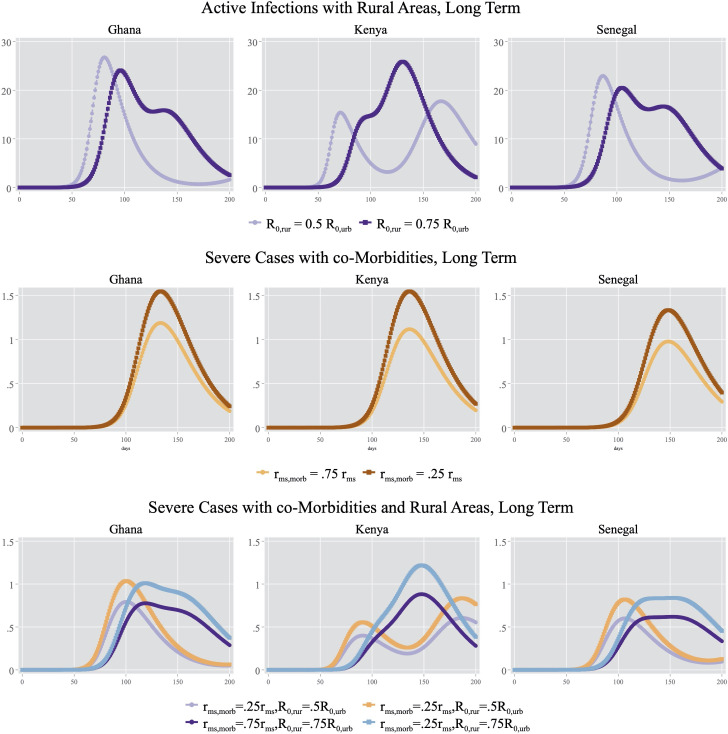
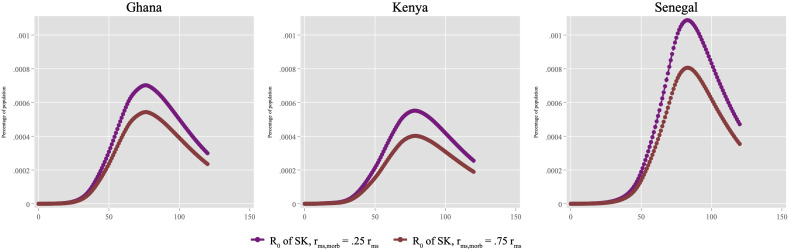
Introduction: A novel coronavirus disease 2019 (COVID-19) has spread to all regions of the world. There is great uncertainty regarding how countries’ characteristics will affect the spread of the epidemic; to date, there are few studies that attempt to predict the spread of the epidemic in African countries. In this paper, we investigate the role of demographic patterns, urbanisation and comorbidities on the possible trajectories of COVID-19 in Ghana, Kenya and Senegal. Methods: We use an augmented deterministic Susceptible-Infected-Recovered model to predict the true spread of the disease, under the containment measures taken so far. We disaggregate the infected compartment into asymptomatic, mildly symptomatic and severely symptomatic to match observed clinical development of COVID-19. We also account for age structures, urbanisation and comorbidities (HIV, tuberculosis, anaemia). Results: In our baseline model, we project that the peak of active cases will occur in July, subject to the effectiveness of policy measures. When accounting for the urbanisation, and factoring in comorbidities, the peak may occur between 2 June and 17 June (Ghana), 22 July and 29 August (Kenya) and, finally, 28 May and 15 June (Senegal). Successful containment policies could lead to lower rates of severe infections. While most cases will be mild, we project in the absence of policies further containing the spread, that between 0.78% and 1.03%, 0.61% and 1.22%, and 0.60% and 0.84% of individuals in Ghana, Kenya and Senegal, respectively, may develop severe symptoms at the time of the peak of the epidemic. Conclusion: Compared with Europe, Africa’s younger and rural population may modify the severity of the epidemic. The large youth population may lead to more infections but most of these infections will be asymptomatic or mild, and will probably go undetected. The higher prevalence of underlying conditions must be considered.
Overview
The claims and statistics of this paper haven’t been checked yet.
Run the check — free, no account needed. It reads the open-access text and checks the sources it cites.
Integrity signals
Registry
Cites
Statistics
Figures
Verification
Claims the paper makes
The claims and statistics of this paper haven’t been checked yet.
Run the check — free, no account needed. It reads the open-access text and checks the sources it cites.
Claims other papers make about this one
Each is checked against this paper’s own text: does it say what the citing paper says it does?
The source backs part of the claim, not all of it — or backs it for a different population, condition or comparison.
In the citing paper
“This disparity has been attributed to limited capacity for diagnosis, timely implementation of stringent containment measures, a younger population structure, and a predominance of asymptomatic and mild infections (3, 4).”
From Seroprevalence of anti–SARS-CoV-2 IgG antibodies in Kenyan blood donors (2021) · cites this paper as [3]
Experimental — accuracy not yet measured
Self-check
Percentages, sums and reported differences re-computed from the paper’s own numbers.
The self-check needs the paper’s full text.
Citations
Cites
Zhou, F., Yu, T., Du, R., Fan, G., Liu, Y., Liu, Z., Xiang, J., Wang, Y., Song, B., Gu, X., et al. (2020) · The Lancet · doi:10.1016/s0140-6736(20)30566-3 · Cited by 27,263
Grasselli, G., Zangrillo, A., Zanella, A., Antonelli, M., Cabrini, L., Castelli, A., Cereda, D., Coluccello, A., Foti, G., Fumagalli, R., et al. (2020) · JAMA · doi:10.1001/jama.2020.5394 · Cited by 5,469
Estimates of the severity of coronavirus disease 2019: a model-based analysis
Verity, R., Okell, L. C., Dorigatti, I., Winskill, P., Whittaker, C., Imai, N., Cuomo-Dannenburg, G., Thompson, H., Walker, P. G. T., Fu, H., et al. (2020) · The Lancet Infectious Diseases · doi:10.1016/s1473-3099(20)30243-7 · Cited by 3,660
Ferguson, N. M., Laydon, D. J., Nedjati-Gilani, G. L., Imai, N., Ainslie, K. E. C., Baguelin, M., Bhatia, S., Boonyasiri, A., Cucunubá, Z. M., Cuomo-Dannenburg, G., et al. (2020) · Spiral (Imperial College London) · doi:10.25561/77482 · Cited by 3,619
Mizumoto, K., Kagaya, K., Zarebski, A. E., & Chowell, G. (2020) · Eurosurveillance · doi:10.2807/1560-7917.es.2020.25.10.2000180 · Cited by 2,317
Estimation of the asymptomatic ratio of novel coronavirus infections (COVID-19)
Nishiura, H., Kobayashi, T., Miyama, T., Suzuki, A., Jung, S.-M., Hayashi, K., Kinoshita, R., Yang, Y., Yuan, B., Akhmetzhanov, A. R., et al. (2020) · International Journal of Infectious Diseases · doi:10.1016/j.ijid.2020.03.020 · Cited by 1,279
Walker, P. G. T., Whittaker, C., Watson, O. J., Baguelin, M., Winskill, P., Hamlet, A., Djafaara, B. A., Cucunubá, Z., Olivera Mesa, D., Green, W., et al. (2020) · Science · doi:10.1126/science.abc0035 · Cited by 993
Read, J. M., Bridgen, J. R. E., Cummings, D. A. T., Ho, A. Y. W., & Jewell, C. (2021) · Philosophical Transactions of the Royal Society B Biological Sciences · doi:10.1098/rstb.2020.0265 · Cited by 992
Projecting social contact matrices in 152 countries using contact surveys and demographic data
Prem, K., Cook, A. R., & Jit, M. (2017) · PLoS Computational Biology · doi:10.1371/journal.pcbi.1005697 · Cited by 889
Eubank, S., Eckstrand, I. A., Lewis, B. L., Venkatramanan, S., MARATHE, M. V., & Barrett, C. L. (2020) · Bulletin of Mathematical Biology · doi:10.1007/s11538-020-00726-x · Cited by 882
Research works printed but not linked: 3
- Lancet global burden of disease. Available: https://www.thelancet.com/gbd?source=post_page [Accessed 27 Apr 2020].
- Read J , Bridgen J , Cummings D , et al . Novel coronavirus 2019-nCoV: early estimation of epidemiological parameters and epidemic predictions. medRxiv 2020. · DOI
- Arenas A , Cota W , Gomez-Gardenes J , et al . A mathematical model for the spatiotemporal epidemic spreading of COVID19. MedRxiv 2020. · DOI
Cited by
Sorted by citations
Seroprevalence of anti–SARS-CoV-2 IgG antibodies in Kenyan blood donors
Uyoga, S., Adetifa, I. M. O., Karanja, H. K., Nyagwange, J., Tuju, J., Wanjiku, P., Aman, R., Mwangangi, M., Amoth, P., Kasera, K., et al. (2021) · Science · doi:10.1126/science.abe1916 · Cited by 328
The COVID-19 pandemic: diverse contexts; different epidemics—how and why?
Damme, W. V., Dahake, R., Délamou, A., Ingelbeen, B., Wouters, E., Vanham, G., van de Pas, R., Dossou, J., Ir, P., Abímbọ́lá, Ṣ., et al. (2020) · BMJ Global Health · doi:10.1136/bmjgh-2020-003098 · Cited by 213
The potential public health consequences of COVID-19 on malaria in Africa
Sherrard-Smith, E., Hogan, A. B., Hamlet, A., Watson, O. J., Whittaker, C., Winskill, P., Ali, F., Mohammad, A. B., Uhomoibhi, P., Maikore, I., et al. (2020) · Nature Medicine · doi:10.1038/s41591-020-1025-y · Cited by 179
Okuku, E. O., Kiteresi, L. I., Owato, G. O., Otieno, K., Mwalugha, C., Mbuche, M., Gwada, B., Nelson, A., Chepkemboi, P., Achieng, Q., et al. (2020) · Marine Pollution Bulletin · doi:10.1016/j.marpolbul.2020.111840 · Cited by 183
Lewis, H., Ware, H., Whelan, M., Subissi, L., Li, Z., Ma, X., Nardone, A., Valenciano, M., Cheng, B., Noel, K., et al. (2022) · doi:10.1101/2022.02.14.22270934 · Cited by 177
Metadata
- Authors
- Diop, B. Z., Ngom, M., Pougué Biyong, C., & Pougué Biyong, J. N.
- Affiliations
- University of Oxford (GB)
- Mathematics and Computer Science, Argonne National Laboratory, Lemont, Illinois, USA
- Economics, Université Paris 1 Panthéon-Sorbonne, Paris, Île-de-France, France
- Mathematics, University of Oxford, Oxford, UK
- Corresponding author
- Diop, Binta Zahra
- ORCID
- Diop, Binta Zahra
- Venue
- BMJ Global Health
- Publisher
- BMJ
- Published
- 2020-05
- Volume
- 5
- Issue
- 5
- Pages
- e002699
- ISSN
- 2059-7908 (ISSN-L)
- PMC
- PMC7252974
- OpenAlex
- W3027173470
- Cited by
- 207
- References
- 36
- Citations by year
- 2026: 7 · 2025: 8 · 2024: 11 · 2023: 26 · 2022: 37 · 2021: 79 · 2020: 39
- FWCI
- 7.23
- Type
- journal article
- Language
- en
- Update notices
- correction (2020-07-16)
- Open access
- gold
- doi.org
- Licence
- Locations
- BMJ Global Health (publishedVersion, cc-by-nc)
- medRxiv (acceptedVersion, cc-by-nc-nd)
- PubMed Central (publishedVersion, cc-by-nc)
- PubMed (publishedVersion)
- OSTI OAI (U.S. Department of Energy Office of Scientific and Technical Information) (submittedVersion, other-oa)
- DOAJ (DOAJ: Directory of Open Access Journals) (submittedVersion, cc-by-sa)
- Funders
- U.S. Department of Energy (DE‐ AC02‐06CH11357, AC02‐06CH11357, 06CH11357, DE-AC02-)
- Global Challenges Research Fund
- Office of Science (AC02‐06CH11357, DE-AC02, 06CH11357, DE-AC02-06CH11357)
- Engineering and Physical Sciences Research Council (DE-AC02-06CH11357)
- Topics
- Physical Sciences › Mathematics › Modeling and Simulation › COVID-19 epidemiological studies
- Physical Sciences › Mathematics › Applied Mathematics › Mathematical and Theoretical Epidemiology and Ecology Models
- Social Sciences › Sociology and Political Science › COVID-19 Prevention and Impact
- Keywords
- COVID-19 pandemic, epidemic projection, age structure, rural population, urbanization, comorbidities, HIV, tuberculosis, anemia, SARS-CoV-2 transmission, containment measures, disease severity, asymptomatic infection, Ghana, Kenya, Senegal
- MeSH terms
- Betacoronavirus, COVID-19, SARS-CoV-2, Africa, Humans, Pneumonia, Viral, Rural Population, Severity of Illness Index, Coronavirus Infections, Pandemics
About these checks
Registry, retraction, Cites and statistics results are computed, not judged, with one exception: a printed reference that no index lists is read once by a model before it counts as a citation error. Claims are extracted by a model and kept only when their quote appears verbatim in the text; each cited source is then checked, with a model’s help, for whether it says what the claim relies on. Those verdicts can be wrong — read the claim’s quote and the cited source before relying on one.
Statistics and arithmetic are recomputed, not judged.
Confidence bands are shown only for fields calibrated on our annotated test set. None is calibrated yet, so no band is shown.
What counts as a claim ›How we measure confidence ›How we check this ›
Are you an author, or do you see a problem with this page? Request a review
